




Abstract
To allow rapid growth of the number of base stations, reducing the energy consumption of the stations, as the main energy consumers in cellular networks, has become an important research topic. In this paper, we attempt to find an adaptive cell zooming method to reduce the energy consumption of base stations. The cell zooming mechanism was formulated as an optimization problem with consideration of varying traffic patterns and interference, as well as the service availability of the whole area. Simulations were then conducted to verify the performance of the proposed cell zooming method. The simulations considered varying traffic conditions, both timely and spatially, in traditional 19-cell configuration. The proposed scheme demonstrated reduction of energy consumption of up to 4.72 times for urban environments and 3.78 times for rural environments against traditional static cell operation.
1. Introduction
Currently, the telecommunications industry is responsible for about 2% of the global carbon dioxide (CO2) emissions but could increase to 4% by 2020 given the projected growth in mobile multimedia communications. In January 2013, there were more than six million traditional base station (BS) sites worldwide, a number expected to exceed more than 11 millions by 2020. Furthermore, the global number of small cells, not counted in this figure, now exceeds the total number of traditional base stations. It is well known that the main source of energy consumption in cellular mobile network is the BSs, which are responsible for roughly two-thirds of the total CO2 emissions of radio access networks [1]. Therefore, reducing the energy consumption of BSs, as the main energy consumers in cellular networks, has recently become an important research topic.
Over the past few years, the increasing energy demand has prompted considerable research on the subject of green communications. For example, the authors in [2, 3] proposed a mathematical model that calculates the total power consumption of a BS and turns off the BS's power amplifiers according to traffic load. The authors in [4] focused on relays and MIMO systems for energy efficiency. They also discussed the importance of additional overhead for relays, considering both the additional time and energy used. For a comprehensive introduction to this field, the reader is directed to recent survey articles [5–10].
The typical cell planning mechanism currently in practice is to set the cell size according to the estimated traffic load measured at peak times. However, while the static cell planning is simple to operate, it may lead to poor performance when the traffic patterns do not conform to the estimation. So far, overprovision has widely been used to absorb the traffic fluctuations in several networks, such as 3G and long-term evolution (LTE). However, massive overprovisioning based on the traffic measured at peak times is inefficient in terms of operating costs. Cell breathing [11] is a well-known mechanism which allows overloaded cells to offload subscriber traffic to neighboring cells by changing the geographic size of their service area. This allows heavily loaded cells to decrease in size, while neighboring cells increase their service area to compensate. Thus, some traffic is handed off from the overloaded cell to neighboring cells, resulting in load balancing. However, this mechanism marginally affects the energy savings of a base station. According to [12], when a BS is in working mode, the energy consumption of the processing circuit and cooling system make up approximately 60 percent of the total energy consumption. Therefore, merely controlling the transmission power of the radio equipment has a marginal effect on energy savings.
Recently, cell zooming mechanisms [13–15] have been brought to attention in the literature. In cell zooming scenarios, the challenge is to reduce the overall energy consumption while adapting the target of spectral efficiency to the actual load of the system and meeting the quality of service (QoS). In order to save energy, the cell zooming scheme reduces the number of active cells during periods when they are unnecessary due to low traffic. When some cells are switched off, the remaining cells usually zoom out to guarantee service availability of the whole area. Weng et al. [14] formulated the cell zooming mechanism as an optimization problem and also proposed an (
In this work, we attempted to find an adaptive cell zooming method according to the offered traffic load. As in [14], the cell zooming mechanism was formulated as an optimization problem with consideration of varying traffic patterns, interference, and the service availability of the whole area. Simulations were then conducted to verify the performance of the proposed cell zooming method. The results showed that the proposed scheme can reduce energy consumption in both urban and rural environments, while maintaining adequate throughput and providing full service coverage.
The rest of the paper is organized as follows. Section 2 describes the power consumption model of a base station and formulates the optimization problem of network power consumption. The proposed scheme is experimentally verified in Section 3. Finally, Section 4 presents the conclusions.
2. Problem Formulation
2.1. Power Consumption of a Base Station
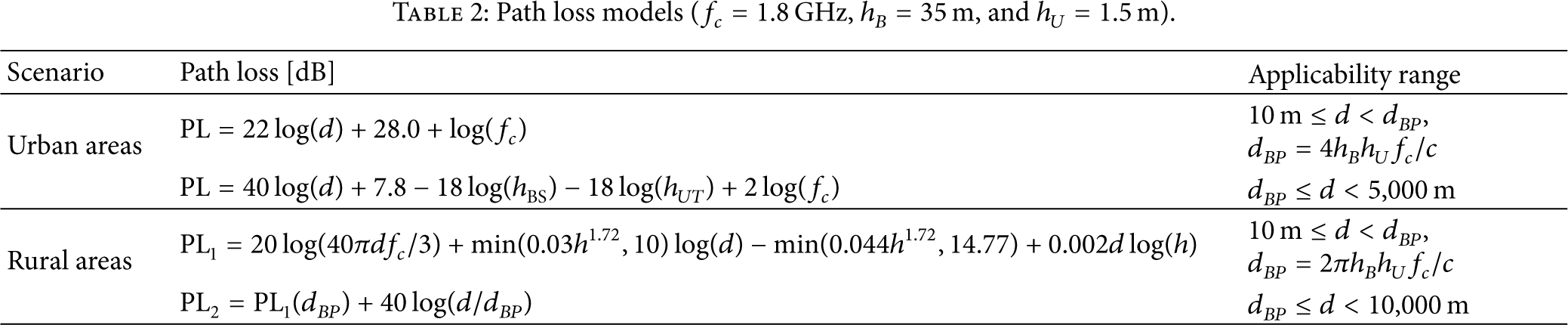
The channel model considered herein is the COST 231-Walfish-Ikegami model. This model distinguishes between line-of-sight (LOS) and non-line-of-sight (NLOS) cases. For LOS, the total path loss, PL [dB], is


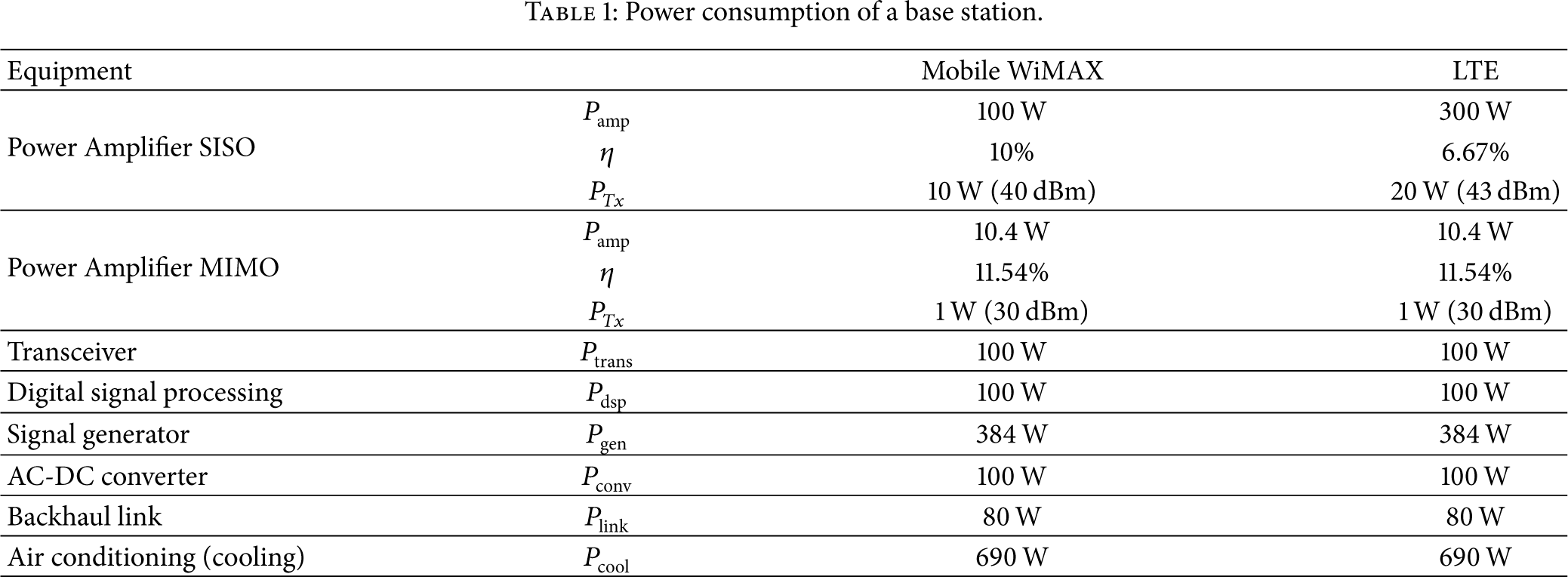
A base station typically consists of several power-consuming components. Power consumption requirements for the air conditioner and backhaul link equipment are common for all sectors. However, some equipment is sector-specific, such as the digital signal processor, power amplifier, transceiver, signal generator, and AC-DC converter. The power consumption of each component of the base station is a constant value in Watts, except for the power amplifier, which depends on the coverage. The power consumption,


Power consumption of a base station.
2.2. Optimization of Network Power Consumption
The notations used in this paper are as follows:

As formulated by the authors in [14], given the traffic intensity and coverage constraints, we shall minimize the energy consumption of the whole network 


Our goal is to find 
Using (9), the second constraint of (6) can be rewritten as


An exhaustive search algorithm was applied to solve the optimization problem of (6)–(8). Optimization of the function
3. Simulations
3.1. Simulation Conditions
Simulations were conducted to verify the performance of the proposed cell zooming scheme. As shown in Figure 1, the system consisted of a network of 19 hexagonal cells, with six cells surrounding the center cell in the first tier and 12 cells surrounding the center cell in the second tier. The BSs were located at a constant distance of 1.2 km for urban topologies and 6.0 km for rural topologies. The carrier frequency,
Path loss models (

Network topology for single-sector (19 cell) configuration with frequency reuse factor of 1.
3.2. Simulation Results
It was assumed that the service rate of BS i is fixed to
Observed cell zooming scenarios under


Various cell zooming scenarios according to traffic demands.
Among the four possible scenarios shown in Table 3, the second cell zooming scenario,
Observed cell zooming scenarios with time-varying and geographically uniform traffic arrival.
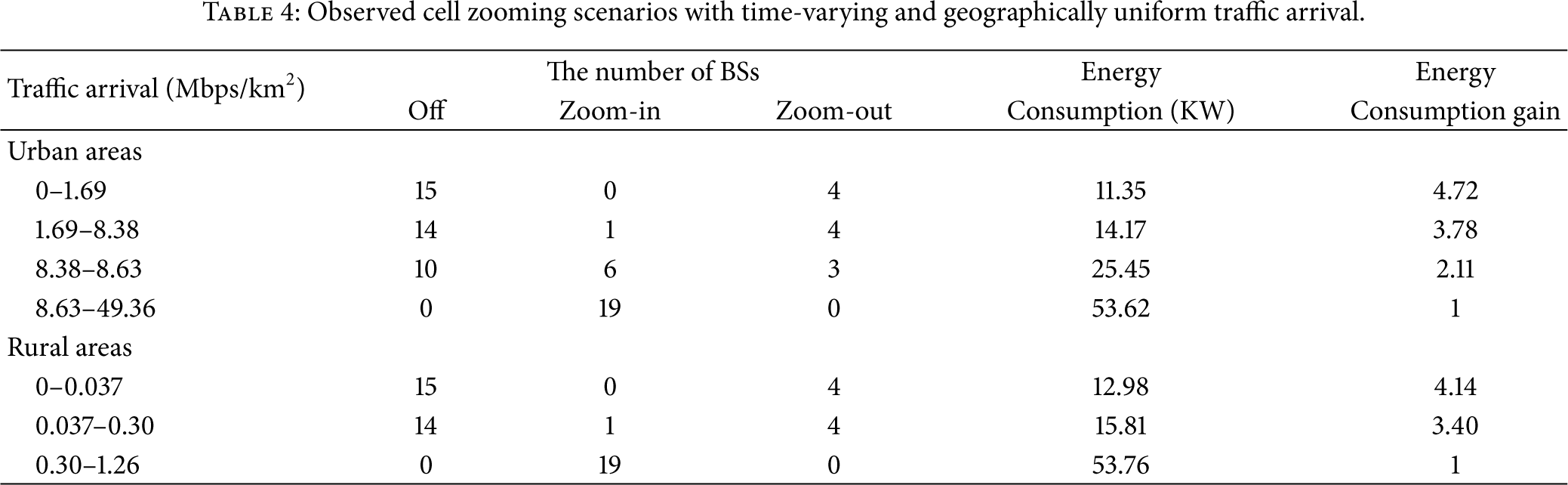
To evaluate the performance of the proposed algorithm in cellular networks with spatial load fluctuations, selective cells with relatively higher load than other areas were generated. The simulation setting was as follows. First, cell 1 of the urban area was set at
Observed cell zooming scenarios with time-varying and geographically nonuniform traffic arrival.

Second, urban cells 1, 2, and 3 were set to
4. Conclusions
In this work, we attempted to find an adaptive cell zooming method according to offered traffic load. As in [14], cell zooming mechanism was formulated as an optimization problem, considering varying traffic patterns and interference, as well as the service availability of the whole area. Simulations were then conducted to verify the performance of the proposed cell zooming method. The simulations considered varying traffic conditions, both timely and spatially, in a traditional 19-cell configuration. The results showed that the proposed scheme achieved reduction of the energy consumption by up to 4.72 times for the urban environment and 3.78 times for the rural environment compared to traditional static cell operation, while maintaining adequate throughput and full service coverage. In this work, though only three power levels were used to reduce the computational complexity, we plan to apply the particle swarm optimization (PSO) algorithm to find an optimization solution for (6).
Footnotes
Conflict of Interests
The authors declare that there is no conflict of interests regarding the publication of this paper.
Acknowledgments
This research was supported by the Basic Science Research Program through the National Research Foundation of Korea (NRF) (NRF-2012R1A1A2044107) and the Ministry of Science, ICT and Future Planning (1400100019-140010200). The work reported in this paper was conducted during the sabbatical year of Kwangwoon University in 2015.