




Abstract
Attacks are always seeking ways of exploiting any existing weakness in wireless network. The purpose of security situation awareness is to recognize, analyze, forecast, and handle the misbehaviors, assisting network management. Nevertheless, the appearance of ubiquitous network and the network convergence technology has made a challenge to realize network security and adaptation. Aiming at these research problems, this paper proposes a decision-aided situation awareness mechanism based on multiscale dynamic trust from the perspective of time and space, which can recognize misbehaviors and regard social network as the research object. We build trust and satisfaction based on Ebbinghaus forgetting regular and spatial correlations. This mechanism carries out decision making assessment through trust authenticity test, logicality test, and feedback parameters. In addition, load balance is used to avoid resource congestion. Simulation analysis demonstrates that compared with other trust mechanisms, this mechanism proposed in this paper can recognize and handle entity attacks more effectively, which is relatively eclectic and realistic in aspect of trust mensuration.
1. Introduction
Security situation awareness [1], including security elements detection, perception, prediction, evaluation, visualization, and management, can sense security information, extracting and analyzing security essential elements. It can also find out the existent threats and attacks [2], to cope with the characteristics of dynamics, openness, and uncertainty. Simultaneously, that also contains the steps of decision support, risk assessment, and situation visualization. Security situation awareness is increasingly becoming popular with the appearance of network convergence technology. Those network entities of situation awareness mechanism, which can flexibly and intelligently respond to the environment change, can be regarded as interactive entities existing in multiagent system, Peer to Peer Network named P2P, Wireless Sensor Network named WSN, and Mobile Ad hoc Network named MANET. Nevertheless, attacks and existing weaknesses also have made a challenge for researchers to effect network security and adaptation with the dynamic change of location, permission, role relationship, and information acquisition capability.
An effective method to minimize the threats is to evaluate the trusts of the interactive entities. As the main security element in security situation awareness mechanism [3–5], trust has long played a critical role in trust model or mechanism that can suppress misbehaviors effectively in network security area. Whereas, if mechanisms can process and manage entities dynamically, as the network environment changes, they will evolve to situation awareness mechanisms based on dynamic trust [6–8]. The situation awareness mechanism based on dynamic trust endows the entities with the capabilities of trust acquisition and perception [9] to assist in evaluating performance [10] and process real-time decision [11], against the uncertainty, transitivity, and time decay. This is the principal difference between security situation awareness mechanism and classical network security researches, which just uses access control, authentication, and firewall, not forming a real-time decision system.
At present, there are some aspects needing to be further improved in most of the existent trust mechanisms [12]. (i) In time scale, the weights of historical trusts should conform to the regular that the more recent the trusts are, the higher their weights are. Furthermore, in space scale, during trust computation, many mechanisms allocate fixed weights to indirect trusts and direct trusts, not changing with the working condition dynamically. Additionally, when taking a third party recommender into consideration, these mechanisms have neglected whether it has been captured or not, thus provoking hidden trouble. (ii) Most of them have considered how to obtain and compute trust without decision support and risk assessment. (iii) They have held uniform trust standard about the whole system, however, independent trust standards are not allowed to exist in individuals, which cannot meet the requirements of independent individuals. (iv) When confronted with some anomalous attacks or behaviors, emergency strategy is invalid. (v) Few mechanisms have adopted the load balance strategy, but preferring to select the most authentic entity as the service object, which can bring about excessive load and resource congestion. (vi) If the malicious and eliminated entities were to attempt to regain system, time interval should have been set. (vii) In case of the fact that entities are honest to a special service, but cheat others, different services should have different trusts in a system; however, most of mechanisms have only one type of trust.
Aiming at these research problems, this paper proposes a decision-aided situation awareness mechanism based on multiscale dynamic trust named DynamicTrust in wireless network, which can visualize abrupt changes about misbehaviors. It takes social network as the research object. DynamicTrust computes integrated trust and exerts fuzzy theory to descript entity relationship and trust, consulting such parameters including satisfaction, indirect trust, direct trust, historical trust, and individual relevance. Building entities trusts based on different service types can deal with the misbehaviors, which are honest to some service types, but cheat others. The usability, capability, vulnerability, trust authenticity test, and trust logicality test have been used to feed back to trust computation in period of decision making and assessment. The utilization of load balance avoids resource congestion. If we newly set environmental parameters, this mechanism can also act on P2P, Ad hoc, and WSN, etc.
For example, if network nodes in WSN or Ad hoc should have adequate sources and store capacities, we could apply the proposed system in WSN or Ad hoc, with definition parameters in system, such as satisfaction and trust. The network nodes in WSN or Ad hoc will become the entities of DynamicTrust and also will collect trust information in process of data interaction with other nodes, computing the parameters required by the proposed system. The parameter collection and computation can be descripted as Section 3.
The remaining part of the paper is organized as follows. Section 2 mainly reviews the related works. In Section 3, we introduce our model about situation awareness mechanism based on multiscale dynamic trust and also present how our situation awareness mechanism has carried out. In Section 4, we research how our model resists the confronted threats and compare our mechanism with others by comparatively studying simulations and performances. Finally, we conclude the paper in Section 5.
2. Related Works
These security trust models or mechanisms based on trust [6–16] contain the steps of information acquisition, trust computation, entity selection, and behavior bonus-penalty. They have considered direct trust and indirect trust, but minority of them has added feedback empiric values in trust computation process, and most of them adopt recommended trust from a third party without checking its usability. In fact, they all cannot shape a real-time security situation awareness system, not visualizing the attacks or evils and also not making management strategy for misbehaviors.
These existing mechanisms based on trust, for such networks including multiagent system, P2P, MANET and WSN, have utilized Bayesian [12], expertise [13], fuzzy theory [14], evidence theory [15], bioinspired [16] and social network graph theory [11] to build and describe dynamic trust relationship. The prestandardization of trust and reputation models in [17] concludes that the research based on fuzzy theory is relatively more than other researches. The existing researches related to network security mechanisms based on trust can be roughly divided into 4 stages from the perspective of processing sequence [18]. Originally, the first stage is information acquisition. In this stage, the mechanism collects information, such as entity parameters, empirical values, and service times. Then, the second stage is trust computation. The transaction weights, direct trust, indirect trust, and empirical values are utilized to compute trust and other parameters. Moreover, the third stage is entity selection. Several rules and methods service to entity selection and decision support. The last stage is bonus-penalty. Misbehaviors are doomed to punished, but honest ones need to be rewarded. The goal of constructing the situation awareness mechanism based on dynamic trust is to provide more reliable service, make full use of system resources, and achieve profit maximization.
PeerTrust in [4] is a peer to peer communication model, whose trust lies on feedback satisfaction, service number, feedback trust, community factor, and transaction factor. PeerTrust can recognize misbehaviors and also can distinguish false information and honest information. Whereas, all the parameters of service providers will be used to compute trust, without considering historical trust and time relation factor, which is the weakness of PeerTrust. Moreover, no load balance strategy has been applied.
A dynamic trust computation model for secured communication in [7], named SecuredTrust, has computed trust depending on trust similarity, trust difference, feedback trust, and historical trust. It thinks over the time near-far effect and ponders behavior bonus-penalty. The load balancing has also been considered. However, only one historical trust value before recent trust has been adopted, but historical trust values on other moments are abandoned. After misbehaviors have been found out, no strategy has been taken.
Decision making matters in [8], named DecisionTrust, has referred usability as trust assessment parameter in whole model and also introduced 4 decision makings into trust model. Nevertheless, trust computation relies on direct trust, recommended trust, and environmental factor, without pondering on the time decay. In addition, the capability of each entity is a given and fixed constant.
The multistrategy trust evolution model in [10] has used fuzzy theory to compute the uncertainty and fuzziness of trust, solving the problem of only obtaining but never sharing information. The game evolvement method has been adopted during trust computation, but no excessive load strategy has been taken into account.
To some extent, the existing models or mechanisms can recognize misbehaviors and improve accuracy of mechanism to actualize security communication. During trust computation, historical trust has been used. However, they all cannot shape a real-time security situation awareness system, without making real-time strategies for attacks.
DynamicTrust proposed in this paper has built a decision-aided situation awareness mechanism based on dynamic trust in wireless network. From time perspective, DynamicTrust computes trust and satisfaction, referring to historical values and Ebbinghaus forgetting factor. From space perspective, after time perspective treatment, DynamicTrust will compute parameters based on social network model and spatial relationships among entities. Moreover, Trust authenticity test and logicality test are used to detect the reliability of entities. Ultimately, the results of decision making and assessment can feed back to trust computation.
3. The Decision-Aided Situation Awareness Mechanism Based on Multiscale Dynamic Trust
3.1. System Model
The intent of our mechanism is to provide an effective dynamic situation awareness mechanism to resist and minimize the threats. The model of DynamicTrust proposed in this paper can be divided into 4 levels, trust acquisition level, trust comprehension level, decision support level, and performance assessment and management level. In first level, DynamicTrust obtains trust based on indirect satisfaction and direct satisfaction from the scales of time and space. In second level, DynamicTrust uses trust authenticity test and trust logicality test to see whether the trusts provided by entities are reliable. The trust logicality contains transitivity, symmetry, and memorability. In third level, after these two trust tests, all trusts of entities will be separated into 6 types, such as true type, opposite type, overstated type, understated type, collusion type, and other type. For each type, this mechanism has made a homologous strategy. In fourth level, DynamicTrust will manage capability, vulnerability, usability, and loads of entities, providing feedback to other 3 levels and achieving the dynamic adaptation. The model of DynamicTrust is given in Figure 1.

The decision-aided situation awareness model based on multiscale dynamic trust.
3.2. Trust Acquisition
This section describes several definitions at first level of DynamicTrust. The range of satisfaction definition is from 0 to 1. If entity a is entirely satisfied with entity b, the satisfaction of entity a to entity b will be 1. Otherwise, if entity a is not satisfied with entity b, the satisfaction will be 0. If an entity is incompletely satisfied with another one, the satisfaction will be a value in the range of 0 to 1, fuzzily. Similarly, the ranges of vulnerability, capability and trust are similar. The parameters of entities not participating in services will keep their own values.
3.2.1. Satisfaction
Definition 1 (indirect satisfaction named
).
Indirect satisfaction of entity

Definition 2 (direct satisfaction named
).
Direct satisfaction of entity
Definition 3 (temporal satisfaction named
).
Temporal satisfaction of entity

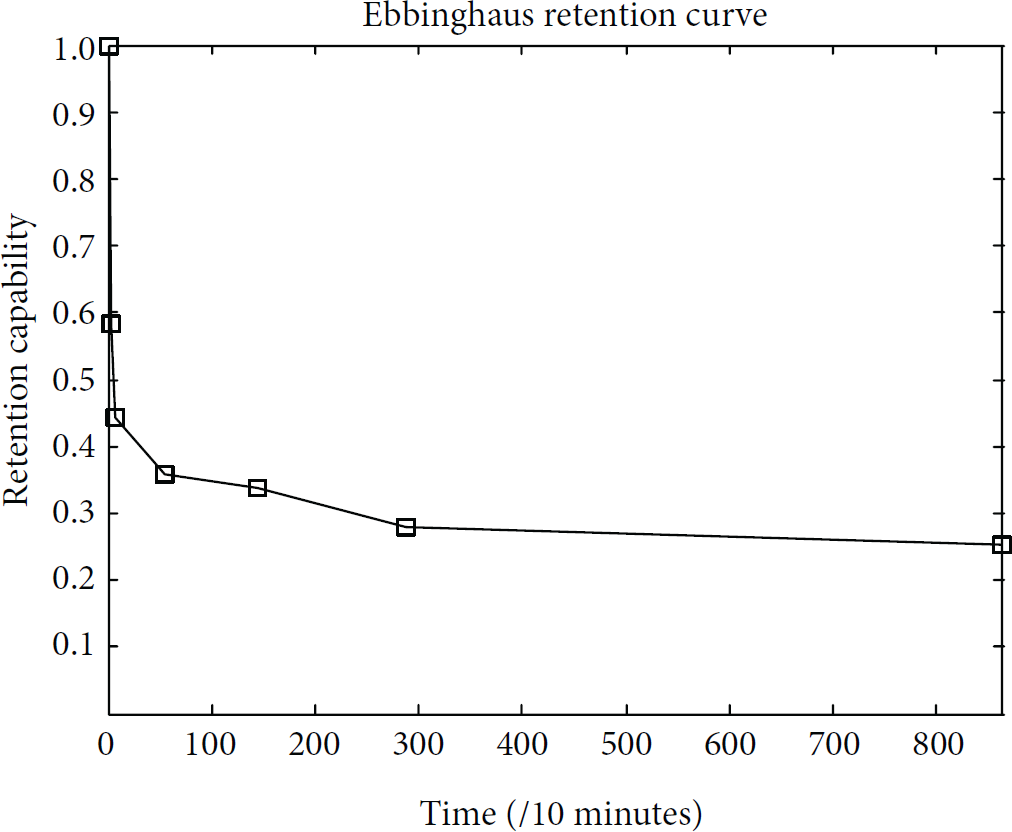
Ebbinghaus retention curve.
Example 4.
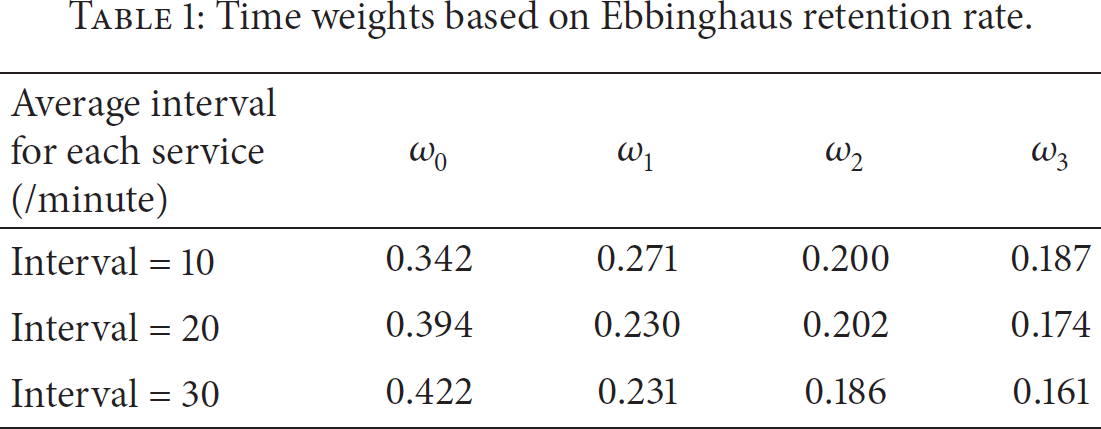
If N is 4, the weights
Time weights based on Ebbinghaus retention rate.
Definition 5 (correlated consistency named R ).
Correlated consistency between entity 
Definition 6 (spatial satisfaction named
).
Spatial satisfaction of entity 
Example 7.
With the known condition that there is only one community 
According to the indirect satisfactions, we can get temporal satisfactions

Furthermore, correlated consistency and spatial satisfaction are as follows:

Definition 8 (integrated satisfaction named
).
Integrated satisfaction of entity 
3.2.2. Trust Definition
Definition 9 (entity trust named T ).
Entity trust of entity 
Definition 10 (local trust named
).
Local trust of community 
Definition 11 (globe trust named
).
Globe trust in nth state represents the whole trust of this system, which can be described as

In Example 7, the trust of community
3.3. Trust Comprehension
Trust comprehension is at second level of DynamicTrust. The main purpose of this section is to validate the authenticity and logicality of entity trust. There are two trust tests, trust authenticity test and trust logicality test.
3.3.1. Trust Authenticity Test
The trust authenticity test is to detect the authenticity of entity. We define the object collection as 
If the test result is
During the treat processing, the under test set
Step 1.
Initially,
Step 2.
If the trusts of entities are equal to 0.1, we will put them out of set
The algorithm in trust authenticity test is given in Algorithm 1.
(1) let (2) (3) all the entities in group (4) (5) (6) let (7) (8) (9) let p get out of collection (10) (11) (12) break (13) (14) (15) (16)
3.3.2. Trust Logicality Test
Definition 12 (trust difference named
σ
).
The trust difference between the real trust of entity h and the trust of entity h said by entity q at nth state, which can be described as
The under test set
(a) Symmetric Consistency Test. The trust of entity h said by entity q should be equal to that of entity h said by entity u,
(b) Transitivity Test. In view of the fact that multilevel transmission may bring up the expending of attacks, we set transitivity with only one level. For example, if entity q trusts entity h and entity h trusts entity p and entity p trusts entity y, we can know entity q trusts entity p but do not know whether entity q trusts entity y.
Theorem 13.
With the known condition
Proof.
From
(c) Memorability Test. Compared with historical entity trust, if current entity trust is higher or identical, we will think the entity is credible. However, if current entity trust is lower, we will consider it as an unbelievable entity.
Those entities not passing the trust authenticity test or trust logicality test, which will be regarded as unbelievable entities, will come under decision set
3.4. Decision Support
Decision support exists at third level of DynamicTrust. After trust acquisition and trust comprehension, in this section, DynamicTrust will determine the trust type and then make decision for different trust types.
3.4.1. Trust Type Decision
Definition 14 (trust deviation named Δ ).
The trust deviation between the real trust and the mean trust of entity i in 
Taking the possible contingencies into consideration, we classify trusts into 6 types, such as true type, opposite type, overstated type, understated type, collusion type, and other type.
True Type. If there is
Opposite Type. If there are
Overstated Type. If there is
Understated Type. If there is
Collusion Type. If there are more than 3 entities whose trusts are identically opposite or overstated or understated in a same community, we will take such entities into collusion entities.
Other Type. If entities do not belong to the former 5 types, we will collect them into other types.
3.4.2. Trust Decision Support
Definition 15 (deviation factor named
ρ
).
The deviation factor of the trust deviation to the real trust of entity 
Decision 1. For entity
Decision 2. For entity
Decision 3. For entity
Decision 4. For entity
Decision 5. For entities
Decision 6. To entity
This system will filtrate out entities with trust not in the range of
3.5. Aided Performance Assessment
This section is at fourth level of DynamicTrust. To cope with the condition that an entity with high trust is compromised at current service, but we also look on it as reliable entity, we introduce usability into this mechanism, to reduce the probability of attack success. We take integrated trust as the capability.
Definition 16 (entity capability named
).
Entity capability of entity 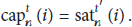
If a new entity a enters the system, system will initialize its capability as
Definition 17 (community capability named
).
Community capability of 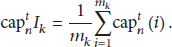
Definition 18 (entity vulnerability named V ).
Entity vulnerability of entity 
Definition 19 (entity relative usability named
).
Entity relative usability of entity 
Supposing that the capability of entity i is
Example 20.
In Example 7, with the known parameters,
3.6. Load Balance Related to Select Service Object
This section introduces a load balance method at fourth level of DynamicTrust. According to the significance of service, services have been separated into 4 types, such as type A, type B, type C, and type D, thus constituting service set
Service parameter table.

What should we select to provide service, if there is no entity meeting the parameter requirement?
In load balance, the related steps are listed as follows.
Step 1.
After entity p makes a request for service S, all entities responding to the request compose the response set H. We define the response entity finally providing service as entity q.
Step 2.
If set P is nonempty,
Step 3.
If credible set P is empty but the candidate set Q is nonempty,
Step 4.
If sets P and Q are empty, we will select response entity from
Assuming that g is 1, the load balance is given as Algorithm 2.
responding to p for service S, and under decision set (1) (2) (3) (4) (5) (6) (7) (8) (9) (10) (11) (12) (13) compute the load (14) (15) (16) (17) (18) compute the load (19) (20) (21) (22) (23) (24) compute the load (25) (26) (27) (28) (29) (30) (31)
4. Simulation Analysis and Performance Comparison
In this section, we simulate the decision-aided situation awareness mechanism based on multiscale dynamic trust relaying on the above theoretical frame to evaluate the mechanism performance and prove the applicability and effectivity. We have fulfilled our simulation at MATLAB 7.1 simulation platform in Windows operating system with Intel Core (TM) Duo 2.66 GHz CPU, 2 GB Memory. There are M entities and the total number of service times is C in our simulation. The length of time window is N. We set M as 100, classifying all services into 4 communities
Parameter settings.
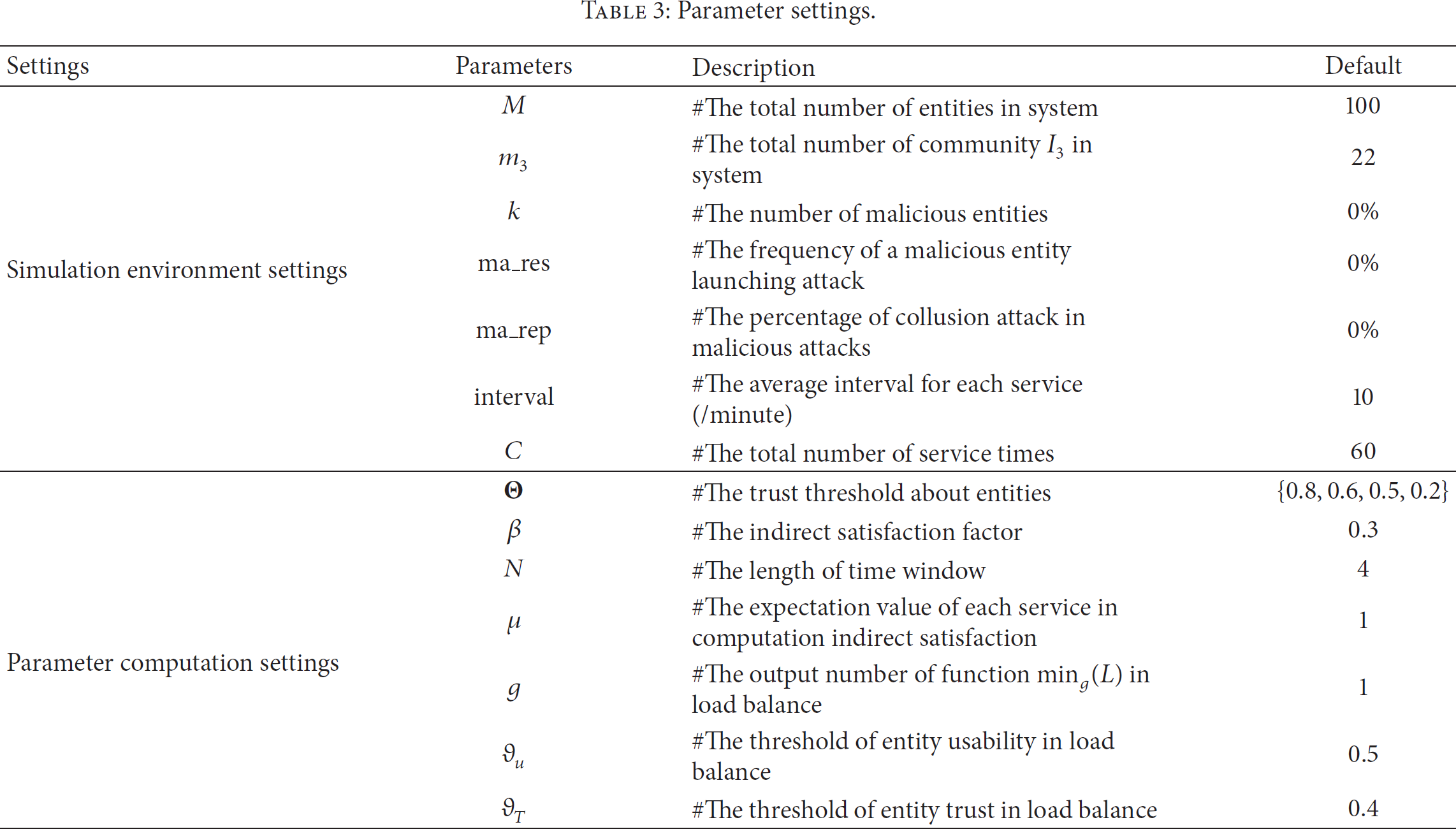
In this part, we compare our DynamicTrust with SecuredTrust [7], PeerTrust [4] and DecisionTrust [8], from 4 aspects, including sensitivity and consistency evaluation, stability evaluation, usability evaluation and load balance evaluation.
4.1. Sensitivity and Consistency Evaluation
Definition 21 (sensitivity named
).
The sensitivity of entity i in nth state represents the average deviation degree between the real trust and the actual trust of entity i, which can be described as 
Based on above theory, trust is a significant parameter in trust model. In community

Attaks distribution situation.
As is shown in Figure 3, 4th entity will tell other entities that its own real trust is 0.6 every 4 services, but 6th entity will tell other entities that its own real trust is 0.6 every 8 services. The 10th entity will always report its trust value as 0.6, maliciously. The 2nd entity will always report the real trust value. After we compare the trusts and sensitivities of these 4 entities according to the known condition in Figure 3, we will gain the situation comparison as Figure 4.
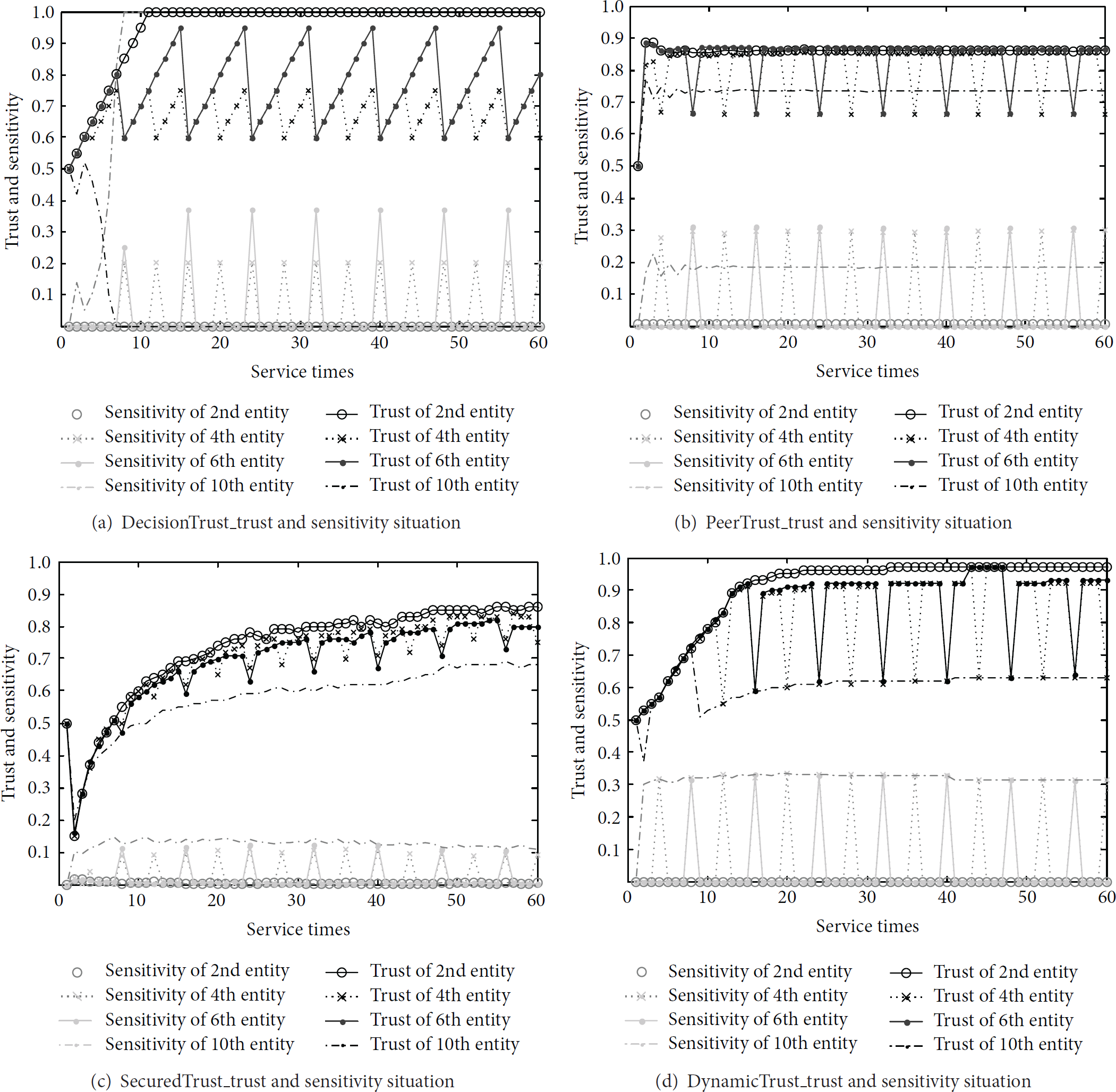
Trust and sensitivity situation.
In Figure 4, we can see the sensitivity of SecuredTrust is the lowest. The sensitivities of other 3 entities are relatively bigger. Most of trusts in these four models are from 0.5 to 1. In these 4 sub-figures, only in DecisionTrust model can the 2nd entity trust reach 1, but cannot reach 1 in other 3 models, because other models have used community parameters to compute trust. If there is a malicious entity, all entity trusts cannot reach 1, but can be extremely near to 1.
In Figure 4(a), if there is no attack, the entity trust will rise, but when there exists an attack, it will decline very soon. The 10th entity always launching attacks has been eliminated and never returned the system, after providing the 8th service, which may mean DecisionTrust has overestimated the effects of attacks.
In Figure 4(b), if there is no attack, the entity trust will keep, but when there exists an attack, it will decline with relative smaller amplitude. The 6th entity trust should be lower than the 4th entity trust and the 10th entity trust, factually. However, some trust values of 4th entity are higher than 6th entity's, not agreeing with the fact.
In Figure 4(c), if there is no attack, the entity trust will keep and slowly go up, but when there is an attack, it will decline with smaller amplitude. Whereas, no matter the entity is malicious, the entity trusts are always from 0.55 to 0.85, to a large extent, which reveals the extreme underestimation of the whole system.
In Figure 4(d), if there is no attack, the entity trust will retain and slowly rise, but when there is an attack, it will decline with relative smaller amplitude. There is no overestimation and underestimation in DynamicTrust model, which is relatively eclectic and realistic.
4.2. Stability Evaluation
The mechanism regards the sensitivity variance named
Definition 22 (sensitivity variance named
).
The sensitivity variance of entity i represents the fluctuation of the average deviation degree between the real trust and the factual trust of entity i, which can be described as

Malicious entities want to alter its own trust to mislead other entities, which will arouse the fluctuations of entity trust. According to sensitivity variances of 2nd, 4th, 6th, and 10th entities in DynamicTrust, SecuredTrust [7], PeerTrust [4], and DecisionTrust [8] models, we can obtain variances listed as Table 4 based on sensitivity evaluation in Figure 4.
Stability comparison.

In Table 4, we can see that the mean
4.3. Entity Relative Usability
Based on the known condition in Figure 3, we can also gain the usability of 2nd, 4th, 6th and 10th entities as Figure 5. There is a regular that the usability of 2nd entity should be higher than that of 4th entity and that of 6th entity. The usability of 10th entity should be the lowest.
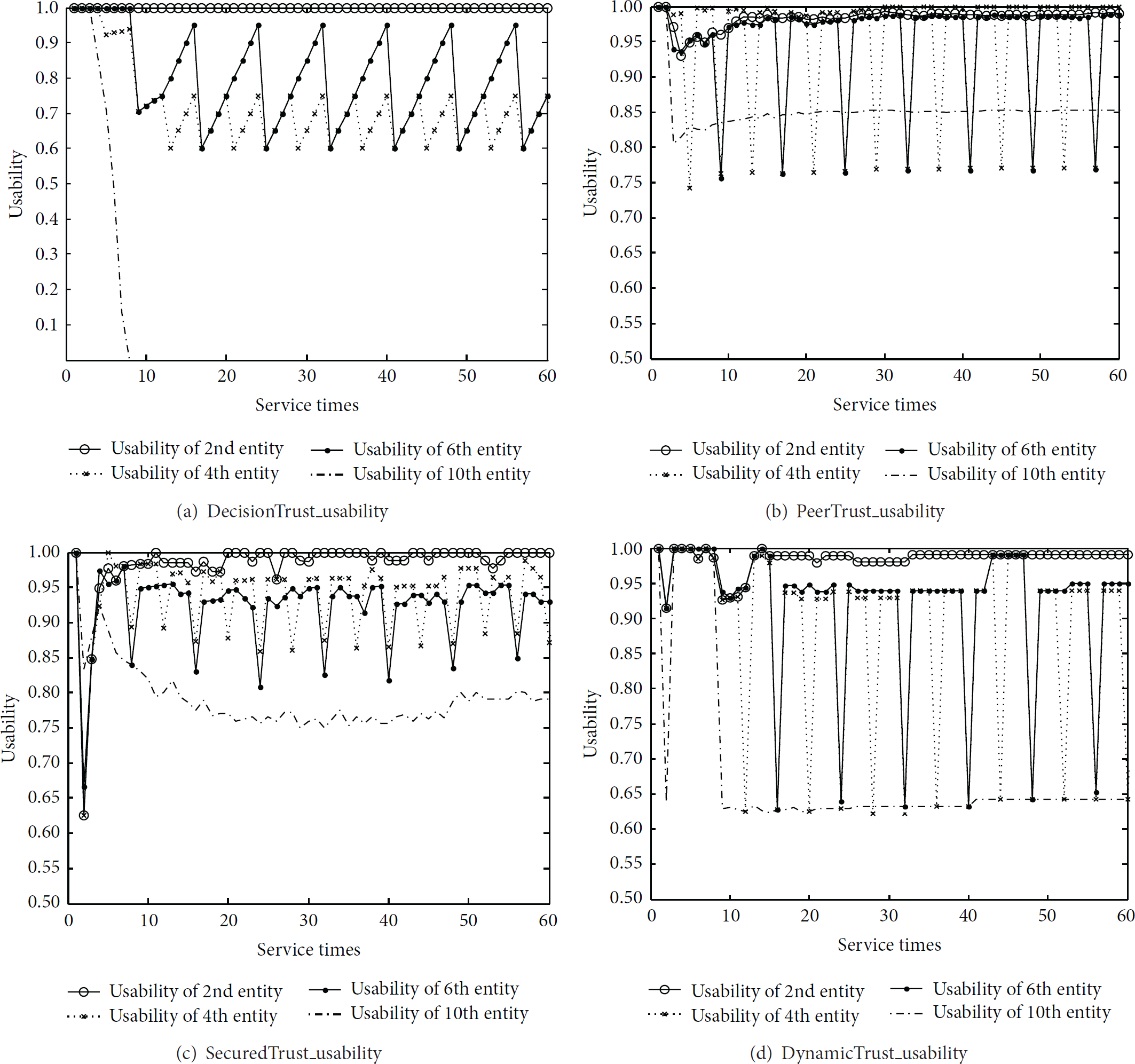
Entity relative usability.
From Figure 5(a), we know most of the relative usability of entities is from 0.6 to 1 and they meet the usability regular. However, the 10th entity has also been eliminated and never returned the system, after providing the 8th service. In Figure 5(b), the relative usability is from 0.75 to 1, but does not meet the usability regular. Sometimes, the usability of 10th entity is higher than that of 4th entity, not in line with the fact. In Figures 5(c) and 5(d), the usability of entities both meets the usability regular and is in line with reality.
4.4. Load Evaluation
In this section, we suppose there are 1000 services and 12 entities in a system. The 1000 services contains 250 type A services, 250 type B services, 250 type C services and 250 type D services. The trust threshold set is
Entity parameter settings.

We suppose that entity trust threshold and usability threshold are both 0.7. After an entity emits service request, PeerTrust will randomly select service object from the most credible entities with trusts bigger than 0.7. DecisionTrust will always select service object from the entities whose trusts and usability are both bigger than 0.7. SecuredTrust has its own load balance strategy, which preferentially selects service object from the entities with trusts bigger than 0.7 or randomly selecting entity as service object. DynamicTrust will select service object, according to the service type, load, logicality, usability, and entity trust. For type A services, the entities with higher usability and trusts can be service objects. For type D services, the entities with lower usability and trusts can become service objects, thus making full use of all entities existing systems. We have obtained Figure 6, comparing the loads of DynamicTrust, PeerTrust, DecisionTrust, and SecuredTrust.

Load comparison.
As is indicated in Figure 6, PeerTrust will always select 1st entity, or 2nd entity, or 3rd entity as service object. The average load of PeerTrust is high. DecisionTrust will select service object from 1st entity to 6th entity, so its average load is lower. SecuredTrust will select service object from 1st entity to 7th entity. DynamicTrust will select service object with load balance strategy for different services. For type D service with lower requirement, DynamicTrust selects service object from 8th entity to 12th entity. The average load of DynamicTrust is the lowest.
5. Conclusion
Aiming at existing research problems, this paper proposes a decision-aided situation awareness mechanism based on multiscale dynamic trust in wireless network. DynamicTrust computes and defines satisfaction, trust, and other parameters based on Ebbinghaus forgetting regular from time perspective and spatial relationships from space perspective. We have also used usability, capability, and trust tests to form feedback and aid decision making and assessment. Compared with 3 other models, DynamicTrust is relatively eclectic and realistic for trust mensuration, which can also make full use of entities in system, avoiding resource congestion. However, the trust situation may arise interrupted. To emergencies, the mechanism should make more perfect strategies based on historical and current information, which needs a large-scale database. That is the challenge of situation awareness technology, remaining to be improved.
Footnotes
Conflict of Interests
The authors declare that there is no conflict of interests regarding the publication of this paper.
Acknowledgments
This work is supported by the National Nature Science Foundation of China (nos. 61271260; 61102062; 61301122), NSF of Chongqing (no. cstc2014jcyjA40052), the Research Program of Chongqing Municipal Education Commission (no. KJ1400405), Program for Changjiang Scholars and Innovative Research Team in University (IRT1299), the special fund of Chongqing key laboratory (CSTC), NSF of CQUPT (no. A2013-30), and the Doctor Science Research Starting Foundation of CQUPT (no. A2013-23).