




Abstract
In wireless sensor networks, cooperative communication can combat the effects of channel fading by exploiting diversity gain achieved via cooperation communication among the relay nodes. A cooperative automatic retransmission request (ARQ) protocol based on two-relay node selection was proposed in this paper. A novel discrete time Markov chain model in order to analyze the throughput and energy efficiency was built, and system throughput and energy efficiency performance of proposed protocol and traditional ARQ protocol were studied based on such model. The numerical results reveal that the throughput and energy efficiency of the proposed protocol could perform better when compared with the traditional ARQ protocol.
1. Introduction
Recently, wireless sensor networks (WSNs) are becoming a fast-developing research area which is related to a wide range of applications, such as environment surveillance, military, and patient monitoring. WSNs are composed of a large amount of sensor nodes which are typically powered by small batteries. Moreover, it is undesirable or impossible to replace or recharge the sensor nodes in many situations. Hence, there is a great need for a reliable and energy-efficiency transmission strategy to improve the throughput and energy efficiency and prolong the network lifetime while satisfying specific quality of service requirements.
Cooperative communication among sensor nodes has been considered to provide diversity in WSNs where fading obviously affects point to point link, which can help combat fading effectively and enhance the reliability of the communication significantly, so cooperative communication has been studied extensively. On the other hand, traditional automatic-retransmission-request protocol (TA) is an effective method to improve transmission quality and combat poor channels condition in a radio channel by retransmission of the data packet which is incorrectly received in previous slot. Thus, cooperative ARQ (CARQ) mechanism, which combines the cooperative communication and ARQ protocol, is receiving more and more attention over the past decade or so [1–4]. CARQ mechanism can increase the successful rate of data receiving in destination node and combat channel attenuation simultaneously. As viewed from energy consumption, CARQ mechanism can achieve higher energy efficiency because it makes the wireless communication between source node and destination node more successful than that of traditional ARQ protocol in data receiving rate and more reliable than normal cooperative communications.
In the past few years, cooperative communication has established itself as an effective and energy conserving method for wireless sensor networks. One of the promising techniques is to use a relay to help source node communicate with destination node, in which each node is equipped with only one antenna. With the help of the relay node, a virtual MIMO antenna array system is formed, which can provide spatial diversity without multiple antennas per terminal node [5, 6].
The so-called single-relay cooperation is considered where the data packet sent by the relay node was only received by the destination node [7, 8], but due to the broadcast nature of wireless channel, the signal can be received by the destination node as well as the other relays. Departing from most previous works in cooperative communication, an alternative method to improve system throughput performance is applying ARQ protocol at the data link layer [9, 10].
Energy efficiency of cooperative communication has been studied in [11] which uses the model as hierarchical cooperative clustering scheme and compared with cooperative multiple-input multiple-output (CMIMO) clustering scheme and traditional multihop Single-Input-Single-Output (SISO) routing approach. Experimental results show increase in network lifetime and significant energy conservation is acquired. In two-dimensional WSNs [12], the energy efficiency of cooperative and noncooperative transmissions is studied under the same end-to-end throughput and at a certain outage probability, the simulation results show that the energy efficiency advantage increases with the nodes density and distance.
Recently, cooperative communication has been proposed in connection with wireless sensor networks to improve energy efficiency, throughput, and reliability in fading condition [13]. In [13], the authors propose a novel cooperative ARQ strategy where cooperative communication and ARQ scheme is combined for clustering-based WSNs. Through a generalized discrete time Markov chain model to analyze the throughput and energy efficiency, simulation results show that the proposed cooperative ARQ strategy is much better than the traditional ARQ scheme. The spectral efficiency for CARQ scheme in WSNs is investigated thoroughly but does not analyze the energy efficiency and throughput of the proposed system in [14].
The works all focus on no-relay or single-relay node between source node and destination node with ARQ. In this paper we turn our attention to two-relay node network. Comparing with the volume of former research focused on the single goal, such as energy conservation or spectral efficiency, we focus on the analysis of trade-offs in energy efficiency and throughput. Important questions include where to place the relay nodes. Our aim here is to optimize energy consumption per packet and throughput under different network geometry. This work bridges the current literature gap by considering relay position, energy efficiency, and throughput optimization.
The contribution of this paper is twofold.
First, we develop a new cooperative ARQ protocol of two relay nodes in wireless sensor network, called TRCAP (two-relay cooperative ARQ protocol), derived from two relays and CARQ that enhances significantly the network throughput and energy efficiency comparing to the traditional ARQ protocol. Furthermore, we have also introduced a retransmitting probabilities scheme, named RDFP (retransmit data frame probabilities) based on the network environment and performance require. We propose a novel DTMC (discrete time Markov chain) model in order to analyze the throughput and energy efficiency of TRCAP in wireless sensor networks.
The remainder of the paper is organized as follows. In Section 2, a description of the system model of two-relay node and the corresponding model is introduced. The performance analysis of throughput and energy efficiency of two-relay node cooperative ARQ protocol is provided in Sections 3 and 4, respectively. After that, in Section 5, the numerical simulation is conducted. Finally, we summarize the conclusions.
2. System Model and Operation Model
2.1. System Model
In this paper, we consider a typical model of WSNs which consists of some sensor nodes and a sink node. When the network operates, some clusters are formed according to LEACH protocol, where CH is short for cluster head and CN is short for cluster node. There exist two transmission phases: firstly, each CN transmits its data frame to the corresponding CH according to some protocol; secondly, the CHS forwards the received data frame to the sink node according to a certain protocol.
That is to say, there are two different cooperative communication modes: intracluster cooperative communication and intercluster cooperative communication, which means cooperative communication between CN and CHS in the same cluster and cooperative between CHS and CHS or sink node from different clusters, respectively. In this paper, we have considered the Nakagami-m distribution,
No matter in which cooperative communication mode, for simplicity, we consider that a two-relay node cooperative ARQ model is equivalent to a four-node system with one-source node (S), two-relay nodes (

Simplified system model.
2.2. Operation Model
In this paper, we use space time encoding (STC) that means a data frame is encoded by a code book. A set of codewords is formed behind the mapping of every n bit. S and two relay nodes transmit the first, the second, and the third row of the code book, respectively. The system persists until the data frame is correctly received by D.
The two-relay cooperative ARQ protocol is as follows. First, S sends an information packet to both two-relay node (
If the data frame is correctly decoded at the destination D, D feeds back an ACK message to both S and two-relay node (
If D incorrectly decodes the received data frame, it sends back a NACK message to both S and two-relay node (
If neither two-relay node (
Suppose path loss exponent is denoted by α, noise components are additive white Gaussian noise (AWGN) with variance


Assume the modulation is 16-QAM and the closed-form formula is given for the average bit error rate (BER) by [16]

Having the instantaneous received SNR γ and BER, we can calculate the packet error rate (PER):


Considering the above


3. Throughput Analysis
In order to analyze the throughput and energy efficiency of the TRCAP protocol, we model the transmission process with a DTMC illustrated in Figure 2.
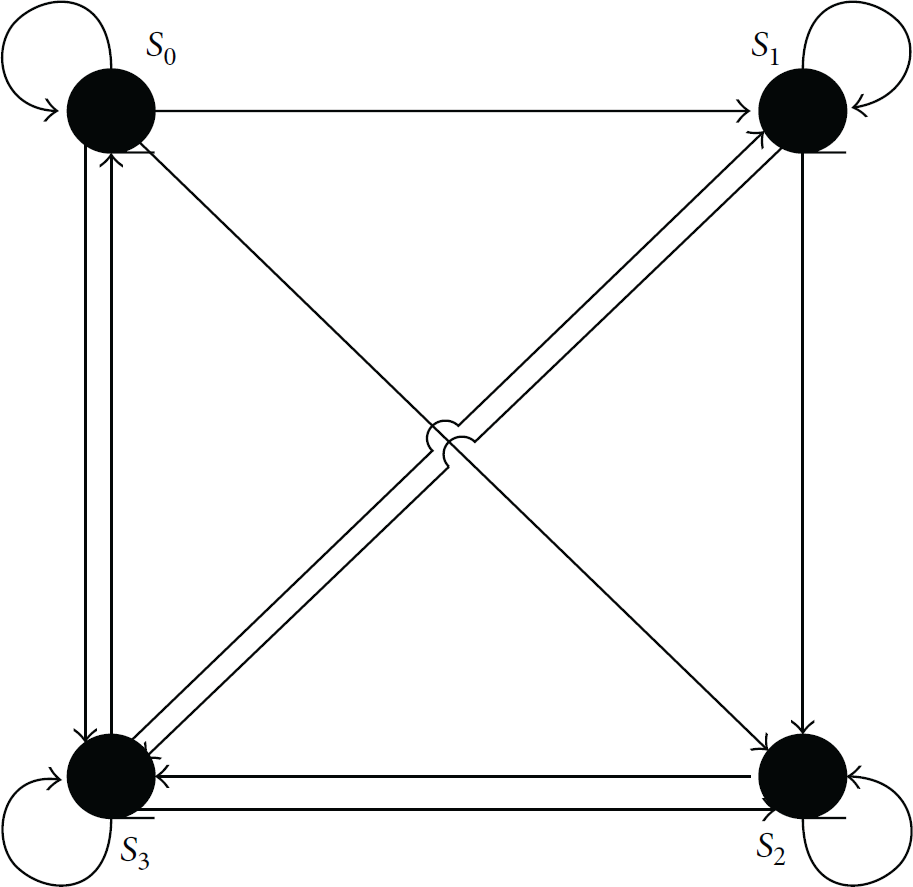
The state transition of the DTMC model.
There are four states in the DTMC, as follows.
State State State State
The state transition of the DTMC model can be seen from Figure 2. What needs to be pointed is that the relay node will store the correctly received data frame until the data frame is correctly decoded by D.
On state
On state
On state
On state
By solving the state transition equations listed below, where

Suppose the transition probability matrix P of the DTMC is initiated from state
In this paper, the throughput is defined as the average number of data frames received successfully by destination node D per time slot and can be computed as the average number of time slots that the DTMC spends in state

Comparing the throughput of TRCAP and CA ([19], (18)), we can easily calculate the throughput gain as follows:

4. Analysis of Energy Efficiency
The power consumption of the internal RF circuitry and the power amplifier is the main energy consumption of the sensor node [20]. Assume that the total energy consumption of the system is composed of the power consumption of the power amplifier and circuit blocks of the nodes. Let

Considering that the total packet is composed of the header, payload, and the trailer, the energy efficiency can be expressed as follows:
Traditional ARQ:

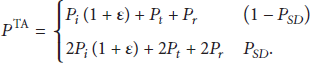
In the first term of the above expression, when the data frame is received successfully by D with the probability
So the total energy consumption of transmitting the packet in traditional strategy with ARQ is expressed as follows:

Energy efficiency of traditional strategy with ARQ can be obtained by substituting (6) and (13) into (12):
Two-relay node cooperative ARQ protocol:



In the first term in (16), when the data frame is correctly received by D with the probability
In the above expression, the probability of different state is represented by the steady state (
The total energy consumption of successfully transmitting a packet from S to D using TRCAP can be derived from our Markov model as follows:

Energy efficiency of TRCAP can be obtained by (9) and (18) into (12):

5. Numerical Results
In this section we numerically evaluate the throughput and energy efficiency of the presented protocol compared with that of traditional TA and TRCAP. Throughout this simulation we assume that the length of a packet is set to be 1024 bits and the system parameters take the following values:
We assume that the connections of the relays
Figure 3 depicts the throughput performances of different ARQ protocols versus the

The throughput performances of different ARQ protocols.
Figure 4 depicts the throughput gain of TRCAP compared with TA under different relay locations, respectively. From the figures, we can see that the throughput gain is the best when relay nodes are close to the middle location between the source node and the destination node D. And the value of throughput gain will become more and more big along with the distance increases.

The throughput efficiency gain of TRCAP compared with TA.
Figure 5 depicts the energy efficiency of the system versus the distance between the source node S and the destination node D with different ARQ protocols. The simulation results are very close to the theoretical result, which verified the energy efficiency performance analysis in Section 5. From Figure 5, we can see that the value of energy efficiency becomes more and more small first because the PER increases with the

The energy efficiency of different ARQ protocols.
Figure 6 depicts the energy efficiency gain of TRCAP compared with TA under different relay locations, respectively. We can find that the biggest gain is acquired when relay nodes are close to the middle location between the source node and the destination node D. The energy efficiency gain is almost the same when destination node is near to source node.

The energy efficiency gain of TRCAP compared with TA.
6. Conclusions
In this paper, the throughput and energy efficiency of the TRCAP and TA protocol in WSN are studied and compared. The theoretical analysis and numerical results prove that when the distance of source and destination is above the threshold distance, the TRCAP has larger throughput and more energy efficiency than TA and two-relay node gains can be achieved. Moreover, when
So far, we have only considered a simple four-node wireless network. In the future, we will study the more complicated and the practical wireless sensor networks. However, the focus and the contribution of our work are the theoretical analysis of the throughput and energy efficiency of proposed two-relay node cooperative ARQ protocol in WSNs which is based on a novel DTMC model.
Footnotes
Conflict of Interests
The authors declare no conflict of interests.
Authors' Contribution
In this work, the general conception has been developed by Haiyong Wang, Geng Yang, and Yiran Gu, while the test has been developed by Haiyong Wang and Jian Xu. Moreover, Haiyong Wang has prepared the final draft and Zhixin Sun has guaranteed the critical reading.
Acknowledgments
Thanks are given to referees whose comments and suggestion were very helpful for revising the authors' paper. This research is supported by the National Natural Science Foundation of China under Grant nos. 61272084, 61202004, the Specialized Research Fund for the Doctoral Program of Higher Education under Grant nos. 20113223110003, 20093223120001, the Key Project of Natural Science Research of Jiangsu University under Grant no. 11KJA520002, the Natural Science Foundation of Jiangsu Province under Grant no. BK2011754, and the Project of Nanjing University of Posts and Telecommunications under Grant no. NY214099.