




Abstract
We address the target localization problem by using bistatic range (BR) measurements in widely separated multiple-input multiple-output (MIMO) radar network. The BR information defines a set of elliptic equations from which the target location can be estimated. By applying the semidefinite relaxation (SDR), we transform the nonconvex BR-based localization problem into a convex semidefinite programming (SDP) problem, whose solution is guaranteed to be globally optimal without initial estimate. Moreover, we extend this method to robustly solve the localization problem in the presence of antenna position errors. Simulation results demonstrate that the proposed SDR method provides superior estimation performance over the existing method.
1. Introduction
Target localization problem by using multiple-input-multiple-output (MIMO) radar with widely separated antennas (WSA) structure has received significant attentions [1–4]. Unlike the direct multilateration, which requires high computational cost [3], the indirect multilateration involving estimating position of target by jointly utilizing multiple bistatic range (BR) measurements from a subset of distributed receivers is more practical. In this letter, we focus on the target localization problem in MIMO radar based on BR measurements.
In principle, the maximum-likelihood estimation (MLE), which is asymptotically optimum, is a straightforward solution to this problem. However, the realization of MLE involves intensive computations. Moreover, owing to the high nonlinearity and nonconvexity of this maximum-likelihood (ML) problem [3], it cannot guarantee convergence to the global solution. To circumvent the nonlinearity drawback, a method based on the concept of best linear unbiased estimator (BLUE) has recently been proposed in [4], which linearizes the BR elliptic equations using Taylor series expansion and hence obtains a closed-form solution. Nevertheless, the BLUE method requires a good initial estimate and still cannot ensure global convergence. A least squares (LS) estimation method, which lends itself to a closed-form without requiring any initial condition, has been developed in [5]. However, the LS solution is based on the noise-free measurement model which is unreachable in practical situations.
Recently, convex optimization, particularly the semidefinite relaxation (SDR) methodology, has been well applied in localization applications with noisy time of arrival (TOA) or time difference of arrival (TDOA) measurements [6–9]. Aiming at achieving a tradeoff between high accuracy and global convergence of location estimate, we intend to relax the nonconvex BR-based localization problem to a semidefinite programming (SDP) problem [6]. The contribution of this letter is twofold: first, we start from reformulating the ML problem as an equivalent constrained optimization problem and then relax it to obtain a convex SDP problem by applying SDR technique; second, we devise a robust SDR method to tackle the BR-based localization problem when antenna positions are subject to errors, which has not been presented in the literature for the BR-based localization methods. Finally, we evaluate the performance of the proposed SDR method compared with the Cramêr-Rao lower bound (CRLB) by numerical simulations.
Notations.
2. Problem Statement
Consider a BR-based two-dimensional (2D) localization problem employing M transmitters and N receivers at known locations

The BR from the kth transmitter to the lth receiver through

By defining the following vectors,



3. SDR Method for Target Localization without Antenna Position Errors
The optimization problem of (5) is highly nonlinear and nonconvex, implying that the global minimum can hardly be obtained. In this section, we present an SDR method to approximately solve the MLE problem (5). To facilitate the development of the SDR approximation for MLE problem, we first focus on reformulating the original MLE problem. Then we show how the reformulated MLE problem can be approximated in a convex manner using SDR technique.
Firstly, (1) can be rewritten as

Squaring both sides of (6) yields

Substituting
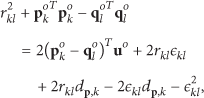


Note that

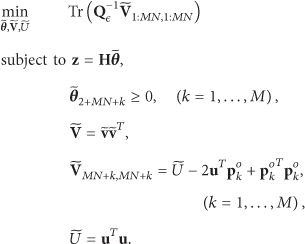
Relaxing the nonconvex constraints in (12) gives the SDR formulation for BR-based localization:

This optimization problem in (13) can be solved using standard convex optimization methods such as SeDuMi [11].
4. SDR Method for Target Localization with Antenna Position Errors
In practice, the radar antenna positions are typically not exactly known, and the localization performance can be significantly improved by taking antenna position errors into account. Here, we extend the SDR method to address the localization problem because of the receiver antenna position uncertainties (APU). The case concerning localization in the presence of transmitter APU will follow the similar steps which is omitted here. Let
Substituting

We let

Expressing (14) in matrix form, we have


Using the same relaxation technique as in the previous section, we define

The optimization problem in (18) can now be solved efficiently using standard SDP tools.
5. Simulations
5.1. Simulation Setup
In this section, we provide two examples to demonstrate the performance of the proposed SDR target localization methods comparing with the BLUE method [4]. The proposed SDR methods are realized by utilizing the MATLAB toolbox YALMIP [12] where the solver SeDuMi [11] is employed. In our test, we place
5.2. Localization Performance without APU
In this example, we consider no radar antenna position errors. We choose three different initial reference points for simulations of the BLUE method [4] and the results of efficiency comparison between the proposed approach and the BLUE method for different initial conditions are presented in Figures 1 and 2.
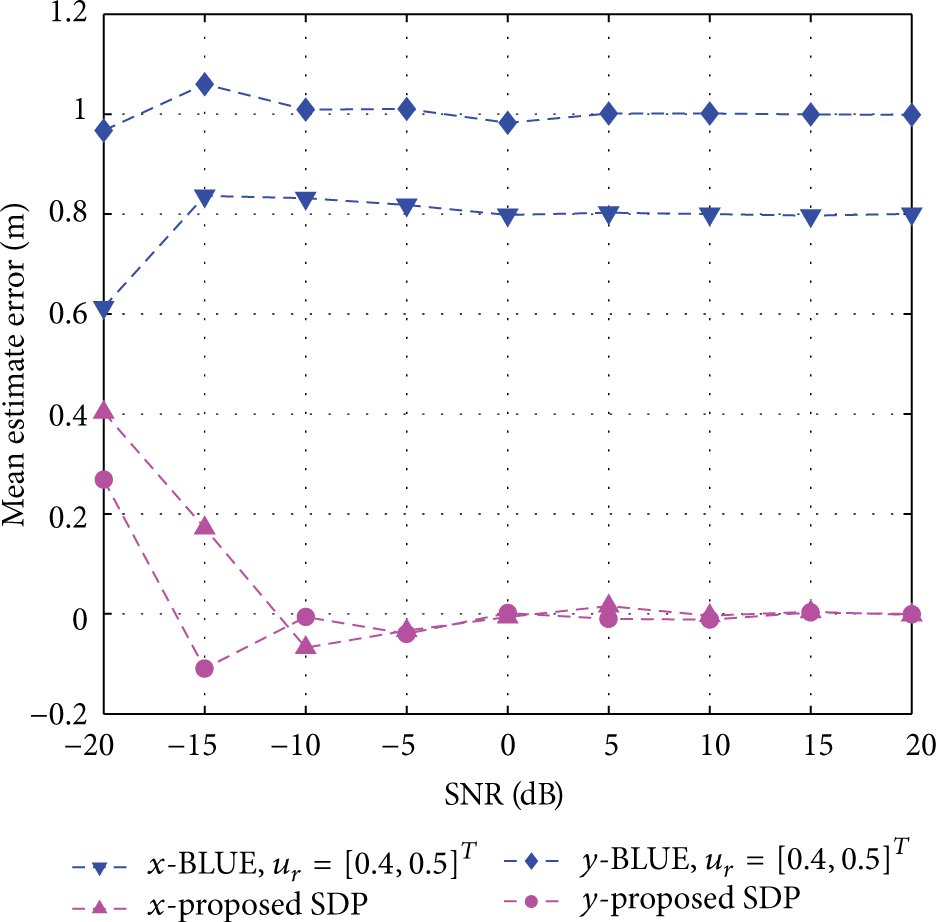
Comparison of mean estimate error using SDR and BLUE methods in the absence of antenna position errors.

Comparison of RMSEs using SDR and BLUE methods with different reference points in the absence of antenna position errors.
Since the BR measurements are highly nonlinear with respect to
5.3. Localization Performance with APU
Here, we consider localization in the presence of receiver APU. The RMSE is also used to evaluate the performance of the proposed algorithm. We assume

Comparison of RMSE using SDR and CRLB in the presence of antenna position errors.
We see in Figure 3 that although the RMSE of the position estimates cannot attain the CRLB in the presence of APU, it is still close to RMSE without antenna position errors when
6. Conclusion
We have proposed an SDR formulation to target localization problem in MIMO radar network based on the BR measurement model. Our method applies the SDR technique to the reformulated MLE problem to obtain an SDP. Accordingly, it guarantees global convergence without initial estimate. We also propose a robust SDR method to obtain location estimate when antenna positions are subject to errors. Simulation results demonstrate the performance advantage of the newly developed SDR methods for BR-based target localization over BLUE method, under various SNR conditions and in the presence of antenna position errors. The proposed SDR method can either serve to estimate target location or serve as an initialization to the original ML problem.
Footnotes
Conflict of Interests
The authors declare that there is no conflict of interests regarding the publication of this paper.
Acknowledgments
The work was supported in part by Grant from National Natural Science Foundation of China under no. 61302142 and National Science Fund for Distinguished Young Scholars under no. 61025006.