




Abstract
How to improve the rotation speed of heavy/large CNC vertical lathe, the machining efficiency, and machining precision is one of the key issues which need to be solved urgently. Hydrostatic thrust bearing is the key part to the heavy/large CNC vertical lathe; its performance directly affects the machining quality and operation efficiency. This paper analyses the latest research results from the perspective of the mechanical properties of hydrostatic thrust bearing, oil film lubrication, static pressure bearing thermal deformation, and the high efficiency refrigeration and evaluates the future scientific research direction in this area. Analysis shows that with the development of hydrostatic thrust bearing to the high speed, high precision, high efficiency, high stability, high multifunction, and high power, the study of hydrostatic thrust bearing will focus on the optimal design of the oil chamber to produce the least amount of heat, how to control the thermal deformation of hydrostatic thrust bearing, and the high efficiency refrigeration to ensure the machining accuracy of CNC equipment.
1. Introduction
Heavy/large CNC machining equipment is mainly used in energy, transportation, heavy machinery, aerospace, ship building, and national defense and other national key industries, and it is the typical products of China equipment manufacturing industry. With the rapid development of modern industry, the machining of heavy/large CNC machining equipment is in the direction to the high speed, high precision, high efficiency, high stability, high multifunction, and high power. The heavy/large hydrostatic thrust bearing is the most important part of the heavy/large CNC machining equipment, and its performance directly affects the machining quality and operation efficiency. Hydrostatic bearing technology first appeared at the Paris International Exposition which exhibited the free floating bearing which almost had no friction in 1878. In 1938, California's palomar mountain astronomical observatory first successfully put the hydrostatic thrust bearing which weighed up to five hundred ton applied into a two-hundred inches optical telescope, with an extremely low speed (1 r/day) and drive power (70 w) [1]. The French engineer P. Gerard invented the radial static pressure bearing in 1945 and successfully applied it into the spindle of the Gerard Grinding Machine in 1948 [2]. In the later decades, static pressure technology got rapid development and matured, and its application scope expands rapidly, almost throughout the manufacturing industry, military industry, and civilian equipment. Research and application of static pressure bearing technology in China started in the 60s, and the professors Chen and Wu of Beijing university of aeronautics and astronautics have done a lot of work in this respect [3]. Guangzhou machine tool research institute focused on the research of dynamic and static pressure thrust bearing since the 70s and put hydrostatic bearing technology applied into machine tool equipment according to the different performance requirements [4]. At present, the domestic and foreign research for the hydrostatic thrust bearing is in the direction to large scale, heavy load, and full automatic control. This paper analyses the latest research results from the perspective of the mechanical properties of hydrostatic thrust bearing, oil film lubrication, static pressure bearing thermal deformation, and the high efficiency refrigeration and evaluates the future scientific research direction in this area.
2. The Working Principle of Hydrostatic Thrust Bearing
The working principle of hydrostatic thrust bearing is shown in Figure 1. The pressure oil film of hydrostatic bearing is formed by hydraulic oil supply system mandatorily injecting pressure lubricating oil into the oil cavity between friction pair. The bearing force of hydrostatic thrust bearing which is formed by the interaction between oil cavity sealing side and workbench clearance throttle rises the bearing spindle and bears the external load.

Constant flux oil supply system of hydrostatic bearing.
Hydrostatic thrust bearing has the following advantages.
The working speed range is very wide, under the low speed crawl phenomenon.
The movement precision is high. The pressure of oil film between the moving pair has homogenizing effect to the error, making the precision of processed parts be much higher than the accuracy of motion pair itself.
The coefficient of friction and the driving power are low, and it usually has a low temperature.
It has a long working life. As long as the oil supply device works in a reliable condition, it can keep the precision for a long time with little wear.
It has good static and dynamic inflexibility, vibration absorbing performance, and stability. Generally, we do not need to consider the dynamic performance in the design and calculation.
We can take advantage of oil cavity pressure differential accomplishing some automatic control such as cutting and automatic constant force of cutter.
3. The Hydrostatic Thrust Bearing Mechanics Performance
Heavy/large hydrostatic thrust bearing has many pad structure shapes such as fan-shaped, rectangular, round, oval, and convex type. This paper only analyzes the mechanical property of hydrostatic thrust bearing whose oil pad structure shape is fan and other hydrostatic thrust bearings with different oil pad structure have similar mechanical property derivation. The fan pad is shown in Figure 2. On the basis of computational fluid dynamics, lubrication theory, and the actual flow characteristics of the fan-shaped pad, the practical model can be simplified as an oil cavity which is composed of annular plane and two parallel rectangular plates. Inside and outside oil outflowing sides can be regarded as annular oil cavity plate oil pad, and the left right oil outflowing sides can be regarded as a rectangular parallel plate [5–7].

The shape of sector cavity.
(1) The Flux Equation. The rectangular parallel-plate flow equation is shown as follows:
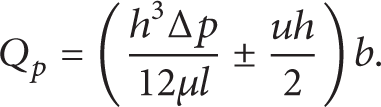
The annular plate flow equation is shown as follows:

The flow equation which is caused by centrifugal force is shown as follows:
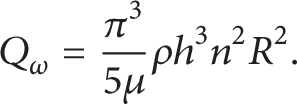
From what has been discussed above, a single fan oil pad fluid flow equation of the hydrostatic thrust bearing can be deduced as follows:

In flow equations from (1) to (4): Q: a single oil pad flow (m3/s); Q p : parallel plate flow (m3/s); Q a : ring andante flow (m3/s); Qω: centrifugal flow (m3/s); h: oil film thickness (m); Δp: pressure difference between import oil hole and export oil hole (Pa); μ: oil viscosity (N·s/m2); l: plate length (m); u: top and bottom plate relative velocity (m/s); b: plate width (m); R1: fan oil pad photosensitive inside oil edge inner diameter (m); R2: fan oil pad photosensitive inside oil edge outer diameter (m); R3: fan oil pad outside oil edge inner diameter (m); R4: fan oil pad outside oil edge outer diameter (m); R: centrifugal distance (m); ρ: liquid density (kg/m3); n: speed (r/s); φ1: week to seal oil inside and oil pad axis angle (rad); φ2: weeks to the edge of the lateral seal oil and oil pad axis angle (rad).
(2) The Oil Film Thickness Equation. The oil film thickness equation of the sealing side is shown as follows:

The oil film thickness equation of oil chamber is shown as follows:

In equations from (5) to (6): h0: design of the oil film thickness (m); e w : the workbench translation distance under the axial load (m); h z : the oil cavity depth.
(3) The Oil Pad Bearing Capacity Equation.The liquid intensity of pressure multiplied by bearing area is the bearing force. A single fan oil pad bearing capacity equation of the hydrostatic thrust bearing is shown as follows:

(4) The Oil Film Inflexibility Equation with Constant Current. We do differential operation between bearing force and oil film thickness. The oil film inflexibility equation with constant current is deduced as follows:

(5) The Frictional Force Equation and the Friction Power Equation. The frictional force equation is shown as follows:

The friction power equation is shown as follows:
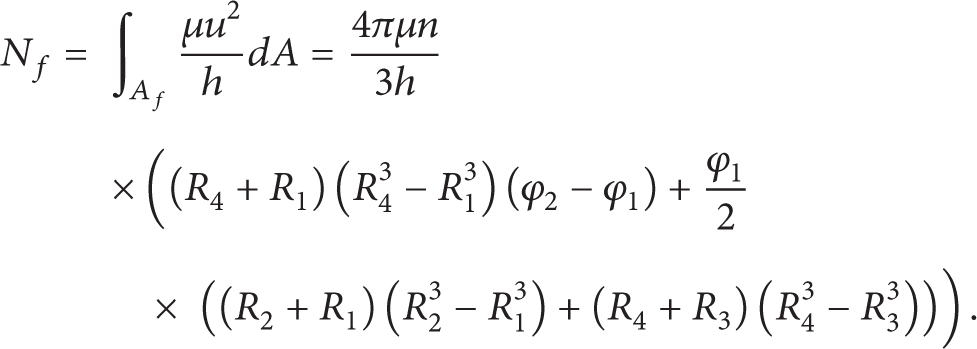
We can draw the conclusion from (1) to (10) that the bearing capacity of thrust bearing is not only associated with constant flow and shape of the pad but also related to oil viscosity in heavy/large constant current static pressure thrust bearing system (Figure 5). When the external load and the oil film thickness are invariable, the oil film inflexibility is constant. With the improvement of constant current static pressure thrust bearing speed, friction power increases, the oil film shear zone temperature increases, the oil viscosity is reduced, oil film thickness is reduced, the heat flux per unit area increases, and the performance of thrust bearing system is reduced; therefore, efficient refrigeration technology must be used to make heavy/large constant current static pressure thrust bearing to get higher rotation speed.
4. Research Development of the Static Supporting Theory and Its Pressure Performance
The characteristic of static supporting technology is the establishment of oil supporting in a completely static state. It can ensure that two friction surfaces are not in direct contact in the start-up phase and widely used in heavy-duty CNC equipment because of the advantages of small bearing capacity and dynamic friction coefficient.
In recent years, the research of static supporting by domestic scholars has developed rapidly. In 2007, Yu Xiaodong has studied that with the increasing of oil chamber area, the circular cavity curve of pressure increases to a limit extreme value gradually at first and then the pressure decreases gradually. It shows that there is an optimal value to a certain definite size oil chamber. When the filler opening is located in the center of the circular cavity and oil chamber area is 72% of the tile area, the pressure of the oil chamber is maximum. With the increasing of oil chamber depth, the curve of pressure increases to a value gradually and remains in the same order of magnitude. At this time the oil chamber depth is 30 mm and it is the max oil chamber pressure as shown in Figure 3. Similarly, with the increasing of oil chamber area, the sector cavity curve of pressure increases to a limit extreme value gradually at first and then the pressure decreases gradually. When the filler opening is located in the center of the sector cavity and oil chamber area is 75% of the tile area, the pressure of the oil chamber is maximum. This oil cavity area is optimal capacity for supporting oil pressure. With the increasing of oil chamber depth, the sector cavity curve of pressure increases to a value gradually and remains in the same order of magnitude. At this time the oil chamber depth is 30 mm and it is the max oil chamber pressure as shown in Figure 4. So oil chamber area and depth has more influence on the temperature field than velocity field of circular cavity and sector cavity.

Relation curve between pressure of roundness oil chamber and radius of oil chamber.

Relation curve between pressure of sector oil chamber and equivalent radius of oil chamber.
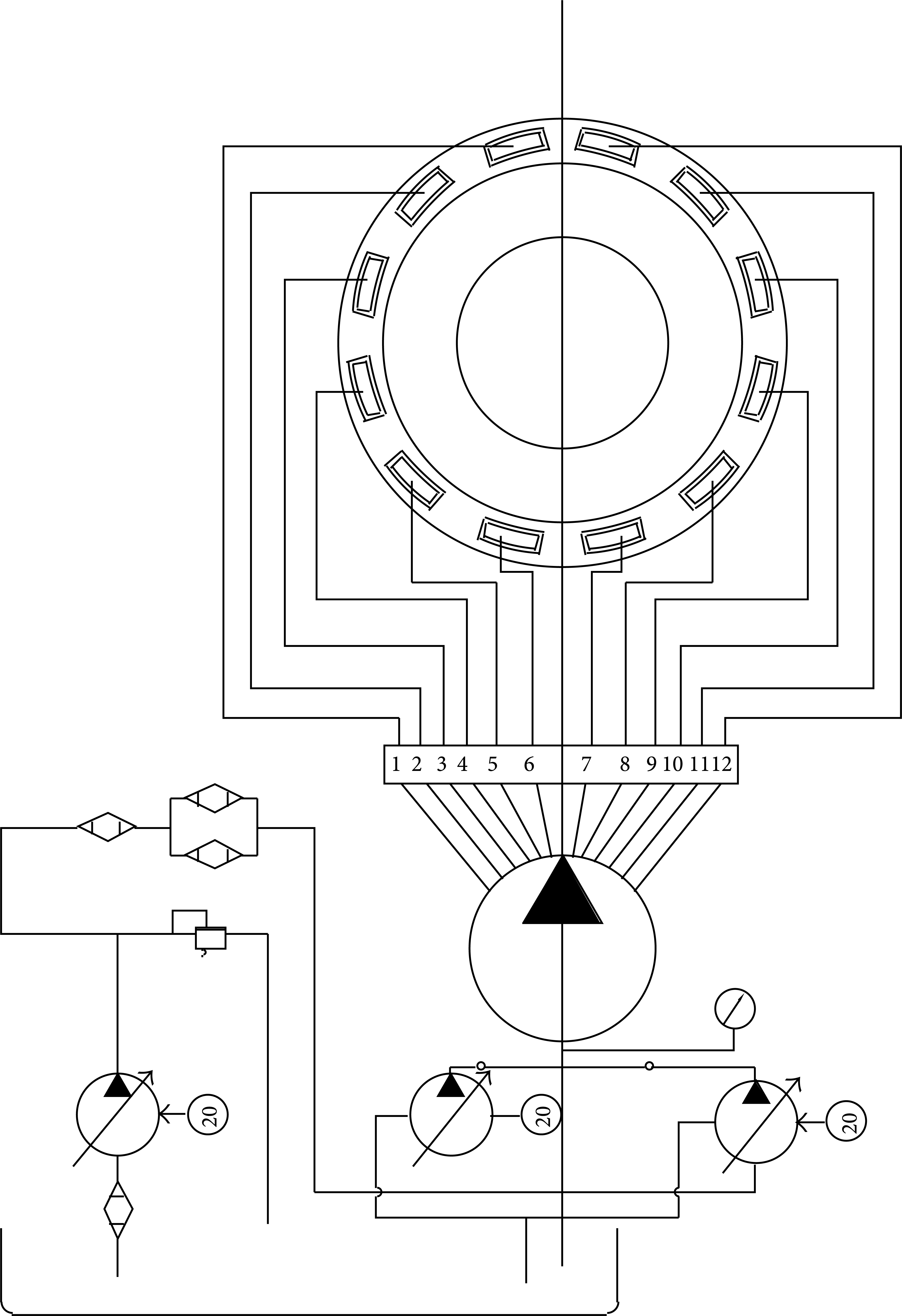
The fan cavity with many oil pads constant-current hydrostatic thrust bearing lubrication system.
Xie and Xu have proposed that two different oil supply methods (i.e., constant pressure oil supply and quantitative oil supply) have different effects on oil-film stiffness, which provide a theoretical basis for the oil supply system in hydrostatic bearing with heavy loads [8]. Shao et al., through studying the optimization problem of heavy duty hydrostatic bearing oil cavity structure which bases on the technology of hydrostatic bearing and using the finite volume method to simulate the gap fluid temperature field of fan-shaped cavity and circular cavity, also established equations on rotating coordinate system and, lastly, figured out the temperature distribution of the two-phase cavity shaped in the same speed, depth, and effective bearing area, in order to optimize the oil chamber structure [9]. Meanwhile, the study of hydrostatic thrust bearings with chambers in different shapes figures out that rectangular or circular oil chamber can acquire an optimal performance under the same processing capacity [10]. Wei et al., by numerical simulation of the hydrostatic bearing system of the working table, obtained the number of different hydrostatic bearing working oil chamber of the turntable at different vibration frequencies of the spring stiffness, using the numerical fitting methods to give the spring relational expression between stiffness and vibration frequencies and presented that with the increase in the number of oil chamber, hydrostatic bearing system working turntable vibration frequency value compared with other declines in the number of oil-chamber system modal order increases, his research laid the foundation for further study of other dynamics of hydrostatic bearing system and improved work performance of turntable [11]. Tang et al., in order to solve the bias load problem of large heavy NC table, whose single oil chamber partial hydrostatic thrust bearing cannot withstand the load, proposed a composite design scheme, which combines single oil-chamber hydrostatic bearing and hydrostatic radial bearing, and one new oil-chamber back-slot structure for the convenient oil-chamber processing in radial hydrostatic bearing [12]. Zhang, through hydrostatic thrust bearing performance testing and analysis, found that the oil film bearing capacity under different loads and different inlet pressures, the film stiffness, flow, temperature, and other key performance parameters, validated that the theory of critical performance parameters modeling and flow field and temperature field performance analysis is correct [13].
In foreign countries, Satish, by the analysis of Static and dynamic characteristics for round hydrostatic thrust bearings of different oil chamber shape, has found that their performance (stiffness, carrying capacity, pressure, and flow) varies. Arafa and Osman [14] have studied the flow state of hydrostatic bearing characteristics of laminar flow, in which the researchers, by using a constant pressure oil supply to various ways with the oil chamber and putting throttling device on the respective oil chamber entrance, which calculated the relationship between the different oil pressure oil chamber pressure and bearing characteristics, have optimized the arrangement of the oil chamber and the number of positions viscous oil chamber pump system and improved the stiffness and bearing capacity. Yablonskii et al. [15], firstly have researched the rheological properties of the hydrostatic bearing lubricant by using computer simulation method, and, on this basis, the carrying capacity of the hydrostatic bearing has been studied to obtain the pressure field of a hydrostatic bearing. Novikov et al. [16] has established the mathematical model of hydrostatic thrust bearing ring and made a numerical analysis of the performance with using ecocleaning fluid as a low viscosity lubricant, considering the bearing manufacturing and assembly errors. Crabtree et al. [17] have used shallow oil chamber in designing hydrostatic thrust bearing, rather than the traditional deep oil chamber and found their nuances.
According to scholars at home and abroad for research and analysis of the mechanical properties of the hydrostatic bearing, it can be concluded that the hydrostatic bearing capacity, rigidity, pressure, and so forth have been closely related to oil chamber design. Future directions for research on the mechanical properties of hydrostatic bearing are how to optimize the structure of the main oil chamber to try to get better mechanical properties.
5. Oil Film Lubrication Theory and Performance Research Progress
Hydrodynamic lubrication phenomenon was discovered by American B.T power by accident, when he was in research of railway vehicle axles sliding bearing in 1883. The liquid film pressure differential equation in woven gap which was called Reynolds equation was deduced by a British named Renault in 1886, which laid the foundation theory of hydrodynamic lubrication [18].
Dynamic pressure lubrication film is formed by the relative motion friction surface which has certain geometry with the help of a viscous fluid dynamic effect. Metal surface friction is separated by the lubricating film layer in the sufficient fluid lubrication state, and there is little solid phase contact. Friction occurs only inside the fluid, so the fluid lubrication has a small friction coefficient [19, 20].
We study the stress distribution of the viscosity lubricant film, supporting force and friction theory with the application of the fluid mechanic theory and lubrication theory in order to reduce the operation friction resistance of the machine parts and improve the carrying capacity of the lubricating film and eventually achieve greater speed and improve the machining precision and machining efficiency goals.
Circular guide hydrostatic thrust bearing which is commonly used in engineering has two types, circle cavity and fan cavity, which also includes two forms, back chute into the tank and no return chute. Compared with the circular guide multicavity hydrostatic thrust bearing with no return chute between the oil chamber, the hydrostatic thrust bearing with return chute has better bearing ability to resist overturning moment because of no inner flow effect. Return chute can prevent the lubricating oil flowing outside but also can make the oil discharge smoothly. Although the latter has better stiffness and higher ability to resist overturning, if the size of the tank is too large or working in a bad lubrication state, the air can enter into the bearing under high speed and its dynamic inflexibility is reduced greatly.
In China Wenshizhu comprehensively expounds the lubrication theory study research progress and the existing problems of fluid lubrication, boundary lubrication, elastohydrodynamic lubrication, thin film lubrication, mixed lubrication, and so on and puts forward some suggestions to the future research on lubrication theory [21]. Zhang et al. did three-dimensional numerical simulation for large fan hydrostatic thrust bearing lubrication performance with the CFD technology, which can predict large hydrostatic bearing lubrication characteristics and possible problems in the rotation process, and had a certain role in promoting the economic loss and improving the work efficiency. They also discussed the temperature effect on the oil film lubrication [22], which is shown in Figure 6.
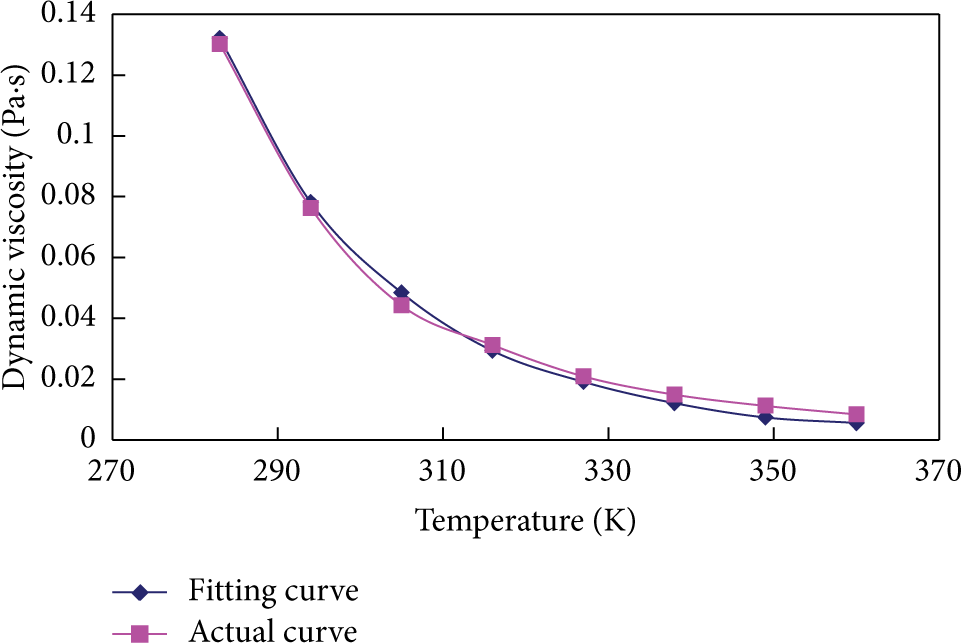
Lubricating oil viscosity-temperature curve.
Considering the variation of lubricating oil viscosity and deformation field condition, Shao junpeng put forward many new problems for the high-speed heavy-duty hydrostatic thrust bearing such as type of cooling, friction pair material, lubricating oil medium, turbulence, eddy current, and dynamic characteristic. If those problems were solved, hydrostatic thrust bearing could be under the condition of high speed and heavy loading with high stability and accuracy. Yu et al. accomplished to predict the dynamic characteristics of fan cavity with many oil pads hydrostatic thrust bearing during the research [23].
Abroad, in terms of oil film lubrication, Kazama and Yamaguchi analyzed the influence of rotation speed, surface roughness, supply pressure, and load on hydrostatic thrust bearing system. By his introducing the concept of average pressure for the analysis of bearing capacity for roughness and static equilibrium, the experimental data are normalized [24]. van Ostayen et al. did the research of overweight constant hydrostatic thrust bearing with the mixed lubrication between the bearing and trackhydrostatic support in a new type lock gate, which provided a theoretical basis for using the model in the future [25]. Zhang et al. found that viscosity effects on hydrostatic bearing cannot be ignored, especially in a high speed requiring a higher requirement in the lubrication oil film [26]. Most researchers predict oil film likely situations in practical work mainly through software simulation, which can improve the efficiency for practical work.
6. Research Progress of Thermal Deformation Control and High Efficiency Cooling in Hydrostatic Bearing
During working, lubricating oil viscosity changes as oil film temperature rises; thus, bearing capacity and stiffness will change. If the temperature rise is too large, excessive thermal deformation of bearing will influence machining accuracy. Therefore, control thermal deformation hydrostatic bearing and high efficiency cooling is the prime problem for hydrostatic bearing to solve. The domestic and foreign scholars have done a lot of research on it.
On thermal deformation control, Ma established relationship model between temperature rise of the temperature measuring point and thermal error based on neural network technology and analyzed the measurement data of vertical machining center spindle box. The results show that the RBF neural network model approximates the actual thermal error model well and reduces the thermal error. Concerning various working conditions of CNC machine tools, thermal coordinate system and the cold were proposed on the basis of original machine tool coordinate system and the workpiece coordinate system. A thorough analysis under various working conditions of nc machine tool was done and provides a thought to solve the problem unexpectedly in the process of nc machining [27]. Chen et al. analyzed the thermal deformation of hydrostatic guideway vertical lathe bearing workbench and established corresponding model based on the theory of elastic deformation, plastic deformation theory, and the thermal deformation theory. The model is consistent with the experimental results and optimized the workbench structure to make less thermal deformation [28]. Wang et al. discussed difficulties and skills during the finite element model establishing of dynamic and hydrostatic bearing. The temperature distribution and deformation in the circumstance of frictional heat and the sensitive parameters of fluid-structure interaction was obtained [29]. Wang simulated thermal deformation field of hydrostatic bearing workbench, temperature field, and thermal deformation field tendency in different rotation speed. At the same time, the measurement of adding stiffened plates to decrease thermal deformation was proposed. Then, thermal deformation analysis of optimum workbench was carried out. The simulation verifies the feasibility of this method, reveals the change law of temperature field, and deformation field. It provides theory basis for the structural design of the workbench, while, the analysis, the influence of stiffened plates on thermal deformation field, improves the machining precision and machining efficiency [30].
Abroad, Chen et al. proposed 32 items machine tool including thermal error and geometric error on the basis of the original 21 items of machine tool error term and began a study on machine tool thermal error compensation [31]. Srivastava et al. established error model of five axis machining center by HTM [32]. Wang et al. proposed offline and online thermal error compensation model based on the grey system theory [33]. South Korean scholar Lee et al. established thermal error model of horizontal machining center based on fuzzy logic strategy [34]. Singapore Ramesh et al. established thermal error model, which is bayesian networks supporting vector machine (SVM) [35]. American scholars Yang and Ni did thermal elastic analysis of machine tool system in view of dynamic characteristics. It shows that pseudo lag effect is the main cause of thermal error in traditional thermal error model, and a system dynamic thermal error model and a system model adaptive method using iteration to revise model coefficient were established [36]. Taiwan scholar Wang et al. proposed a new high-efficiency error compensation model of multiaxis nc machine tool [37]. Eastwood and Webb developed a temperature compensation method by analysis thermal deformation of parallel structure of machine tool during work. It enables parallel structure into practical application [38]. Vyroubal presented how to improve the processing precision by thermal deformation compensation and illustrated how to compensate thermal deformation in detail. It provided theoretical support for thermal deformation compensation [39]. Shao et al. discussed influence cavity depth on temperature distribution of oil film in heavy hydrostatic bearing on the basis of numerical calculation of temperature field in different cavity depth [40]. Kim and Song put forward neural network compensation model and system compensation of machine tool mechanical origin to reduce the influence of thermal deformation on machining precision [41].
Because temperature rise had great influence on hydrostatic bearing device, heat pipe technology can be used to achieve high efficiency cooling. Heat pipe technology is a new heat transfer technology found in 1960s. The heat conduction capacity is better than any known metal heat conduction ability and occupied an important position in radiator manufacturing industry [42]; its working principle is shown in Figure 7.

Working principles of micro heat pipe.
In the aspect of using heat pipe as the high efficiency cooling, Zhao and Yu think heat pipe has great potential and advantages in the electronic device cooling and described the development of heat pipe cooling technology in the electronic device cooling and application prospect in the airborne electronic equipment cooling technology [43]. Yu et al. applied plate type heat pipe into electronic components to improve heat dissipation and did system research on performance. The effect gravity directions on heat transfer performance of heat pipe were explored. The measurement flat heat pipe with liquid core that can be used in aviation machine plant to promote electronic equipment cooling was presented [44]. Lu et al. established physical model and the equation of concentrated solar absorption heat pipe, analyzed the condensing heat transfer performance of heat pipe heat, and optimized system efficiency [45]. Ming et al. did system research and optimization design on the feasibility of airborne heat pipe. The axial reverse acceleration resistance of flat heat pipe effective length of 0.12 m is up to 1.2 g. It overcomes negative impact large aircraft maneuvering flight acceleration and azimuth change on heat pipe working [46]. Deng and Xu analyzed the cooling system of high-speed motorized spindle and applied highly effective thermal conductivity of heat pipe, uniformity of temperature, and structure diversity into the cooling of high speed motorized spindle. It can export heat energy quickly and solve high speed motorized spindle temperature change by heat pipe cooling technology [47]. Yan designed a heat pipe cooler in heavy vehicle cooling system and analyzed application feasibility of heat pipe fitting on the vehicle cooling system [48]. In a word, the development of heat pipe technology is very mature. It is a trend using heat pipe technology to achieve rapid cooling in the thermal control of hydrostatic bearing in the future.
7. Conclusion
Hydrostatic bearing technology is widely used in ultraprecious machine tools and heavy equipment; therefore, the research of static pressure support technology for the mechanical processing industry has great significance, great application prospect, and potential, and it will have a great role for mechanical processing industry. This paper analyzes the working principle of hydrostatic thrust bearing and mechanical performance and expounds research of the present situation and the development trend of theory of hydrostatic bearing, mechanical properties, theory and performance of oil film lubrication, static pressure bearing thermal deformation control, and high efficiency refrigeration. With the development of hydrostatic thrust bearing to the high speed, high precision, high efficiency, high stability, high multifunction, and high power, the study of hydrostatic thrust bearing will focus on the optimal design of the oil chamber to produce the least amount of heat, how to control the thermal deformation of hydrostatic thrust bearing, and the high efficiency refrigeration.
Conflict of Interests
The authors declare that they have no conflict of interests regarding the publication of this paper.
Footnotes
Acknowledgments
This project is supported by National Natural Science Foundation of China (51075218), Natural Science Foundation of Heilongjiang Province of China (E200909), University Key Teacher Foundation of Heilongjiang Province of China (1253G065), and Reserve Talents of Universities Overseas Research Program of Heilongjiang.