




Abstract
This paper examined the effects of performing an e-mail receiving and sending task using in-vehicle computer (iPad4) on driving performance and driver eye movements to determine if performance decrements decreased with practice. Eighteen younger drivers completed the driving on driving simulator while interacting with or without an e-mail task. Measures of fixations, saccades, vehicle control, and completion time of the secondary task were analyzed. Results revealed that using in-vehicle computer featured “large touch-screen” to receive and send e-mail greatly weakened driver's distraction and decreased their ability to control the vehicle. There was also evidence that, however, drivers attempted to regulate their behavior when distracted by decreasing their driving speed and taking a large number of short fixations and a quick saccades towards the computer. The results suggest that performing e-mail receiving and sending tasks while driving is problematic and steps to prohibit this activity should be taken.
1. Introduction
As the number and complexity of in-vehicle information systems (IVIS), such as large information density devices of computer and television increase, so too do concerns over the potential for these technologies to distract drivers. Driver distraction can be defined as the diversion of attention from the driving task as compelled by an activity or event, inside or outside the vehicle, which competes for the attention of the driver. It usually results in a delayed recognition and processing of the information needed to safely accomplish the driving task [1–3]. According to Nevile and Haddington's reports, drivers commonly engage in distracting activities while driving accounting for 14–21% of crashes caused by distraction [4]. Estimates from the 100-Car Naturalistic Driving Study are similar, placing secondary task engagement as a contributing important factor in over 22 percent of crashes and near-crashes. As complexities of in-vehicle and modernized technologies grow, this figure is expected to increase [5, 6].
Compared to some portable devices such as mobile phones, navigation system, music players, and radio, relatively few studies have systematically examined the effects of interacting with more recent technologies on driving performance, especially in-vehicle computer with a big touch-screen, which is just the focus of this study. Previous studies have shown that the effects of secondary task difficulty and interaction style on driving safety were significant. Young et al. found that portable music player that features “touch technology” increased the amount of time that drivers spent with their eyes off the roadway and decreased their ability to maintain a constant lane position and time headway from a lead vehicle [6]. Jin et al. reported that the in-vehicle touch-screen telephone weakened driver's ability to control the vehicle [7]. Victor et al. research showed that the task difficulty also had significant effect on driver eye movements [8]. It must, however, be stressed that driver distraction is not just related to the difficulty and interaction style of secondary task. Distraction caused by aspects of the highway environment is also a major issue. In addition, touch-screen computer use in vehicles has raised concern, primarily because they are likely to place significant visual demand on the driver due to the absence of tactile and kinaesthetic feedback [6]. Because the absence of tactile cues, users are required to glance at the interface more often to confirm that a correct selection or action has been made [9], a perturbing finding given the predominantly visual nature of the driving task [6].
As discussed above, distraction is a significant and multifaceted road safety issue. Researchers have been scarcely devoted to in-vehicle touch-screen computer as a modern device. Excepting that researchers only focused on secondary task difficulty and interaction style, they also only work out to find the effects of secondary task on driver fixation while ignoring saccades behavior which is also an important factor of eye movements. Aimed at that, this study examined the effects of performing secondary tasks of receiving and sending e-mail on an iPad4 touch-screen in different road environments with a range of measures for eye fixations and saccades behavior, driving performance, and secondary task performance.
2. Methods
2.1. Participants
Eighteen participants (10 females, 8 males, mean age = 25.32 years) between 20 and 31 years of age were recruited from the Jilin University and surrounding communities. All participants were required to hold a valid class C1 driver's license for more than 2 years and drive a minimum of 5000 km per year. The divers were also required to be in good physical and mental health, not taking any medication or drugs that would affect their driving performance either.
2.2. Apparatus and Materials
2.2.1. The Smarteye6.0 Eyes Tracking System
Driver eye movements while driving are captured by Smarteye6.0 (Smart Eye AB, Första Långgatan 28, Göteborg, Sweden). It uses four cameras mounted in front of windscreen towards driver's face to capture his/her eye movements and three scenes cameras to record the simulated traffic environment, consequently obtaining visual behavior measures such as the visual direction, fixations, and saccades. Video analysis is performed using Smarteye Analysis, which is an offline data review and reduction analysis program. The Smarteye6.0 is mounted separately from the driver and has fewer influences on driving performance than the head-mounted eye movement tracking system.
2.2.2. Driving Simulator
The driving simulator is a fixed-base, static driving simulator equipped with a Besturn B50 car. The display system projects onto a screen with a wide of 115° horizontal field view in front of the vehicle. The simulator was equipped with numerous sensors and logging equipment to collect the measures of driving performance, including vehicle speed and steering wheel angles. In addition, 60 Hz is adopted as sample frequency both in Smarteye6.0 and driving simulator. Experiment apparatus are shown in Figure 1.

Driver's eye movement apparatus and in-vehicle computer (iPad4).
2.3. Experiment Descriptions
Participants were required to complete the e-mail receiving and sending tasks in nonvehicle and multivehicle road environments separately. The data of driver eye movements (fixations and saccades), driving performance (steering wheel angle, speed, and lateral deviation), and completion time of the secondary task while driving was collected using Smarteye6.0 and driving simulator.
2.3.1. Road Conditions
A highway from Changchun to Siping was designed as the driving road environment by real-time 3D model building software of visual simulation named Multigen Creator and Vega, which was projected on the screen in front of the vehicle. The highway consisted of four-lanes of traffic, two in each direction and separated by a grassy median. Each lane of the highway was 3.75 meters wide and the middle belt was 3 meters wide. All secondary task driving was completed both in nonvehicle and multivehicle road conditions. On the multivehicle road, there were twenty vehicles evenly distributed, keeping the same speed and location simultaneously in the simulation to ensure the same road environment of each test.
2.3.2. Easy Tasks
Easy tasks were defined as having five or six steps, represented common tasks, and took less than 7 s to accomplish when tested alone, with unlocking the iPad4 as the beginning and turning to the mailbox to check if any e-mail received as the end in this study.
2.3.3. Difficult Tasks
Difficult tasks required twelve to thirteen steps, were used to accomplish more complex or specific tasks, and took about 14–20 s to complete when tested alone. Difficult interactions required participants to turn on the iPad4 and send a simple e-mail which has an attachment selected from computer desktop to the first contact people in the address list.
2.3.4. Experiment Sessions
The experiment was conducted in the following steps.
(1) Participants were taught how to operate the iPad4 (easy task, difficult task) and then practice performing the task and driving the simulator in nonvehicle and multivehicle road conditions repeatedly, first separately, and then together. The practice session finished until drivers could operate proficiently.
(2) Drivers were led to complete secondary tasks at any time they feel safe while driving, so as to ensure the validity of the experiment as far as possible. Each driver completed a drive without iPad4 as the baseline and two drives, respectively, with easy and difficult iPad4 tasks on different highway road conditions, including multivehicle and nonvehicle road environments, six experiment sessions of each driver in total.
3. Results
All eighteen drivers successfully completed the driving task. Parameters of driver's visual and driving performance were collected while driving and then analyzed in the first instance through repeated-measures ANOVA in SPSS, SmartAnalysis, and Matlab.
3.1. Eye Movements
Driver eye movements mainly comprise fixation, saccade, and blink, among which driver relies on fixations and saccades to obtain most of the environment information to ensure safety [10, 11], while blink nearly acquires no information and thus is not taken into consideration in the study. Therefore, measures of fixations (percentage of time with eyes off-road, mean number of fixations, maximum off-road fixation time, mean fixation duration, horizontal and vertical search angles, and pupil diameter) and saccades (mean saccade speed, mean saccade amplitude and average number of saccade, and maximum saccade speed) were analyzed.
3.1.1. Region of Interest (ROI) Classification
The objective of classification was to determine the fixation area of the driver, to know where of a set of key areas she/he can be looking at [12]. The 6 different fixation areas used as indication of visual search defined for this project were shown in Figure 2, where ROI stood for region of interest and ROI1 to ROI6 represented the road (road itself and traffic ahead), dashboard, left mirror, right mirror, rearview mirror, and secondary task area, respectively.

Set of key fixation areas.
3.1.2. Fixations
Percentage of Time with Eyes Off-Road. The mean proportion of time spent with eyes off the road (off the ROI1 on the simulation screens) of eighteen drivers on multivehicle road was shown in Figure 3. A repeated-measure ANOVA found that the mean proportion of time spent with eyes off the road differed significantly with the easy and difficult tasks compared to the baseline in both nonvehicle road (baseline: M = 8.77%, S.E. = 1.01%; easy task: M = 19.33%, S.E. = 1.11%, P < 0.01; difficult task: M = 22.24%, S.E. = 1.37%, P < 0.01) and multivehicle road (baseline: M = 12.67%, S.E. = 1.16%; easy task: M = 26.89%, S.E. = 1.17%, F(2, 51) = 45.96, P < 0.01; difficult task: M = 34.58%, S.E. = 1.97%, F(2, 51) = 66.35, P < 0.01) conditions. Differences between easy (M = 22.43%, S.E. = 1.41%) and difficult task (M = 28.57%, S.E. = 1.77%) were also significant, P < 0.01. The mean proportion of time spent with eyes off the road was affected by the road environments, all P < 0.05.
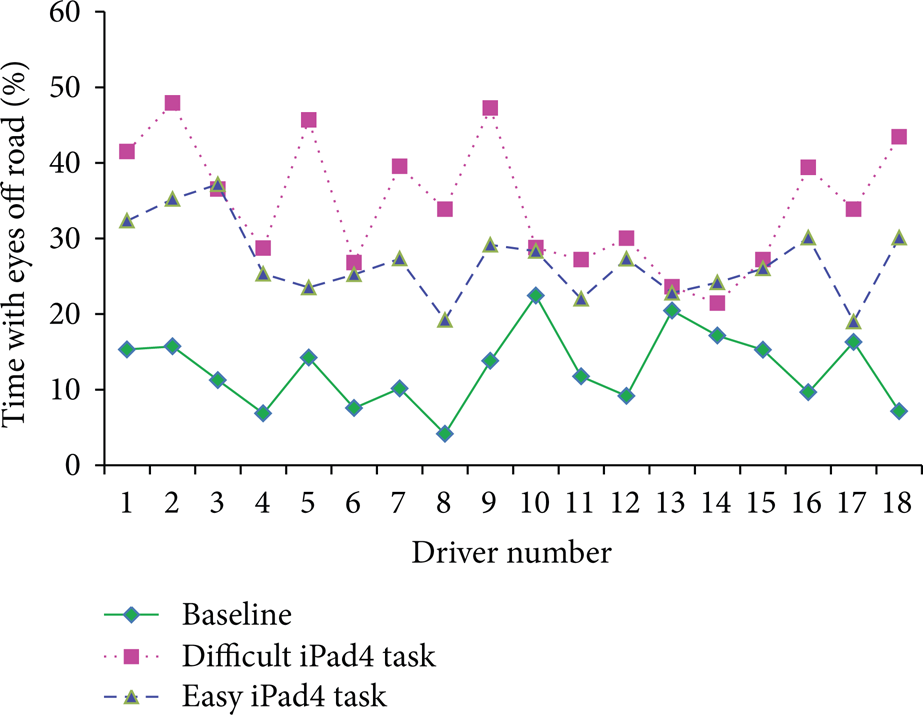
The mean proportion of time spent with eyes off-road of eighteen drivers on.
Mean Number of Fixations. A fixation is defined as the period when a driver is likely to be interpreting information from either the roadway or some in-vehicle device [13]. The mean number of fixations per driving task was examined under the four task conditions in order to determine the mean number of fixations needed to complete the required task in more detail.
(1) ROI1: on-road. Significantly less mean fixations number was found during the interaction with iPad4 tasks (easy iPad4 task: M = 2.79, S.E. = 0.098, F(1, 70) = 50.32, P < 0.01; difficult iPad4 task condition: M = 2.27, S.E. = 0.085, F(1, 70) = 116.6, P < 0.01) compared to the baseline. Differences between tasks of different difficulty degree were also significant (P < 0.05). While mean fixations made on the road did not differ significantly depending on road environments, P > 0.05. Figure 4 described the mean number of fixations on road among the baseline and dual-task conditions.

Mean number of fixations with and without secondary tasks.
(2) ROI6: iPad4. Drivers typically made a large number of fixations at the iPad4 device while driving with secondary tasks. It was found through a repeated-measure ANOVA that the mean number of fixations made on the ROI6 differed significantly between the easy task and difficult task conditions in any road environment. Obviously, the difficult iPad4 task required much more mean fixations into the vehicle (on nonvehicle road: M = 0.58, S.E. = 0.11; on multivehicle road: M = 0.67, S.E. = 0.11; P = 0.03) than the easy iPod interactions (on nonvehicle road: M = 0.22, S.E. = 0.02; on multivehicle road: M = 0.31, S.E. = 0.09, P < 0.05) in any road environment. In addition, mean fixations number on iPad4 significantly differed under different road conditions as well, P < 0.05.
(3) ROI3 and ROI4: rearview mirrors. Statistic results indicated that few drivers in the iPad4 tasks fixated on the rearview mirrors. Analyses revealed that there was a large mean number of fixations on the rearview mirrors in baseline conditions compared to the easy and difficult iPad4 tasks in any road conditions, (all P < 0.05).
Maximum Off-Road Fixation Time. Driving safety will be gravely threatened when the driver's fixation keeps away from road more than 2 s, which is called visual distraction [14, 15]. So the maximum off-road fixation time was calculated to estimate the visual quality. Maximum off-road fixation time significantly differed depending on the difficulty degree of tasks, (easy task on nonvehicle road: M = 1.56 s, SD = 0.17 s, difficult task on nonvehicle road: M = 2.00 s, SD = 0.56 s, P < 0.05; easy task on multivehicle road: M = 1.87 s, SD = 0.37 s, difficult task on multivehicle road: M = 2.11 s, SD = 0.57 s). In the multivehicle road environment, the maximum off-road fixation time was made significantly longer during the easy and difficult tasks than the same tasks in nonvehicle road environment, all P < 0.05.
Mean Fixation Duration. The duration of fixations significantly differed depending on the ROI, P < 0.001. Specifically, longer fixations were made on the ROI6 (M = 0.75 s, SD = 0.11 s) than on the road (M = 0.60 s, SD = 0.03 s) and off the road (M = 0.39 s, SD = 0.027 s), all of which significantly differed from each both in the easy and difficult iPad4 environments, all P < 0.05.
Mean fixation durations differed by secondary tasks, P = 0.0015. Significantly longer fixation durations were found in the difficult iPad4 condition (M = 0.67 s, SD = 0.03 s) compared to the easy task (M = 0.53 s, SD = 0.027 s) and baseline conditions in multivehicle road environment (M = 0.58 s, SD = 0.02 s), all P < 0.05. The similar differences were also found in nonvehicle road environment. The mean fixation duration did not differ significantly depending on road conditions and the duration of each ROI in multivehicle road environment was shown in Figure 5.
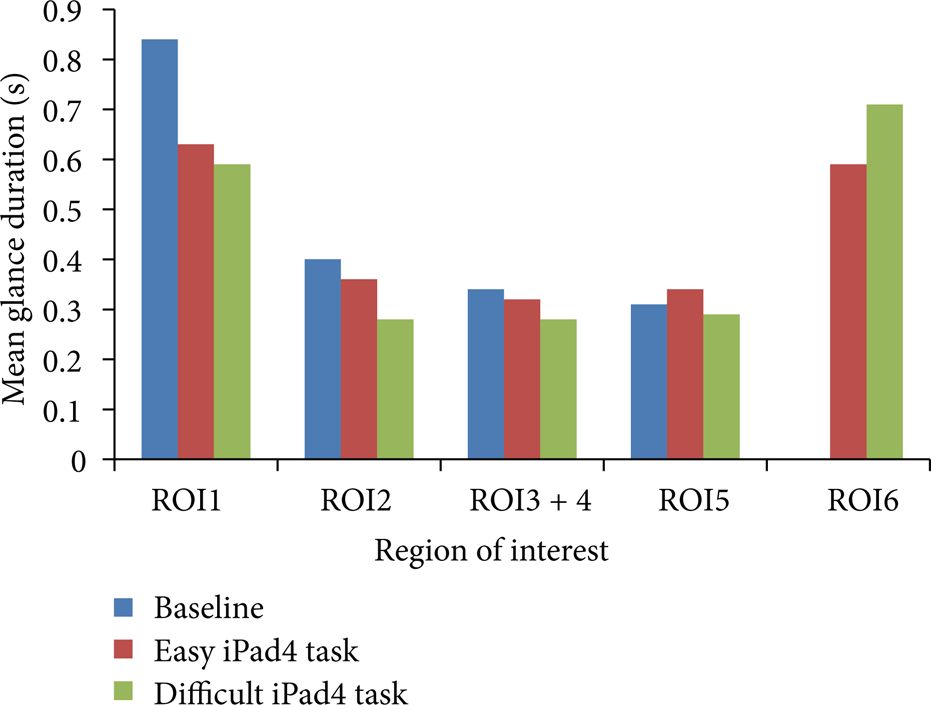
Mean fixation duration of each ROI on multivehicle road condition.
Standard Deviation of Horizontal and Vertical Search Angles. The variance and standard deviation of horizontal and vertical visual search angles were used to evaluate the search breadth and measured by different degrees [16, 17]. However, no significant differences were found in standard deviation of horizontal and vertical search angles while driving with iPad4 tasks in different road environments, all P > 0.05.
Pupil Diameter. The pupil diameter mainly expresses driver intense, as a critical parameter of visual information. Changes of the pupil diameter indicate that attention is aroused by different stimulus [18]. Significant differences were found in pupil diameter under the four iPad4 tasks conditions (F = 13.58, S.E. = 0.11 mm, P = 0.002). Pairwise comparisons revealed that the pupil diameter increased in all four iPad4 conditions from baseline levels (all P < 0.001) and the pupil diameter in multivehicle road environment was bigger than that in nonvehicle road environment, all P < 0.05.
3.1.3. Saccades
As one of important aspects of driver visual behavior, saccade is the process of substantial eye movements. The saccades criteria summarized in Table 1 include mean saccade speed mean saccade amplitude, average number of saccade, and maximum saccade speed, which have also been similarly analyzed in the study using repeated-measures ANOVA. Saccades made in the baseline and iPad4 task conditions were shown in Table 1.
Saccades made in the baseline and iPad4 task conditions.
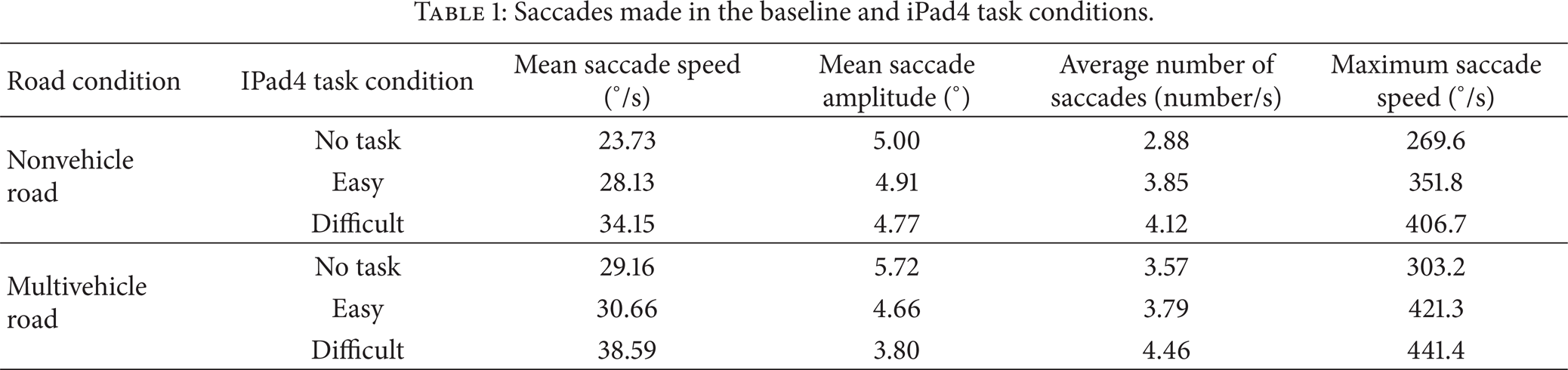
Mean Saccade Speed. Mean saccade speed is the proportion of each saccade distance (angle) to the saccade duration, with “degrees/sec” as its unit. Mean saccade speed can explain the information processing speed in the previous fixation and the searching speed to find the next target [18]. The mean saccade speed during the iPad4 task (M = 34.15°/s, SD = 6.34°/s) differed significantly from the baseline (M = 22.57°/s, SD = 3.21°/s, P < 0.01). Interaction with difficult iPad4 task (M = 36.35°/s, SD = 7.45°/s) was also found at significantly higher mean saccade speed under various road conditions compared to easy iPad4 task (M = 29.26°/s, SD = 8.22°/s, P < 0.05). During the secondary task driving, mean saccade speed on multivehicle road (M = 33.28°/s, SD = 7.35°/s) was significantly faster than nonvehicle road condition, M = 28.77°/s, SD = 5.69°/s, P < 0.05.
Mean Saccade Amplitude and Average Number of Saccades. Mean saccade amplitude is the range of a fixation from the beginning to the end, usually with a visual angle as its unit. Average number of saccade means the searching frequency for information of the driver, decreasing along with the rising complexity of cognitive task. Through statistics on saccade behavior of 18 drivers, neither the mean saccade amplitude nor the average number of saccade was affected by road conditions (all P > 0.05). However, mean saccade amplitude affected by secondary task had obviously narrower amplitude with iPad4 task (M = 4.25, SD = 0.43) than the baseline (M = 5.54°, SD = 0.31°, P < 0.05). Average number of saccades significantly increased with difficult iPad4 task (M = 4.31°, SD = 0.58°) than easy iPad4 task (M = 3.81°, SD = 0.45°, P < 0.05) and baseline (M = 3.01°, SD = 0.23°, P < 0.01).
Maximum Saccade Speed. Maximum saccade speed differed depending on secondary task, F = 5.21, P = 0.007. Difficult iPad4 task was found with higher maximum saccade speed under both nonvehicle (M = 406.7°/s, SD = 58.94°/s) and multivehicle road (M = 441.4°/s, SD = 66.13°/s) conditions. With the same secondary task, maximum saccade speed was also significantly affected by the road condition. Obviously, maximum saccade speed on multivehicle road (M = 405.4°/s, SD = 78.34°/s) was higher than nonvehicle road (M = 362.6°/s, SD = 49.3°/s), F = 8.98, P = 0.008.
3.2. Secondary Task Performance
As the most important aspect of secondary task performance, time completion time was analyzed using Smarteye Analysis and Data Distillery, beginning with the first movement made by participants toward the device and ending with the completion of the task. For each participant and a given condition, mean task completion time was determined by averaging across all captured completion times for that participant and condition. To calculate the overall mean task completion time for a given condition, task completion time was averaged across all participants.
A repeated-measures ANOVA was conducted to explore the impact of task condition (baseline, easy iPad4 task, and difficult iPad4 task) on task completion time. There was a significant difference between task conditions (F = 11.73, P < 0.001) and road conditions (F = 14.15, P = 0.001). As displayed in Figure 6, drivers took longer time to complete the difficult iPad4 task both in nonvehicle and multivehicle road conditions compared to the easy iPad4 task and baseline conditions. The road condition also had significant effects on task completion time, F = 13.58, P = 0.002.

Eighteen drivers' task completion time.
3.3. Driving Performance
3.3.1. Standard Deviation of Steering Wheel Angle
Steering angle variation was used to determine steering corrections made while interacting with the iPad4 and comparable baseline measures on matched roadways, which was measured in degrees. A significant difference was observed for standard deviation of steering wheel angle between tasks of different difficulty degrees. Obviously difficult iPad4 task had larger variation in steering wheel adjustments (M = 3.27°, SD = 0.75°) than the baseline (M = 1.99°, SD = 0.34°, P < 0.05) and easy iPad4 task (M = 2.45°, SD = 0.51°, P < 0.05) conditions. The highway condition also showed a significant effect on standard deviation of steering wheel angle, P < 0.001.
3.3.2. Mean Speed
Repeated-measures ANOVA analysis indicated that mean speed differed significantly under the four task conditions (P < 0.05) and was significantly lower in the interaction with difficult iPad4 task (M = 24.2 m/s, SD = 11.56 m/s) compared to easy iPad4 task (M = 26.7 m/s, SD = 9.33 m/s, P < 0.05) and baseline condition (M = 27.8 m/s, SD = 9.21 m/s, P < 0.01). Mean speed was also significantly affected by the road condition, obviously higher mean speed on nonvehicle road compared to multivehicle road, P < 0.01.
3.3.3. Lateral Deviation
To quantify driver performance in our task, lateral deviation measure that represents the driver's ability to maintain a central lane position was adopted, commonly seen in other driver distraction studies as well. Accordingly, root-mean-squared errors of the lateral deviation between the vehicle's center and the lane center were computed. Analysis results indicated that both easy and difficult iPad4 tasks had significantly effect on lateral deviation compared to the baseline condition (all P < 0.01). Difficult iPad4 task had larger lateral deviation than easy iPad4 task in the same road condition, F = 14.22, P < 0.05.
4. Discussion
This study examined the effects of performing e-mail receiving and sending tasks on an iPad4 touch-screen on a range of driver performance measures, as evidenced through eye fixations and saccades behavior, driving performance, and secondary task performance. The present study identified that performing e-mail receiving and sending tasks on a touch-screen in-vehicle computer (iPad4) while driving increases the amount of time that drivers spend with their eyes off the roadway and decreases their ability to maintain a constant lane position. Although drivers attempt to regulate their behavior when distracted by decreasing their speed, making a large number of short glances towards the device, and reducing speed, the data of eye fixation, eye saccade, driving performance, and secondary task performance all suggest that these strategies are not always sufficient to offset the deleterious effects of in-vehicle computer use. At present, using telephone, navigation, and other in-vehicle electronic devices are clearly forbidden by the law in America, Canada, and France et al. But in fact, multitask driving is still not received enough attention and not effectively resolved, especially in some developing countries, just as China. Meanwhile, Global Road Safety Status Report—Action to Be Taken demonstrated that more than 90% deaths in road traffic accidents happened in developing countries which owned 48% vehicles of the world only. With the development of science and technology, in-vehicle computer which is a highly integrated device including navigation system, entertainment system, and all kinds of information systems will be soon popularized. So the government should pay more attention to this issue and act to prevent traffic accident caused by these secondary tasks.
4.1. Driver Eye Movements
4.1.1. Eye Fixations Behavior
Analysis of the visual demands of using an iPad4 while driving revealed that drivers spent, on average, 2.41 times longer with their eyes off the road while performing e-mail task than they did when driving without a competing task. This finding is similar to that of Young et al. who found that performing music search tasks using an Ipod Touch while driving increased the amount of time that drivers spent with their eyes off the roadway [6]. It is also interesting to compare our results with a more traditional means of changing the radio station. Lehtonen et al. found that the average time of maximum off-road fixation was 1.56 s [19], which is shorter than the approximately 1.8 s found across the different conditions in the current study. Thus, there was evidence in the current study that touch-screen task needs longer fixations to complete than press-button task while driving, and that is because information selection from the touch-screen lacks tactile feedback and needs to locate precisely. Furthermore, in order to minimize the distraction caused by e-mail task, drivers regulated their interaction with the secondary task by taking a large number of fixations to the iPad4. Driver's cognitive load significantly increased, as evidenced through pupil diameter increasing.
4.1.2. Eye Saccades Behavior
Although there were few researches on driver eye saccades behavior, significantly differences were also found in mean saccade speed, mean saccade amplitude, average number of saccades, and the maximum saccade speed between iPad4 tasks and the baseline condition in any road environment. Drivers had 1.5 times higher saccade speed and 2 times higher maximum saccade speed when driving with secondary tasks in comparison with the normal driving. It is because that drivers need to divert their sight quickly to the iPad4 to ensure driving safety as far as possible. Mean saccade amplitude affected by secondary task, with obviously narrower amplitude in the iPad4 task than the baseline. Task difficulty affected driver's average number of saccades. The more difficult it is, the larger average number of saccades turns.
4.2. Driving Performance
The driving performance results suggest that, regardless of the task difficulty, engaging in tasks of receiving and sending e-mail on an in-vehicle touch-screen interface significantly degrades performance on a range of driving measures. As expected, relative to the baseline condition, interacting with iPad4 tasks resulted in degraded lateral control, as evidenced by an increase in the standard deviation of steering wheel angle and root-mean-squared errors of the lateral deviation. When performing the e-mail tasks, standard deviation of steering wheel angle and root-mean-squared errors of the lateral deviation were approximately 64% and 44% higher separately compared to the baseline. The decrease in lateral control observed when receiving or sending e-mail on the iPad4 supports previous research that has shown that lateral position is particularly affected by secondary tasks, such as using navigation system, dialing a telephone, or text messaging [20, 21]. These results are also in line with earlier touch-screen interaction studies, which found decrements in lateral control measures such as standard deviation of lane position and the number of lane excursions [6]. Driving speed, being related to crash risk and to the seriousness of a crash, is also relevant from a traffic safety perspective [20, 22]. The drivers reduced their speed when interacting with iPad4 tasks in this study. The speed reduction was, however, greater for the difficult iPad4 task in multivehicle road environment, which should be interpreted in terms of different degrees of compensation. The reason for the results can be supposed to lie in the fact that drivers had to look away from the road for a longer time period for difficult task in multivehicle road environment than easy task in nonvehicle road environment.
4.3. Secondary Task Performance
The average time taken to complete the e-mail tasks varied according to the difficulty degree of the task and the road environments. Difficult iPad4 task needed 55 s to complete while easy task needed 33 s in multivehicle environments. In nonvehicle road environment, the numbers were 29 and 22, respectively. Rodrick et al. propose that, under dual-task conditions, secondary task completion times in the range of 30–40 s are acceptable provided that the task is self-paced and able to be completed using a series of short fixations not exceeding 2 s [23, 24]. According to this guideline, the results of current secondary task and the eye glance data discussed above would suggest that the difficult iPad4 task in multivehicle road environment is not suitable to perform while driving. Although the completion time of difficult task in nonvehicle road does not exceed 40 s, the off-road fixation is beyond 2 s.
5. Conclusion
The present study concentrated on the effects of interaction with the in-vehicle computer touch-screen on driving performance. The other influence factors of computer operation while driving still remain to be analyzed in detail, such as distractions caused by font size, interface color, mounting position, and speech-based. With the development of science and technology, more and more entertaining and information systems are embedded in the vehicle, and thus various secondary tasks appear sequentially. The risk of interacting with these tasks may get higher and this issue should also be studied further.
Conflict of Interests
The authors do not have any conflict of interests with the content of the paper.
Footnotes
Acknowledgments
This research was supported by School Research Foundation of Shandong Jiaotong University (2014) and the Doctoral Scientific Research Foundation of Shandong Jiaotong University (2014) and it was also supported partly by the International Cooperation Project of Science and Technology of Jilin Province under Grant (20130413056GH), the Tsinghua University Open Fund of State Key Laboratory of Automotive Safety and Energy (KF14182), the Key Scientific and Technological Project of Changchun Technology Bureau (13KG05), and Jilin University Alternates Development Scheme of The National Science Fund for Distinguished Scholars. In addition, this research was supported by Training Fund of Shandong Natural Science Foundation of China (ZR2014EEP014).