




Abstract
The paper investigates the dynamical behaviors of single-walled carbon nanotube (SWCNT) in water, focusing on the effect of external environment (i.e., water) on SWCNT. The SWCNT-water system comprises three constituent parts, that is, the SWCNT, the absorbed layer of water molecules, and the water flow around the water layer. The SWCNT and the absorbed layer of water are modeled as two-layer thin shells coupled via the interlayer vdW interaction, and the water surrounding the absorbed water layer is considered as the potential flow. The numerical simulations show that the vdW interaction is responsible for an upshift in the frequency of the SWCNT and preserving the stability of system. Flow velocity has almost no effect on the natural frequency of SWCNT, while being quite significant for destabilizing of the CNT-fluid system. In addition, the effect of wavenumber on the coupled system is also considered. The study not only greatly reduces simulation time but also provides a new model to explain the experimental observation available in particular cases.
1. Introduction
Carbon nanotubes (CNTs) have attracted a great deal of attention in recent years because of their superior mechanical [1–5], electronic, and chemical properties. Many of the applications are not implemented in vacuo and the interaction of the CNTs with the environment cannot be ignored. For example, Izard et al. [6] reports an upshift in the radial breathing mode of CNTs in suspension and the upshifts have been previously seen by Lebedkin et al. [7] and Rao et al. [8]. So, a good understanding of the interactions between nanotubes and fluids is essential to the development of the CNT-based nanodevices running in the presence of a fluid phase. In the present paper, water as the external environment is introduced to study the dynamical behaviors of SWCNT.
Molecular dynamics (MD) simulations can be used to study the CNT-water interaction. However, because of being complex and time consuming, it has limited application especially for a large-sized system. Considering the difficulties of the controlled experiments at the nanometer scale, continuum theory has been widely used to study the CNT-fluid system. Specifically, the elastic shell model was efficiently used for the mechanical behaviour of CNTs system [9–12].
Up till now, the effort has been made to explore the mechanical behavior of CNT-water system. For instance, Walther et al. [13] and Werder et al. [14] studied the properties of water surrounding a CNT using MD simulations and found that the water radial density profile exhibits the characteristic layering. Then, Longhurst and Quirke [15–17] used multiscale model to study the RB vibration of single-walled carbon nanotube (SWCNT) in water and found that the RB mode can be accurately reproduced by replacing the absorbed water layer with a mean field harmonic shell potential. Furthermore, Wang et al. [11] developed a double shell-stokes flow model to study the axisymmetric vibration of SWCNT immerged in water. In the paper, water is divided into double layers—the absorbed water shell by SWCNT and the water layer surrounding the absorbed layer. The study offers a theoretical explanation for the experimental observation and molecular dynamics simulations available in particular cases.
Motivated by these earlier studies, we develop a double shell-potential flow model for the SWCNT in water. The SWCNT and the external absorbed layer of water molecules are modeled as two-layer thin shells coupled via the interlayer vdW interaction, and the water around the absorbed water layer is considered as the potential flow. As will be shown below, based on the model, discussions in detail on the dynamical behaviors of SWCNT immerged in water are performed.
2. The Double Shell-Potential Flow Model
As shown in Figure 1, the SWCNT-water system contains three parts, that is, the SWCNT, the absorbed layer of water molecules, and the water flow around the water layer. The SWCNT and the absorbed layer of water are modeled as two-layer thin shells coupled via the interlayer vdW interaction, and the water around the absorbed water layer is considered as the potential flow.

The schematic diagram of the SWCNT-water coupling system.
By using the shell theory, the governing equations of radial vibration are stated as


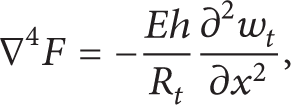

where x and θ are the axial and circumferential (angular) coordinates, respectively, t the time,

where |0.6K| is the well depth and s0 the equilibrium separation of double shell and s = s0 + w. c is the second derivative of (5) at equilibrium distance s0 that is expressed as

For simply supported SWCNT of length L shown in Figure 1, the solution of (1) and (2) can be determined by

where A m,n (t) is the unknown function of time, m is the axial half wavenumber, and n is the circumferential wavenumber. Substituting (7) into the right-hand side of (3), the differential equations for the stress function F are yielded as

In fact, on the Galerkin projection principle [19], a more general orthogonal relationship, is written as

From (1)–(2), we let X i and Z a be
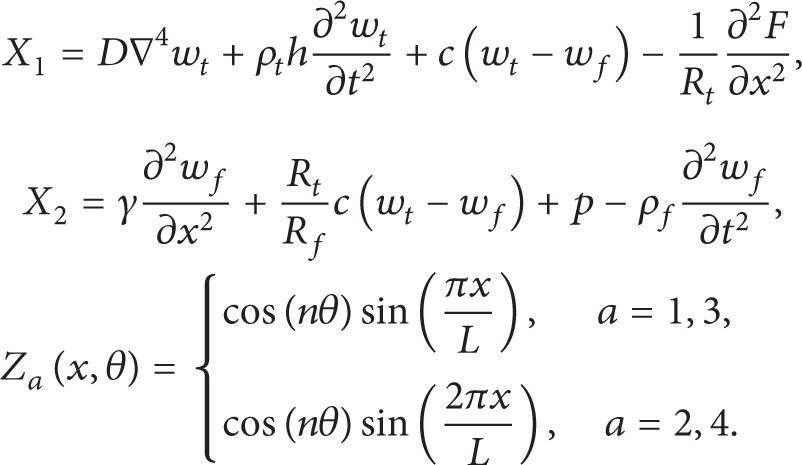
Thus, a set of the linear ordinary differential equations for the unknown functions A m,n (t) are obtained as

where

Furthermore, (11) are converted into the state space with eight first-order differential equations:

A matrix form is used as
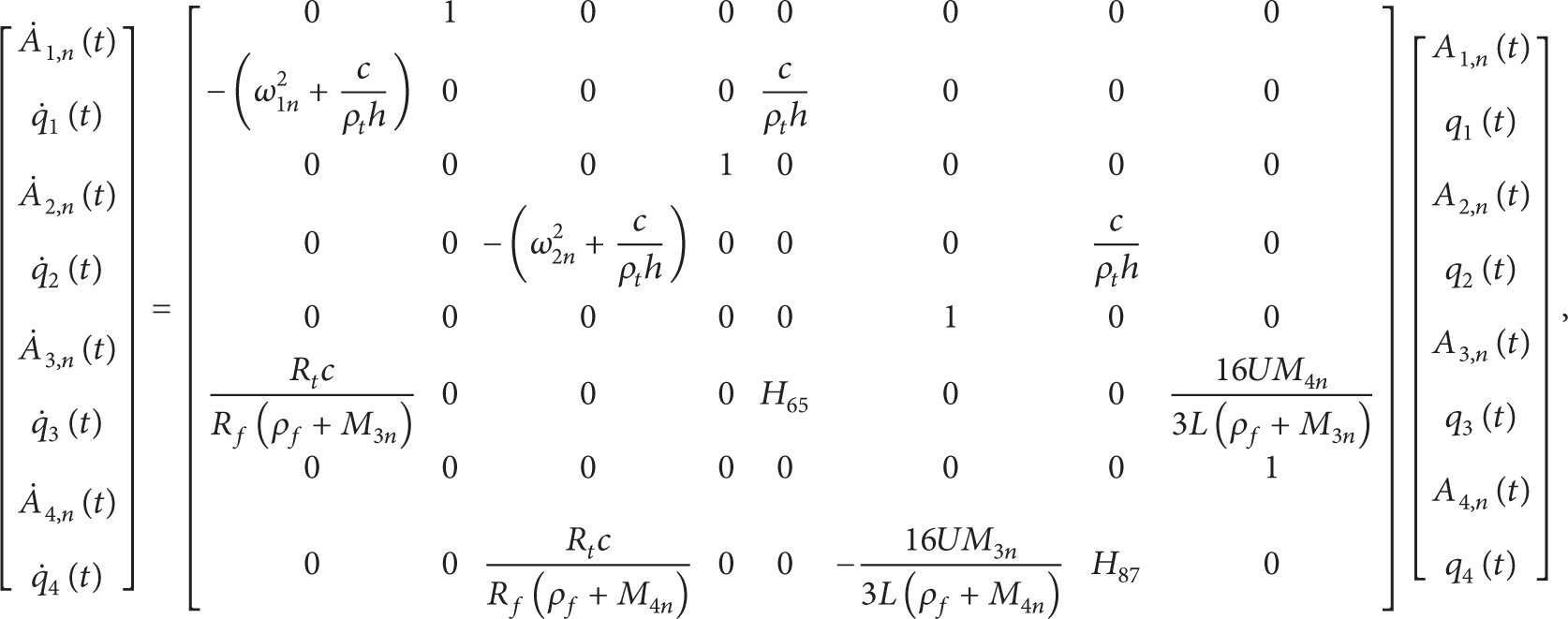
where

Finally, the characteristic equation of the system of (14) is stated as

where [I] is an identity matrix and [C] is the coefficient matrix of the right-hand side of (14), and λ is the eigenvalue of the system. The real part indicates an attenuation/amplification factor of the vibration amplitude due to dissipation/supply of the energy from the flow, that is, the decaying rate, and the imaginary part stands for the angular frequency of the system. Obviously, the eigenvalue is a function of the flow velocity.
3. Results and Discussions
The dynamical behaviors of the (22, 0) SWCNT in water at 300 K are studied in the paper. The parameters used are D = 2 eV, ρ t h = (2.27 g/cm3) × 0.34 nm, Eh = 360 J/m2 [20, 21], and L = 100R t . The values of ρ f , γ, s, and c can be extracted by fitting the double shell model to the MD simulations [15, 16].
Firstly, the dynamic characteristics of the SWCNT are examined. To allow a comparison between the different wavenumbers, the angular frequencies of SWCNT with various fluid velocities are calculated and listed in Table 1 as a representative measure of the strength of the CNT-water interaction. It is observed that the vdW interaction between SWCNT and water shell results in larger frequencies. Furthermore, different wavenumber n leads to different frequencies. However, for the fixed n, the variation of natural frequencies is very small and even can be ignored when fluid velocity and vdW interaction are considered. The reason may be ascribed to the fact that the radial motion cannot be efficiently transferred from the potential flow to the SWCNT because that SWCNT-water coupling is not strong enough as compared with the equivalent radial rigidity of the water shell. This result given by the present model justifies the rigid-shell assumption for the absorbed water layer once again which is in good agreement with [11]. In particular, at n = 0, that is, the axisymmetric mode, the SWCNT with vdW interaction exhibits frequency 138 cm−1 (10−2 ω/2πe, where ω is the angular frequency and e is velocity of light) which is 4.88 cm−1 higher than its counterpart without vdW interaction. In [16], the upshift in RBM for (22, 0) SWCNT for presence of water on outer surface is 4.77 cm−1. Compared to the results in [16], it is in good agreement. At the same time, the effects of exterior water on the axisymmetric mode of SWCNT are also found to be in agreement with existing experimental observation [6–8].
Natural frequencies (× 1013 Hz) of the SWCNT.

Secondly, the dynamic characteristics of the water shell are investigated. The evolution of the real and imaginary parts of the eigenvalues of the system as the flow velocity U is plotted in Figures 2–5. Figures 2–3 show the case that n = 0 with and without vdW interaction, respectively. Obviously, as the flow velocity increases, water shell has a destabilizing way to get through divergence, restabilization and flutter instability in turn, and the critical flow velocities are sequentially identified as U d , U r , and U f with vdW interaction and U D , U R , and U F without vdW interaction. Figures 4–5 show the case that n = 8 with and without vdW interaction, respectively. It is seen from Figure 4 that the system has two divergences at Ud1 and Ud2 before the flutter instability comes out at U f . It is seen from Figure 5 that the system has a destabilizing way through the coupling divergence and restabilization at U DR and flutter at U F .

Evolution of the imaginary and real parts of the eigenvalue of the system as velocity U for n = 0 with vdW interaction.

Evolution of the imaginary and real parts of the eigenvalue of the system as velocity U for n = 0 without vdW interaction.

Evolution of the imaginary and real parts of the eigenvalue of the system as velocity U for n = 8 with vdW interaction.

Evolution of the imaginary and real parts of the eigenvalue of the system as velocity U for n = 8 without vdW interaction.
It is seen from the comparison of Figures 2–3 or Figures 4–5 that vdW interaction significantly affects the stable characteristics of the system, and its effects are to preserve the stability of the system. Moreover, the existence of vdW interaction can change the type of bifurcation.
4. Conclusions
The effects of external environment on the dynamical behaviors of SWCNT in water are studied in the paper. The influences of flow velocity and vdW interaction between the SWCNT and the water shell are taken into account. It is shown that the effect of external environment on the dynamical behaviors of SWCNT must be considered. The vdW interaction between the SWCNT and the water shell is responsible for an upshift in the frequency of the SWCNT. Moreover, the vdW interaction plays an important role in preserving the stability of system. In addition, flow velocity has negligible impact on the natural frequency of SWCNT, while playing an important role in destabilizing of the CNT-fluid system. It is hoped that the paper can provide a new and efficient approach for the study of the general dynamic behavior of CNTs in suspension.
Conflict of Interests
The authors declare that there is no conflict of interests regarding the publication of this paper.
Footnotes
Acknowledgment
The work described in this paper is funded by the research Grant of the Natural Science Foundation of China (Grant nos. 11172115 and 10902044); the authors are grateful for their financial support.