




Abstract
The inlet structure is the main part of an electrostatic precipitator, so its mechanical properties, including the static strength, stiffness, and vibration characteristics, play an important role in the structural safety. In order to achieve good mechanical performance and lightweight of the inlet structure, an optimal design method, which is based on growth mechanism of the branching systems in nature and optimality criteria, named the improved adaptive growth method, is suggested. The method is applied to optimize the stiffener layout of the inlet structure, and the multiobjective optimization mathematical model which consists of the minimum compliance and the maximum natural frequency is considered. The optimality criteria method is applied to solve the design problem. The design result shows that the suggested method is effective, compared with the empirical design of the inlet structure, the weight of the optimal structure is reduced by 3.0%, while the global stiffness and the first natural frequency are increased by 18.83% and 4.66%, respectively.
1. Introduction
As dust purification equipment, the electrostatic precipitator (ESP), which has the advantages of high efficiency, low energy cost, and dust precipitation at high temperature, has been widely used in the fields of metallurgy, cement, station boiler, chemical industry, and so on. The inlet structure is the main part of a large-scale electrostatic precipitator, so the reasonable design with good static strength, stiffness, vibration-proof performance, and lightweight is necessary. The main part of inlet structure is composed of steel panel, stiffeners, and internal supporting rod. Obviously, stiffeners welded on the steel panel have great influence on the mechanical properties. At present, the stiffener layout of the inlet structure is designed empirically, which is the form of vertical and horizontal distribution. In order to achieve a lightweight design, the sizing optimization is usually applied to design the optimal distance between the stiffeners and the stiffener sectional size [1, 2]. However, the sizing optimization design depends heavily on the existing structure; as a result, the final inlet structure may not be an optimal structure. Compared with sizing optimization design, topology optimization can not only improve the mechanical properties, but also save material greatly. Thus it can be used to solve the stiffener layout of the inlet structure. In these decades, many scholars have proposed a variety of structural topology optimization techniques to deal with the problems of the stiffener layout of plate and shell structures, such as homogenization method and density method [3–6]. However, most research efforts to date have focused on transforming the problem of stiffener layout pattern design into a search for an optimal distribution of material. As a result, the stiffener layout may not be clear, and a corresponding postprocessing that distinguishes the real stiffener layout pattern and stiffener dimensions should be introduced.
With the inspiration of branching systems in nature, Ding and Yamazaki [7, 8] have suggested a method called the adaptive growth method. The method has been successfully applied to the stiffener layout design of plate and shell structures. Currently, the adaptive growth method is mainly focused on the relatively simple theoretical research and has not been applied to the practical engineering problems. Recently, the improved adaptive growth method was suggested by Ji et al. [9], in which the iterative formula of the adaptive growth method is derived from KKT condition. Compared with the initial adaptive growth method, the design result can be converged with both the design objective and the volume constraint [9]. Consequently, the method can be applied to more complicated design problem. In this paper, the improved adaptive growth method is applied to optimize the stiffener layout of the inlet structure of electrostatic precipitator. A multiobjective optimization function of the inlet structure, which consists of the minimum compliance and the maximum fundamental frequency, is solved. And an optimal stiffener layout, which is completely different from the empirical design, is obtained.
2. Structure and Mechanical Performance of Empirical Design
Figure 1 is the schematic diagram of an electrostatic precipitator, which consists of inlet flue, inlet structure, electrode, outlet structure, and outlet flue.

The inlet structure is shown in Figure 2, which is comprised of the steel panel, internal supporting rods, and stiffeners. As shown in Figure 2(a), steel panel which is the main load-bearing part of the inlet structure is made of steel. Figure 2(b) is the front view of the inlet structure, the stiffener layout of which is vertical and horizontal distribution.
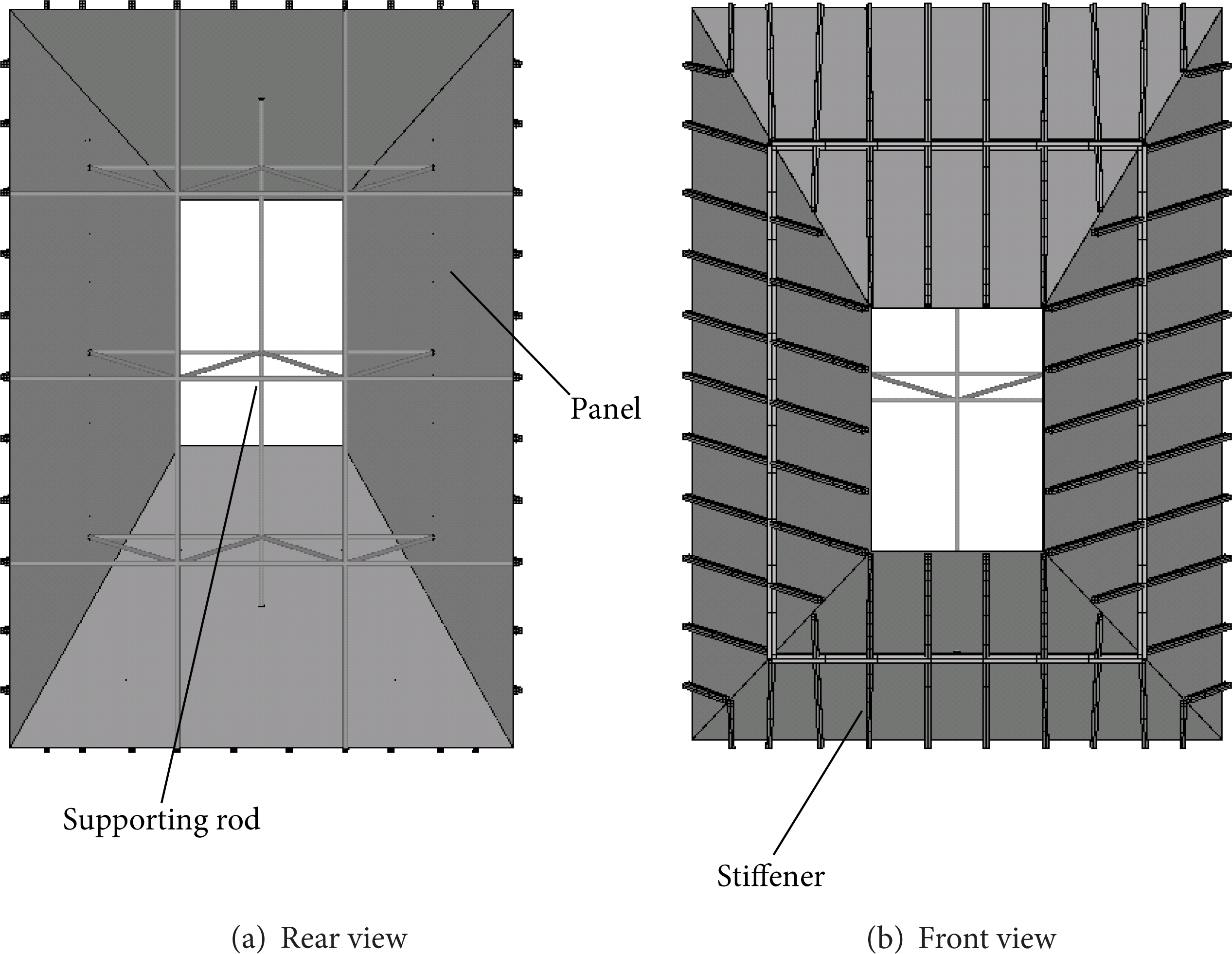
Empirical design of inlet structure.
In order to obtain the mechanical performance of the inlet structure, finite element analysis is carried out. According to the National Standard of China GB50009-2001 [10], the main loads on the inlet structure include the working pressure, self-weight of structure, and wind pressure. The bigger mouth of the inlet is fixed on the main body of the electrostatic precipitator and the smaller mouth is constrained by the flue. The analysis result is shown in Figure 3, in which Figure 3(a) is the Von Mises stress and Figure 4(b) is the deformation. The maximum Von Mises stress of the structure is 152.4 MPa, and the maximum deformation is 12.75 mm. The first natural frequency is 16.52 Hz. The total volume of inlet structure is 928.40 × 106 mm3, in which the volume of stiffeners is 232.1 × 106 mm3. It should be noted that when the self-weight load is included in the finite element analysis, modifying the layout of stiffener leads to changes in the load vector, which may affect the optimization result. But in this paper, the self-weight of structure is just considered in FEM analysis to obtain the structural performance and is neglected during topology optimization process. It is expected that a little difference of the layouts of stiffeners between two cases of considering and neglecting the self-weight during the optimization process may exist, but the main layouts of stiffeners do not change a lot, because the working pressure applied on the structure is much greater than the self-weight of stiffeners.

FEA results of empirical inlet structure.
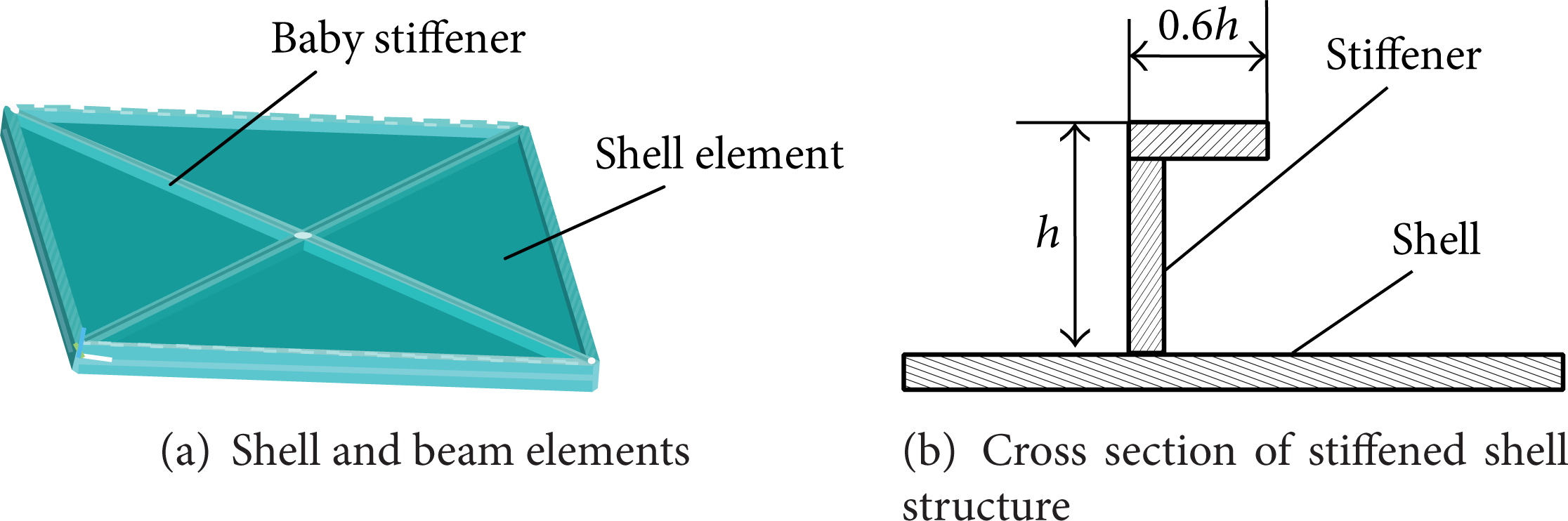
Ground structure.
3. Stiffener Layout Design by Improved Adaptive Growth Method
As we know, various branching systems in nature, such as root of plant and bronchia of animals, can grow and branch off automatically towards such direction that can improve the global functional performance, such as the maximum absorption of water or uniform distribution of nutrition or blood [11]. According to the growth mechanism of natural branch systems, Ding and Yamazaki [7, 8] have suggested the adaptive growth method. The basic idea of the method is that if the stiffeners on plates and shells extend by obeying similar adaptive growing and branching rules as branching systems in nature, stiffened plates and shells can achieve a certain better mechanical performance.
In order to apply the adaptive growth method to the stiffener layout design of the inlet structure of the electrostatic precipitator, a ground structure is constructed, which includes two parts: one is the ground shell and another is the baby stiffeners. According to the practical stiffener, the baby stiffeners on the ground structure are arranged eccentrically and with the L-cross section, as shown in Figure 4. The height of the L-shape stiffener is h, and the length of the flange is defined to be 0.6h. And the thickness of both the web and the flange of the stiffener is the same as the thickness of the shell, which is constant. Thus the cross-sectional area of the stiffener, which is set to be the design variable in the optimal design process, is dependent on the height h.
3.1. Multiobjective Optimization Model
Stiffness and vibration are the main mechanical properties of the inlet structure, so we define the multiobjective optimization function which is composed of the minimum compliance and the maximum fundamental frequency, as shown in

where U is the structural strain energy and Λ is the reciprocal of the mean frequency
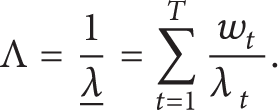
In (2), λ t and w t (t = 1, 2, …,T) are the specified eigenvalue and the given weighting coefficients of λ t , respectively. It is noted that the mean eigenvalue Λ is considered to be the design objective function, so as to make it possible to avoid some difficulties in optimizing a vibrating structure, because that maximizing a chosen eigenvalue may be nonsmooth [12]. The weighting coefficients w t can be chosen as different values for adjusting the contributions of the specified eigenvalues to obtain a desired optimization problem. For example, if we want to maximize the fundamental frequency, and suppose there are five order eigenvalues are included in (2), it may be suitable to set the values of w t (t = 1, 2, …, 5) to be 0.4, 0.2, 0.2, 0.1, 0.1.
The linear combination method is adopted to deal with the multiobjective problem; thus the combination function

where ρ is the weighting coefficient of compliance objective, Umax and
Considering the general stiffener layout design problem of the inlet structure, the optimization mathematical model is

where {R h } is the actively growing stiffener set and H is the number of {R h }. Parameters v and v0 are, respectively, the final volume and the initial volume of the structure, and η is the volume fraction. A i (i = 1, 2, 3, …,I) is design variable, which is the cross-sectional area of the ith stiffener. And A min and Amax are the lower and upper limits of A i .
3.2. Solution of Multioptimization Mathematical Model
Applying the optimal criterion method to solve (4), we can get the following Lagrange associated function:

where χ is the Lagrange multiplier.
When the design variable vector

According to (6), when A min < A i < Amax, the following equation can be obtained:
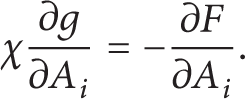
Thus, we can get

For simplicity, we define G i as

where S
i
is the design sensitivity of the multiobjective function F(
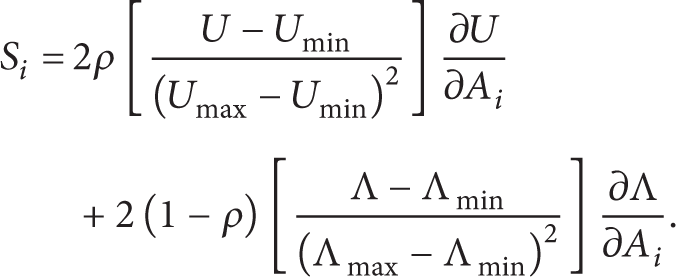
In (10), ∂U/∂A i is the design sensitivity of the structural strain energy U with respect to design variable A i , which canbe obtained by the following equation:

in which
And ∂Λ/∂A
i
is the design sensitivity of the reciprocal of the mean frequency
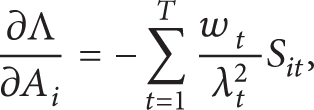
where S it is the design sensitivity of tth frequency λ t with respect to design variable A i , which can be derived from the free vibration equation of undamped system:

in which
According to (9), it is found that when G
i
> 0, the design sensitivity S
i
< 0, and the objective function F(
Because the volume of the structure can be expressed as

the partial differential of the constraint is
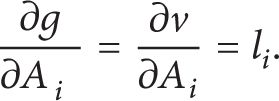
By replacing the corresponding parts of (8) with (9) and (15), we have the iterative updating formula shown in

The Lagrange multiplier χ can be obtained according to (16):

By introduction of a step factor α to ensure the convergence, the iterative formula can be obtained by the following:

where k is the iterative step number.
3.3. Design Process of Stiffener Layout of Inlet Structure
The design flowchart of the suggested method is shown in Figure 5. The adaptive growth technology can be described by the following steps.
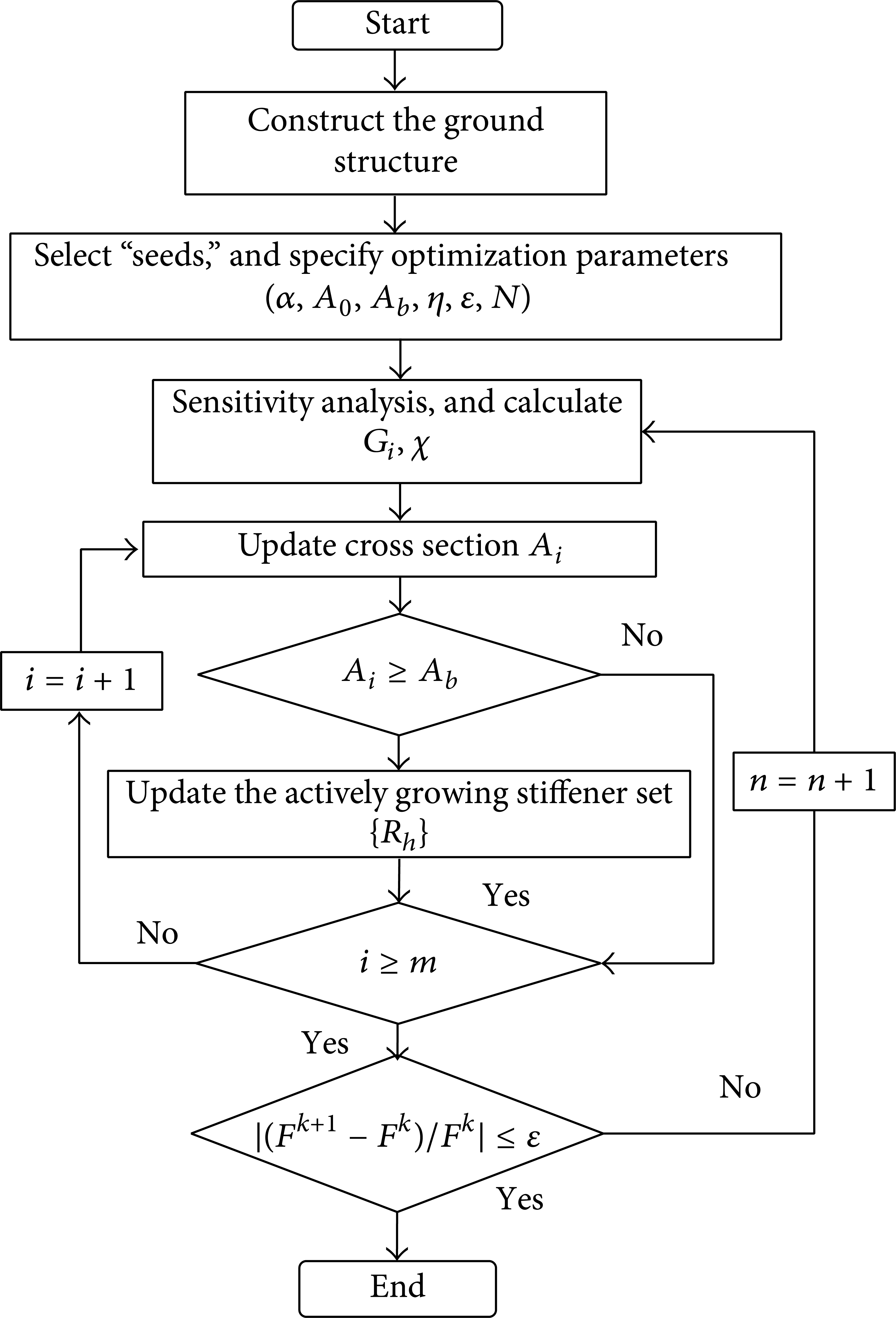
Design flowchart of adaptive growth technology.
Firstly, the ground structure is constructed. The ground plate is discretized into 4-node quadrilateral shell elements. Stiffeners formed by two adjacent nodes of a ground shell element are discretized into 2-node beam elements. And then, several seeds are specified on the ground structure according to the loading and constrain conditions of the plate/shell structure. Baby stiffeners around the seeds are included in the active stiffener group {R h }, and the number of the active stiffeners m is obtained. It is noted that stiffeners in the group {R h } can be grown in the current growth step. Design parameters α, η, ε, N, A0, and A b are also specified, in which α is the step factor, η is the volume fraction, ε is the iterative tolerance of the objective function, and N is the maximum iterative number. A0 and A b are the threshold degeneration and branching dimension of stiffener, respectively. Secondly, the finite element analysis for the whole structure is carried out and the sensitivities of the stiffeners in the active stiffener group {R h } are calculated. And G i and χ are calculated by (9) and (17). The cross section of the ith stiffener A i is updated by (18). The potential ability to branch will be activated for stiffeners whose cross-sectional areas are greater than the specified threshold dimension A b , which means that if the cross-sectional area of a stiffener is greater than A b , its two ends are specified as the new branching points, and all stiffeners that can be extended from the new branching points are added to the active stiffener group {R h } and can be grown in the next iterative growth step. The above steps are terminated until the convergence condition is satisfied. Finally, an optimum layout pattern of the stiffeners can be obtained.
3.4. Design Result
In order to obtain the optimal stiffener layout of the structure, suitable optimization parameters included in Figure 5 should be given in advance, as shown in Table 1. It is noted that the volume fraction η = 0.25, which is the same as that of the empirical inlet structure.
Optimization parameters.

The design model is shown in Figure 6, in which the geometric shape and size are the same as the empirical structure, but the stiffeners are omitted. The same loads as the empirical structure are applied. The weighting coefficient of compliance objective is set to be ρ = 0.5. The design result is shown in Figure 7(a), in which 48 seeds are selected as shown by black points. The optimal stiffener layout pattern is shown in Figure 7(b). It is found that the layout pattern is completely different from the empirical design, which is no longer vertical and horizontal distribution. The supporting points are reinforced by some cross stiffeners, and the strain energy is reduced by 18.83% compared with the empirical structure. Meanwhile, the first order frequency is 17.29 Hz, which is increased by 4.66% compared with empirical design.

Design model of inlet structure.

Design result of multiobjective optimization (ρ = 0.5).
Figure 8 shows the iterative history. It is found that both the objective function and the constraint reach stable states by increasing the iterative number, which means that the design result reaches the optimum when the volume of stiffeners achieves the specified upper limited value.

Iterative histories.
Figure 9 shows the design results with different weighting coefficient of compliance objective ρ, in which Figure 9(a) is the case of ρ = 1.0 and Figure 9(b) is the case of ρ = 0.0. It is noted that when ρ = 1.0 or ρ = 0.0, the design problem becomes the single objective problem, in which ρ = 1.0 is the minimum compliance design and ρ = 0.0 is the maximum mean frequency design. It is found that the stiffener layout of the minimum compliance design objective forms a rhombus, which is concentrated relatively in the central part of the structure, while the stiffener layout of the maximum mean frequency design is distributed in a relative dispersed state. The multiobjective design result is between the above two layouts. It is easily found that the stiffener layouts change from the minimum compliance state to the maximum mean frequency state. The results comparison is listed in Table 2. It can be found that, on the same volume decrease fraction (3.0%) compared with the empirical design, the single objective design problems result in relatively not so good designs, because there is one mechanical performance index decrease; for instance, in the case of the minimum compliance design, although the strain energy has a great reduction (−28.26%), the first natural frequency is also decreased by 4.48%, while, in the case of the maximum mean frequency design, although the first natural frequency is increased by 11.92%, the strain energy is also increased by 8.01%. Thus, the multiobjective design result is best, in which the strain energy of the inlet structure is decreased by 18.83% and the first natural frequency of the whole structure is increased by 4.66%.
Comparison of design results.


Design results of single design objective.
4. Conclusions
The improved adaptive growth method is applied to design the stiffener layout of the inlet structure of an electrostatic precipitator. The multiobjective mathematical model is considered, which consists of the minimum compliance and the maximum mean natural frequency of the structure. The result shows that the optimal layout of stiffeners on the inlet structure is completely different from the empirical design, and both the static and the dynamic performances of the structure are improved, while the weight of the structure is reduced. And the design result of the multiobjective is better than that of the single design objective. It can be found that the improved adaptive growth method can easily deal with the complex practical design problem and can produce distinct stiffener layout patterns of plate and shell structures. It is expected that the adaptive growth method can be applied to wider design fields.
Conflict of Interests
The authors declare that there is no conflict of interests regarding the publication of this paper.
Footnotes
Acknowledgments
This work is supported by the National Natural Science Foundation of China (Grant nos. 50875174 and 51175347) and Innovation Program of Shanghai Municipal Education Commission (Grant no. 13ZZ114).