




Abstract
Challenge of efficient protocol design for energy constrained wireless sensor networks is addressed through application specific cross-layer designs. This design approach along with strong design assumptions limits application of protocols in universal scenarios and affects their practicality. With proliferation of embedded mobile sensors in consumer devices, a changed application paradigm requires generic protocols capable of managing greater device heterogeneousness and mobility. In this paper, we propose a novel lifetime maximization protocol for mobile sensor networks with uncontrolled mobility considering residual energy, traffic load, and mobility of a node. The protocol being generic is equally applicable to heterogeneous, homogenous, static, and mobile sensor networks. It can handle event driven as well as continuous traffic flow applications. Simulation results show that proposed scheme outperforms minimum hop routing and greedy forwarding in terms of network lifetime, data packet latency, and load balance while maintaining comparable throughput.
1. Introduction
Wireless sensor networks (WSN) have wide range of applications in many areas of daily life [1]. Routing protocols for WSN are generally application specific and cross-layer design approach is adopted to achieve efficiency. Application specific cross-layer protocols have strong design assumptions and are not suitable for universal scenarios. This improved performance comes at the cost of design modularity, stability, and robustness. Cross-layer design involves complex interactions among multiple network layers ranging from physical to application layer. Suitable models to describe these interactions are still being investigated. Unless these models are available, cross-layer architecture would find little acceptance in universal context. On the contrary, in layered architecture, complex problems are easily solved by breaking into simple ones. Layered architecture leverages modular, loosely coupled adaptable designs and has secured deeper acceptance in industry.
WSN are traditionally considered as no or quasimobility networks. However, mobility can leverage greater benefits in terms of improved coverage with sparse sensor deployment, healing of topological defects, energy efficiency, and increased application domains. Few areas utilizing mobility are urban sensing, assisted living and residential monitoring, industrial automation, and mobile sensor based wide area monitoring. WSN mobility is characterized as controlled or uncontrolled. Controlled mobility is used for efficient data collection and healing of topological defects. Mobility is deemed to tradeoff delay to achieve energy and resource efficiency. The approach is less suitable for applications with hard realtime constraints. Uncontrolled mobility is relatively less researched but is important in context of proliferation of sensors in consumer devices, mobile phones, personal data assistants, and special purpose platforms. Use of mobile sensors with uncontrolled mobility in routing tasks is so far rather limited. These sensors can be utilized in applications like people centric urban sensing and assisted living. In urban sensing [2] environment, data can be very speedily passed back to static infrastructure using sensors embedded into user devices carried by robots or vehicles.
A sensor network with uncontrolled mobility represents a very large heterogeneous network comprising mobile as well as static networks. Static networks are connected through mobile devices carried by robots or vehicles. This heterogeneous network is connected to back haul infrastructure to form a very large cooperative network in contrast to small scale application specific sensor implementations. Because of overwhelming mobility and heterogeneity of involved devices, managing interactions among network elements is a very complex task.
In mobile wireless sensor networks, due to heavier maintenance cost, static or preconfigured routing is less suitable. Also, proactive approach is not feasible for event driven sensor networks where information generated by sensor nodes is not known a priori and depends on the arbitrary occurrence of events. In [3], authors argue that data packet sizes in WSN are smaller as opposed to other computer networks and signalling overhead in this case becomes significant compared to data traffic. On-demand protocols have less maintenance cost but generate a lot of signalling traffic for discovery of new paths. This assertion can be true in case of scaler data but is not valid for high end futuristic as well as multimedia sensors.
In this work, we propose an on-demand routing scheme for mobile sensor networks with uncontrolled mobility. The protocol considers, in its path selection, the residual energy, traffic load, and mobility of a node. Main design objective of the proposed routing scheme is to maximize network lifetime. The protocol can be applied in static as well as mobile scenarios. It keeps practical limitations in view and does not compromise efficiency. The protocol suits equally event driven as well as continuous monitoring applications. Simulation analysis shows that the proposed scheme can effectively handle sensor network mobility, increase network lifetime, and decrease data packet latency.
The rest of the paper is organized as follows: Section 2 summarizes related work; in Section 3, we present network model; Section 4 describes design of proposed routing scheme and its operation; performance evaluation and analysis of results are given in Section 5. Section 6 concludes the paper and highlights future work directions.
2. Related Work
In this section, we present related work that surveys issues of routing in mobile sensor networks (MWSN) and load balanced routing and energy aware routing.
Research in MWSN gained momentum in recent years especially in mobility assisted data collection and urban sensing. A comprehensive survey of routing protocols for MWSN is available in [4]. Moreover, surveys of mobility based communication techniques are available in [5–7] and mobility models can be found in [8]. In [6], requirements, merits, and demerits of three mobility based schemes are compared. A comprehensive survey of data collection techniques using mobile elements is presented in [5]. The authors categorize mobile elements as relocatable nodes used to heal topological defects, mobile data collectors for data collection, and mobile peers for sensing and routing tasks.
The authors in [9] study use of mobile relays as resource provisioning method to extend lifetime of sensor network in a large dense network. They conclude that use of one energy rich mobile relay can extend network lifetime up to four times of that of static network. The work in [10–13] investigates lifetime maximization problem using mobile sink; especially, issues related to finding optimum sink route or trajectory are addressed. These proposals utilize controlled mobility for efficient data collection and do not take into account nodes embedded into mobile platforms having uncontrolled mobility.
Developing a large scale general purpose sensor network in urban setting for the general public is studied in [2]. Authors propose network architecture based on opportunistic sensor network paradigm capable of supporting urban sensing with widespread people centric applications and heterogeneity in devices. Sensor speed, direction of move, and location are used to select a sensor for delegation or tasking.
The authors in [14] propose a mobility aware routing protocol where mobility is used to form sink cluster and during route discovery process. A cluster based routing protocol for a low mobility homogenous sensor network is presented in [15]. The nodes are considered to follow random mobility model. Zone head is elected based on mobility factor which is taken as ratio of zone changes to position changes within a zone. The scheme considers node speed and location information for determining mobility factor. In our routing scheme, mobility factor is one of the factors considered to select the next hop node. However, our technique of mobility factor determination considers node speed and does not require node location information exchange. The scheme [15] tries to balance energy consumption by considering the number of times a node has acted as zone head whereas in our scheme balance is achieved by considering the traffic load a node receives.
In [16], authors have studied the problem of reducing energy consumption by flow augmentation to balance energy utilization across network. This scheme uses residual energy of nodes as basic admission control criteria. Selection of nodes on the said criteria can balance energy consumption but results in longer source to destination paths and increases latency of information delivery. One of the earliest proposals on energy aware routing [17] considers clustered network topology and utilizes topological information for this purpose. Performance of such protocols is severely affected by mobility as topology constantly changes resulting in significant topology maintenance overhead.
Load balance and local congestion control is investigated in [17]. It considers two identical metrics, that is, maximum connections per relay and overall relay load. These metrics help to increase lifetime of relay node and avert packet loss by avoiding overcommitted nodes from becoming relay. But limiting maximum connections per relay node can result in coverage issues across the network. E-WLBR [18] is a proactive routing protocol, in which load balance is achieved by distributing traffic among the next hop neighbors according to their load handling capacity determined in terms of residual energy levels. Each node notifies its load handling capacity during initialization phase. Protocol in its present form is less suitable for a network with mobile nodes and bears disadvantage of proactive protocols for scalable networks. Authors in [3] show that sending traffic on multiple paths can reduce significant energy consumption. Candidate paths for forwarding traffic are determined based on multiple weighted factors. However, existence of completely disjoint multiple paths can only enhance performance but it is totally dependent on network topology. Also, in mobile networks, using multiple paths will increase route maintenance overhead as mobility can affect all paths. In another scheme [19], one or two next hop neighbors are selected according to hybrid routing metric and traffic is then distributed among these selected neighbors in round robin or weighted round robin manner. Round robin achieves per packet load balancing whereas in weighted round robin traffic is distributed according to assigned weights. In mobile networks, candidate neighboring nodes can change frequently and maintaining even two hop nodes information can result in enhanced energy overhead. LEAR [20] considers a number of active routes through a relay node for load balancing and routes multimedia traffic on fully or partially disjoint paths. However, LEAR does not consider realistic traffic load on a relay node but assumes that each flow is identical, having same data rate. Reference [21] surveys load balanced routing strategies and highlights that this issue still requires significant research.
3. Network Model
In this section, network model is presented and highlights the assumptions and terminologies used in the proposed routing scheme. Moreover, techniques of utilizing and estimating node mobility, energy, and load are described.
The target network is of heterogeneous nature consisting of mix of high and low end sensors. The high end sensors possess relatively better processing and energy resources whereas low end sensors are constrained in these resources. The network nodes are assumed to be deployed according to flat or random topology as depicted in Figure 3. In target network, the majority of network nodes are static while the remaining are mobile. The nodes have inherent mobility detection mechanism in place. Mobility is not used for resource provisioning or data collection; rather, the sensors are onboard a mobile platform, for example, sensing robot, vehicle, consumer device, or an aerial platform.
The terminologies used in this work are defined as follows.
Static Sensor Network. It is a wireless sensor network where all nodes are static. Mobile Node. It is a sensor node embedded in a sensing robot, a vehicle, a consumer device, or an aerial platform. The node not only carries out sensing tasks but also relays messages from other nodes. Mobility Detection. The node is capable of detecting mobility and for this purpose it either has GPS or relative position detection mechanism in place. Low Mobility Network. It is a network which consists of majority of static and some mobile sensor nodes. The mobile nodes may follow random or group mobility models. Medium Mobility Network. It is a network which consists of equal number of mobile and static sensor nodes. Mobile nodes follow random or group mobility models.
3.1. Sensor Network Mobility
Besides benefits, mobility also poses challenges in protocol design as it affects route stability and route maintenance cost. For efficient protocol design, mobility must be taken into account to avoid establishing routes through mobile nodes, thus conserving energy in frequent maintenance. Node mobility is characterized in terms of mobility factor and is estimated based on location information using approaches discussed below. These schemes have varying degree of computation complexity, accuracy, and need for information exchange. For WSN, a lesser complex scheme requiring no additional information exchange is a better choice. However, accuracy may be improved by taking moving average of mobility measure over certain period of time. Mobility prediction approaches are as follows.
3.1.1. Transitions Count
The approach assumes that sensor network is divided into zones which may be defined according to a specific criterion. Node mobility is measured in terms of number of transitions of a mobile node across different zones. The scheme has limitations in case of group motion where although the nodes move across different zones they may still maintain association or link with their neighbors. This approach also requires location information exchange.
3.1.2. Remoteness
To capture the notion of relative mobility, the concept of remoteness is introduced in [22]. Here the mobility factor is determined in terms of rate of link change. If nodes in a zone are in group motion, average link change is minimal. The node movement in such scenarios does not affect association of node with a zone or a link. So the remoteness of a node from its neighbors can be treated as a measure of mobility and is given as

3.1.3. Speed
Node speed may also be used as measure of node mobility. However, such a representation has limitations especially in case of group motion. If the nodes are in group motion at constant speed, they do not break link despite motion. In other cases, a node itself may be static with the least mobility factor but its neighbors may move out breaking the link. However, this approach does not require any location information exchange and can be very easily calculated:

3.2. Energy Aware and Lifetime Maximization Based Routing
WSN have extreme constraints of energy; therefore, energy efficiency is the main design objective during protocol design. Several approaches for energy consumption are in practice [16, 23, 24]. One of the well-known metrics for decreasing energy consumption and latency is the selection of minimum hop paths. However, this results in premature death of those nodes that are frequently used in minimum hop routing paths. On the contrary, energy balanced algorithms utilize suboptimal paths to maximize network lifetime [16, 23].
3.3. Load Balanced Routing
Network load balance is another important factor for lifetime maximization [3, 17, 19, 20]. Load aware routing helps to conserve energy by avoiding collisions and overcome delays caused by local congestion. Load balance is achieved by spreading traffic either on multiple paths or by avoiding overcommitted nodes as relays. Multipath routing has related overheads and energy costs, whereas later approach is simple and can be implemented without global knowledge. This metric helps in achieving longer network lifetime by avoiding overloaded nodes to participate in routing. The traffic load of a node is given as follows:

4. Proposed Routing Scheme
The scheme uses hybrid cost function for routing decisions. The hybrid metric is formed based on the factors discussed in Section 3. Summarized description of these factors is as follows.
(1) Mobility Factor. Competing approaches to estimate mobility have been discussed in Section 3.1. Considering low mobility, energy expenditure for location information exchange and lesser computation cost mobility factor based on node speed are used in this scheme. Node mobility S is given as below:

(2) Residual Energy. Energy aware routing and network lifetime have been discussed in Section 3.2. This scheme considers residual energy level of a node for selecting it as the next hop. Initially, once energy level is high, this factor has little role to play in routing decisions. However, as energy depletes, it becomes a dominating consideration. This metric allows minimum hop routing initially and thus improved network delays. In our case, a node with greater residual energy is a preferred choice as the next hop node.
(3) Node Load Figure. By considering state of load being handled by a node, energy wastage due to collisions and delay in servicing packets can be reduced. Load balancing helps in achieving better network lifetime and is discussed in Section 3.3. The load at a node is given as follows:

(4) Path Length Constraint. Proposed scheme allows use of suboptimal paths in favour of balanced energy consumption and longer network lifetime. However, a likely pitfall of forming extremely nonoptimal paths is prevented by using path length constraint. A minimum cost routing path is selected only if it is within X hops of the shortest path; otherwise, the shortest path routing is performed. X is the maximum allowed hop deviation from the minimum or shortest path between source and destination. It is dependent on network size and node density. In [20], authors have shown based on experimental results that a deviation of up to four hops from the shortest path can give better throughput in an average size network if the shortest path is not suitable due to high traffic load.
4.1. Cost Function
Hybrid routing metric based on factors discussed here and also in Section 2 is as follows:

Each node in the network calculates its routing metric
4.2. Route Discovery
Once a node has to send data or it receives RREQ, for another node for which it does not have an active route, it broadcasts RREQ message to its neighbors. Besides other information, it inserts value of
Setup reverse path with source Broadcast packet to neighbors Setup reverse path with source of duplicate RREQ Drop packet Drop packet
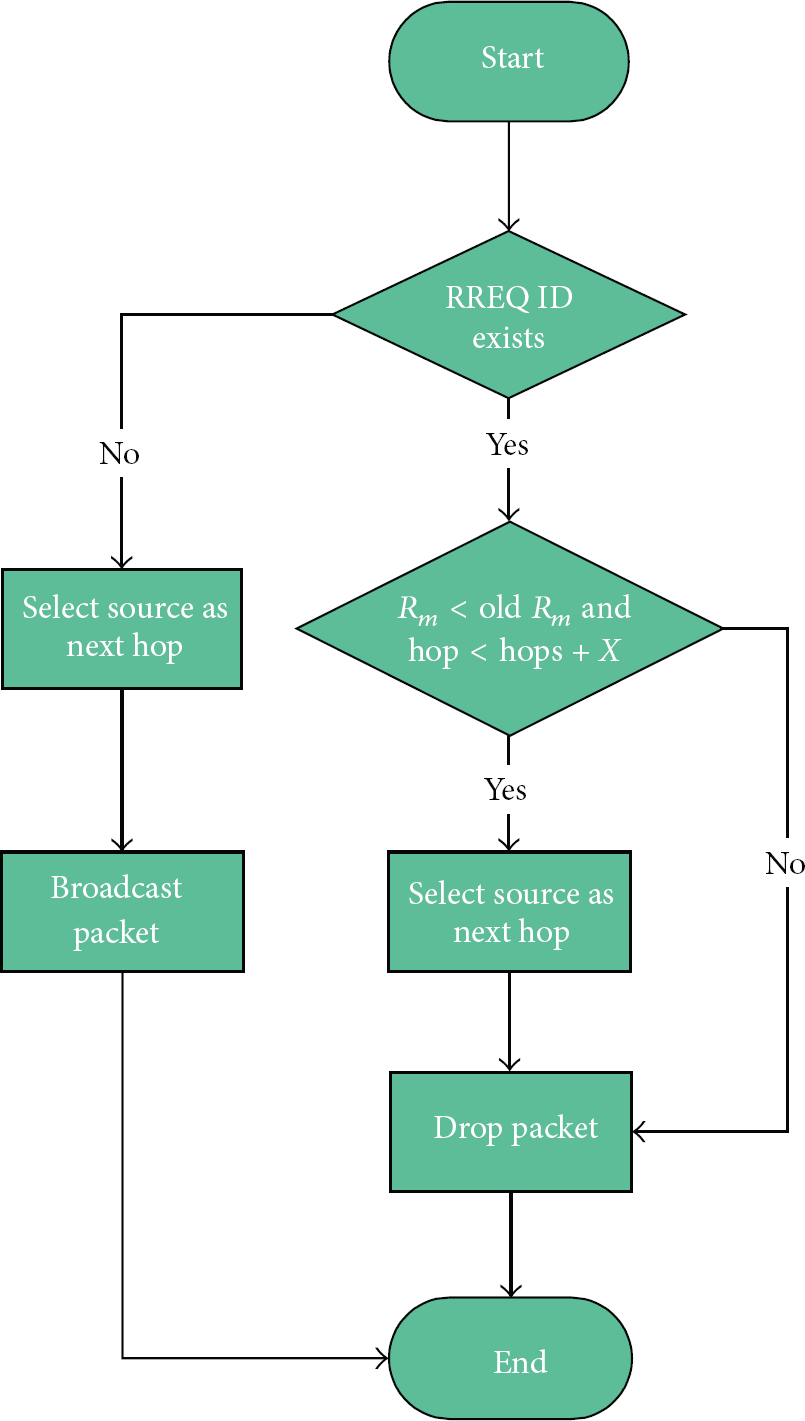
Route discovery process.
4.3. Operation
Load balanced routing (LBR) protocol is an on-demand routing protocol which is designed to maximize network lifetime for sensor networks with mobile elements. Routing decisions are made based on hybrid routing factor
When a node has data to transmit, it broadcasts RREQ message to its neighbors. At a neighbor node, three cases are possible. In the first case, a neighbor node may be the destination itself, so it sends route reply (RREP) message and records value of

Dotted edges show forward dissemination of RREQ from source

Sensing field: showing 100 randomly deployed sensors in
5. Performance Evaluation
In this section, we report performance of LBR compared to shortest path routing and greedy forwarding protocols. For this purpose, AODV and GPSR protocols are used. We study the effect of different weights, network size, traffic load, and mobility on protocol performance. The traffic load is increased gradually by increasing application reporting rate, that is, number of packets per second. However, to capture effect of mobility, the evaluation is done in a static network, a low mobility network with 25% mobile nodes, and a high mobility network with 50% mobile nodes. The evaluation metrics, experimental setup, simulation parameters, results, and their analysis are presented in this section.
5.1. Performance Metrics
The metrics of throughput, data latency, network lifetime, and load balance are used to measure performance. These evaluation metrics are defined as follows.
5.1.1. Throughput
It is the measure of average number of bits per second of application data received at sink during the entire simulation period.
5.1.2. Latency
The end to end delay of data packets is the average time taken by data packets during flow from source to sink. It also includes the time taken during discovery and establishment of route to sink.
5.1.3. Network Lifetime
Network lifetime is determined in a number of ways including time till the death of the first node, certain percentage of nodes, or time till all of the nodes die. During this evaluation, we consider sensor deaths over time and plot the remaining alive nodes over simulation duration. Moreover, nodes with energy less than 0.001 joules are considered dead because of their inability to transmit sensed data due to low energy reserve.
5.1.4. Load Balance
The metric represents the distribution of traffic load per node or across segments of sensing field. In our study, we consider number of packets per node and plot per node load normalized by total number of packets successfully received at sink.
5.2. Experimental Setup
Network simulator (NS-2) is used to evaluate protocol performance. The simulations are conducted over five sensing fields of 200 by 200 meters. Each contains one sink and 99 randomly deployed nodes. The sink is considered to be static while other nodes are a mix of static and mobile nodes. Sensing field with randomly deployed nodes is shown in Figure 3. During this evaluation, one hundred random events scattered over sensing field and staggered randomly over simulation time are considered. After occurrence, the event is assumed to be reported for 60 seconds at specified rate. Summary of simulation parameters is given in Table 1 and key parameters are described as follows.
Simulation parameters.

bSamples for moving average.
cPath length constraint.
5.2.1. Energy
The experiments are conducted assuming homogenous networks and all sensors are set to have initial energy of 2 joules except sink which is assumed to have no energy limitation. The performance of proposed scheme is assumed to be even better in case of heterogeneous network due to energy aware routing.
5.2.2. Mobility
Protocol performance is evaluated in static and a network with 25 and 50 percent mobile nodes. The sink is assumed to be static although protocol imposes no such limitation and relative performance measures obtained for static sink are equally applicable to a mobile sink also. The mobile nodes are assumed to follow random way point mobility model at average speed of 1.11 m/s.
5.2.3. Application Reporting Rate
In case of scaler traffic in WSN, the data rate is considered to range up to few kilo bits; therefor, scheme is evaluated in a scenario where event reporting rate is set to 4, 8, 12, 16, 20, and 24 packets per second.
5.3. Performance with Different Weights
In this work, the weights as in (6) are experimentally selected with an objective to increase overall network throughput. The results are taken over five high mobility network scenarios by varying application reporting rates. A number of events occurring simultaneously are 6.7 (100 events of 60-second duration, uniformly distributed over simulation time of 900 seconds, and thus
Weights selection.

bAveraged over 5 scenarios and 6 application reporting rates in high mobility network.
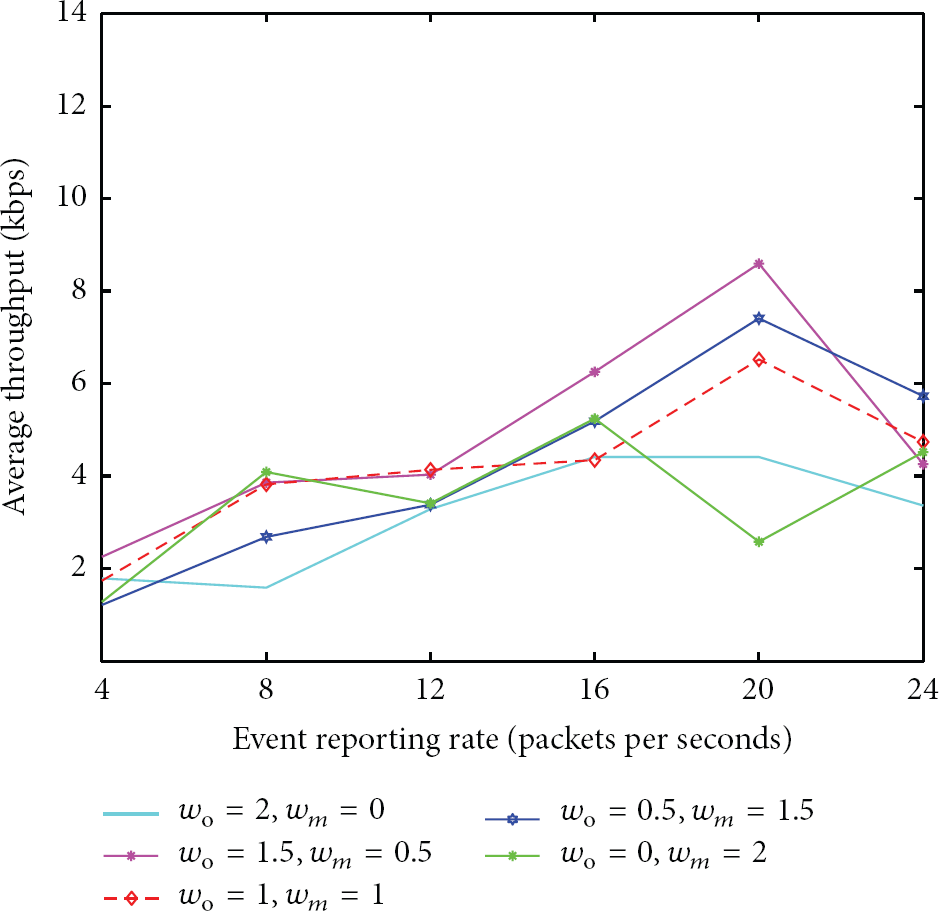
Performance with different weights.
5.4. Routing Overhead and Packet Delivery Ratio
Route request message of LBR is similar to AODV except additional field for piggy packing value of hybrid routing metric
For packet delivery success rate, five random deployment scenarios and hundred events reported at eight packets per second are considered. Performance under no, medium, and high mobility settings is shown in Figure 5. LBR achieves better delivery ratio for static, medium, and high mobility networks compared to AODV because of its congestion and mobility resilience.

Packet delivery success rate.
5.5. Performance versus Network Size
For simulation, networks consisting of 25, 50, 75, and 100 nodes are taken. Each experiment is repeated five times with different random deployment scenarios. In each scenario, 50% nodes are made mobile and 10 traffic flows spanning over 500 seconds are used. Average results in each case are shown in Table 3. With increase in network nodes, the average throughput increases; however, beyond a threshold, throughput starts to decrease as contention for medium access increases resulting in packet drops.
Performance versus network size.

5.6. Evaluation of Results
5.6.1. Throughput
The data throughput is shown in Figure 6. LBR has better throughput than AODV and GPSR for higher mobility and traffic loads, whereas, for lower traffic loads and mobility, it has comparable results. While the increase in traffic load congestion occurs, LBR being congestion resilient avoids overcommitted nodes, thus achieving greater throughput. Similarly, with increase in mobility, link lifetime decreases and maintenance cost is also increased but LBR can still maintain better data throughput because of mobility awareness.
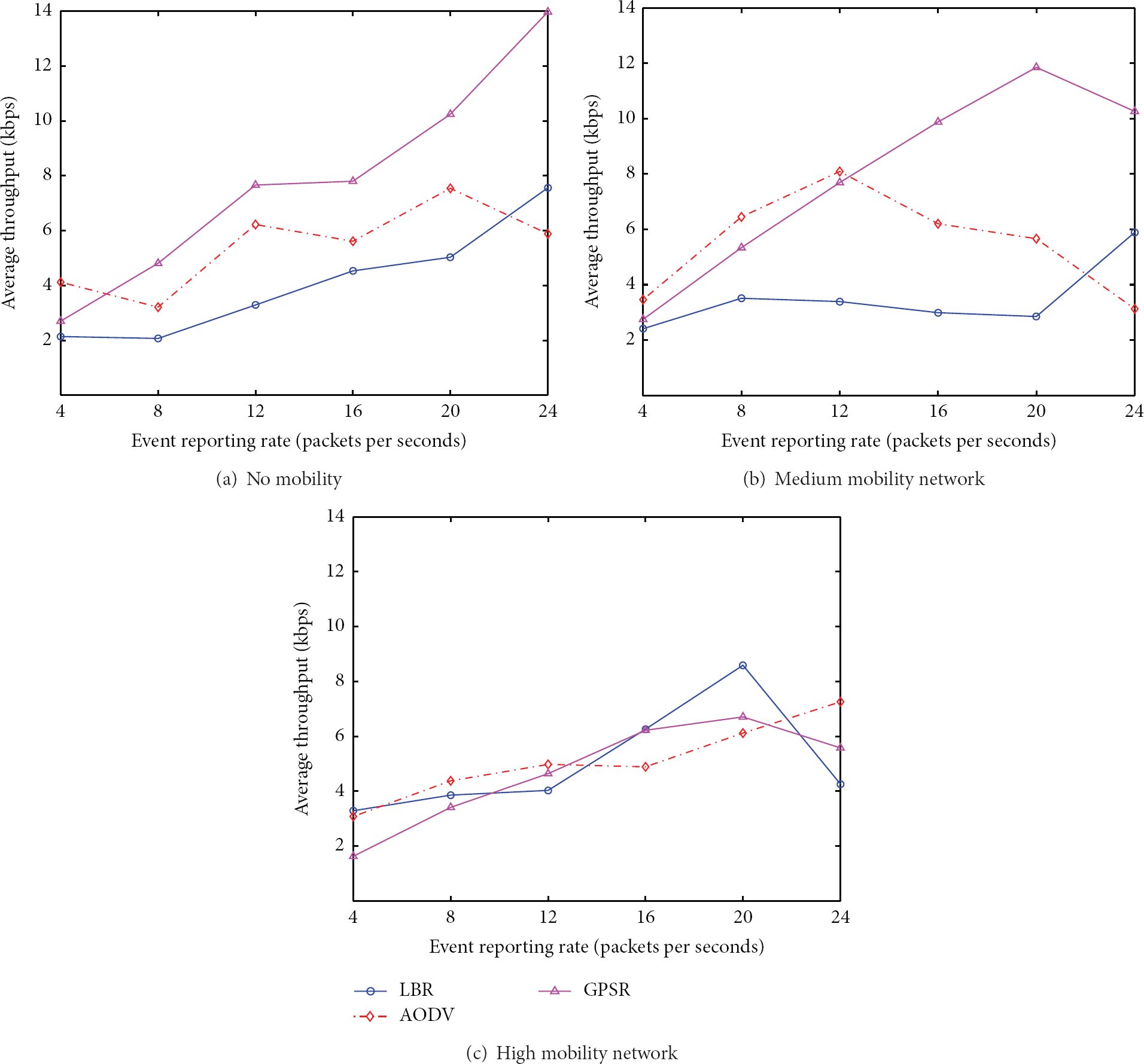
Average data throughput.
5.6.2. Latency
Average end to end data latency is shown in Figure 7. LBR has better average data latency because of load balanced routing which helps to avoid overloaded nodes, improves packet service time, and thus reduces resultant delays. For lower traffic and mobility, LBR has comparable results, but, with increase in traffic load because of congestion resilience, it avoids overcommitted nodes and thus better latency figures are obtained.

Average end to end delay of data packets: graph shows logarithm of delay.
5.6.3. Network Lifetime
The LBR achieves much longer network lifetime than the minimum hop routing and greedy forwarding; the results are shown in Figure 8. For both AODV and GPSR, network partitioning occurs much earlier as indicated by constant number of alive nodes. LBR performs better in terms of both first node death and number of dead nodes. Because of comparable throughput and much longer network lifetime, new scheme can transfer much more data contents compared to both other protocols before network partitioning.

Average number of alive nodes over time.
5.6.4. Load Balance
The network load distribution of three protocols is shown in Figure 9. LBR achieves more even distribution of load despite greater content transfer. Owing to load aware routing, proposed scheme prevents taking of same route and distributes load across nodes. This even distribution contributes towards better lifetime and lower latency figures achieved by proposed scheme. Although per node load for GPSR is less compared to the other two protocols, it can be attributed to premature network partitioning and lesser transferred data. Therefore, results do not reflect a better load balance and the same is evident from very less network lifetime also.

Average normalized routing load per node.
6. Conclusion and Future Work
Sensor network routing protocols are traditionally designed for specific environment and applications to achieve efficiency and assumptions generally made by designers are rather strong limiting protocol application in generic scenarios. Secondly, mobility, in general, is used for data collection and resource provisioning only. With proliferation of embedded sensors in consumer devices, greater variety of applications and accompanied challenges would need to be addressed. In this changed scenario, application paradigm is likely to transform from application specific smaller scale to larger or global one. To address these challenges, generic protocols capable of handling wide ranging applications, device heterogeneity, and uncontrolled mobility would be needed. Proposed protocol utilizes mobility in novel manner and is deemed to address these new challenges. The scheme is energy efficient, load balanced, and congestion resilient and can handle variety in sensor mobility. The protocol is equally suitable for static, mobile sensor networks and can handle event driven as well as continuous traffic flows. Simulation results show that LBR outperforms minimum hop routing and greedy forwarding in terms of network lifetime, load balance, and data latency. The scheme has comparable results as far as throughput is concerned.
In this work, weight selection is performed using simulation method which may not be optimal to handle variety in mobility and load across different applications. Therefore, weight selection based on fuzzy logic or analytical hierarchical process (AHP) may be studied as future work. Moreover, in case of mobile sensor networks, link quality may vary more rapidly compared to static networks, so addition of reliability to routing metric will improve protocol performance and may be another dimension for future research.
Footnotes
Conflict of Interests
The authors declare that there is no conflict of interests regarding the publication of this paper.