




Abstract
Water-alternating-gas (WAG) method provides superior mobility control of CO2 and improves sweep efficiency. However, WAG process has some problems in highly viscous oil reservoir such as gravity overriding and poor mobility ratio. To examine the applicability of carbon dioxide to recover viscous oil from highly heterogeneous reservoirs, this study suggests polymer-alternating-gas (PAG) process. The process involves a combination of polymer flooding and CO2 injection. In this numerical model, high viscosity of oil and high heterogeneity of reservoir are the main challenges. To confirm the effectiveness of PAG process in the model, four processes (waterflooding, continuous CO2 injection, WAG process, and PAG process) are implemented and recovery factor, WOR, and GOR are compared. Simulation results show that PAG method would increase oil recovery over 45% compared with WAG process. The WAG ratio of 2 is found to be the optimum value for maximum oil recovery. The additional oil recovery of 3% through the 2 WAG ratio is achieved over the base case of 1: 1 PAG ratio and 180 days cycle period.
1. Introduction
Recently, interest in CO2 flooding has grown as a method of enhanced heavy oil recovery. Injected CO2 can extract the heavy oil components by oil swelling and viscosity reduction. However, the mobility ratio of CO2 is unfavorable to recover heavy oils. It causes viscosity fingering and gravity override through heterogeneous reservoirs. These phenomena make an early breakthrough of injected CO2 and reduce oil recovery. The problems led by poor viscosity ratio are more severe in heavy oils than light oils. Although the CO2 flooding has been applied and its success has been reported in many heavy oil cases [1–7], there still remain the aforementioned problems that need to be solved in order to implement the CO2 injection in the heavy oil reservoirs.
Mobility control in CO2 flooding is very important to solve the low recovery efficiency problem. CO2 injection method can achieve higher microscopic displacement efficiency than those of other processes. However, viscosity of CO2 is usually about 1/10 that of oil in the reservoir conditions [8]. As a result, the sweep efficiency of CO2 flooding is lower than efficiency of waterflooding. The water-alternating-gas (WAG) process is suggested by Caudle and Dyes [9] to improve sweep efficiency of CO2 injection. Alternating or coinjection of CO2 and water enhances the recovery of oil. The injected water increases sweep efficiency and stabilizes the gas front. When slugs of CO2 and water are injected into reservoir consecutively, some part of CO2 is dissolved in the oil and reduces the oil viscosity. Thus, the mobility ratio between displacing and displaced fluid is decreased. It becomes favorable condition to control the CO2 breakthrough and improve recovery efficiency.
Another suggested technique which advances sweep efficiency for the heterogeneous reservoir including high permeable thief zones is integrated polymer and CO2 flooding. Generally, polymer flooding is known as effective process when mobility ratio of waterflooding is high, the heterogeneity of reservoir is high, or both of them exist [10]. Polymer flooding is processed by adding polymer into the water to decrease mobility of displacing fluid. Dissolved polymer increases the viscosity of displacing fluid and decreases the effective permeability of aqueous phase through adsorption. High adsorption of polymer through mainly high permeable streaks reduces permeability so that it induces diverting displacing fluid into low permeable zones and increases the oil recovery. However, polymer flooding is not a great way to decrease residual oil saturation. The polymer degradation and shear effect have been problems in application of polymer flood. A substantial amount of polymer is required to reduce the unsuitably high viscosity ratio to a value of approximately one in the heavy oil reservoirs. The significant required number of polymers in such reservoirs leads to high cost [11].
To overcome these problems, such as viscous fingering, poor sweep efficiency, and polymer concentration, integrated EOR method as coupling polymer flooding and CO2 flooding is of importance. It has both advantages of CO2 flooding and polymer flooding, solubility of CO2 injection and mobility control of polymer injection. According to Zhang et al. [11], polymer/gas-alternating-water (PGAW) is combination of these two methods. Majidaie et al. [12] simulated chemically enhanced water-alternating-gas (CWAG) injection in homogeneous reservoir. Li et al. [13] carried out a case study of polymer-alternating-gas (PAG) simulation. However, more research for coupling CO2 flooding and polymer injection is still needed. The previous simulation studies [12, 13] have been carried out in light oil reservoir. Although Zhang et al. [11] assessed its performance considering heavy oil, it is limited with experimental scale. Applications of PAG process in heavy and heterogeneous reservoirs have not been conducted sufficiently. For this reason, specific purpose of this study focused on the simulation of PAG process in field scale heterogeneous reservoir containing heavy oil. To evaluate the effectiveness of PAG process in the model, four processes (waterflooding, continuous CO2 injection, WAG process, and PAG process) are implemented and analyzed with oil recovery factor, WOR, and GOR. In addition, PAG ratio and PAG cycle have been parameterized to maximize the performance of PAG.
2. Numerical Simulation
2.1. Fluid Modeling
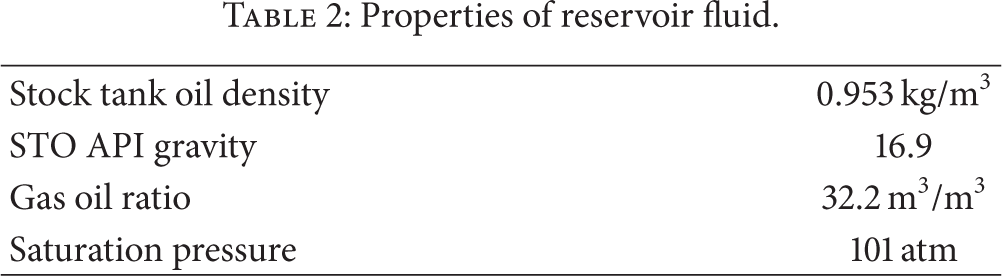
The oil properties of Schrader Bluff and West Sak are referenced for viscous oil modeling. Composition of the oil is reported in Table 1. The portions of intermediate components are small and heavy components are main part. Properties and viscosity data which are used for regression analysis are based on the literature study of Ning et al. (Tables 2 and 3) [14]. Peng and Robinson [15] method is applied to generate PVT data of referenced components.
Composition of viscous oil.

Properties of reservoir fluid.
Viscosity of the reservoir fluid at 24°C.

Due to solubility of CO2 into heavy oil, K-values are calculated to represent an equilibrium state between components. The definition of K-value is the ratio of equilibrium gas component y i to the equilibrium liquid composition x i as follows:

K i is a function of pressure, temperature, and oil composition. K-values are calculated by satisfying the fugacity of equilibrium state based on EOS model. For the oil components given in Table 1, K-values are estimated on various pressures as depicted in Figure 1.
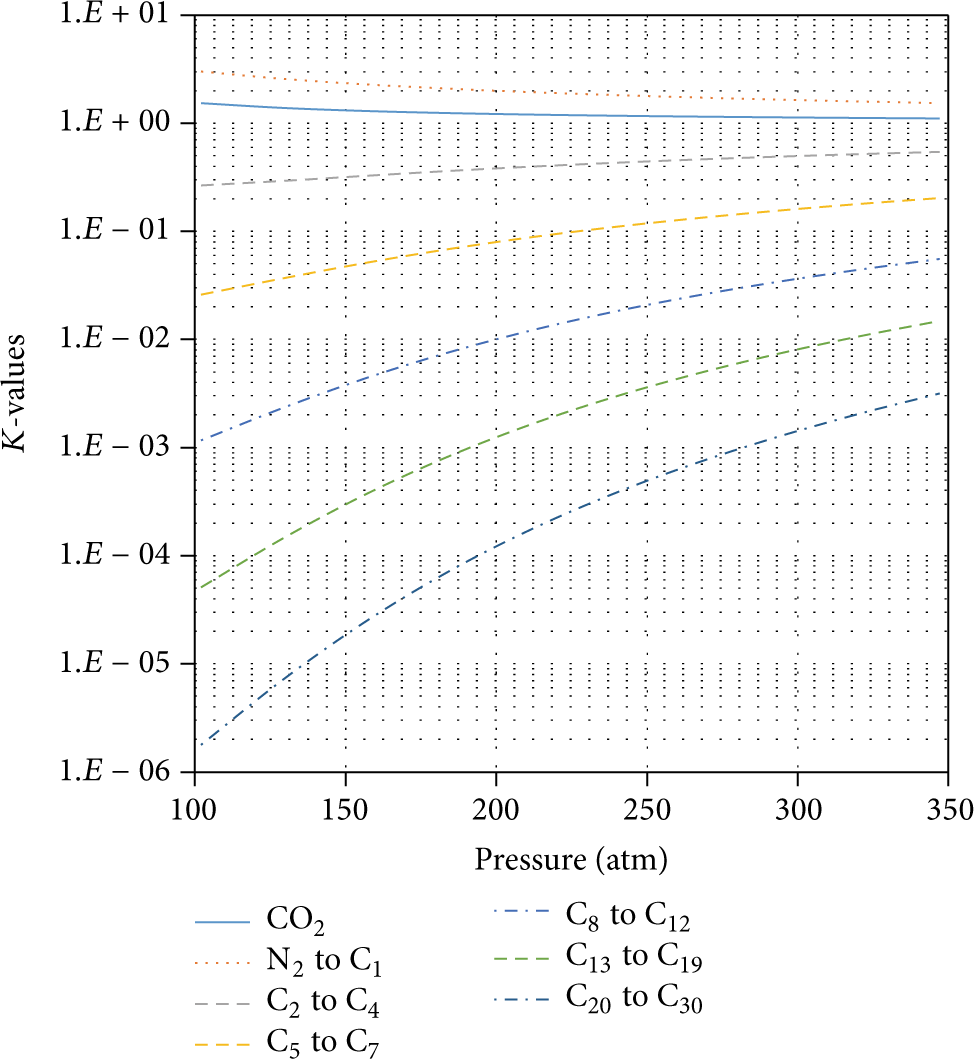
Estimations of K-values for reservoir oil components at 24°C.
2.2. Hypothetical Reservoir Modeling
The hypothetical reservoir model is assumed as layered model which is discretized into 50 × 1 × 10 grid blocks. Each grid block has dimension of 1.2 m × 3 m × 1.5 m (Figure 2). The depth of reservoir is 244 m and reference pressure and temperature at this point are 121 atm and 24°C. The porosity is 30%. Average permeability is 5.3 × 10⁻⁸ m2 which has Dykstra-Parsons coefficient (VDP) representing variation of permeability as 0.75 which is determined by permeability variation [16] as follows:

where k50 is permeability value at 50% probability and k84.1 is permeability value at 84.1% of the cumulative sample. The range of coefficient varies from 0 to 1. If the heterogeneity of reservoir increases, the value of coefficient approaches to 1. Vertical/horizontal permeability ratio is assumed as 0.1. The initial water saturation is 0.2 and oil saturation is 0.8. Viscosity of water is 0.00045 kg/m·sec and oil and CO2 viscosities are estimated to be about 0.094 kg/m·sec and 0.0001 kg/m·sec, respectively. The viscosity of polymeric solution is 0.022 kg/m·sec at the concentration of 1,000 ppm. Tables 4 and 5 present the input reservoir properties and permeability data used for this simulation. Water is injected during the first year and other processes (waterflooding, continuous CO2 injection, WAG process, and PAG process) are implemented for next 10 years.
Input data for reservoir simulation.

Permeability data for layered reservoir.


Hypothetical model consisting of different permeability layers.
2.3. Mobility Control
The objective of WAG process is originally to aim for the ideal oil recovery system: improvements of macroscopic and microscopic sweep efficiency at once. The injected water (or polymeric solution) is able to control the injected gas mobility as follows:

where f is the fractional flow, k is the permeability, and μ is the viscosity [17].
The oil recovery factor (R f ) is determined by microscopic sweep efficiency and the macroscopic sweep efficiency. The macroscopic sweep efficiency can be described by the horizontal and vertical sweep efficiencies. The recovery factor is formulated by
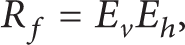
where E v is the vertical sweep efficiency and E h is the horizontal sweep efficiency [10].
The mobility ratio (5) [18] affects horizontal sweep efficiency and the vertical sweep efficiency is related to the ratio of viscous to gravity forces (6) [19]. Consider
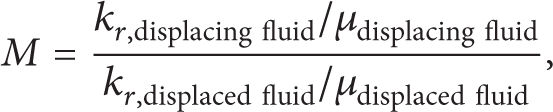
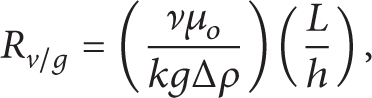
where M is the mobility ratio, Rv/g is the viscous/gravity forces ratio, v is Darcy velocity, μ o is the oil viscosity, k is the permeability, g is the gravitational acceleration, Δρ is difference in oil and solvent densities, L is distance between wells, and h is height of reservoir.
2.4. Polymer Behavior
The polymer adsorption at reservoir rock could be described by Langmuir-type isotherm [20] such as

where a1, a2, and a3 are coefficients of isothermal Langmuir equation, S b is the salinity of the brine, and C p is the mole fraction of polymer. Adsorption is assumed as irreversible process. By means of adsorption, not only more polymer concentration is required to reach target polymer concentration, but also induced reduction of permeability decreases flow capacity [21].
3. Results and Discussion
3.1. Comparison of Processes
This study aims to confirm the effectiveness of PAG process in the heavy oil reservoirs. To examine the performance of various injection processes such as waterflooding, continuous CO2 injection, WAG process, and PAG process, oil recovery factors are compared as depicted in Figure 3. Oil recovery from waterflooding is slightly higher than recovery of CO2 flooding. CO2 flooding has better recovery efficiency than that of waterflooding until the recovery factor reaches 19%. The efficiencies of CO2 flooding and waterflooding are reversed after that point. The reservoir considered in this simulation includes high permeable layer at the top. Gravity overriding effect and early breakthrough mainly occur through the high permeable streak. Figure 4 indicates the gravity overriding effect and CO2 breakthrough after one year of CO2 injection. The breakthrough can develop main CO2 flow path and most of injected CO2 passes through the path. Despite high potential for displacement efficiency, this effect reduces the sweep efficiency in application of CO2 flooding. As this phenomenon makes no more increases in oil recovery after five years of CO2 injection, oil recoveries between waterflooding and CO2 flooding are reversed.

Oil recovery factors for different processes.

CO2 mole fraction after one year of CO2 injection in continuous CO2 flooding.
WAG process is implemented and investigated. WAG ratio is set as 1: 1 and one cycle period is 180 days, respectively. According to Figure 3, WAG process obtains 26% oil recovery while recovery factors of waterflooding and CO2 flooding are less than 20%. This improved oil recovery as much as 6% by application of WAG is reasoned from the increased sweep efficiency and displacement efficiency by applying water and CO2 flooding. A great amount of oil is easily extracted to the producer.
In PAG process, polymeric solution is injected into reservoir instead of water in WAG process. The solution contains 1,000 ppm polymer and it could prove the effect of polymeric solution during PAG process. PAG process achieves the highest oil recovery in Figure 3. PAG process takes 37% recovery factor. The enhancement of oil recovery by PAG method is 89% over water or CO2 flooding and 45% over WAG process. The additional recovery resulted from advance of mobility ratio. The comparison of viscosity between WAG and PAG is reported in Figure 5 which describes viscosity of aqueous phase near the injection well. The viscosity obtained from PAG process continuously increases during the injection period of polymeric solution. The betterment of mobility ratio is due to high viscosity of injected polymeric solution and permeability reduction by adsorption. This improvement is indicated by resistance factor in Figure 6. The resistance factor is a ratio of water mobility to polymeric solution mobility. If the viscosity is increased by polymer injection, resistance factor is increased by reduction of polymer mobility [22]. These processes can alleviate viscosity fingering effect in heterogeneous reservoirs. A channeling due to the permeability heterogeneity of this layered system is a dominant factor to reduce sweep efficiency. Figures 7(a) and 7(b) show that improved mobility ratio in PAG process can mitigate viscosity fingering problem and form a stable front.

Viscosity of aqueous phase in high permeability zone.
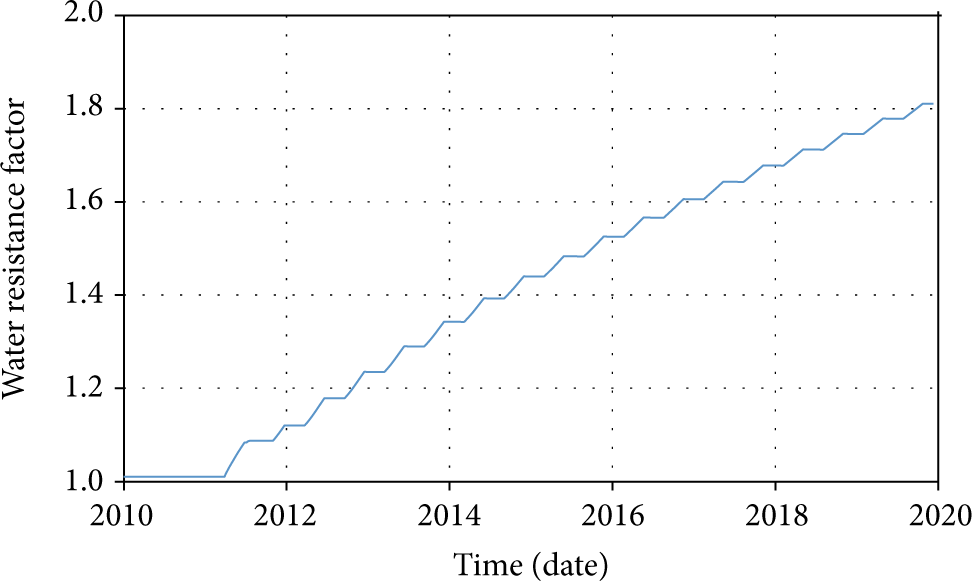
Resistance factor for aqueous phase in high permeability zone.

Water saturation after one cycle of WAG and PAG: (a) WAG process and (b) PAG process.
Figures 8 and 9 represent the water-oil ratio (WOR) and cumulative water production from different processes. According to Figure 8, the results signify that the WOR in the case of PAG process is much lower than those of waterflooding and WAG process during production period, excepting 2014. At this time, WOR of PAG is sharply increased because produced oil rate reaches almost zero due to the temporary blockage with injected CO2 and polymeric solution (Figure 10). In Figure 9, the PAG process indicates 42% and 12% reduction in cumulative water production compared to the waterflooding and WAG process, respectively. These improvements prove effectiveness for polymer injection which has great potential to reduce aqueous phase mobility.

Water-oil ratios for different processes.
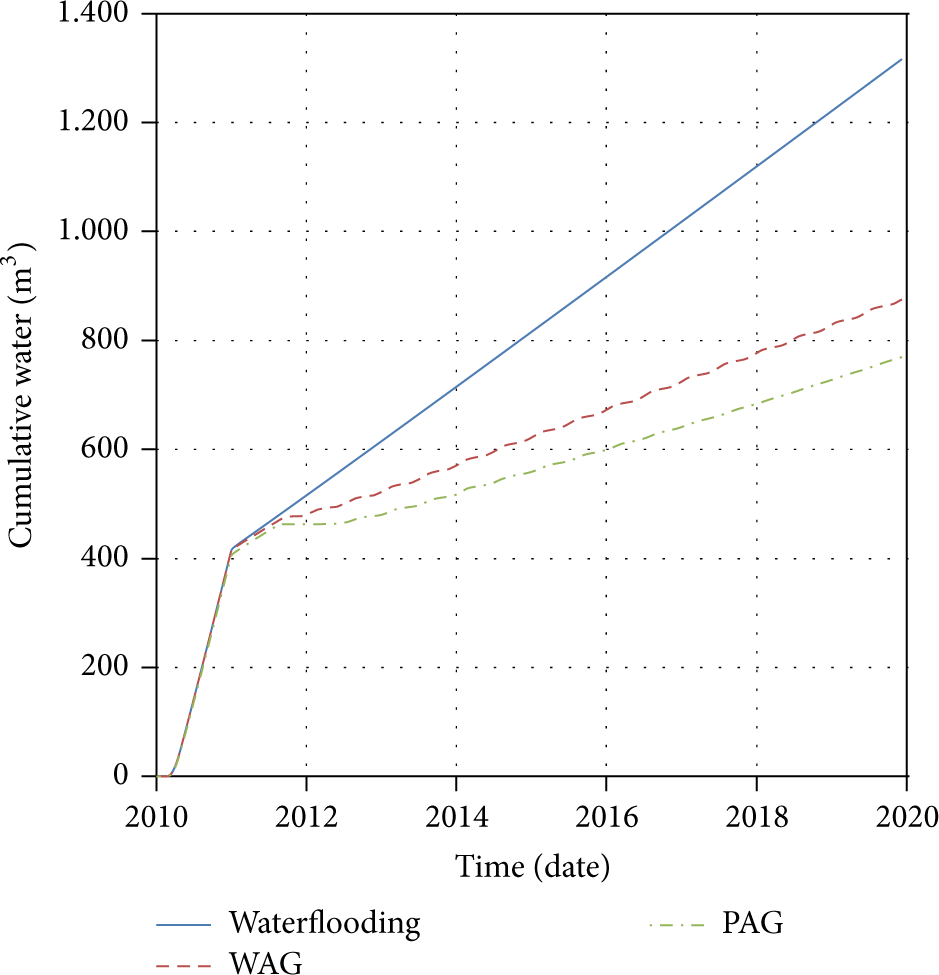
Cumulative water productions for different processes.

Produced oil, water, and CO2 rate of PAG process in 2014.
Figures 11 and 12 describe the gas-oil ratio (GOR) and cumulative gas production. In Figure 11, similar problem with WOR existed at 2014. As aforementioned, the same problem at this point results from low oil rate. The amounts of gas productions are 3.4 × 10⁵ m3 in CO2 flooding and 1.6 × 10⁵m3 in WAG and PAG process. PAG process obtains 53% reduction in cumulative gas production compared to CO2 flooding. GOR of PAG process is significantly lower than that of WAG process. PAG process in heterogeneous heavy oil reservoir attains better performance than WAG does.

Gas-oil ratios for different processes.

Cumulative gas productions for different processes.
Figure 13 depicts the oil saturation distribution for four processes at the end of production. Average oil saturation is 0.64 in waterflooding, 0.67 in CO2 flooding, 0.63 in WAG process, and 0.56 in PAG process. In comparison with Figures 13(a), 13(b), and 13(c), Figure 13(d) shows that better recovery efficiency resulted from high sweep efficiency and high displacement efficiency. In PAG process, the reduced permeability contrast due to the preferential adsorption of polymer in relatively high-permeability layers enables water and CO2 to penetrate into low-permeability layers and the recovery efficiency to be increased.
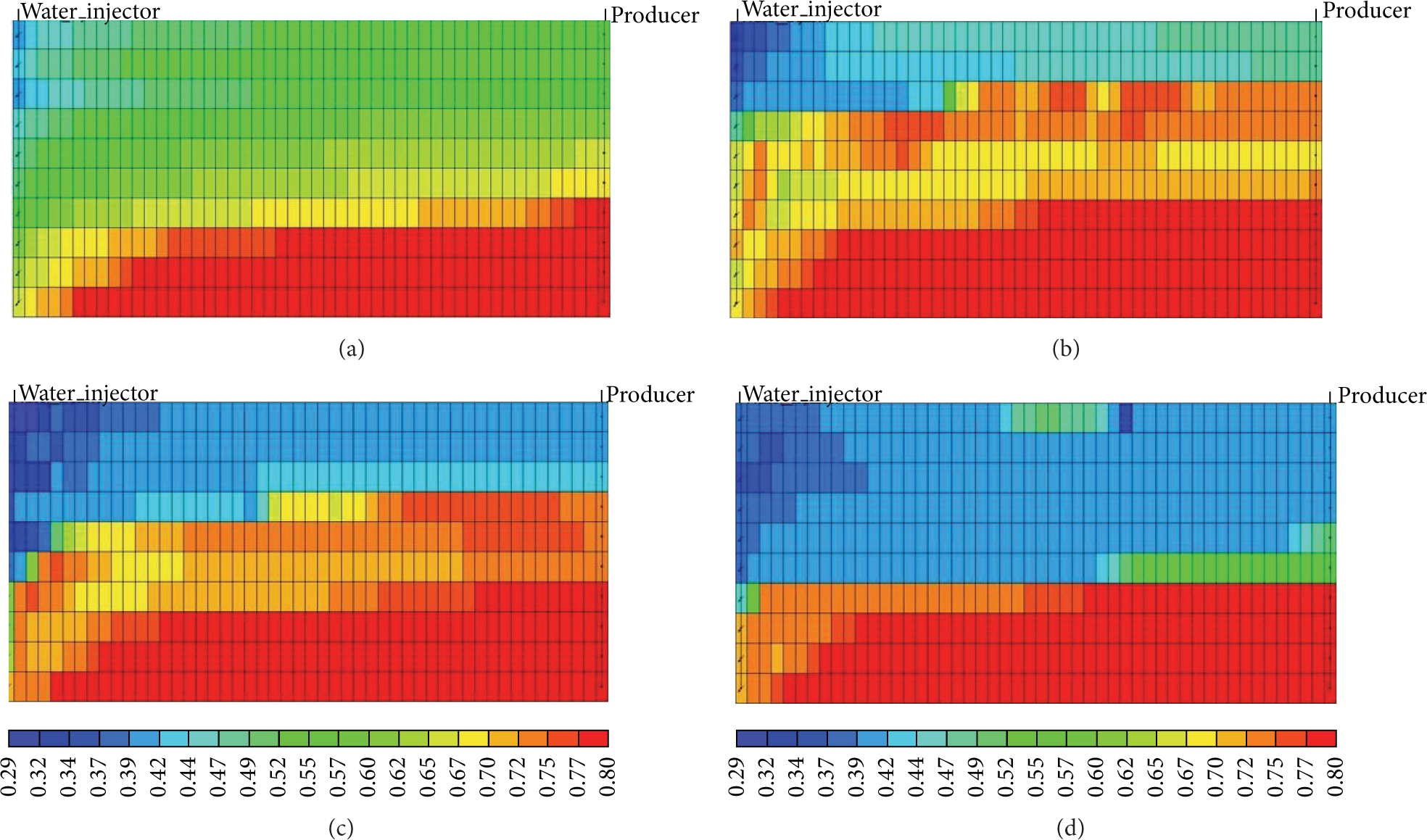
Oil saturations at the end of simulation: (a) waterflooding, (b) continuous CO2 flooding, (c) WAG process, and (d) PAG process.
3.2. PAG Cycle and Ratio
PAG cycle and ratio are general parameters which determine the characteristics of PAG process. The base case is 1: 1 PAG ratio and 180 days cycle period. Various PAG cycle periods are applied to compare the oil recovery in the same PAG ratio (1: 1). In this PAG process, CO2 is injected first and polymeric solution follows. The results of these processes are shown in Figure 14. Ultimate recoveries are similar for all cases although increasing points of recovery factors are different. If the respective total amounts of injected CO2 and polymeric solution are the same in five cases, they have similar efficiencies of sweep and displacement. These results are well matched with those from previous WAG simulation study [23].
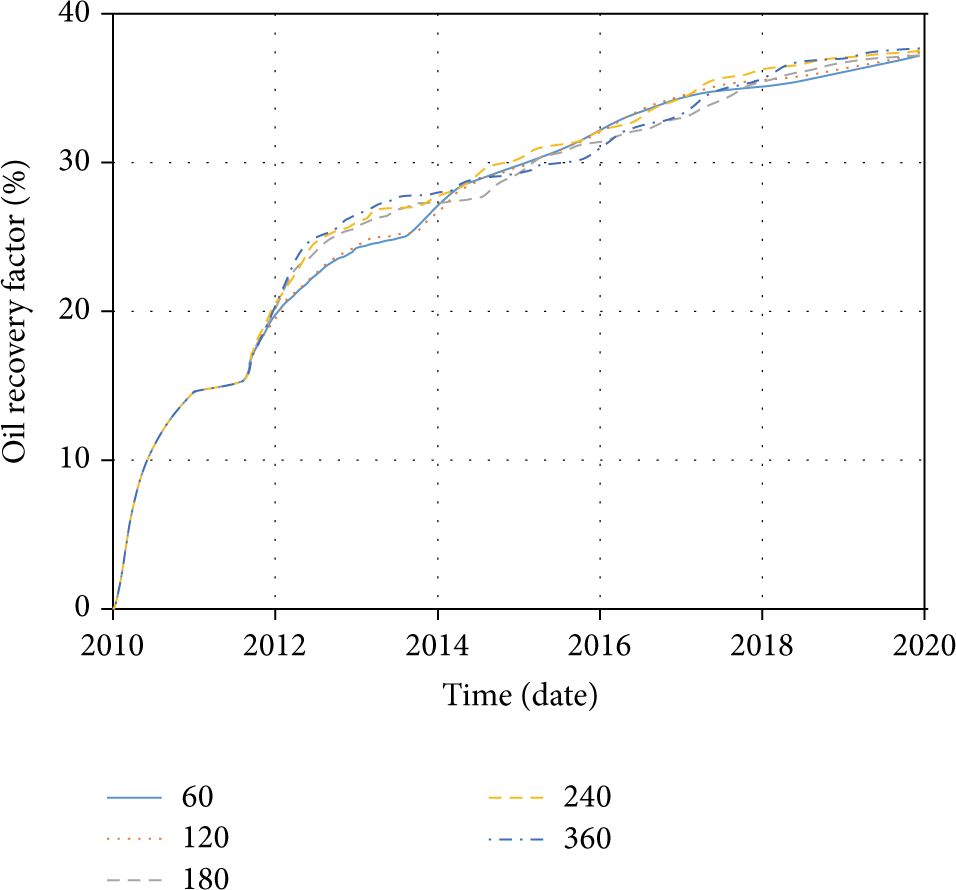
Oil recovery factors at different WAG cycle periods.
Figure 15 is the result of oil recoveries for different PAG ratio processes. Oil recovery factor of 2: 1 PAG ratio is 3% larger than that of 1: 1 PAG ratio. As a result, injection of more polymeric solution has advantage for oil recovery by increased sweep efficiency. However, too much polymer injection could reduce the oil recovery because mobility of polymer is low and polymer does not reduce residual oil saturation (1: 5 PAG ratio case).

Oil recovery factors at different WAG ratio cases.
4. Conclusions
The results of numerical simulation on the flow of polymeric solution with CO2 in heavy oil reservoir were analyzed. The main challenges to reduce oil recovery are high viscosity of heavy oil and high heterogeneity of reservoir. The polymer-alternating-gas process showed significant advance of recovery efficiency compared with other processes.
By the control of mobility ratio, the PAG process has better sweep efficiency than those of other processes. The PAG process represented the highest oil recovery factor by 37%. It was 89% higher than results of waterflooding or CO2 flooding and 45% higher than consequence of WAG process.
In heterogeneous heavy oil reservoir, water and CO2 breakthroughs are key factors to reduce the oil recovery in WAG process. In comparison to WAG process, PAG process would decrease the WOR by 12%. Moreover, GOR in PAG process was maintained below GOR of WAG method.
The cycle time of PAG process did not affect the recovery performance. However, 2: 1 PAG ratio could improve the oil recovery factor by about 3% over the base case.
Conflict of Interests
The authors declare that there is no conflict of interests regarding the publication of this paper.
Footnotes
Acknowledgment
This work was supported by the Energy Efficiency & Resources Core Technology Program of the Korea Institute of Energy Technology Evaluation and Planning (KETEP) granted financial resource from the Ministry of Trade, Industry & Energy, Republic of Korea (no. 20122010200060).