




Abstract
An effective transmission power control (TPC) method is proposed and demonstrated, in which an appropriate active margin is directly applied rather than a step-by-step margin as in the conventional TPC method. Active-margin transmission power control (AM-TPC) is based on an algorithm that selects an optimized transmission power by considering the channel conditions in mobile environments. For obtaining the optimal transmission power, effective minimum detectable signal (EMDS) has been introduced which considers the change both in the channel noise and in the path loss (PL) dispersion caused by multipath fading. The transmission power is determined by the EMDS and active margin to improve the efficiency of the communication. The AM-TPC improves the reliability and reduces the power consumption, because it prevents unnecessary retransmission by reducing the number of error packets. By using the AM-TPC in mobile environments, we have experimentally obtained 28.3% reduction in current consumption when compared with using maximum power transmission.
1. Introduction
Wireless sensor networks (WSNs) are widely used in many applications such as for supporting military surveillance, emergency response, environmental monitoring, and scientific exploration. With advanced studies, compact and lightweight wireless communication modules have been developed. Power consumption is an important issue because small nodes are generally operated with limited batteries [1]. With energy constraint, the reliability and efficiency of the system should be satisfactory. However, there is a trade-off relation between the reliability and the efficiency of the system. The reliability can be improved by transmitting packets at the maximum transmission power; however, this condition causes unnecessary high energy consumption. Therefore, a method considering both the reliability and the energy consumption is required. Transmission power control (TPC) algorithm is one of the methods to reduce the energy consumption with satisfactory reliability. TPC algorithms are divided into two groups, which are step-by-step (SBS) control and direct control. In general, WSNs use the SBS method, which has excellent stability by assuming fixed nodes. In the case of the SBS control, the transmission power is sequentially increased according to the minimum detectable signal at the receiver. It has the advantage that the received power is stable. Various SBS methods such as TPC with blacklisting [2] and interference-aware TPC [3] have been studied. TPC with blacklisting uses a constant number of transmission power levels (13 levels) on the basis of the reference packet reception rate (PRR), which regulates the maximum accuracy for power tuning. Interference-aware TPC calculates the received signal strength (RSS) of the receiver target, and the transmission power is increased or decreased by 1~3 dB. Although the above-mentioned SBS power control methods are stable, these methods have the disadvantage of long stabilization time. On the other hand, TPC using direct control method has short stabilization time because it calculates the transmission power on the basis of the sensitivity and channel loss in every packet. For example, TPC for healthcare monitoring [4] uses the threshold of the link quality indicator (LQI) parameter to accurately set the transmission power. However, it is limited to the body monitoring system for a short distance. Actually the channel setting in real mobile environment is different from that of the human-body monitoring system. The received signal is changed instantaneously in the mobile environments because of channel fading, noise, loss, and other effects. Nonetheless, the previous TPC algorithms do not consider the wireless channel characteristics under moving condition, and thereby their performances are not satisfactory for real-time WSNs.
In this paper, we propose an active-margin transmission power control (AM-TPC) algorithm using effective minimum detectable signal (EMDS) to achieve short stabilization time as well as reliability in mobile environments. For achieving the reliability, we define EMDS in which the signal-to-noise ratio (SNR) and channel noise are added to the previous minimum detectable signal (MDS). In addition, we theoretically analyze and experimentally demonstrate AM-TPC by considering both the channel noise and multipath fading in mobile environments. The remainder of this paper is organized as follows. The wireless channel is described in Section 2. In Section 3, the designed AM-TPC algorithm is stated with EMDS and margins. In Section 4, AM-TPC is evaluated with real-time experiments. Finally, we derive the conclusion in Section 5.
2. Motivation
Traditional models for wireless communications define only the connected and disconnected regions. However, several works [5–8] have reported on the existence of a third “transitional” region in which the PRR is quite erratic. The extent of this region is important as the upper-layer protocols disregard it leading to, for example, inefficient routing topologies. In [8], it was stated that multipath fading reduces the width of the transitional region. In [9], the fact that a large transitional region also occurs is expected to be because of the CC2420 smaller path loss (PL) exponent, which actually increases the transitional region. The wireless channel has to be analyzed in order to ensure a large range and reliability in the transitional region.
When an electromagnetic signal propagates, it is diffracted, reflected, and scattered. These effects have two important consequences on the signal strength. First, the signal strength decays exponentially with respect to the distance. Second, for a given distance d, the signal strength is random and log-normally distributed around the mean distance-dependent value. Most of the wireless propagation models simultaneously use the formula and experimental analysis for the unique characteristics of each environment. One of the most common radio propagation models is the log-normal PL model [10]. Empirical studies have shown that the log-normal shadowing model leads to the development of more accurate multipath channel models when compared with the Nakagami and Rayleigh models for indoor environments [11]. This model is expressed as

3. Design of Active-Margin Transmission Power Control (AM-TPC)
The transmission power is required to be accurately set by considering various factors. When the transmission power is not correctly determined, the data packet is lost, and the transceiver transmits the packet with the maximum transmission power again. Therefore, optimization of the transmission power is required to avoid unnecessary retransmissions. In this section, we propose an AM-TPC algorithm, which basically consists of two functional coefficients: EMDS and active margin.
3.1. Effective Minimum Detectable Signal (EMDS)
In wireless communication, MDS, known as the noise floor that is the measure of the signal created from the sum of all the noise sources and unwanted signals within a measurement system, is the smallest signal power that can be received by a RF receiver. In this case, sensitivity is defined as the minimum signal level that the system can detect with acceptable SNR of the RF receiver:

The experimental results shown in Figure 1 indicate that the correlation between the RSS and the LQI is largely influenced by the environment. Both the shape and the degree of variation depend on the environment. The sensitivity of the module used in the experiment is −91 dBm. However, the sensitivity should be changed to a point that receives reliable data. Although we have performed the experiment with the same module and same packet, the sensitivities are different because the channel noises are different depending on the environment. In real wireless channel, the sensitivity should be diligently determined by considering the channel noises. The RSS in the receiver can be expressed as follows:


Variation in RSS versus LQI: (a) outdoor and (b) indoor.
The channel noises considering various factors in the physical channels are included in (5). Accordingly we introduce an EMDS, which is defined as the sum of the estimated channel noise and minimum SNR:

When the transmission power considers the EMDS, which is based on the channel noise that changes in every packet in the actual wireless channel, the stability and reliability are enhanced. We can efficiently control the transmission power with appropriate selection of the EMDS.
3.2. Active Margin
In Section 2, we mentioned that the log-normal PL model and
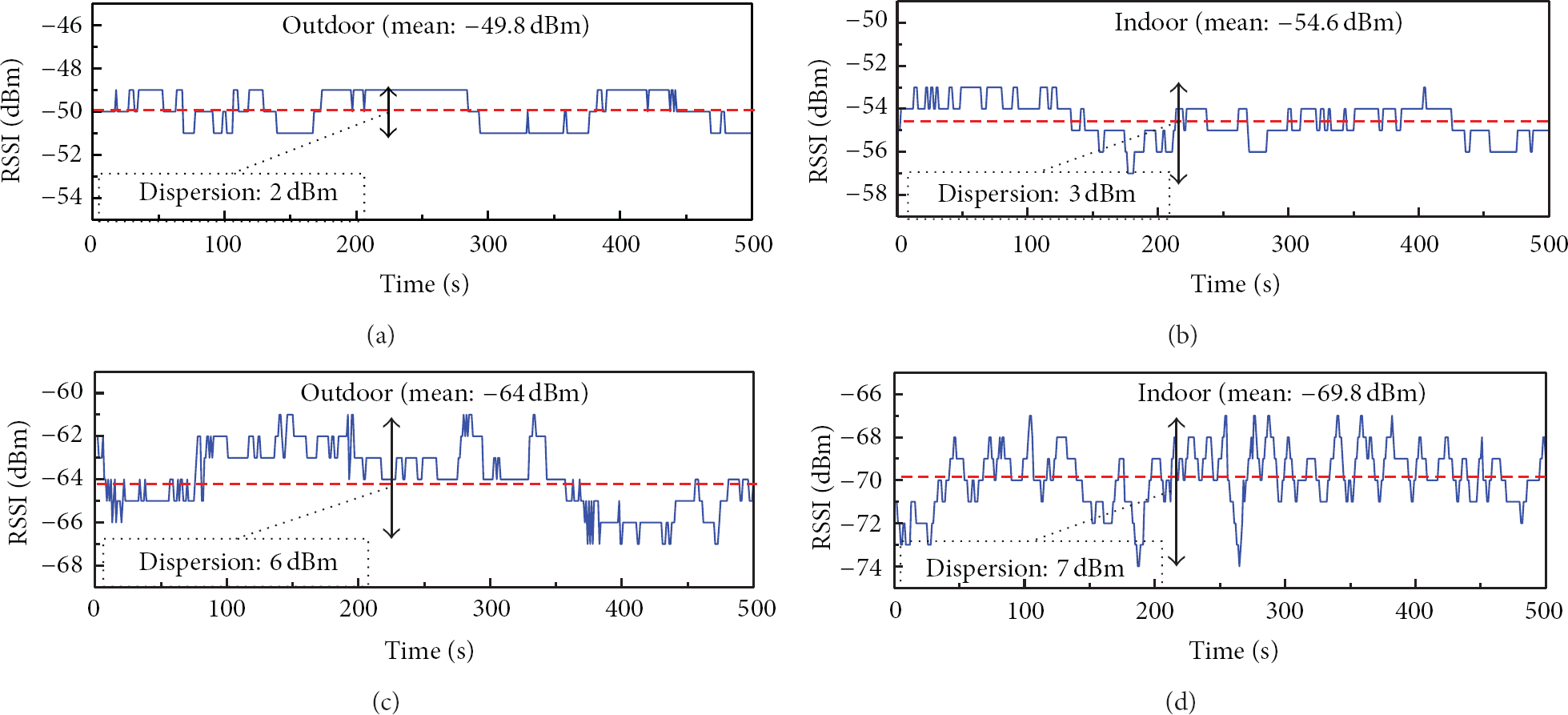
Dispersion of channel loss in outdoor and indoor environments.
The PLD increases when the received average signal becomes smaller, while it decreases when the received average signal becomes larger. PL is expressed using the log-distance path loss model as follows:


Dispersion of path loss with different environment coefficients.
3.3. Proposed Algorithm Based on the Active Margin
In general, the method of transmission power selection using TPC algorithm is described as follows:

We propose an AM-TPC with EMDS and a PL parameter for decreasing the probability of packet error. As shown in the previous experiments, it is inefficient to define the margin as a constant because the dispersion varies according to the environment. The value of margin is determined depending on the environment and RSS:

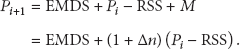
Figure 4 shows the AM-TPC algorithm. In the proposed algorithm, the first packet is transmitted with the maximum power. The channel noises are calculated with the RSS, SNR, and return information by the acknowledge (ACK) packet in the receiver. The transmitter calculates the channel noise again with the ACK packet, and the EMDS is determined by considering both the received packet and the ACK packet. Further, it selects the margin to prevent the packet loss and increase the reliability of communication on the basis of the environment coefficient and RSS. Finally, the optimized transmission power that is suitable for mobile environment is selected. The operation is minimized by the AM-TPC algorithm in order to select the optimized transmission power through only one feedback loop.

AM-TPC algorithm.
4. Experimental Results and Discussions
We evaluate the performance of the proposed method using the AM-TPC algorithm. The test device is CC2430, which is a chip based on the IEEE 802.15.4 standard. The transmitting node periodically transmits 50 byte data packets to the receiving node by using different transmission power selection methods, and we repeat each experiment with 1000 packets. The packet error rate (PER) test is run with the CC2430 module and test-bed. The experimental environment is a real WSN including human beings, other objects, and interferences as shown in Figure 5. The distance between the nodes is 25 m (fixed) and 15~35 m (moving).
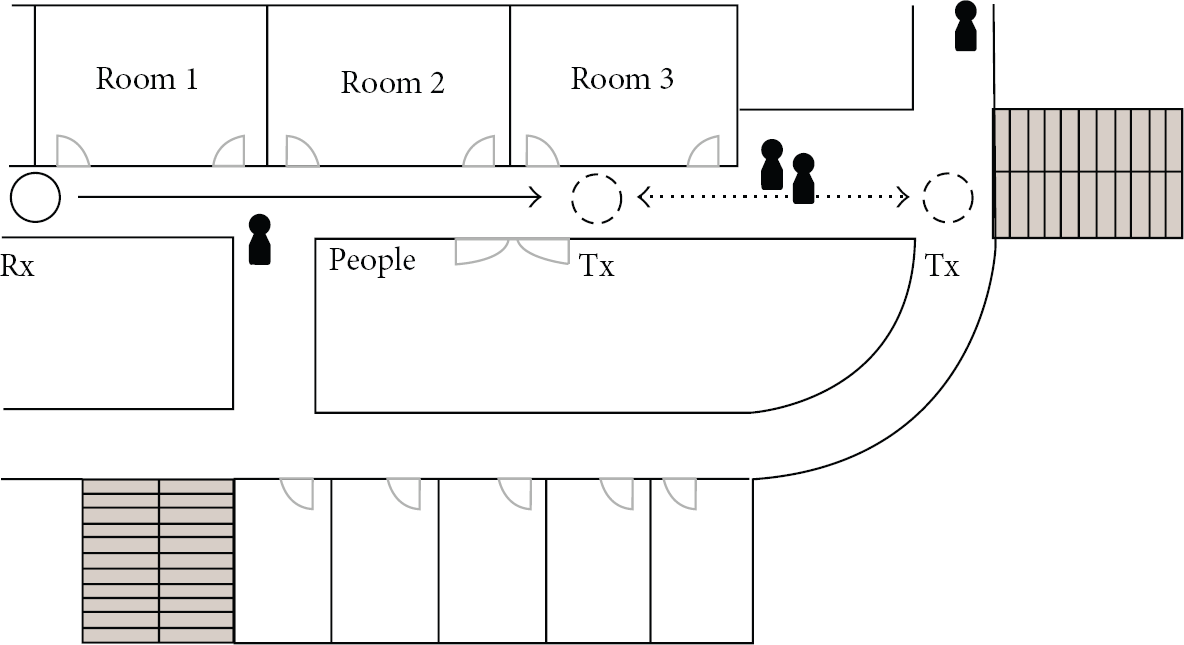
Experimental scenario.
Figure 6 shows that the Tx and Rx powers change in every packet. Under the moving condition, the SBS power control occurs in many error packets, while the Rx power satisfies the sensitivity. However, AM-TPC stabilizes very quickly because the transmission power is calculated using the EMDS and active margin in every packet. The delayed response time causes error packets and retransmissions, resulting in wastage of energy and low reliability. As observed in the experiment and analysis, there are various effects in a real WSN, and we propose an effective transmission power algorithm. From the experiment results, we demonstrate that the proposed TPC is robust to the PL dispersion caused by multipath fading.

Change in the Tx and Rx power under moving condition.
Table 1 summarizes the results of the experiment with no TPC, SBS-TPC, and AM-TPC. The PER performances of the SBS-TPC and AM-TPC are worse than that with the maximum power transmission because of packet transmission failure. When the nodes are fixed, the proposed algorithm shows better PER of 1.2% and 1.8% of current consumption when compared with SBS-TPC. The SBS method considers stability instead of fast response because it assumes that the nodes are fixed. On the other hand, although the direct method is not stable, the proposed algorithm achieves less current consumption and reliability in a fixed experimental environment. When the nodes are moving, AM-TPC shows a better PER of 6.2% and 8.8% of current consumption when compared with SBS-TPC. SBS-TPC shows worst performance when compared with AM-TPC under moving condition because it considers that the nodes are fixed. The proposed AM-TPC shows much better performances under moving condition because it considers PLs and channel noises in each packet in real-time.
Experimental results of comparison with the previous algorithms.

5. Conclusion
This paper presents an AM-TPC algorithm. The previous TPC algorithms have limitations that render them difficult to be applied to real WSNs because they only consider white Gaussian noises and do not include multipath fading effects. When the algorithm controls the transmission power without considering the channel noises and other effects, many packets fail to arrive at the receivers. In this work, we defined the channel noises through EMDS for reliability and stability and analyzed the path loss dispersion by multipath fading effect through various experiments. The AM-TPC algorithm selects the optimal transmission power by calculating the active margin, which includes EMDS by considering the noises in the wireless channel and PL parameter in every packet. Thus, the proposed algorithm offers robust characteristics. From the experimental results with CC2430 based on IEEE 802.15.4 in real channel space, we observe that the PER performance improves by 6.2% when compared with the previous algorithm, and the power consumption decreases by 8.8%. The AM-TPC shows good PER performances and low power consumption in various wireless channel environments, which is an important design issue in real WSN applications.
Footnotes
Conflict of Interests
The authors declare that there is no conflict of interests regarding the publication of this paper.
Acknowledgment
This work was supported by the National Research Foundation of Korea (NRF) Grant funded by the Korean government (MSIP) (NRF-2012R1A2A1A01011488).