




Abstract
This paper investigates the nonlinear dynamic behavior for a plain classic bearing (fluid bearing) lubricated by a non-Newtonian fluid of a turbo machine rotating with high speed; this type of fluid contains additives viscosity (couple-stress fluid film). The solution of the nonlinear dynamic problem of this type of bearing is determined with a spatial discretisation of the modified Reynolds' equation written in dynamic mode by using the optimized short bearing theory and a temporal discretisation for equations of rotor motion by the help of Euler's explicit diagram. This study analyzes the dynamic behavior of a rotor supported by two couple-stress fluid film journal lubricant enhances the dynamic stability of the rotor-bearing system considerably compared to that obtained when using a traditional Newtonian lubricant. The analysis shows that the dynamic behavior of a shaft which turns with high velocities is strongly nonlinear even for poor eccentricities of unbalance; the presence of parameters of couple stress allows strongly attenuating the will synchrony (unbalance) and asynchrony (whipping) amplitudes of vibrations of the shaft which supports more severe conditions (large unbalances).
1. Introduction
The plain bearings are frequently used in the guidance of shaft lines of modern rotating machines rotating with high speed. The presence of oil film in these bearings (Figure 1) acts on dynamic behavior of the shafts which they hold. The actual technical development level enables the increase in the rotational speed to levels such that it is necessary to consider the nonlinear study of the bearings in order to examine their behavior in the unstable zones described by the linear theory or when they are subjected to unspecified cycles of load.

Contact in a plain bearing [10].
Experimental studies have shown that oils containing additives had a viscosity of non-Newtonian rheological behavior; their viscosity decreases as the shear rate at which they are subjected increases. Thus, runoff can be described by the classical theory of continuous media neglects the particle size. In the literature, there are several theories describing the flow of complex fluids with known torque and surface constraints. Among these theories Vijay Kumar Stokes theory [1] is the most widely used because of its simplicity; it takes into account the size of the particles in motion. It is interesting to note that the concept of the couple stress was introduced by Voigt [2] in the mechanics of continuous media. Because of its mathematical simplicity on the model of the fluid with couple stress which has been widely used to study many problems of hydrodynamic lubrication, Lin [3, 4] studied the effects of torque parameter constraint on the characteristics of the damper film bearing a long arc part and a bearing of finite length by applying the theory of continuous media stokes microphones. The theoretical results show that the presence of the pair of restraint provides an improved load capacity and prolongs the response time of the film of the damper system.
Oliver [5] has shown experimentally that the presence of dissolved polymer in the lubricant causes an increase in the load capacity of the lubricating film and a decrease in the coefficient of friction. In another study Lahmar [6] conducted an analysis of elastohydrodynamic double layered newspaper and bearings demonstrated that the use of a couple-stress lubricant increases the load-carrying capacity and stability of the bearing system and reduces friction effects and the attitude angle of the rotor.
In [7] results have showed that the common assumption of a linear journal housing suspension system results in a significant underestimation of the vibration amplitudes of both the rotor and the bearing. Lahmar and Bou-Said [8] have studied the influence of the torque parameter constraint on the stability of a rigid smooth landing. It was shown that with a fluid lubricated torque restraint system is more stable than a Newtonian fluid lubricated.
Lin [9] showed that the presence of additives in the lubricant has nonnegligible effects on the static and dynamic performance characteristics as well as the dynamic stability and response of the bearing especially at high values of stresses (constraints) couple parameter, that is, for higher chain length of the additive molecule.
Nonlinear dynamic analysis of the fluids bearings requires at the same time the simultaneous resolution of Reynolds equation modified in transient mode and the motion equations of the shaft in the bearing illustrated in Figure 1. Therefore, in the present paper a study of the nonlinear dynamic behavior of a plain bearing is proposed. The aim is to show the influence of couple-stress parameters on the stability of the shaft in the bearing.
2. Description of a Plain Bearing
Figure 2 represents a geometrical schematization of plain bearing composed of a shaft and of a bearing separated by a fluid film.
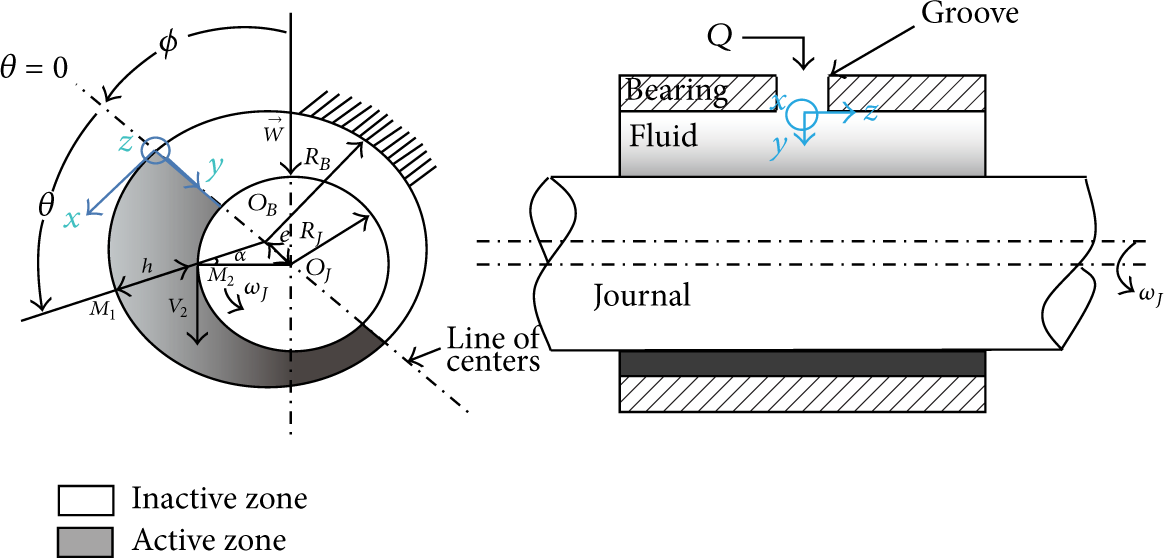
Diagram of a plain bearing.
3. Equations of Hydrodynamic Lubrication
For the plain bearing operating in dynamic mode, the field of pressure was created in the lubricating film as illustrated in Figure 3 which is the result of drive and crushing effects. For a non-Newtonian and incompressible fluid in laminar flow, the modified Reynolds’ equation takes the following form [2]:


The standardized modified Reynolds’ equation is

with

Hydrodynamic bearing capacity is

P is the pressure in the lubricating film, μ is the fluid dynamic viscosity, and ℓ is the parameter of stress couple representing the length of the largest molecular chain of the polymer.

Short-bearing pressure distributions.
R, L, and C are, respectively, the radius, the length, and the radial backlash of the bearing X, Y shaft center coordinates. Consider

In (3)
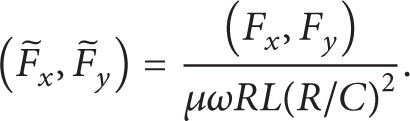
Conditions to satisfy are:

θ1 and θ2 angles defining the active zone of film.
The application of the method of balanced residues of Galerkin allows finding a low integral form.
Considering the equation as presented below:

with
4. Methodology
The hydrodynamic pressure field can be determined either by a resolution of second degree elliptical partial derivative equations (1) or by the method of finite difference.
In order to reduce the calculation time, we have used an approach based on the theory of optimized short bearing in which the curve of pressure according to the axial direction of bearing is supposed to be of parabolic form; this assumption is valid for an aligned bearing [11]. Consider

with

The solution of the Euler-Lagrange equation is

The ordinary differential equation (11) can be integrated numerically by the method of finite difference. The resulting matrix system will be solved by the method of Gauss-Seidel with a coefficient of overrelaxation. The grid of bearing is done only according to its circumferential direction. The knowledge of pressure field makes the calculation of hydrodynamic pressure bearing components possible.
5. Equations of Shaft Motion
The various forces acting on the shaft are the weight Mg, the hydrodynamic forces Fx and Fy, the forces of inertia

6. Resolution of the Equations of Motion
When the dynamic force is important, it is necessary to solve the nonlinear system composed of the precedent equations by the method of explicit integration of Euler:

We have applied the one-dimensional approach in the study of the effect of couple-stress parameter
bearing subjected to static loading only (ε b = 0);
bearing under static load with unbalances (ε b = 0.2, 0.32, 0.64 and 0.8);
the results are presented for the rotational speed of the shaft N = 3000 rpm and L/D = 0.64;
the calculations are conducted using the theory of the laminar hydrodynamic lubrication for different values of the couple stress.
These results concern the following:
the trajectories described by the center of shaft in the bearing,
the temporal spectra according to x(t) and y(t).
6.1. Bearing Subjected to Static Loading Only
This is shown in Figure 4.

Trajectories of the center of the tree for various values of parameter of couple stresses (ε b = 0), N = 3000 rpm.
6.2. Bearing under Static Load with Unbalance
This is shown in Figure 5.

Trajectories of the center of the shaft for various values of the parameter of couple stresses in the case of unbalances, N = 3000 rpm.
7. Results and Comments
Figure 4 represents a comparison of the trajectory of shaft center calculated for different values of couple-stresses parameter for a Newtonian fluid
In the case of unbalance the trajectories of the shaft center with and without parameters of the couples stresses are plotted, respectively, on Figures 5(a) and 5(b), giving to the shaft high amplitude of circular motion and the nonlinear dynamic behavior appears clearly.
It is to remember that the circular orbit described by the shaft center is near to the circle of backlash; this merger is dangerous because it can cause a metal-metal contact between the surfaces of the shaft and the bearing. The presence of the parameters of the couples of stresses in the fluid lubricating on one hand is positive purposes with respect to stability of the bearing; on the other hand, the presence of the additives of long molecular chains allows reducing the size of orbits to a significant degree. Figures 6(a) and 7(a) represent peak to peak amplitudes of vibration according to the conditions imposed by the experiments which gives thirty-three revolutions obtained from the shaft for weak unbalances (ε
b
= 0.2), in transient mode, and for various values of stress couple (ℓ = 0,
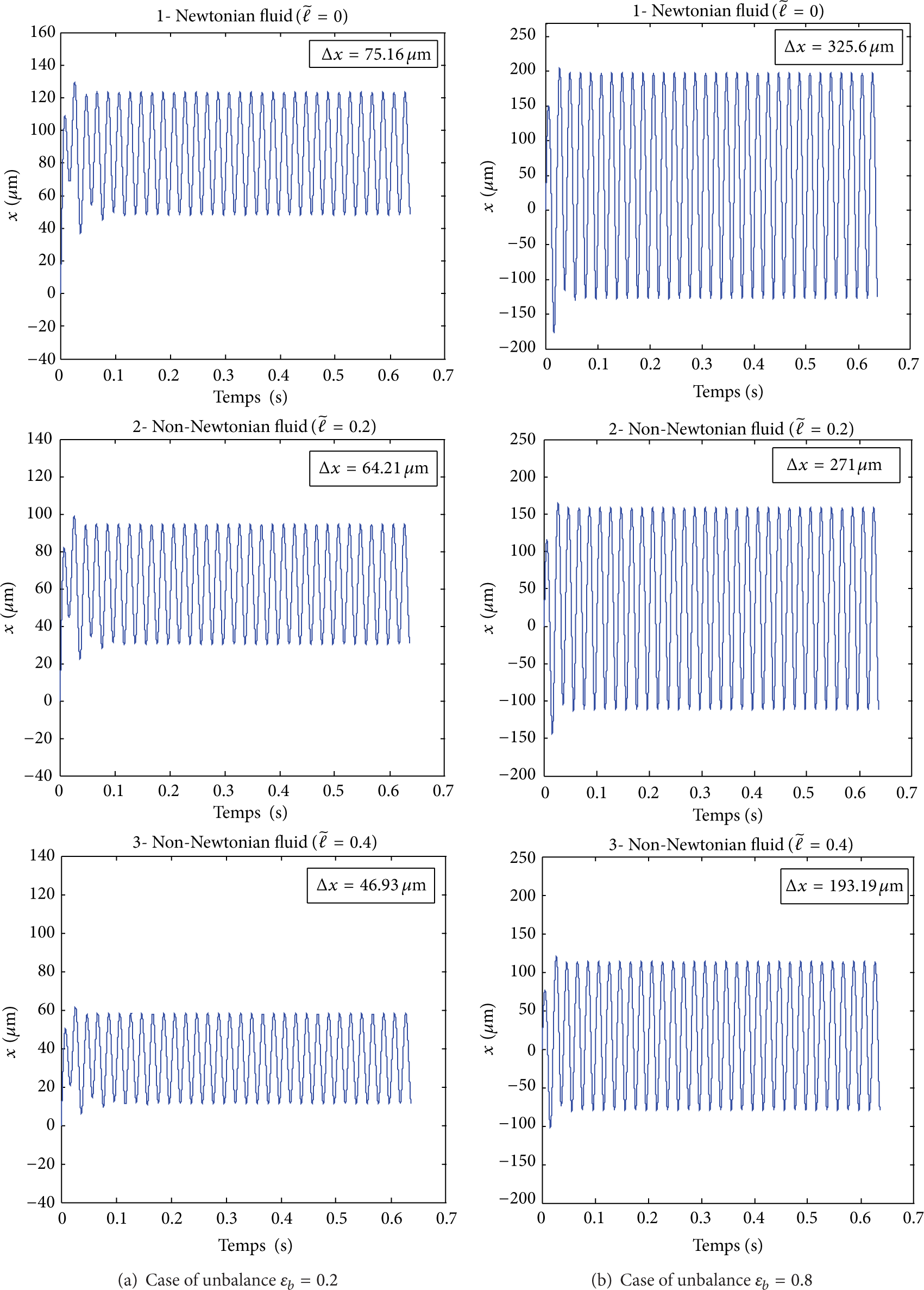
Variations of displacements x(t) of shaft center according to the time for various values of parameter of couple stresses and values of the unbalance, N = 3000.
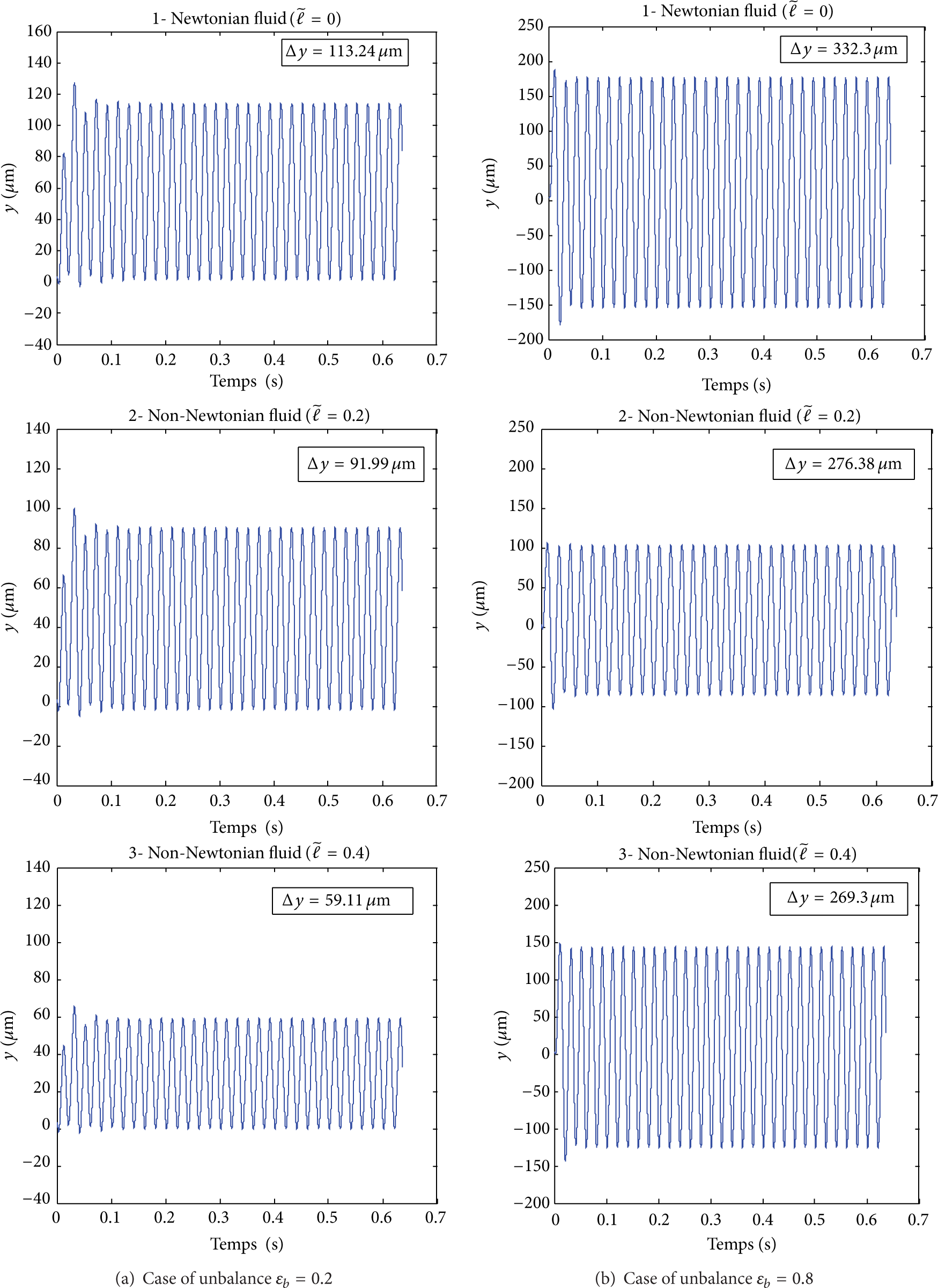
Variations of displacements y(t) of shaft center according to the time for various values of parameter of couple stresses and values of the unbalance, N = 3000 rpm.
The reduction of the vibratory movement is due to the weak dynamic head compared to statics, whereas, for great unbalances (ε
b
= 0.8), the peak-to-peak amplitudes of vibrations calculated (Δx = 325.6 μm and Δy = 332.3 μm) for a Newtonian fluid which are very close to radial backlash C = 350 μm of the bearing Δx = 271 μm and Δy = 276.38 μm and Δx = 193.19 µm and Δy = 269.3 μm correspond to the values of stress couple ℓ = 0.2 and
8. Conclusion
The influence of parameters such as the unbalance and the couple stresses on the trajectory of the shaft center in the bearing and the temporal components of displacement shows the following.
In comparison with the Newtonian fluids the polar fluids or couple of stress allow the following:
obtaining a more stable trajectory,
an important attenuation of the amplitudes of the vibrations even for the great eccentricities of unbalance.
The effects of the couples stress on the fluid lubricating allow
reducing the size of the stationary orbits and ensuring a great operational safety of the smooth bearing;
attenuating considerably the amplitudes of the vibrations due to the presence of the unbalance.
These effects are all important since the length of the molecular chain of polymers added to the basic lubricant to improve its performances.
Footnotes
Nomenclature
Conflict of Interests
The authors confirm that there is no conflict of interests.
Acknowledgment
The authors gratefully acknowledge the Algerian DGRDT for their technical and financial support to conduct this work.