




Abstract
Traditional mobile networks will become dual-layer wireless networks due to small cells’ deployment. The advantages of dual-layer networks are improving network capacity and overcoming the problem of unbalanced traffic distribution in time-space domain. In this paper, performance of small cells deployment is evaluated in simulations. It is shown that users’ traffic is offloaded by small cells obviously. At the same time, performances of signal to interference plus noise ratio (SINR) and throughput are also improved. However, low SINR (
1. Introduction
With the rapid development of mobile Internet services, the traditional wireless networks are faced with large challenges. As data services are increasingly visited by mobile terminal users, traffic load of wireless communication networks is rising rapidly. As forecasted by Cisco research, the global mobile data traffic will achieve 1000 petabytes per month. And the proportion of mobile video will be 66.4% [1], as shown in Figure 1. However, the traditional wireless networks, which are mostly monolayer coverage with radio resource limited, could not afford so large traffic load.
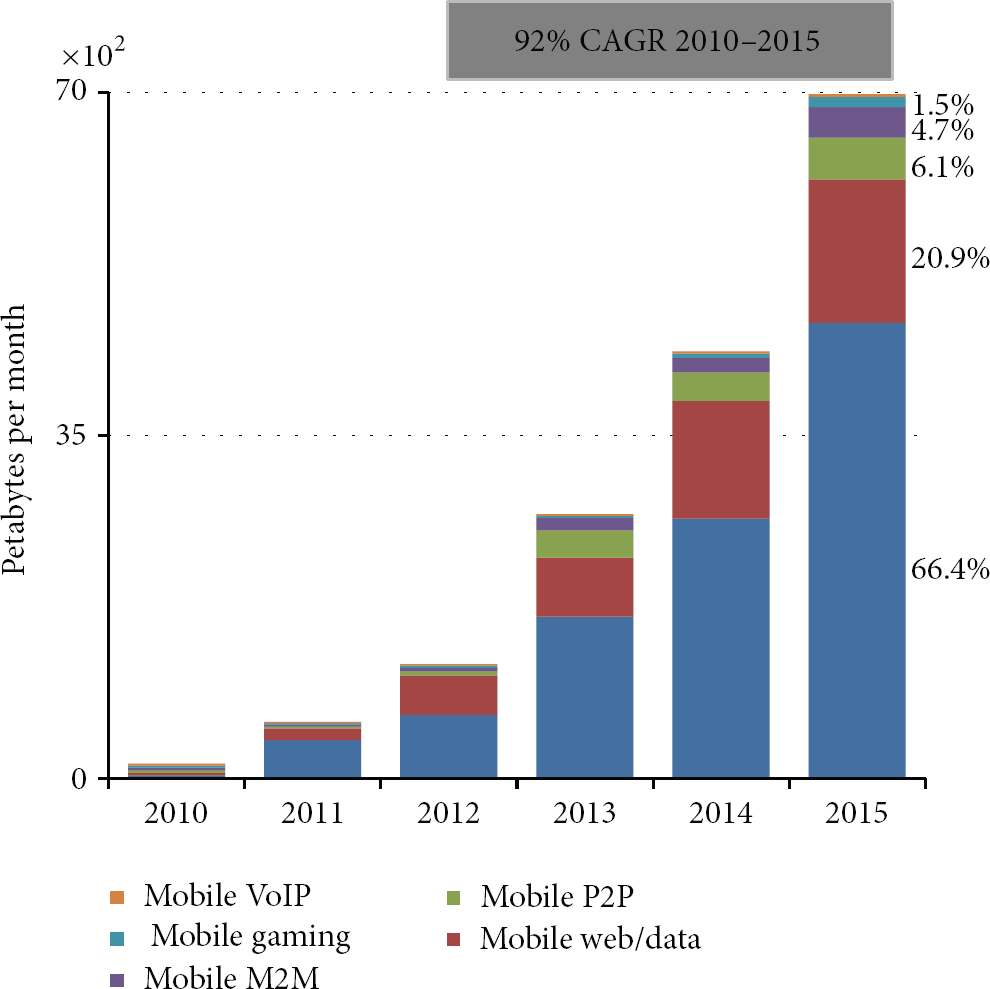
Forecast of global mobile data traffic by Cisco.
In order to meet the high data rate requirements of multimedia services, small cell deployment is adopted by some network operators in the world. Thanks to small cell deployment, the traditional mobile networks become dual-layer networks. The advantages of dual-layer networks are obvious. On the one hand, it could improve network capacity by radio resource reuse. On the other hand, it is an effective method to overcome the problem of unbalanced traffic distribution in time-space domain [2].
However, there are several problems of small cell deployment. Firstly, the performance improvements of small cell deployment need to be evaluated. Secondly, cooperation between small cells and macro cells should be discussed. Finally, as more and more small cells are deployed, energy saving should be taken into consideration. Those questions will be studied in the paper.
The remainder of the paper is organized as follows. The related work is introduced in Section 2. The system model is given in Section 3. The methods of small cells’ deployment and their performances are discussed in Section 4. Section 5 gives a smart cooperation scheme between small cells and macro cells for energy saving. The evaluation and performance results are also described in this section. Finally, Section 6 concludes the paper.
2. Related Works
Traditional cellular networks usually consist of macro cells, which are deployed in monolayer to maximize the coverage and minimize the interferences. In a certain area, features of macro base stations are usually similar, such as antennas and power levels [3].
Small cells will overlay some areas of the macro cells and make networks come to be dual-layer networks, which are also called heterogeneous networks (HetNet). The purposes of small cells deployment are coverage improvement in particular conditions and traffic distributary in hot spots. There are multiple forms of small cells, including microcells, picocells, femtocells, and Wireless Fidelity (Wi-Fi) access points.
First of all, the methods of small cells deployment are taken into consideration. How to deploy small cells overlaid with macro cells, improving the performance of overall networks, is a key question. Hoadley and Maveddat [4] show the necessity and challenge of small cell deployment. Chen et al. [5] investigate this question by studying the network performance in terms of spatial outage and throughput of a completely random topology in comparison to that of a perfectly regular topology. The backhaul of small cells is discussed in [6]. And an automated small cell deployment for heterogeneous cellular networks is addressed in [7].
Secondly, cooperation between small cells and macro cells is very important. Smart cooperation will improve the efficiency of radio resources as well as satisfying the requirements of high rate data traffic. Liu and Li [8] give radio access management mechanisms for multimode reconfigurable terminals in heterogeneous networks. Su et al. [9] show an adaptive radio access control scheme based on terminal mobility and service arriving cognition in 3G and WLAN networks. Interferences between small cells and a macro cells are discussed in [10]. Liu and Li [11] also propose an adaptive spectrum sharing scheme based on frequency hopping communications for antijamming in heterogeneous networks.
Thirdly, energy saving will be taken into account along with small cells rapidly increasing. Soh et al. [12] investigate the design and the associated tradeoffs of energy-efficient cellular networks through the deployment of sleeping strategies among small cells. In [13], energy-efficient SLEEP mode algorithms are introduced for small cell base stations in a bid to reduce cellular networks’ power consumption. Onireti et al. [14] derive a generic closed-form approximation of the energy efficiency-spectral efficiency trade-off for the uplink of CoMP system and demonstrate its accuracy for both idealistic and realistic power consumption models.
3. System Model
Several architectures of heterogeneous networks have been shown in [8, 9, 15, 16]. Actually, small cells usually overlay macro cells partially. Figure 2 gives the heterogeneous networks scene overlaid by small cells and macro cells in this paper. Here, Cell 0 is a macro cell. In the area covered by Cell 0, there are 3 small cells deployed, named Smallcell 1, Smallcell 2, and Smallcell 3. Of course, the number of small cells is not limited to three. The forms of those small cells could be different, such as picocell, femtocell, and Wi-Fi access point.

Heterogeneous networks scene overlaid by small cells and macro cells.
However, the macro base station and those base stations of small cells overlaying a certain area should be controlled by an Area Control Center (ACC) in this paper, as shown in Figure 3. ACC could be deployed in Mobility Management Entity (MME) in Long Term Evolution (LTE) system.

Forecast of global mobile data traffic by Cisco.
There are 4 models in ACC. They are basic information management model, state management model, traffic load monitoring model, and decision model. The basic information management model is responsible for storing and updating basic information of base stations, including position, power limitation, and backhaul ability. The state management model is in charge of storing and updating the working states of base stations, such as open and sleep. The traffic monitoring model takes charge of monitoring the traffic of base stations and storing the history records of traffic load. The decision model answers for deciding the working states of base stations, including open, sleep, and transmit power. The decision algorithms will be described in the rest of the paper.
4. Performance of Small Cells’ Deployment
Performance improvement after small cells’ deployment is very important. As well known, traffic of the macro cell should be distributed by small cells, and capacity of networks should be increased. However, interferences between the macro cell and small cells will also influence the performance of heterogeneous networks. In this section, performance of small cells deployment in LTE networks is estimated, in condition of no cooperation between macro cells and small cells.
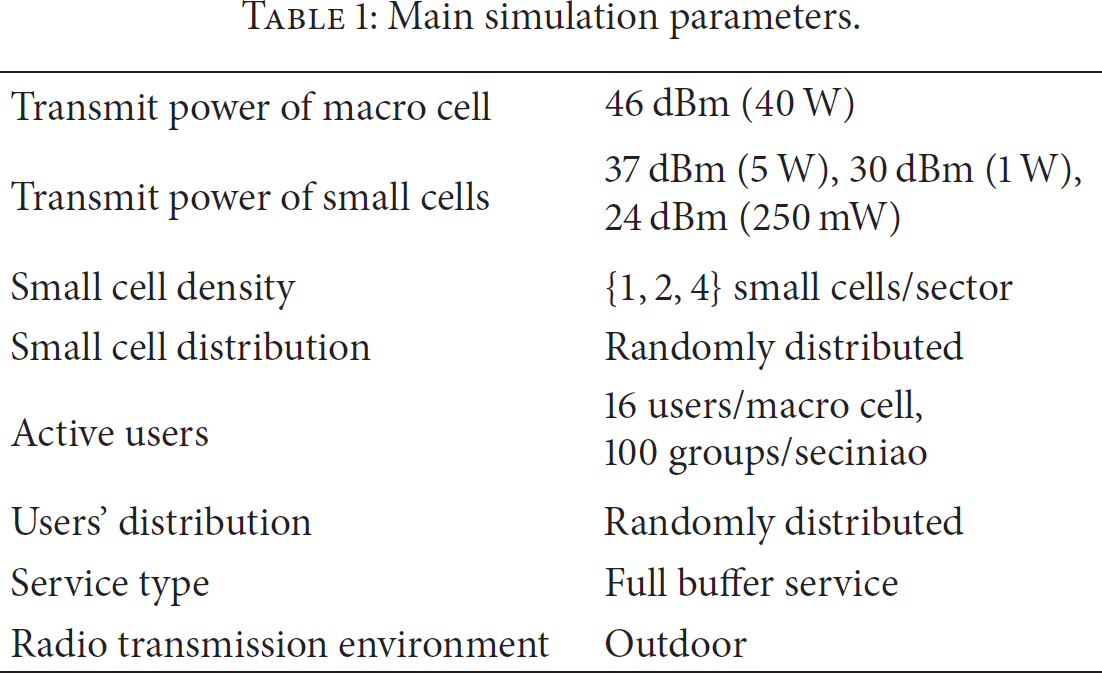
According to simulation parameters of the 3rd Generation Partnership Project (3GPP) and International Telecommunication Union (ITU) standards, we simulated a scene with macro cells and small cells overlapped. The simulation platform is operational tracking network (OPNET) software. As shown in Figure 4, there are 19 macro cells in the scene, and each macro cell consists of 3 sectors. Suppose users and small cells are randomly distributed in each sector. And macro cells and small cells share the same carrier frequency. Wireless communication environment is outdoor. The main simulation parameters are shown in Table 1, which are defined according to 3GPP protocol 36.814, 36.819, and ITU standards Uma, UMi.
Main simulation parameters.
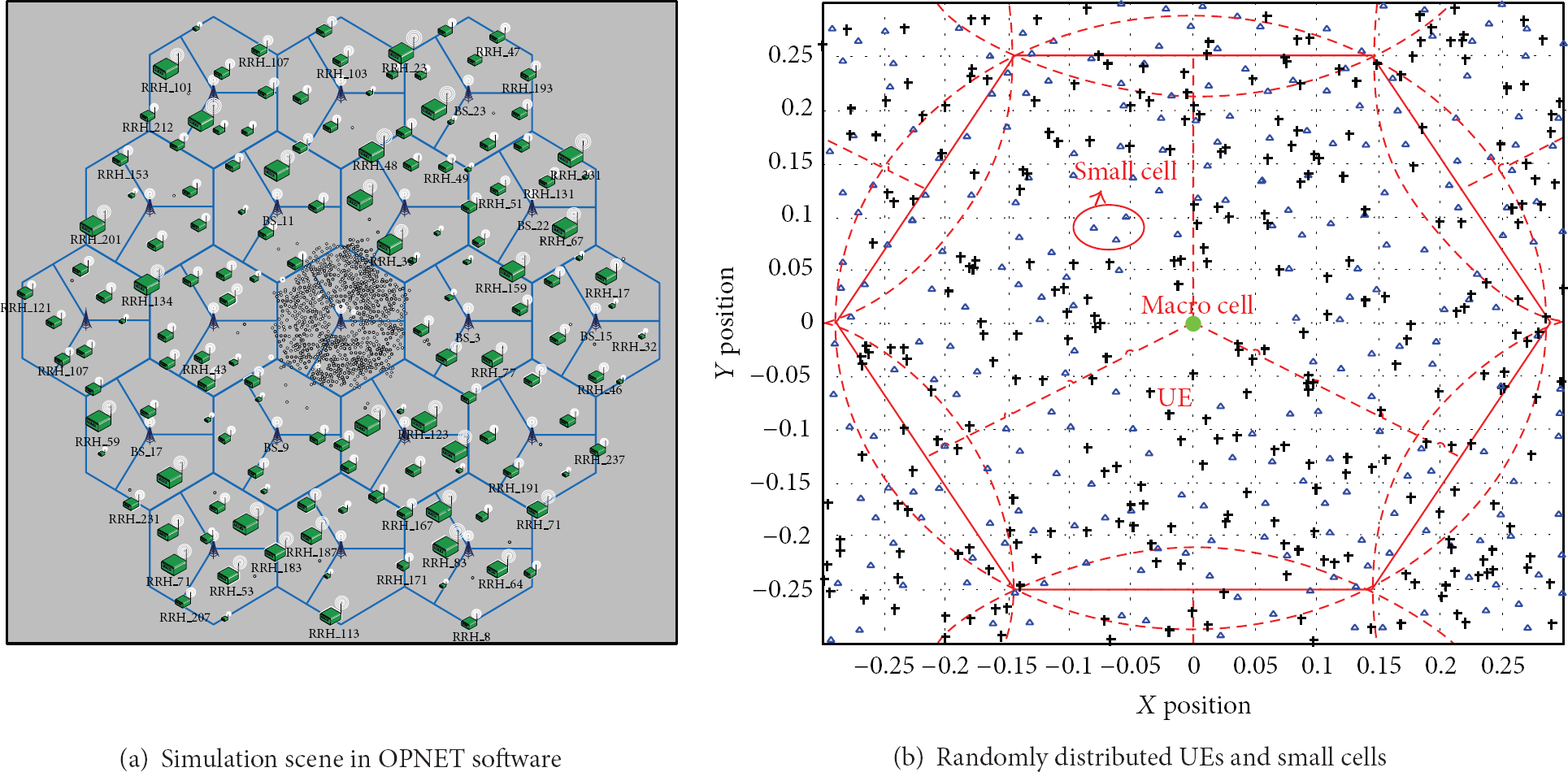
Simulation scene of heterogeneous networks.
Performance simulations are divided into 2 groups. In the first group, transmit power of small cells is 1 W, and the number of small cells is increased from 1 to 4 per sector.
The users’ SINR and throughput distributions are given in Figure 5. As shown in Figure 5(a), compared with macro cell only networks, high SINR (SINR > 20 dB) users are increased obviously thanks to small cells deployed. However, low SINR (SINR < 10 dB) users are also increased, and this is because of interferences between macro cells and small cells. As small cells increased, the SINR and throughput performances of dual-layer networks are improved. As shown in Figure 5, when only one small cell deployed per sector, users with SINR > 10 dB are less than 40%, and users with throughput >2 Mbps are less than 1/3. However, when 4 small cells are deployed per sector, users with SINR > 10 dB are more than 50%, and users with throughput >2 Mbps are more than 2/3. The offload of small cells is obvious. As shown in Figure 6, with small cells increased from 1 to 4, users visited services through small cells are increased from 13% to 39%, and throughputs of small cells are increased from 33% to 61%.

Probability distributions of SINR and throughput with small cells increased from 1 to 4.
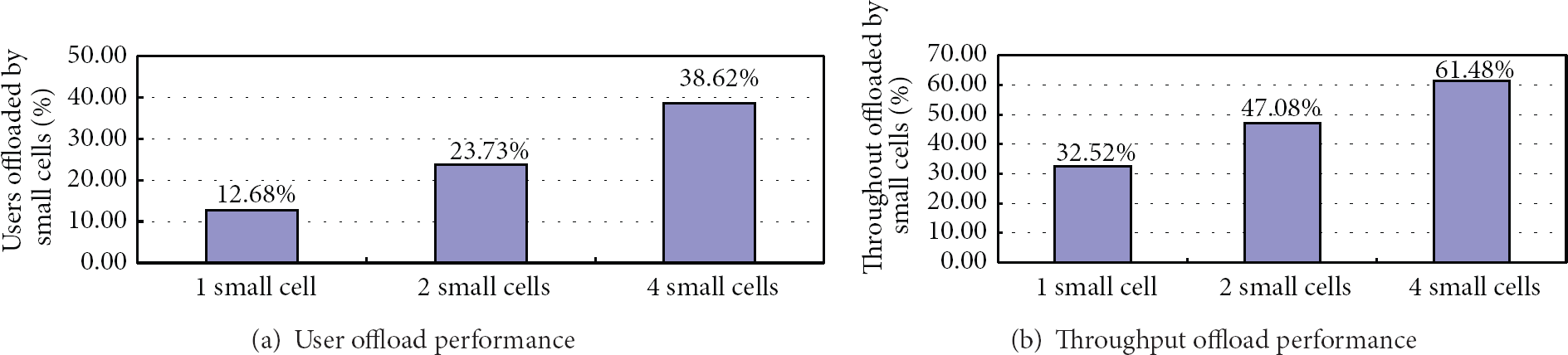
Offload performances with small cells increased from 1 to 4.
In the next group, the number of small cells is fixed to one small cell per sector, and transmit power of small cells is increased from 250 mW to 5 W. The users’ SINR and throughput distributions are given in Figure 7. It is shown that the SINR and throughput are both improved with transmit power increased.
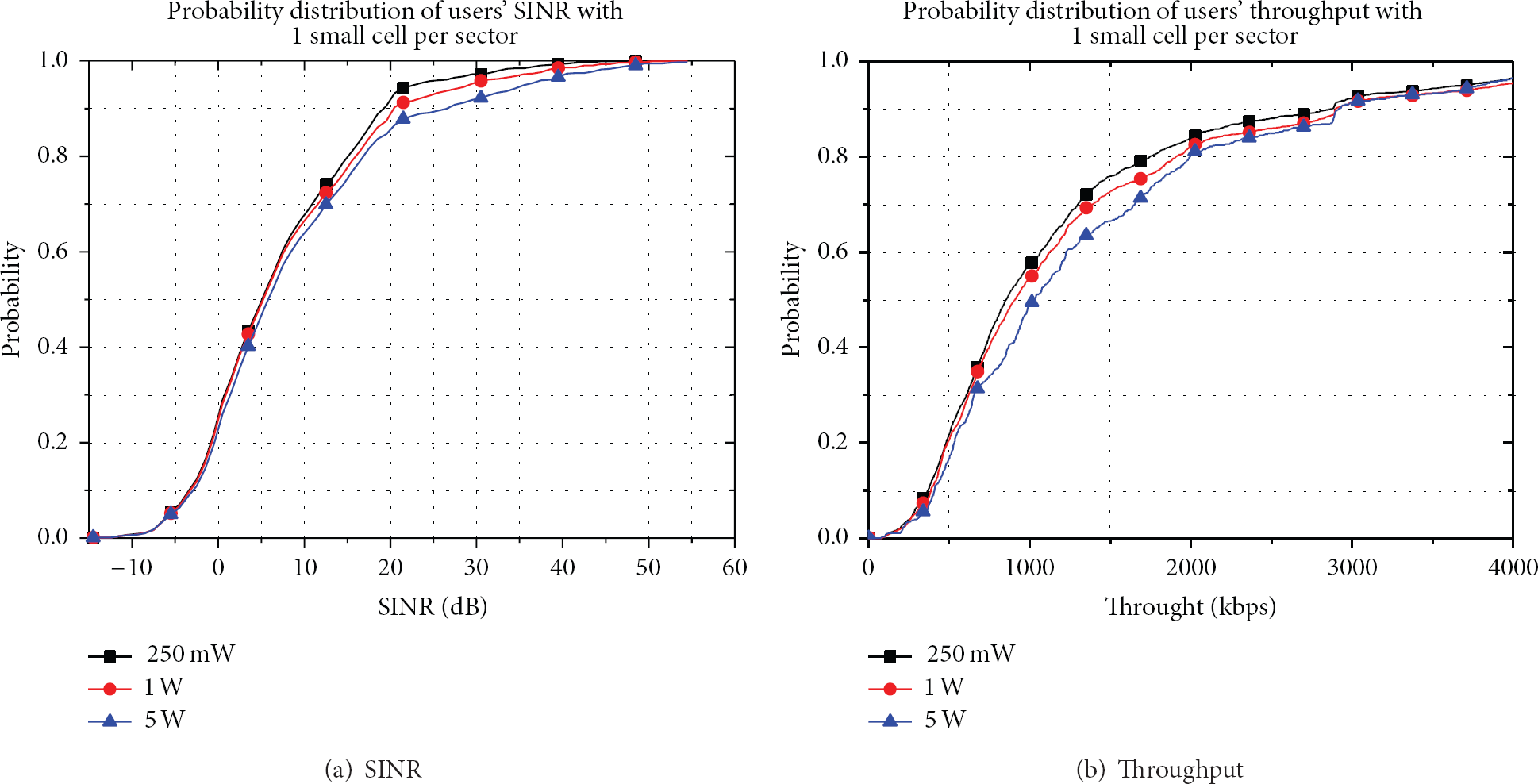
Probability distributions of SINR and throughput with transmit power of small cells increased from 250 mW to 5 W.
5. Smart Cooperation and Energy Saving
As small cells increased, cooperation between macro cells and small cells will become necessary. Liu et al. have given some cooperation schemes [2, 8, 9, 11, 16] in heterogeneous networks. In this section, a new cooperation method is proposed for energy saving in dual-layer networks.
As we know, small cells are deployed to offload peak traffic load in certain areas. However, when traffic load is low, such as at night, all of service traffic could be visited through macro cells. In this case, small cells could be closed, so that energy is saved. The questions are that when small cells can be closed and how many small cells should be closed.
5.1. Energy Saving Model
Assuming there are I small cells in a macro cell. As shown in Figure 2, the macro cell is named Cell 0, and the small cells are named 


5.2. Performance Analysis
Taken Figure 2 as an example, there are one macro cell and 3 small cells overlapped in a certain area. Suppose that UEs are randomly distributed in macro cell covered area. However, density of UEs in Cell 1 overlaid district is 2.5 times as that in only macro cell covered area. Then it is 3 times in Cell 2 overlaid district and 2 times in Cell 3 overlaid district. It is assumed that users’ traffic changes over time. In this simulation, hourly throughput in each cell covered district is given in Figure 8. It is shown that busy hours in Cell 1 are at night, busy hours in Cell 2 are in the daytime, and traffic peak in Cell 3 is not obvious. The overall throughput in this area is also given in Figure 8.
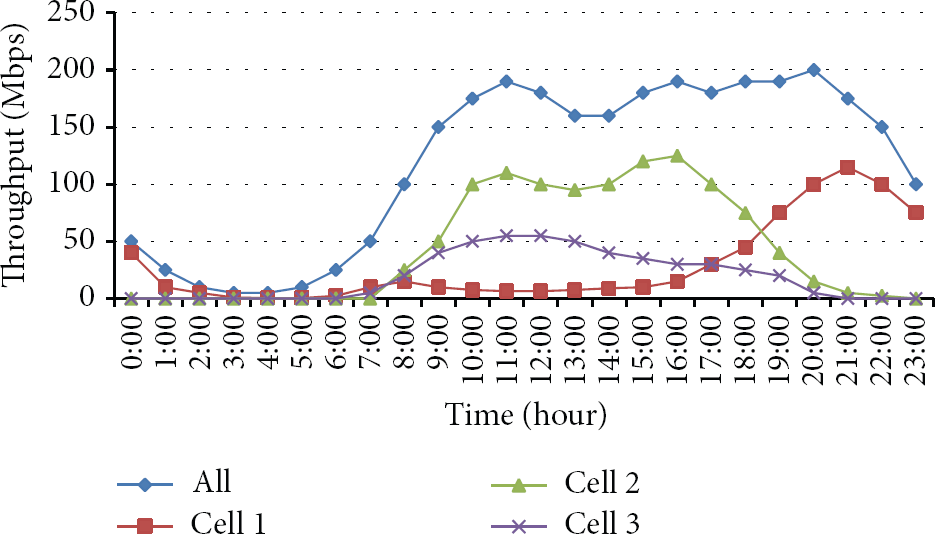
Throughput distribution in a certain area.
In no-cooperation mode, all of small cells and the macro cell are always open. In cooperation mode, the macro cell, named Cell 0, is always open. In each hour, small cell is open when Cell 0 could not afford the traffic load in this area. If one small cell is open, the users’ traffic demands could be satisfied. Then the other two small cells are sleep. Otherwise, another small cell will be open. The rest may be deduced by analogy. Here, small cells are open in order of hourly traffic load in each cell, as shown in Figure 8. The above method is implemented through the Area Control Center (ACC) described in Section 2.
Comparison of no-cooperation mode and cooperation mode is shown in Figures 9 and 10. Assuming that the energy consumption of macro station is 500 W and that of each small station is 100 W, it is assumed that the value of redundancy coefficient ω is 0.8. When throughput capacity of each cell is 150 Mbps, the cooperation mode proposed in this section can save energy from 15% to 25%, and average energy saving is 21%. When throughput capacity of each cell is 120 Mbps, the cooperation mode can save energy from 8% to 25%, and average energy saving is 19%.

Hourly energy consumption in a certain area.

Average energy consumption in a certain area.
6. Conclusion
Due to small cells’ deployment, the traditional mobile networks become dual-layer networks. The advantages of dual-layer networks are obvious. On the one hand, they could improve network capacity by radio resource reuse. On the other hand, they are an effective method to overcome the problem of unbalanced traffic distribution in time-space domain.
In this paper, a system model in dual-layer network is proposed, and Area Control Center (ACC) is used for networks’ cooperation. Then performance of small cells deployment is evaluated in simulations. And a new cooperation method is proposed for energy saving in dual-layer networks. Finally, simulation results of energy saving performance are given to show benefits of the network cooperation scheme.
Footnotes
Conflict of Interests
The authors declare that there is no conflict of interests regarding the publication of this paper.
Acknowledgments
This research is supported by the National Basic Research Program of China (“973 program”) under Grant no. 2013CB329101 and by the Fundamental Research Funds for the Central Universities under Grant no. 2013JBM004. The authors would like to acknowledge the helpful pieces of advice from simulation team members in China Unicom, including Ma Zhangchao, Pei Yushan, Wu Yunxiao, and Xu Jun. They sincerely appreciate the suggestions and feedback from anonymous reviewers.