




Abstract
Wireless sensor networks (WSNs) have been widely applied in many monitoring and surveillance processes. Due to the limited onboard energy resources, the operation of a WSN is severely hindered by its shortened lifespan arising from energy depletion. In order to alleviate this problem, and with the possibility of partitioning sensing workloads, the divisible load theory (DLT) can be adopted to derive a proper workload assignment scheme. However, special considerations have to be paid for its generic applicability in feasible workload assignment for WSNs. In this paper, an examination of DLT based WSN operations including the effect of assignment, measurement, and report times is presented, and the problem of negative workloads inherently generated in some schemes is revealed. Furthermore, by making use of the negativity phenomenon, an active-sleep scheme is proposed for the WSN such that sensor energy consumptions can be reduced and consequently extend the WSN operation lifespan. Specifically, sensors with smaller amount of residual energies are put into the sleep mode when the assigned workloads are negative. On the other hand, positive workloads are normalized and reassigned to sensors with larger amount of onboard energies. Simulation studies are carried out to demonstrate the negative workload phenomenon, and satisfactory performances of the proposed active-sleep scheme are verified.
1. Introduction
Monitoring and surveillance of the environment have become common practices in contemporary societies. For example, it is needed for security purposes in mass transportation terminals as well as required in situations like disaster control. Sensors together with technological advancements in microelectronics and radio communications have made low cost and high efficiency monitoring task realizable. When sensors are deployed in operation in unstructured and harsh environments, sensed data are mostly reported to a central processor through radios. This arrangement then constitutes a wireless sensor network (WSN) [1]. The network may contain sensors ranging from tens to hundreds and it becomes complicated to manage their data reporting operations. In particular, when the radio bandwidth is restrictive then purpose built routing protocols with properly ordered data reporting schemes are required in order to fuse the sensed data and to minimize the communication delay. Generally, routing can be designed in terms of data-centric, hierarchical, and location-based considerations [2]. However, one of the paramount design requirements is concerned with minimizing sensor energy consumption. In most cases, sensors are only equipped with onboard batteries as the sole source of energy that supports their operations. On the other hand, battery capacities are always limited; thus, the operation lifespan of a wireless sensor is severely affected by the energy consumed in operations including sensing, processing, and radio communication. When a significant number of sensors in the WSN deplete their onboard energies, the whole network may become malfunctioned. In order to reduce energy consumption, schemes such as duty cycling [3] can be adopted where, by making use of network redundancy, a small subset of sensor is making active while the others are placed into the sleep mode.
As the fundamental purpose of a WSN is to monitor the target environment, it is a basic requirement that the sensed environment is adequately covered. However, when wireless sensors are placed into their operation positions, there is no guarantee that they are distributed evenly. In order to resolve this limitation, sensors are frequently dispatched in large numbers into their operation field. In such cases, some sensors may be switched off to conserve their energy consumption [4]. Further to putting sensors into the inactive or sleeping mode, it is concerned that sensors need to be returned to their operation state as soon as possible. Such operation, however, is vulnerable to delays in detecting the desired events [5]. Moreover, coverage and energy consumption considerations are interrelated where their integrated designs with active-sleep schemes are crucial to the effectiveness of WSN operations.
In addition to and in parallel with the coverage consideration, sensors are often grouped into clusters such that the sensed data can be routed to the central processor through communication paths with minimum energy consumption. According to the principle of clustered approach, routes are constructed in more than one hierarchy where cluster heads are elected to channel the sensed data. In this way, radio paths are maintained at short distances hence energy consumptions are reduced [6]. Specifically, a cluster head is often an energy rich sensor and when its residual energy reduces, another sensor takes over its role [7] and the overall network lifespan is thus prolonged. Based on the same principle, it is also possible to select cluster heads in accordance with their distances to the central processor permitting low radio power transmission [8]. Furthermore, there are alternatives applied, such as unequal clustering [9] with different numbers of sensors, to provide a reduction in transmission energy.
It has been well recognized that the limitation in onboard energy is a major concern for the extended lifespan operation of WSNs. While it is possible to preserve sensor energy by carefully manage its data reporting routes, it is also feasible to arrange their sensing activities. Provided that the central processor is able to fuse and analyze the measurements, sensors are assigned fractions of the overall sensing workload so as to reduce the energy used. To this end, the divisible load theory (DLT) originally developed for computer workload allocations can be applied in WSNs [10]. According to the principle of DLT [11], it is assumed that the computation workload can be arbitrarily divided into granular portions. When the workload is appropriately assigned to a network of computers, the whole computation task can be finished in a minimum time. Over the past years, DLT has been successfully employed in a large class of computing systems. For instance, it can be used in networks structured in the bus topology [12], star, and tree architectures [13]. The theory is also sufficiently flexible that it can adaptively probe the network parameters for optimal workload assignment in dynamical workstations as well as WSNs [14].
The operation of a wireless sensor subjected to partial workload allocations involves three steps. First, the central processor issues an assignment command, through the radio channel, of the amount of sensing workload required. The sensor then carries out the sensing process which lasts a period of time proportional to the workload. Finally, the sensor reports the sensed results to the central processor also through the radio channel [15]. When the DLT is used in WSN workload scheduling, it has to take into account the different operation schemes. For example, sensors can be arranged in clusters, and reporting can be done using multihop transmissions [16]. On the other hand, different operation schemes may impose difficulties when DLT is applied. In [17], an evaluation was undertaken on operation schemes including sequential reporting, simultaneous task completion, and embedded data preprocessing. Results therein had revealed that workload portions assigned to sensors depend critically on the operation protocol. Furthermore, it was also observed that some schemes may result in negative workloads derived from DLT [18], which are practically infeasible. This special feature, however, can be made use of in putting sensors into the sleep mode to preserve the battery energy.
Because of the fact that sensors are deployed in large numbers to form a sensor network to monitor a targeted environment, redundancies are present in most systems. When sensors are not reporting their sensed data through the wireless link, the amount of energy consumed could be much reduced. Hence, when the sensor operation sequence is properly managed, including the sleep mode, its energy drained can be reduced [19]. Furthermore, it has also been attempted to periodically put sensors into their sleep modes [20] either deterministically or adaptively [21]. On the other hand, sensors are frequently placed in the inactive state and being waked up in response to some events. For these approaches, a critical consideration is on the delay encountered when sensors are reactivated [22] and a bound has to be imposed in practical systems. In [23], a level by level offset schedule was proposed such that alarms arising from critical events are broadcasted through sensors with minimum delay. In the continuous monitoring paradigm, an intelligent result reporting algorithm was developed to put sensors into standby in order to avoid the transmission of irrelevant information to the central processor [24]. With the reduction in radio communication, sensor energies are effectively preserved. In order to manage sensor activities, their topologies can be utilized to form backbones to route the sensed results to the central processor [25]. The essence of such schedule rests on evenly distributing the energy consumption among a multitude of overlapping backbones where sensors are dynamically turned off to save energy. On the other hand, a wakeup algorithm was developed for a mesh sensor network [26]. The locations of sensors are made known to their neighbours and a routing path is designed. The frequency that a sensor becomes active is determined from its position in the result reporting path. Furthermore, an optimal wakeup schedule for a WSN configured in the tree topology was formulated [27]. The wakeup frequency of each sensor satisfies a deadline imposed on the completion time that sensed data have to reach the central processor.
Wireless sensor networks unavoidably have to work under the unfavourable condition of limited onboard battery energy supplies. Since it is difficult to replace the batteries once the sensors are deployed into their sensing field, the minimization of energy consumption is one of the critical issues that enable a WSN to function over a longer lifespan [28]. While satisfying coverage requirements and radio reception strength constraints, methods are being developed to reduce energy consumptions. These include grouping sensors into clusters to route the sensed data, to cooperatively complete the sensing task by sharing the workload, and to enter into sleep or inactive states to preserve energy and consequently extend their operation durations.
In this research, the problem of extending WSN operation lifespan is addressed. We focus on using the cooperative sensing approach where sensors are assigned part of the sensing workload using the divisible load theory. A generic operation scheme is first formulated and two control parameters determining the characteristics of the operations are defined. Variations with regard to the existence of workload assignment time and the result reporting methods are examined. Special situations for some of the schemes that result in fictitious negative workload are revealed. While sensors to be assigned with negative workloads may be treated as redundancies, this phenomenon is beneficial for WSN operations. The contribution of this paper rests on the development of an operation scheme that makes use of the particular negative workload feature, together with the remaining onboard sensor energies, to drive sensors into their sleep modes and extend lifespan.
The rest of this paper is organized as follows. In Section 2, the principle of divisible load theory is reviewed and the characteristics of a generic wireless sensor network operation scheme are examined. In Section 3, the active-sleep operation protocol based on assigned sensor workload and its onboard residual energy is formulated. Simulation studies and results are described and presented in Section 4. A conclusion is drawn in Section 5.
2. Divisible Load Theory in Generic Wireless Sensor Network Operations
The divisible load theory has been frequently applied in scheduling computation works between connected computers [10] such that the required computation tasks can be finished in the shortest time. Based on its analytical tractability and the equivalence between computer networks and WSNs, the DLT had also been used in scheduling sensor workloads [7]. However, the operation of the WSN is severely affected by the nonreplaceable and small amount of battery energy stored onboard the sensors. Therefore, the DLT has to be further enhanced to cope with this implementation challenge. In the sequel, more detailed descriptions of the WSN architecture and DLT implementation issues are revealed.
When the DLT is applied in WSN workload scheduling, it is assumed that the sensing workload can be arbitrarily divided into small portions. Workloads assigned to sensors are calculated at the base station (BS) and the workload dependent durations of sensing are then assigned to the sensors. The overall information gathered from the sensed environment is finally fused at the BS for future analysis. Consider that there are N homogeneous sensors in the WSN having the same sensing and reporting characteristics. The sensors communicate in a star network topology and are grouped into a cluster [29] where a cluster head (CH) has been selected. The other sensors receive workload assignments from the BS through the CH. Moreover, the sensed data are reported from sensors to the CH in the same radio channel [15]. Figure 1 illustrates the WSN architecture in the star topology.
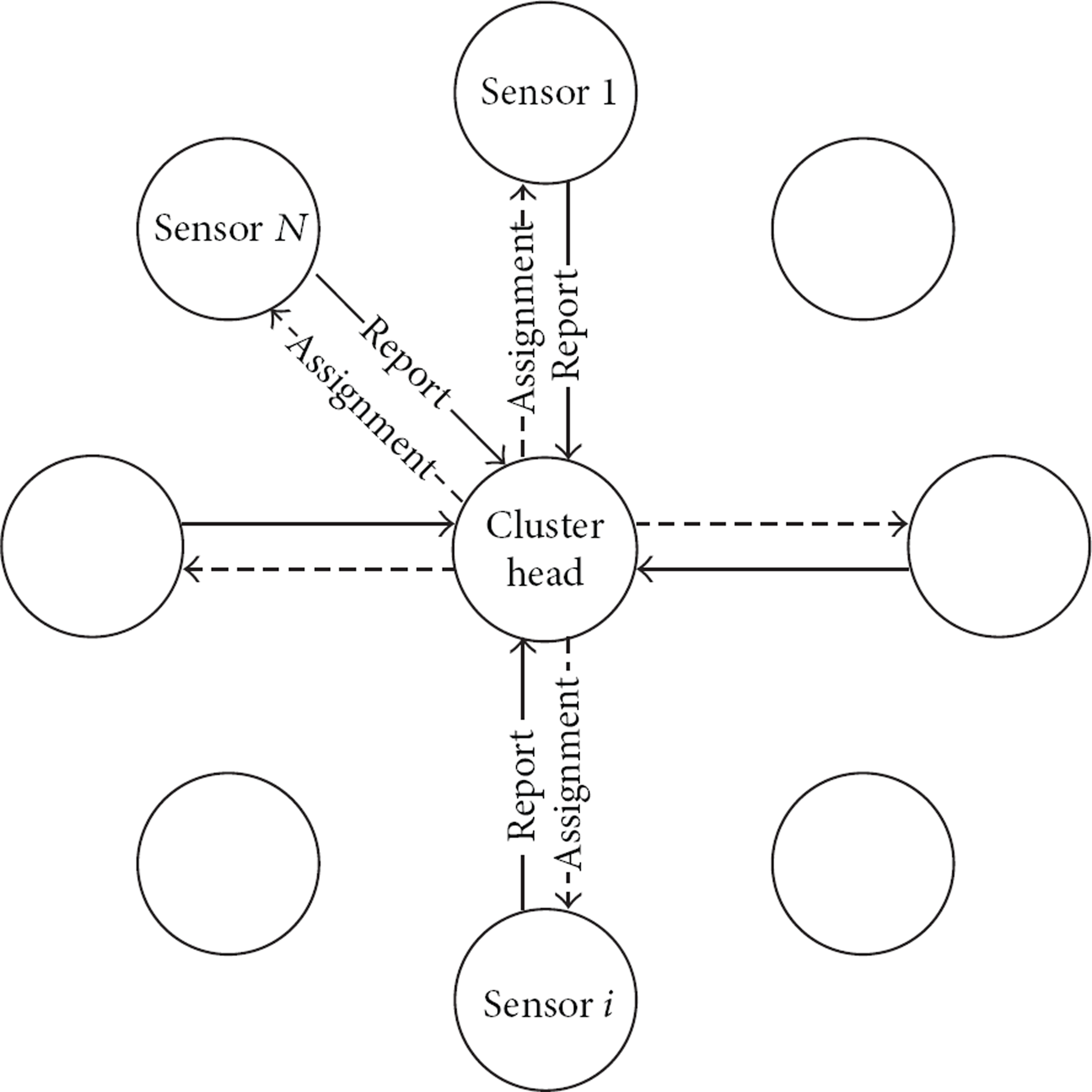
Star network architecture.
2.1. Generic Operation Scheme for Wireless Sensor Networks
Consider a generic arrangement of an operating wireless sensor network. The operation consists of a workload assignment stage, the workload dependent measuring period, and the sensing result reporting phase. The scheme takes a number of forms based on two control parameters,

Workload assignment, measuring, and result reporting scheme.
From the timing diagram showing the operation of two sequentially indexed sensors




Based on the timing relationship, the workload portion to be assigned to individual sensors can then be calculated. Let the workload be normalized, such that all workloads sum to unity:


In order to obtain numerical values of the workloads, the first portion


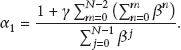
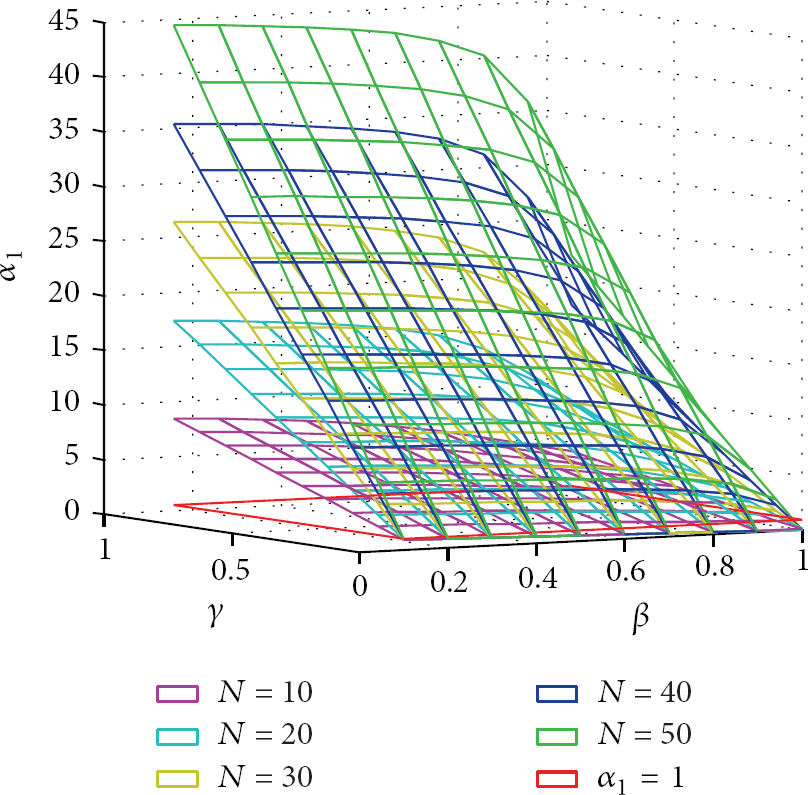
Effect of control parameters β, γ and number of sensors N on the value of the first workload portion.
In the figure,
2.2. Wireless Sensor Network Operation Schemes
Based on the generic wireless sensor network operation schemes and the control parameters, the workloads assigned to sensors can be obtained from (10) and (13) as derived above for specific operation schemes to be described in the following.
2.2.1. Simultaneous Measurement and Dependent Reporting Scheme (SMDR)
Simultaneous measurement operation is realized with the control parameter,

Simultaneous measurement dependent report scheme (SMDR).
In particular, the workload coefficients become

The workload portions are then given by


Workload portions in the SMDR scheme with
2.2.2. Instantaneous Measurement and Dependent Reporting Scheme (IMDR)
In this operation scheme, sensors start measuring the environment once their assigned workload command is received. However, with a single communication channel, assignment commands are transmitted from the CH on a one-by-one basis. Hence, sensor

Instantaneous measurement dependent report scheme (IMDR).
For this considered scheme, the control parameters are


Workload portions in the IMDR scheme with

Workload portions in the IMDR scheme with
In Figure 7, workload portions on increasing β values are plotted. It can be seen that when β increases, some workloads result in negative values. This phenomenon is particularly noticeable when

The change of workloads against coefficient γ is depicted in Figure 8. It is illustrated that workloads change more rapidly for small β values. For large β, the first workload
In practice, negative workload assignments to sensors are not realizable. It would be anticipated that sensors if assigned negative workloads can be put in their inactive or sleep mode. Although its implementation is complicated, inactive sensor is anticipated to reserve energy and consequently extends its lifespan and the time instance when all sensors in the network deplete.
2.2.3. Simultaneous Measurement and Independent Reporting Scheme (SMIR)
In this case, the control parameters are set as

Simultaneous measurement independent report scheme (SMIR).
From the set values of the control parameters, the coefficients that determine the workloads are

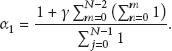


Figure 10 shows the plot of

Workload portions in the SMIR scheme with
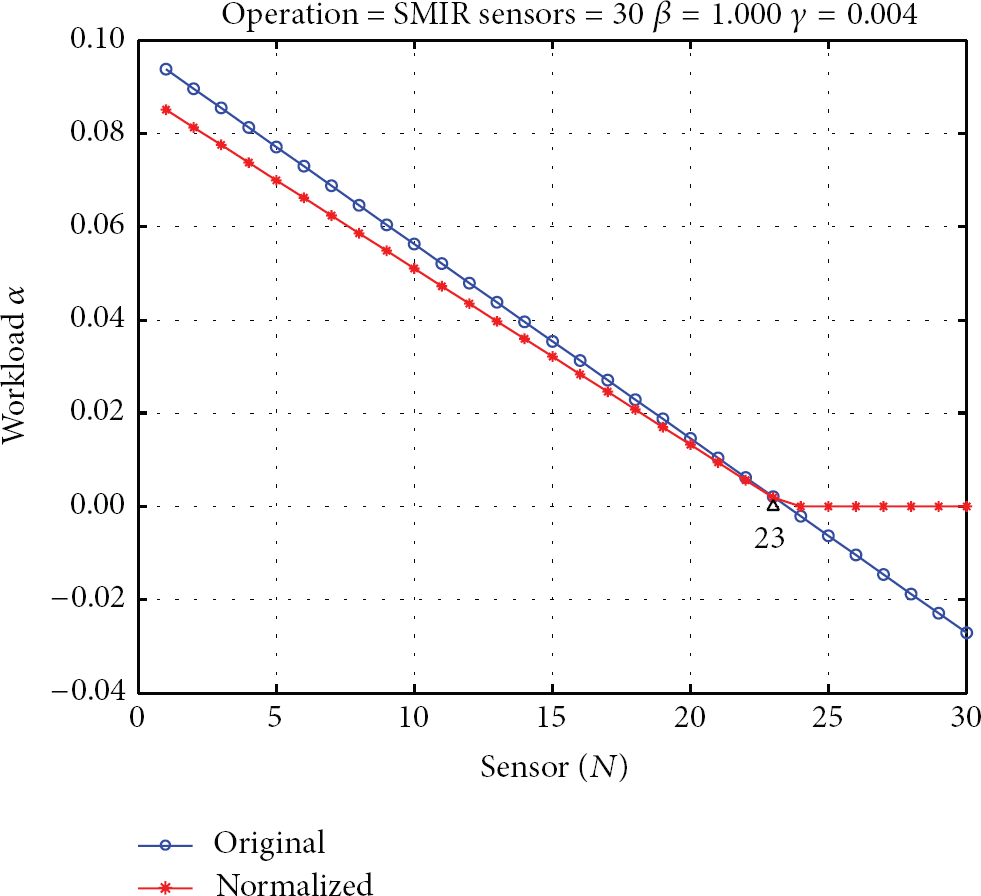
In order to ensure feasible workloads assigned to sensors, it requires


Equation (27) can be rewritten by substituting (25), giving


The effect of workload coefficient γ on the number of sensors

Effect of γ on the approximate number of sensors receiving positive workloads.
2.2.4. Instantaneous Measurement and Independent Reporting Scheme (IMIR)
In this operation scheme, the workload assignment time is nonzero and the result reporting time is independent of the assigned workload. The control parameters are


Instantaneous measurement independent report scheme (IMIR).
With the fact that the workload coefficients are equivalent to the simultaneous measurement and independent reporting scheme, the workload behaviours will be equivalent. However, it should be noted that different definitions are applied in the workload coefficients; see (21) and (31). In general, the γ value will be larger in the IMIR scheme due to a larger value in
3. Active-Sleep Scheme for Wireless Sensor Networks
Workload assignments for sensors in a wireless sensor network, using the divisible load theory, have been examined according to different operation schemes. In particular, some schemes will result in fictitiously negative workloads. The use of this phenomenon together with sensor residual energies as a guideline to put sensors into their sleep modes is presented below. First, the energy consumption profile of a sensor is formulated. Then the method that makes use of the negative workload phenomenon is proposed.
3.1. Sensor Energy Consumption Profile
Consider that the central processor requires a set of B bytes of data to interpret the environment being monitored. This amount of data is the quantity of report produced by all sensors in the WSN and takes
Each sensor is initially installed with a battery onboard as the energy source [30]. Let the average battery voltage during the operation be V volt and the battery capacity is A ampere-hour. Therefore, the initial energy carried by the sensor is


If it is determined by the operation scheme that workload assignment times

Let the electric current drained to sense and produce one bit of data be

When reporting the sensed data that is depending on the sensing time, the report time is

If the sensor is in its sleep mode, its radio receiver remains turned on in order to receive the assignment for the next sensing round. Let the electric current drawn in the sensor circuitry during the sleep period be

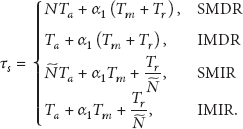
The residual energy remained on the sensor, after the tth sensing and reporting round, is hence equal to

3.2. Active-Sleep Scheme
Based on the residual energy given by (39) and the polarity of the workload inherently derived from DLT, sensors will be placed into their active or sleep mode. In the active mode, sensors will carry out measurements and energies will be consumed. On the other hand, sleeping sensors drain only a very small amount of energy such as maintaining radio reception for subsequent workload assignment commands. The implementation of the proposed DLT based WSN workload assignment scheme is shown in Algorithm 1.
(1) Determine control parameters, ω, z according to operation schemes: SMDR, IMDR, SMIR, IMIR (Section 2.1) (2) (3) Calculate initial workload coefficients (4) (5) Normalize positive workloads, using (28) (6) Select sensors having larger amount of residual energy as active sensors, the number of active sensors is equal to the number of positive workloads (7) Declare the other sensors having negative workloads as in the sleep mode (8) (9) Update the residual energy of each sensor according to whether sensors are (10) (11) Remove these sensors from the list of sensors (12) (13)
4. Experiments
Simulations are conducted to verify the effectiveness of the proposed active-sleep scheme when it is applied in the workload allocation of a wireless sensor network. Programs are coded in the MATLAB R2010a software platform in Windows operation system. The hardware used is a Personal Computer with Intel Core 2 Duo CPU E8400, 3 GHz, and 4 GB RAM.
Test cases studied include the SMDR, IMDR, SMIR, and IMIR operations schemes. It is assumed that sensors are deployed randomly over the sensing field and clusters had been established. Furthermore, in order to test scalability, three cases of increasing sensor numbers and sensing areas are included in the tests. The numbers of sensors are 30, 50, and 100 while the sensing areas are 50 m2, 70 m2, and 100 m2, respectively. These numerical settings allocate approximately 1 sensor for every 10 m2 area.
Because of the randomness in initial sensor deployments, the effectiveness will be assessed by a number of repetitive tests. Statistics are collected on the instances that the first sensor energy depletes and the sensing rounds that half sensors deplete their energies. The simulations conducted are based on the system and sensor parameters given in Table 1.
Simulation parameters.

In the simulations for the proposed approach, sensors are deployed randomly over a square sensing area as shown in Figure 13 at the first sensing round, using the SMDR operation scheme test case as an example. In the figure, a red square is used to represent the cluster head. Sensors are indicated as black dots while their initial energies are denoted by circles whose diameters are proportional to the onboard energy.
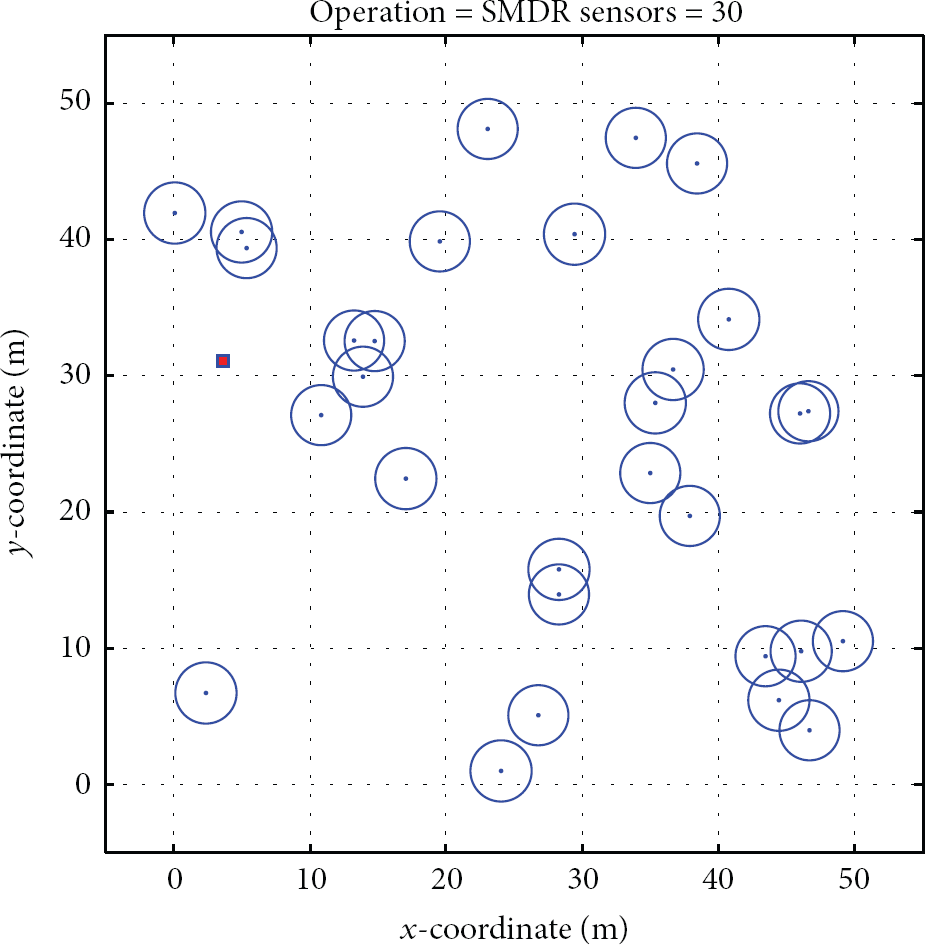
Example distribution of sensor locations (SMDR scheme).
4.1. Initial Workload Coefficient Characteristics
Depending on the operation schemes, the initial workloads assigned to sensors may contain negative elements and those have to be modified in practical implementations. In the following, we illustrate the features of the existences of negative workloads and their effects on the WSN performance.
4.1.1. Simultaneous Measurement and Dependent Reporting Scheme (SMDR)
For the SMDR test case, the initial workload coefficients,

Initial workload coefficients (SMDR scheme).
4.1.2. Instantaneous Measurement and Dependent Reporting Scheme (IMDR)
In the IMDR operation scheme, the workload coefficients are

Initial workload coefficients (IMDR scheme).
4.1.3. Simultaneous Measurement and Independent Reporting Scheme (SMIR)
Figure 16 shows the values of the initial workloads in the SMIR operation scheme. In this case, the coefficients are
Initial workload coefficients (SMIR scheme).
4.1.4. Instantaneous Measurement and Independent Reporting Scheme (IMIR)
When the WSN is operated in the IMIR scheme, its workload values are depicted in Figure 17. The workload coefficients are

Initial workload coefficients (IMIR scheme).
4.2. Energy Depletion Characteristics
The operation of the WSN critically depends on the number of sensors capable of sensing the environment and reporting the resultant data. This functionality is provided only when battery energies onboard sensors have not been drained completely. Simulations are thus conducted to examine the sensing rounds expired when the first sensor depletes and when half of the sensors used up their energies. For sensing rounds beyond the deaths of more than half of the sensors, it is regarded that the WSN has become inoperative and is not further considered.
4.2.1. Simultaneous Measurement and Dependent Reporting Scheme (SMDR)
The instance that the first sensor depletes its energy for the SMDR test case is depicted in Figure 18(a). Since the sensors are deployed randomly and their positions relative to the cluster head would affect the energy consumption, numerical values given here are regarded as typical sample values only. It can be seen that in the SMDR approach, at the 2203 sensing round when the first sensor depleted, other sensors still maintain relative large amount of remaining energies. Figure 18(b) illustrates the instance when half of the sensors depleted their energies with respect to the initial energies inherent in the system and the amount of sensed data transmitted through the radio channel. The sensing round conducted in the SMDR case is 4956.
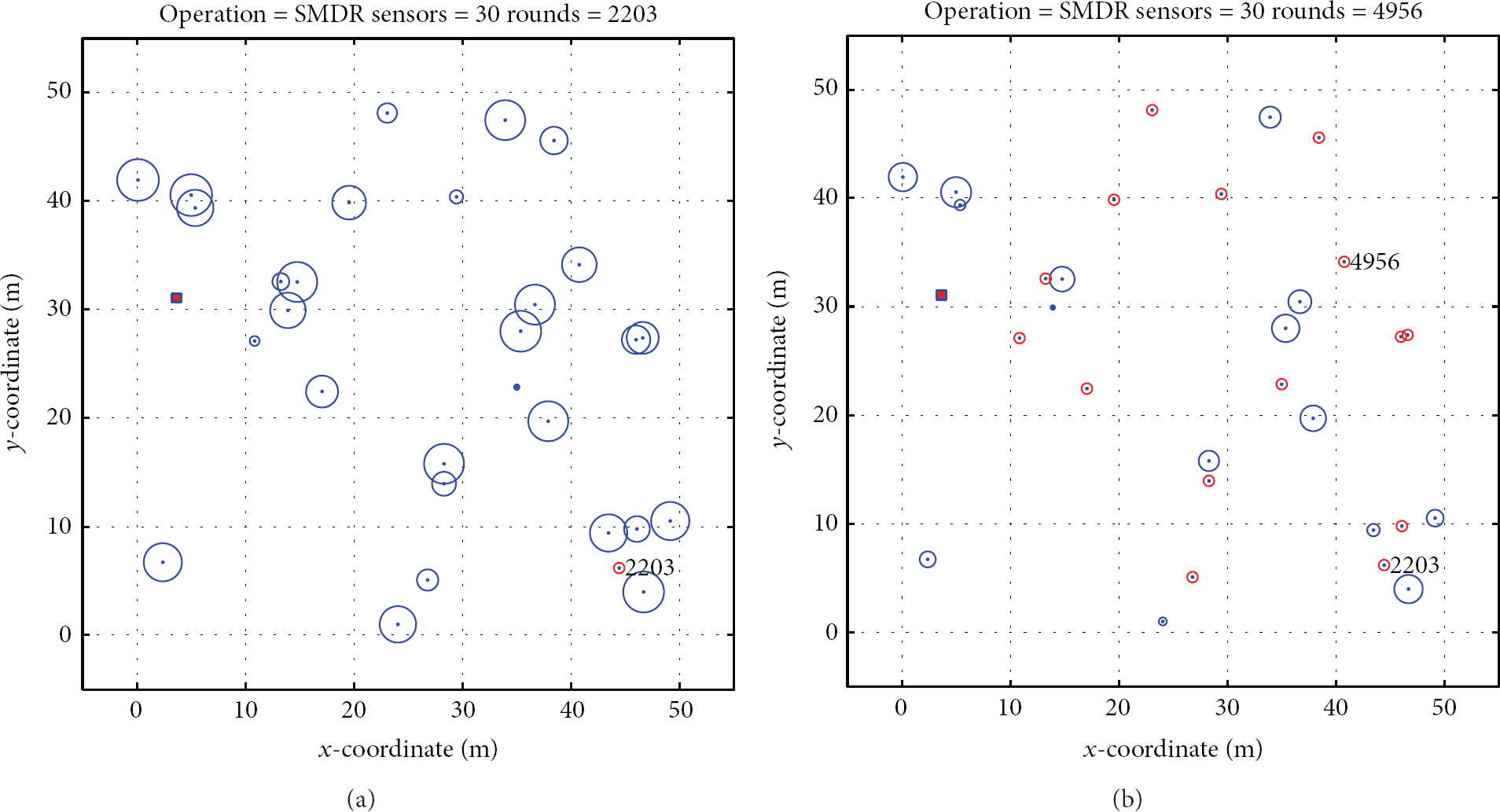
Energy depletion history (SMDR): (a) instance of first sensor depletion and (b) half of the sensors depleted.
4.2.2. Instantaneous Measurement and Dependent Reporting Scheme (IMDR)
The snapshots corresponding to the instances, in the IMDR operation scheme, when the first sensor and half of the sensors depleted are shown in Figure 19. It is observed that the sensing rounds 6407 and 6569, for the two cases, respectively, are much more than the SMDR case. It is because, in the IMDR operations, a collection of sensors was put into their sleep modes according to the proposed activation-sleep workload allocation scheme. Furthermore, the fact that the two instances are closer indicates that the whole WSN is able to function with most of the sensors in most of the lifespan. Because of the evenly distribution of energy consumptions among sensors with the incorporation of the sleep mode, energies had been conserved and led to extended sensing rounds.

Energy depletion history (IMDR): (a) instance of first sensor depletion and (b) half of the sensors depleted.
4.2.3. Simultaneous Measurement and Independent Reporting Scheme (SMIR)
The behaviour of sensor energy consumptions in the SMIR operation scheme is illustrated in Figure 20. It can be seen that the first sensor depleted in the 6303 sensing round while half of the sensors depleted at the 6465 sensing round. The depleting sensing rounds are numerically close to the IMDR case. Furthermore, it is also observed that most sensors can operate through the sensing rounds and have their energies all drained almost at the same time. Since both cases had put sensors into their sleep mode, the extensions in energy depletion times are expected.

Energy depletion history (SMIR): (a) instance of first sensor depletion and (b) half of the sensors depleted.
4.2.4. Instantaneous Measurement and Independent Reporting Scheme (IMIR)
For the IMIR operation scheme, the response in depletion time is shown in Figure 21. The first sensor and half of the sensors depleted at the 6572 and 6712 sensing rounds. Since this operation scheme has sensors in their sleep modes, energies are also conserved as in the IMDR and SMIR cases. Furthermore, the analytical basis for the IMIR scheme is the same as that of the SMIR except a higher workload coefficient γ value and a smaller number of positive workload sensors. Hence, their performances are similar.

Energy depletion history (IMIR): (a) instance of first sensor depletion and (b) half of the sensors depleted.
4.3. Statistical Performance Evaluation
Because of the uncontrollable random placement of sensors into their positions, repeated simulations had been carried out to evaluate the performance of the proposed method from a statistical perspective. In particular, the evolutions of the number of life sensors are collected over the simulation runs and a summarization is also provided.
4.3.1. Simultaneous Measurement and Dependent Reporting Scheme (SMDR)
In the SMDR scheme, all workloads are positive and there is no sensor being put into the sleep mode. Evidently, battery energies had not been conserved and led to early depletion of sensor energies which receive the largest amount of workload. As shown in Figure 22, after the death of the first sensor, the number of life sensors follows a linear decreasing trend. However, when the number of life sensors was reducing, larger portions of workload were placed on the remaining sensors. Consequently, sensors depleted in an accelerated pace as indicated by the steeper slope of the number of life sensors.

History of life sensors operating in the SMDR scheme.
4.3.2. Instantaneous Measurement and Dependent Reporting Scheme (IMDR)
For this operation scheme, some sensors were put into the sleep mode and the conservation of energy was realized. From Figure 23, it can be seen that most sensors can function up to about 6300 sensing rounds which are almost three times of the SMDR scheme. Moreover, it is observed that the number of life sensors decreases rapidly after the death of half of the sensors. This phenomenon indicates that a larger portion of sensors can maintain in the functioning stage up to a larger number of sensing rounds.

History of life sensors operating in the IMDR scheme.
4.3.3. Simultaneous Measurement and Independent Reporting Scheme (SMIR)
Figure 24 shows the history of life sensors operating in the SMIR scheme. Similar to the previous case, sensors here had been put into sleep when they received negative workloads. Consequently, the history of life sensors follows that of the IMDR case. The equivalence includes both the numerical values and the trend.

History of life sensors operating in the SMIR scheme.
4.3.4. Instantaneous Measurement and Independent Reporting Scheme (IMIR)
In the IMIR scheme, the history of life sensors is depicted in Figure 25. Because of the existence of negative workloads, sensors had also been placed in their sleep modes to reduce their energy consumption. Hence, the behaviour of the number of life sensors resembles that of the IMDR and SMIR schemes.

History of life sensors operating in the IMIR scheme.
4.3.5. Scalability
The effects of sensor numbers on the performances of different sensing and reporting schemes are examined. Figure 26 shows the comparison of results on all operation schemes for 30 sensors. Specifically, the mean values over the simulation runs are plotted together with indicators of instances when the number of life sensors is

Comparison of life sensor ratios of operation schemes (30 sensors).
In Figure 27, the comparison of workload assignment schemes with 50 sensors is depicted. It is observed that when the number of sensors increases, the network lifespan also increases. This is expected as workloads are shared between the many sensors. From the test results, it is noticed that the IMDR scheme performs better than the others. In this case, the workload is separated between active and sleeping sensors. Hence, the network lifespan increases as expected.

Comparison of life sensor ratios of operation schemes (50 sensors).
Comparison for the case of 100 sensors is shown in Figure 28. The result is similar to those observed in the 50 sensors case that the network lifespan is the longest in the IMDR scheme. On the other hand, the improvement is more than the previous case. This is due to the fact that the more sensors can be placed into the sleeping mode; thus, larger amounts of sensor energy are preserved. Consequently, the lifespan is extended.

Comparison of life sensor ratios of operation schemes (100 sensors).
5. Conclusion
In this paper, approaches have been presented aiming at extending the operation lifespan of a wireless sensor network (WSN) in a clustered star topology. Methods based on the divisible load theory (DLT) to derive sensing workloads to sensors are considered. By revealing the dependence of the DLT on the derivation of operation schemes, an active-sleep strategy is formulated and evaluated. These schemes include the combinations of simultaneous/instantaneous sensing after the reception of workload commandments and data reporting dependently/independently of the measuring duration. Particularly, when the workload assignment duration is considered in the DLT, negative workloads may result. This special feature is made use of to place sensors having smaller amounts of residual battery energies into the sleep mode. When these sensors are not active, their energy consumptions are reduced. Consequently, the whole WSN lifespan can be extended particularly in the instantaneous measurement and independent reporting scheme for small sensor numbers. On the other hand, the instantaneous measurement and dependent reporting scheme is most effective when the number of sensors is large. Results have verified that by putting sensors into sleep modes, the extension of lifespan can be realized. By using the developed strategy, energy consumptions among sensors are well balanced and the operation duration of the WSN is increased.
Footnotes
Nomenclature
Conflict of Interests
The authors declare that there is no conflict of interests regarding the publication of this paper.
Acknowledgments
This work was supported in part by Hong Kong, Macau and Taiwan Science & Technology Cooperation Program of China (2014DFH10110), National Science and Technology Support Plan (2012BAD10B0101), National Natural Science Foundation of China (61379123, 61325019, and 61173096), ZJNSF of China (R1110679), and Scientific Research Project of Shaoxing University (20135003).