




Abstract
Wireless sensor networks consist of various sensors with limited power, which collect different useful and privately relevant information. We pay attention to some issues related to sensor's location privacy. Ant colony optimization provides a natural and intrinsic way of exploration of search space for preserving sensor's location privacy. In this paper, we focus on protecting the sensor's location by introducing suitable modifications to sensor routing to make it difficult for an eavesdropper to find the original location. And we propose an energy efficient preserving sensor's location privacy based on ant colony optimization scheme, which is a flexible routing strategy to protect the sensor's location. Simulation results show that our strategy can efficiently reduce the chance of packets being detected and prolong the network lifetime. And the adversary can find it difficult to find the exact location of the source node.
1. Introduction
Wireless sensor networks have gained more popularity in recent years. In wireless sensor networks, sensors are deployed in various kinds of applications to monitor events and transmit information to base station. In battlefield, sensors are deployed to monitor enemy's activity and send messages to base station. And sensors can also be deployed to monitor the environment and temperature in civilian applications or monitor animals in natural habitats.
In a wireless sensor network, location information often means the physical location of the event, which is crucially given some applications of wireless sensor networks [1]. So if an attacker gets location information by analyzing a message that was captured, he will move to the location and monitor the event. Meanwhile, the attacker will collect a lot of private information. So the information retrieved by these networks is of vital importance and must be properly secured not only from curious eavesdroppers but also from more skilled adversaries. Messages traversing the network can be protected using traditional confidentiality and integrity mechanisms. But, even if an adversary cannot obtain the information contained in the payloads, he can still retrieve other sensitive information by observing and analyzing the communications [2]. For example, an attacker can obtain the information from the network and the environment being monitored by simple observation of the network traffic [3]. Besides, an attacker can compromise users’ location privacy by observing the wireless signals from user devices [4, 5].
Although many existing privacy techniques can be employed in sensor network scenarios, they cannot effectively preserve the sensor location in a sensor network [6, 7]. The reason is that the problems are different in fact and many of the methods introduce overhead which are too burdensome for sensor networks. And many techniques do not consider the capacity, computing power, and power of sensors, which are the limiting factors in wireless sensor networks. And some techniques analyze privacy and anonymity issues and propose solutions by manipulating the message contents [8, 9]. In contrast to their schemes, this paper addresses the location privacy threat due to the physical wireless medium that allows the adversary to perform traffic analysis to derive the message flows.
In wireless sensor networks, minimization of energy consumption is considered a major performance criterion to provide maximum network lifetime. Ant colony optimization algorithms simulating the behavior of ant colony have been successfully applied in many optimization problems such as vehicle routing and the asymmetric traveling salesman as well as routing in wireless sensor networks [10].
In this paper, we preserve sensor location information and prolong the network lifetime in wireless sensor networks. We present an energy efficient source location privacy protecting mechanism (EELP), which applies the ant colony optimization method to protect the location privacy information. Our work differs from previous works. In order to provide strong communication anonymity, a random packet-forwarding strategy is presented. Whenever a node receives a packet, it will figure out the next hop based on the information of the pheromones, the distance, and the remaining energy according to the routing table. Then each node will update the information. After certain rounds of transmissions, procedure of evaporating and depositing pheromones will be applied which help EELP to adjust the amount of the pheromones. So it is unlikely that the adversary will continuously receive event packets from a monitored node because packets are sent through different nodes which can be far from each other. Moreover, even if the adversary could capture the same packet at different relaying nodes, he cannot correlate the packets. When a node sends an event packet, any neighboring node can be the receiver and it is infeasible to figure out the next-hop node. The adversary cannot also infer the direction to the source node by following the movement of the packets because the packets are sent after random delay. A detailed analysis of EELP is provided, and a comprehensive comparison with existing schemes is presented to show its effectiveness and efficiency to preserve sensor location privacy and prolong the network lifetime.
The rest of the paper is organized as follows. Related work and previously proposed techniques for location privacy are presented in Section 2. In Section 3, we illustrate the preliminaries of the paper. After that, Section 4 discusses the system model. Then we present our energy efficient source location privacy protecting scheme in Section 5, followed by the security analysis and performance analysis in Section 6. Section 7 shows the experimental results and their analysis and comparison. Finally, we have the conclusions in Section 8.
2. Related Work
In wireless sensor networks, it is important to provide confidentiality to the sensor's location. In this section, we describe previous proposed technologies that were designed to protect the objects and establish energy efficient topologies to save energy.
For the location information, the periodic collection and the source simulation schemes are proposed in [11], which can protect the source location privacy against the global eavesdropper. In periodic collection method, every sensor node independently and periodically sends packets at a reasonable frequency regardless of whether there are real data to send or not. Although the periodic collection method can efficiently preserve the source location privacy, every sensor node must periodically send data and the method increases the communication overhead and the latency. And in source simulation method, the fake source nodes simulate the real source node to send fake packets. This can confuse the adversary. But there is no balanced energy consumption between nodes.
In order to protect the source location privacy, a cross-layer approach is presented in [12]. This scheme is similar to phantom routing but it hides the walking phase in the MAC layer to prevent the eavesdropper from monitoring messages in the vicinity of the source node. Since beacons are periodically broadcast regardless of the occurrence of real events, the adversary is unable to distinguish legitimate beacons from those containing event data.
ELSP is proposed in [13], which separates the sensor nodes into groups. The source packet is randomly forwarded within and between the groups with elaborate design to ensure communication anonymity. Furthermore, members of each group exchange encrypted traffic of constant packet length to make it difficult for the adversary to trace back. However, the proxy nodes and the key nodes exhaust a lot of energy.
Ren et al. [14] propose a cyclic diversionary routing scheme called CDR. The network is divided into several rings according to the hop counts from the sensors to the sink. And CDR establishes cyclic diversionary route at different levels with a variant probability. When the data package comes to a ring which is scheduled to establish cyclic diversionary route, it will take a round trip and gather data of all the cluster heads in the ring. So this can increase the energy cost of the network.
In order to maximize the time for adversary trace back to source, a parallel-routing protocol is proposed in [15]. The packets from the same source are passed through different paths to the base station. Furthermore, a weighted random stride routing is presented that breaks the entire routing into rounds. In [16], FitProbRate is proposed to maintain source anonymity, which is an exponentially distributed dummy traffic generation scheme. The Fitprob parameter decides the dummy traffic generated at a dynamic rate, which differs from other similar works. It is a great improvement over source simulation and fake sources but still has the drawback of having overhead due to dummy packet generation.
Fan et al. [17] preserve location privacy by using homomorphic encryption operations to prevent traffic analysis in network coding. In [18], each cluster header can filter the dummy packets received from the sensor nodes of its cluster to reduce the number of dummy packets. However, the scheme requires much computation overhead due to using asymmetric-key cryptography, and the packet delivery delay is long because the cluster header sends packets with a fixed rate regardless of the number of events it collects. Mehta et al. [19] formalize the location privacy problem using a global adversary model and compute a lower bound for the overhead required for achieving a given level of privacy protection. The proposed scheme by Alomair et al. [20] can guarantee event indistinguishability by achieving interval indistinguishability, where the adversary cannot distinguish between the first, the middle, or the end of the interval. In [21], dummy packets can be filtered at proxy nodes, and the lifetime of the WSN is analyzed at different proxy assignment methodologies. Hong et al. [22] propose a scheme that can thwart time correlation attack. In this attack, the adversary exploits the time correlation of transmissions in successive links to learn the end-to-end route. Zhou and Yow [23] propose an anonymous geographic routing algorithm which includes three components to avoid the explicit exposure of identity and location in communication.
In energy-constrained wireless sensor networks, energy efficiency is critical for prolonging the network lifetime. A family of ant colony algorithms called DAACA is proposed in [24]. DAACA consists of three phases: initialization, packets transmissions, and operations on pheromones. In the transmission phase, each node estimates the remaining energy and the amount of pheromones of neighbor nodes to compute the probabilities for dynamically selecting the next hop. After certain rounds of transmissions, the pheromones adjustments are performed, which take the advantages of both global and local merits for evaporating or depositing pheromones. Four different pheromones adjustment strategies which constitute DAACA family are designed to prolong the network lifetime.
In [10], the author wanted to maintain network life time at a maximum, while discovering the shortest paths from the source nodes to the base node using a swarm intelligence-based optimization technique called ACO. A multipath data transfer is also accomplished to provide reliable network operations, while considering the energy levels of the nodes. The energy efficient ant-based routing algorithm for WSNs (EEABR) is proposed in [25], which is another proposed ant-based algorithm to maximize the lifetime of WSNs. The algorithm uses a good strategy considering energy levels of the nodes and the lengths of the routed paths.
3. Ant Colony Optimization Algorithm
3.1. Ant Colony Optimization
In the ACO-based approach, each ant k tries to find a path to provide minimum cost in the network. Ants are launched from a source node s and move through neighbor repeater nodes


In traditional ACO, a special memory named
After all ants have completed their tour, each ant k deposits a quantity of pheromone
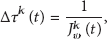

Pheromone values are stored in a node's memory. Each node has information about the amount of pheromone on the paths to their neighbor nodes. After each tour, an amount of pheromone trail

In simulations, ACO parameter settings are set to values 1 for α, 5 for β, and 0.5 for ρ, which were experimentally found to be good by Dorigo [26].
3.2. Energy Consumption Model
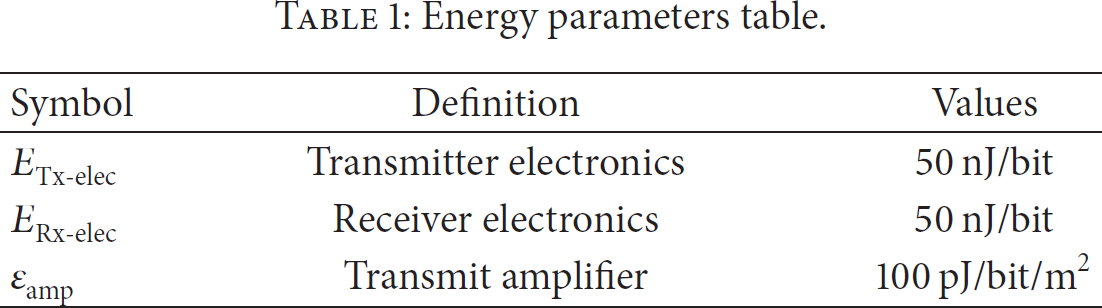
Many energy models [27, 28] are used for energy consumption in wireless sensor networks. In our work, we employ the model in which a packet with the size


Energy parameters table.
4. System Model and Design Goals
4.1. Network Model
Sensor networks consist of a number of different types of sensor nodes that have been deployed to monitor environment or collect data and send information to the sink in an area. In sensor networks, every sensor sends data to its neighboring nodes within its radio range.
In this paper, we assume that sensor nodes are evenly deployed in the sensor network and do not move after being deployed. All of sensors have roughly the same capabilities, power sources, and expected lifetimes. When a sensor node monitors an object, the node will send a message to a base station. And a message is forwarded through certain routing strategies that adopted the sensor networks. Moreover, we assume that a base station is deployed in the network and collects event data with greater computational capabilities.
4.2. Adversary Model
For various kinds of wireless sensor networks, we assume that an adversary is a motivated and funded attacker whose objective is to learn sensitive location-based information. The adversary has unbounded energy resource, adequate computation capability, and sufficient memory for data storage. And the adversary can observe and eavesdrop on the information in a limited range. Although the adversary can eavesdrop on the message between nearby sensor nodes to backtrace to a parent node, the adversary cannot determine the content of the message that is encrypted by secret keys.
Similar to [29], we assume that the adversary stays nearby the base station or the sink, where it is guaranteed that a large number of packets will arrive eventually. The adversary is constantly monitoring and eavesdropping. When the eavesdropper monitors a message, he knows which node among the neighborhood sent that message and will move to the transmitting node. If the eavesdropper does not monitor any message for a certain time, he will stay or go back one step and keep monitoring. The adversary repeats this process until it reaches the source. Then the adversary can know the location information of source node. Besides, the adversary can monitor the different transmission rates between the nodes and select the correct backtracking routing. And the eavesdropper may observe the correlation in transmission times between a node and its neighbor, attempting to deduce a routing path.
4.3. Design Goals
The network is modeled as a visibility graph
5. The Energy Efficient Location Privacy Protecting Scheme
In this section, we propose EELP family to protect location privacy. In EELP family, we choose different process of evaporating and depositing pheromones to prevent the adversary from getting the location information. We first give the basic idea of the energy efficient location privacy protecting scheme (EELP), and then two heuristic algorithms (LRP-EELP, LPU-EELP) are proposed to enhance the basic idea. In Section 5.1 we present the basic idea of EELP, LRP-EELP is shown in Section 5.2, and Section 5.3 describes LPU-EELP in detail, respectively. And we assume that the contents of all transmitted data packets are encrypted by secret keys so that the adversary cannot gain the content of transmitted packets and find the location of sensors. Many key predistribution protocols can be used for our purpose [30–32]. So the adversary cannot use the content to trace the object.
5.1. The Basic Idea of EELP
In wireless sensor network, nodes are considered as the artificial ants. The routing table records the amount of the pheromones of links. Whenever a node receives a packet, it will figure out the next hop based on the information of the pheromones, the distance, and the remaining energy according to the routing table. Then each node will update the information. After certain rounds of transmissions, procedure of evaporating and depositing pheromones will be applied which help EELP to adjust the amount of the pheromones. The objective of this process is to guide the transmitting routing path to approach the global optimal routing path which will conserve energy for the network to some extent.
Firstly every node constructs its own neighbor set and routing table by broadcasting its
The structure of EELP is shown in Algorithm 1. Initially, the initialization of the network is carried out. Each node broadcasts “Init” message to its neighbors. Then only the nodes that are nearer to the sink node will be recorded in the routing table and the contents of the table are initialized. Then the transmission begins, the source nodes periodically send the data packets to the sink node. When a relay node receives a packet, it will calculate the probability of selecting the next hop based on the elements in the routing table including the distance, the amount of the pheromones, and the estimated remaining energy. The transmission proceeds until the data are transmitted to the sink node. After transmitting
(1) Network Initialization Node Initialization Neighbor Initialization Routing Table Initialization (2) The source node begin to send its data packets to the destination hop by hop (3) (4) the node s evaluates the energy of i. (5) the node s calculates (6) the node s selects the next hop node k based on (7) (8) the node s sends the packets to the node k (9) (10) (11) the node k evaluates the energy of j. (12) the node k evaluates (13) the node k selects the next hop node g based on (14) (15) the node k sends the packets to the node g (16) (17) round = round + 1 (18) (19) Evaporating Pheromones. (20) Depositing Pheromones. (21) Updating Routing Table. (22) Energy Broadcasting. (23)
In the EELP, the pheromone is the most critical part in adjusting the probabilities in the routing table. Therefore, we firstly illustrate the constitution of the routing table. The routing table contains the following elements: 
α and β are two parameters which control the relative weight of the pheromone 

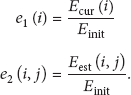


In the transmission phase, when a node receives a packet, it will evaluate the remaining energy of all the neighbors and update all the values in the routing table to dynamically select the next hop. When round is multiple of 
ρ stands for the rate of evaporating pheromones. Then the procedure of depositing pheromones is performed. Each node selects the neighbor with the maximum estimation energy (e.g., the node j) and increases the pheromone of node j by 
When round is multiple of
(1) (2) the node i evaporates the pheromones. (3) the node i searches for the node with the highest (4) the node i deposits pheromones (5) (6) (7) j deposits pheromones of i according to (15). (8) i broadcasts the current energy. (9) (10) (11) (12) the node i updates (13) the node i updates the routing table. (14) (15)
Once Algorithm 2 is finished, in the next period of
If a node happens to exist in the conjunction of two or more different paths, the parent nodes will also use (15) to increase the pheromones.
5.2. The Limited Range of The Pheromones-Based EELP
In order to protect the location privacy, we require that the packets are randomly transmitted to the sink according to the pheromones. We use
We set the format of the packet header, which obtains the id sequence of nodes and total energy consumption as
When a packet is received by a node, it will be taken which adds id information and energy consumption information into the newly defined packet header. And the sink node can gain the energy cost of the transmission path and adjust the amount of pheromones to obtain more transmission paths. Let
When a packet is sent to the sink node, the sink node checks if the 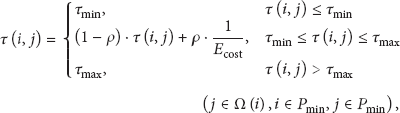
5.3. The Local Pheromones Updating-Based EELP
According to [33], Ant Colony System (ACS) applies the mechanisms of ACO but some changes have been made to overcome the drawbacks of ACO and enhance the performance of ACO. ACS can make full use of the accumulated pheromones in the path. And the evaporating and releasing of the pheromones are only carried out in the most optimal path so far. When an ant passes through a trail, the pheromone of that trail will be reduced which aims at enhancing the possibility of finding more optimal solutions in other trails.
We use the Ant Colony System-based EELP algorithm for establishing the location privacy protecting paths to preserve energy called LPU-EELP. When a node selects the next hop node, we set a random parameter 
After successfully sending the packet in each round, each node will locally update the pheromones as follows:

ρ stands for the rate of evaporating pheromones and

The local pheromones updating aims at reducing the probability of the selected node; thus, the probabilities of unselected nodes will increase. So this can prevent the adversary from getting the source information by analyzing the traffic pattern.
6. Performance Analysis
In this section, we will analyze the source location privacy of the proposed routing scheme. And then we will give the analysis of the communication overhead of EELP. Finally, we make an evaluation of the trace back time. From the following analysis, we can see that our scheme brings a better network security and maximal network lifetime.
6.1. Security Analysis
In EELP, the contents of all transmitted data packets are encrypted by secret keys so that the adversary cannot gain the content of transmitted packets and find the location of sensors. So the adversary cannot use the content to trace the object. And we assume that the adversary monitors a local area with the intention of locating objects. We describe that a node i transmits a packet which is observed by the adversary at time t. And each observation is a tuple
The adversary wants to identify a set
There is a close relationship between the location privacy and the analysis of location information of the adversary. The more uncertainty the adversary will analyze the location of nodes, the better protecting location privacy is. In the eavesdropping area, the adversary will need to choose the nodes of his analysis. We assume that the possible sensor nodes in 

The entropy characterizes the adversary's uncertainty about the location of the source node in a wireless sensor network. The maximum entropy (or the maximum privacy level) can be achieved when the probabilities
In this case, the source node is perfectly hidden in the network and the adversary cannot reduce the anonymity set. Therefore, we have the optimal entropy

We note that the level of location privacy is measured by the size of
We note that the size of
For packet back tracing attack, it is unlikely that the adversary will continuously receive event packets from a monitored node because packets are sent through different nodes which can be far from each other. Moreover, even if the adversary could capture the same packet at different relaying nodes, he cannot correlate the packets. When a node sends an event packet, any neighboring node can be the receiver and it is infeasible to figure out the next-hop node. The adversary cannot also infer the direction to the source node by following the movement of the packets because the packets are sent after random delay.
6.2. Communication Cost and Privacy
While we preserve the location privacy in the sensor network, we are interested in minimizing the amount of communication overhead. It is efficient to extend the lifetime of sensor network by decreasing the communication overhead. Let 
Theorem 1.
Given a possibility set 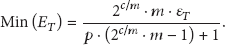
Proof.
For a possibility set 
We can get the relationship between privacy and communication cost from Theorem 1. Meanwhile, in order to get the minimum communication cost in the sensor network, we need to achieve a given level of location privacy. If the size of the set
Figures 1 and 2 show the relationship between the level of privacy and communication cost. Figure 1 shows the relationship with the different number of protected nodes. For the same p, we can see that as the number of protected nodes

The different number of protected nodes.

The different probabilities p.
In Figure 2, when p increases, the location of nodes is more possible in another trace and the higher level of privacy is needed to generate less communication overhead. When p decreases, we note that an observation belongs to only a few traces, so an observation is in another trace with less possibility. So increasing privacy is needed to generate increasing communication cost.
6.3. Trace back Time
In order to preserve location privacy, we analyze the adversary trace back time. If we can increase the trace back time, we can efficiently protect the location information and the adversary may spend lots of time to choose the correct routing. In our scheme we note that sensor nodes can randomly choose their neighbors to transmit a packet to the base station. So this can generate n paths as a set 
We note that when all of the flows are distributed to
7. Experimental Results
In this section, we simulate different algorithms (CDR, ELSP, EELP, LRP-EELP, and LPU-EELP) to evaluate and compare the performances of the EELP family with existing schemes. We analyze the energy cost of each node and the network lifetime. Meanwhile, we evaluate the network security and location privacy against the adversary attack. In the experiments, our method can effectively preserve the location privacy of sensor node and decrease the communication overhead.
7.1. Simulation Setup
The simulation is based on TOSSIM [35]. In the simulation, we assume that there are sensor nodes distributed randomly in a square area of
Simulation parameters table.

During our evaluation, three metrics are used to evaluate the performance of the proposed schemes: remaining energy, latency, and privacy. Remaining energy is defined as the remaining energy of the sensor network. Latency is the time for an event message traveling from the source to the base station. Privacy is the important information for different schemes.
7.2. Simulation Results
According to (6) and (7), Figure 3 shows the total energy expended in the system as a transmission distance increases from
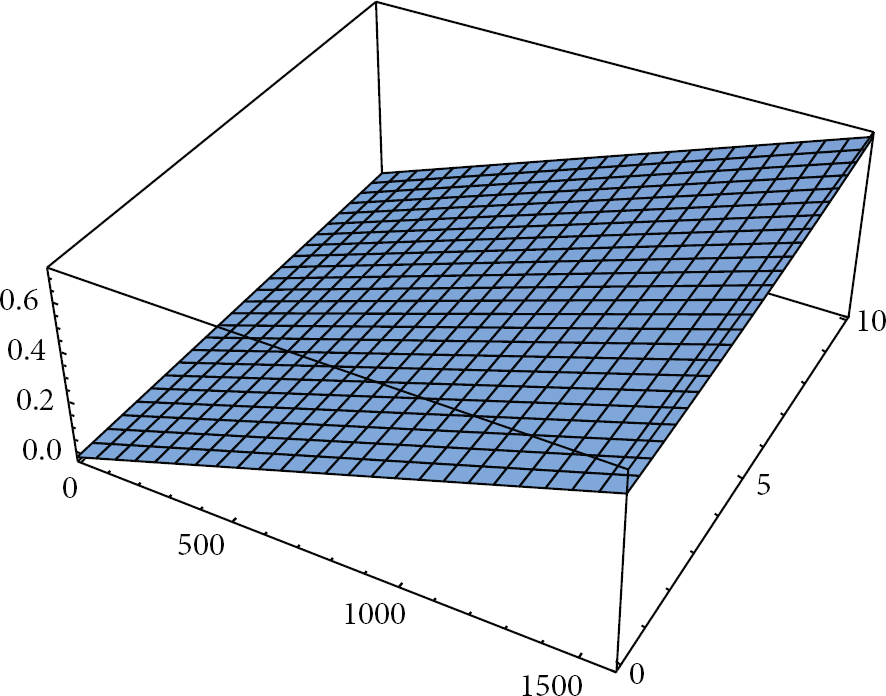
Energy consumption under EELP route scheme (3D).
In Figures 4 and 5, we calculate the average remaining energy of nodes with different algorithms. And higher remaining energy means less energy consumption. Each algorithm will initialize the topology of the network. With the transmissions going on, some of the algorithms will reconstruct or maintain the topology to balance the energy cost of each node [36]. Hence, the topologies of some algorithms are dynamical.
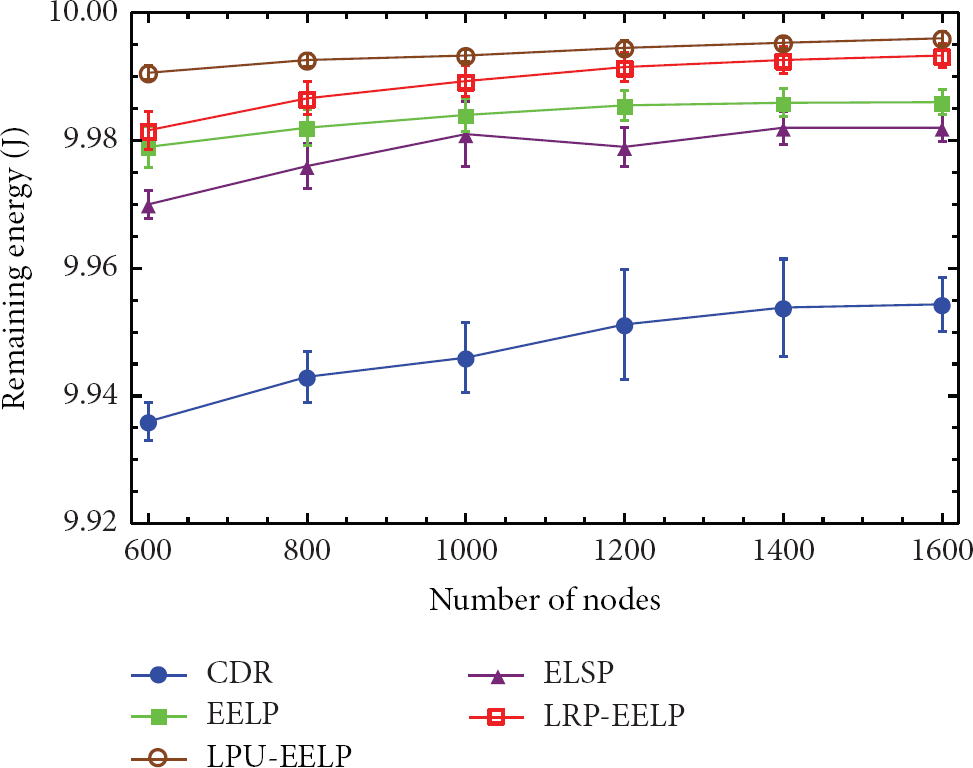
The remaining energy after transmitting 5000 packets.

The remaining energy of the network.
We can see that the energy consumptions of construction and maintenance of the network topology are high in CDR and ELSP. For CDR scheme, in order to conduct dummy traffic to hide real events, CDR divides the network into several rings according to the hop counts from the sensors to the sink. In each period, the ring where the object appears must establish cyclic diversionary route. And other rings are scheduled to establish cyclic diversionary route with a certain probability
In the family of EELP, there is no energy consumption in maintaining or reconstructing the topology; therefore, the average energy cost is lower than other algorithms. The energy consumption concentrates on sending packets to the next hop. After certain rounds of transmissions, the pheromones adjustment will be carried out, which does not cost much energy. From Figures 4 and 5, the relationship among the EELP family in terms of average energy cost is LPU-EELP < LRP-EELP < EELP. So our methods can efficiently save the energy.
From Figures 6 and 7, we calculate energy difference to evaluate the balanced consumption of energy. We aim at testifying which method can balance the usage of energy. The balanced consumption can directly affect the lifetime of the network, which is the most prominent feature in energy efficiency in wireless sensor networks. If the energy difference is big, the energy is not averagely used, whereas smaller energy difference indicates the balanced energy consumption.

Energy difference after transmitting 5000 packets.

Energy difference of the network.
We can see that the energy difference of CDR is the highest. The reason is that it will establish cyclic diversionary route at different levels with a variant probability. And some nodes send dummy packets to their cluster heads with a probability q. And in a ring, the packet will take a round trip and gather data of all the cluster heads in the ring. So the cluster nodes and its neighbors generate unbalanced energy consumption. Therefore, a big energy difference occurs.
In ELSP, the proxy nodes and the key nodes consume most of the energy. Because the proxy nodes receive the other group packets and send the packets to the key nodes. Then the key nodes transmit the packets to other normal nodes. So the packets must be transmitted by the proxy nodes and the key nodes in a group. Thereby, there is a large energy difference between the proxy nodes or the key nodes and others.
In EELP, when selecting the next hop, each node will estimate the remaining energy of its neighbor to achieve balanced usage of energy. Moreover, in the process of depositing pheromones, the path with minimum energy cost will obtain additional pheromones, by which the balanced usage of energy is implemented. The energy difference relationship among EELP family is LPU-EELP < LRP-EELP < EELP.
The initial energy of each node is set as 0.05 J. We measure how many rounds the network will sustain until any node exhausts in each algorithm. The parameter

Network lifetime of different protocols.
In Figure 9, we analyze the average success ratio of one hop transmission of each algorithm. Packets are sent from the sources to the destination nodes. We count the success ratio of one hop transmission of each packet and calculate the average successful ratio of the one hop transmission. And the successful ratio of EELP is higher than other algorithms.

Average successful ratio of one hop transmission.
Figure 10 compares the network transmission latency in different algorithms. In CDR, the packet will take a round trip and gather data of all the cluster heads in the ring. Before the packet is transmitted to the sink, the packet will take a round trip in each ring. And the packet will need time to process the dummy messages in CDR. So the transmission latency will keep rising as the number of rings grows between the source and the sink. In ELSP, the packet will be transmitted to each group. In a group the packet will randomly be sent to the internal nodes. So the transmission latency increases. In EELP family, each node will estimate the remaining energy of its neighbor to send the packets to the next hop. And our methods can choose the short transmission path using the ant colony optimization. So the transmission latency is short in EELP family. The transmission latency relationship among EELP family is LPU-EELP < LRP-EELP < EELP.

Latency comparison among different routing protocols.
Figure 11 shows that we have to pay communication costs to achieve a given level of location privacy. During the simulation, we assume that there is only one object in the network. And whenever a sensor node receives a packet, it will forward it to the next hop as soon as possible. And the object frequently generates the event messages. So the interval is very small. We can see that the communication cost increases as the level of privacy increases. And the communication cost of our method is very close to the performance of the optimal privacy, which is analyzed in Theorem 1. In CDR, cyclic diversionary route and some dummy messages are created to confuse the adversaries. But this can generate massive and unbalanced energy consumption. In ELSP, the packets are transmitted from one group to another group. And the proxy nodes and the key nodes frequently send packets in a group. Although it can protect the source node, it generates more communication cost in ELSP. In EELP family, according to the remaining energy of the neighbor, a node randomly chooses the high remaining energy node as the next hop node. So the EELP family can effectively and efficiently preserve location privacy with practical tradeoffs between communication cost, privacy, and latency.

The relationship between communication cost and the level of privacy.
7.3. Other Characteristic
7.3.1. Robustness
When selecting the next hop, each node will refer to the probability recorded in the routing table, all the paths are dynamical, if a node is removed from the network, only the nodes nearby are required to update the routing table. Therefore, the adjustment of removing a node can be locally achieved. As a result, EELP family owns the feature of robustness.
7.3.2. Fault Tolerance
Suppose errors occur in the element of the node which prohibits it from working. In this case, the node nearby can remove this node from the routing table. Therefore, the faulty nodes will no longer exist in the topology of the network. They cannot affect the transmission of the network. So EELP family is fault tolerant to faulty nodes.
7.3.3. Scalability
Since nodes are deployed randomly in the network, each node only needs to maintain the routing table for dynamically selecting the next hop. Therefore, if a node is added in the network, it only needs to broadcast its identity information and sets up routing table; the nodes nearby are only required to add a new item of the routing table. So we can conclude that EELP family is scalable.
8. Conclusion
In this paper, we focus on the location privacy problem in sensor network. We propose an energy efficient source location privacy protecting scheme (EELP), which applies the ant colony optimization method to prevent an adversary from back tracing message routing paths to the event source. Whenever a node receives a packet, it will figure out the next hop based on the information of the pheromones, the distance, and the remaining energy according to the routing table. Then each node will update the information. After certain rounds of transmissions, procedure of evaporating and depositing pheromones will be applied which help EELP to adjust the amount of the pheromones. And it can efficiently protect the location information of source node and prolong the network lifetime.
Wireless sensor network is widely deployed to collect valuable information. However, it is obvious that preserving private location information is a big challenge in sensor network. And an eavesdropper may be able to find location information by monitoring and analyzing message routing paths, which can be a serious privacy issue. Our future work is to further study wireless sensor networks and efficiently protect location privacy. And we are extending the proposed protocol to support other functions, such as range query, top k-query, and data aggregation.
Footnotes
Conflict of Interests
The authors declare that there is no conflict of interests regarding the publication of this paper.
Acknowledgments
This work is supported by NSFC (Grant nos. 61300181, 61272057, 61202434, 61170270, 61100203, and 61121061) and the Fundamental Research Funds for the Central Universities (Grant nos. 2012RC0612 and 2011YB01).