




Abstract
Tracking and monitoring system using radio frequency identification (RFID) have gained a lot of improvements especially for applications that need automation with reduction in human intervention and become more interesting nowadays with the increasing market demand for internet of things (IoT) technologies. The objective of this study is to improve the machine-to-machine (M2M) communication using active RFID with wireless sensor networks (WSNs) with heterogeneous data transfer (regardless of power meter type) for monitoring and identification of household electrical consumption. M2M is a popular technology and has become a part of our daily life. WSN through ZigBee technology is applied to monitor data and to read the load consumption from the electrical household power meter by embedding a tag module into the meter. In-house built-in tag was embedded into an electrical power meter with a power management circuit communicating to a reader at an RF signal of 2.45 GHz based on the star network topology with the sleep mode function. The experimental results indicated that the electrical power meters with embedded tags successfully worked wirelessly with acceptable mean value of electrical consumption difference in Watts more than those without tags (standalone meter), which is in the range of 2.44 W to 2.5 W based on 10-hour measurements.
1. Introduction
New technologies have become very useful and important in our daily life, and they were made easier and more manageable with their low cost, as well as their ability to reduce manpower requirement. Thus, obtaining higher system reliability is an important objective. Therefore, a growing interest in sensor application has created the need for protocols and algorithms in large-scale self-organizing ad hoc network that consists of hundreds or thousands of nodes. Hence, in the past decades, WSNs have been the subject of considerable research because of their potential for civilian and military applications and their applicability to M2M networks. M2M networks do not only consist of sensors. WSNs play an important role in M2M communication as they are the key components. Therefore, sensor networks are sometimes referred to as M2M networks [1, 2].
The RFID technology plays an important role in any kind of applications because of its ability to identify and track information. RFID tags are the most important components in this technology [3]. RFID is an automatic identification (ID) method whereby ID data are stored in electronic devices called RFID tags (or transponders). These data are retrieved by RFID readers (or interrogators) using RFs [4]. RFID mainly consists of a tag and a reader, and these two devices are wirelessly connected. The signal sent out by the tag is read by the reader when both of the devices are within the prescribed distance range. The read signal is then sent for data utilization [5]. RFID comes generally with three types of RFID tags. The active RFID tags contain a battery and can transmit signal autonomously. The passive RFID tags do not have a battery and require an external source to start signal transmission. The battery-assisted passive RFID tags require an external source to power them up but have significant higher forward link capability that provides longer range [3].
RFID technology has been used for ID and monitoring in many applications, such as in the Universiti Kebangsaan Malaysia (UKM) campus bus ID and monitoring, which uses RFID and geographical information system (GIS) [5]. RFID is used to monitor and identify the location of a certain bus, which is presented as a map aided by the GIS software. RFID has also been used in monitoring enterprise activities stream using RFID tags [6] and in an accurate location tracking based on active RFID for health and safety monitoring [7].
In this paper, the wireless data monitoring of electrical power meter in a household by using the embedded active RFID tag module with WSN platform is employed. Active RFID by ZigBee protocol is used to monitor the value and to identify the electrical power meters. The ZigBee modules embedded into the electrical power meter act like wireless sensors that monitor the electricity consumption value of electrical power meter and transmit the data value with the RF signal to the portable reader. The relayed signal is applied to facilitate some daily life processes, save time, and reduce cost and error in information system that can be committed by humans. This work is the first attempt to combine and embed RFID and WSN technology into a single platform with household power meter and improve the heterogeneous functionality in data transfer regardless of power meter type. The scope of this paper is limited to the proposed hardware communication reliability compared to the standalone system communication.
The aims of this research are as follows: to develop an M2M communication system using RFID system concept for household power meter monitoring, to study the performance of the proposed household electrical power meters with embedded active RFID tags based on WSN platform in comparison to standalone design, and to analyze the power consumption of the embedded power meter with RFID tags under the same load for characterization.
Sequentially, this paper is organized as follows. In Section 2, the research methodology is divided into four parts, namely, (Section 2.1) the principle of electrical power meter; (Section 2.2) the embedded active RFID tag architecture; (Section 2.3) the portable reader architecture; and (Section 2.4) the proposed WSN. Section 3 describes the experimental results and presents the discussion. Finally, the conclusions are summarized in Section 4.
2. Methodology
In this study, the wireless monitoring of electrical power meter using embedded RFID tag with WSN platform is proposed. This research used an active RFID tag embedded into the power meter to monitor the value on real-time function and to read the electrical power meter using the star network topology based on the sleeping-mode function. The end part of the RFID tag sends the data to the reader tag, which can communicate with the reader several meters away. The main principle of the study is presented in the details of the following sections.
2.1. Principle of Electrical Power Meter
In this section, the basic theory of the electrical power meter is presented. Electrical power meter is an energy provided by a source to a load in a unit time. Let us consider an alternating voltage

Active power is the energy used by the load to perform work in a unit of time. This power is the one actually used by the circuits and the loads, and it is the average of the instantaneous power:

Reactive power is used in the generation of the electric and magnetic fields. It is expressed as

Apparent power, S, is the combined power value that is obtained by allowing for the different values of current and voltage or the quadratic sum of the active and reactive powers as defined above in (2) and (3). Thus, S can be found as follows:

A power meter is an instrument that measures the electric power or the supply rate of electrical energy (in Watts) in any given circuit. An instrument that measures the electrical energy in Watt-hour (electricity meter or energy analyzer) is essentially a Wattmeter that accumulates or averages the power consumption. Such instruments can measure and display many parameters such as the following: voltages, current, apparent instantaneous power, actual power, power factor, energy consumption over a period of time, and cost of electricity consumed [9].
2.2. Embedded Active RFID Tag Architecture
Embedded system has become a centrally important element in a wide variety of applications, ranging from hand-held devices to household appliances and RFID tags [10]. Tags need power to perform computations. These tags can obtain power from a battery or from electromagnetic waves emitted by readers that induce an electric current in the tags. The power requirements of a tag depend on several factors, including the operating distance between the tag and the reader, the frequency being used, and the functionality of the tag. In general, the more complex the function supported by the tags is, the larger it is for the power requirement. For example, tags that support cryptography or authentication require more energy than those that are limited to transmitting an identifier [11].
The active RFID tag can function as a sensor. On the other hand, the components that compose a wireless sensor node are similar to those that compose the active RFID tag. A sensor node is equipped with an onboard battery and transmits sensing information to a sensor network router or coordinator, whereas the active RFID tag transmits ID information to the active RFID reader using the same components. If we consider a tag's ID as one type of sensing information, the concept of the sensor is extended to involve the active tags [12]. Therefore, in this section, the application of an active RFID tag embedded in the power meter to monitor the value in real time is presented. The active RFID tag contains some types of power source [13]. It enables a greater communication range and can be applied to metal objects. It also allows easy addition of sensing modules [14, 15].
In this part, the proposed embedded active RFID tag module architecture is presented. The proposed embedded active RFID tag module is designed to support the heterogeneous electrical household power meter. Smart RFID tag modules are capable of measuring instantaneous voltage and current of the electrical circuit which it is connected to. The RFID tag module draws its power supply from the electrical power meter, which contains a power management circuit faction that transforms the voltage source of active RFID power supply of 3.3 V. The embedded device contains a microcontroller as well as a software programme that determines the behavior of the active RFID tag, and communication is created between devices. In this work, ZigBee is applied to act as a wireless sensor to monitor the value of the power consumption from the electrical household power meter and send information to the reader as shown in Figure 1.

Electrical power meter with embedded RFID tag module.
The details of RFID tag module are shown in Figure 2 illustrating the elements of embedded module which consists of microcontroller unit, current sensor, voltage sensor, real-time clock, memory, display unit, and RF transceiver.

The proposed embedded RFID module.
In the proposed study, the embedded RFID module is designed to minimize the power consumption. The functions of each part are described as follows.
Current Sensor. It is a sensor to detect the electrical current consumption from the electrical power meter.
Voltage Sensor. It is a sensor to detect the voltage signal to the microcontroller, which uses the basic of voltage divider circuit.
Microprocessor. It is necessary to have some processors in the circuit to communicate with the electrical power meter through the ZigBee interface and retrieve the necessary information.
RF Transceiver. Wireless ZigBee Pro Series 2 module is used for wireless communication between the smart embedded RFID tag module and the reader which are available in the utility company/office.
Display Module. The LCD module shows the data value as the process.
Real-Time Clock. The function of this clock is to generate the integration period for the embedded module.
Memory. It is a unit to record and store data such as current, voltage, time, date, and month.
The principle of data monitoring for embedded RFID tag module is shown in the flowchart in Figure 3.

Flowchart of data monitoring.
2.3. Portable Reader Architecture
RFID is a communication system between two nonequivalent nodes: the RFID reader and the RFID tag. The RFID reader is stationary, large, and expensive and has a direct current (DC) supply. On the other hand, the RFID tag has almost the opposite characteristics [19].
All readers have an RF subsystem interface to communicate with tags. Most of them have a second interface to communicate with the enterprise subsystem. The enterprise subsystem interface supports transfer of RFID data from the reader to enterprise subsystem's computer for processing and analysis. In most cases, the enterprise subsystem interface is used for remote management of the readers. The interface may be a wired (e.g., Ethernet) or a wireless (e.g., Wi-Fi or satellite) link. Many systems use Simple Network Management Protocol (SNMP) to monitor the readers and alert administrators of conditions that warrant attention [11].
In this section, basic principle of the RFID tag-reader communication is presented. The architecture of the active RFID reader is shown in Figure 4.

The proposed architecture of the active RFID reader.
Figure 4 shows the architecture of the proposed active RFID reader, which is similar to the embedded active RFID tag module. The functions of each part are explained as follows.
Microprocessor. It controls every part of the architecture, which is connected to the RF transceiver, to receive the data signal and send it to the RS-232 USB interface to a personal computer.
RF Transceiver. ZigBee Pro Series 2 module is adopted to be as RF transceiver, to send the wake-up signal to the end device tags, and to receive the data signal from the end device tag to the microprocessor.
LCD Module. It displays the value received from the end device tag, which is embedded within the electrical power meter.
Clock. It generates the time of the database system.
Memory. It records and stores data such as current, voltage, time, date, and month.
USB Interface. A USB peripheral is also available on this portable active RFID reader which would be useful in exporting data read from the smart meter to a PC for further processing or monitoring.
2.4. The Proposed WSN
The tag-reader communication protocols are often specified in the RFID standards. The prominent international standards include the ISO/IEC 18000 series for item management and the ISO/IEC 14443 and ISO/IEC 15693 standards for contactless smart cards. The most recent EPC global Class-1 Generation-2 standard is essentially equivalent. It is inexpensive, has power savings features, and uses the low data-rate wireless star technology design which uses the LR-WPAN type. Its lower layers are based on the IEEE 802.15.4 LR-WPAN standard. The electrical power meter with embedded active RFID tag communicates with the tag reader at 2.45 GHz to support the wireless network communication by developing a fully automatic and embedded system to monitor the value and ID.
An ideal wireless sensor should have the following properties: being smart and scalable, possibility to be incorporated into a network, having very low power consumption and programmable software, being capable of fast data acquisition, reliable, accurate over a long period, and economical to acquire and install, and requiring no maintenance [19]. Selecting the optimum sensor and wireless communications link requires the knowledge of the application and the problem definition. Battery life, sensor update rates, and size are all major design considerations.
In this study, the ZigBee protocol based on IEEE802.15.4 standard with star network topology in sleeping-mode function is proposed (single point-to-multipoint) where a single base station can send and/or receive a message from a number of remote nodes as illustrated by Figure 4. The remote nodes can only send or receive a message from the base station but they are not permitted to send messages to one another [20].
The embedded RFID in the proposed module for reading and sending data wirelessly is based on radio frequency 2.45 GHz. Each of the three RFID tag which are embedded inside communication modules is programmed to be an END DEVICE. The portable reader also uses the same protocol that is set to be as COORDINATOR in sleeping-mode function. The end device tags can communicate by sending packet data to the reader automatically under the system installed as shown in the structure in Figure 5.

The proposed wireless communication system based on star network topology.
The star network is adopted in this study because of its low latency communication between the remote node and the base station [20]. The proposed study takes three electrical power meters with embedded active RFID tag module using a two-way communication between the end device tags and the portable reader. The electrical power meters with an embedded RFID tags module can communicate wirelessly to the portable reader whenever the reader sends the wake-up signal to the end device tags. The RFID tag stays in the power-up mode until it builds a DC voltage. When the DC voltage is generated, the RFID reader sends a continuous RF signal to all the RFID tags in the neighborhood, and it starts to send the address of the RFID tags to the chosen one. The RFID reader sends the address of the signal from the RFID reader and enters the reading mode. Subsequently, the RFID tag sends the information to the RFID reader until it receives a STOP command from the reader or until the RF signal vanishes. In this study, the tag-reader communication based on the sleeping-mode function is used because sleep mode minimizes the power consumption.
3. Experimental Results and Discussion
In experiments for performance evaluation, the important parameter to determine is the difference between the electrical power meters in the household with the absence and presence of embedded RFID tags. The experimental results are presented in Table 1.
Comparison of three electrical power meters without and with embedded RFID tags.

The results are divided into three parts, which consist of the following: (Section 3.1) electrical power meters without embedded RFID tags; (Section 3.2) electrical power meter with embedded RFID tags; and (Section 3.3) performance analysis. The details are explained as follows.
3.1. Electrical Power Meter without Embedded RFID Tag
In this section, the experimental results of the electrical power meter without tag for three electrical power meters, namely, A, B, and C, are presented. Each electrical power meter is tested under different loads. Electrical power meters A, B, and C had a load of 100 W, 200 W, and 300 W, respectively. The experimental results are obtained for an hour per day for ten days. The experimental results are shown in Table 1. The obtained results indicated that the electrical power meters without RFID tag modules had no error and they can show the correct value according to the real load consumption.
3.2. Electrical Power Meter with Embedded RFID Tag
In this section, the experimental results of electrical power meters A, B, and C with embedded RFID tags under the same loads as those of the electrical power meter without embedded tags are presented. The results present that electrical consumption is higher than the one without RFID tag modules ranging from 2.44 W to 2.46 W.
3.3. Performance Analysis
This section is to compare the power difference of electrical power meters without and with embedded RFID tag modules. The power consumption differences are shown in Table 1.
Figure 6 shows the comparison graph of electrical power meters A, B, and C without and with embedded RFID tags under the loads of 100, 200, and 300 W, respectively. The graph shows that the power differences in terms of Watt for three of electrical power meters have fluctuated between 2.44 and 2.46 W with time of testing for 10 hours.

Magnitude of power difference for the electrical power meters A, B, and C between those without and with embedded RFID tags.
The graph in Figure 7 shows the power difference results of electrical power meters with load consumption of 100 W, 200 W, and 300 W, respectively. The graph compares three electrical power meters with difference loads, which shows that when the electrical consumption is increased, the power differences in terms of percentage (%) will gradually decrease to be more stabilized.
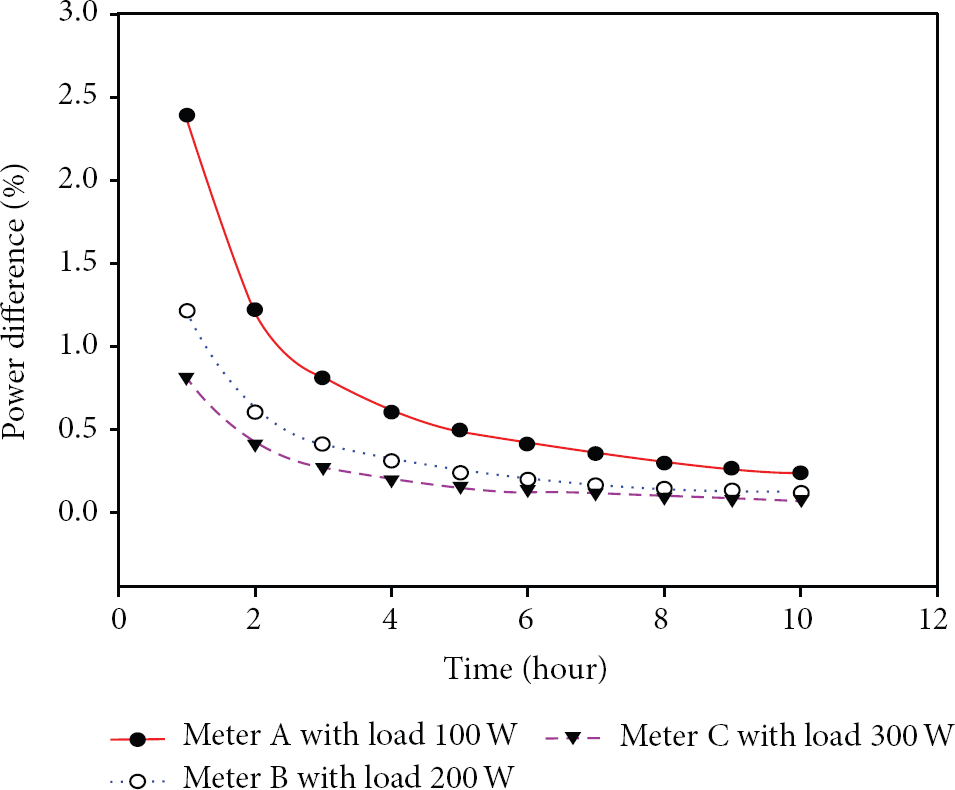
Power difference in terms of percentage (%) between electrical power meters A, B, and C without and with embedded RFID tags.
The electrical power consumption of monitoring RFID module is approximately 2.43 W, which can be explained by the illustration of individual block in Figure 8.

Total power consumption of the proposed embedded RFID tag based on individual blocks.
The total power consumption of the RFID tag module consists of many sections, such as current sensor, voltage sensor, microcontroller, embedded active RFID tag, display module, real-time clock, memory, and power supply, and can be calculated as follows:
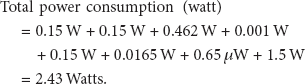
Therefore, the calculated total electrical consumption which is about 2.43 W verifies the measured power difference (ranging from 2.44 to 2.46 W) and it is within the acceptable limits meaning that it is at least +/− 0.07 W from theory. In addition, this also indicates that the addition of the embedded RFID tag into the electrical power meter only increases the electrical usage by 0.24% to 0.71% only for 10 hours, which is very small compared to electrical consumption of other household appliances like common 14 W for bulb and 55 W for fan per hour.
The research is to be useful, which can be applied in real environment. The billing electrical charges companies can take into consideration to deduct the additional billing prices (due to additional power consumption of embedded tag which can be negligible) since the proposed wireless monitoring reduces the operational cost for manual electrical power meter collection at the premises.
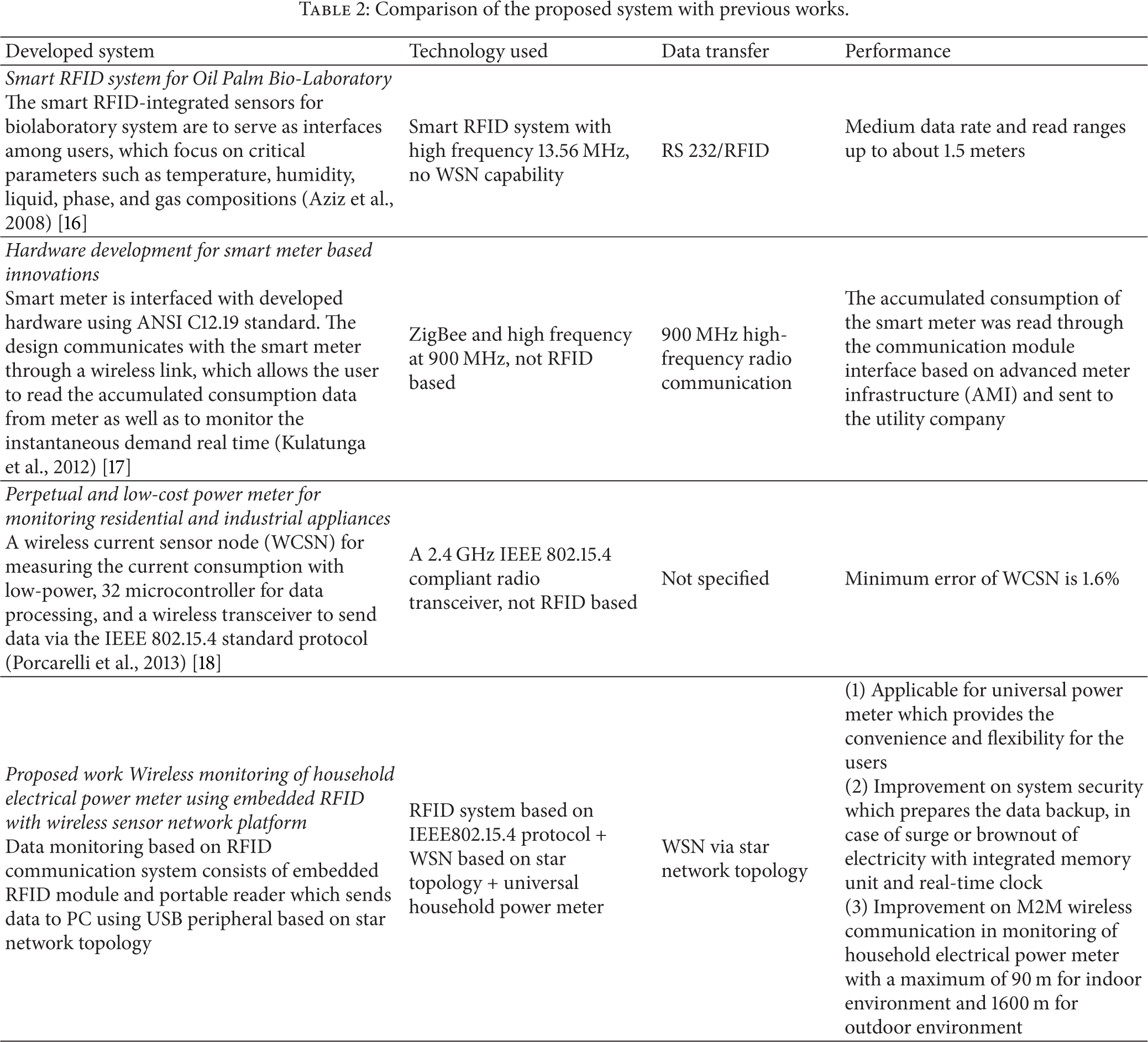
From the proved results, the RFID system based on WSN application is best suited where the business processes are dynamic or unconstrained, the movement of the tagged assets varies, and more sophisticated security, sensing, and/or data storage capabilities are required [21]. In this paper, smart embedded module is proposed to read accumulated power consumption for the month and current demand through the user interface. On the other hand, it is also effective to monitor the electrical power consumption in real time with more security of information, which sends the wireless data monitoring to the users. The WSN based on ZigBee is adopted in this system because of lower cost and lower power consumption than the Bluetooth [22] and Wi-Fi in the 802.11 standard [23]. The ZigBee can be defined as a low tier, ad hoc, terrestrial, and wireless standard; in some ways, it is similar to Bluetooth. It is promoted by ZigBee Alliance and incorporated in the IEEE 802.15.4 standard, although ZigBee has some features in addition to those of the 802.15.4 standard. Another protocol is needed because other existing short-range protocols such as the 802.11 and 802.15 use too much power and are too complex (and, thus, too expensive) to be embedded in virtually every kind of device imaginable. The data rate of ZigBee is 250 kbps at 2.4 GHz. ZigBee allows small, low-cost devices to transmit quickly the small amount of data such as temperature readings for thermostats, on/off requests for light switches, or keystrokes for a wireless keyboard. ZigBee devices [24], typically the battery-powered ones, can actually transmit information up to 90 m for indoor environment and 1600 m for outdoor environment because each device within the listening distance passes the message along to any other device within the range, and only the intended device acts upon the message. Meanwhile, Bluetooth is mainly used for short-range communications, for example, from a laptop to a nearby printer or from a cell phone to a wireless headset. Its normal range of operation is 10 m (at 1 mW transmit power), and this range can be increased to 100 m by increasing the transmit power to 100 mW [22]. Moreover, to highlight the advantages and benefits of the proposed RFID system based on WSN platform, a comparison is done with the previous works as shown in Table 2. This shows that the combination of RFID, WSN, and power meter technology heterogeneously into a single platform is feasible. This paper provides guidelines for design requirements employing the proposed mentioned technologies.
Comparison of the proposed system with previous works.
4. Conclusions
In this paper, the wireless data monitoring of electrical power meters using embedded RFID module with WSN platform is proposed with consideration given to fulfill the requirement for universality usage of household power meter types. Smart measuring of embedded RFID module provides data to the utility office and can be more frequent. These data may contain a considerable amount of confidential information based on RFID system with WSN platform application, which is useful for monitoring the value and ID of the electrical power meters to facilitate some daily life processes, saving time, and reduce the operating cost because of the reduction in the manpower requirement and error in information system that can be omitted through humans, thus improving the M2M communication and providing higher reliability on the communication system because the current development will focus on local control strategies. This study can be guidelines to the electrical power utility company and consumers for alternatives in electrical consumption billings in the future.
Footnotes
Conflict of Interests
The authors declare that there is no conflict of interests regarding the publication of this paper.
Acknowledgments
The authors would like to thank the USM RU (Research University) Grant Secretariat and Malaysia Ministry of Higher Education (LRGS Fund) for sponsoring the development of the in-house built-in RFID devices.