




Abstract
Multiphase structure of bainite and M/A constituent can be obtained for X80 oil-gas pipeline through a novel heat online partitioning (HOP) technology. The effects of partitioning temperature on the microstructure and mechanical properties of the experimental steels were researched by means of mechanical properties test, microscopic analysis, and X-ray diffraction. The results show that with the increase of the partitioning temperature, the strength of the experimental steel decreases and the ductility increases because of the increase of bainite lath width, the decrease of dislocation density, the increase of retained austenite content, and carbides coarsening. The decrease of the volume content and stability of retained austenite is the key factor, which leads to the increase of strength and the decrease of plasticity in a high range of partitioning temperature.
1. Introduction
Extensive studies to develop high deformability line pipe have been conducted. Recent studies [1, 2] indicate the significant economic advantages of using higher grade line pipes in constructing long distance pipelines. On the other hand, construction of pipeline has expanded into the environmentally severe regions such as cold region, seismic region, deepwater, and sour gas environment. Various material properties in addition to higher strength, such as high toughness, high deformability and sour resistance property, are required for recent line pipe steels. One of the most challenging fields for pipeline developments is thought to be the seismic and permafrost regions where large plastic deformation is expected to be introduced to buried line pipes.
In order to improve the deformability of pipes, two different types of microstructural control technologies were proposed, based on theoretical and analytic studies on the effect of microstructural characteristics on stress-strain behavior. Grade X65 to X100 line pipes with ferrite-bainite microstructure were manufactured by optimizing the microstructural characteristics. Grade X80 line pipes with bainitic microstructure containing dispersed fine M/A constituents were also developed by applying new conceptual TMCP process. Steel plates with bainite and martensite-austenite constituent (M/A) microstructure can be obtained by applying heat online partitioning (HOP) process subsequently after accelerated cooling process. HOP process is an induction heating process that heats steel plates rapidly. Variety of microstructural controls, such as fine carbide precipitation and M/A formation, can be utilized by this newly developed heat process. One of the significant features of the HOP process is to improve resistance to strain-aged hardening. Both free carbon and dislocation density can be reduced by carbides precipitation and tempering of bainite during the partitioning step of HOP process [3–6]. Therefore, the partitioning process plays a key role in improving the deformability of pipeline steels. Trial production of X80 pipeline steel was conducted by applying the HOP process. Microstructural characteristics and mechanical properties of developed X80 high deformability line pipes are introduced in this paper.
2. Material and Method
Trial production of grade X80 pipeline steel was conducted by applying the heat online partitioning process. Table 1 shows the chemical composition of grade X80 pipeline steel. Plates with the thickness of 18.4 mm were manufactured in the plate production mill, which is equipped with accelerated cooling and online heating devices. Plate manufacturing conditions in controlled rolling, accelerated cooling, and heat treatment online process were precisely controlled so that enough strength and high deformability were achieved.
Chemical composition of the trial X80 pipeline steel.

The heat online partitioning process was developed in order to produce various properties in addition to higher strength, such as toughness, deformability, and sour resistant property [7, 8]. Figure 1(a) shows the schematic illustration of temperature profiles in plate manufacturing process; Figure 1(b) is Gleeble 3500 thermal simulator. The HOP process divides into three steps. First, accelerated cooling (ACC) is stopped above the bainite transformation finishing temperature, where untransformed austenite remains. At this stage, the microstructure is bainite and untransformed austenite. Secondly, immediately after ACC, partitioning at 410°C, 440°C, 470°C, and 500°C (TP = 410~500°C for 500 s), respectively. The subsequent step is partitioning above the fast quenching temperature Tq to accomplish the partitioning (diffusion) of carbon from supersaturated bainite into retained austenite so as to keep carbon enriched austenite stable during subsequently cooling to room temperature. During the heating, carbon in bainite diffuses into austenite. Finally, after the quenching, austenite with higher carbon content retained, and this can transform into MA by water cooling because of highly concentrated carbon in the austenite.
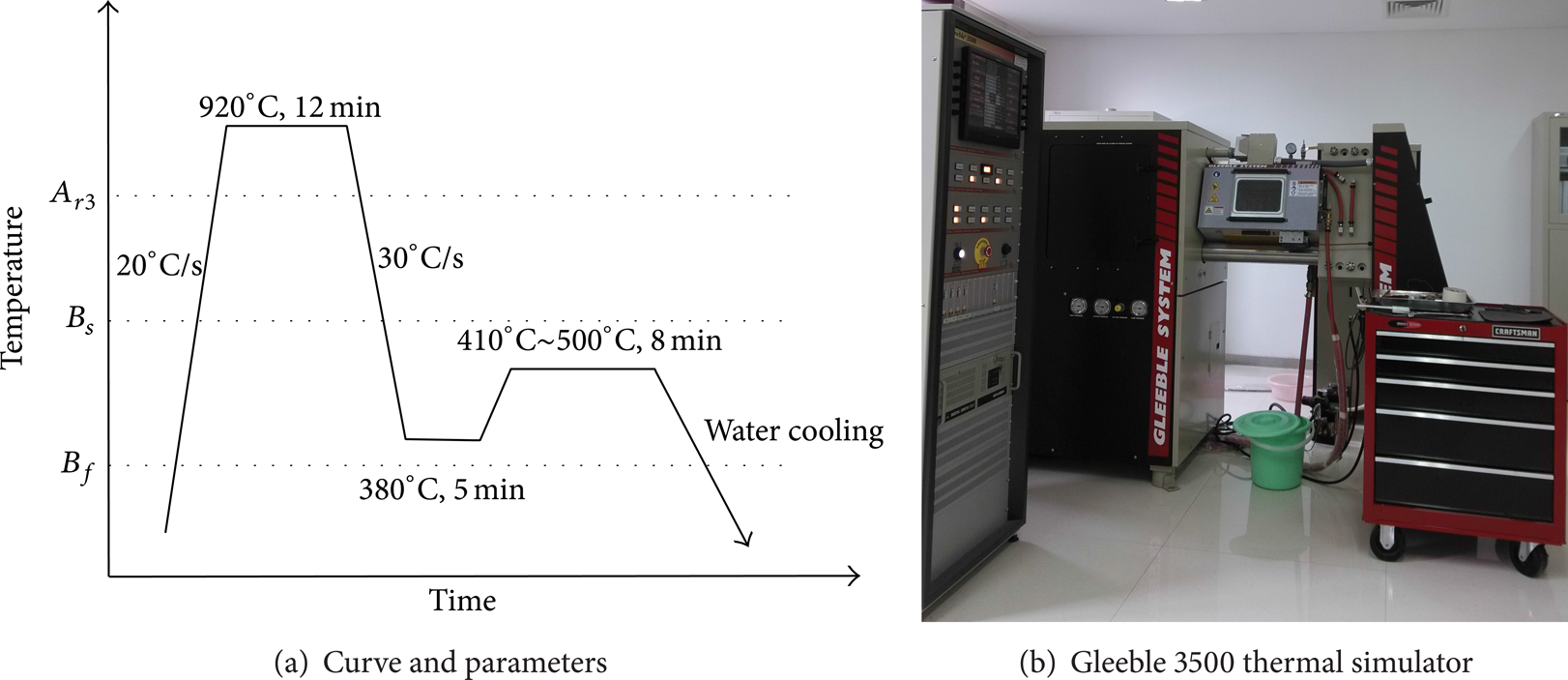
HOP thermal simulation process.
Volume fraction of MA is affected by chemical composition of the steel and ACC and heating conditions. Effect of volume fraction of MA on Y/T ratio of steel plates which was applied with the new process was studied [9, 10]. Y/T ratio decreased with the partitioning temperature increasing, and Y/T ratio below 85% was able to be achieved by MA volume fraction above 5%. The studies indicated that the heat online partitioning is a promising way to produce high performance pipeline materials that can fulfill various requirements for recent pipelines.
Tensile properties were analyzed in accordance with the ASTM A370 method. The tensile specimens were machined with their axis oriented parallel to the rolling direction and cut into the diameter of 5 mm, the criterion length of 25 mm, shown in Figure 2. They were tested on a MTS810 machine at the strain rate of 10−3 m/m·s−1 at room temperature. Charpy impact test was performed on standard Charpy V-notch specimens (size: 10 × 10 × 55 mm) along the thickness direction of the steel body at 253 k temperature (−20°C) in accordance with the ASTM E23 by a Charpy impact tester of 500 J capacity, as shown in Figure 3.

Tensile specimens.

Charpy V-notch specimens.
As Figure 4 suggests, the microstructural examination of the sample was conducted using JSM-6390A scanning electron microscope (SEM) after conventional nital etching. Transmission electron microscope (TEM) specimens were first mechanically thinned to 0.5 mm from thin slices, followed by electropolishing in a twin-jet polisher using 4% perchloric acid solution at ~20 mA, 15 V, and 20°C. TEM examination was carried out in a JEM-200CX microscope at 100 kv. Retained austenite contents were determined using an X-ray diffraction technology. XRD measurement was performed using a copper X-ray source operating at 40 Vkv and 150 mA with a nickel filter; scans were run between 40 and 95 deg 2-theta to capture the significant bainite and austenite diffraction peaks.

Microscopic analysis and X-ray diffraction.
3. Results and Discussion
3.1. Mechanical Properties
X80 grade pipeline steel was developed by applying the heat online partitioning subsequently after accelerated cooling process. Figure 5 shows the engineering stress-strain curves of the trail grade X80 pipeline steels at different partitioning temperature. All pipes show round-house type stress-strain curves. One significant feature of these pipes is the higher levels of uniform elongation.

Stress-strain curves of developed X80 line pipes by different partitioning temperature process.
The variation of yield and tensile strength in the range of partitioning temperature (410–500°C) is shown in Figure 6(a). In the experimental steels, the strength indicates the decline trend with the increasing partitioning temperature; while the partitioning temperature is 500°C, the strength increases. However, the effect of partitioning temperature on the plasticity of the dual-phase steels is contrary to the strength trend, shown in Figure 6(b). The trend of variation of the ductility parameters (A, UA) with increasing partitioning temperature is similar for trail steels.
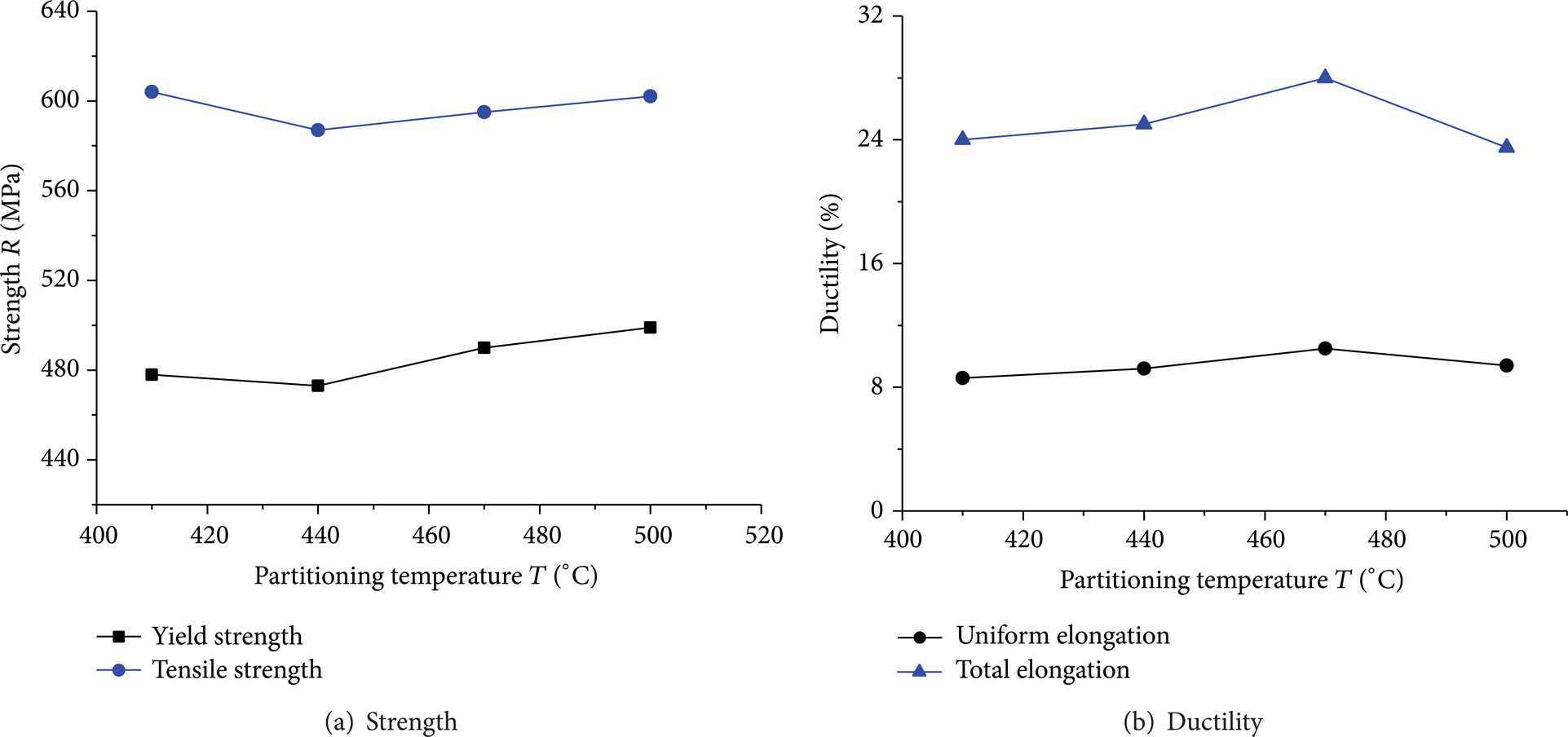
Relation between partitioning temperature and mechanical properties in tensile test.
Table 2 shows the deformability parameters of the trial X80 pipes. The Y/T ratio decreases with the increasing partitioning temperature. All experimental steels at different partitioning temperature show low Y/T ratio, high uniform elongation, and strain hardening exponents. From these results, it is considered that developed dual-phase line pipes with bainite and MA microstructure give significant benefit in high strain applications [10, 11].
The yield ratio, uniform elongation, and strain hardening index of X80 experimental steels at different partitioning temperature.

The Charpy impact toughness values for the trail steels at 273 K (−20°C) temperature are given in Figure 7. As seen in Figure 7, the impact toughness for each sample is more than 300 J. The average value fully satisfies the specifications of ISO for the energy necessary to arrest propagation of unstable ductile fracture of X80 line pipes.

Impact toughness of X80 experimental steel at different partitioning temperature.
3.2. Microstructure
Figure 8 presents the evolution of microstructure in the trail steels treated by different partitioning temperature. It is clear that the microstructural feature of these samples is typical bainite (dark field) with fine dispersed MA (bright field).
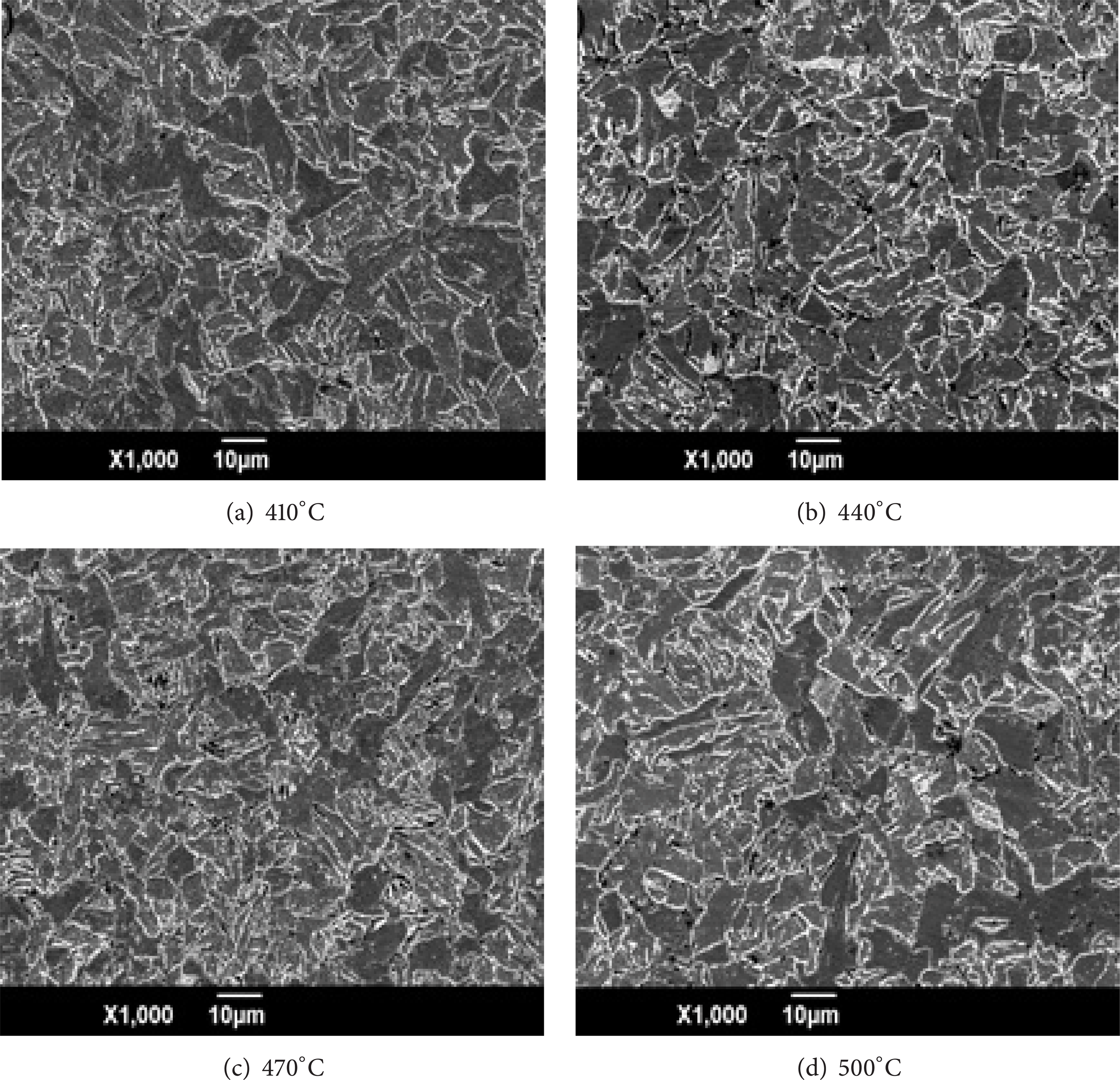
SEM micrograph of X80 samples at different partitioning temperature.
As shown in Figure 8, the experimental X80 steel has similar microstructure characteristic. However, the difference is that untransformed austenite maybe transformed into M/A with adequate partitioning time when the partitioning temperature is above 440°C. At the same time, higher partitioning temperature promotes carbides precipitation from supersaturated bainite and then maybe transform bainite into the polygonal ferrite. Examples of these microstructure features are indicated with arrows in Figures 9(a) and 9(b). Nanometer-sized fine carbide precipitates were observed.

TEM micrograph of carbides precipitation at higher partitioning temperature.
3.3. Discussion
Based on the above results on microstructure and mechanical properties, high strength pipeline steels with lower yield ratio, higher uniform elongation, and strain hardening index were developed aiming to meet the technical requirements of high deformability line pipes and are suitable for the environmentally severe regions such as permafrost and seismic regions. It is well known that the good contribution of high strength and ductility of trail steels is mainly due to the various changes of (B + M/A) dual-phase microstructure.
Bainite. Representative TEM micrograph illustrating the microstructure of X80 pipeline steels treated by partitioning at 653 K and 773 K is presented in Figure 10. It can be also seen from Figure 10 that the typical bainite laths and dislocation structures are observed in the bainite matrix of all samples.

Typical TEM micrograph of X80 samples treated at different partitioning temperature.
Figure 10 shows the morphology change of bainite laths with the increase of the partitioning temperature. In the high-temperature partitioning process, the lath structure of samples is not obvious because the migration or disappearance of bainite/austenite interfaces and subboundaries makes the bainite laths confused. On the other hand, adjacent bainite laths with small angle orientation may migrate and fuse, which results in the coarsening of bainite laths [12, 13]. With the further increase of partitioning temperature, it can be observed that a part of the bainite is transformed into polygonal ferrite for the recovery and recrystallization of bainite. At the same time, the dislocation configuration of bainite changes at the different partitioning temperature, as shown in Figure 11. It is apparent that the samples partitioned at 410°C have higher dislocation density and the samples partitioned at 470°C have lower dislocation density. Therefore, the strength of test steels will decrease while the plasticity is a rise trend with the partitioning temperature increasing.

TEM micrograph of dislocation configuration in bainite matrix treated at different partitioning temperature.
Martensite-Austenite Constituent. One of the most significant features of the heat online partitioning process is to produce dual-phase microstructure which consists of two parts: bainite matrix phase and dispersed MA (martensite-austenite constituent). Figure 12 shows the example of SEM microphotograph of MA produced by HOP process. A large number of MA constituents which are seen as white region were observed in the HOP experimental steels. When the volume fraction of MA was about 13.3%, X80 experimental steels show higher uniform elongation and n-value. Besides, the retained austenite of MA is beneficial to toughness of pipeline steels. Research results show that the high strength of HOP steels results from dislocation-type bainite laths and dispersively distributed carbides in bainite matrix, while excellent plasticity is attributed to the considerable retained austenite [13–15].

The SEM microstructure of X80 experimental steel with excellent deformability.
Figures 13–15 show the TEM micrograph of (B + MA) dual-phase microstructure. It can be seen that most of retained austenite as thin film morphology were kept treated at low partitioning temperature in Figure 13. The thickness of this retained austenite varies from 50 nm to 100 nm, implying the higher stability of thin film-like austenite than that of the large sized austenite which eventually is changed into fresh martensite after quenching. After short time partitioning treatment, the martensitic structure still remained in the final microstructure and most amounts of carbon atoms are enriched in dislocation and lath boundaries. At the same time, a small proportion of carbon atom diffuses from bainite into untransformed austenite, which results in a small proportion of retained austenite with enough carbon content which can be stabilized at room temperature. With the increase of partitioning temperature, the retained austenite is presented as rods located in the bainite lathes in Figure 14. Therefore, the content of retained austenite increased. At a higher partitioning temperature, the driving force for martensite formation is available. On the other hand, diffusion controlled processes may be activated such as carbides precipitation or further growth of bainite laths by interfaces migration. A different trend is observed for the grade X80 pipeline steel, shown in Figure 15, where the highest partitioning temperature results in the lowest volume fractions of retained austenite. Hence, all diffusion controlled processes resulting in austenite decomposition seem to be promoted.

Diffraction analysis of retained austenite partitioned at 410°C.

Diffraction analysis of retained austenite partitioned at 440°C.

Diffraction analysis of retained austenite partitioned at 500°C.
The X-ray diffraction spectrums of four samples were shown in Figure 16(a), and the retained austenite volume fraction was calculated according to YB/T 5338-2006; the results were shown in Figure 16(b).

XRD diffraction spectrums and content of the retained austenite for X80 steels at different partitioning temperature.
As shown in Figure 16(b), the variation of volume fraction of presents the peak change with the increasing of partitioning temperature, so did the plasticity. Besides, the stability of retained austenite is determined by carbon concentration. Partitioning at higher temperature is beneficial to the carbons diffusing into austenite from bainite. So from Figure 16(b) we could see that the highest retained austenite volume fraction is obtained when partitioning temperature is 470°C. When the partitioning temperature is enough high, the slope in the change of the retained austenite curve becomes lower owing to the multiple reactions that may occur, such as transition carbides formation, cementite formation, martensite formation, and tempering of bainite, which lead to the decrease in the amount of retained austenite stabilizing at room temperature.
Carbide Precipitation. In order to further identify the microstructures, TEM observation was performed on three typical HOP specimens at 684 K, 731 K, and 773 K (410°C, 440°C, and 500°C). Figure 17 shows the microstructural features of the carbides precipitation of the experimental steel. The formed microalloy carbon and nitrogen compounds during the partitioning process and bainite matrix are harmonious. It is generally believed that transitional ε-carbide dissolved at 400°C and thus mainly formed θ-carbide in the partitioning process. However, sometimes ε-carbide can also be observed in the pipeline steel because of microalloying elements Nb and Mo in experimental steel [16, 17]. As the partitioning temperature proceeds (470 to 500°C), the slope in the change of the retained austenite curve becomes higher and the quantity of θ-carbide precipitation increases gradually, which indicate that θ-carbide formation consumes a large amount of carbon atoms, narrowing the gap in the carbon potential between the bainite and the untransformed austenite. In addition, the migration of carbon atoms from bainite to austenite further leads to very little increase in the amount of retained austenite stabilizing at room temperature.
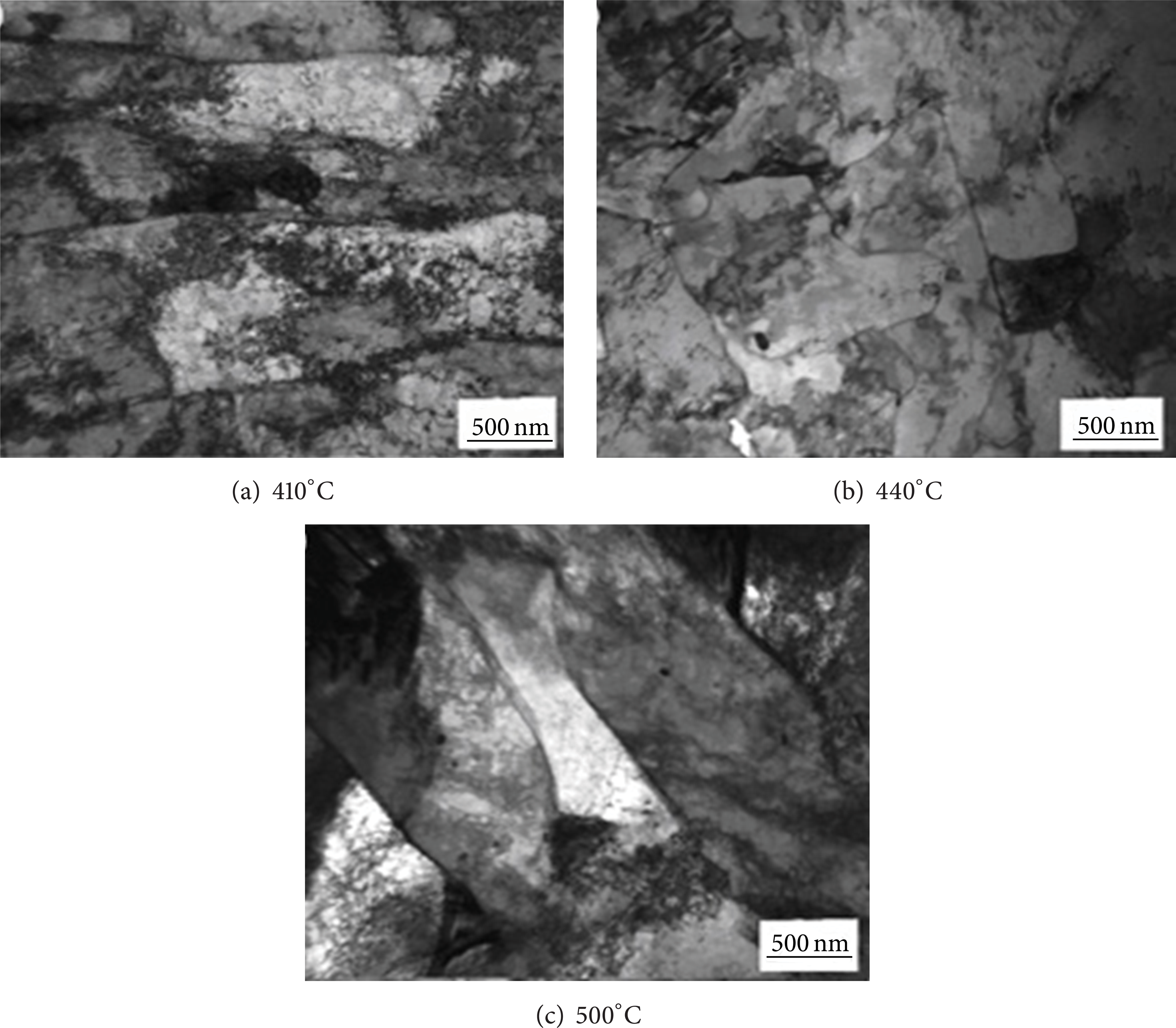
TEM micrograph of carbides at typical partitioning temperature.
In general, the weak precipitation hardening effect of cementite and the softening of bainite matrix lead to the poor mechanical properties of HOP specimens during partitioning at 500°C. Besides, TEM observation also indicates that the addition of alloying element Si in X80 pipeline steels can only delay the precipitation of Fe3C in bainite matrix at relatively low temperature but cannot suppress the formation of Fe3C at relatively high temperature [18–20]. Analysis results suggest that the formation of these carbides reduces the carbon content in bainite. There is not much of a reduction in the strength of steels, but it can actually increase for steels during the early stages of ε-carbide precipitation. With the partitioning temperature further extended, the carbon content and dislocation density in bainite are reduced, which result in the increase of strength and decrease in plasticity of steels.
4. Conclusions
Trial production of grade X80 pipeline steel was conducted by applying the heat on-line partitioning (HOP) process. Microstructure and mechanical properties of the trial X80 pipeline steels and the effect of partitioning process on (B + M/A) X80 were investigated. Results are summarized as follows.
Trial produced grade X80 pipeline steels showed sufficient strength and excellent deformability for the bainite-MA dual-phase microstructure control.
With the increasing partitioning temperature, the strength of the experimental steels decreases and the plasticity increases because of the increase of bainite lath width, the decrease of dislocation density, the increase of retained austenite content, and carbides coarsening.
When the partitioning temperature is enough high, the decrease of the volume content and stability of retained austenite is the key factor influencing the increase of strength and the decrease of plasticity.
The (B + M/A) X80 steel has lower yield ratio, higher uniform elongation and strain hardening index at different partitioning temperature, aiming to meet the technical requirements of high deformability line pipe.
Conflict of Interests
The authors declare that there is no conflict of interests regarding the publication of this paper.
Footnotes
Acknowledgments
This work was supported mainly by the National Natural Science Fund of China (Grant no. 51174165). The authors also give great acknowledgments and thanks to the Department of Material Science and Engineering at Xi'an Shiyou University for support of their work.