Cognitive radio is a growing zone in wireless communication which offers an opening in complete utilization of incompetently used frequency spectrum: deprived of crafting interference for the primary (authorized) user, the secondary user is indorsed to use the frequency band. Though, scheming a model with the least interference produced by the secondary user for primary user is a perplexing job. In this study we proposed a transmission model based on error correcting codes dealing with a countable number of pairs of primary and secondary users. However, we obtain an effective utilization of spectrum by the transmission of the pairs of primary and secondary users' data through the linear codes with different given lengths. Due to the techniques of error correcting codes we developed a number of schemes regarding an appropriate bandwidth distribution in cognitive radio.
1. Introduction
Cognitive radio is the latest technology in wireless communication by which the spectrum is dynamically utilized whenever the primary user, the authorized holder of the spectrum, is not consumed. The idea of cognitive radio is initiated in [1]. Rendering to this notion the cognitive radio has the competence to judge the radio environs and step up the decision according to the transmission parameters such as code rate, modulation scheme, power, carrier frequency, and bandwidth. By [2], power is allotted to total bandwidth power is allotted to total bandwidth; order to increase capacity, retain the interference at the primary user at the given inception and make the entire transmission power inside the preset limits.
Alternative clue of the interference temperature model of [3] is essential for the primary receiver to fix the interference boundary and hence the secondary user can transmit under the set level. The central plan in [4] is to issue license spectrum to secondary users and bound the interference observed through primary users. To shield the primary user from the interference triggered by the secondary user during transmission, Srinivasa and Jafar [5] presented an organization of transmission models as interweave, underlay, and overlay.
By [1], in the interweave model the secondary user has opportunistic access to the spectrum slum, whenever the primary user is out and pull out when the primary wants to utilized the spectrum again. Wisely watching and sensing primary user is very noteworthy for interweave case. Thus dissimilar type of the sensing methods is used to identify the primary user and evade the interference shaped by the secondary user. By [6] two leading methods are receiving attention for primary user uncovering, known as energy detection, feature detection, and match filter. In cognitive radio secondary user is permissible to use a spectrum of primary user without making interference with the primary user. However, the secondary users have to frequently screen the management of the spectrum to keep away from snooping with the primary user (see [7]). Underlay and overlay are argued with spectrally modulated and spectrally encoding (SMSE) procedure all along with code division multiple access (CDMA) and orthogonal frequency division multiple access (OFDMA). According to [8], in underlay, concurrent transmission of primary and secondary user happens underneath the situation that the secondary user interferes less than a positive beginning with the primary user. Spectrum sensing is not obligatory for underlay. Only the interference limit is compulsory for the secondary user for proficient utilization of the spectrum. Hence, this interference limitation confines the communication of secondary user to minute range. However, by [2], some amount of the power should be allowed to the subcarrier of underlay as it also creates extra interference with the primary user. The demand of wireless devices is increasing every day. Therefore, efficient utilization of spectrum is a burring subject to reduce the spectrum over crowdedness. By [9], the overlay model allows the simultaneous transmission of primary and secondary users. The secondary transmitter is assumed to have awareness of the primary message and use for reducing the interference at its receiver. Specifically, in underlay and overlay models the secondary users can transmit their data simultaneously with the primary users under some constraints: in case of underlay, secondary users can transmit with sufficient power due to interference limit fixed at the primary receiver while in the case of overlay transmission of secondary users is only possible if secondary transmitter knows the codebooks and channel information. Furthermore, both of these models do not ensure that secondary user will not create interference with primary user during simultaneous transmission. Likewise, enabling grounds for these models may harm the transmission of both primary and secondary user.
In [10] wireless mesh network is used for end to end bandwidth allocation which used the routing and scheduling algorithms. The max-min model is used for selection of a fair bandwidth allocation. In [11] TV band is used for the cognitive radio through sensing and opportunistically utilizing the unused frequencies. The different types of protocols are used for centralized and decentralized spectrum allocations.
By using the secret messages for cognitive radio channels first of all set the limits for channel capacity. Two transmitters having the primary and secondary messages pass through the channel which was received at the receivers with separate primary and secondary messages. By [12], enhancement of spectral efficiency in cognitive radio can be obtained by the secondary user through the permission to utilize the shiftless part of the spectrum which is allotted to the primary user. Hence the optimum bandwidth is required from the many bandwidths allocated to the primary and secondary users. Moreover, the secondary users try to opt for the best possible bandwidth out of the different many sets of bandwidths. Furthermore in [12], different spectrum sharing protocol is designed to enhance the cognitive radio networks.
An introduction of a transmission model in cognitive radio based on error correcting codes is presented in [13]. However, in continuation of [13], in this study we proposed a novel transmission model in cognitive radio based on error correcting codes which provides an effective utilization of the spectrum. Furthermore it brings comfort to the secondary users of each pair by many restrictions which are imposed in the underlay and overlay models. The strategies adopted are dealing with a pair of users (a primary and a secondary) transmitting the data through linear codes having fixed given lengths. By this proposed model, despite of existing techniques, first we allocate a pair of linear codes for each pair of a primary user and a secondary user of the given family. Secondly for each pair of these linear codes, there is a transforming code. However, this transforming code carries all the information/data possessed by its corresponding pair of linear codes. Accordingly all the data on a whole family of pairs of a primary user and a secondary user is transmitted through these different transforming codes. Nevertheless, irrespective of using individual data transmission technique of primary and secondary users, we use the simultaneous data transmission technique for primary and secondary users of each pair of the family. Owing to this plausible procedure of error correcting codes we settled a number of arrangements vis-à-vis suitable bandwidth dispersal in cognitive radio. We use the method which opportunistically works in such a way that there is precise pattern of bandwidths available against the different transforming codes corresponding to the pairs of primary and secondary users. Thus, if this total bandwidth is greater than the bandwidth W of another transforming code T, then the code T could send its data through . Hence the enhancement of spectral efficiency in cognitive radio is obtained by the pseudo cognitive user T through the approval to utilize the idle part of the spectrum which is allotted to the transforming codes , the pseudo primary users. Consequently we established a method which provides efficient utilization of spectrum as described in [12].
2. Preliminaries
This section contains some of the basic results related to monoid ring and polynomial codes and some on transmission parameters.
To construct a polynomial over a finite field , where q is power of some prime, we select a polynomial of degree from . A message is represented by a polynomial, called the message polynomial, , of degree less than or equal to . The code polynomial corresponding to this is and is equal to , where is the remainder of after dividing it by . A polynomial code is an error correcting code whose codewords consist of multiple of a given fixed polynomial known as the generator polynomial.
Let and be a commutative semigroup and an associative unitary commutative ring, respectively. The set of all finitely nonzero functions f from S into is a ring with respect to binary operations addition and multiplication defined as and where the symbol indicates that the sum is taken over all pairs of elements of S such that and it is settled that in the situation where s is not expressible in the form for any . is called a unitary commutative semigroup ring of S over . If S is a monoid, then is called monoid ring. This ring is represented as whenever S is a multiplicative semigroup and elements of are written either as or as The representation of will be whenever S is an additive semigroup. A nonzero element f of is uniquely represented in the canonical form , where and for . Of course, the monoid ring is a polynomial ring in one indeterminate if S is the additive monoid of nonnegative integers.
The concept of degree and order is not generally defined in a semigroup ring. But if S is a totally ordered semigroup, the degree and order of an element of semigroup ring are defined as follows: if is the canonical form of the nonzero element , where , then is called the degree of f and we write and similarly the order of f is written as . Now, if is an integral domain, then, for , we have and .
We initiate by an observation that, for a field F and an integer , the structures of a polynomial ring and a monoid ring have many cohesions; for instance, for an ordered monoid S, the monoid ring is a Euclidean domain if F is a field and or (cf. [14, Theorem 8.4]). Of course here is totally ordered and has an isomorphism with .
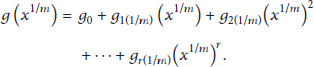
Let F be any field and the additive monoid; then is a monoid ring. A (generalized) polynomial of arbitrary degree r in is represented as
In [15–22] certain cyclic codes are considered as the ideals in the factor ring of some monoid rings , where p is prime, k is positive integer, and is a local finite commutative ring or a binary field. Subsequently these studies addressed the strategies in enhancing the code rate and error correction capability of the codes under consideration.
Remark 1.
Let be the set of all polynomials in having degree at most , where n is a positive integer. Then is a vector subspace of with the basis .
Theorem 2.
If C is a linear code generated by r degree generator (generalized) polynomial with minimum hamming distance d and , then
can detect up to errors;
C can correct up to t errors.
Definition 3.
Let S be the signal set and M the number of signals in the signal set. Suppose is the codeword of an corresponding to a message at time t and we have divided each into blocks, where , the case . Then, modulation is a map M: defined as , where and S is a subset of N-dimensional real Euclidean space, that is, [23, Chapter 7].
Definition 4.
The bandwidth required for an code is , where and is the source data rate [24].
3. The Transformation Model for Primary and Secondary Users' Pairs
In this section, we propose a simultaneous transmission model by using error correcting codes. The proposed model also ensures the noninterference across the pairs.
For any positive integer m, let be the family of degree (generalized) polynomials in such that if , where s is a positive integer with . The family of (generalized) polynomials generates the linear code family , where , and the positive integers are varying and likewise is r. Yet, for each different r, the family of codes and the family of codes are generated through the polynomial , in .
Table 1 can be constructed for different m, where integer .
Corresponding to the sequence of pairs of codes of primary and secondary users, there are sequences , of transforming codes.
For a sequence of pairs of codes of primary and secondary users we may opt for any of the schemes from (i) with fixed m or (ii) by varying m. However the second option has complexities.
In (2) (i) for different transforming codes there are varying codes of primary and secondary users. For instance is code for primary user with code of secondary user having transforming code . At the same time is the code for secondary user corresponding to the transforming code having its primary user's code .
Lemma 5.
Each code is equivalent to the direct product of the suitable polynomial codes over .
Lemma 6.
For each j, if , and are the dual of the codes , and , respectively, then the code is equivalent to the code .
Proposition 7.
Consider the following.
For each j, if , and are the minimum hamming distances of the codes , and , respectively, then .
For each j, If , , and are the code rates of the codes , and , respectively, then .
Now we establish the following proposition.
Proposition 8.
For the families of codes with corresponding families of code rates, if , then .
Proof.
If , then . Since , and . This implies . Hence and thus .
3.1. The Model
In this work we advocated a transmission model in cognitive radio focused on error correcting codes for the solid utilization of the spectrum with no interference between primary and secondary users. Instead of a single pair of users (one primary and one secondary) we designed a model consisting of family of pairs of primary and secondary users transmitting the data by linear codes having permanent given lengths. Fashioning the simultaneous transmission with overlay and underlay, however, depends on the technique similar to the linear error correcting codes for reliable communication of primary and secondary users in noisy environments. For a fixed m but varying , corresponding to the family , is the family of triplets of linear codes for individual and simultaneous transmission of primary and secondary users, where and are the codes generated by and by and if . Furthermore each is modulated through , where are modulation maps; that is, , where are the signal sets and are the number of signals in the signal sets , respectively. However are integers.
In this study we only focused on data transmission through of all members of the family for all j. Yet, we choose m for each j, in such a way that .
In model, there is no power constraint or codebooks and channel information known to the secondary users. The only constraint is that primary users should use the codes of the family and secondary users should use the codes of the family . The case of simultaneous transmission is handled by the codes family of codes. Furthermore it is important to notice that the family of code lengths of the codes will shape the family of codes lengths of the codes .
The end of the whole process is the destination of data of each pair of primary and secondary users in the family . So we can obtain the family of pairs of codes for primary and secondary users through the family of transforming codes and hence the data of each pair of primary and secondary users in the family .
The proposed model as shown in Figure 1 is consisting of the following main components for each pair of the family.
The model.
Message assembler of pair () is making messages of the code and it is encoded through the encoder of simultaneous transmission of pair (). After it, universal transmitter (UT) is operating. To avoid the complexity of the model, UT has been introduced. Instead of using an individual transmitter for each pair, all pairs use UT for their transmission. The function of UT is to transmit codewords of each code . All of are modulated through a modulator consisting of all modulation schemes . Universal receiver and vector separator decider (URVSD): all the transmitted codewords from UT will be received at URVSD. The URVSD will analyze the length of each vector and send them to their respective vector separators. For example, if the length of received vector is , then URVSD will send it to , the vector separator of pair for each j, which separates decoder of primary user () and decoder of secondary user () of pair for each j.
3.2. The Schemes for Effective Use of Bandwidths
The interference triggered by secondary user for primary user is tiny, as in case of simultaneous transmission the messages of secondary and primary users are linked together to make a message of the code and then transmitted, in its place of transmitting them individually. Similarly the primary user need not picture its messages at secondary transmitter or secondary user need not sense primary user for simultaneous transmission as in the case of overlay model. The only constraint on primary and secondary users of pair is that the primary user ought to use code and the secondary should use .
Here under the proposed model we discuss two different schemes for transmitting data of family of pairs of primary and secondary users regarding smart usage of bandwidths.
With MPSK modulation, where is in the power of , and also coding rate , where k is the number of information bits and n is the number of coded bits, the required bandwidth , where is the data transmission rate (or bit rate).
Scheme 9.
If there is no order in the set of bandwidth , then the scheme will be as follows:
This scheme proposes that there is only possible to a pair of primary and secondary users that to use bandwidth allotted against it.
The following theorems explain the efficiency of Scheme 9 in terms of bandwidth which is the actual benefit of cognitive radio.
Theorem 10.
For each j, let be the required bandwidths for the triplet . If and are the same, then
,
.
Proof.
(1) By Proposition 7, . This implies . So . This means that . Hence .
(2) It is followed by part (1).
Remark 11.
It is apparent by Theorem 10 that it is most appropriate to send data of both types of users through as it requires less bandwidth than that of the combined bandwidths of primary and secondary users of each pair of the family. Hence in the proposed model the bandwidth is utilized efficiently.
Scheme 12.
In the spirit of Theorem 13, if , where , then the data transmission scheme will be as follows:
Theorem 13.
Let be the family of bandwidths corresponding to the family of codes.
Initially, this scheme is working the same as Scheme 9; however, it opportunistically works in such a way that whenever there is of specific pattern of bandwidths is available against the pairs of primary and secondary users. That is, if the total bandwidth required for data transmission of codes and is and , where is the bandwidth required for transmission of data for the code , then the code could send its data through after the transmission of the codes and . In a similar manner we continue this method for combinations larger than this one. The gain of this scheme is the saving of the bandwidth and hence of in general. Despite all of this, it is possible on the compromise that larger code in each transmission process must use the sum of bandwidths of the preceding codes after their spectrum utilization.
Remark 14.
If the bandwidth is equal to or greater than the bandwidth sum of codes of primary and secondary users corresponding to the transforming code , then we could transmit the data of the pair concern separately through respective codes of primary and secondary users.
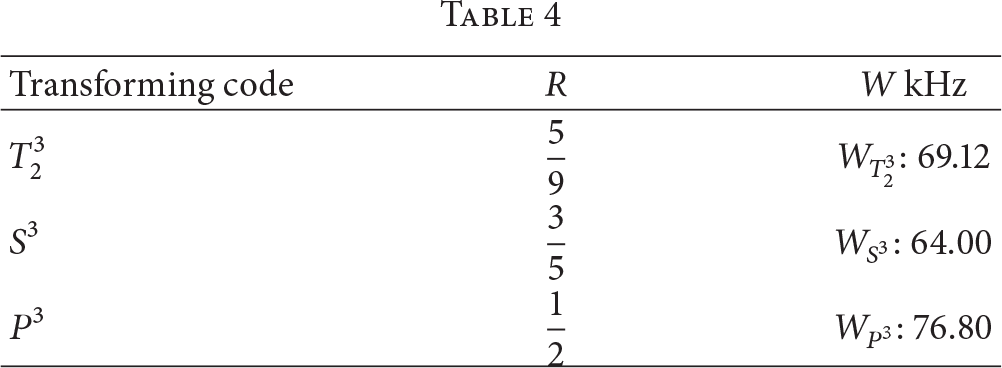
Illustration. For fixed , the relation between bandwidth and code rate is given as , where w is the bandwidth expansion, is the transmission rate, and is the code rate. The bandwidth with different code rates is given in Table 2 (chosen transforming codes are from Table 1).
Corresponding to any pair we can choose the most suitable transforming code which requires the minimum bandwidth for data transformation. For instance, the pair has the best option of (Table 4).
Transforming code
R
W kHz
: 69.12
: 64.00
: 76.80
Now we are able to discuss Schemes 9 and 12 of data transmissions as follows:
Since kHz and kHz, we could transmit the data of the pair concern with the transforming code separately through respective codes () of primary and secondary users.
To obtain the essential bit error rate at the receiver end depends on the selection of the transmission power. When the transmission power is increased at the transmitter, the SNR increases at the receiving end, which causes strengthening in the quality of signals. The transmission power cannot increase up to a limit because when we increase the power in case of the transforming code designed for the pairs of the primary and secondary users, the interference may occur among the other transforming codes. When the multiple users access the spectrum via transforming code, the interferences are to be mitigated among the alternative transforming codes by reducing the transmission power up to some limits.
Since the power required for bandwidth is more than that of bandwidth (cf. [2]), due to Scheme 12 of data transmission, we obtain two gains: (1) in power (i.e., the low power is required) and (2) in bandwidth. This means Scheme 12 is opportunistically working in such a way that there is a specific design of bandwidths available for the different transforming codes . Hence, if the bandwidth is greater than the bandwidth of another transforming code , then the code might send its data by . Consequently the improvement of spectral efficacy in cognitive radio is attained by the pseudo cognitive user through the agreement to utilize the shiftless part of the spectrum which is allotted to the transforming codes , the pseudo primary users.
Remark 15.
On every occasion there is clear-cut pattern of bandwidths existing alongside the diverse transforming codes against the pairs of primary and secondary users. Accordingly, if the bandwidth is greater than the bandwidth W of a new transforming code T, then the code T may perhaps send its data by the shiftless part of the spectrum which is allotted to the pseudo primary users having codes . Henceforth the improvement of spectral efficiency in cognitive radio is achieved by the pseudo cognitive user T. As a result we proved a process which offers an efficient utilization of spectrum as termed in [12].
4. Conclusion
This study proposes that there is an alternate way for transforming the data of a countable family of pairs of a primary user and a secondary user by a countable family of linear transforming codes instead of a countable family of the pairs of linear codes. For this purpose Table 1 provides a suitable transforming code corresponding to the chosen pairs of linear codes for each pair of a primary user and a secondary user. Simultaneously, these transforming codes carry all the information/data, possessed by their corresponding pair of linear codes.
The enhancement of spectral efficiency in cognitive radio is obtained in three different layers.
Data transmission of both types of users through transforming code requires less bandwidth than that of the total bandwidth required for primary and secondary users of each pair of the family.
Scheme 9 is offered whenever there is no order in the set of bandwidths required for the set of transforming codes; then, information/data will transmit independently.
Scheme 12 works opportunistically in such a manner that there is an accurate configuration of bandwidths available and unfilled against the distinct transforming codes corresponding to the pairs of primary and secondary users. Accordingly, if this total bandwidth is larger than the bandwidth W of another transforming code T, then code T uses for its data transmission. During this strategy there is a further gain in spectrum saving than of Scheme 9.
This model can serve in a more complex situation whenever we consider a variation in the degree r of the given polynomial .
Footnotes
Conflict of Interests
The authors declare that there is no conflict of interests regarding the publication of this paper.
References
1.
MitolaJ.Cognitive radio: an integrated agent architecture for software defined radio [Ph.D. dissertation]2000Stockholm, SwedenKTH
2.
BansalG.DuvalO.GagnonF.Joint overlay and underlay power allocation scheme for OFDM-based cognitive radio systemsProceedings of the IEEE 71st Vehicular Technology Conference (VTC '10)May 201010.1109/VETECS.2010.54940302-s2.0-77954898623
3.
ClancyT. C.Achievable capacity under the interference temperature modelProceedings of the 26th IEEE International Conference on Computer Communications (IEEE INFOCOM '07)200779480210.1109/INFCOM.2007.98
4.
ZhaoQ.SadlerB. M.A survey of dynamic spectrum accessIEEE Signal Processing Magazine2007243798910.1109/MSP.2007.3616042-s2.0-34249728222
5.
SrinivasaS.JafarS. A.The throughput potential of cognitive radio: a theoretical perspectiveIEEE Communications Magazine2007455737910.1109/MCOM.2007.3588522-s2.0-34249104148
6.
KimH.ShinK. G.In-band spectrum sensing in cognitive radio networks: Energy detection or feature detection?Proceedings of the 14th Annual International Conference on Mobile Computing and Networking (MobiCom '08)September 2008142510.1145/1409944.14099482-s2.0-60149086999
7.
MishraS. M.SahaiA.BrodersenR. W.Cooperative sensing among cognitive radiosProceedings of the IEEE International Conference on Communications (ICC '06)July 2006Istanbul, Turkey1658166310.1109/ICC.2006.2549572-s2.0-42549125692
8.
SonK.JungB. C.ChongS.SungD. K.Opportunistic underlay transmission in multi-carrier cognitive radio systemsProceedings of the IEEE Wireless Communications and Networking Conference (WCNC '09)April 2009Budapest, Hungary1610.1109/WCNC.2009.49178652-s2.0-70349182629
9.
AlamA. T. M. S.DooleyL. S.PoultonA. S.Dynamic spectrum access based on cognitive radio within cellular networksProceedings of the 7th IEEE International Conference on Wireless Advanced (WiAd '11)June 2011London, UK858910.1109/WiAd.2011.59832912-s2.0-80052453362
10.
TangJ.HincapiéR.XueG.ZhangW.BustamanteR.Fair bandwidth allocation in wireless mesh networks with cognitive radiosIEEE Transactions on Vehicular Technology20105931487149610.1109/TVT.2009.20384782-s2.0-77949760437
11.
YuanY.BahlP.ChandraR.MoscibrodaT.WuY.Allocating dynamic time-spectrum blocks in cognitive radio networksProceedings of the 8th ACM International Symposium on Mobile Ad Hoc Networking and Computing (MobiHoc '07)September 200713013910.1145/1288107.12881252-s2.0-37849003487
12.
XuD.JungE.LiuX.Efficient and fair bandwidth allocation in multichannel cognitive radio networksIEEE Transactions on Mobile Computing20121181372138510.1109/TMC.2011.1682-s2.0-84863443025
13.
HussainS. A.ShahT.AzamN.A transmission model in cognitive radio based on error correcting codesArchives des Sciences2012659568576
14.
GilmerR.ParkerT.Divisibility properties in semigroup ringsThe Michigan Mathematical Journal1974211658610.1307/mmj/1029001210MR0342635
15.
AndradeA. A.ShahT.KhanA.A note on linear codes over semigroup ringsTrends in Applied and Computational Mathematics20111227989MR284474610.5540/tema.2011.012.02.0079
16.
ShahT.Amanullahde AndradeA.A.A decoding procedure which improves code rate and error correctionsJournal of Advanced Research in Applied Mathematics201244375010.5373/jaram.1283.013112MR2988687
17.
ShahT.AmanullahAndradeA. A.A method for improving the code rate and error correction capability of a cyclic codeComputational and Applied Mathematics201332226127410.1007/s40314-013-0010-1MR31012902-s2.0-84879207286
18.
ShahT.AndradeA. A.Cyclic codes through B[X], B[X; (1=(kp))Z0] and B[X; (1=(pk))Z0]: a comparisonJournal of Algebra and Its Applications20121141250078
19.
ShahT.AndradeA. A.Cyclic codes through B [X; (a=b) Z 0]((a=b) 2 Q +; b = a + 1) and encodingDiscrete Mathematics, Algorithms and Applications201244141250059
20.
ShahT.KhanA.AndradeA. A.Encoding through generalized polynomial codesComputational & Applied Mathematics201130211810.1590/S1807-030220110002000062-s2.0-80051788111
21.
ShahT.KhanA.AndradeA. A.Constructions of codes through the semigroup ring and encodingComputers & Mathematics with Applications20116241645165410.1016/j.camwa.2011.05.0562-s2.0-80051794240
22.
ShahT.KhanM.AndradeA. A.A decoding method of an n length binary BCH-code through (n +1) n length binary cyclic codeAnais da Academia Brasileira de Ciencias2013853345354
23.
KroukE.SemenovS.Modulation and Coding Techniques in Wireless Communications2011New York, NY, USAJohn Wiley & Sons
24.
Rahman Doost-Mohammady, Cognitive Radio Design : An SDR Approach, Wireless and Mobile Communications Mekelwe 4, 2628 CD Delft The Netherlands