




Abstract
Although the IEEE 802.15.4a network provides accuracy localization for sensor nodes, it still suffers from congestion and bottleneck problems since the data traffic tends to concentrate on a certain intermediate node due to the shortest path first criteria when it utilizes a greedy routing method. Furthermore, the limited network bandwidth and node mobility features exacerbate this problem in wireless sensor networks with tiny sensor platforms. In this paper, we propose a new dynamic load aware geographical routing protocol, named DLAG, which periodically monitors the channel condition of each node and forwards a packet to the neighboring node with the least traffic load by defining new buffer threshold values for controlling the congestion. In addition, the proposed protocol also introduces traffic adaptive backoff and frame retransmission tuning techniques to provide prioritized channel access for congested nodes. In order to verify the performance of the proposed protocol, we conduct simulation verification experiments and the results show that the proposed protocol provides better performance than the legacy geographical routing schemes in terms of packet delivery ratio, end-to-end delay, network lifetime, and so forth.
1. Introduction
A WSN (wireless sensor network) is one of the most rapidly growing technologies for users with portable devices to access network resources easily, anytime and anywhere, in a timely way. In sensor networks, sensor nodes are usually scattered and the positions of sensor nodes do not have to be predetermined. In order to support this architecture, IEEE 802.15.4a standard [1] provides the fundamental MAC layer operations which focus on low cost communication and low energy consumption between sensor devices. Since this standard does not support accuracy localization method, the IEEE 802.15.4a [2] is proposed and it defines two additional PHYs using the ultrawide band (UWB) and the chirp spread spectrum (CSS). Although global positioning system (GPS) also provides location information based on satellite navigation signals, it significantly suffers from performance degradations such as high measurement error ratio and poor packet reception ratio since the IEEE 802.15.4a based WSN is still characterized by limited bandwidth, low buffer capacity, and inconstant transmission latency. In particular, as the requirements of multimedia application are gradually increased, the network congestion and reliability problems are inevitable for developing the WSNs.
Another open problem for IEEE 802.15.4a based WSNs, the design of an efficient routing protocol, is also important challenging issue to deliver packets (both data packets and control packets for localizations). When we obtain the accuracy location information of every node, in general, geographic routing schemes provide more efficient packet delivery rather than conventional on-demand routing protocols such as ad hoc on-demand distance vector routing (AODV) [3] and dynamic source routing (DSR) [4] because location information can mitigate the control overheads during the route discovery procedure [5]. One of the most representative location based routing protocols is greedy perimeter stateless routing (GPSR) [6] which uses greedy forwarding. The basic operation is to forward a packet to the neighboring node which is geographically closest to the destination node. However, it does not consider network load which may result in congestion and link failures. For example, in typical WSNs, data gathering from a number of sensor nodes is the main task and the gathered data is periodically transmitted to the sink. However, when the WSN is characterized by multihop transmission and funnel based topology, the probability of the bottleneck occurrence near the sink is significantly high. Furthermore, since the greedy forwarding tends to merely transmit packets to a certain neighboring node close to the destination, the traffic concentration may contribute to several network problems such as long transmission delay and poor delivery ratio. In order to tackle this problem, several related works have been proposed by improving the greedy method [7–9]. However, these previous works do not highly consider the specifications of IEEE 802.15.4a and neglect providing more transmission priority to bottlenecked node in funnel network architecture with a few sink nodes.
In this paper, in order to mitigate the above problems, we propose a dynamic load aware geographic routing protocol (DLAG) which monitors the channel load status and avoids the bottlenecked neighbor nodes. After route selection procedure is finished, DLAG additionally controls the MAC layer backoff algorithm to support prioritized channel accesses.
The rest of this paper is organized as follows. Section 2 gives a brief overview of related researches on geographical routing protocols for WSNs and congestion control schemes. Section 3 describes the proposed protocol in detail and Section 4 presents the performance verification of the proposed protocol compared with previous works. Finally, concluding remarks and future works are given in Section 5.
2. Related Works
2.1. Geographical Routing Protocols for WSNs
Although GPSR provides simple packet delivery by using greedy method, it shows poor performance when it meets specific link failures such as connectivity holes, obstacle, and congestion. Thus, the authors in [8] introduce a general framework for the design of geographical routing schemes based on optimizing the ratio of a cost measure and a measure of progress. The authors in [9] address the traffic load issues and propose a load detection scheme by calculating the percentage of time in which the medium was busy or idle, respectively, by summing up all measured states over a predefined sampling period. However, this scheme mainly depends on the packet sending rate and beacon frame exchange for sharing the load information, which is not directly applicable to the beaconless WSNs. In order to consider lossy link conditions of the wireless network, a routing protocol with packet reception ratio (PRR) and distance traveled to destination is proposed [10]. The key idea is to calculate PRR * distance metric as route selection criteria and the packet is forwarded through neighboring nodes that have the highest metric. Besides PRR based scheme, dynamic link detection and localization scheme for non-line-of-sight (NLOS) are proposed in order to mitigate unstable communication problems for indoor environments [11]. Interference aware energy efficient geographical routing protocol (IEG) [12] is suggested to cope with wireless interference effects. This protocol periodically measures interference power level and avoids the maximum interference zone during the relay node selection time. Even though both PRR and interference metric can be measured by observing the packet transmissions or beacon frames, the node does not exactly identify the actual buffer status of its neighbor nodes. Thus, both PRR and IEG only can identify the link failures after the buffer overflows already occurred. To tackle this congestion problem, load-balancing geographic routing (ALBA-R) [7] integrates load balanced geographical routing, contention based relay node selection, and load balancing schemes by adopting a cross layer design concept. However, ALBA-R basically assumes that all nodes use a handshake mechanism with ready to send (RTS) and (clear to send) CTS packets for estimating the relaying node selection, which is not directly applicable to conventional IEEE 802.15.4a standard protocol since 802.15.4a mainly depends on carrier sense multiple access/collision avoidance (CSMA/CA) backoff algorithm without reserving the channel via handshakes. Cost to progress ratio (CPR) routing [13] also deals with load balancing during hop selection in wireless networks. Its cost metric includes power, reluctance, delay, and hop count. The network congestion aware geographical forwarding (RACE) [14] is another congestion handling routing protocol which introduces a new congestion aware buffer management scheme and packet loss rate based link estimator during the routing decisions. However, most geographical routing protocols mainly focus on detour routing to avoid the most congested relay nodes and they did not significantly consider actual traffic alleviations at the MAC layer. Thus, we also review several MAC solutions for congestion mitigation in the next section.
2.2. Dynamic Channel Access for Congestion Mitigation
Several previous works have exploited the dynamic operations of channel access to enhance the performance at the MAC layer. Most of these works propose adaptive contention window (CW) tuning methods or find optimal CW values when the network traffic dynamically fluctuates. Natkaniec and Pach [15] showed the relationship between MAC performance and CW values according to the number of contending nodes. They also showed that performance enhancement can be achieved by the selection of the optimal
For performance enhancement in wireless sensor networks, adaptive contention control strategy (ACCS) [17] has been developed. This approach introduces a memorized backoff scheme (MBS) to identify the traffic load and dynamically adjust the size of the CW based on the network load. Although this scheme may distribute the data traffic without additional new packet types, it requires the help of a coordinator to manage the CW information of every node as well as slot allocations, which is a potential overhead for the network performance. The task aware MAC (TA-MAC) protocol [18] utilizes the total transmission attempt rate representing the frequency that the sensor node tries to access the channel per unit time. Then it tries to adjust channel access probability through the collaboration with neighbors. In the traffic adaptive MAC protocol [19], the network traffic load is defined as the number of lost packets due to collisions, and it applies an adaptive CW tuning algorithm according to the load. However, TA-MAC suffers from significant overhead for neighbor nodes to monitor one another. Traffic adaptive MAC also imposes a certain overhead on the monitoring of the number of channel collisions and it does not simultaneously consider differentiated CW adjustments and localization data acquisitions and as such is not suitable for directly integrating with IEEE 802.15.4a networks. Furthermore, since most previous works do not propose channel yield operations among the contending nodes, immoderate MAC parameter tuning may incur additional packet collisions and link failures which make the congestion worse.
As a summary of related works, the previous works do not simultaneously resolve the routing with load balancing and congestion mitigation at the relaying nodes. Thus, in this paper, we propose a new geographical protocol to tackle both load balancing and prioritized channel access during the routing procedure.
3. Proposed Protocol
3.1. Motivation
Although the IEEE 802.15.4a standard provides an efficient operation for low data rate communication with a localization capability, it may suffer from some performance degradations when it adopts the geographical routing protocol in unstable network environments. For example, in some environments, the network includes several obstacles such as walls, partitions, buildings, and walking people. These unexpected obstacles may cause a number of packet transmission failures and localization errors. In addition, the network also may produce a routing error such as loop and dead end problem. These challenging issues are more serious especially when the network is highly congested with burst data traffic.
To improve the geographic routing performance in the unstable network environments, we need to monitor not only the congestion status but also the error frequency. Then, a suitable routing protocol which can avoid the congested route is needed. Thus, in this paper, we propose a novel routing protocol that combines dynamic link quality estimation scheme and load balancing algorithm by avoiding the congested route. When compared with previous works, our contributions in this work are described as follows. First, to the best of our knowledge, the previous works do not simultaneously provide load balancing and transmission reliability during the routing and channel accesses, respectively. Second, the proposed scheme further investigates the congestion status by defining a new channel quality factor (e.g., CQ) and classifying congestion phases according to the buffer occupancy level in a node. Then, it provides prioritized channel accesses when the node is highly bottlenecked. Finally, the proposed protocol is fully compatible with the IEEE 802.15.4a standard without additional control message overheads.
3.2. Dynamic Load Aware Geographical Routing
The proposed protocol, named DLAG, basically uses the symmetrical double-sided two-way ranging (SDS-TWR) scheme to determine the range between two nodes. TWR approach can resolve the synchronization problem by applying the measurement as a two-way travel to the receiver and mirroring it back to the transmitter. And SDS-TWR is an enhanced scheme of TWR by adopting additional ranging operations in order to improve the ranging accuracy [20]. In addition, this is compatible with IEEE 802.15.4a and is described in Figure 1.

SDS-TWR scheme.
In Figure 1, a test packet, called ranging frame (e.g.,
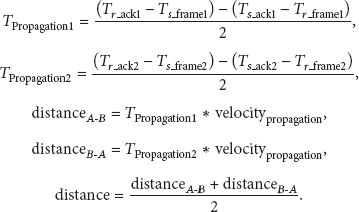
By using this method, a sink node and its neighboring node can estimate the distance between them. Since all sensor nodes periodically exchange the ranging frame with their neighbors, they easily determine the total ranging distance to the sink node.
After determining the distance among the sensor nodes, each node starts to transmit data packet to the destination nodes. However, as mentioned in Motivation section, the nodes may suffer from several transmission failures due to unstable network conditions such as network congestion and wireless link failures. In addition, to tackle these problems, a link estimation mechanism for monitoring congestion status and the frequency of link errors is required. Thus, DLAG newly defines a link estimation metric called the channel quality (CQ) factor in each node and it is calculated as follows:


In addition to the relay node selection procedure, DLAG has a route maintenance algorithm which avoids the potentially bottlenecked node by monitoring its buffer status. To do this, DLAG newly defines two threshold values,
Meanwhile, note that DLAG does not simply compare the current buffer level,

Dynamic threshold adoption with period θ.
3.3. Dynamic Channel Access for Congestion Mitigation
When the DLAG has finished calculating the optimal route with the fewest

If Delay for Random ( else Delay for Default Backoff (IEEE 802.15.4a CSS)
Algorithm 1
Similarly, AMinBE is calculated by subtracting
However, the immoderate backoff shrink operation may result in more severe packet collisions and link failures due to limited backoff ranges and low bandwidth. Thus, in DLAG protocol, the node that is not judged to be congested (e.g., phase I) performs a channel yield operation for congested neighbors (e.g., phase II) only if it detects that one of neighboring nodes is congested. This detection is also conducted via the TWR frame exchange procedure and then it performs Algorithm 2.
If Delay for Random ( else Delay for Default Backoff (IEEE 802.15.4a CSS)
Algorithm 2
Note that the above yield function provides the conceptually opposite operations compared with prioritized transmissions. That is, the nodes with low traffic loads are requested to have fewer transmission opportunities than heavily loaded nodes. The first yield operation is to increase both MinBE and MaxBE to increase the backoff delay. Then, it decreases frame retransmission trials because it has relatively low transmission priority than the nodes with phase II. Finally, if the node with phase I does not detect any neighboring nodes with phase II, it performs ordinary backoff operations according to the default function of IEEE 802.15.4a CSS. In addition, according to the neighbor table management policy, after deleting the stale entity (e.g., expiration of
4. Performance Verification
In order to validate our proposed protocol and performance, we undertook experimental evaluation via the ns-2 simulator [21]. The IEEE 802.15.4a CSS standard is adopted as MAC protocol and DLAG, the proposed protocol, is compared with the existing GPSR and PRR based routing protocols which are a kind of greedy forwarding protocol and packet reception rate based forwarding protocol, respectively. The network is configured with 150 nodes which are randomly distributed over a 100 m * 100 m rectangular topology. All sensor nodes are fully mobile and move at the given maximum speed of 3 m/sec with the pause time of 30 seconds. The radio propagation range and the interference range for each node are set to 15 m and 30 m, respectively. The data packet size is set to 80 bytes and the total number of data connections between the source and destination is set to 30. In each data flow, the source is randomly selected without duplication and data is continuously generated and transmitted to destination nodes. All source nodes are assumed to generate a user datagram protocol (UDP) with constant bit rate (CBR) traffic rather than a transmission control protocol (TCP) because TCP may invoke its additional congestion control operations which make it difficult to identify the effects of actual network congestion situations. For the network traffic variation, packet arrival time is utilized by tuning the interval ranging from 0.1 to 0.8 seconds. It is assumed that the maximum buffer size of the interface of each node is set to 50, which means that the node cannot maintain more than 50 packets at the moment and it will be faced with buffer overflows if the node receives additional packets. Then, we used four different combinations of
For an evaluation and performance comparison with conventional protocols, we employed the following major performance metrics.
Number of link errors: the total number of link failures during the simulation periods. End-to-end packet delivery ratio: the average number of data packets actually received by the sink node over the number of data packets originated by sources. End-to-end delay: the average time that elapses from the time a data packet is originated by a source to when it is successfully received by the sink node. Network lifetime: the time duration before the forwarding sensor node is exhausted due to battery shortages.
Figure 3 shows the averaged number of link failures during the data communications as a function of traffic loads, where DLAG provides fewer link failures because it firstly avoids the congested route during the routing procedure and then, secondly, it can dynamically adjust both the BE and retransmission opportunities according to the current congestion status. Furthermore, DLAG also mitigates potential link failures via the proposed route maintenance policy. In contrast, the other conventional protocols experience poor performance in terms of link failures due to traffic concentration on a certain intermediate node. In particular, GPSR merely forwards the data packet according to the shortest path principle without considering bottleneck situations. This traffic concentration increases the buffer occupancy ratio of the node, which finally leads to entire performance degradations such as poor packet delivery ratio, a longer end-to-end delay, several packet collisions, and greater battery consumption. Another reason for poor performance of conventional GPSR is that it participates in the channel contention of MAC layer with identical probability even though the node is highly congested. Although the PRR based routing protocol outperforms GPSR, it still shows poor performance that is worse than DLAG because PRR scheme only considers the packet reception ratio with travel distance and it also does not suggest any suitable solutions for prioritized channel access during the channel contention time.
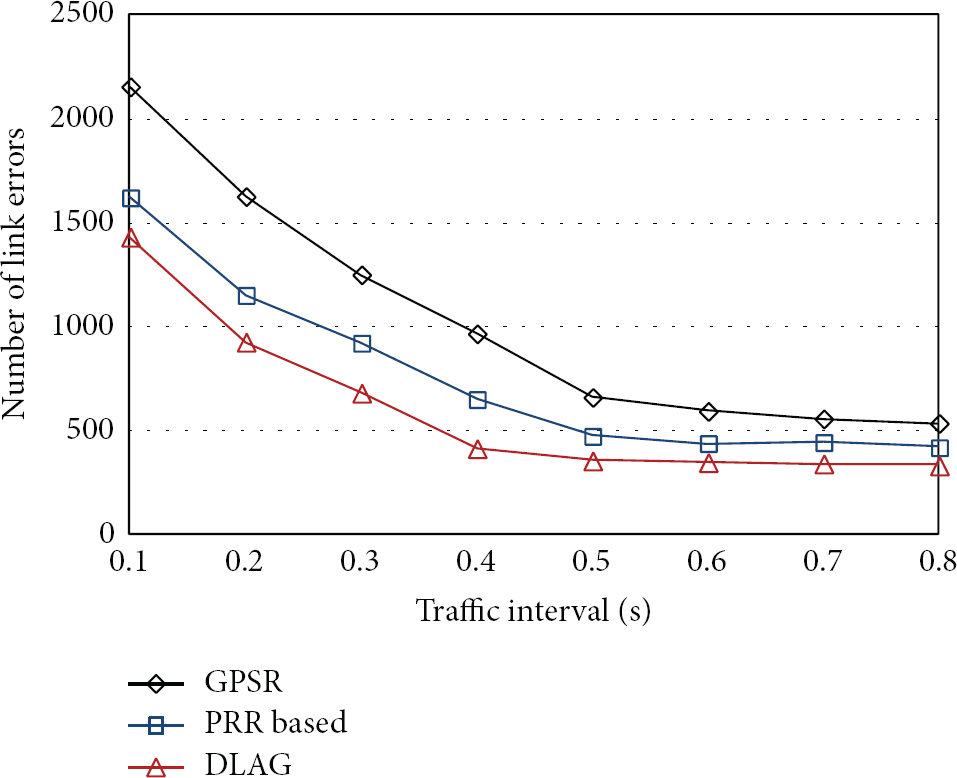
Number of link errors.
Figure 4 describes the delivery ratio performance according to various traffic loads. As a result, we can observe that DLAG shows a better delivery ratio than those of GPSR and PRR schemes in all intervals between 0.1 and 0.8. In particular, when the network load increases, this performance gap also increases because DLAG can monitor the channel status and dynamically avoid the bottleneck nodes during the relay node selection procedure. Meanwhile, both GPSR and PRR schemes suffer from severe link errors due to inevitable network bottleneck. In addition, another reason why the delivery ratio of DLAG does not decrease rapidly is that it provides more retransmission opportunities rather than allowing simple packet drops in congestion environments.

Delivery ratio.
Figure 5 shows the end-to-end delay performance as the function of network traffic load. Although all protocols show similar patterns with a delay increase in congested situations, both GPSR and PRR schemes have higher latency than DLAG because they experience more transmission failures due to buffer overflows and packet collisions, which is also explained by the results in Figures 3 and 4. These transmission failures require additional retransmission for the lost packet or rerouting to alternative path, which finally increases the packet end-to-end delay.
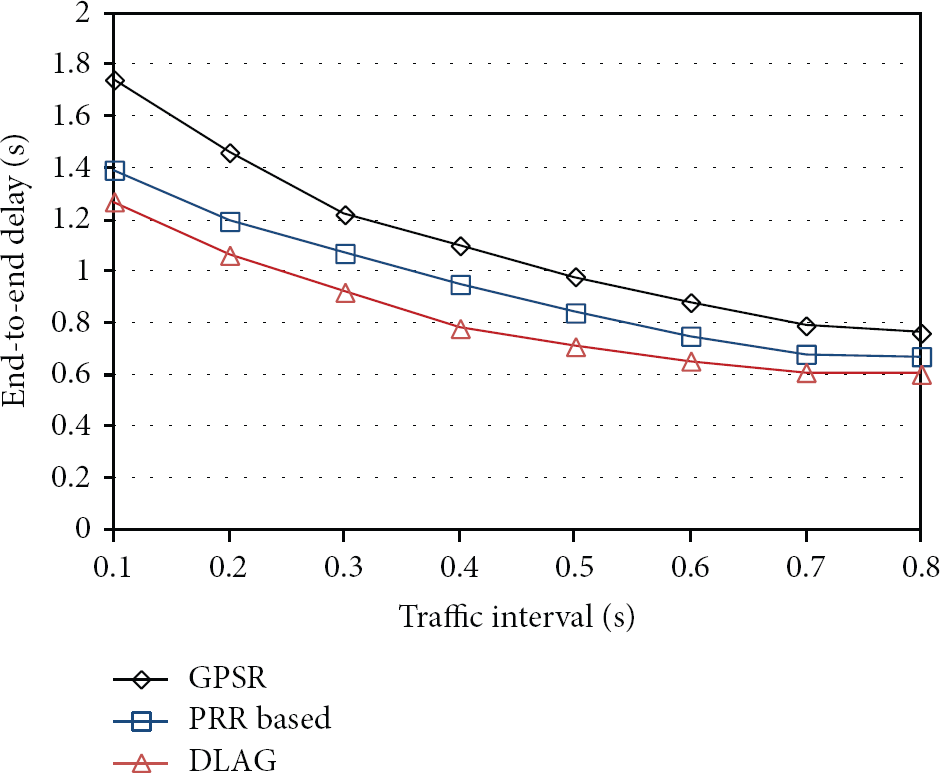
End-to-end delay.
Figure 6 shows the performance of the network lifetime during the data communication periods. As the network becomes either congested or saturated with heavy traffic, the proposed scheme shows better lifetime performance than GPSR and PRR based schemes because of less frequent buffer overflows, which corresponds to previous results (e.g., Figures 3, 4, and 5). This reflects that the congested node tends to consume more energy to receive and forward the packets. Furthermore, the more a node consumes energy, the earlier it dies. This result is accompanied by the link failure and reduces network lifetime in the end. This vicious cycle evokes more traffic concentration on another neighboring node and makes the congestion worse. However, DLAG can detour the most congested nodes by monitoring the CQ and buffer threshold values during the routing process.

Network lifetime.
Finally, Tables 1 and 2 summarize a performance comparison of the delivery ratio, end-to-end delay, and network lifetime by configuring various predefined thresholds with
Parameter tunings of DLAG with a 0.2 traffic interval.

Parameter tunings of DLAG with a 0.7 traffic interval.

5. Conclusion
In this paper, we have proposed a new geographical routing protocol by considering channel quality conditions on mobile sensor nodes. To do this, the proposed protocol, named DLAG, newly defines CQ factor which consists of buffered packet information and channel error ratio. For accurate buffer status monitoring, two kinds of buffer thresholds are introduced. Then, every node can share it with neighboring nodes during the location estimation procedure. In addition, the proposed protocol provides more prioritized channel access opportunities for bottlenecked nodes to achieve prompt and reliable packet transmissions. DLAG is fully compatible with conventional IEEE 802.15.4a standard and can easily be adopted to other greedy based algorithms. Through the performance evaluation, we have revealed that DLAG outperforms the conventional geographical forwarding schemes especially when the network is heavily loaded.
For future works, we plan to investigate more detailed network requirements of real-time data traffic in order to support more reliable communications than previous works. Then, we will also develop a real test-bed system and suitable applications for IEEE 802.15.4a based WSNs.
Footnotes
Conflict of Interests
The authors declare that there is no conflict of interests regarding the publication of this paper.
Acknowledgments
This work was supported by Daegu Gyeongbuk Institute of Science and Technology (DGIST) and was funded by Ministry of Science, ICT, and Future Planning of Korea. A preliminary version of the key ideas and results was presented as part of the IIISC'14 conference, January 2014.