




Abstract
This paper presents an improved energy detector (ED) with weights to improve detection performance in this situation that the primary user's status changes as arriving or leaving randomly in cognitive radio networks. The idea is derived from the concept of unequal scale sampling such that the instantaneous energy statistic of the sampling points in the sensing period is endowed with monotonic weights. The probabilities of false alarm and detection for our ED are deduced under the new detection model. Numerical simulation results show that the proposed ED offers better detection performances with a reduced probability of false alarm compared to conventional ED, and improved energy detector can improve the overall probabilities of detection, when spectrum sensing is performed for a network with high traffic.
1. Introduction
Cognitive radio (CR) [1] emerges as a way to improve the overall spectrum usage by exploiting spectrum opportunities in both licensed and unlicensed bands and its development has been widespread concerned by academia and industry. In cognitive radio networks (CRN), there are two types of users, (i) primary users (PU) who lease portions (channels or bands) of the spectrum directly from the regulator and have priority to use the spectrum and (ii) secondary users (SU) who lease channels from primaries and can use a channel when it is not in use by the primary or without interfering the PU [2]. Spectrum sensing is a critical functionality of CR. It enables SU to find the “spectrum holes.”
Energy Detection (ED) [3] (in this paper, we also call it the conventional ED) at the physical layer constitutes a preferred approach for spectrum sensing in CR owing to its simplicity and applicability as well as its low computational and implementation costs; it allows a quick sensing decision to be made within a short sensing period. Various kinds of improved ED versions [4–6] have been proposed to improve the performance of detection for CR system in recent years. In [4], an improved ED was proposed for random signals in Gaussian noise by replacing the squaring operation of the signal amplitude in the conventional ED with an arbitrary positive power operation. In [5], the authors proposed an improved version of ED algorithm and the proposed scheme outperformed the conventional scheme while preserving a similar level of algorithm complexity. In [6], an improved one was proposed in low SNR environment based on the trade-off between misdetection probability and false alarm probability under noise uncertainty [7].
However, all of these previous researches [3–7] assume that the PU is either absent or present during the whole sensing period [8]. However, in practice, the PU traffic could be high or the sensing period could be long such that the PU may arrive and depart during the sensing period. In this case, parts of the samples from the licensed channel contain noise only, while parts of the samples from the licensed channel contain PU signal plus noise, which is different from the conventional binary hypothesis testing problem for spectrum sensing. The effect of the PU traffic on the sensing performance is evaluated to show that the PU traffic causes significant performance degradation based on ED [9, 10].
A few of studies related to the above problem have been proposed recently [9–13]. Considering the effect of the PU traffic on the spectrum sensing performance, the conventional binary hypothesis testing problem for spectrum sensing can be formulated into the quaternary hypothesis, and the probabilities of false alarm and detection are deduced under the new detection model [10]. Collaborative spectrum sensing is a promising method to alleviate the deleterious effects caused by PU traffic. Authors theoretically analyzed performances of four commonly used feature-based detectors for spectrum sensing as Maximum Eigenvalue (ME) detector, ratio of Maximum to Minimum Eigenvalue (MME) detector, ratio of average Energy to Minimum Eigenvalue (EME) detector, and COVariance (COV) detector that are compared by assuming that the PU may arrive or depart during the sensing period, a realistic case when the PU traffic is high or the sensing period is long. The effect of PU traffic on the performance of SU data transmission is investigated in [11]. The authors theoretically analyzed the achievable throughput for different sensing periods and proved that the degree of throughput degradation is related to the PU band which frequently changes between 1 (busy) and 0 (idle). The effect of multiple PUs on spectrum sensing performance has also been investigated [12]. They discussed multiple PU status changes during the SU sensing period. The spectrum sensing performance was significantly degraded by PU traffic and the degradation decreased when the number of PUs increased; also the extent of this degradation is related to how long the spectrum band was occupied by the PU and the SNR received at the SU. This other research [9–12] focuses on performance analysis; however, any new detection scheme has not been proposed to solve or resist this problem.
So, novel improved ED structure was proposed in [13]. In [13], the authors assumed that the arrival or departure of the PU followed a Poisson process and the detection performances under both statuses were discussed by using the generalized likelihood ratio test to improve the conventional ED. However, under the model proved by the authors, the probability of a PU's status change was low for the later time slots without considering the equal probability of PU arrival and departure within each time slot. Additionally, the performance did not satisfy the CRN's needs in a low SNR environment.
To solve the aforementioned problems, the authors here present a new improved ED with weights to improve the performance of detection for PU status changes. Firstly, we theoretically analyze the limitations of conventional ED and introduce the concept of unequal scale sampling, and then our proposed ED is obtained. Secondly, the probabilities of false alarm and detection for our ED are deduced under the new detection model. Finally, we simulate and analyze the detection performances among four kinds of ED as follows: our improved ED, conventional ED, and the ones proposed in [4, 13]. Numerical simulation results show that, for PU status changes, the improved ED proposed with weights offers better detection performance with reducing probability of false alarm compared to the existing EDs, and it can improve the overall probabilities of detection, when spectrum sensing is performed for a network with high traffic.
The rest of the paper is organized as follows. The system model is presented in Section 2. We introduce the principle of traditional ED briefly and then considering the effect of PU traffic on the spectrum sensing, the new detection model for conventional ED is presented. In Section 3, we analyze the detection performance as affected by the sampling points and introduce the unequal scale sampling. As a result, our proposed ED is obtained in Section 4 and the theoretical probabilities of false alarm and detection for our ED are deduced. The corresponding simulation results and our analyses are showed in Section 5. Finally, we conclude the paper in Section 6.
2. System Model for Primary User Status Changes
In the conventional model [3], the PU is assumed to be either present or absent during the entire sensing frame duration. In practice, a PU may arrive or leave during the sensing period, especially when a long sensing period is used to achieve good sensing performance or when spectrum sensing is performed for a network with high traffic. Therefore, to accurately and effectively detect whether or not the PU band is free, the PU's status changes during the SU sensing period should be considered.
When spectrum sensing is carried out using ED during the sensing period, where the received signal from the licensed channel is prefiltered by a band-pass filter, and is squared and integrated over the sensing period
Considering the effect of PU traffic on the spectrum sensing performance, the conventional binary hypothesis testing problem for spectrum sensing can be formulated into the quaternary hypothesis [10] shown in Figure 1.
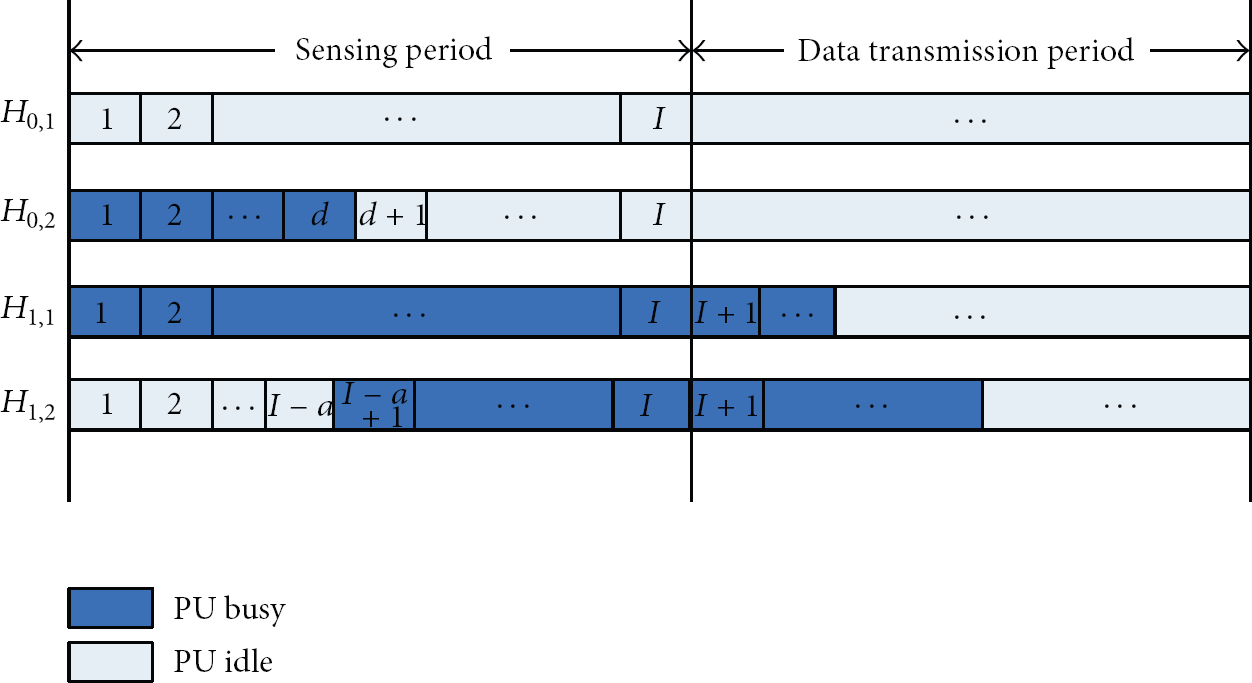
The system model for primary user status changes.
In Figure 1,

When I is relatively large, according to the central limit theorem, the probability of false alarm and the probability of detectioncan be calculated as follows [10]. In


In


Here, we undertake to analyze the PU traffic on the performance of SU's spectrum detecting. Obviously,
3. Sampling Points and Weights
The squaring and integrating process of sampling points using conventional ED over the sensing period is considered as a constant amplitude operation, in which all samples have the same coefficient, which is 1. For example,
From this analysis, considering the effect of PU traffic on the spectrum sensing performance, conventional ED has its limitations. It does not recognize that the sampling points in different positions affect the detection performance. As a matter of fact, the proportion of energy statistics in the former part of Y is the smaller, the better; on the contrary, the one in the later part is the bigger, the better. Figure 2 shows the importance of sampling points in Y in the sensing period.

The importance of the instantaneous energy statistic of sampling points in the sensing period.
Based on the above analyses, we introduce the idea of unequal scale sampling, which is the instantaneous energy statistic of sampling point endowed with weights

The problem of the optimal weights is finding the best power p. In theory, searching the optimal power can be modeled as an optimization problem:
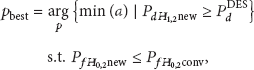
With the p increasing, the rate of convergence of this optimization problem is becoming much slower. Because of simplicity and low implementation costs of ED, for analytical simplicity, this paper chooses the elementary function listed as follows:

4. Improved Energy Detector with Weights
4.1. Improved Detection Model
According to (1) and (8), the quaternary hypothesis testing problem of improved ED becomes

Now, we analyze its probabilities of detection and false alarm. According to (9),
In


In


In

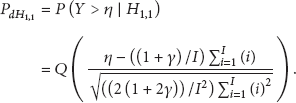
In


In the Neyman-Pearson criterion, when the constant false alarm rate (CFAR) strategy is adopted [15], the threshold η is calculated by assigning a predetermined probability of false alarm. So, according to (11), η for improved ED is

4.2. The Average Probability Affected by PU's Traffic
Assuming that the PU traffic is modeled as a 1-0 random process [16], where “1” and “0” states represent the busy and idle channel, respectively. The holding time of each status obeys the Exponential Distribution, with mean parameter
Therefore, we can obtain that at any time instant, the channel is busy with probability


So, by combining the conditional probabilities of detection, false alarm, and the transition probabilities of the licensed channel state, the overall probabilities of detection for the new sensing model by using our improved ED can be given by

In a similar way, the overall probabilities of false alarm can be derived as

5. Simulations and Analyses
In Section 4, we have derived the probabilities of detection and false alarm for our improved ED. In this section, the MATLAB simulation results will be investigated.
Considering that all simulations are conducted using a BPSK modulation on the AWGN channel, the carrier frequency is 500 MHz, sample frequency is 6 MHz, the smallest possible probability of false alarm
Choosing the SNR of −5 dB, −10 dB, and −12 dB, the sampling time is 1 ms, so the total number of samples I is 6000. In

The probability of detection comparison versus a among four kinds of ED in different SNR environments for
From Figure 3, we can infer a match between the simulation and numerical results which indicates that the theoretical analyses of proposed ED are correct. The probability of detection increases as the PU signal samples increases. Thus, one can achieve a larger probability of detection for larger values of a and one can achieve a high probability of misdetection for smaller a, as expected.
Figures 4 and 5 show the probability of detection among four kinds of EDs in high SNR and low SNR environment, respectively. We can achieve that Beaulieu's scheme in [13] has limitation and it only can improve the performance in high SNR environment such as SNR = −5 dB depicted in Figure 4. However, when in the low SNR environment such as SNR = −10 dB showed in Figure 5, the performance of [13] is similar to the conventional one. The performance of Chen's ED proposed in [4] is less than other ones on matter what the SNR is. However, our ED significantly outperforms its counterparts in all kinds of cases considered. That is to say, our ED needs less number of PU signal samples to fulfill the target probability of detection

The probability of detection comparison versus a among four kinds of ED in SNR = −5 dB.

The probability of detection comparison versus a among four kinds of ED in SNR = −10 dB.
In
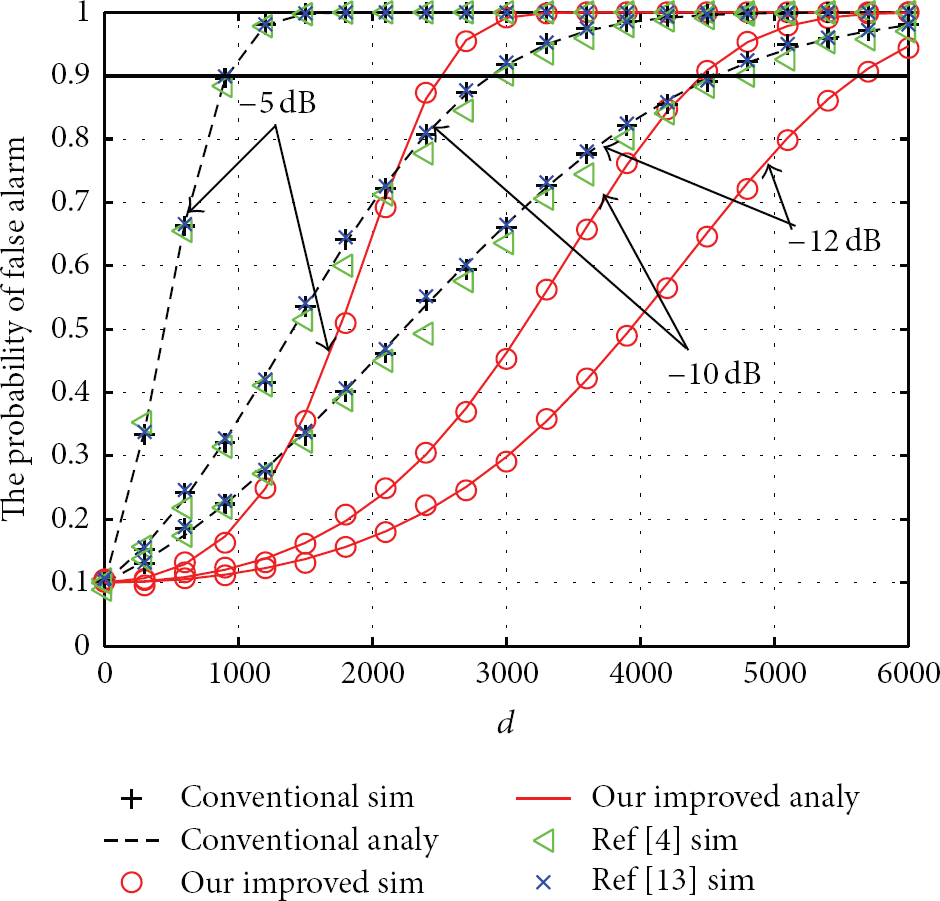
The probability of false alarm comparison versus d among four kinds of ED in different SNR environments for
In conclusion, considering the new detection model, the proposed ED is superior to the compared schemes. In other words, considering the effect of PU traffic on the spectrum sensing performance, our EDs not only can improve the probability of detection as shown in Figure 3, but also reduce the probability of false alarm as seen in Figure 6. Now, we compare the sensing performance in
Figure 7 shows the probability of detection versus SNR under
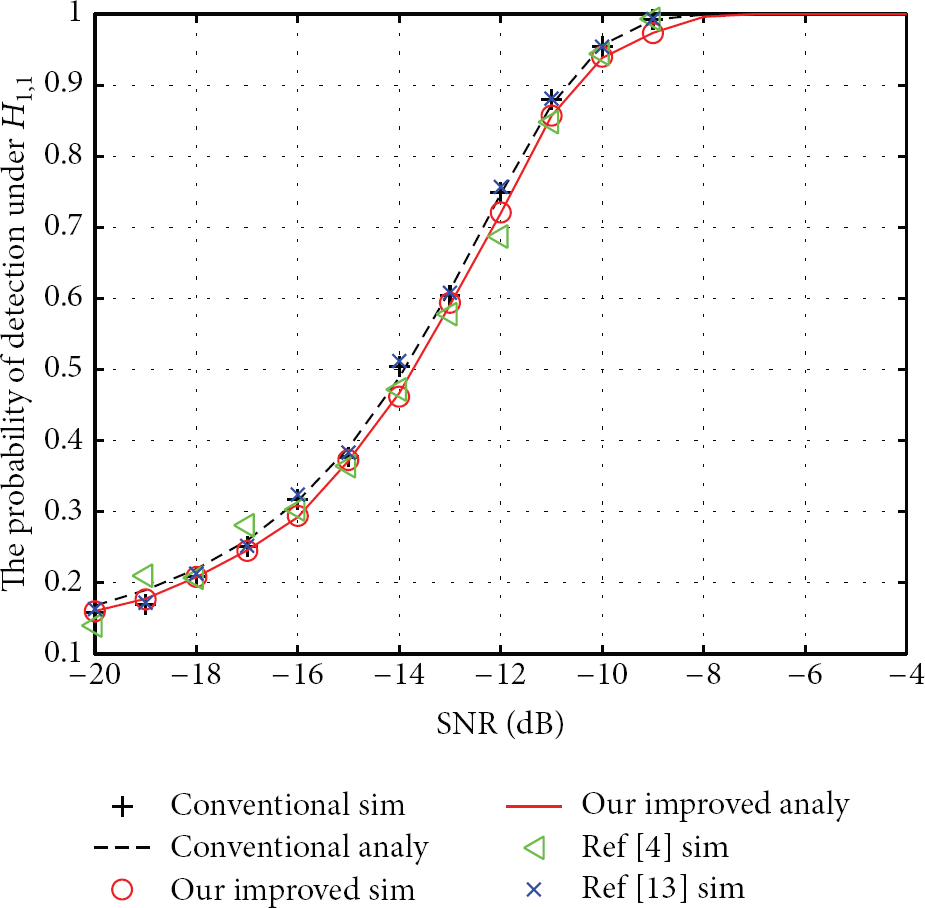
The probability of detection comparison versus SNR among four types of ED under
Figure 8 shows the receiver operating characteristic (ROC) curves of spectrum sensing performance among four types of EDs for different SNR received at SU in local spectrum sensing under
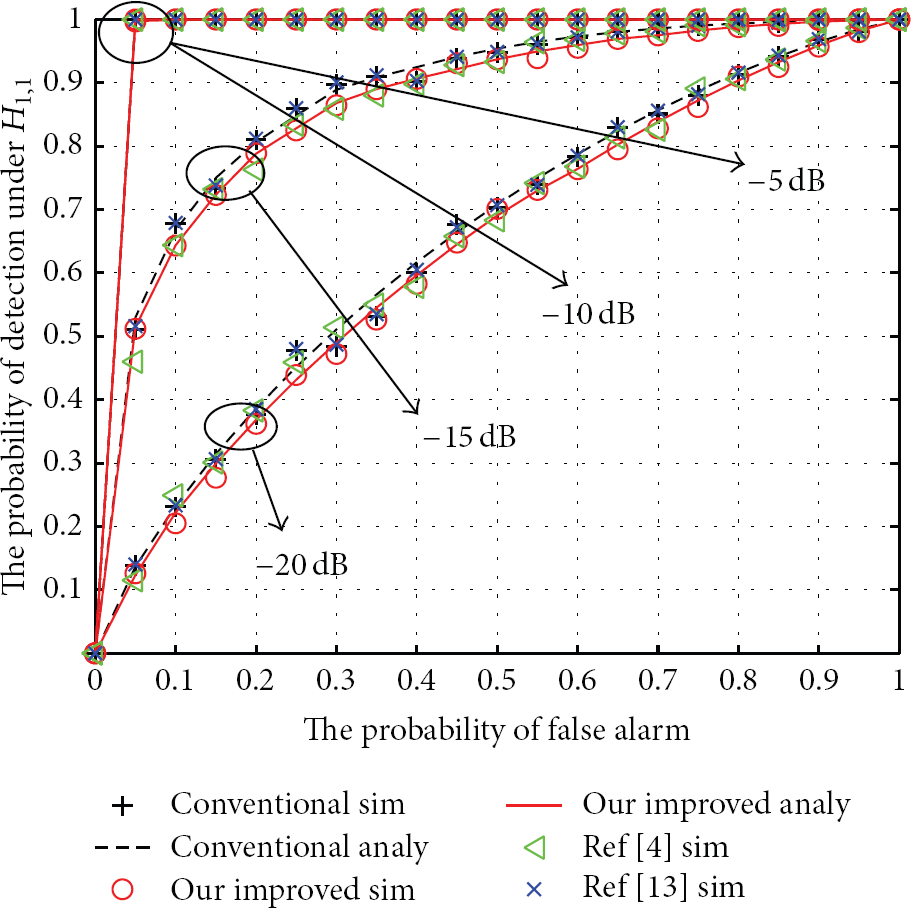
ROC curves for four kinds of ED for
Now, the performance of spectrum sensing based on the PU traffic is investigated. The average probability of detection is compared between conventional ED and improved ED with weights. The Neyman-Pearson rule is used to determine the detection threshold by maximizing the average probability of false alarm.
We choose simulation parameters

ROC curves for conventional ED and our improved ED in different SNR environments.
Figure 10 shows the receiver ROC curve of spectrum sensing for different values of the parameters of the PU traffic model, corresponding to
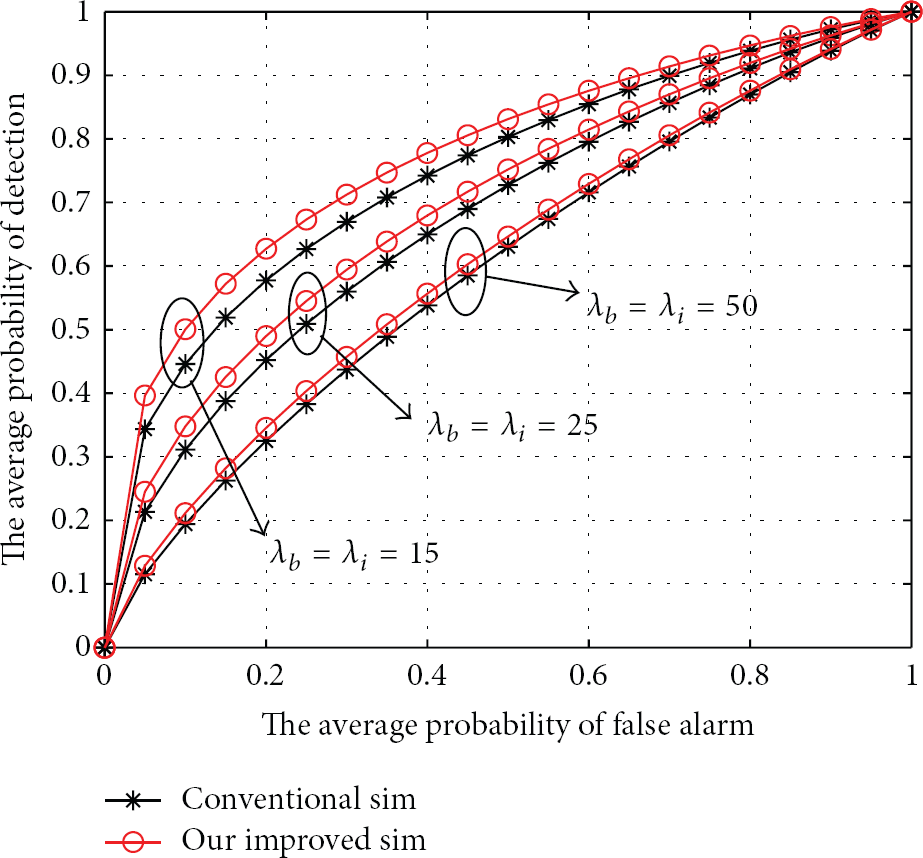
ROC curves for conventional ED and our improved ED in different PU traffic intensity environments.
6. Conclusion
We propose an improved ED with weights to improve detection performance in the face of PU's status changes when arriving or leaving randomly in cognitive radio networks. The idea is derived from the concept of unequal scale sampling such that the sampling points in the sensing period are endowed with monotonic weights. The probabilities of false alarm and detection for our ED are deduced under the new detection model. The simulation results show that our ED not only offers better detection performance but also reduces the probability of false alarm and can improve the overall probabilities of detection compared to conventional energy detector, when spectrum sensing is performed for a network with high traffic.
Footnotes
Conflict of Interests
The authors declare that there is no conflict of interests regarding the publication of this paper.
Acknowledgments
This paper was supported by the National Nature Science Foundation of China under Contract nos. 61271259 and 61301123, the Chongqing Nature Science Foundation under Contract no. CTSC2011jjA40006, the Research Project of Chongqing Education Commission under Contract nos. KJ120501, KJ120502, and KJ120536, Program for Changjiang Scholars and Innovative Research Team in University (IRT1299), and the Special Fund of Chongqing Key Laboratory (CSTC).