




Abstract
To meet the wireless network congestion control problem, we give a definition of congestion degree classification and propose a mechanism of directed cooperative path net, guided by the wireless network's cross-layer design methods and node cooperation principles. Considering the virtual collision and “starved” phenomenon in congested networks, the QRD mechanism and channel competition mechanism QPCG are proposed, with introducing the game theory into the cross-layer design. Simulation results showed that directed cooperative path nets could effectively improve network resource utilization and network transmission performance in congested network. And the QRD and QPCG mechanism could effectively reduce the probability of “starved” phenomenon and increased the wireless network throughput with reducing the packet loss rate.
1. Introduction
With the development of wireless networks, cross-layer design and node cooperation have become key technologies of wireless network communication. Cross-layer design has broken the conventional layered concept to coordinate parameters between different layers with considering the influence of wireless communication transmission layers, so it could ensure the overall performance of wireless network communication [1–3]. Through node cooperation, the cooperative communication (CC) provides more network performance gain for the wireless networks [4–6]. It is valuable to combine cross-layer design with node cooperation, to improve the transmission quality of wireless networks. By introducing game theory (GT) into the cross-layer design and node cooperation, the parameters in different layers can be effectively used to formulate wireless network bidding functions. Besides, combined with the resource scheduling mechanism of node cooperation [7], the Nash equilibrium strategy of wireless networks can be constituted to obtain overall performance gain of the wireless networks [8].
Currently, the node cooperation mechanism (NCM), based on GT and cross-layer design, has achieved certain results, in terms of node energy consumption, transmission quality, and protocol optimization. Combined with CC protocol, [9] studied the key problems of relay selection schemes and analyzed the application prospect of GT and adaptive learning techniques in network resources’ allocation. Reference [10] proposed a selfish node punishment strategy, which is a NCM based on GT and effectively overcomes the nodes’ selfishness, to increase the probability of nodes’ cooperation. Based on GT, [11] presented a network nodes’ collusion strategy and took a comprehensive consideration of network layer information and data link layer information, to realize cooperative transmission and ensure the nodes’ best interests. Combined with the GT, [12] proposed a method of wireless network nodes’ independent control of data transmission channel. This method is equivalent to a distributed transmission system on the function and effectively enhances network throughput in aspect of distributed multiple antenna system diversity. In the consistent random backoff (CRB) scheme of [13], a contention window (CW) size at each backoff stage is determined by hashing the session identifier and the talk spurt index, so as to reduce the channel access delay jitter. Based on cross-layer design and energy-harvesting mechanism, [14] proposed a secure routing protocol. In this protocol, parameters are exchanged between different layers to ensure efficient use of energy. Through comprehensive consideration of relevant data in physical layer and MAC sublayer, [15] applied cross-layer concept to realize nodes’ cooperative transmission and improve nodes’ power consumption. The CL-MAC protocol in [16], as a novel cross-layer MAC protocol, can effectively handle the wireless network's communication mode of multiple packets, multiple-hops, and multiple flows and reduce nodes’ load pressure. Through each layer's comprehensive information, CL-MAC protocol can reflect the current network situation and provide a dynamic scheduling mechanism to reduce the end-to-end delay and finally improve the delivery rate and reduce the average energy consumption. As for the unfairness of channel occupation in multimedia wireless networks, [17] gave a node cooperation strategy of weighted fairness. Through adding a label field in the RTS/CTS frame, the fairness problem of multimedia stream is solved effectively.
In this paper, we combined cross-layer design and node cooperation through GT and proposed a mechanism of cross-layer cooperation communication based on game concept. By this mechanism application, the resource competition and cooperation of wireless network cross-layer design achieve an overall optimal effect.
2. The Mechanisms of QRD and QPCG Based on GT
2.1. QRD Mechanism
In the 802.11e EDCA protocol, there are multiple sending queues in one node. When sending the packets of multiple queues, nodes need to transmit with considering queues’ priority, to avoid the virtual collision problem. But when the collision occurs frequently, “starved” phenomenon will occur to lower priority data flows, at the same time the wireless network is congested. The fairness of queue scheduling mechanism should also be taken into consideration. In accordance with the existing strategy of proportional fairness, [18] proposed a queue-length scheduling mechanism
Based on the queue length and the current transmission rate, a fair queue dispatch mechanism, Queue and Rate Dispatch (QRD), is proposed. QRD mechanism not only considers the nodes’ current length of each transmission queue, but also considers the influence of previous and successor nodes transmitted. The main idea of QRD mechanism is that, within any time period, queue backlog ratio is reflected as the queue's load level of this specific time period. The queue backlog represents the ratio of the queue's average sent throughput and average receipt throughput in a certain time period. When the queue backlog is greater than 1, it means that the queue's load level is decreasing constantly; otherwise, the load level is increasing.
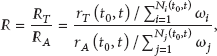
The queue's backlog ratio is defined as the ratio value R of the average, sent throughput
For the queue's sent packets,

Within the time period

For a queue's reception packets,

In the time period

As in formula R, the standardized sent throughput and receipt throughput can well reflect the relationship between packet's channel occupation priority and the queue's throughput, thus providing a fair packet sending mechanism. According to the analysis above and the queue backlog definition, nodes’ queue scheduling mechanism QRD is composed of the following events.
(1) Scheduling Rules. To ensure a fair packet transmission chance for each queue in the same node, QRD mechanism only needs to minimize the differences of each queue's R value, and R value should be as much as possible. So, the queue with a minimum R value is transmitted firstly. If multiple nodes own the same R value, QRD mechanism will choose a queue of the minimum priority to prevent the lower priority data stream from being “starved.”
(2) Updating Rules. After packets’ transmission, R value needs to be updated. According to the computation formula of
When frequent collision occurs to the multiple queues’ packet sending inside one node, QRD mechanism will abandon the inherent strategy of sending by priority; instead, it will comprehensively consider the relationship between current node with its precursor and subsequent nodes to formulate bidding function, thus competing for the packets’ sending order. During the wireless network congestion processing, QRD mechanism is specific for the time-varying property of wireless network and owns better dynamic adaptability, which is because the value of bidding function R changes with queues’ variation status inside each node. So the QRD mechanism effectively improves the fairness of queue scheduling mechanism and avoids the “starvation” phenomenon of low-priority data stream. For this scheduling mechanism, both the time complexity and space complexity of R value are linear, thus adapting to the low computing capacity and low power consumption of wireless network nodes.
2.2. QPCG Mechanism
The channel competition mechanism QPCG (Queue Transmission Path of Channel Game) is an incompletely cooperative game communication mechanism, which is based on queue length and channel competition weights. Our ideas of incompletely cooperative game refers to the concept in [19, 20]. The reason we call it an incomplete cooperation is that the mechanism considers both the wireless network nodes’ noncooperative selfishness and the positive collaboration when without cooperation protocol. Because of the selfish nodes’ noncooperation, the incomplete cooperation game solution is also the one of noncooperative game mechanism, called Nash equilibrium concept. The incomplete cooperation game and Nash equilibrium solution in [19, 20] are mainly specific for 802.11 DCF, and its game competition condition is node number. The channel competition mechanism QPCG proposed in this paper not only considers the influence of node number on game competition, but also considers the impact of data transmission priority and the queue length. When considering selfish nodes’ priority, we standardize the influence of priority on the selfishness to highlight the cooperation property. The following is an analysis of the main idea of channel competition mechanism QPCG; an illustration of the Nash equilibrium solution property is presented as well. QPCG is divided into two stages of game's delay time initializing and mechanism state updating.
(1) Set the Game's Delay Time
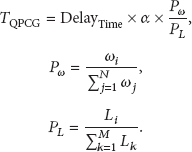
In accordance with the Nash equilibrium concept, the explanation of each parameter is described as follows.
Parameter Delay_Time represents waiting time of current channel competition, which is changing with the channel competition degree. Assuming that fierce competition happened among n data flows, the average transmission time of one data stream is
The initialization value of parameter α is set as the sent packet weight
Parameter
(2) Update the State of Mechanism QPCG. During the initialization process of parameter

Under the condition that the channel competition is intense, QPCG channel competition mechanism not only considers current node's status, but also comprehensively considers the situation of its precursor and subsequent nodes. By balancing the relationship between the transmission data priority and the queue packet length in each node, the fair and effective bidding function
3. The Model Establishment of Cross-Layer CC
When applying cross-layered concept to solve wireless network congestion problems, we should first monitor the information of congested nodes or channels [21], synthesize the feedback information of each layer [22], and then achieve the purpose of cross-layered processing of the wireless network congestion with a joint optimization [23]. The congestion degree function calculation achieves a meticulous classification of congestion degree, and depending on the specific congestion degree, we take a corresponding congestion control mechanism or pretreatment mechanism, so as to avoid more serious wireless network congestion phenomenon and eventually achieve an improvement of wireless network transmission quality.
3.1. Congestion Degree Division Based on Cross-Layer Design
Because of the complicated cause of wireless network congestion, it is necessary to synthesize congestion formulation reasons. In this paper, we consider congestion reasons from three aspects (node, link, and channel). According to the congestion degree function

According to the transmission rate, expected transmission time (ETT), and expected transmission times (ETX), we can quantify the levels of node load, link load, and channel interference.
Any node's load is related with the previous nodes and the next node. The load degree of node i can be described by its transmission queue length. As shown in Figure 1, node i is the previous-hop of node

Schematic diagram of wireless network node transmission queue.
Nodes’ load is influenced by waiting queues’ length and packets’ sending and receiving rate, so nodes’ accumulated load degree could be used to measure the congestion degree of all nodes on the whole transmission path:

Even though both the sending rate and receiving rate can be adjusted but the sending rate is changing over time, so it will bring about a big difference. Assume that the nodes’ sending speed limit is

Even if the rate limit of node i is close to
For the link load level

The channel interference degree is described by

3.2. The Cross-Layer Cooperative Congestion Processing Model Based on GT
Through the congestion degree division, the wireless network congestion is processed with a specific mechanism, thus achieving a targeted dynamic adaptive system of the wireless network congestion. The main processing flow is shown in Figure 2. First of all, the wireless network uses cross-layer technology to monitor the channel information of physical layer, sending/receiving rate information of link layer's MAC sublayer and the buffer queue information of the network layer and then apply the congestion measurement function to get a comprehensive evaluation which is used to judge block and find the main causes of congestion.
When the congestion is caused by nodes’ overload, we should use formula When the congestion is caused by links’ heavy load, we should determine whether the load has reached the link load's threshold defined in formula When the congestion is caused by excessively strong channel interference, first what we should do is to determine whether it has exceeded the tolerance range of channel interference. If it is within the tolerance range, the congestion can be processed through channel competition mechanism QPCG; otherwise it needs to find cooperative nodes to realize node cooperation transmission. When the congestion reasons cannot be simply classified into one class, which means two or three congestion reasons exist at the same time, the congestion should be controlled according to the following order: first to deal with the effects of excessive channel interference on network transmission; then, process the effects of excessive node load on network transmission; and last, process the effects of excessive link load on network transmission. Why we follow such processing flow is because only after the channel interference degree decreasing, can improve nodes’ average sending/receiving rate, so as to reduce the load pressure of a single node and eventually reduce the link load pressure.

Processing flow of different congestion.
So, when the congestion reaches a certain extent, it needs to seek for cooperative nodes to realize nodes’ cooperation processing. If cooperative nodes cannot be found within a certain region, then set a time trigger in the congested node to monitor a time period's information including channel information of physical layer, sending/receiving rate information of MAC sublayer in link layer and buffer queue information of network layer. If in a time period, the corresponding information is weakening, then we should reuse the congestion metric function to classify congestion degree; otherwise, we need to reestablish a transmission path. If several cooperative nodes have been found, we should establish the directed cooperative path net through trust level and AFCR algorithm, then we should seek for an optimal cooperative path in the directed cooperative path net to realize cooperative transmission. The targeted congestion processing can eventually realize an improvement of wireless network transmission quality.
When congestion reached a certain degree, it is necessary to establish a directed cooperative path net to solve the congestion. The main idea of directed cooperative path net is described as follows. In Figure 3, when node C is congested, or load of transmission path
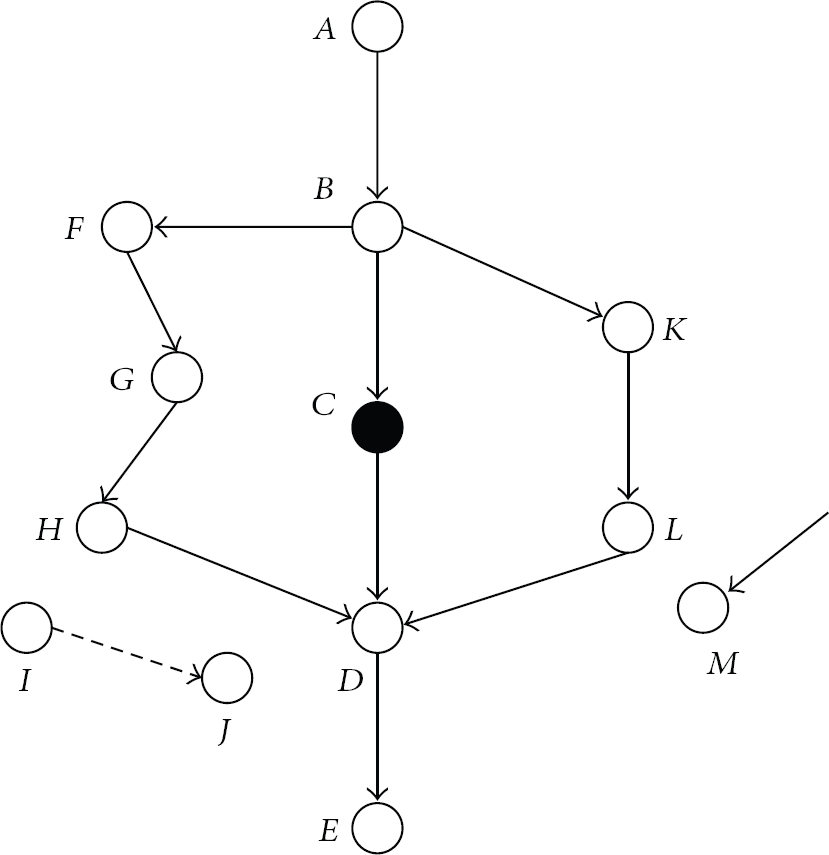
Directed cooperative path net.
The establishment steps of directed cooperative path net are shown as follows.
(1) Select Credible Nodes of the Directed Cooperative Path Net. Node C will broadcast cooperation request to its neighbor nodes within its radiation scope. If received from cooperative nodes, the cooperative set
(2) Establish Directed Cooperative Path Net. According to the AFCR [24] algorithm, the rest nodes within one-hop are clustered. Before AFCR algorithm, it needs to initialize each node's weight according to the formula of CMM and immediately send the initialization information of one-round clustering to all nodes in CS; then each node forms a temporary table of neighbor nodes and set a clustering timer. In the execution process of AFCR algorithm, we select nodes of larger weight as the cluster head. After every node in CS finishing route selection, each node needs to save a temporary table of adjacent nodes, a temporary table of cluster heads and a temporary table of cluster members. The clustered nodes conduct wireless communication through route establishment, route selection, and route maintenance.
(3) Create Optimal Path in the Directed Cooperative Path Net. During the route selection process, each node needs to initialize the credibility value based on formula CMM and the credibility value is
The directed cooperative path net around a congested node can effectively protect the congested node and prevent its load increasing and channel interfering. And the credibility concept introduction can realize a targeted route selection, which not only reduces the node's load pressure, but also decreases the link load pressure and channel interference. Thereby, the NCM greatly improves the utilization rate of network resources, and finally achieves the purpose of improving entire network service quality.
4. Performance Analysis
In this paper, we choose Glomosim [25] as simulation tool and the simulation is based on 802.11 protocol. In the simulation experiment, under the simulation environment of gradual congestion phenomenon and the ever-changing congestion degree and congestion reasons, we compare the network transmission quality of no congestion process, single rate control mechanism, and the adopting different congestion mechanism based on different congestion degree. The simulation scope is

Simulation scene.
Firstly, we conduct a simulation of directed cooperative path net which is based on congestion degree division to verify the effectiveness of congestion degree division mechanism and cross-layer cooperation congestion processing.
When the wireless network load is gradually increasing, Figure 5 shows the total throughput variation trend of 4 different congestion processing mechanisms. With the CBR number increasing from 3 to 10, the network total throughput is also constantly increasing. But, there exists obvious difference between different congestion processing mechanisms. Clearly, in the current simulation environment, for the first three mechanisms, except directed cooperative path net mechanism, the total throughput begins declining after reaching a peak, which indicates that, under this three mechanisms, the network will be congested after its load pressure reaching a certain extent, thus causing a declination to the total network throughput. But when applying the directed cooperative path net, because of its effect of congestion degree division, the total throughput obviously improves.

Wireless network total throughput variation trend.
In the case of CBR number increasing from 3 to 10, which means the wireless network load is increasing, Figure 6 shows the wireless network average end-to-end throughput variation trend of 4 different congestion processing mechanisms. Obviously, under the condition of equal initial average end-to-end throughput, when applying the directed cooperative path net mechanism, the average end-to-end throughput declines more modest, which means the average end-to-end throughput is improved obviously.

Average end-to-end throughput variation trend.
Then, we apply QRD mechanism and QPCG mechanism in the directed cooperative path net and contrast the processing effect of wireless network congestion.
In the case of wireless network load increasing, Figure 7 shows the wireless network's total throughput variation trend. With the CBR number increasing from 3 to 10, three different congestion processing mechanisms bring obviously different impact to the total throughput. Under the condition of without any processing mechanism, a sharp decline point is the total throughput peak, which indicates that serious congestion has occurred to the wireless network. But for the game cross-layer CC based congestion processing, this simulation has not yet appeared congested trend, and the network's total throughput has displayed an obvious increasing tendency, which indicates that the congestion processing mechanism based on game cross-layer CC can tolerance immense network load pressure.

Wireless network overall throughput variation trend.
In the case of network load increasing, Figure 8 shows the wireless network's average packet delivery rate variation trend. With the CBR number increasing from 3 to 10, compared to no processing mechanism and a single cooperative mechanism, game cross-layer CC mechanism has the most gentle declination tendency of the average packet delivery rate. With the CBR number increasing, the congestion classification function of game cross-layer cooperation communication mechanism can adaptively control the congestion according to the current wireless network environment thus to maintain a relatively stable transmission quality of wireless networks.

Wireless network average packet delivery rate variation trend.
5. Conclusions
With considering GT, cross-layer design, and CC, this paper gave a concept of directed cooperative path net, for wireless network congestion processing. With the congestion degree division, we realize a targeted processing of wireless network congestion. During wireless network congestion processing, the applications of QRD and channel competition mechanism QPCG can effectively enhance the fairness of the wireless network resource competition, improve the resource utilization of wireless network, and increase the wireless network transmission. Simulation comparison shows that the integration of game concept into cross-layer cooperation can improve the wireless network throughput, reduce the packet loss rate, increase the utilization rate of spare nodes, and decrease the risk of “starved” phenomenon. Combined with the cross-layer concept and GT, the applications of QRD and channel competition mechanism QPCG can improve the blindness of wireless networks, thus effectively improving the transmission quality of wireless networks.
Footnotes
Conflict of Interests
The authors declare that there is no conflict of interests regarding the publication of this paper.
Acknowledgments
This research is partly supported by the National Nature Science Foundation of China under Grant no. 61272412, Ph.D. Programs Foundation of Ministry of Education of China no. 20120061110044, and Jilin Province Science and Technology Development Program under Grant no. 20120303.