




Abstract
The convective drying kinetics of porous medium was investigated numerically. A mathematical model for forced convective drying was established to estimate the evolution of moisture content and temperature inside multilayered porous medium. The set of coupled partial differential equations with the specified boundary and initial conditions were solved numerically using a MATLAB code. An experimental setup of convective drying had been constructed and validated the theoretical model. The temperature and moisture content of the potato samples were dynamically measured and recorded during the drying process. Results indicate that thermal diffusion coefficient has significant positive impact on temperature distribution and mass diffusion coefficient might directly affect the moisture content distribution. Soret effect has a significant impact on heat flux and temperature distribution in the presence of large temperature gradient.
1. Introduction
Drying is one of the basic techniques for preserving wide variety of products, from raw materials to finished goods and from cereals to fruits. It is a highly complex transient process involving conjugated transfer phenomena of water content and heat. Drying controls to a large extent the final quality of the dried products and consumes a comparatively large amount of latent heat to eliminate the water content within the various perishable products [1, 2]. In order to make better dried products, improve dryer efficiency, and reduce the operating expenses and time, the mathematical modelling tools have been one of the most important areas in modern drying technology [3].
In recent years, many investigators like Mujumdar, Tsotsas, and Zbicinski have devoted their research to drying mathematical model of conjugated transport of moisture content and heat flux through porous medium [4–7]. Ranjan et al. [8] reported a two-dimensional diffusion model describing the heat and mass, momentum transfer to predict the drying rate of bananas. They reported that the experimental results were in good agreement with predicted results. Bennamoun et al. [9] developed a transient model to evaluate the convective drying curve and the product temperature with introduction of shrinkage. Da Silva Morais et al. [10] investigated the diffusion coefficient and drying curves of cowpea grains based on different mathematical models. Wawrzyniaka et al. [11] presented a CFD modeling of heat and mass transfer during spray drying process. Although numerous studies have been published concerning heat and moisture transfer model under different dimensions, mostly in mathematical analysis of the drying rate, the temperature and water content distribution within different materials, cortex effect [12], and the evaporation and diffusion transport properties [13], little literature is available on the effect of thermophysical properties on the convective drying kinetics by taking the conjugated heat and mass transfer effects into account [14, 15].
In this work, a dynamic model with the third boundary condition for describing the transient heat and mass diffusion process inside the moist porous medium during forced hot air drying was proposed. An experimental method for forced convective drying was investigated and fresh potato was used as the sample. The measured values in different running conditions were compared with the calculated results to validate the effectiveness of the theoretical model developed. Effects of using different thermophysical properties of potato samples on the convective drying rate by taking into account the thermal diffusion and diffusion-thermo effects were then investigated with numerical method.
2. Mathematical Model
A physical model that explains the sliced porous material is exposed to the hot air drying process used as shown in Figure 1. The physical mechanisms of heat and mass transfer involved in the convective drying are as follows: conductive heat transfers from the high-temperature region to the low-temperature region; forced convection takes place between the external surface of porous medium and the drying air surrounding it; mass transfer in the product is one-dimensional process, which takes place only at the surface level of the sliced porous solid; the gradients of temperature and relative moisture content are considered as the driving force of mass diffusion.

Physical model of porous product subjected to drying.
The physical model that involves the simultaneous heat and mass transfer process, as a consequence, is a very complicated model [16]. In order to simplify the model, the hypotheses listed below have been made.
The flat porous slab is unsaturated, homogeneous, and isotropic.
At time zero, the products are assumed to be at uniform temperature and moisture content distributions.
The side and bottom surfaces of the product had been insulted, and dimensions in the other directions are sufficiently large that heat transfer and moisture diffusion may be considered as 1D only through x-axis.
The porous bodies are continuous slab during the drying period and compressibility effects are negligible.
According to Luikov's theory and the nonequilibrium thermodynamics using the above assumptions [17, 18], the one-dimensional governing equations with coupled energy transfer and mass diffusion within moist medium subjected to hot air drying can be given as follows:

where T is the local temperature of different thickness within the porous medium (K); M is the materials moisture content (kg water/kg solid, dry basis); a q and a m are the thermal diffusivity (m2s−1) and effective moisture diffusion coefficient (m2s−1), respectively; δ and ξ are the thermogradient coefficient (K−1) and moisture gradient coefficient of the material (K); τ is the drying time (s).
Initially, the moisture content and temperature are assumed to be homogeneous within the porous material. Consider

The boundary conditions of partial differential equations are given as follows:

where λ, D, h t , and h m are the heat transfer coefficient (Wm ‒2K ‒1), mass transfer coefficient (ms−1), and convective heat and mass transfer coefficient, respectively; l is the thickness of the multilayered porous materials (m); x is the vector dimension in the direction of the thickness (m).
The coupled partial differential equations were discredited with the specified boundary and initial conditions. Equations (1)–(3) were integrated numerically by using a LU decomposition scheme, and a MATLAB 8.0 procedure code was developed to solve the system of partial equations. Figure 2 is the flow chart of the detailed solution procedure.

Flow chart of the numerical calculation.
3. Experimental Procedures
In order to validate the theoretical model, drying tests were carried out to investigate the coupled heat and mass transport in moist materials. Figure 3 shows the convective drying experimental set-up scheme. The whole installation include a hot air drying chamber, a humidifier, an air heater, an analytical balance, a hygrometer, and a fan. Before each new test, the drying apparatus is set to the experiment conditions required and then is left running for 90 min to ensure and maintain the steady-state operating conditions.

Overall sketch of the experimental apparatus.
Fresh potato, which was used as the sample, was obtained from a market under the same brand. At the beginning of each drying test, the drying samples were stabilized at ambient air temperature, then peeled, and cut into slices approximately 8 mm thick. The samples were put in the drier, where air was circulated through the top surface of drying material. As Figure 1 shows, the local temperatures of different thickness within the potato samples were measured by five T-type thermocouples, then recorded, and stored in a digital data logger at an interval of 30 s. To obtain the drying rate, the weight change of the potato specimen during drying was dynamically measured and recorded with an electronic balance (Figure 3). At the end of each drying test, the potato specimens were put in a hot air circulation oven at 120°C for 24 h and weighed again to determine the bone-dry weight.
To investigate the force convective drying process, a number of drying experiments were conducted using the same samples under different conditions as Table 1 shows.
Estimated parameters of the contact drying experiment.
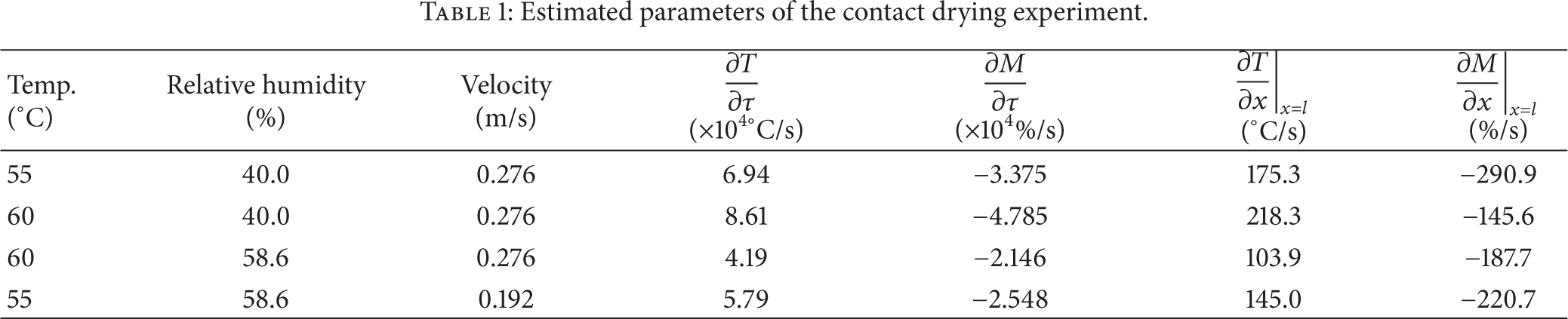
By inverse problem method [19, 20], the thermophysical parameters were estimated and the heat and mass transfer coefficients were a q = 2.54 × 10⁻⁷ m2s−1, a m = 6.95 × 10⁻⁸ m2s−1, δ = 0.0124 K−1, and ξ = 0.0185 K.
Figure 4 shows the comparison of the simulated and experimental values of temperature and average moisture content within the potato sample during forced convective drying. Figure 4(a) illustrates that the local temperature of every layer of the sample will become higher as drying time goes by. The temperature difference between the top and bottom surfaces of the sample decreases with the drying time. There were no significant differences between the predicted and experimental temperature values at about 5% level. The drying rate can be obtained from the rate change of moisture content as Figure 4(b) shows. This model could predict the temperature and moisture content variations in close agreement with the experimental data.
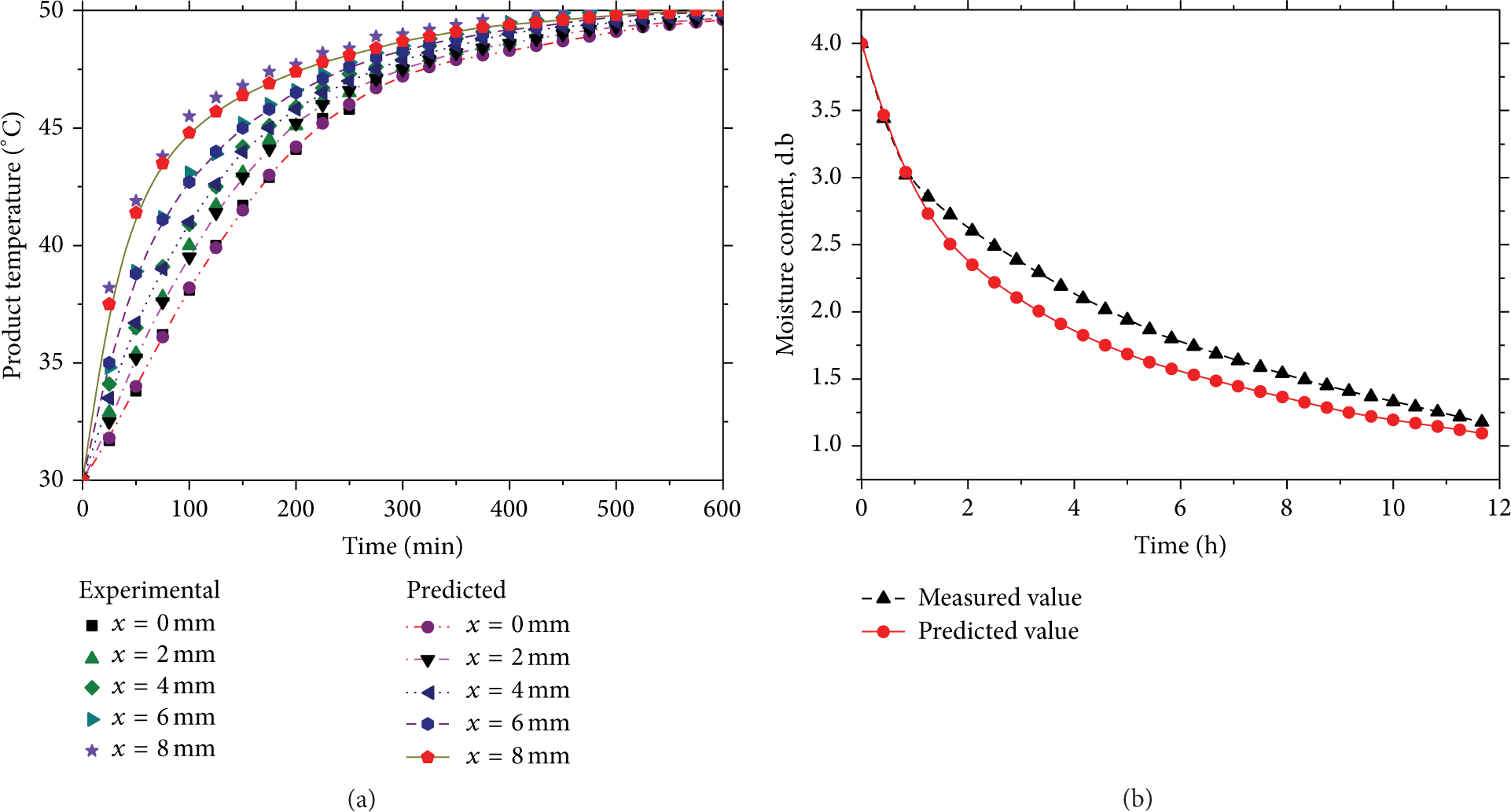
Comparison of predicted and experimental temperature (a) and average moisture content (b) with time.
4. Results and Discussion
Different phenomena linked to local temperature variation and moisture content loss with drying time are observed in the course of modern drying technology [21, 22]. Figure 5 shows local temperature and moisture content distributions profile in the sample under real parameters. It is observed that the phenomenon of high temperature and low relative humidity appear in the top surface of the sample than those in the bottom surface. As shown in Figure 5(a), the transient temperature of the upper part of the sample was increased rapidly and close to the hot air temperature near the end of drying.
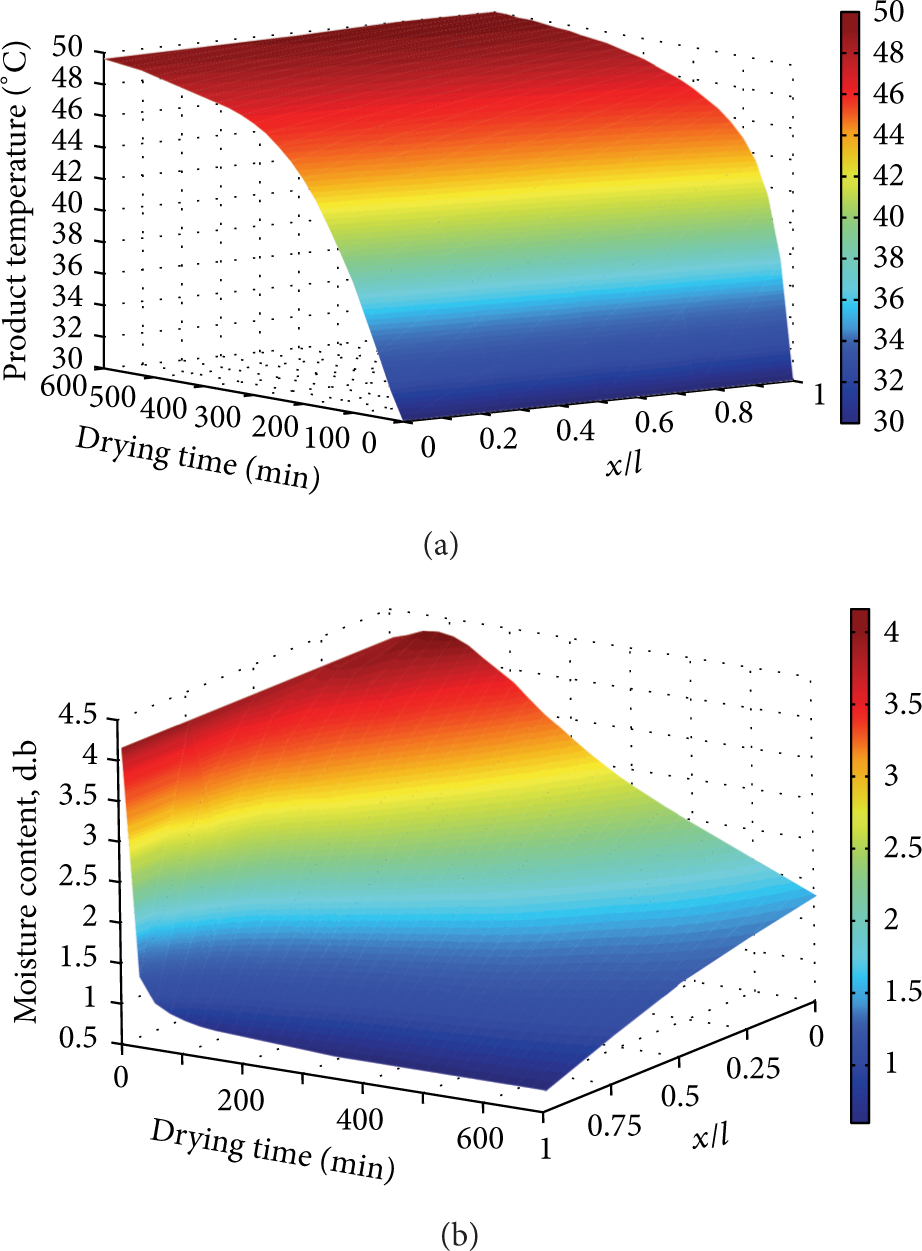
Temperature (a) and moisture content (b) distributions in the product under real condition.
As shown in Figure 5(b), the water content of the upper exposed surface layer of the product gradually decreased with the drying process, and the accumulation phenomenon of local humidity was found in deeper part of the product. As time goes on, the increased range of local moisture content of the deep layer would decrease, and the value would rise steadily. Subsequently, the water content of the product was gradually diminished and nearly equal to the hot air humidity at the end of the drying process. This is attributed to the fact that the mass flux migrates along the temperature gradient under Soret effect.
In order to describe heat and moisture transfer within potato product due to thermal diffusion, the simulation was repeated with thermogradient coefficient a q = 2.54 × 10⁻⁶ m2s−1 and the numerical simulation results are presented in Figure 6. Figure 6(a) shows that heat flow from hot air to the porous product is a process of energy transfer tending to equalize temperature in a very short time. These findings confirm that thermal diffusion coefficient has significant positive impact on heat flux and temperature distribution. However, there is no obvious difference between Figure 5(b) and Figure 6(b). One reason for this could be that the thermal diffusion behaviour has no significant effect on moisture content distribution and dehydration in the product during conventional drying process.

Effect of heat diffusion coefficient on temperature and moisture content distribution in the product.
Figure 7 shows the local water content and temperature distributions profile within the moist product as the effective mass diffusion coefficient increasing by 10 times. Comparing Figure 5(a) with Figure 7(a), one can easily find that it is of no obvious difference; this may be due to the fact that effective water vapour diffusion coefficient is very small and its influence on the temperature gradient and heat flow is less weak. It can be found in Figure 7(b) that the humidity of the product is rapidly decreasing and the bulk of the water vapour migrates much easily through the upper exposed surface of the material and then quickly evaporated into the atmosphere. These findings imply that diffusion coefficient affects mass transfer and moisture content distribution.
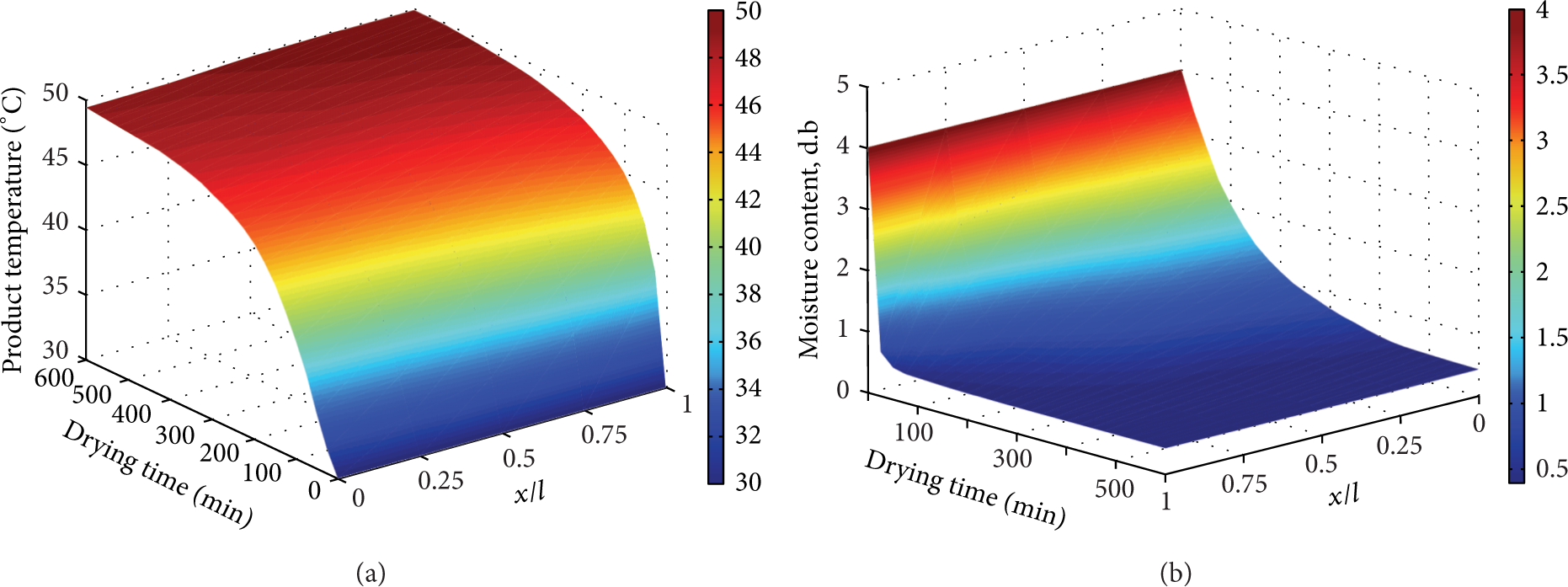
Effect of mass diffusion coefficient on temperature and moisture content distributions in the product.
As the thermogradient coefficient of the material increasing by ten times, the local temperature and moisture content distribution profiles are as shown in Figure 8. It can be concluded from Figure 8(a) that the thermogradient coefficient of the moist material has relatively less effect on the heat flux. As shown in Figure 8(b), the accumulation phenomena of moisture content in that deep part of the product will become more marked; this is due to the fact that water content diffuses towards the lower part of the product under Soret effect to the maximum extent. Also note that the growth of local moisture content of the deep part of the product reduces constantly and the humidity amount would reach a maximum.

Effect of thermogradient coefficient on temperature and moisture content distribution in the product.
Variation of moisture content coefficient inside the product with drying time is shown in Figure 9. It can be seen that moisture content coefficient has no obvious influence on the temperature distribution in the product. This shows that Dufour effect has relatively weak effect on temperature distribution in convective drying. The results indicate that the effect of mass transfer on heat transfer is very week in conventional drying.
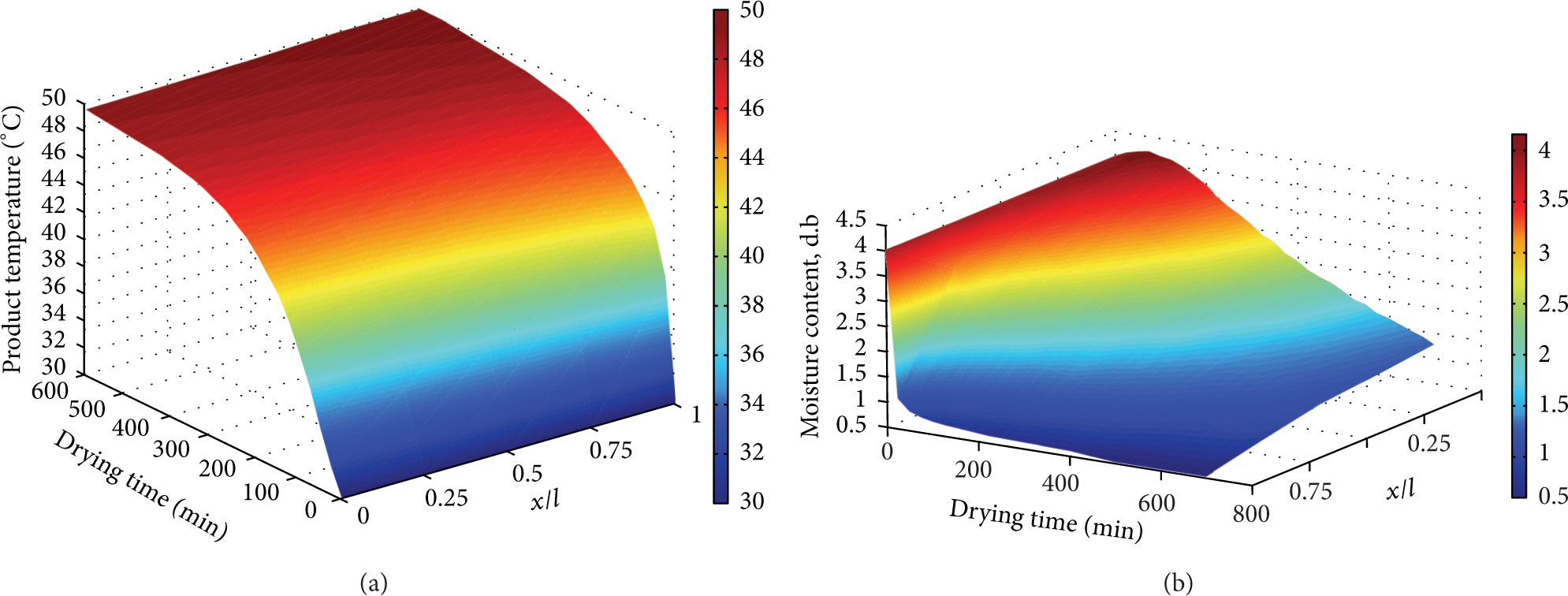
Effect of moisture gradient coefficient on temperature and moisture content distribution in the product.
5. Conclusion
This paper proposes a theoretical model of coupled heat and moisture transport to evaluate the effects of thermophysical properties on the moisture content and temperature distributions within the porous materials during convective drying. An experimental system for analyzing the convective drying characteristic was developed to investigate the coupled heat and mass transport in the moist materials. The predicted temperature and moisture content were compared with the experimental data.
Effects of using different thermophysical properties of potato samples on the convective drying rate by taking into account the thermal diffusion and diffusion-thermo effects were investigated. The predicted results show that thermophysical parameters of the product have significant influence on the combined moisture content and heat transport inside the potatoes subjected to forced convective dried, and the accumulation phenomena of moisture content are found in the deep part of the moist product. Thermal diffusion coefficient has significant positive impact on heat transfer, and effective mass diffusion coefficient might directly affect the moisture content distribution and convective drying rate. Soret effect has a significant impact on heat transfer in the presence of large temperature gradient during convective drying.
For further work, it would be desirable to estimate the thermophysical parameters of different porous materials and extend the modelling to multidimensional heat and moisture transfer process within moist media during forced convective drying.
Footnotes
Nomenclature
Conflict of Interests
The authors declare that there is no conflict of interests regarding the publication of this paper.
Acknowledgments
This material is based upon the work funded by Zhejiang Provincial Natural Science Foundation of China under Grant no. Y1100673, programs supported by Ningbo Natural Science Foundation under Grant no. 2011A610073, and Beilun Science and Technology Innovation Foundation. This material was also funded by National Undergraduate Innovation and Entrepreneurship Training Program (201311058005) and Wang Weimin Innovation Foundation (2013014).