




Abstract
Carbon-hemp composite laminate provides good thermal properties. For this reason this type of material is presently being used for various applications like insulator for airplanes, spaceships, nuclear reactors, and so forth. Unfortunately their mechanical properties are less studied. These characteristics are very important since they should be guaranteed also for important mechanical stress in addition to the thermal one. The present paper presents a study regarding the impact testing of some hybrid composite laminate panels based on polyester resin reinforced with both carbon and hemp fabric. The effects of different impact speeds on the mechanical behavior of these panels have been analyzed. The paper lays stress on the characterization of this hybrid composite laminate regarding the impact behavior of these panels by dropping a weight with low velocity.
1. Introduction
Composite materials for thermal insulation [1–3] are used in a wide range of applications; however, they are used with prudence in applications where transverse loadings appear, for instance, loadings given by transverse impact with low velocity. Since this type of materials is used also for applications involving new technologies like aeronautic industry, space missions, or nuclear reactors, the mechanical properties must be more carefully investigated. In general, failures and imperfections are inevitable in composite structures. In this context, design concepts of composite structures are used to take into account these failures, such as damage tolerance and damage resistance. Damage resistance is connected to the material's capability to minimize the failures’ effects given by impact, while damage tolerance is given by the material's capability to maintain its properties even after failures’ appearance in material. Usually, these properties are called residual properties. One of the difficulties regarding the properties and evaluation of composites is, ironically, an advantage, namely, the capability to allow users to tailor their properties to suit the design needs [4, 5]. There are a huge number of fibers ranges and combination ways, resins, additives, stacking and orientation ways, manufacturing possibilities (thermal treatments) and therefore is very difficult to extrapolate the composite behavior depending on these parameters for a certain combination of them [6, 7]. In applications, the use of composites based on natural fibers is yet limited at the so-called nonstructural components such as inner components of cars. One of the main reasons for this limitation consists in the sensitivity of these composites at impact and the difficulty in critical evaluation regarding damages caused at impact.
2. Material and Method
The research has been carried out on ten composite panels presenting a rectangular shape and being underpinned on all edges. All panels have the same material's structure:
a layer of thermosetting resin reinforced with carbon fabric;
a layer of thermosetting resin reinforced with hemp fabric;
a layer of thermosetting resin reinforced with carbon fabric;
a layer of thermosetting resin reinforced with hemp fabric.
The plies sequence has been carried out in the hand lay-up process using a roll for resin impregnation of carbon and hemp fibers. Finally, the structure's thickness has been 4 mm. The laminate panel has been maintained at room temperature for two weeks from which ten specimens of rectangular shape (150 × 100 mm) have been cut. The specimens have been subjected to impact by dropping a weight according to the standard ASTM-D5420-98a (Figure 1). The impact testing by dropping a weight is used to characterize the dynamic behavior of a material. The experimental setup consists in a two-column frame and a weight which can be lifted and released in free fall with minimum friction by sliding along columns under own weight (Figure 2). The indenter presents a hemispherical head with a 16 mm diameter and its mass is equal to 1.9 kg. This indenter hits the middle of the rectangular specimen. The accelerometer is fixed on the upper part of the indenter and the signal (acceleration) is taken over in computer by help of an acquisition device type NI USB 6521 BNC. Using this kind of testing, some data regarding the mechanical properties of a material can be obtained, namely:
the energy, U, absorbed during impact;
the variation of impact force, F, at the impact moment;
the variation of inventor's displacement, d, versus time, and so forth.
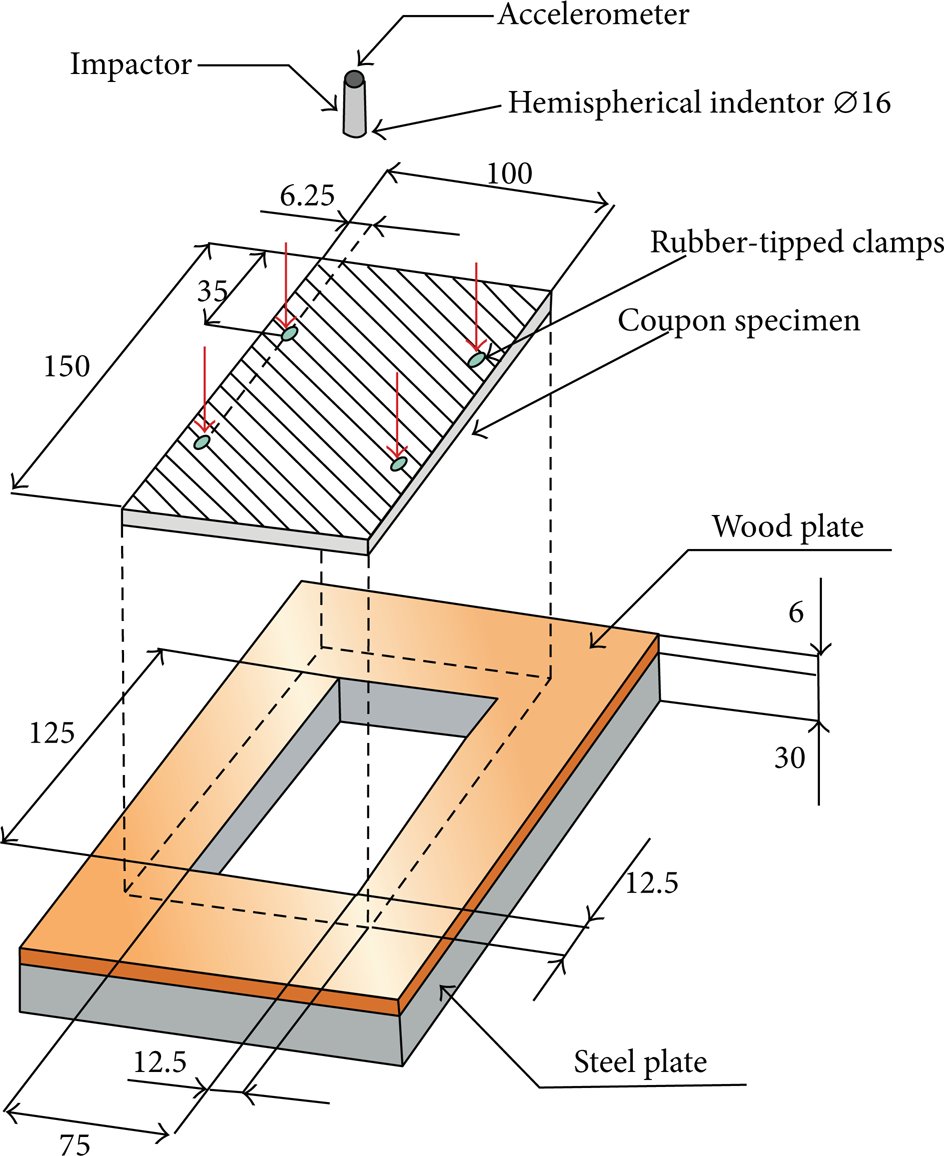
The specimen's geometry and fixing mode.
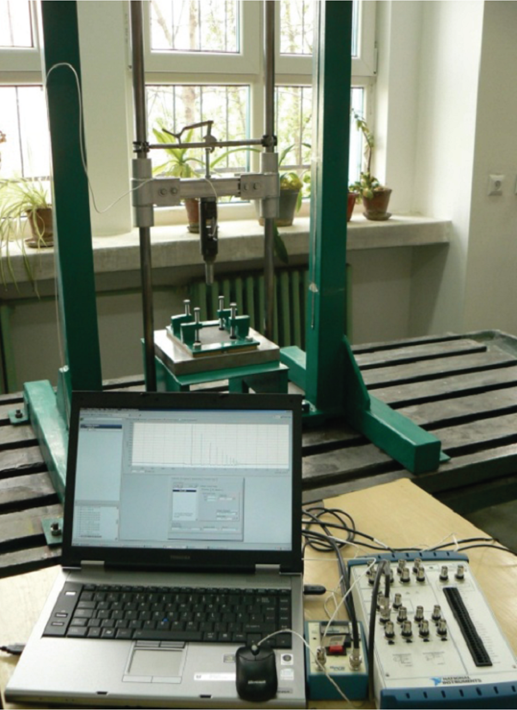
The impact device.
In case of impact testing by weight falling, the only measured feature versus time is the contact force, F(t), exerted by the weight which falls on specimen while the specimen's deflection is determined as a function of time by numerical integration of the indentor's motion equation. The acquisition of experimental data (acceleration) as well as computing the response parameters described above has been carried out using a block diagram conceived by the LabView program.
The height from which the weight is released has been computed with the well-known relation:

where g represents the gravitational acceleration. The indentor's motion equation can be written by help of the following relation:

where m represents the impactor's mass.
The absorbed energy can be computed according to the following relation:

3. Results
Using the LabView program, the variation of force F has been computed at the impact's moment after the signal has been recorded with the accelerometer through the acquisition device (Figure 3). In the same way, the following distributions have been represented:
the variation of impact force F versus the displacement δ at the impact's moment (see Figure 4);
the variation of indenter's displacement δ at the impact's moment (Figure 5);
the variation of energy U at the impact's moment (Figure 6).
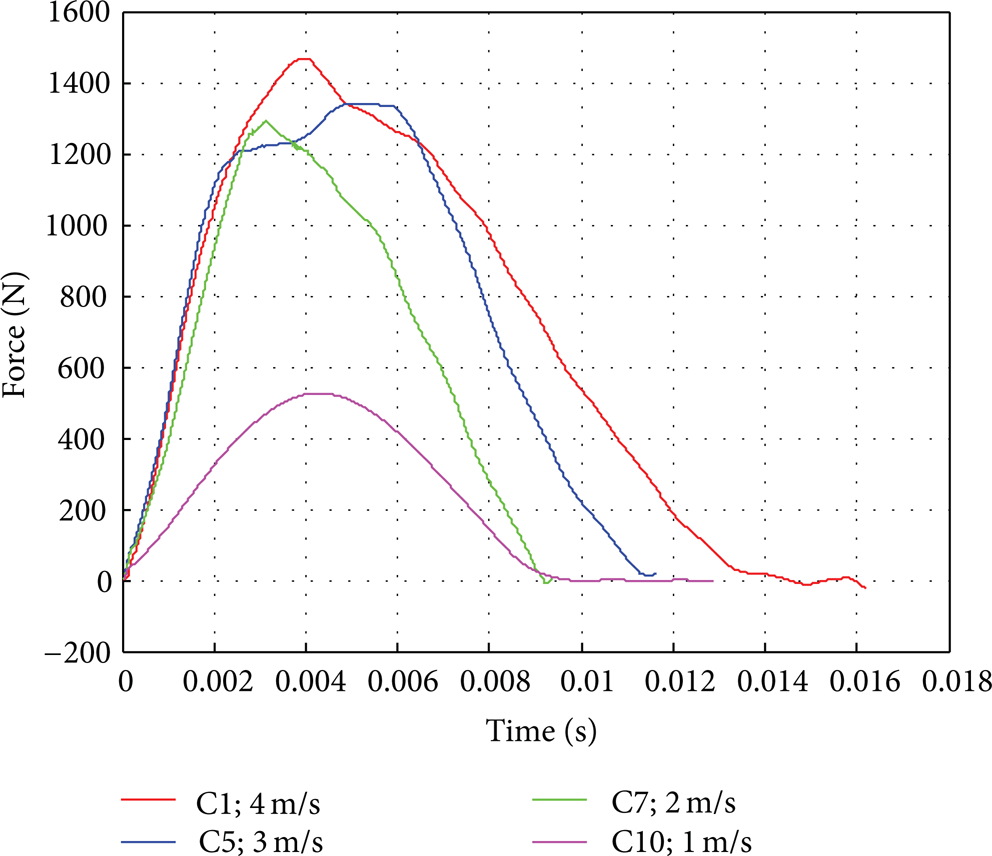
Force-time (F-t) distribution at the impact's moment.

Force-displacement (F-δ) curves at the impact's moment.

The variation of indenter's displacement δ at the impact's moment.

The variation of energy U at the impact's moment.
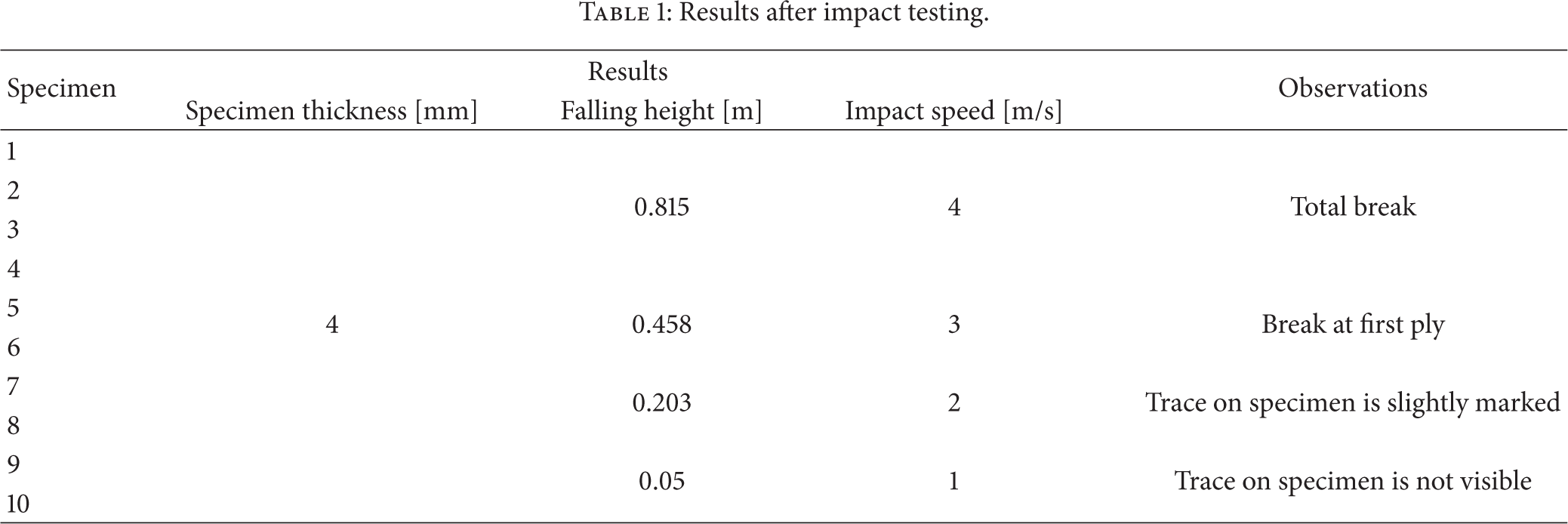
The results obtained after the impact testing of hybrid carbon-hemp composite laminate are presented in Table 1 as well.
Results after impact testing.
The indenter's falling height has been computed as follows:

4. Discussion and Conclusions
Analyzing especially the graphics from Figure 6, we can say that these curves present leaps and inflexions due to the presence of delamination. Integrating the area under the loading curve (force-displacement, Figure 3) until the maximum value of the force (according to the first failure), the energy required to initiate the failure, can be obtained. At the impact's moment, the energy accumulates in time and is directly proportional with the force and increases until it reaches a constant landing. After reaching a maximum value of the force, this decreases in time, the energy U being absorbed in material and the force's decrease took place after reaching the landing of U. In general, at the composite laminates the energy is frequently absorbed by creating some delamination surfaces called delamination breaks that lead to the strength and stiffness decrease. Analyzing the specimens after impact testing (Figure 7) it can be noticed that the failure areas localized on the specimens’ surface (where the intender hits) are smaller than those localized on the back front. We conclude that the cracks have been propagated from the place where the indenter hits to the back front of the panel. Thus, we can conclude that the panel manufactured from the hybrid composite material involved in this study is stiff. On the other hand, as expected, the grater the impact speed is, the grater the failure area has been noticed.

Specimen after impact testing.
This type of materials is feasible for various applications, for example, in the automotive industry and airplanes. More systematic studies regarding the mechanical properties of the composite materials must be performed. The influence of ionising radiation over the insulating composite materials must be also investigated in order to increase the safety and security for various types of missions.
Conflict of Interests
The authors declare that there is no conflict of interests regarding the publication of this paper.