




Abstract
A polynomial model was suggested for precompressed honeycomb paperboard packaging system, and then both of the inner-resonance conditions for packaged product and the critical component were obtained applying the variational approach. Finally, the effect of fatigue damage on the inner resonance conditions was discussed. The results show that both the packaged product and critical component can be damaged by inner-resonance when some conditions required were met, and the fatigue of honeycomb paperboard will obviously affect the inner-resonance conditions.
1. Introduction
Packaged product can be easily damaged by dropping [1]. Wang's dropping damage boundary concept [2] and succeeding modified damage evaluation approaches [3–7] provide the packaging research community simple but effective methods to characterize the damage potential of drop to packaged products and critical components [4, 5]. To protect the product effectively during distribution, the honeycomb paperboard is widely applied due to its perfect protective performance both in shock and vibration environment [8, 9]. Despite its strong dependence nature of properties on humidity [10], honeycomb paperboard is still a competitive candidate for cushioning packaging because it is green and light. Though lots of publications can be found in the literature, few focus on the inner-resonance conditions of honeycomb paperboard packaging system. Wang studied first the inner-resonance condition for typical nonlinear packaging system [11], and then it was extended to varied kinds of nonlinear packaging system, such as the tilted support spring coupled nonlinear packaging system [12]. Though the protective performance of honeycomb paperboard has been thoroughly studied, few works on the performance of precompressed honeycomb paperboard were reported in the literature. The aim of this study is to obtain the inner-resonance conditions for both the packaged product and critical component for precompressed honeycomb packaging system.
2. Inner-Resonance Conditions for Single-Degree-of-Freedom Packaging System
To study the inner-resonance conditions for precompressed honeycomb paperboard, the stress-strain relationship is first proposed as [13] (though the dynamic model honeycomb paperboard can be described by 9th-order polynomial equation [14], the 8th-order polynomial model is enough for precompressed honeycomb paperboard, as shown in Figure 1, for a sample of 250/105/250 g/m2 with a height of 40 mm under 23°C, 50% RH, with R2 = 0.99):

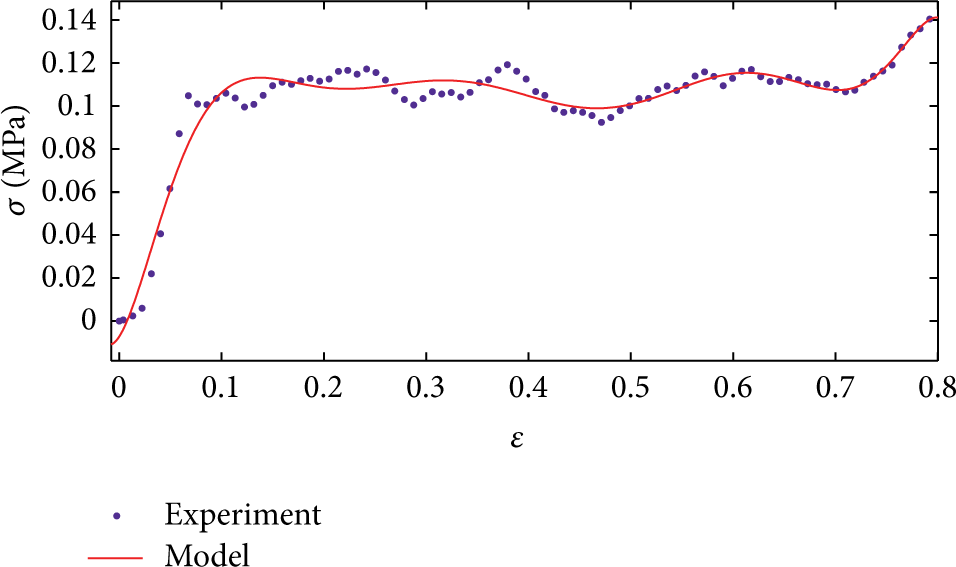
Model for precompressed honeycomb paperboard.
Here c i denote, respectively, the characteristic constants of the cushioning pad which could be obtained by compression test. Then, the governing equations of the honeycomb paperboard cushioning packaging system can be expressed as
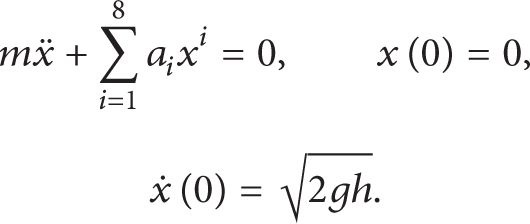
Here the coefficients m denote the mass of the packaged product, while a i denote, respectively, the characteristic constants of the cushioning pad which could be obtained by compression test, and h is the dropping height.
By introducing these parameters,

where

Applying the variational iteration method [15], the following iteration formulae can be constructed:

Beginning with the initial solutions,

We have
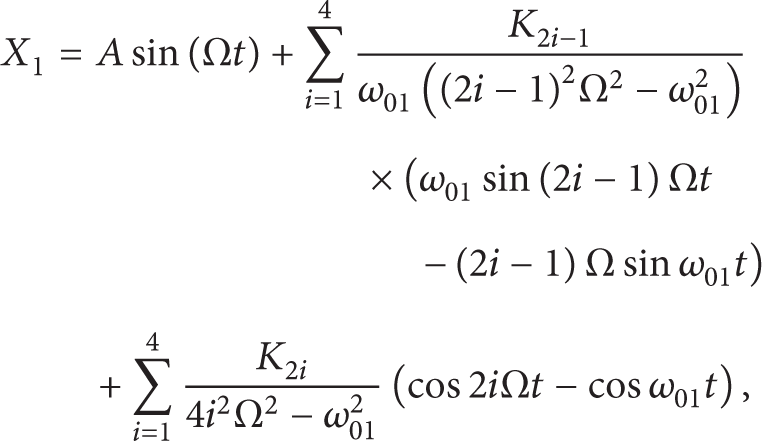
where
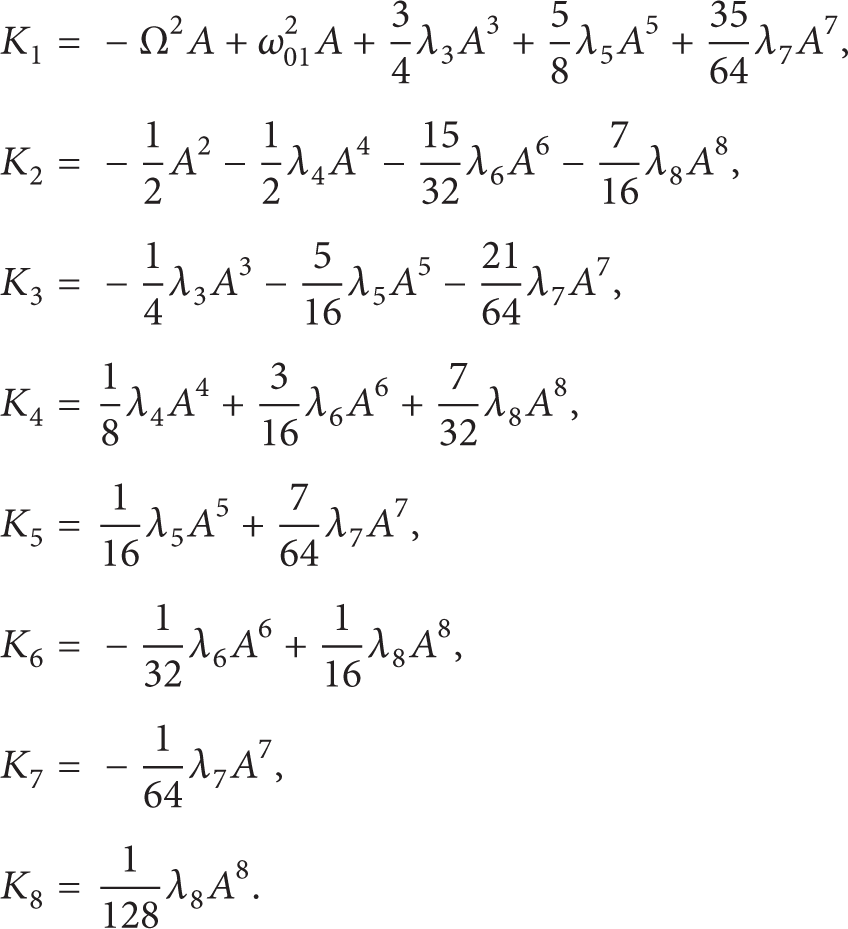
Then, the resonance can be expected when one of the following conditions meets:

These conditions should be avoided during the cushioning packaging design procedure.
3. Inner-Resonance Conditions for Double-Degree-of-Freedom Packaging System
The governing equations of the honeycomb paperboard cushioning packaging system with critical component can be expressed as
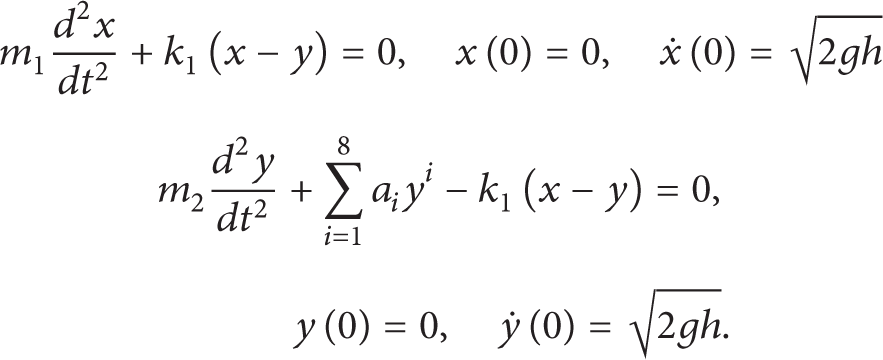
Here the coefficients m1 and m2 denote, respectively, the mass of the critical component and main part of product, while β i represents the nonlinear elastic coefficient of corrugated paperboard cushioning pad. k1 is the coupling stiffness of the critical component, and h is the dropping height.
By introducing these parameters,

where

Applying the variational iteration method, the following iteration formulae can be constructed:
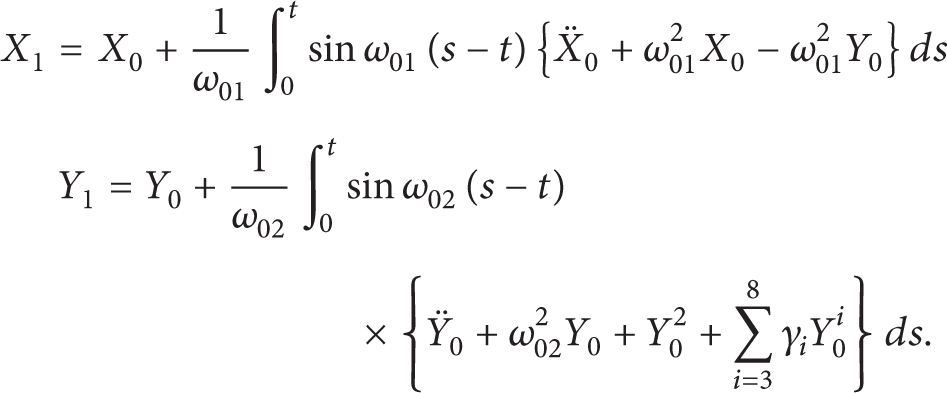
Beginning with the initial solutions,

We have

where

The inner resonance can be expected when one of the following conditions meets:
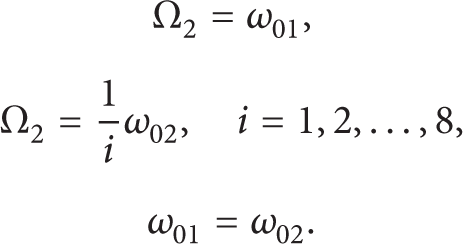
These conditions should be avoided during the cushioning packaging design procedure.
4. Effect of Fatigue on the Inner-Resonance Conditions
The specimens were made in thickness of 40 mm, 250/105/250 g/m2, by the professional manufacturing industry of paper honeycombs. All samples were first preconditioned for 24 hours in 23°C, 50% RH before the 15% strain ratio precompression test, after which the samples were divided into three groups and 10% strain ratio fatigue compression test was conducted for N = 0, 5000, 10000, and 20000 separately. Finally, the samples after all tests above were compressed separately and the stress-strain relationship was recorded, as shown in Figure 2. The results show that the fatigue affects remarkably the model parameters of precompressed honeycomb paperboard, which will have a noticeable effect on the inner-resonance conditions for packaged product and critical component. Specially, the model coefficient c1 decreases from 2.039 to 0.1174 with c2 from −9.098 to 37.53 when N increases from 0 to 10000. It should be noted that the shift of model coefficients will inevitably affect the inner-resonance conditions for both packaged product and critical component as illustrated by (9) and (17).

Effect of fatigue stress-strain relationship of precompressed honeycomb paperboard.
5. Conclusion
The main contribution of this work is not only to propose the compression model for precompressed honeycomb paperboard but also derive the inner-resonance conditions for both packaged product and critical component. The results show that the model parameters of honeycomb paperboard have a noticeable effect on the inner-resonance conditions for packaged product and critical component. Therefore, during the distribution process, the model parameters of the packaging will change due to the fatigue damage, leading to the shift of inner-resonance conditions. The mathematical model for effect of fatigue will be discussed in the following papers. The results suggest that the packaged product and critical component can be damaged not only by the shock pulse exceeding the damage boundary, but also by the inner resonance when some conditions meet. The packaging designers should select carefully the cushioning packaging to avoid the inner-resonance conditions, especially when the fatigue damage should be considered.
Conflict of Interests
The authors declare that there is no conflict of interests regarding the publication of this paper.
Footnotes
Acknowledgment
This work was supported by Fundamental Research Funds for the Central Universities (Grant no. JUSRP51403A).