




Abstract
For a gasoline-hybrid electric vehicle (HEV), the energy management strategy (EMS) is the computation of the distribution between electric and gasoline propulsion. Until recently, the EMS objective was to minimize fuel consumption. However, decreasing fuel consumption does not directly minimize the pollutant emissions, and the 3-way catalytic converter (3WCC) must be taken into account. This paper proposes to consider the pollutant emissions in the EMS, by minimizing, with the Pontryagin minimum principle, a tradeoff between pollution and fuel consumption. The integration of the 3WCC temperature in the EMS is discussed and finally a simplification is proposed.
1. Introduction
A gasoline-electric hybrid electric vehicle (HEV) has two power sources (fuel and electricity) and two associated converters to ensure propulsion (a gasoline engine and an electrical machine), allowing stop-and-start and zero-emission vehicle operating modes. In this context, the energy management strategy (EMS), which consists in finding the best power distribution to meet a drivers request, provides the possibility of reducing the fuel consumption [1].
For this reduction, different optimal offline strategies were proposed, based on the Pontryagin minimum principle (PMP) [2] or dynamic programming derived from Bellman's principle of optimality [3]. Some suboptimal online strategies were adapted from the PMP method such as the equivalent consumption minimization strategy (ECMS) [4] or adaptive-ECMS (A-ECMS) [5].
However, decreasing the fuel consumption does not directly ensure the reduction of the pollutant emissions. In order to minimize both fuel consumption and pollutant emissions, three off-line EMS have been proposed.
Strategy A. This strategy minimizes a tradeoff between engine pollutant emissions and fuel consumption with the PMP method in the same way as for fuel consumption minimization. It has been applied in diesel-HEV [6–8] and gasoline-HEV [9] contexts.
Strategy C. This strategy now minimizes a tradeoff between post-3WCC or vehicle pollutant emissions and fuel consumption. The PMP is applied by considering, as a second state, the 3-way-catalytic converter (3WCC) temperature [10–12], because of its key role in converting the engine pollution emissions.
Strategy B. This strategy is a simplification of strategy C, without the 3WCC temperature constraint.
The paper compares these three strategies with a reference strategy minimizing only the fuel consumption. It highlights the better results of strategy B compared to those of strategy C. Integrating the 3WCC temperature dynamics, as in strategy C, reduces pollutant emissions with a relatively small increase of fuel consumption. Nevertheless, better reductions with smaller increase in fuel consumption can be found with a simpler method by changing the tradeoff between engine pollution and fuel consumption and without 3WCC temperature constraint (strategy B).
The next section describes a 4-dynamics gasoline-HEV model, determined with the aim of testing different strategies. Section 3 formalizes the reference fuel consumption minimization strategy with the PMP method and introduces strategies A, B, and C. For these strategies, the next section presents some simulation results for a first tradeoff between fuel consumption and NO X emissions. A second tradeoff between fuel consumption, CO, and NO X emissions is proposed. This compromise shows also good results in decreasing each pollutant species emissions including HC. Finally a conclusion is given and the simplification of strategy C into strategy B, where the 3WCC temperature dynamics is not considered explicitly in the PMP optimization method, is discussed.
2. Gasoline-HEV Model
The HEV is a parallel mild-hybrid vehicle with the electrical machine connected to the gasoline engine by a belt. The HEV is modeled with a 4-state model represented in Figure 1. The four dynamical states are the battery state of charge (SOC), 3WCC temperature θcata, engine block temperature θ i , and engine water temperature θ w . Other variables are static and depend directly on the driving speed. From the driving cycle speed, with the vehicle and gearbox models, the rotation speeds of the thermal engine ω i and electrical machine ω e and the requested torque T0 can be deduced; see Figure 1. These computations take into account the gearbox ratio and the different transmission ratios and efficiencies.

HEV model with four dynamical states θ i , θ w , SOC and θcata.
2.1. Engine Model
The engine temperature θ
i
and the water temperature θ
w
dynamics are deduced from a simple 2-state zero-dimensional thermal model derived from the heat equation. A look-up table gives the used fuel mass flow rate
2.2. 3WCC Model
In the gasoline-HEV context, the 3WCC is the only current technology that ensures that vehicles based on a spark-ignition engine comply with the CO, HC, and NO X emission standards. The operation of a 3WCC can be expressed by its pollutant conversion efficiency, defined as

where
The conversion is influenced by the following variables:
temperature of the 3WCC monolith, θcata, deduced from a simple 1-state zero-dimensional model,
flow rate of exhaust gas through the monolith, qexh, deduced from ω i and T i with a map,
air-fuel ratio (AFR) of the mixture in the spark-ignition engine.
The dependence of the conversion efficiencies to AFR is neglected here, insofar as the air/fuel mixture is considered at the stoichiometry.
Equation (1) can be rewritten as

For each pollutant, the conversion efficiency is computed from the 3WCC temperature θcata and exhaust gas flow rate qexh with two maps:

2.3. Battery Model
At each time t, the power delivered by the electric machine P e is computed from the speed ω e and torque T e :

Then, the electrochemical battery power Pχ is written from the power balance:

where the power losses Plos are deduced from the speed ω e and torque T e by a look-up table and the power used by the auxiliaries Paux is considered constant here.
From (5), using an internal resistance model for the battery, the battery voltage Ubat can be deduced as

where U0 is the open circuit voltage and R int the internal resistance deduced from SOC by two look-up tables.
Finally, by using (5) and (6), the battery current intensity

leads to the SOC dynamics

where Qmax is the battery capacity and c is a constant allowing to obtain a dimensionless expression of SOC in %.
2.4. Control Model
A parallel HEV has two propulsion systems and the requested torque at the entrance of the gearbox T0 is simply

where the thermal engine torque T i and electrical machine torque T e take into account the different transmission ratios to be expressed in the same referential, the entrance of the gearbox.
A torque split variable u is introduced as the ratio between the electrical machine torque and the requested torque:

Note that many variables can be now noted with respect to torque split control variable u, as, for example, the engine
The goal of the EMS is to find the control u that fulfills different objectives. While minimizing HEV fuel consumption is the main objective, other secondary objectives can be considered such as oil temperature maximization [13] (to reduce fuel consumption), drivability [14], limitation of battery aging [15] or, as in this paper, reduction of pollutant emissions [10–12].
3. Optimal Strategies
Some recalls of the optimization framework are given first. Then the strategies are presented for fuel consumption minimization, and next for pollution/fuel consumption joint minimization, where a simplification is proposed.
3.1. Pontryagin Minimum Principle
Consider a problem P0 where the goal is to minimize a discrete-time cost function J(

and the criterion to be minimized is expressed by

where Φ(

P0 can be written, with U the admissible control space, as

Introducing the Hamiltonian

with the Lagrange parameter vector (or costate)

The last equation, where
3.2. Fuel Consumption Minimization Strategy
Optimal (off-line) strategies assume the knowledge of the full driving horizon, from time t0 to time t f . Then, for fuel consumption, the following performance index has to be minimized:

where

The performance index (17) is minimized with PMP, as described above, considering the one-state SOC dynamics (7):

To this end, the Hamiltonian

is defined, where λ is the co-state associated with the SOC dynamics, respecting

The optimal control u* is obtained by minimizing (20), at each time t:

In the case of HEV, considering

has a very little influence on fuel consumption, since the SOC dependence on R
int
and U0 is low. Then
3.3. Pollution Constrained Fuel Consumption Minimization Strategies
Strategy A. The first approach, when considering pollution in the EMS, is to define a tradeoff

where

that can be minimized as (17).
Strategy C. The second approach is based on the tradeoff

In (3), for the minimization, the 3WCC conversion efficiencies are simplified as

A new performance index

is then defined. If the θcata dynamics is considered during minimization, the Hamiltonian becomes:

Using (23), the first co-state λ1 can be found constant as in the fuel consumption minimization strategy. The second co-state λ2 associated with the 3WCC temperature dynamics is obtained by solving
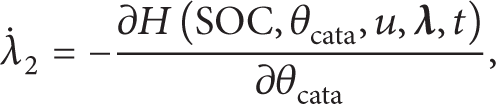
yielding the exponential form

where a is a constant and b is a function, which can be found from (26) and (27), and λ20 is the second co-state initial condition.
Strategy B. This strategy is a simplification of strategy C and considers a zero 3WCC temperature co-state in (31):

The idea is to take into account in the minimization strategy the 3WCC temperature dynamics only through the vehicle pollutant emissions (26) and not in (29).
4. Results
This section presents some simulation results obtained on Worldwide harmonized Light vehicles Test Cycles (WLTC). Tradeoffs between fuel consumption and NO X emissions, then CO/NO X emissions, are minimized with the strategies presented above, which are compared.
Fuel consumption minimization strategy is the reference and the corresponding fuel consumption and pollutant emissions are obtained with instantaneous minimization of the Hamiltonian (20). The constant value of λ is found by a binary search while respecting the final SOC constraint (18).
4.1. NO X Emissions/Fuel Consumption Compromise
Tradeoffs between NO X emissions and fuel consumption are chosen and minimized with different strategies.
The first tradeoffs between engineNO X emissions and fuel consumption

are minimized with strategy A, for different values of αNOX, from αNOX = 0, which is the reference, to the maximal value allowed by the battery size. Note that the maximal battery demand translates into the maximum SOC deviation obtained during an optimal simulation.
Next, tradeoffs between vehicleNO X emissions and fuel consumption

are minimized with strategies B and C.
For strategy B, the results are obtained by minimizing a Hamiltonian such as (29) for different αNOX values in (34) and a choice of λ20 = 0 as in (32). For strategy C, the results are obtained for two fixed αNOX values in (34) and different values of λ20 in (31).
The results presented in Figure 2 show that strategy A yields the largest reductions in engine pollution for the lowest increases in fuel consumption. As expected, strategy A is the best one to minimize the engineNO X emissions.

Relative NO X engine emissions reduction versus relative fuel consumption increase.
Figure 3 shows that strategy B and strategy C are more efficient in minimizing the vehicleNO
X
emissions. At a fixed tradeoff between NO
X
vehicle pollution and fuel consumption

Relative NO X vehicle emissions reduction versus relative fuel consumption increase.
Next, Figure 4 reveals that strategy C implies a stronger use of the battery than strategy B, which is not desirable. The battery demands are represented by the maximum SOC deviation obtained during a driving cycle with the optimal control.

Relative NO X vehicle emissions reduction versus maximum relative SOC deviation (zero costate).
Figure 5 shows the trajectories of SOC, relative 3WCC temperature θcata, and relative cumulative normalized NO
X
engine emissions

SOC, 3WCC temperature, and NO X engine and vehicle emissions trajectories.
4.2. CO/NO X Emissions/Fuel Consumption Compromise
Similar to (33) and (34), tradeoffs between CO and NO
X
engine emissions and fuel consumption, with

are minimized with strategy A, and tradeoffs between CO and NO
X
vehicle emissions and fuel consumption, with

are minimized with strategies B and C.
For the three strategies, the vehicle emissions with respect to fuel consumption are shown in Figure 6, for HC, Figure 7, for NO X , and Figure 8, for CO.

Relative HC vehicle emissions reduction versus relative fuel consumption increase.

Relative NO X vehicle emissions reduction versus relative fuel consumption increase.

Relative CO vehicle emissions reduction versus relative fuel consumption increase.
Again, strategies B and C are better than strategy A in minimizing vehicle emissions, and, compared to strategy C, strategy B leads to better reduction of vehicle pollutant emissions, including HC.
Note that other compromises can be easily built with different objectives concerning CO, NO X , and/or HC pollutants.
5. Conclusion
Optimal strategies have been proposed to minimize fuel consumption while taking pollutant emissions into consideration. A simple tradeoff between engine pollution and fuel consumption can be minimized with the PMP, ensuring good results.
These results can be improved if the strategy takes the 3WCC behavior into account. Two ways are proposed to minimize a tradeoff between vehicle pollution and fuel consumption. The first one includes the 3WCC temperature dynamics in the Hamiltonian (strategy C), while the second one does not include this dynamics (strategy B). Introducing a second dynamics improves the results, but better results are found with lower battery demands with a zero second co-state, simply by changing the compromise between vehicle pollution and fuel consumption.
To conclude, the fuel consumption minimization with pollution constraint does not require considering directly the 3WCC temperature in the minimization method, as in strategy C. The simplicity and better results of strategy B are preferable for a future on-line adaptation. This is reinforced by the frequent difficulties in deducing the 3WCC temperature and its associated co-state in a real environment.
Conflict of Interests
The authors declare that there is no conflict of interests regarding the publication of this paper.