




Abstract
Wireless sensor networks (WSNs) are receiving a lot of research attention due to continual improvement in the technologies used by these networks. The energy efficiency of sensor nodes and the network as a whole is of specific importance. One possible area where energy savings can be made lies within the routing protocols employed; however, these protocols are typically only simulated. In this work we develop a WSN testbed and conduct investigations on the fidelity of simulated energy-aware WNS routing protocols. It was found that the real-world performance of these energy-aware protocols was significantly lower than that predicted by simulation models. This can be mainly attributed to chip-level effects not taken into account by simulation models, leading to simulated results that cannot be achieved in real-world deployments. This work illuminates the shortfalls of existing simulation models and suggests ways in which these models can be improved. Additionally the testbed allows other energy-aware routing protocols to be investigated easily.
1. Introduction
In recent years wireless sensor networks (WSNs) have become more popular due to their wide range of application areas and a decrease in the cost, size, and power consumption of sensor nodes (SNs) [1]. The majority of existing SNs are powered by constrained energy sources which include batteries and power scavenging devices [1]. Due to the limited energy available to the sensor network all aspects of the network must be optimised in order to minimise the energy consumption. The routing solution employed in a WSN affects the energy consumption of the network, and thus WSN routing protocols are an active area of research [2–5]. In order to compare existing routing protocols and to develop improved protocols, the energy consumption characteristics of these protocols must be investigated [2, 3].
The majority of studies on the energy efficiency of WSN routing protocols are conducted using simulations [4–6]. This is because simulations offer a more time and cost effective solution when compared to experimentation. Some common axioms used when modelling wireless networks are described by Kotz et al. in [7]. Most simulations do not take all the factors that influence a WSN into account, and factors that are taken into account are not always 100% accurate. This is especially true in the case of the energy consumption characteristics of the transceiver modules of the SNs.
In this work a WSN testbed is developed that allows the characterisation of the energy consumption of a SN, both from transceiver and routing protocol points of view. Insight is provided into how the energy consumption of realistic SNs differs from simulated works by implementing a MTTPR routing scheme on the testbed. Additionally recommendation as to how simulation models could be improved is also provided.
In the remainder of this paper some background to wireless sensor networks, IEEE 802.15.4, and sensor nodes is provided in Section 2. Section 3 details the development of a custom SN, which is used for the testbed configured in Section 4. Section 5 provides details on the experimental setup, with the results and discussion presented in Sections 6 and 7. Concluding remarks are provided in Section 8.
2. Background
This section provides some background on WSNs, the IEEE 802.15.4 standard, and energy-aware routing schemes.
2.1. Wireless Sensor Network
A WSN is a group of spatially removed SNs which form a cooperative wireless network. Not all of the SNs in such a network can communicate with each other directly. These nodes forward data to nodes that are outside their communication range in a multihop fashion using other SNs. Some nodes in a WSN act as network gateways. These nodes are called sink nodes. A WSN can consist of hundreds and even thousands of nodes. Figure 1 depicts a typical WSN. In recent years commercial interest in WSNs has moved into the direction of large static networks which is taken into account by the Internet Engineering Task Force (IETF) Routing over Low-Power and Lossy Networks (ROLL) standard [8]. Some promising WSN application areas include [9, 10]
home and automation;
personal health care;
industrial control;
utility meter communication;
automatic meter reading and demand-side management;
battlefield surveillance.

Depiction of a typical wireless sensor network (WSN).
2.2. IEEE Standard 802.15.4
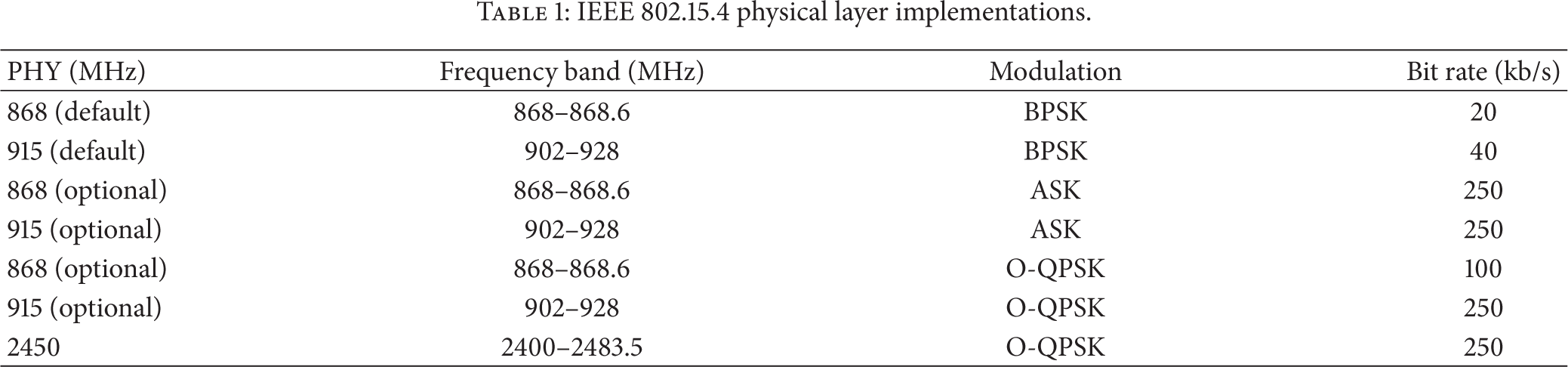
The IEEE 802.15.4 standard defines a physical communication layer and a data link layer for low-rate wireless personal area networks (LR-WPANs). The standard gives attention to energy conservation in such wireless networks [11]. The Medium Access Control (MAC) and physical layer (PHY) specifications of the standard can be found in IEEE Std. 802.15.4-2003 [12]. The standard utilises carrier sense multiple access with collision avoidance (CSMA-CA) and supports point-to-point and star network topologies. Table 1 depicts the frequency band, modulation, and data rate details of the IEEE 802.15.4 standard physical layer [12]. The IEEE 802.15.4 standard defines four frame structures which were designed to reduce complexity while still providing a robust solution for noisy channels. These frames include
a beacon frame;
a data frame;
an acknowledgement frame;
a MAC command frame.
IEEE 802.15.4 physical layer implementations.
The data and acknowledgement frames are used to accomplish data transfer between nodes. Beaconing serves as a synchronization service within the network, and the MAC command frame is used for network management and control [11].
2.3. Energy-Aware Routing Schemes
This section details some common energy-aware routing schemes.
(1) Minimum total transmission power routing: minimum total transmission power (MTTP) routing selects the path between communicating nodes based on the minimum transmission power. When forwarding data between nodes the route with the minimum total transmission power is selected. Although MTTPR is an improvement over simplistic routing schemes, such as shortest path first routing, it does not take an individual node's remaining energy into account. This could lead to certain nodes being overused.
Mathematically, the total transmission power

All possible routes form a set A from which the MTTP route (m) is selected by means of

(2) Minimal-battery cost routing: the minimal-battery cost (MBC) routing scheme selects the highest remaining total battery life path between communicating nodes [14]. As is the case with MTTP routing, MBCR does not take an individual node's energy capacity into account. As such, individual nodes may be subjected to overuse.
The remaining battery capacity of node

The total battery cost for route k,

All possible routes form a set A, from which the minimal battery cost route, z, can be calculated as per

In the event that two or more routes have the same battery cost the shortest route is selected.
(3) Min-max battery cost routing: min-max battery cost (MMBC) routing attempts to improve MBCR by avoiding the nodes with the least amount of energy remaining. This ensures that no single node within the network gets overused. However, there is no guarantee that the chosen route is a MTTP route or a minimal battery cost route. Equation (6) redefines the cost of route k for the MMBCR scheme:
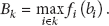
The min-max battery cost route (s) is calculated from (7). As before A is a set which contains all of the possible routes [13]. Also, as was the case with MBCR, where two, or more, routes have a similar cost metric, the shortest route is selected:

(4) Conditional Max-Min Battery Capacity Routing: Conditional Max-Min Battery Capacity (CMMBC) routing is a combination of MTTPR and MMBCR. The MTTPR scheme is used to choose routes; however, if the remaining energy of a node on the chosen route is below a certain threshold, γ, another route is chosen. This ensures that single nodes do not get overused [13].
(5) Minimum total transceiving power: the minimum total transceiving power (MTTCP) routing scheme is an extension of the MTTP routing scheme. The MTTCP routing scheme attempts to minimize the total transmission and reception power used on the path between communicating nodes [15]. Similarly to the MPPT scheme no guarantee is provided that individual nodes will not be overused.
(6) Minimum total reliable transmission power: the minimum total reliable transmission power (MTRTP) routing scheme is yet another extension of the MTTP routing scheme. The MTRTP routing scheme takes the reliability and the transmission power setting of each link into account [15].
2.4. Existing Sensor Nodes
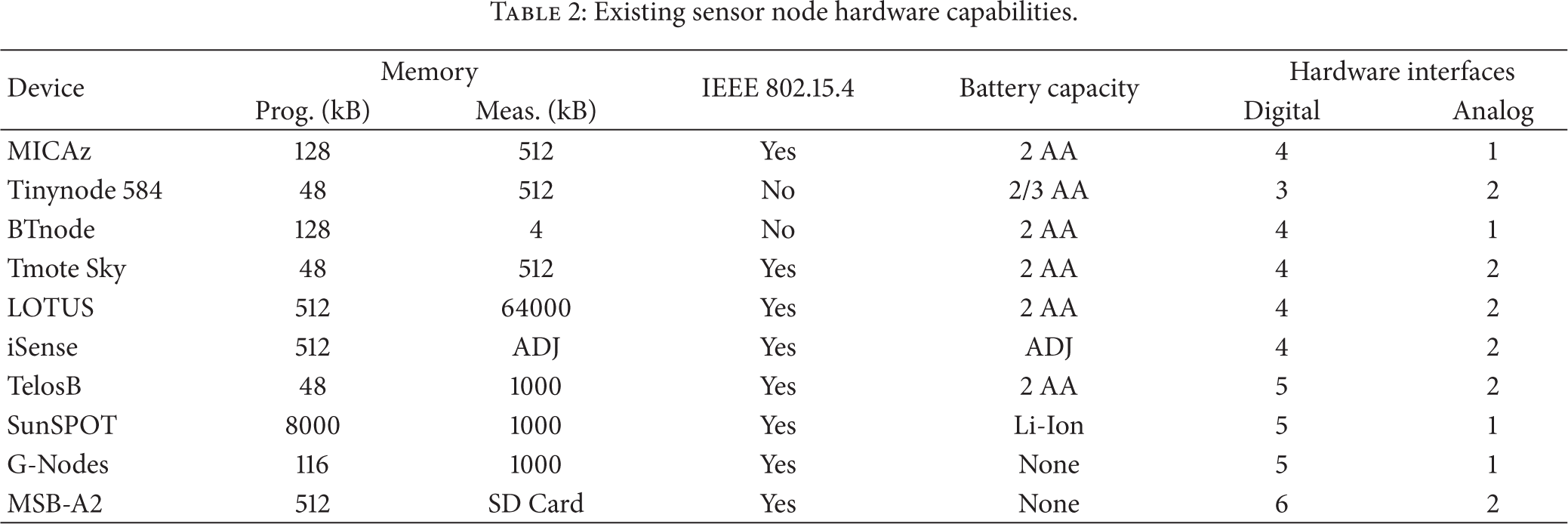
From surveys conducted by Hellbruck et al. [16] and Steyn and Hancke [17] in 2011, SNs commonly used in WSN testbeds include MICAz, SunSPOT, iSense, TelosB, G-Node, and Tmote Sky. Table 2 provides some features of existing SNs [18–27]. A brief perusal of the information contained in Table 2 shows that microcontrollers deployed in SNs range from low-power 8-bit devices to more powerful 32-bit devices. When selecting a SN microcontroller the energy efficiency and the computational power requirements of the SN must be kept in mind in order to maximize the SN lifetime. This is especially true for SNs powered by limited energy sources. In terms of communication hardware the majority of SN designs make use of IEEE standard 802.15.4 compliant transceivers. Most of the SNs are powered by two AA (R6) batteries, which are typically disposable as SNs will not typically be redeployed during their lifetime [28]. None of the existing nodes feature integrated battery charging capabilities. Whilst this is not critical to the operation of a WSN SN it hampers the ease of use in a testbed deployment. The WASPMOTE [29] features a modular design with many available sensor and transceiver options and features integrated battery charging but cannot measure its own energy consumption. For this reason, a SN capable of measuring its own energy consumption is developed. The SN is developed with a specific focus on testbed deployment.
Existing sensor node hardware capabilities.
3. Sensor Node Design
The requirements of a SN suitable for testbed deployment were first outlined by Krige et al. in [30] and are summarized as follows:
capable of measuring SN's own energy consumption;
integrated battery recharging;
ease of protocol implementation;
modular design that is standards compliant.
A product development methodology, based on the systems engineering process, was followed. Hence, the operational environment in which the testbed was to operate was studied in order to derive the operational requirements. By taking all requirements into account the operational architecture in Figure 2 was developed. By making use of the operational architecture the functional architecture of the sensor node was developed. In Figure 3 the functional architecture of the SN can be seen. Notice that the SN is of modular design with a main board, sensor module, and transceiver module. This is similar to the architecture of the WASPMOTE but with the addition of energy measuring hardware. Each SN is capable of measuring and recording its own energy consumption and remaining battery capacity. Sensor modules and transceiver modules are easily replaced and this increases the flexibility of the SN in testbed deployments. The addition of an integrated lithium-ion battery and charging circuitry improves the usability of the SNs.

Operational architecture of WSN testbed.

Functional architecture diagram of WSN sensor node.
Each of the main components of the SN will now be discussed.
3.1. Microcontroller
The microcontroller is responsible for controlling the SN as well as implementing the communications protocol. As such, it must provide sufficient resources whilst at the same time being as energy efficient as possible. A 16-bit processor from Microchip (PIC24FJ128GA310) was selected as this provided more adequate resources whilst at the same time being energy efficient. The microcontroller is part of Microchip's nanoWatt Extreme Low-Power (XLP) technology family of devices and consumes only 20.7 mW and a maximum idle mode power consumption of 4.2 mW when operating at 16 MIPS [31]. Sleep mode power consumption can be as low as
3.2. Energy Measurement Unit
To implement the energy measurement unit a current sense resistor and a voltage divider circuit were used. A 300 m
3.3. Communications Interface
By using the MRF24J40MC IEEE standard 802.15.4 compliant RF transceiver from Microchip the SN design is simplified. Firstly, the RF transceiver is standards compliant, and secondly the MiMAC protocol stack can be freely used. The Microchip Wireless (MiWi) Media Access Controller (MiMAC) defines a MAC and PHY layer which is supported across all Microchip transceivers. Standards compliance is achieved by the combination of the MiMAC stack and a suitable transceiver. Additionally the use of the MiMAC simplifies the implementation of various routing protocols [34], and it is thus of great value in testbed applications.
3.4. Form Factor and Interconnects
The overall design of the SN is modular, as the communications module and the sensor module can be easily replaced, depending on the experimental requirements. In Figure 4, the communications module, measurement and control module, and the sensor module can clearly be seen. Also the DE9 connector at the bottom edge of the measurement and control module that allows (a) the programming of the module by in-circuit means and (b) charging of the integrated battery are of interest. Four status LEDs are available to the user to inform the user of the current state of the SN (either during charging or other experimental processes). A single connector forms one convenient interface for node charging, node programming, and serial communication.
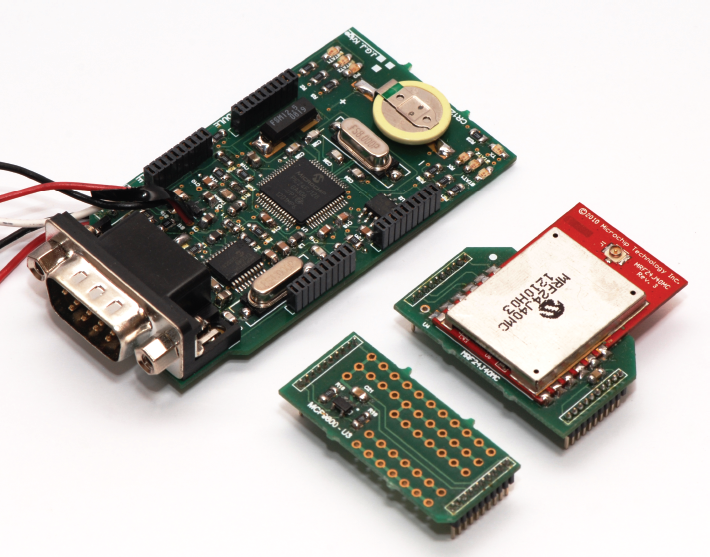
Photograph of a sensor node with its sensor and transceiver modules being removed.
3.5. Power Consumption
Typical node power consumption (calculated from device datasheet information) is outlined in Table 3. A 1100 mAh lithium-ion battery powers the SN during experimental deployment and depending on transmission power settings should provide at least 10 hours of operational life. The battery status is displayed via three (3) LEDs and the battery can be charged by the integrated circuitry via the DE9 connector.
Sensor node power consumption (calculated).

3.6. Measurement Accuracy
The accuracy of the SNs’ energy measurement circuitry was determined by comparing the SNs’ measurements with those of a calibrated precision bench-top multimeter (Tektronix DMM4050). Current measurement accuracy was compared for the following three scenarios:
SN is idle;
SN is transmitting at
SN is transmitting at 19 dBm (maximum).
In each case the accuracy of the SN measurement is denoted by the ratio of the SN measurement with the bench-top (BM) measurement, to wit
Sensor node voltage measurement accuracy.

Sensor node current measurement accuracy.

From the values in Tables 4 and 5 it is clear that the SN's measurements are slightly higher than those obtained from the bench-top multimeter. This, however, is not an issue as the measurements are well within acceptable ranges. Each SN could be individually calibrated to provide exact measurements, but this complicates testbed deployment. As such a small variance (as was observed) in SN measurements is acceptable. A completed SN is shown in Figure 5.

Photograph of a completed sensor node.
4. Testbed Setup
4.1. Physical Node Placement
Twenty (20) of these nodes were developed to implement the WSN testbed (see Figure 7). For the purposes of our investigation the SNs were placed in a rectangular grid (see Figure 6). In order to eliminate any bias in terms of routing protocol performance due to the physical architecture of the network, a rectangular grid was used. Although this is not representative of all real-world WSN deployments it provides a consistent and repeatable architecture for experiments. Furthermore, grid-like WNS deployments are attractive from a redundancy perspective [35] and considered to be quite typical for environmental sensing and office deployments [36]. To ensure proper communication between nodes, certain antenna dependent factors must be considered. From antenna theory, proper communication can only take place if communicating nodes fall within each other Fraunhofer region. In this region proximity of devices to the antenna does not affect its far-field radiation characteristics. It is easy to show that for the operating frequency of 2.45 GHz, and with the chosen antenna, the Fraunhofer region starts at approximately 0.3 m. As such, the nodes were placed 0.5 m apart.
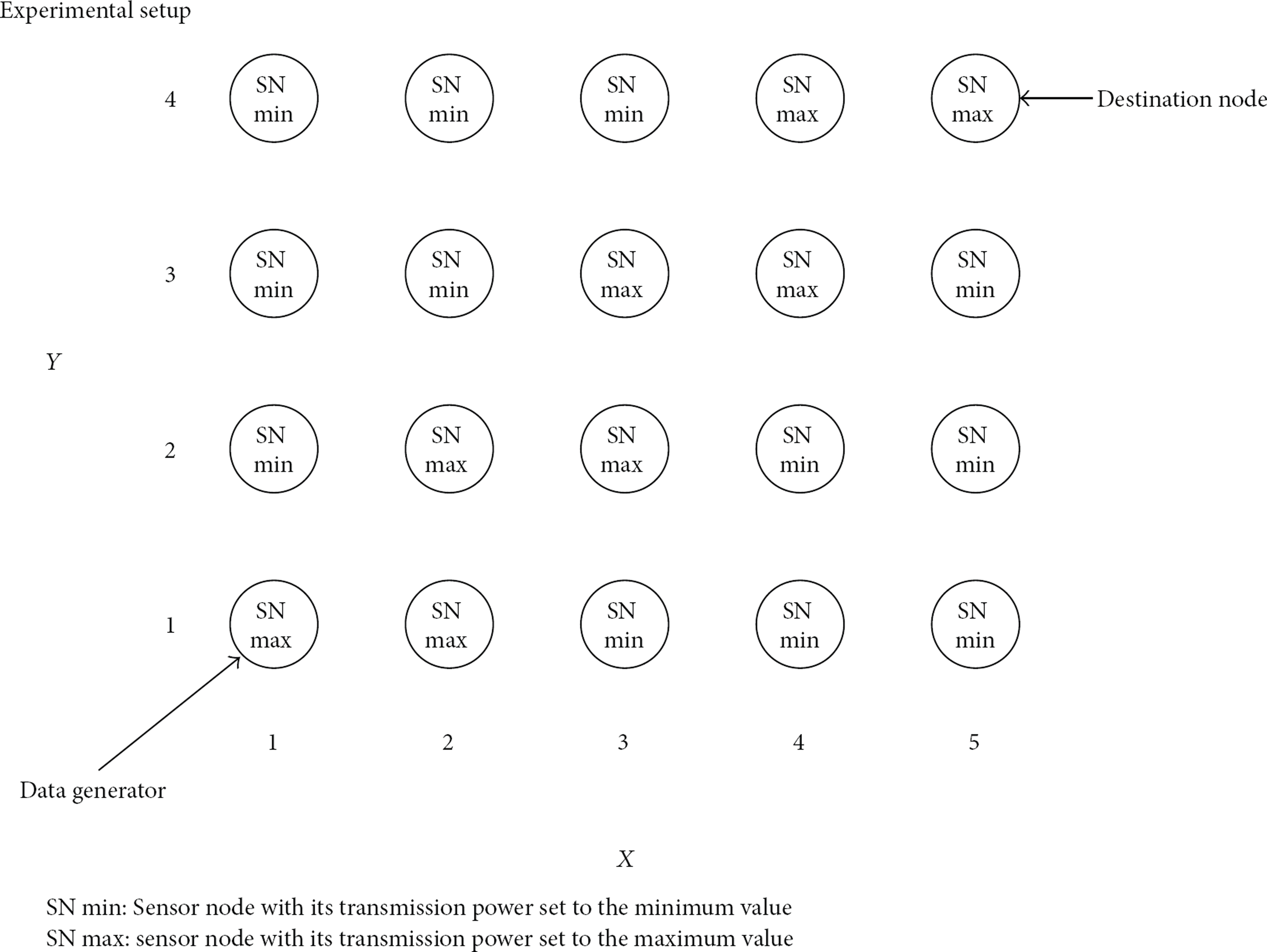
Testbed hardware setup diagram.

Picture of the WSN testbed consisting of 20 nodes.
4.2. Radio Interference
It is well known that the 2.4 GHz band is one of the most hostile communication channels in the ISM environment. Results from [37] show that specifically IEEE 802.11b transmitters and microwave ovens negatively affect the performance of IEEE 802.15.4 networks. However, the interference can be mitigated by proper channel selection [38]. Suitable channels include 15, 20, 25, and 26, and for this reason the testbed operates its IEEE 802.15.4 network on channel 25.
4.3. Internode Communication Distance
Even when a SN is set to its lowest transmission power level (
4.4. Routing Framework
In order to ease the implementation of various routing schemes a simple framework was developed. This framework is based upon a distance vector routing protocol similar to the Routing Information Protocol (RIP) [39]. The three types of packets used by this protocol are listed as follows:
discovery packets;
update packets;
data packets.
Although only the source node actively generates data, other nodes in the network still forward data and maintain routing information. For our purposes only a single node actively transmits as this allows a clear observation of routing behaviour.
5. Experimental Setup
In order to conduct any experiment on the WSN testbed a specific chain of events must take place.
The specific setup steps (as shown in Figure 8) are
implementing a routing protocol;
implementing a data generator;
programming all SNs partaking in experiment;
synchronising senor nodes;
clearing SN measurement memories.

Diagram detailing the experimental flow.
5.1. Control Experiment
To determine whether the entire testbed is functional an experiment is conducted during which each SN measures its own energy consumption. During this experiment the SNs actively discover nodes and maintain routing information, but no data is transmitted.
5.2. Validation Experiment
In order to perform validation on the testbed, a very simple experiment was conducted using a shortest path routing scheme. The details of this experiment are detailed hereon forth. A shortest path routing scheme was implemented by appending the existing routing framework as to include a cost metric based on the number of hops. As the name implies, the shortest route (based on the number of hops) is selected.
Data generation is accomplished by transmitting 200 packets, of 50 bytes each, once every 10 seconds from the source (nodes
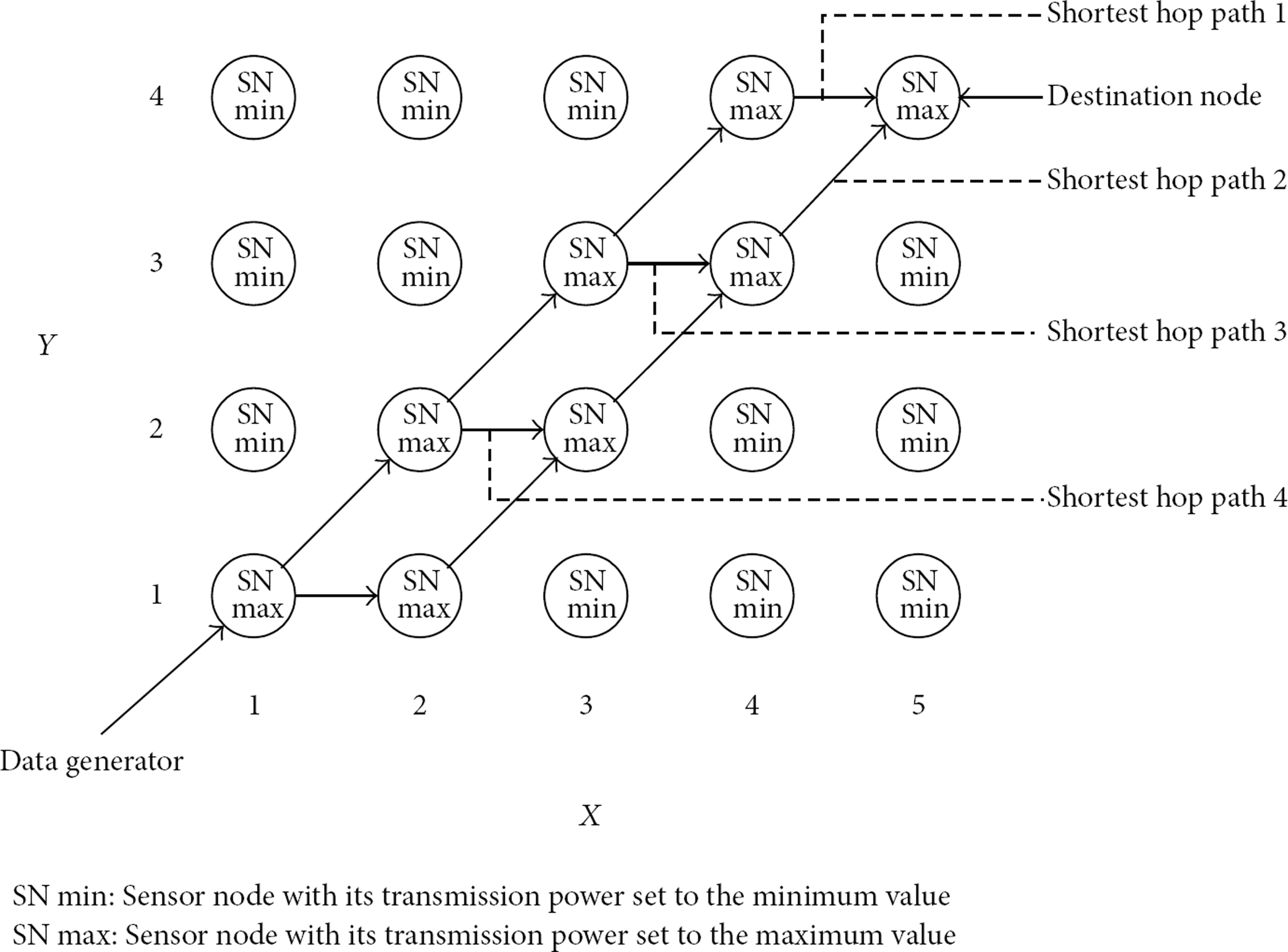
Possible shortest hop paths.
As the shortest path routing protocol will select the same path continually, SNs on the selected path will be subjected to overuse. In order to ensure that the SNs remain alive for the duration of the experiment, the experiment was conducted for 60 minutes. The experiment was repeated three times in order to gather suitable amounts of data for statistical analysis. In order for the testbed to be validated one would expect the nodes located on the shortest path to have the highest energy consumption.
5.3. MTTP Experiment
As stated in Section 1, most of the active WSN routing protocol research is simulation based. It was postulated that this is due to the time efficiency afforded by simulation; however, one must be cognisant of the limitation of simulations, specifically as it pertains to the assumptions that the aforementioned simulation model is based on. For this reason, the MTTP routing scheme introduced in Section 2 will be implemented on the testbed. MPPT routing is selected as it serves as the foundation for many other proposed routing schemes (see Section 2).
As was the case with the validation experiment the existing routing framework is modified to include a transmission power cost metric that represents the total transmission energy cost associated with a route. As such, the MTTP routing protocol might select longer routes in an attempt to conserve energy. Thus, the end-to-end delay between source and destination nodes might be increased. The same data generator as that used for the shortest path routing protocol was used in the MTTPR experiment. The possible paths selected by the MTTP routing scheme are indicated in Figure 10.

Possible minimum total transmission power (MTTP) paths.
6. Results
The results of both the validation and research experiments are presented in this section.
6.1. General Results
After completion of each of the individual experiments some statistical analyses were performed on the data to determine the accuracy of the results. For each of the experimental setups (control, SHP, and MTTP), the average network energy consumption was recorded and is graphed in Figure 11. Levene's test for homogeneity of variances is performed on this data to determine if the observed variances are due to random sampling. The values calculated by Levene's test are summarized in Table 6. A P value of less than
Levene's test for homogeneity of variances.

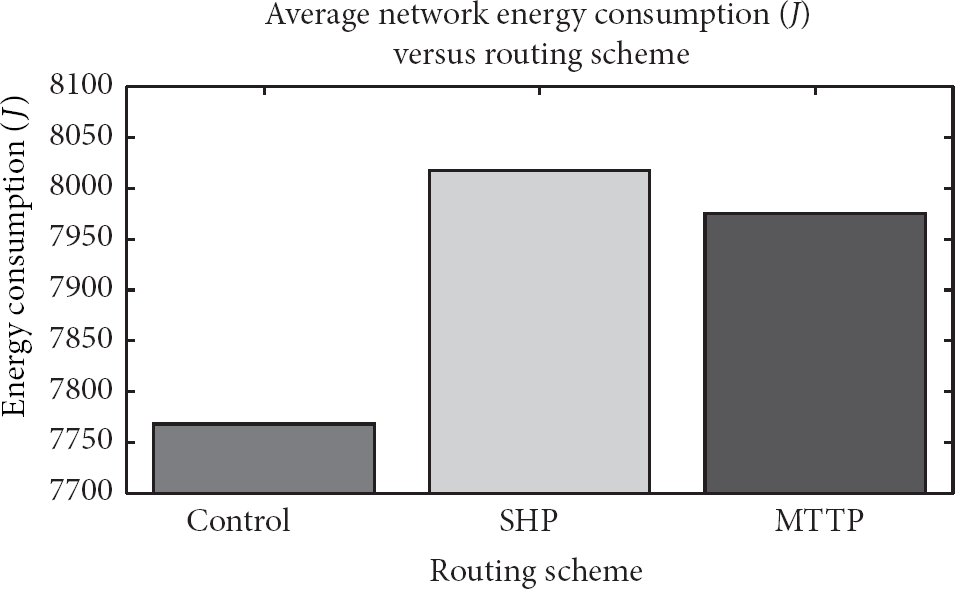
Plot of average network energy consumption
Additionally, a Tukey HSD test is performed to determine if the differences between routing schemes (none, SHP, and MTTP) are due to random chance. The Tukey approximate probabilities are provided in Table 7. All the P values are smaller than
Tukey HSD test for homogeneity of variances (Approximate Probabilities).

6.2. Validation Results
A contour plot of the average network energy consumption for the shortest hop path routing scheme experiment can be seen in Figure 12. The nodes that consumed most of the energy are located on the path labelled shortest hop path 2 in Figure 9. This is the expected behaviour of the shortest path routing scheme. Therefore, the testbed is considered to produce valid data and is thus validated.

Contour plot of the average node energy consumption
6.3. MTTP Results
A contour plot of the average network energy consumption when MTTP routing scheme is used can be seen in Figure 13. The nodes that consumed the most energy are located on the path labelled MTTP path 1 in Figure 10.
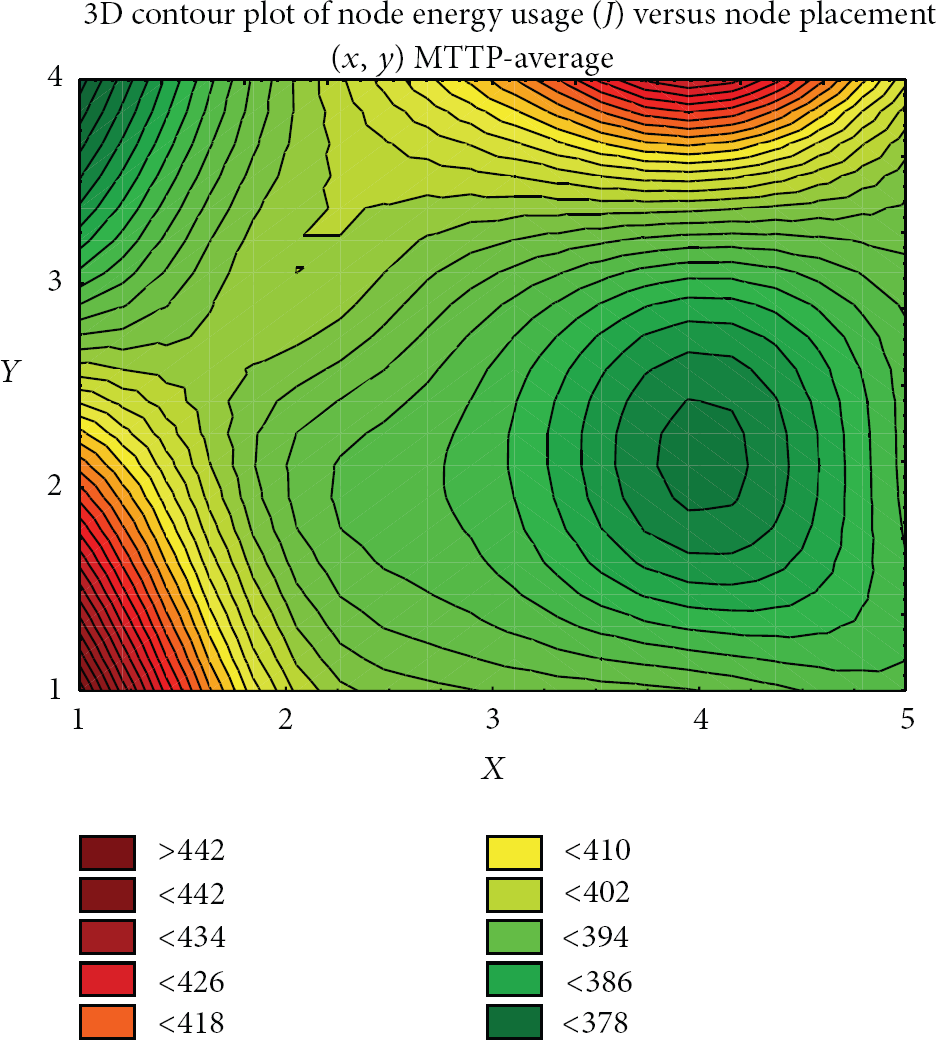
Contour plot of the average node energy consumption
7. Discussion
In Figure 11, the average energy consumption of the entire network for all three experiments can be seen. Although the MTTP scheme uses less energy than the shortest path benchmark, the saving is significantly less than expected. The RF transceiver used has a maximum output power of 19 dBm and a minimum transmission power of
Keeping in mind that the shortest path experiment made use of shortest path 2 in Figure 9, five full-power nodes were used. By a similar argument the MTTP scheme (which used MTTP path 1 in Figure 10) made use of 3 full-power nodes and 3 low-power nodes. Normalising individual node power to full-power nodes and assigning the expected energy saving of 45.4 dB to low-power nodes, it can be shown that MTTP should provide saving of almost
In order to explain this, the energy consumption characteristics of SNs versus transmission power settings need to be investigated. In Figure 14, the energy consumption of 10 SNs is shown for the idle, low-power (

A depiction of the energy consumption of 10 nodes at idle state, transmitting at minimum transmission power, and transmitting at maximum transmission power.
In an attempt to reduce the energy consumption of a WSN the MTTPR scheme replaces high transmission power hops with one or more low transmission power hops, in most cases expecting significant energy saving. However, due to the chip-level drain efficiency of low-power transceivers (typically employed in WSNs) this is not the case. In fact, the MTTPR scheme might even select routes that use more energy than a non-energy-aware routing protocol (such as shortest path) would use. This is because the MTTPR scheme replaces a single high-power hop with multiple low(er)-power hops but ignores the aforementioned output power dependent efficiency of the transceivers. It is clear that the MTTPR scheme can be modified to account for this. Currently the majority of simulation models used for the evaluation of the MTTPR scheme do not take this into account. This is also true for similar routing schemes such as MTTCP routing, MTRTP routing, and CMMBCR routing [13, 15, 40–43].
8. Conclusion
In this paper the development of a WSN sensor node capable of measuring its own energy consumption is detailed. Additionally, the authors investigated the fidelity of energy-aware WSN routing protocols, specifically MTTP routing. Although it was shown that MTTP routing offers some energy savings, as compared to non-energy-aware routing protocols, the saving was miniscule. The measured energy efficiency of MTTP routing and the theoretical expectations differ significantly. This is due to the chip-level drain efficiency of low-power RF transceivers, typically used in WSNs, not being taken into account by the MTTP routing scheme. In a worst-case scenario the MTTP scheme may even select a route which has a higher energy cost than a route selected by a non-energy-aware routing protocol (such as shortest path routing).
The transceiver's output power dependent energy efficiency negatively affects existing MPPT routing schemes’ expected energy savings. Routing schemes based on MTTP, such as MTTCP, MTRTP, and CMMBCR, are also affected. A simple modification to the MTTPR scheme would account for the observed phenomenon, but this modification would be unique for each transceiver. The simulation models used to compare energy-aware routing schemes will also need to be modified to take the transmission power dependent efficiency of SN transceivers into account.
Footnotes
Conflict of Interests
The authors declare that there is no conflict of interests regarding the publication of this paper.