




Abstract
In this paper, an approach based on transfer matrix method of linear multibody systems (MS-TMM) is developed to analyze the free vibration of a multilevel beam, coupled by spring/dashpot systems attached to them in-span. The Euler-Bernoulli model is used for the transverse vibration of the beams, and the spring/dashpot system represents a simplified model of a viscoelastic material. MS-TMM reduces the dynamic problem to an overall transfer equation which only involves boundary state vectors. The state vectors at the boundaries are composed of displacements, rotation angles, bending moments, and shear forces, which are partly known and partly unknown, and end up with reduced overall transfer matrix. Nontrivial solution requires the coefficient matrix to be singular to yield the required natural frequencies. This paper implements two novel algorithms based on the methodology by reducing the zero search of the reduced overall transfer matrix's determinate to a minimization problem and demonstrates a simple and robust algorithm being much more efficient than direct enumeration. The proposal method is easy to formulate, systematic to apply, and simple to code and can be extended to complex structures with any boundary conditions. Numerical results are presented to show the validity of the proposal method against the published literature.
1. Introduction
The vibration problem of beam-type structures is of particular urgent issue in many branches of modern aerospace, mechanical, and civil engineering. Natural vibration frequencies and modes are one of the most important dynamic characteristics of these kinds of systems. For example, the precision in manufacturing can be highly influenced by vibrations. If the vibration characteristics cannot be solved or preestimated exactly when designing a mechanism system, it is often hard to obtain a good dynamic performance of the mechanism system and consequently hard to control its vibration.
There are different types of beam models. One of the well-known models is the Euler-Bernoulli beam theory that works well for slender beams. According to the Euler-Bernoulli beam theory, the length of each beam section is much greater than the height of each section and the shear and rotary inertia effects are ignored.
The vibration theory of single-beam systems is well developed and studied in detail in hundreds of contributions. The vibration of systems composed of uniform double-beam coupled by translational springs or elastic layers have been studied extensively in the literature. Inceoğlu and Gürgöze [1] studied the bending vibrations of a combined system consisting of two clamped-free beams carrying tip masses to which several double spring-mass systems are attached across the span. Using Green's function method, the frequency equation of the system is established. Kukla [2] solved the problem of free vibration of two axially loaded beams which are connected by many translational springs. The solution contains possible combinations of the classical boundary conditions. The technique of the solution consists of developing a Green function. In [3], the vibrations of uniform beams connected by homogeneous elastic layer are devoted. Oniszczuk [4] discussed the free transverse vibrations of two parallel simply supported beams continuously joined by a Winkler elastic layer. The motion of the system was described by a homogeneous set of two partial differential equations, which was solved by using the classical Bernoulli-Fourier method. Oniszczuk [5] is devoted to analyze the undamped forced transverse vibrations of an elastically connected complex double-beam system in the case of simply supported beams. The classical modal expansion method was applied to determine the dynamic responses of the beams due to arbitrarily distributed continuous loads. Vu et al. [6] presented an exact method for solving the vibration problem of a damped double-beam system subjected to harmonic excitation. The double-beam system consists of two identical beams with the same boundary conditions on both sides. The beams are connected by a viscoelastic layer. Natural frequencies and mode shapes of vibration of the system are determined and the forced vibrations are investigated. Gürgöze and Erol [7] determined the natural frequencies of a clamped-free double-beam system carrying tip masses to which several spring mass systems are attached across the span. However, there are only few contributions dealing with the vibration of multibeam systems. That is, probably, the general vibration analyses of an elastically connected multibeam system are complicated and laborious in view of a large variety of possible combinations of boundary conditions, and thus, the solution of the governing coupled partial differential equations is difficult [8].
Multibody system dynamics (MSD) has become an important theoretical tool for wide engineering problems analysis in the world. Lots of methods of MSD have been studied by many authors on theory and computational method [9–15]. Professor Rui Xiaoting and his students have been enlightened by the method of letting state vectors (SVs) be transferred into classical transfer matrix method and built up a new multibody dynamics method called “Transfer Matrix Method of Linear Multibody Systems-MS-TMM” [16]. Using MS-TMM, the eigenvalue of linear multi-rigid-flexible-body system is computed easily, the computational ill-condition is overcome, and the computational efficiency is increased. Over 20 years, MS-TMM has been developed and used widely in engineering applications.
Motivated by the interesting study by Kukla [2] which was published on the problem of the natural longitudinal vibrations of two rods coupled by many translational springs and by the two novel algorithms based on the new recursive scanning approach presented by Bestle et al. [17], this paper presents a unique yet simple scenario of obtaining the exact free vibration characteristics of undamped/damped multilevel beam coupled elastically. The scenario developed in this paper is based on MS-TMM and Euler-Bernoulli beam theory.
The text is organized as follows. The problem statement is presented in Section 2. In Sections 3 and 4, the general theorem brief of MS-TMM and problem solution scenario are shown. In Section 5, some results calculated by MS-TMM and the other method are given which can validate the proposed method. The conclusions are presented in Section 6.
2. Problem Statement
The transversely vibrating system in a plane under consideration consists of multi-level parallel, elastic, and homogeneous Euler-Bernoulli beam with general boundary conditions. Beam bending stiffness is EI, where E is the elastic modulus and I is the area moment of inertia. Beam mass per unit length

A system of a multi-level beam with a distributed spring/dashpot system(s).
3. MS-TMM Strategy in the Context of Free Vibration Characteristics
3.1. MS Topologies
According to the natural attribute of bodies, a complicated MS can be represented by various bodies (e.g., rigid bodies, elastic bodies, lumped masses, etc.) interconnected by hinges (e.g., spherical joints, sliding joints, cylindrical joints, dampers, springs, etc.). In MS-TMM, there are different topologies based on a certain set of modeling variables to formulate the dynamic equations of MS. Such topologies are chain, tree, closed loop (as illustrated in Figure 2 for reference), network, and so forth.
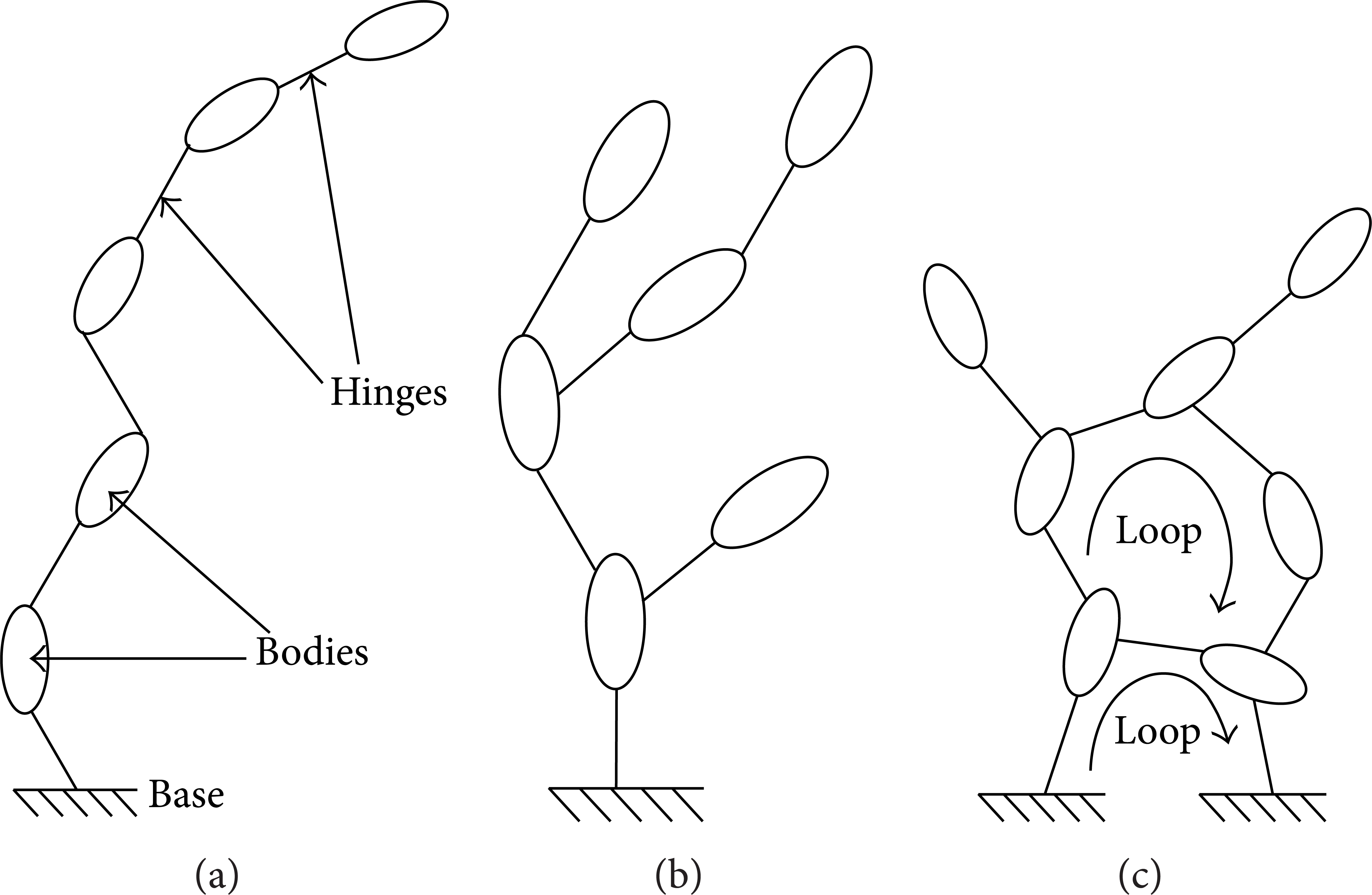
Multibody systems (a) chain, (b) tree, and (c) closed loop topology.
3.2. State Vector, State Variables, and Transfer Direction
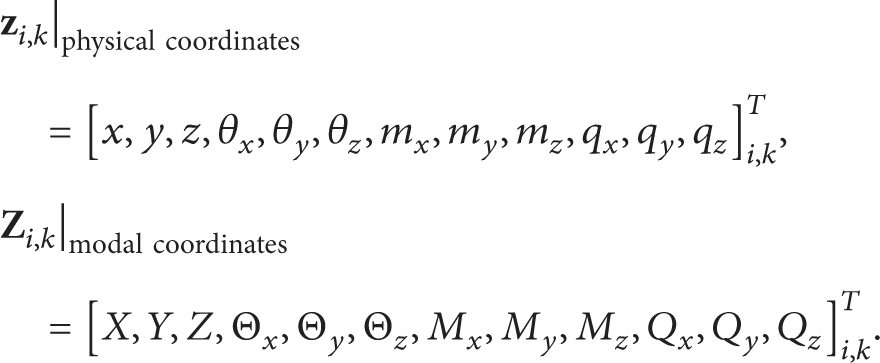
The state vector (SV) at a connection point of MS is a column vector denoting the mechanics state of this point. It includes the displacements of the point (including angular displacements) and the corresponding internal forces (including internal moments). Therefore, the SV is given by kinematics (displacements) and kinetics (internal forces) quantities, called state variables. For convention in this paper,

Sign convention at (a) input; (b) output.
In case of 1D or 2D applications, the SV will be reduced as shown later. Defining a boundary point of the MS as the transfer end, the direction from all other boundary points to the transfer end is called transfer direction. Along the transfer direction, the nodes entering into elements are called inputs denoted by I and the nodes leaving from elements are called outputs O.
3.3. Transfer Equation, Transfer Matrix, Overall System Transfer Matrix, and Overall System State Vector
A vibrating MS comprised of n-components, see Figure 4, is used as an example to show how to deduce the overall transfer equation and overall transfer matrix of the system. In order to describe conveniently the idea, the chain topology is considered in the following. This vibrating system is comprised of n components and n + 1 connection points. The SVs of the boundary right extremity and other boundary left extremity of the system are expressed as


TMM-MS in the sense of chain topology. A vibrating system comprised of n-components with n + 1 connections.
The constant matrix

Rewrite (2) as

where


Herein,
3.4. Eigenfrequency Equation of the Whole MS
The overall transfer equation (4a) only involves the boundary SVs, and the SVs at all other connection points do not appear. The SVs at the boundary are composed of displacements, rotation angles, moments, and shears, which are partly known and partly unknown. For common boundary conditions, half of state variables of

has to be fulfilled. The natural frequencies of the system can now be computed.
3.5. Beam Transfer Matrix
The full derivation of transfer matrices for the Timoshenko and Euler-Bernoulli beams vibrating in a plane (with kinematics and kinetics’ SV defined as

A1, A2, A3, and A4 are arbitrary constants, and


The direction of the state vector of Euler-Bernoulli beam component.
The coefficient vector

where

is the transfer matrix of the Euler-Bernoulli beam component.
3.6. Summary
In the context of free vibration characteristic, the general strategy of linear MS-TMM, in summary, is as follows.
(1) Break up the complicated MS into components with simple dynamic properties, which can be expressed in matrix form and SVs (for each component, it is possible to obtain the close form expression of the transfer matrix giving the displacements and the forces applied to one extremity to the displacements and forces applied to the other extremity). In other words, on the component level, the governing partial and ordinary differential or algebraic equations are transformed to algebraic transfer equations, where the output state results from a product of the input state and an element specific transfer matrix. These component matrices are considered as building blocks. In fact, the transfer matrix of such components needs not to be rededuced but may be taken directly from a transfer matrix library.
(2) Following the transfer direction that has been designed already by the analyst and according to the topology of the MS, these component transfer matrices are then assembled and end up with a system of linear algebraic equations called the overall transfer equation.
(3) Substitute the boundary conditions into the overall transfer equation to construct the eigenfrequency equation. Consequently, the vibration characteristics such as frequencies can be deduced as the roots of a transcendental equation. Due to narrow couples of natural frequencies, the classical zero search method is likely to fail. However, a new recursive scanning approach for minima of the absolute values of the determinant shows much more efficiency and reliability than direct enumeration.
4. Problem Solution Scenario
Figure 6 illustrates the suggested scenario for the solution of the problem statement and as follows. There are (1: m) multi-level beam. Each beam level is divided into (1: n) components, which have (0: n + 1) connection points and coupled with another beam level by a system (say 1: j) of a viscoelastic material (modeled as a spring/dashpot system). The massless dummy body as shown in Figure 6 (e.g., A,B,C, and so on) is a connection point between the two beam segment components and spring/dashpot system(s). The main key of MS-TMM is transferring the SV from one component to another following the general transfer equation (2). For the beam segment component, the transfer matrix is available (8b), while it is not for spring/dashpot system at the connection point between two or multi-level beam in this paper. However, it is based on the kinematics and kinetics of the spring/dashpot to formulate the transfer matrix and it needs two steps. First, as an example, let us consider a connection point j between two beam segment components and system of spring/dashpot may be grounded or connected to another connection point. Figure 7(a) sketches the first step. According to the continuity, j has identical displacements, angles, and moments at input and output:

And from the force analysis shown in Figure 7(b), the spring/dashpot force F changes the shear forces:

Equations (9a) and (9b) in the view of the SV as a matrix form


Structure of a multi-level beam with the distribution of spring/dashpot.

(a) Two beam segments and spring/dashpot system connected at massless dummy body, (b) state vectors (SV) at the massless dummy body j-connection point, (c) force analysis of a spring/dashpot system, (d) a system 1, 1 connected two levels 1–2 through two connection points A and B shown in Figure 6, and (e) two systems j, 1 and 1, m − 1 connected with multi-level (1–2–3) through three connection points G,C, and V shown in Figure 6.

Herein,

For system 1, 1 connected two levels 1–2 through two connection points A and B shown in Figure 6, the second step is how to deduce the transfer equation between the input and output related to these two levels. For the connection point A (see Figure 7(d)) and using (11) with F = Fsys,

Similarly, for connection point B and using (11) with F = − Fsys,

Combining (12a) and (12b) in one matrix form, we ended up the second step by writing the transfer equation and transfer matrix of a system located between two levels as

The transfer equation for two systems j, 1 and 1, m − 1 connected with multi-level (1–2–3) through three connection points G, C, and V shown in Figures 6 and 7(e) can be obtained similarly:
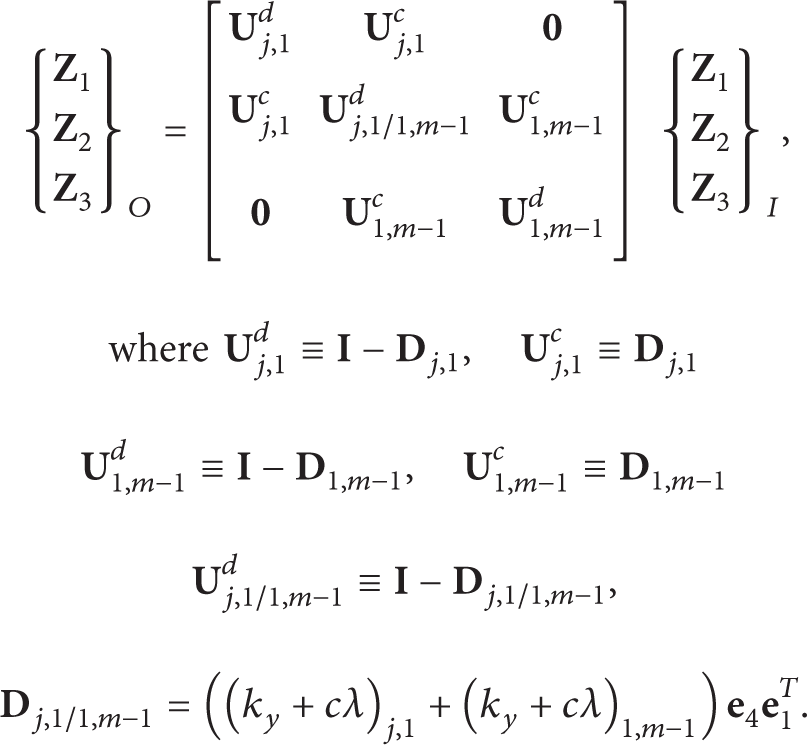
Now we are in the position to end the solution scenario. From the MS-TMM topology point of view, the system shown in Figure 1 or equivalently Figure 6 can be modeled as a multichain, following the similar procedures mentioned above in Section 3.3 to determine the overall transfer equation and ending up with determinant solution of the reduced overall transfer matrix.
5. Numerical Examples
Before the free vibration analysis of a multi-level elastic beam coupled by a spring/dashpot system(s) is performed, the reliability of the suggested scenario and the Matlab computer program developed for this paper are confirmed by comparing the present results with those obtained from the existing literature.
5.1. Reliability of the Suggested Scenario
Figure 8(a) consists of two free-free and clamped-clamped undamped beams connected to each other with two symmetrically distributed linear translational springs. The hybrid system is vibrating transversely in the x − y plane. The beams are supposed to have the same length, material, and geometrical data, that is, (L = 1 m,





(a) Free-free and clamped-clamped beams connected with two linear translational springs, (b) chain TMM-MS: State vectors and transfer direction of the suggested solution scenario.
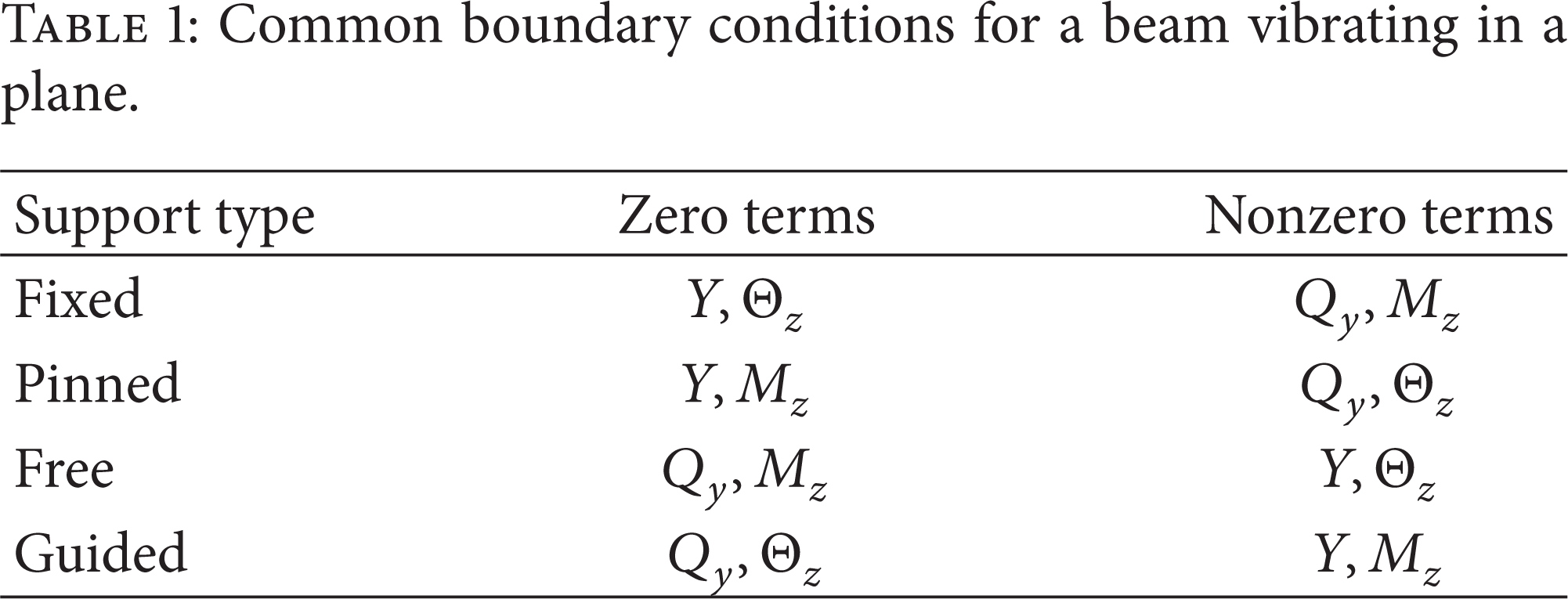
Applying the boundary conditions listed in Table 1, half of state variables of
Common boundary conditions for a beam vibrating in a plane.
The natural frequencies of the system can now be computed by zero search of the determinant, which is based on sign change of Δ(ω) (in case of real numbers) or Δ(λ) (in case of complex numbers) during a scanning of an interesting frequency range. This procedure can be cumbersome for several reasons. Therefore, reliable and efficient algorithms called recursive scanning approach are applied (see [17] for more details of the proposed algorithm) by switching from zero search for Δ to minimization of the absolute value |Δ| of the determinant, which is equally well applicable to both the real and the complex cases. The algorithm general idea is as follows. In a first iteration step, it divides an interesting band of frequencies into a number of sample points and searches for lower peaks. Each region having a lower peak is then divided again into small intervals to find more narrow regions of lower peaks as second iteration step. The algorithm proceeds until the required precision of roots is achieved. MS-TMM natural frequency results are obtained using fMin1D algorithm [17] (frequency ranges

fMin1D function determinant of a system consisting of free-free and clamped-clamped beams coupled with two springs. k y = 100(EI/L3) and x1 = 0.3 m.

Dimensionless frequency parameter
5.2. Free Vibration of Damped Elastically Coupled Triple Beams
The physical model of the transversely vibrating system under consideration is composed of three parallel uniform rectangular Euler-Bernoulli beams of homogenous properties. Each two-level beam is joined (connected) together by two spring/dashpot systems located at x1 and x2, respectively (see Figure 1). The beams have the same length and are pinned at their ends. The small damped vibrations of the system are considered. In the sense of the chain MS-TMM (see Figure 11), the overall transfer equation, overall transfer matrix, and overall SV are, respectively,


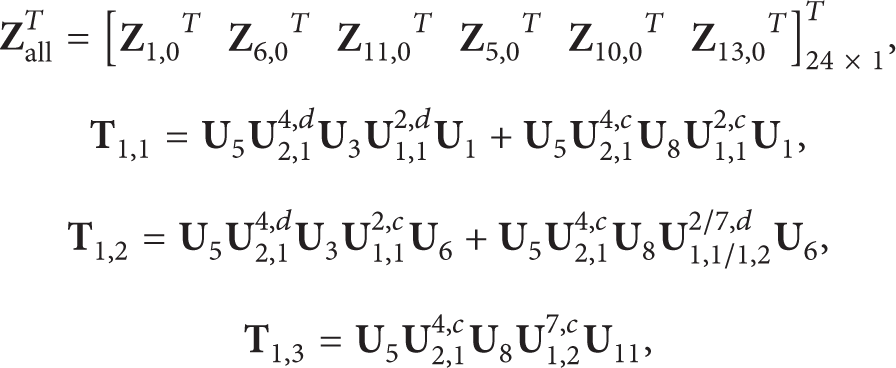
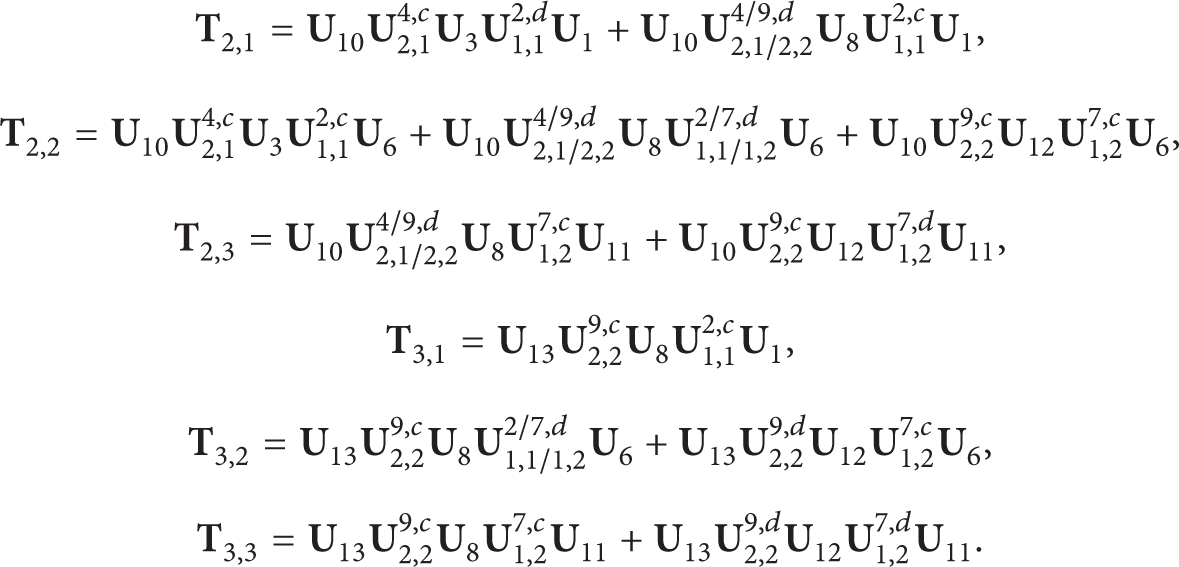
Herein,

Chain TMM-MS: state vectors and transfer direction of pinned-pinned multi-level beam connected by spring/dashpot systems.
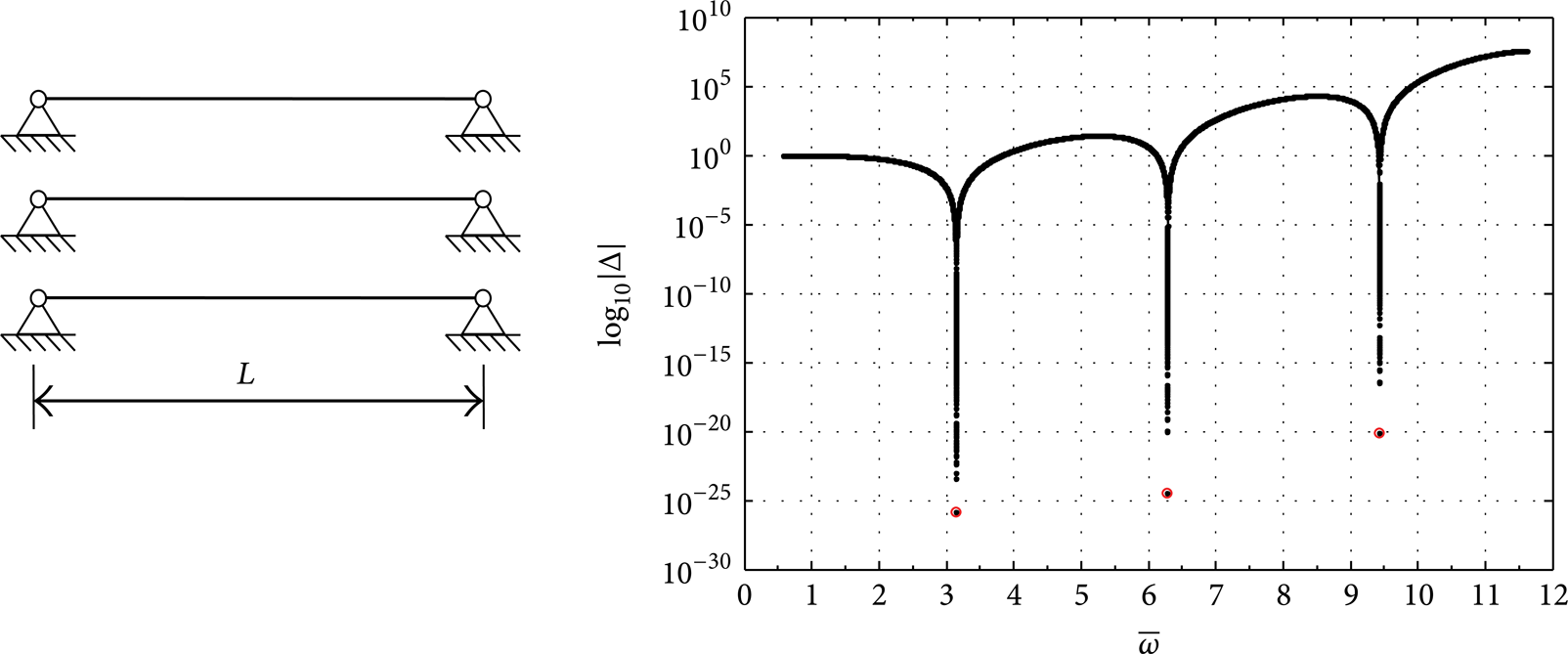
fMin1D function determinant to evaluate the lowest three

(a) The lowest three
The effect of the dashpot is included in the system making the model more complicated. The two spring/dashpot systems coupled with three-beam are located at position x1 = 0.25 m. The spring/dashpot system in parallel is similar to viscoelastic material model. The given values of damping are
Chain MS-TMM eigenvalues results of damped, coupled pinned-pinned three-beam.

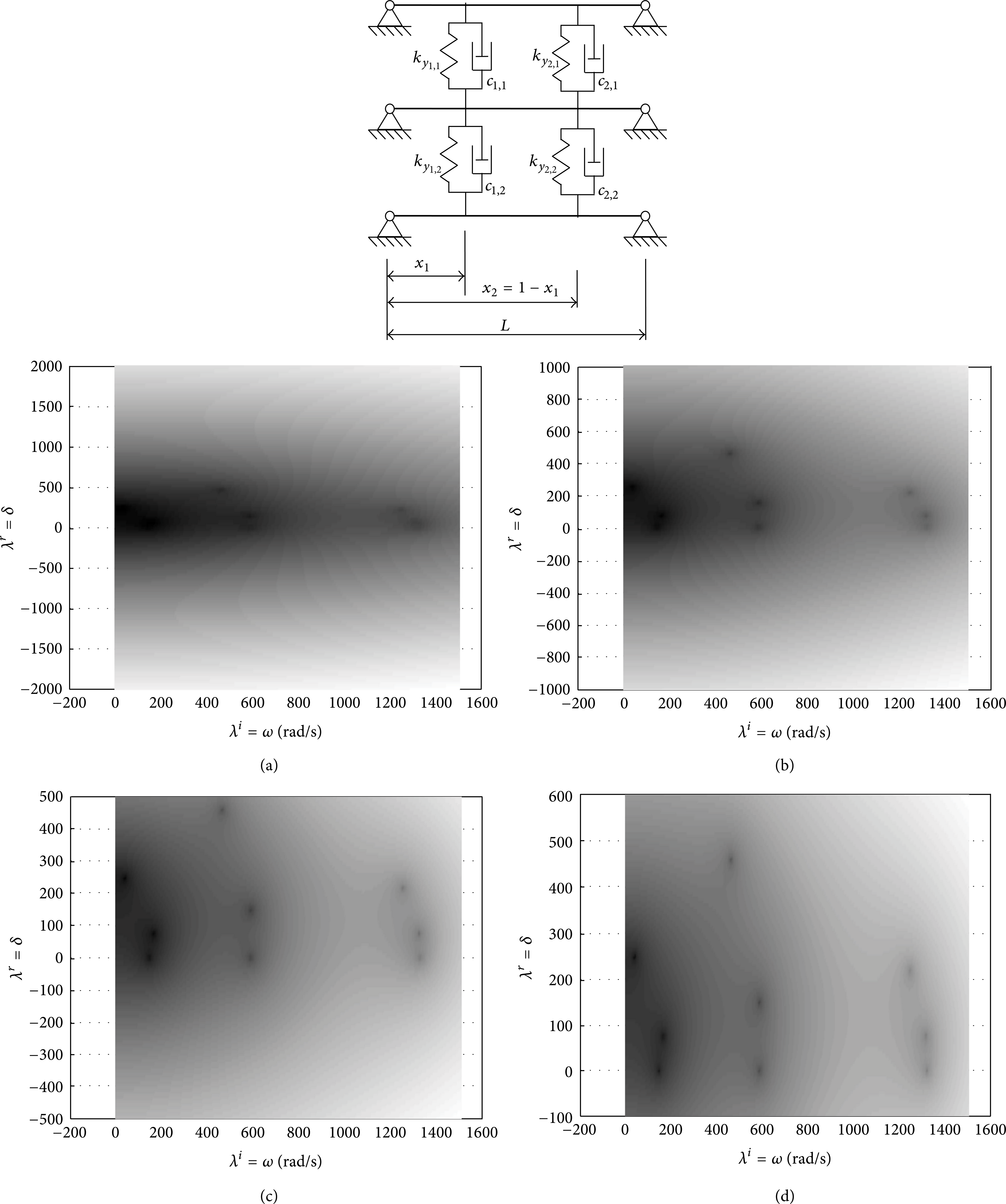
fMin2D first step: damping (λ r = δ) range scanning of a specific frequency band (λ i = ω ≤ 1500 rad/sec) for damped, coupled pinned-pinned three-beam, (a) [− 2000, 2000], (b) [− 1000, 1000], (c) [− 500, 500], and (d) [− 100, 600].

fMin2D second step: function determinant to evaluate the eigenvalues (λ = − λ r ± iλ i ) for a damped, coupled pinned-pinned three-beam.
Chain MS-TMM for undamped/damped coupled multilevel beam with the suggested scenario and the two novel recursive scanning algorithms provide a closed-form solution, not only presents the principles of the vibration problem but also shed light on practical applications. Since the solution is almost exact, it allows a complete understanding of a problem.
6. Conclusions
Starting from the principle of mechanics and the elementary formulations for the flexible beam, the free vibration analysis of laterally vibrating system made up of a multi-level Euler-Bernoulli beam to which spring/dashpot systems are attached across the span is performed using one of the Transfer Matrix Method of Linear Multibody Systems (MS-TMM) scenarios. Although the number of coupling springs or spring/dashpot systems considered in the examples given was limited to three, there is no inherent difficulty in extending the current method to solve the problems of vibration of systems consisting of any number of uniform/nonuniform beams with different boundary conditions and coupled with any number of spring/dashpot systems. The numerical results obtained to reveal that the eigenfrequencies calculated by this method are in very good agreement with those obtained by the published literature. Moreover, MS-TMM is encouraging for further investigations of more complex multibody systems of this type with rigid bodies due to simplicity in the formulation of the transfer equation, being systematic to apply, and being easy to program.
Conflict of Interests
The authors declare that there is no conflict of interests regarding the publication of this paper.
Footnotes
Acknowledgments
The research was supported by the Research Fund for the Doctoral Program of Higher Education of China (20113219110025), the Natural Science Foundation of China Government (11102089), and the Program for New Century Excellent Talents in University (NCET-10-0075).