




Abstract
With the promise of cost effective, unobtrusive, and unsupervised continuous monitoring, wireless body sensor networks (WBSNs) have attracted a wide range of monitoring applications such as medical and healthcare, sport activity, and rehabilitation systems. Most WBSN's medical and healthcare applications are real-time and life-critical, which require strict guarantee of quality of service (QoS), in terms of latency, and reliability. Reliability in routing plays key role in providing the overall reliability in WBSNs. This paper presents reliability aware routing (RAR) for intra-WBSNs that aims to provide high reliability for reliability constraint data packets. It considers the high and dynamic path loss due to body postural movements and temperature rise of the implanted biomedical sensor nodes. We have used two network models in this paper: RAR without Relays (RAR) and RAR with Relays (RARR). The simulation results reveal that RARR outperforms the other state-of-the-art schemes while RAR has slightly low reliability at low data rates as compared to RARR but significantly higher than other state-of-the-art schemes.
1. Introduction
Wireless sensor network (WSN) is a network of small sensor nodes capable of gathering information from the surroundings and sending them to the base station or coordinator. The base station performs data fusion based on the accumulated sensory data from multiple sensor nodes [1]. WSN can be used in many applications to facilitate the lifestyle of the people such as entertainment and sports, intelligent transport system, health monitoring, care and monitoring of disable people, emergency reliefs, and many more [2]. In coming years the world will face the problem of high increase in elderly population especially in the developed countries living with chronic diseases. This will require huge amount of additional health and medical care cost [2–5]. These days WBSNs are becoming increasingly popular and have shown great potential in real-time monitoring of the human body and reduce medical and healthcare cost. With the promise of cost effective, unobtrusive, and unsupervised continuous monitoring, WBSNs have attracted a wide range of monitoring applications such as medical and healthcare, sport activity, and rehabilitation systems.
WBSN is a special application of WSN; where the tiny biomedical sensor nodes collect the vital signs of the human body and send to base station also known as Body Coordinator (BC). The biomedical sensor nodes (e.g., electroencephalography (EEG), blood pressure, electrocardiography (ECG), body temperature, electromyography (EMG), and many others) can be fitted out on the wearers, well-placed on the human body, or implanted inside the human body. WBSN has some unique challenges and constraints such as heterogeneous nature of data, high and dynamic on and in body path loss, and temperature rise of the implanted sensor nodes as compared to conventional WSNs. The biomedical sensor nodes in critical medical and healthcare applications generate different types of data that require various kind QoS, where reliability and delay are the most important [6].
The traditional path loss models of wireless communication where the losses occur due to free-space wave propagation and multipath fading are no longer appropriate for WBSNs, having higher and dynamic path loss as compared to conventional WSNs. The reasons are (1) due to saline-water nature of the human tissues, they absorb the electromagnetic waves during wireless communication and (2) the postural movement of human body [7, 8]. Moreover, the antenna radiation absorption during data transmission to the neighbor nodes and the power consumption of the nodes' circuitry may increase the temperature of the in-body biomedical sensor nodes which may damage some tissues if remained for long period of time [3, 4, 9].
The routing in WBSN has attracted the attention of the researchers due to its characteristics and challenges. Different routing schemes considering the heterogeneous behavior of data, temperature rise issue, and high path loss have been proposed during the last decade. The focus of the proposed state-of-the-art schemes is either QoS or temperature rise or path loss and most of QoS-aware routing schemes are inter-WBSN [3]. To the best of authors' knowledge, TMQoS [6] is the only QoS-aware routing that considers the intra-WBSN routing and the temperature rise issue but not considering the very high and dynamic on and in body path loss. Exclusion of this in any intra-WBSNs communication will make the network and its performance unrealistic. So far, we know no such integrated solution has been proposed that considers the nature of the generated data, path loss, and temperature rise issue for intra-WBSNs.
As various kinds of data packets are generated by biomedical sensor nodes and some of them (e.g., EEG, ECG, EMG, respiratory monitoring, pH-level monitoring, etc.) should be transmitted with highest reliability [6, 10, 11]. In this paper, we propose Reliability-Aware Routing (RAR) for Intra-Wireless Body Sensor Networks that ensure the best possible reliable transmission of the Reliability Constraint Data Packets (RCDPs) by considering both the nature of data packets and path loss while maintaining acceptable level of temperature rise. RAR follows a modular based approach and uses separate modules for reliability-constraint and normal data packets. It uses end-to-end path reliability-aware routing while decisions are made at each intermediate node without the discovery and maintenance of end-to-end path. We have performed extensive simulation in order to evaluate the performance of RAR with other state-of-the-art scheme.
The remaining paper is organized as follows. Related work is summarized in Section 2, while Section 3 describes the proposed RAR for intra-WBSNs. The performance evaluation is discussed in Section 4. Finally Section 5 concludes this paper.
2. Related Work
The architecture of WBSN consists of intra-WBSN, inter-WBSN, and extra-WBSN communications [3, 9], as shown in Figure 1, redrawn from [3]. In intra-WBSN the biomedical sensor nodes send the collected information to the base station or BC, while the different BCs forward the received information to the sink(s) in inter-WBSN through other BCs or regular infrastructure. The sinks then send that information to remote health-care center or other point of interest (e.g., medical server and cloud computing) through the Internet in extra-WBSNs.

Architecture of wireless body sensor networks.
During last decade, different people have tried to solve the path loss problem of intra-WBSNs by defining a periodically updated cost function. The route, based on minimum cost, is being selected to forward the data from the biomedical sensor nodes to the BC. Opportunistic routing proposed in [12] is based on Line-of-Sight (LoS) and Non-Line-of-Sight (NLoS) communication. If the source and destination node are in LoS then the source node will forward the data otherwise it will inform the relay node near the destination for data forwarding. While the authors in [13–15] use store and forward/flood mechanism to forward the data toward the destination node. If a packet is received at any node, it stores the packet until it found any node(s) with least cost function. All these state-of-the-art schemes consider the path loss but ignore the heterogeneous nature of data and the temperature rise issue of intra-WBSNs except [16] where the cost function considers both path loss and temperature rise. Furthermore, they do not ensure the real-time monitoring of the human body.
The wireless communication among different implanted or in-body biomedical sensor nodes may result in thermal rise due the antenna radiation absorption during transmission of the data packets to neighbors and power consumption while processing the data packets. The temperature sensitive parts of the human body such as human tissues may be affected due to this temperature rise and it may damage them, if remained for long period of time. The rate at which the human tissues absorb the radiation energy per unit weight is known as specific absorption rate (SAR) and is given in [17] as

Special type of nodes known as relay nodes (wearable) have been used in [7, 18–21] in order to increase the life time and reliability and decrease the thermal effects of the implanted biomedical sensor nodes. The energy consumption due to transmitting the data can be reduced by using these relay nodes, which results into improved life time and protect the human tissues from the thermal effects of the implanted biomedical sensor nodes. Furthermore, it also reduces the number of small surgical operation in order to replace the implanted biomedical sensor nodes in case the battery is expired.
Biomedical sensor nodes generate different types of data packets that require various kinds of quality of services. Very few routing protocols exist in the literature that consider the required QoS parameters based on the nature of data [6, 10, 11, 22]. DMQOS [10] and LOCALMOR [11] are modular based routing schemes designed for inter-WBSNs communication and categorize the data into critical data, delay sensitive data, reliability sensitive data, and normal data. On the other hand, QPRR [22] classifies the data into reliability constraint data and normal data and is designed to display the vital information of the patients inside hospital on medical display. All these QoS aware routing schemes used separate modules for different types of data and perform well in order to reduce delay and enhance reliability. However, their main concern is to provide the required QoS based on the nature of data but they do not consider the thermal-effects caused due to the antenna radiation absorption and high path loss because of wearer's movement, especially of the implanted biomedical sensor nodes, as they are designed for inter-WBSNs communication.
So far, we know TMQoS [6] is the only QoS aware routing scheme that supports intra-WBSN communications and considers the temperature rise issue of the implanted biomedical sensor nodes. TMQoS categorizes the data packets into four categories same as in [10, 11] and it performs better than other state-of-the-art schemes [17, 23]. But it does not consider the high and dynamic on and in body path loss which makes any intra-WBSN and its performance unrealistic. Moreover, it considers only those neighbor nodes' reliability information that have least number of hop-counts but reliability constrained data packets may tolerate some delays. The classical path loss models of the wireless communications cannot be used for intra-WBSN as the path loss exponent is high and dynamic due to the postural movement of the human body.
As discussed above, all the proposed state-of-the-art schemes for WBSNs consider either path loss or temperature rise or the heterogeneous nature of data except TMQoS [6] and ETPA [16]. TMQoS [6] considers the temperature rise issue with heterogeneous nature of data while the cost function used in ETPA [16] is based on the thermal effects along with the path loss. Our RAR for intra-WBSNs addresses these shortcomings by considering the path loss, thermal effects of the implanted biomedical sensor nodes and selects the next-hop node based on end-to-end path reliability from the source to the destination for reliability constraint data packets.
3. Proposed Method
The network models, classification of the generated data, and the proposed reliability aware routing for intra-WBSNs are discussed in the following subsections.
3.1. Network Models
In this paper, we consider the two deployment scenarios. In first scenario, we consider intra-WBSN comprised of purely biomedical sensor nodes implanted inside the human body and a body coordinator (BC) with replicable power source placed on the human body. We model it as connectivity graph as given below:

In second deployment scenario, along with biomedical sensor nodes and BC, we consider some special type of nodes known as Relay nodes same as in [7, 18–21]. We model it as connectivity graph as given in (2). Where V is the union of S, R, and BC; that is,
3.2. Classification of Generated Data
The main design focus of RAR for intra-WBSNs is the provision for reliability-constrained data packets. Considering reliability as the QoS constraint, we categorize the generated data packets into reliability-constraint data packets (RCDPs) and normal data packets (NDPs). The RCDPs should be transmitted with highest reliability and packet losses may cause serious consequences. Data generated from electrocardiography (ECG), electroencephalography (EEG), electromyography (EMG), respiratory monitoring, pH-level monitoring, and so forth can be considered as examples of RCDPs. On the other hand, the NDPs do not impose any such sort of constraint. Example of such type of data can been pulse count, body temperature, blood pressure, and so on.
3.3. Proposed Reliability Aware Routing (RAR) for Intra-Wireless Body Sensor Networks
The proposed RAR is modular-based cross-layered interaction of Network and MAC layers. The block diagram of the different modules of the proposed RAR and their interactions is shown in Figure 2. The MAC receiver module is responsible to receive the data and Hello packets from the neighbor nodes and/or BC and passes them to packet classifier module, while the MAC transmitter module transmits the data and Hello packet to the neighbor nodes and/or BC. The packet classifier module classifies the incoming packets from the neighbor nodes and/or BC as data packets and Hello packets and forwards them towards data packet classifier module and routing module, respectively. When data packets are received either from the upper layers or from the packet classifier module, the data packet classifier module categorizes them into RCDPs and NDPs and sends them towards reliability aware module and temperature aware module, respectively. The other modules are discussed in detail in the following subsections.
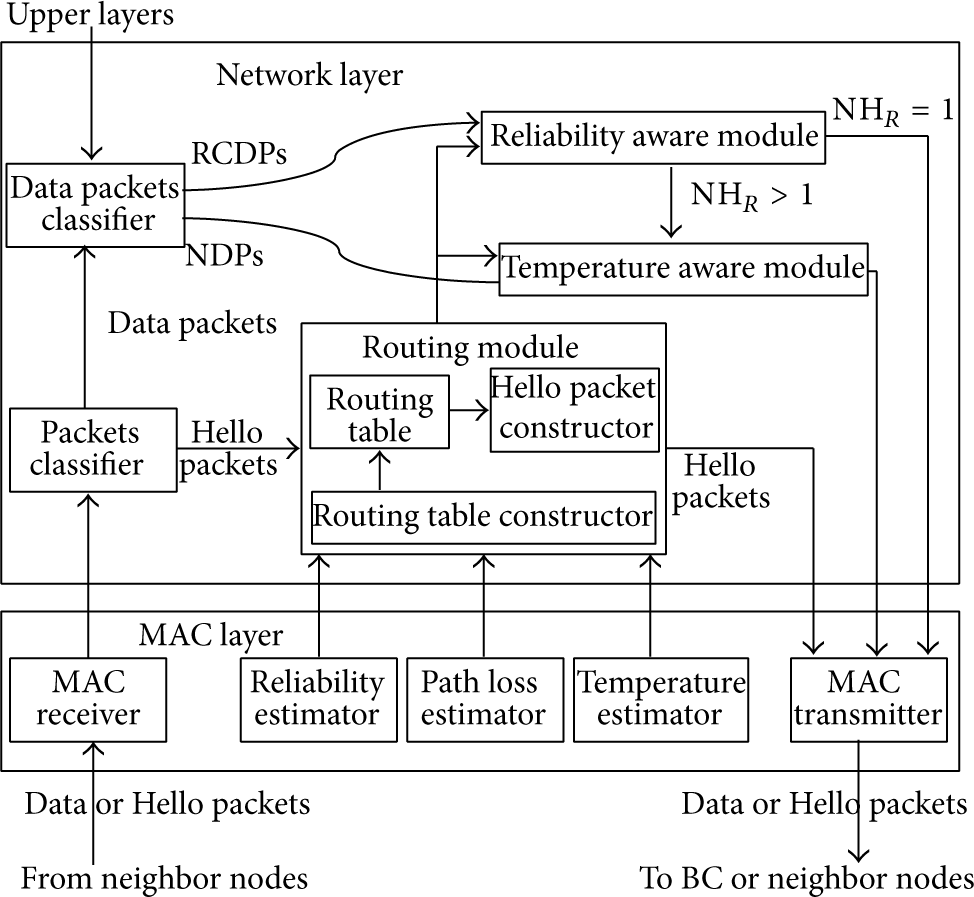
Network architecture of reliability aware routing (RAR) for intra-WBSNs.
3.3.1. Reliability Aware Module
The reliability aware module is responsible for providing routing services to RCDPs that fulfill the minimum reliability requirement. As presented in Algorithm 1, for any packet P belonging to RCDPs the proposed protocol looks at the routing table RT and if there is no entry in RT then it drops the packet immediately (lines: 1–3). The NULL RT case arises when initially the routing table is not constructed or no appropriate neighbor node can be found whose temperature rise is less than a certain threshold level. If there are some entries in RT then at any node
(1) (2) (3) drop the packet immediately (4) (5) (6) (7) put node (8) (9) (10) (11) Drop the packet immediately (12) (13) (14) (15) put node (16) (17) (18) (19) (20) DNH = (21) send packet to DNH (22) (23) call Temperature Aware Module with input RCDPs, N (24) (25) drop the packet immediately (26) (27) (28)
3.3.2. Temperature Aware Module
The temperature aware algorithm of the proposed RAR protocol is presented in Algorithm 2, which is responsible to provide thermal aware routing services to both normal and reliability constraint data packets based on temperature rise
(1) (2) (3) (4) drop the packet immediately (5) (6) (7) (8) put node (9) (10) (11) (12) drop the packet immediately (13) (14) (15) put TR of (16) (17) DNH = whose TR = = (18) send the packet to DNH (19) (20) (21) (22) (23) put TR of (24) (25) DNH = (26) send the packet to DNH (27) (28)
3.3.3. Routing Module
The routing module consists of three submodules: routing table constructor, routing table, and Hello packets constructor. The routing table constructor is responsible for constructing and/or updating routing table based on the information provided by the neighbor nodes and/or BC through Hello packets, reliability estimator, path loss estimator, and temperature estimator. At any node

The structure of the routing table is given in Table 1, where AddDest is the address of BC,
Structure of routing table.

Every node
Structure of Hello packet.

Where
3.3.4. Reliability Estimator
At any node 

3.3.5. Path Loss Estimator
At any node 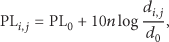

3.3.6. Temperature Estimator
The temperature rise of any node 
3.4. Discussions
Routing in intra-WBSN is a challenging task due to the unique constraints imposed by deployment of implanted biomedical sensor nodes, chemistry of human's body tissues, and human's motion patterns. To the best of our knowledge, TMQoS [6] is the only intra-WBSN routing scheme that takes into account some of the constraints, that is, heterogeneous nature of data and temperature rise issues. However, due to various postural movements and electromagnetic waves absorption behavior of body tissues, high and dynamic path loss is caused. TMQoS completely overlooks the path loss issue which makes it unrealistic. Moreover, it selects the next-hop based on least number of hop-counts strategy for packets forwarding which does not guarantee the required reliability demand. RCDPs can tolerate some delays but need to be transmitted with high reliability; thus the hop-count strategy does not fit well for forwarding such packets. Our RAR for intra-WBSNs addresses these shortcomings by considering the path loss and thermal effects of the implanted biomedical sensor nodes and selects the next-hop node based on end-to-end path reliability from the source to the destination for reliability constraint data packets.
There are several cases that lead to dropping the data packets in intra-WBSNs: if the path loss is considerably high between the source and destination pair or unavailability of a desired neighbor node that fulfils the demanded QoS parameter. Due to the inherent multifacet next-hop selection strategy of RAR, the packets drop ratio is greatly minimized thereby improving the overall system performance.
4. Simulation and Performance Evaluation
We have used NS2 (Network Simulator Version-2) to simulate our proposed RAR algorithm. NS2 is a discrete event simulator and supports multihop routing for wired and wireless networks with complete MAC, Data Link, and Physical layer models. We have considered two network models to simulate our proposed RAR scheme: RAR without Relay nodes (RAR) and RAR with Relay nodes (RARR). We have compared our proposed scheme with TMQoS [6] to evaluate its performance in terms of packet loss ratio due to path loss, average packet delivery ratio, average energy consumption, and average temperature rise. To the best of our knowledge TMQoS is the only QoS aware existing schemes designed for intra-WBSNs routing; hence, comparison is limited to it only. The configuration of the network parameters is given in Table 3.
Network parameters.

Figure 3 shows the packet loss ratio due to different path loss threshold at low data rates. If the path loss between any two nodes is higher than certain path loss threshold then the packet is dropped. It is clear from Figure 3 that RARR results in lowest packet loss ratio at all path loss thresholds as compared to RAR and TMQoS. RAR shows slightly poor performance at low path loss thresholds but at high path loss thresholds it performs same as RARR. On the other hand, the packet loss ratio is significantly high in case of TMQoS as compared to RAR and RARR, as it is not considering the path loss parameter and selecting next-hop based on least hop-counts.
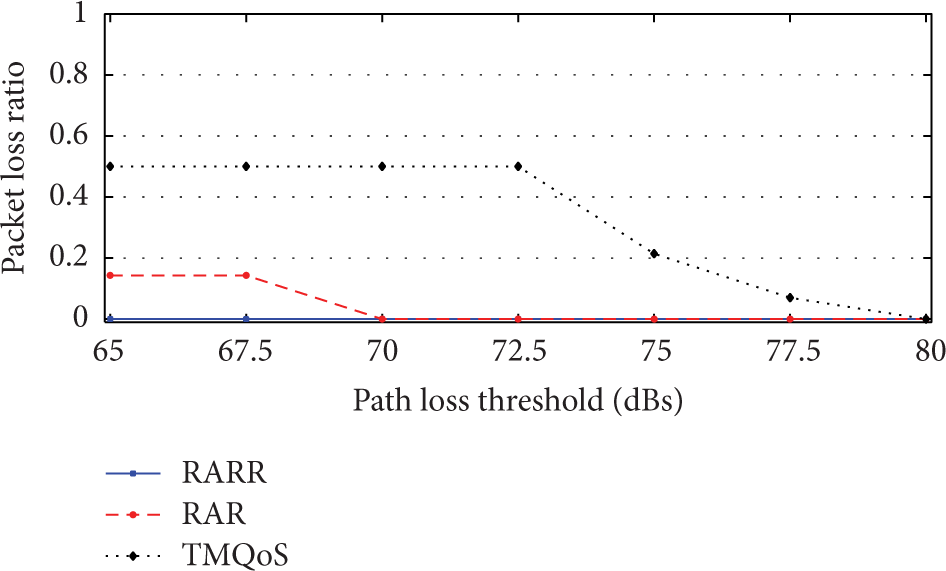
Packet loss ratio versus path loss threshold at low data generation rate.
Figure 4 indicates the average packet delivery at different path loss thresholds against different data generation rates for RCDPs while Figures 5 and 6 illustrate the same against different required reliabilities at low and high data rates, respectively. Figures 4, 5, and 6 indicate that with increase in the data generation rate and required reliability the packet delivery ratio deceases for all three cases. It is clear that RARR shows better performance at low data rates as compared to the other two. RAR results in slightly low packet delivery ratio compared to RARR at low data rates while at high data rates RARR shows slightly poor performance, it could be due to high congestion on the relay nodes. On the other hand, RAR and RARR show significantly better results compared to TMQoS. Again it suffers due to unawareness of high and dynamic path loss and selecting next hop based on least number of hops.

Average packet delivery ratio versus different data generation rates at different path losses for RCDPs.
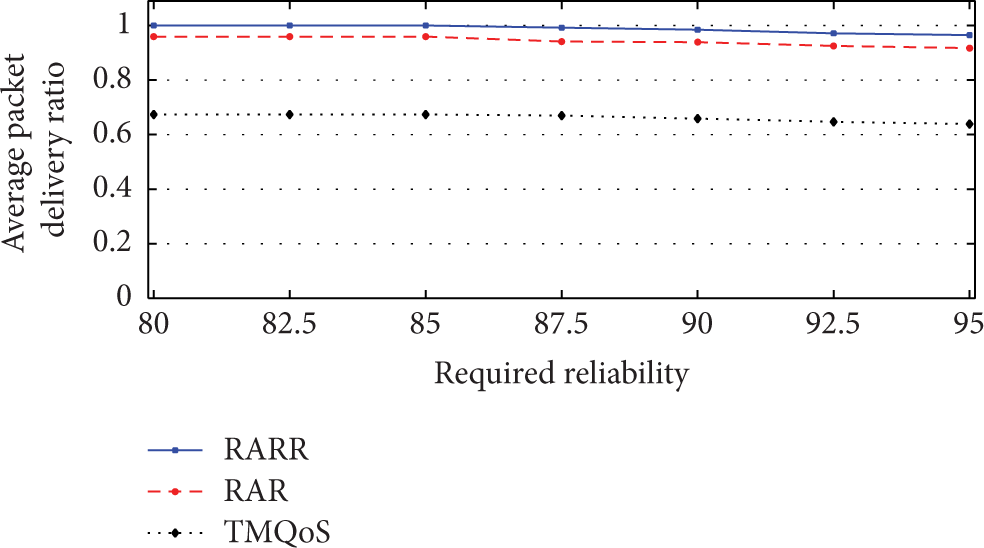
Average packet delivery ratio versus different required reliability at different path loss thresholds and low data generation rate for RCDPs.

Average packet delivery ratio versus different required reliability at different path loss thresholds and high data generation rate for RCDPs.
Figures 7 and 8 show the average energy consumption and average temperature rise of the biomedical sensor nodes at different path loss thresholds against different data generation rates, respectively. It is clear from Figures 7 and 8 that both the average energy consumption and the average temperature rise of the biomedical sensor nodes increase with high data generation rate. High data generation means more communication which means more energy consumption and more temperature rise. RARR outperforms both RAR and TMQoS both in terms of average energy consumption and average temperature rise because the biomedical sensor nodes are using low transmission power and are used only as source nodes and not used for forwarding the sensory data towards BC, which is the responsibility of the relay nodes. The average energy consumption and average temperature of RAR is slightly high as compared to TMQoS because RAR selects desired next hop based on path loss and reliability information instead of least hop count strategy being used in TMQoS.

Average energy consumption of the sensor nodes versus different data generation rates at different path loss thresholds.

Average temperature rise of the sensor nodes versus different data generation rates at different path loss thresholds.
5. Conclusion
In this paper, we have presented Reliability Aware Routing (RAR) for intra-wireless body sensor networks. RAR's main focus is to forward the reliability constraint data packets towards body coordinator with highest possible reliability. RAR considers the end-to-end path reliability from source to destination (body coordinator), high and dynamic path loss due to postural movements of the human body, and the thermal effects of implanted biomedical sensor nodes due to antenna radiation absorption and the power consumed during different operations. Two network models: RAR with Relays (RARR) and RAR without Relays (RAR) have been used in this paper.
Simulation results show that RARR achieve better performances in terms of packet loss ratio, average packet delivery ratio, average energy consumption, and average temperature rise. RAR results in slightly high packet loss ratio and low average packet delivery ratio as compared to RARR low data generation rate. But at high data generation rate the average packet delivery ratio of RARR is slightly lower as compared to RAR, which might be due to high congestion at the relay. However, both RAR and RARR show significantly better performance to reduce packet loss ratio and enhance average packet delivery ratio of RCDPs as compared to TMQoS. The average energy consumption and average temperature of RAR are slightly high as compared to TMQoS because RAR selects desired next hop based on path loss and reliability instead of least hop count strategy being used in TMQoS. We will consider the delay constraint and critical data packets in our future work.
Footnotes
Conflict of Interests
The authors declare that there is no conflict of interests regarding the publication of this paper.
Acknowledgments
The research is supported by Ministry of Education (MoE) Malaysia and conducted in collaboration with Research Management Center (RMC) at Universiti Teknologi Malaysia (UTM) under VOT no. Q.J130000.2528.06H00.