




Abstract
We study the trade-off between energy efficiency (EE) and spectral efficiency (SE) in cooperative cognitive radio networks (CCRN); joint power and subcarrier allocation scheme is proposed. Resource is assigned to each user in a way which ensures maximizing energy efficiency, maintaining primary and second user quality of service (QoS) requirements. Optimum transmit power of user is got by analysis; validity of theory is verified by simulation, and the proposed algorithm can adaptively allocate resource for CCRN.
1. Introduction
In consequence of wireless communications exponential increase, frequency spectrum becomes one of the scarcest resources. Cognitive radio (CR) networks have been seen as a promising solution to improve the current spectrum efficiency. Wireless devices can access radio spectrum without causing harmful interference to licensed users [1]. Orthogonal frequency division multiplexing access (OFDMA), which offers a high flexibility in adaptation of subcarriers to fast changing conditions in radio spectrum, is deemed as an appropriate air interface of a CR system [2]. The OFDMA-based systems can flexibly incorporate dynamic resource allocations in cognitive radio networks. Different subcarriers can be allocated to different users to take advantage of the varying nature of channel quality across users in a given subcarrier, which is known as multiuser diversity [3].
Spectrum efficiency (SE) has been widely studied from the perspective of spectrum allocation and management in the past decades. Green radio emphasizes energy efficiency (EE) besides spectral efficiency (SE); the energy efficiency (EE) has been considered more and more important in future wireless systems. It is reported [4] that a large electricity bill results from the huge energy consumption of a wireless base station (BS). From [5–7], more than 80% of the total energy is consumed by the radio access part, where 50–80% is used for the power amplifier (PA). Therefore, from the operators' perspective, energy efficiency (EE) not only has great ecological benefits and represents social responsibility in fighting climate change but also has significant economic benefits.
From the users' perspective, energy-efficient wireless communication is also imperative. The latest report [8] in China also reflects the same problem. Based on the data in [8], up to 60% of the users complained that battery endurance was the greatest burden when using 3G services. The authors in [9–12] studied the allocation of subcarrier and power in OFDMA networks so that EE is maximized. A risk-return model was introduced to incorporate channel reliability by defining an average rate loss function in [9]. The advantage of this model is that it takes into account not only channel reliability for power allocation but also the interference constraint limits. The researchers [10] set up a general EE-SE trade-off framework, where the overall EE, SE, and per-user quality of service (QoS) are all considered, and prove that, under this framework, EE is strictly quasiconcave in SE. The energy-efficient power allocation problem of OFDM-based CR systems is studied under the total power constraint, the interference power constraint, and the rate constraint [11]. A time-sharing method was employed to transform resource allocation into a nonlinear fractional programming problem [12], which can be further converted into an equivalent convex optimization problem. It can be solved by standard optimization technique.
Power and/or subcarrier allocation in OFDM/OFDMA-based CR systems have received much attention. For conventional OFDMA-based systems, subcarrier allocation and power allocation have been studied extensively [13]. Most of the existing works aforementioned regard the secondary transmission as a harmful interference and hence the CR users do not participate in the primary transmission. However, a cooperative orthogonal frequency division multiple access- (OFDMA-) based cognitive radio network is proposed, where the primary system leases some of its subchannels to the secondary system for a fraction of time in exchange for the secondary users (SUs) assisting the transmission of primary users (PUs) as relays [14]. The energy-efficient resource allocation in OFDMA systems with relay strategies also needs to be addressed [15]. When relay strategies are used in OFDMA systems, energy-efficient resource allocation may become more complicated. However, both relay systems and OFDMA are among the key technologies in LTE-Advanced; thus this issue warrants further study. Efficient and reliable subcarrier power allocation in cooperative cognitive radio networks is still a challenging problem.
In this paper, we address optimal energy-efficient resource allocation in cooperative cognitive radio networks with the consideration of spectral efficiency. We model the problem as maximizing EE under each user peak power constraint. We then solve the problems by the Lagrange dual decomposition (LDD) and continuous relaxation, respectively.
The rest of the paper is organized as follows. In Section 2, we describe the system model and formulate the optimization problem. The optimal power and subcarrier allocation for spectrum-efficiency and energy-efficiency trade-off relation is investigated in Section 3. We search for optimal cognitive radio energy efficiency by bisection method and update the Lagrangian dual variables through subgradient method. In Section 4, we present numerical results and conclude the paper in Section 5.
2. System Model and Problem Formulation
In this section, we describe the architecture of CCRN and frame structure. The primary system coexists with the OFDMA-based CCRN as shown in Figure 1. The primary system is an ad hoc network, consisting of multiple user pairs with each user pair conducting bidirectional communications. Primary user may select several secondary users from the secondary network to behave as the cooperative relays and, in return, give them the chance to access the channel which is assumed to be occupied only by primary system.

System architecture of the CCRN.
There are totally K users, with the first
The source node sends data to the destination node through relay transmission with direct link as in Figure 2.
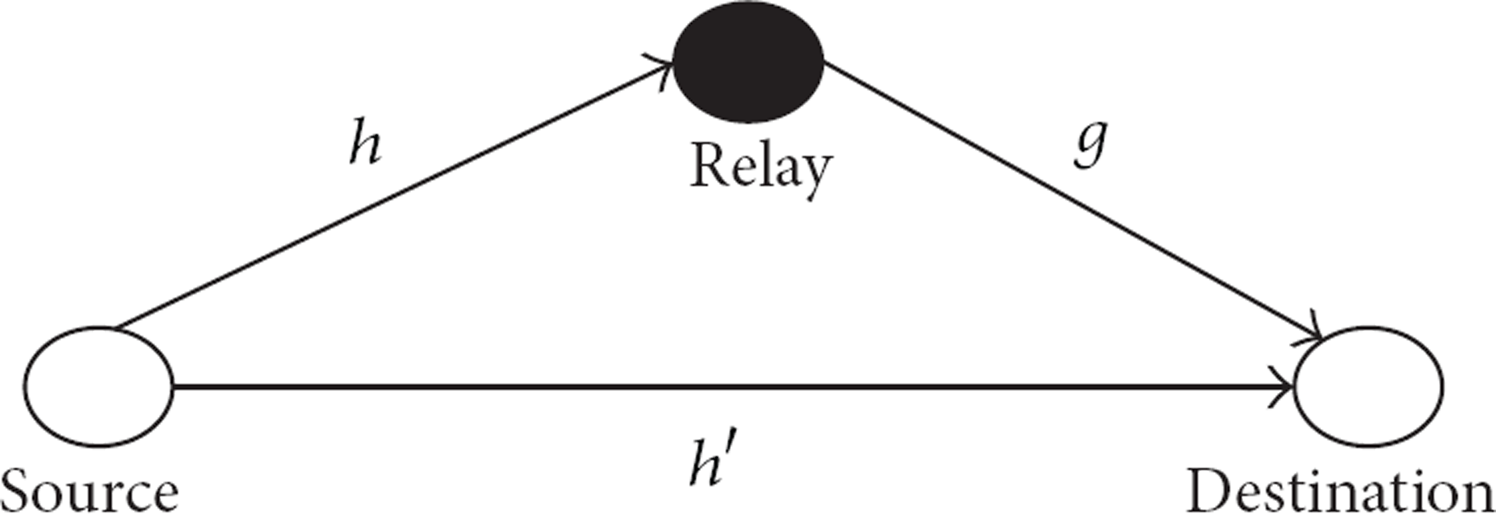
Relay mode.
The broadband wireless channel is assumed to be frequency-selective Rayleigh slow fading; all the channel state information is perfectly known at the BS. Let


The coefficient
The most popular is “bits-per-Joule,” which is defined as the system throughput for unit-energy consumption [15]. The optimization problem is mathematically formulated as the following problem (4):
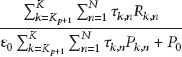

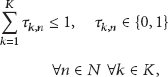

Here, (5) is the minimum rate requirement for the service requested by each user. Constraint (6) represents that each subcarrier can be assigned to only one user, following the essential principle of OFDMA to avoid cochannel interference (CCI). Constraint (7) denotes the transmission power upper bound for the user.
3. QoS Aware Energy-Efficient Resource Scheduling
This section considers resource allocation adaptive schemes that will result in maximum energy efficiency. The problem (4) is nonconvex for power and it is a mixed integer programming problem. It is shown in [16] that the duality gap for a nonconvex optimization problem is zero if the optimization problem satisfies a time-sharing condition. Further, the time-sharing condition is always satisfied for the multiuser spectrum optimization problem in multicarrier systems when the number of frequency carriers goes to infinity and for most practical systems with a finite number of frequency carriers the duality gap is still nearly zero [17].
The fractional programming in (4) can be associated with the following parametric problem:

With

It is clear that
The value of h plays an important role in solving

The Lagrangian dual function is given by

And the dual problem can be expressed as

The dual function can be rewritten as


It is independently solved at each subcarrier given

The per-subcarrier optimization in (14) can be expressed as


If relaying is required on a given subcarrier, in case of DF one-way relaying, the per-subcarrier problem in (16) can be rewritten as

In order to minimize power, the equality

The above is a convex problem. By applying the KKT conditions, the optimal power allocation is given by

The function
4. Simulation Result
In order to assess the performance of the proposed algorithm, a single-base-station cognitive radio system with rate constraints is set beforehand. Let us concentrate on the simulated system, consisting of
Figure 3 shows the energy efficiency versus spectrum efficiency for noncooperation transmission strategy. From this figure, it can be seen that energy efficiency first increases and then decreases. There is a maximum energy efficiency satisfying the rate requirement. The proposed scheme outperforms WSPmin scheme in [17], because our algorithm looks for the optimal energy efficiency over the whole domain, while the other yields energy efficiency, respectively, on the boundary of (5) and (7).

Relationship of energy efficiency and transmission data rate.
5. Conclusion
In this paper, we study a QoS-based RA algorithm, in order to improve the energy efficiency and simultaneously fulfill the requirement of the primary and cognitive users. It is a network-level scheme for cognitive OFDMA radio systems. Prior frequency planning is not required and simulation results show that the proposed scheme is able to offer optimal solution.
Footnotes
Conflict of Interests
The authors declare that there is no conflict of interests regarding the publication of this paper.
Acknowledgments
This work was supported in part by the National Natural Science Foundation of China (Grant nos. 61261018 and 61362007), in part by Guangxi Science Foundation (2013GXNSFFA019004), and by the Open Research Fund of the Key Laboratory of Cognitive Radio and Information Processing (Guilin University of Electronic Technology), Ministry of Education (Grant no. 2013ZR01).