




Abstract
A local-area and energy-efficient (LAEE) evolution model for wireless sensor networks is proposed. The process of topology evolution is divided into two phases. In the first phase, nodes are distributed randomly in a fixed region. In the second phase, according to the spatial structure of wireless sensor networks, topology evolution starts from a network of very small size which contains the sink, grows with an energy-efficient preferential attachment rule in the new node's local-area, and stops until all nodes are connected into network. Both analysis and simulation results show that the degree distribution of LAEE follows the power law. The comparison shows that this topology construction model has better tolerance against energy depletion or random failure than other nonscale-free WSN topologies.
1. Introduction
Wireless sensor networks (WSNs) are a kind of self-organized distributed wireless networks composed of a large quantity of energy-limited nodes. Topology construction is one of the primary challenges in WSNs for ensuring network connectivity and coverage, increasing the efficiency of media access control protocols and routing protocols, improving the routing efficiency, extending the network lifetimes, and enhancing the robustness of the network [1–5]. The main aim of topology construction is to build a topology to connect network nodes based on a desired topological property. A dense network topology leads to high energy consumption due to overlapped sensing areas and maintenance costs of topology, while a very sparse network topology is vulnerable to network connectivity [6].
The development of complex networks provides new ideas for topology construction of WSNs. Study on complex networks is a newly emerging subject that focuses on the networks which have nontrivial topological features [7, 8]. There are many common characteristics between WSNs and typical complex networks models: networks contain a large number of nodes and have nontrivial topological features and nodes in networks connect to each other through multihop paths [9]. More importantly, typical complex network models, such as the small-world [10, 11] and scale-free [12] network models, show some characteristics which are beneficial in WSNs. Small-world networks present small average path length between pairs of nodes which is beneficial to saving energy in topology construction and routing in WSNs [13]. Scale-free networks have power-law degree distributions and show an excellent robustness against random node damage [14, 15]. A random attack does not significantly affect the scale-free network performance [8, 16]. Therefore, it is significant to consider complex networks topology when optimising the topology in WSNs [17]. However, complex networks are a kind of relational graphs whose nodes make direct contact according to their logical relationships, while WSNs are spatial graphs in which the existence of links depends on the node's positions and radio range [18]. Thus, the complex networks theory cannot be directly used in WSNs. Some efforts have been made to tune wireless networks into heterogeneous networks with small-world [13, 19–22] or scale-free features [9, 23–25].
In this paper, we propose a local-area and energy-efficient (LAEE) evolution model to build a WSN with scale-free topology. In this model, topology construction is divided into two phases. In the first phase, nodes are distributed randomly in a fixed region, and a node gets other node's information in its transmission range (radio range) through HELLO message. In the second phase, topology evolution starts from the sink, grows with preferential attachment rule, and stops until all nodes are added into network. Following conditions are considered when we design the evolution model: (i) links between nodes depend on the positions and transmission range. Therefore, nodes beyond transmission range cannot make direct contact. (ii) Nodes can only get local information as WSNs are distributed networks. (iii) The remaining energy of each node is considered. Nodes with more remaining energy have higher probability to be connected. (iv) In order to avoid excessive energy consumption, upper bound of degree for each node is needed.
The remainder of this paper is organized as follows: Section 2 reviews background and related works on scale-free networks and scale-free based wireless networks. In Section 3, we propose the LAEE evolution model and deduce the theoretical degree distribution. Section 4 shows simulation results based on LAEE evolution model and examines the tolerance of LAEE to random failures. Finally, we conclude in Section 5.
2. Background and Related Work
2.1. Traditional Topology Constructions in WSNs
Unit disk graph (UDG) is the underlying topology model for WSNs which contains all links in transmission range. Assume that all nodes are randomly distributed in region S. Each node is positioned in a particular subarea with independent probability
Almost all other topology construction methods in WSNs build a reduced topology from UDG [26, 27]. Based on the topology production mechanism, they can be categorized into Flat Networks and Hierarchical Networks with clustering [27].
In Flat Networks, all nodes are considered to perform the same role in topology and functionality. Typical examples include directed relative neighborhood graph (DRNG) [28], k-nearest neighbor (KNN) [29], TopDisc [30], Euclidean minimum spanning tree (EMST) [31], local Euclidean minimum spanning tree (LEMST) [32], Delaunay triangulation graph (DTG) [33], and cone-based topology control algorithm (CBTC) [34].
In KNN, a node sorts all other nodes in its transmission range in Euclidean distance and then links the k-nearest nodes as neighbors in the final topology. It is a scalable and parameter-free in WSNs and very easy to implement. In DRNG, a link connects nodes u and v if and only if there does not exist a third node w that is closer to both u and v in distance. TopDisc discovers topology by sending query messages and describing the node states using three or four color system. It is a greedy approximation method based on minimum dominating set. In EMST or LEMST, each node builds its overall or local minimum spanning tree based on Euclidean distance and only keeps nodes on tree that is one hop away as its neighbors. In DTG, a triangle formed by three nodes u, v, and w belongs to topology if there are no other nodes in the scope of the triangle. CBTC uses an angle α as a key parameter. In every cone of angle α around node u, there is some node that u can reach.
Nodes in Hierarchical Networks with clustering are heterogeneous in functionality as cluster heads or cluster members. LEACH is a typical Hierarchical Network topology model [35] in which the network is clustered and periodic updated. The cluster heads have the responsibility to communicate directly with the sink for the whole cluster members. A node selects itself to be a cluster head with a probability related to factors such as its remaining energy and whether it has served as cluster head in the last r rounds.
The WSNs topology can be indicated as graph
2.2. Scale-Free Evolution Models
Barabási and Albert provide an evolution model, called BA model, to generate a scale-free network [12]. The BA model is as follows.
Initialization: the network starts from a fully connected network of small size Growth: a new node is added. Preferential attachment: the new node will connect to m ( Halt: repeat (2) and (3) until all nodes and links are added to the network.
In BA model, the degree distribution follows the power-law distribution
Many other scale-free models contain growth and referential attachment features as BA models shows [38–40]. One of the main differences between these algorithms is that they have various referential attachment mechanisms that lead to different values of scaling exponent γ in degree distribution and other scale-free properties.
Li and Chen propose a local-world evolution model [38].
Similarly to BA model, the local-world model is also divided into four steps of initialization, growth, preferential attachment, and halt. But differently, in preferential attachment mechanism of local-world evolution model, the new node selects M of all existing nodes randomly, refereed to as the local world of this new node. So the preferential attachment probability for a new node connecting to an existing node i at time step t is

2.3. WSNs Topology Constructions with Scale-Free Theory
In preferential attachment mechanisms of BA, local-world, and many other scale-free models, the new node has the tendency to connect itself to some richer node (such as with larger degree). In WSNs, the concept of richer node can be extended as a node with more resources, such as with larger degree, more remaining energy, or any other resources.
Several methods have been proposed to build WSNs with the scale-free property [9, 24, 25, 41]. These methods take complex network characteristic such as growth, preferential attachment into account, and some of them consider the local-area feature in WSNs.
Zhang provides a model of WSNs based on scale-free network theory [24]. In this model, each node has a saturation value of degree,

One of the main drawbacks of Zhang's model is the sum of
Wang et al. propose an arbitrary weight based scale-free topology control algorithm (AWSF) [9]. All nodes in the network are coupled with a sequence of random real numbers W with a power-law distribution
Zhu et al. propose an energy-aware evolution model (EAEM) of WSNs [25]. Energy is taken into account in the EAEM model. This algorithm assumes that the probability

3. Local-Area and Energy-Efficient Evolution Model
In this section, we propose our scale-free topology construction model for WSNs.
We assume that nodes are distributed in a given region with static positions. Then connections between them are built to generate a network. Based on this fact, the process of topology construction is divided into two phases: in the first phase, nodes are distributed randomly. We define the set of scattered nodes as the nodes having no access to the network topology yet in the process of evolution, as shown in Figure 1. An arbitrary node, marked as node v, gets all other nodes' information in its transmission range via HELLO message and takes these nodes as its potential neighbor nodes. Then in the second phase, topology evolution starts from sink, grows with the preferential attachment rule, and stops until all nodes are added into the network.

At every time step, add a scattered node into the network with m (
The LAEE evolution model is proposed.
Step 1.
Nodes are distributed randomly in region S. Each node gets its potential neighbor nodes' information in its transmission range through HELLO message. All these nodes are scattered and topology has not been formed at this moment.
Step 2.
Topology evolution starts from sink with At every time step, add a scattered node into the network. To do that, we find the node which has the most scattered neighbor nodes and mark it as node a. Choose a scattered node randomly in node a's potential neighbors as the new node, denoting as node b. With this strategy, the network expands outward and fills the region S as fast as possible. Randomly choose m nodes, which are already in the topology and are node b's potential neighbors, and link them to node b. If the number of node b's potential neighbors is smaller than m, all these nodes will be linked to this new node. Connect node b with node i in these m potential neighbor nodes based on the preferential attachment:
Repeat (1), (2), and (3) until all nodes are added to the topology.

LAEE generates a reduced topology from UDG. In LAEE, a topology of network grows step by step via adding new nodes and connecting these nodes to network. According to the LAEE modeling algorithm, at every time step, a scattered node is added to network and then connected to the other nodes within its transmission range in network via preferential attachment rule. One of the conditions of selecting a new node as scattered node is that this node is in the transmission range of at least one node in network. Therefore, once an arbitrary node is connected to other nodes in UDG, it will be connected to at least one node via LAEE.
In (4),


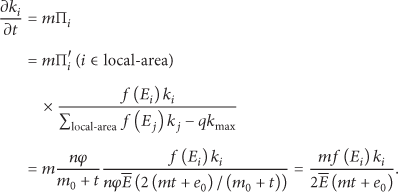


According to the initial degree of node i at time step


Then we can obtain the probability density of the degree of a node with energy E as

In the above equation,
In order to get the probability density of degree with remaining energy E, we have

4. Numerical Results
Table 1 presents the parameters used in our simulation. We distribute
Parameters for simulation.

The simulation and theoretical degree distributions of LAEE are presented in Figure 2. The theoretical degree distribution of LAEE model is close to the degree distribution of BA model, and the simulation result of degree distribution is close to the theoretical value when

(Color online) LAEE degree distribution with
Fault tolerance is a key issue in WSNs. Many real applications do not require all nodes to be connected. It is appropriate to consider relaxing the connectivity requirement [42]. When a fraction of nodes are out of work, the remains may not be connected and the application of entire network may become invalid. Then, it is important to introduce the giant component, which means the largest connected component [43, 44], to measure the fault tolerance of WSNs with the nodes' failure. Two types of data flows exist in WSNs, flows between any pair of nodes and between sink and other nodes. Therefore, two kinds of giant component are considered correspondingly: the normal one which contains the largest number of nodes and the one with the sink. Sometimes these two giant components are the same, whereas sometimes they are not.
We examine how the fault tolerance of WSNs can be improved by LAEE. Nodes are removed randomly to simulate the procedure of energy depletion or random failure. Typical WSNs construction models UDG, KNN, DTG, LEACH + KNN (LEACH for cluster heads election, KNN for topology construction in each cluster), and LEACH + DTG (DTG for topology construction in each cluster) are used for comparison. The degree parameters are shown in Table 2. We can see that their average degrees are close to that of LAEE with
Degrees in topology.


(Color online) Giant component size of WSNs under random nodes failure.
5. Conclusions
Topology control is one of the primary challenges to make WSNs resource efficient. In this paper, we propose a local information and energy-efficient based topology evolution model. The process of topology evolution is divided into two phases. In the first phase, nodes are distributed randomly in a fixed region. In the second phase, topology evolution starts from sink, grows with preferential attachment rule, and stops until all nodes are added into network. The theoretical degree distribution of LAEE evolution model is approaching that of BA model. Simulation result shows that when
Footnotes
Conflict of Interests
The authors declare that there is no conflict of interests regarding the publication of this paper.
Acknowledgments
This work is supported by the National Natural Science Foundation of China (NSFC61174153) and (NSFC61273072) and the Research Funds for the Ocean Discipline in Zhejiang University (no. 2012HY005A).