




Abstract
Next generation networks integrate different wireless technologies, including Wi-Fi, Wi-Max, and 3GPP (UMTS, HSPA, and/or LTE), in which the mobile node (MN) has the opportunity to switch from one network to another, under an always best connected scheme. In such heterogeneous environment, discovering which types of network connectivity and services are available is a critical challenge. The IEEE 802.21 standard specifies a network information server entity providing network information within a geographical area by which the MN can discover a service or a network. In this paper, we propose a zone-based media independent information service using the IEEE 802.21 standard to accelerate the neighbor discovery procedure. In the proposed scheme, the access networks are associated and grouped in mobility zones, through an efficient set of rules, to minimize the amount of control messages flowing in the core network. Through a NS-2 based simulation, the results demonstrate that the proposed scheme reduces the neighbor discovery delay as well as the signaling overhead if compared with the standard MIIS deployment.
1. Introduction
In the heterogeneous wireless environments, discovering available networks is one of the most challenging issues. Typically, the available information about candidate networks provided by advertisements messages (e.g., 802.11 beacon frames, 802.16 DCD) is rather minimal. To improve the MN experience, the IEEE 802.21 media independent handover standard [1] specifies a media independent information service (MIIS) supporting various information elements which provide network information within a geographical area. Based on that information (such as available bandwidth, cost per use, and security) from several access networks, the MN can qualitatively choose a better handover candidate amongst the possible ones, taking a more accurate handover decision.
To access this information, the MN queries a MIIS server using specific query IEEE 802.21 information messages, which transport the information, and the MIIS server replies with information about the availability of access networks in a determined geographic area. To exploit geographic location, the IEEE 802.21 standard allows some parameters to be introduced into the query message that can be used by the MIIS to refine its response. Between the available values, we can mention the querier location parameter which enables the MN to send the query request with its current location information. The value field contains either the MNs current location measurement (the MN can use global positioning system (GPS) or other kind of service location equipment) or, when the MN does not have its current location information, an observed link-layer address (e.g., beacon frame or some broadcast mechanism for other technologies) that the MIIS server will be able to use as a hint to establish an estimate of the clients current location. For many applications, this is sufficient but others require much more specific, granular, and precise location data. Moving between networks requires an accurate location map of users and networks. In a crowded and populated city (Manhattan use case), tens or hundreds of meters may strongly impact the number of networks in the response message from a MIIS server, leading to the fact that the user experiences delay and overhead.
Looking at the standard [1] as well as the related work [2–14], it is typically assumed that the MIIS server is aware of the MNs location, sending a response message with information about candidate networks. The representation of the MIIS role and usability is very lacking in terms of usage details, architecture, and characteristics used. Moreover, the existing MIIS deployments usually consider a network-centric approach not being scalable systems.
In this way, we propose in this paper a zone-based MIIS architecture which exploits the geographical location of the networks by splitting the coverage into different mobility zones, enhancing the neighbor discovery task. Using such a scheme, the MN is provided with a complete and consistent view of detailed handover possibilities information. The aim of this architecture is threefold. First, MN without GPS built can use the MIIS server and obtain network-related information within a geographical area. Second, MN will experience less neighbor discovery delay if compared with the standard MIIS architecture. Finally, the proposed architecture reduces the signaling load in the operators core network.
The paper is organized as follows. In Section 2, the related work focused on the IEEE 802.21 services is presented. Then, we briefly describe the IEEE 802.21 standard. We then move on to present the zone-based MIIS architecture deployment. Then, we evaluate the performance of our proposed MIIS system in Section 5, through a NS-2 based simulation. Finally, we conclude this work in Section 6 with some final considerations.
2. Related Work
A number of mobility mechanisms in heterogeneous environments have been proposed [2–14] that employ models relying on the IEEE 802.21 MIIS service. In [2], a vertical handover scheme between UMTS and WiMAX employing the IEEE 802.21 framework is proposed. They use the MIIS service in order to obtain relevant information from neighbourhood networks. Seol and Chung [3] propose an interesting vertical handover solution for WiMAX and 3GPP networks based on IEEE 802.21 services taking a network-based mobility management approach using proxy mobile IP. Stevens Navarro et al. [4] use the IEEE 802.21 MIIS service to determine the conditions under which vertical handoff should be performed. The problem is formulated as a Markov decision process with the objective of maximizing the total expected reward per connection.
The proposal by Liu et al. [5] is to obtain network maps from MIIS service and provide this information to the elimination-based cost function to enable energy efficient handover. Christakos et al. [6] explore the MIIS service to improve mobility performance for FMIPv6 by providing authentication information allowing the MN to authenticate with the target network while connected elsewhere on the network. They focus especially on information that aids the authentication process, providing MNs with authentication information that they would not normally have until they connect to a new PoA. Mussabbir et al. [7] define a heterogeneous network information container for facilitating in the store and retrieval of the L2 and L3 static information of neighboring networks obtained through the IEEE 802.21 MIIS.
In [8], the authors present a timely effective handover architecture based on the neighbor network information. In the proposed architecture, they estimate the exact required handover time based using the network information obtained by the MIIS server. Lim et al. [9] make use of the MIIS service providing the MN with a valid channel list stored on the MIIS server. Upon receiving a response message, the MN performs a selective scanning procedure, reducing the network discovery time. In [10], the authors propose integrating the MIH architecture into an IP multimedia subsystem (IMS) in order to optimize the quality of end-to-end service. Their cross-technology architecture considers a MIIS infrastructure, where MIIS servers exchange information such as QoS and cost related parameter.
Some authors have started to work in a more detailed MIIS framework and architecture specifications. The authors in [11, 12] introduce an enhanced information server in which the MN periodically reports dynamic information to the MIIS server. Their main contribution is that the MIIS server is able to store, manage, and deliver real-time dynamic information, such as the user preferences, running services, mobile device characteristics, and available network resources. In [13] an enhanced media independent handover framework and mobility management mechanism are proposed. The MIIS service is used to collect link-layer and application layer information from the networks. Finally, in [14] a decentralized MIIS approach is specified. The envisioned architecture is based on a hierarchical distributed hash table (DHT), where the MIIS information database is also maintained by the mobile users.
The previously mentioned works typically assume that the MIIS server is aware of the MNs location, sending related network information from a particular geographical area. No attention is given to how the MN can obtain information if GPS equipment is not available. Our framework contributes to the MN neighboring network information acquisition even without using any GPS equipment, by specifying a zone-based MIIS architecture.
3. IEEE 802.21 Standard
The IEEE 802.21 standard [1] specifies a media independent handover (MIH) framework that facilitates handover in heterogeneous access networks by exchanging information and defining commands and event triggers to assist in the handover decision making process. Specifically, the standard consists of a framework that enables service continuity while a MN transitions between heterogeneous link-layer technologies. Also, it defines a new logical entity created therein called the media independent handover function (MIHF). The MIHF also provides three primary services: event services, command services, and information services.
The media independent event service (MIES) is responsible for detecting events at lower layers and reporting them from both local and remote interfaces to the upper layers (the MIH users). A transport protocol is needed for supporting remote events. These events may indicate changes in state and transmission behavior of the physical data link and logical link layers or predict state changes of these layers.
The media independent command service (MICS) refers to the commands sent from MIH users to the lower (physical data link, and logical link) layers in order to control it. The commands generally carry the upper layer decisions to the lower layers on the local device entity or at the remote entity. MIH users may utilize command services to determine the status of links and/or control the multimode device for optimal performance.
The media independent information service (MIIS) provides a framework and corresponding mechanisms by means of which a MIHF entity may discover and obtain network information existing within a geographical area to facilitate the handovers. MIIS includes support for various information elements which provide information that is essential for a network selector to make intelligent handover decisions. The information may be present in some MIIS server, where the MIHF in the MN may access it. Moreover, the MIIS provides capability for obtaining information about lower layers like neighbor maps and other link-layer parameters, as well as information about available higher layer services such as internet connectivity, for instance, knowledge of whether security, supported channels, cost per use, networks categories (such as public, enterprise, and home), and QoS supported may influence the decision to select such an access network during handover process.
The information supplied by the MIIS is provided in information elements (IE) which can relate to higher layer services such as availability of IP mobility schemes at a certain operator or to lower layer such as link neighbor maps and link configuration parameters. More concretely, information available via the MIIS can be categorized as follows.
General and access network specific information: general overview of different networks, providing coverage within a specific area such as network type, operator, and service identifier. Information including QoS, security, technology revision, and cost is also available. Link connection point information: information about points of attachment for each access network available, comprising aspects such as MAC address of the access point, geographical location, and channel configuration. Other information: network, service, or vendor specific information. Detailed information about the IEEE 802.21 standard, its services, and characteristics can be found in [15–17].
4. Zone-Based MIIS Architecture
In this section we describe the zone-based MIIS architecture and its support for an optimized MN neighbor discovery performance. We propose the splitting of the network coverage area into mobility areas or zones (MZ) as illustrated in Figure 1. Each MZ is composed of several access networks or point of attachments (PoA). A zone MIIS server (ZMIIS) is specified to manage the information details of each one of these MZs. The ZMIIS is able to interchange information with different MZ, with an awareness of which ZMIIS servers are related to which specific access network.

Zone-based MIIS architecture.
Algorithm 1 summarizes the neighbor discovery scheme using the zone-based MIIS architecture. In the initialization phase, the MN checks all the available networks and selects one for the current PoA. Upon connecting, the operator also supplies detailed network information about endpoints in the particular MZ. In the movement from one network coverage to another, the MN receives a link detected trigger. As long as the MN detects a new PoA, it looks inside the zone information to check if the detected PoA has better characteristics than the PoA that the MN is actually connected. If the detected PoA belongs to the same MZ, no MIIS query is sent to the ZMIIS server, because the MN holds enough information to take an optimized handover decision. In the case of the detected PoA belonging to a different MZ, the MN sends a MIH get information request message to the ZMIIS server containing the detected PoA identifier (
① Initialization (); ② Table ③ ④ inZone = check (T, ⑤ ⑥ trigger handover decision;
⑦ send query ⑧ ZMIIS contacts the target zones ZMIIS; ⑨ target zones ZMIIS builds a optimized response; ⑩ MN receives ZMIIS response; ⑪ trigger handover decision;
In the case of the MN moving between multiples zones, it is useful to maintain the information of each of the MZs for a certain time. Since the MN often moves back and forth between a small set of PoAs, an internal cache can be helpful. This prevents the MN from querying the MIIS server unnecessarily.
An important feature in the specification of a MIIS server architecture is the scalability support. As can be seen in Figure 1, we specify l
Using the zone-based MIIS architecture, the MN receives detailed information only related to its general neighborhood environment, even without any location service equipment. This architecture also distributes the queries over several ZMIIS servers with the objective of reducing operators’ burdens, evolving into a cheaper and more efficient architecture.
5. Performance Evaluation
This section presents the performance evaluation of the proposed MIIS architecture. The simulations were made in the NS-2 simulator [18]. We have modified the original module, adding the MIIS functionality in a decentralized way. Table 1 shows the network parameters considered for the simulation. The number of ZMIIS servers, MZs, and Wi-Fi PoAs are variable (4, 16, and 36). We have chosen these values to always keep a topological square area, obtaining more reliable results. Finally, a MN is moving using the random way point mobility (RWP) model. MN speed varies from 2 m/s to 10 m/s. The simulation time is 1 hour. In order to compare the results with the existing MIIS implementations, the standard MIIS server (std. MIIS) is located inside the operator (core network side), since it is a network-centric deployment.
Simulation parameters.

In particular, three performance metrics are evaluated: (1) the average number of MIIS queries triggered by the MN, (2) the total MIIS query delay, and (3) the signaling overhead (in bytes).
5.1. Average Number of MIIS Queries Triggered by the MN
From Figure 2, the effect of the MN speed on the number of MIIS queries can be observed. Higher velocity indicates that more PoAs are detected and discovered by the MN. Consequently, it crosses more MZs and triggers more MIIS queries. The results show that the std. MIIS has less performance because it triggers more MIIS queries than the proposed scheme. Also, it can be noted that the more PoAs per zone exist the fewer MIIS queries are generated using the ZMIIS server. Hence, most PoAs in the scenario will increase the average number of std. MIIS queries, causing overhead in the backbone.

Average number of MIIS queries.
5.2. Total MIIS Query Delay
In Figure 3, the effect of delay on the wired link and the effect of hop count between MN and MIIS server on the total MIIS query time are shown. The MIIS query time is the time from the instant the MN sends a query message, up to the time it receives the response message from any MIIS server. The total MIIS query delay is the delay for one MIIS query multiplied by the number of triggered queries during the simulation time. The hop count between the MN and the MIIS server varies from 2 to 10 and the wired delay varies from 5 ms to 25 ms.
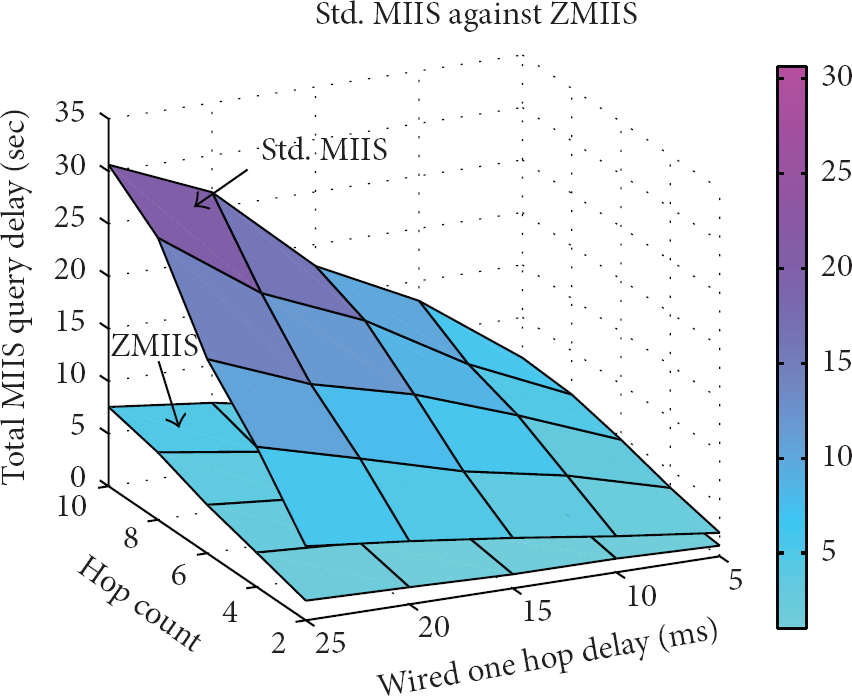
Total MIIS query delay.
It can be seen that, as wired delay increases, the performance of the std. MIIS degrades. Also, the MIIS query time using the std. MIIS is considerably affected with an increase of the hop count. The MN experiences a total MIIS query delay from 1.03 s up to 7.56 s using the ZMIIS server and 2.24 s up to 30.61 s using the std. MIIS server, due to the fact that the ZMIIS servers are installed closer to the MN (at the access router) and the std. MIIS is located in the operators core network. The results clearly show that the zone-based MIIS architecture drastically reduces the neighbor discovery delay.
5.3. Signaling Overhead (in Bytes)
We also evaluate the effect of the number of MZs in the signaling overhead. Each MIIS message carries about 40 bytes of length for the std. MIIS and 52 bytes for the ZMIIS (4 PoAs information). It is expected that, increasing the number of MZs, more queries are generated using the ZMIIS server, causing more overhead. However, Table 2 shows that the difference in the number of transferred bytes when there are 4 MZs (1.5 KB) and 36 MZs (1.67 KB) is minimal. Moreover, the ZMIIS architecture always presents a mean overhead reduction of almost 37% in relation to the std. MIIS.
Simulation parameters.

6. Conclusion
We presented a zone-based MIIS architecture, in which the access networks are grouped into mobility zones, managed by different MIIS servers. The decentralized MIIS deployment provides higher resilience and scalability with regard to the mobility information distribution. The results show that the proposed scheme outperforms the std. MIIS in terms of discovery delay and signaling overhead. Future work includes the study of security mechanisms and interoperator service agreement models.
Footnotes
Conflict of Interests
The authors declare that there is no conflict of interests regarding the publication of this paper.
Acknowledgments
Part of the computations of this work was performed in EOLO, the HPC of Climate Change of the International Campus of Excellence of Moncloa, funded by MECD and MICINN. This is a contribution to CEI Moncloa. This work was supported by the PNPD/CAPES-Programa Nacional de Pós-Doutorado/CAPES program.