




Abstract
The main concern of the present paper is to study the MHD mixed convective heat transfer for an incompressible, laminar, and electrically conducting viscoelastic fluid flow past a permeable wedge with thermal radiation via a semianalytical/numerical method, called Homotopy Analysis Method (HAM). The boundary-layer governing partial differential equations (PDEs) are transformed into highly nonlinear coupled ordinary differential equations (ODEs) consisting of the momentum and energy equations using similarity solution. The current HAM solution demonstrates very good agreement with previously published studies for some special cases. The effects of different physical flow parameters such as wedge angle (β), magnetic field (M), viscoelastic (k1), suction/injection (fw), thermal radiation (Nr), and Prandtl number (Pr) on the fluid velocity component (f′(η)) and temperature distribution (θ(η)) are illustrated graphically and discussed in detail.
1. Introduction
Flows over the tips of rockets, aircrafts, and submarines are some common examples of stagnation flow applications [1]. Since the pioneer work of Hiemenz [2], who reduced the Navier-Stokes equations for the forced convection problem to an ordinary form of third order via a similarity transformation, Eckert [3] studied a similar solution considering the momentum and energy equations. Ariel [4] presented a numerical algorithm for computing the laminar two-dimensional flow of a second grade fluid near a stagnation point. Abel et al. [5] carried out a study on heat transfer in a viscoelastic boundary-layer flow over a stretching sheet, considering two types of different heating processes, PST, and PHF. Prasad et al. [6] analyzed the effect of variable viscosity on MHD viscoelastic fluid flow and heat transfer over a stretching sheet and revealed that with the increase of magnetic field parameter the wall temperature profile decreases. Datti et al. [7] depicted a notable increase in the thickness of the thermal boundary-layer and fluid temperature with the increase in thermal radiation parameter in a viscoelastic fluid flow over a nonisothermal stretching sheet. Aliakbar et al. [8] realized that any increase in the elasticity number decreases the total amount of heat transfer from the sheet to the fluid. Furthermore, study of viscoelastic fluid flow and heat transfer over a stretching sheet with variable viscosity is carried out by Subhas Abel et al. [9]. Their study showed that the effect of fluid viscosity parameter is to decrease the temperature profile through either porous or nonporous medium, due to the decreasing of thermal boundary-layer thickness. Anwar et al. [10] demonstrated that there is a value for the mixed convection parameter in heated cylinder which boundary-layer does not separate at all and the value of this parameter increases with the increase of the viscoelastic parameter. Sonth et al. [11] presented hypergeometric (Kummers) function for a viscoelastic fluid flow over a stretching surface in presence of heat source/sink, viscous dissipation, and suction/blowing. Pal [12] presented a numerical solution in a stagnation-point flow over a stretching surface with thermal radiation and illustrated the influence of different parameters on velocity, temperature, and concentration profiles for both cases of assisting and opposing flows. Hsiao [13] showed that heat and mass transfer of MHD viscoelastic mixed convection flow decreases the heat transfer efficiency. Rashidi et al. [14] employed HAM to study a non-Newtonian flow over a nonisothermal wedge. Chamkha et al. [15] investigated MHD forced convection flow adjacent to a nonisothermal wedge in the presence of a heat source or sink by the implicit finite-difference method. In another study of MHD convection of viscoelastic fluid past a porous wedge by Hsiao [16], he showed that the elastic effect increases the local heat transfer coefficient and heat transfer of a wedge. Erfani et al. [17] solved an off-centered stagnation flow towards a rotating disc using the Modified Differential Transform Method. Rashidi et al. [18] investigated a steady, incompressible, and laminar-free convective flow of a two-dimensional electrically conducting viscoelastic fluid over a moving stretching surface through a porous medium analytically. Mahapatra et al. [19] studied an inclined stagnation point of viscoelastic fluid flow over a stretching sheet with three different temperature distributions. Other researchers have studied different aspects of stagnation point flows [20, 21].
HAM is known as one of the most reliable techniques to solve nonlinear problems. HAM was employed by Liao, who was the first to offer a general analytical method for nonlinear problems [20, 21]. Considering the effects of Brownian motion and thermophoresis, Mustafa et al. [22] studied stagnation point flow of a nanofluid towards a stretching sheet using HAM. Rashidi et al. [23] perused partial slip, thermal-diffusion, and diffusion-thermo on MHD flow over a rotating disk with viscous dissipation and Ohmic heating. The mixed convection of an incompressible Maxwell fluid flow over a vertical stretching surface was studied by Abbas et al. [24] via HAM, considering both cases of assisting and opposing flows. Thermal radiation effect on an exponential stretching surface was perused by Sajid and Hayat [25] via HAM. Rashidi et al. [26] demonstrated the parametric analysis and optimization of entropy generation in unsteady MHD flow past a stretching rotating disk using artificial neural network (ANN), particle swarm optimization (PSO) algorithm, and HAM. Dinarvand et al. [27] employed HAM to investigate the unsteady laminar (MHD) flow near the forward stagnation point of a rotating and translating sphere. Abbasbandy et al. [28] employed HAM for nonlinear boundary value problems. Nowadays HAM has been employed by researchers for different nonlinear problems. Shahmohamadi et al. [29] investigated the flow of a viscous incompressible fluid between two parallel plates due to the normal motion of the plates using HAM. In another study, Rashidi et al. [30] presented the homotopy simulation for nanofluid dynamics from a nonlinearly stretching isothermal permeable sheet with transpiration.
In the present study we examine the analytical solution for two-dimensional MHD mixed convection viscoelastic fluid flow over a porous wedge with thermal radiation. Analytical solutions for the velocity and the temperature distribution are obtained using a powerful technique, namely, HAM. The profiles are plotted and discussed for the variations of different involved parameters.
2. Problem Statement and Mathematical Formulation
We assume the steady 2D MHD mixed convective heat transfer in an incompressible and electrically conducting viscoelastic fluid flow past a permeable wedge in the neighborhood of a stagnation point flow, with a variable magnetic field


where u and v are the velocity components in the x and y directions along and normal to the wedge surface, respectively, ν is the kinematic viscosity, k0 is the viscoelasticity parameter, σ is the electrical conductivity, ρ is the fluid density, T is the fluid temperature, k is the thermal conductivity, C p is the specific heat at constant pressure, and q r is the radiative heat flux term.

Configuration of the flow and geometrical coordinates.
By applying the Rosseland approximation for radiation, the radiative heat flux q r is introduced as
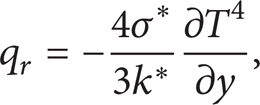
where σ* and k* are the Stephan-Boltzman constant and the mean absorption coefficient, respectively. We assume that the temperature difference within the flow is such that the term T4 can be expressed as a linear function of temperature. This is accomplished by expanding it in a Taylor series about T∞ as follows [33]:

By neglecting the second and higher-order terms in the above equation beyond the first degree in (T − T∞), we obtain

Applying the above approximation to (4), we have

The appropriate boundary conditions are introduced as
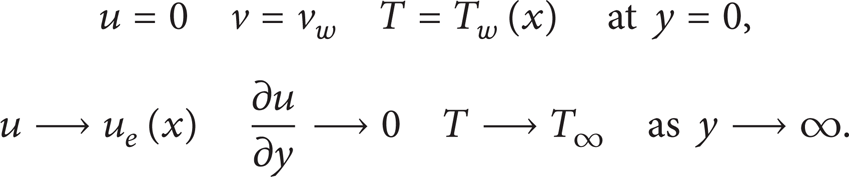
The suction/injection velocity distribution across the wedge surface is assumed to have a function form of

where ψ(x,y) satisfies the continuity equation and the stream function defined as u = ∂ψ/∂y and v = − ∂ψ/∂x. By substituting (7) and (9) into (2)–(3), the momentum and energy equations are transformed into a nonlinear coupled system of similar equations:

where M = σB02/aρ is the magnetic parameter, k1 = k0axm − 1/ν is the viscoelastic parameter (when m = 1(β = 1), the viscoelastic parameter takes the form of k1 = k0a/ν similar to the viscoelastic parameter obtained by Hayat et al. [34]), Nr = 16σ*T∞3/3k*α is the thermal radiation parameter, Pr = μC p /k is the Prandtl number, and primes denote differentiation with respect to η. The corresponding boundary conditions become

where f w is the suction/injection parameter with f w > 0 showing a uniform suction through the wedge surface.
3. HAM Solution
We select the initial approximations such that the boundary conditions are satisfied as follows:

The linear operators ℒ f (f) and ℒθ(θ) are introduced as
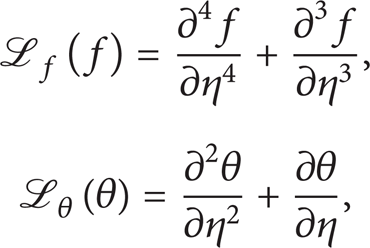
with the following properties:
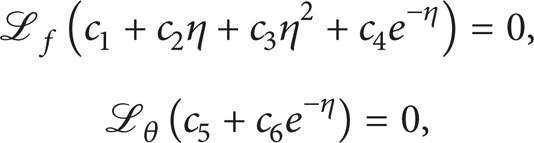
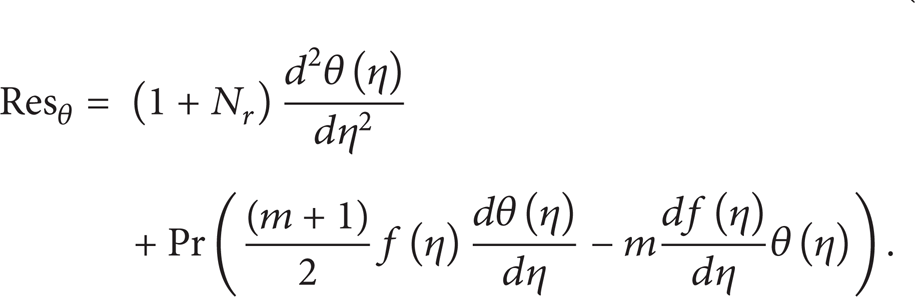
where c i ,i = 1 − 6, are the arbitrary constants. The nonlinear operators, according to (10), are defined as

The auxiliary functions become

The symbolic software Mathematica is employed to solve the ith order deformation equations:

where ℏ is the auxiliary nonzero parameter and

are the involved parameters in HAM theory (for more information about the different steps of HAM, see [20, 35, 36]). To control and speed the convergence of the approximation series by the help of the so-called ℏ- curve, it is significant to choose a proper value of auxiliary parameter. The ℏ- curves of f ″′ (0) and θ′(0) obtained by the 18th order of HAM solution are shown in Figure 2. To obtain the optimal values of auxiliary parameters, the averaged residual errors are defined as


The ℏ- curves of f ″′ (0) and θ′(0) obtained by the 18th order approximation of HAM solution when M = f w = Pr = Nr = 1, β = 1/3, and k1 = 3.
In order to survey the accuracy of the present method, the residual errors for the 18th order of HAM solutions of (19) and (20) are illustrated in Figures 3 and 4, respectively. In addition, we compare some of our results with the results of the previously published studies of [37, 38] to highlight the validity of the applied method for some values of fixed parameters: M = k1 = 0 and β = 1. A very excellent agreement can be observed between them as seen in Table 1.
Comparison results of f″(0) for different values of suction/injection parameter (f w ) when M = k1 = 0 and β = 1.


The residual error of (19) when f w = 1, β = 1/3, k1 = 0.5, and M = 5.

The residual error of (20) when M = f w = Nr = 1, β = 1/3, k1 = 0.5, and Pr = 5.
4. Results and Discussion
The nonlinear ordinary differential equations (10) subjected to the boundary conditions (11) are solved for some values of the wedge angle parameter β, magnetic parameter M, viscoelastic parameter k1, suction parameter f w , thermal radiation parameter Nr, and Prandtl number Pr via HAM. This section discusses the effects of above flow physical parameters on the velocity and temperature profiles f′(η) and θ(η). It should be mentioned that some representative physical parameters are used to simulate realistic flows.
Figures 5 and 6 illustrate the effect of the wedge angle parameter on the velocity profiles and temperature distributions when M = f w = Pr = Nr = 1 and k1 = 0.5. It should be noticed that m = 1 (β = 1) permits complete similarity solutions of (10), where k1 is constant and not f(x) as shown in Figures 5 and 6. However, if m≠1 (β≠1) solutions can be obtained but it will be local in other words local similarity is sought as seen in other figures in this section. An increase in the wedge angle parameter leads to increase in the free stream velocity and the Reynolds number and consequently the velocity boundary-layer thickness decreases. The temperature distribution and the thermal boundary-layer thickness decrease, as the wedge angle parameter increases. Indeed, increase in the wedge angle parameter causes the increase in the heat transfer coefficient and the rate of heat transfer.
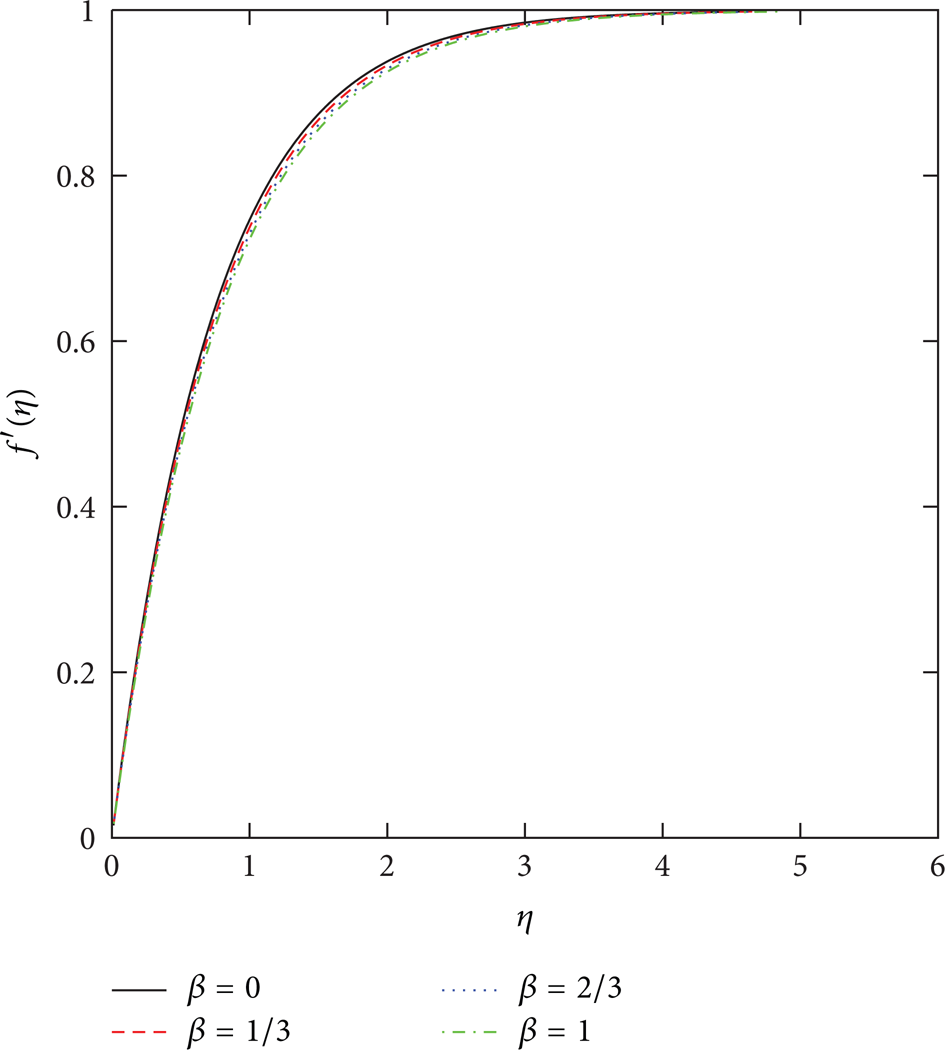
Effect of wedge angle parameter on the velocity profile when M = f w = 1 and k1 = 0.5.

Effect of wedge angle parameter on the temperature distribution when M = f w = Pr = Nr = 1 and k1 = 0.5.
The effect of magnetic parameter on the velocity profiles and temperature distributions is displayed in Figures 7 and 8 with f w = Pr = Nr = 1, β = 1/3, and k1 = 0.5. A drag-like force named Lorentz force is created by the infliction of the vertical magnetic field to the electrically conducting fluid. This force has the tendency to slow down the flow over the wedge. Accordingly, the velocity and temperature boundary-layer thickness decrease with the increasing of the magnetic interaction parameter.

Effect of magnetic parameter on the velocity profile when f w = 1, β = 1/3, and k1 = 0.5.
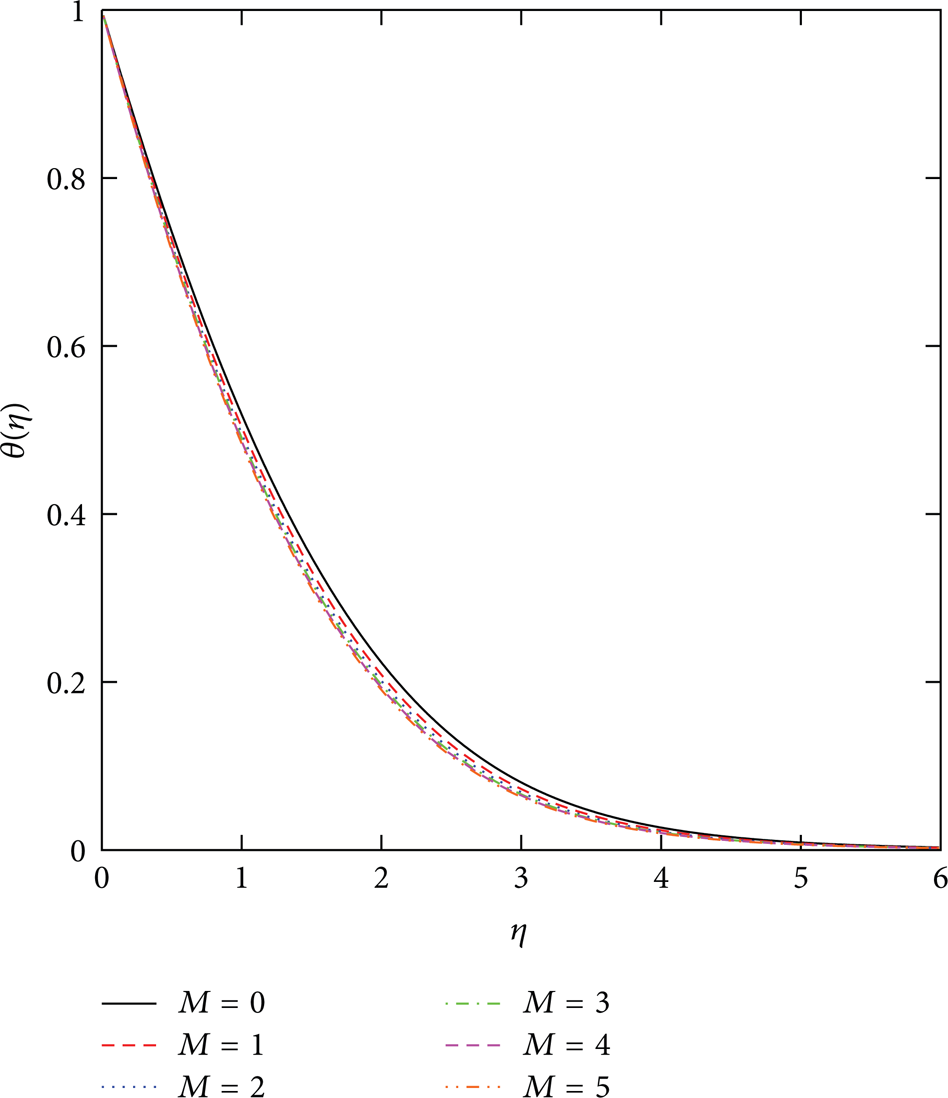
Effect of magnetic parameter on the temperature distribution when f w = Pr = Nr = 1, β = 1/3, and k1 = 0.5.
Figures 9 and 10 show the effect of the viscoelastic parameter on the velocity profile and temperature distribution with the constant values of other parameters: M = f w = Pr = Nr = 1 and β = 1/3. As the viscoelastic parameter increases, the fluid velocity profile decreases and also the temperature distribution increases. This occurs due to the development of the tensile stress. This behavior is similar to that reported by Anwar et al. [10].

Effect of viscoelastic parameter on the velocity profile when M = f w = 1 and β = 1/3.

Effect of viscoelastic parameter on the temperature distribution when M = f w = Pr = Nr = 1 and β = 1/3.
The effect of suction parameter on the velocity and temperature profiles is demonstrated in Figures 11 and 12 with M = Pr = Nr = 1, β = 1/3, and k1 = 0.5. In this study the suction case has been considered in all figures, based on the boundary-layer assumption which stated that the boundary-layer thickness is supposed to be very thin and it will not be allowed to increase as it will violate the boundary-layer assumption displayed by Prandtl in 1904. Applying the suction at the wedge surface causes the amount of the fluid to draw into the surface and consequently the hydrodynamic boundary-layer becomes thinner. In addition, the thermal boundary-layer gets depressed by increasing the suction parameter.
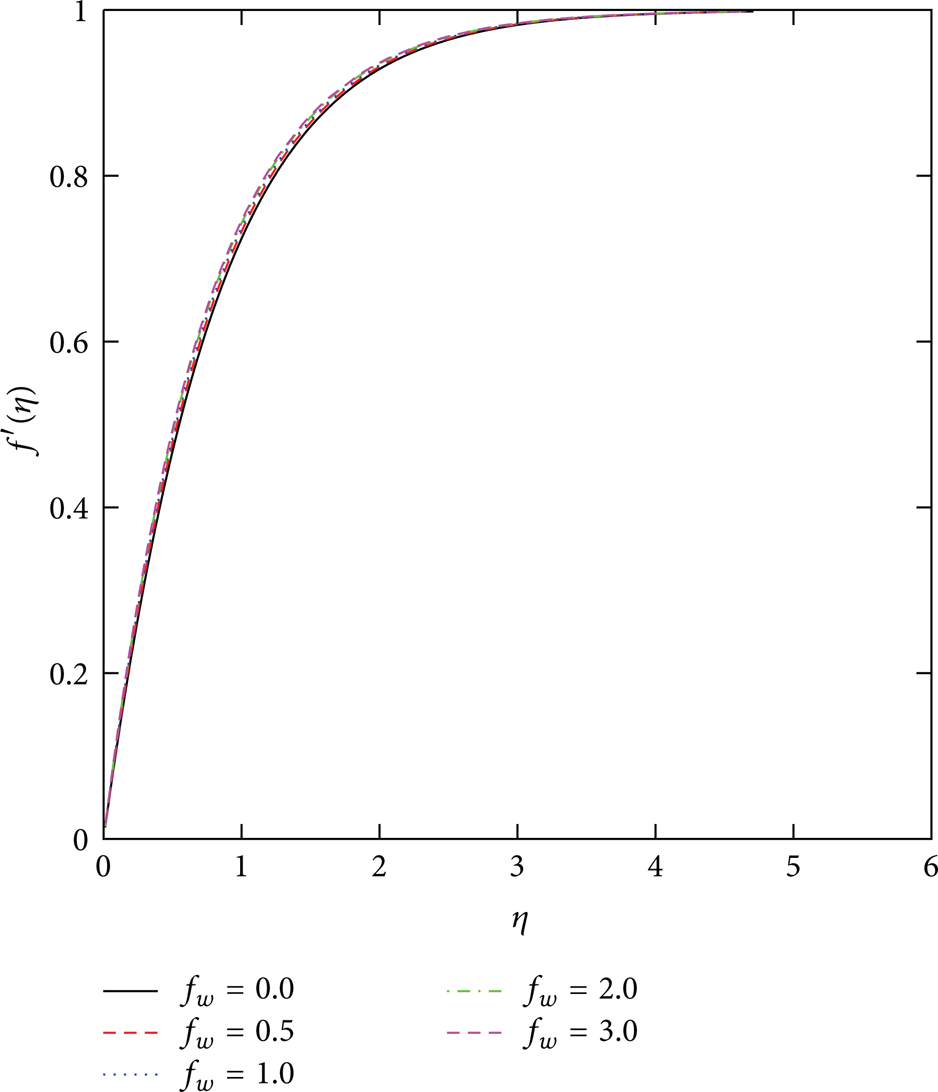
Effect of suction parameter on the velocity profile when M = 1, β = 1/3, and k1 = 0.5.

Effect of suction parameter on the temperature distribution when M = Pr = Nr = 1, β = 1/3, and k1 = 0.5.
The effects of the thermal radiation parameter and the Prandtl number on the temperature distribution are shown in Figures 13 and 14 when M = f w = Nr = 1, β = 1/3, and k1 = 0.5. The rate of energy transport to the fluid increases by increasing the thermal radiation parameter. Thus, the temperature of the fluid increases. On the other hand, the increase of radiation parameter leads to overcoming the effect of convective heat transfer. Based on the Prandtl number definition (Pr = ν/α), this parameter is defined as the ratio between the momentum diffusion to thermal diffusion. Thus, with the increase of Prandtl number the thermal diffusion decreases and so the thermal boundary-layer becomes thinner as seen in Figure 14. It physically means that the flow with large Prandtl number dissipates the heat faster to the fluid as the temperature gradient gets steeper and hence increasing the heat transfer coefficient between the surface and the fluid.

Effect of thermal radiation parameter on the temperature distribution when M = f w = Pr = 1, β = 1/3, and k1 = 0.5.

Effect of Prandtl number on the temperature distribution when M = f w = Nr = 1, β = 1/3, and k1 = 0.5.
5. Conclusions
In this paper, the semi-analytical/numerical technique known as HAM has been implemented to solve the transformed differential equations describing the MHD mixed convective heat transfer for an incompressible, laminar, and electrically conducting viscoelastic fluid flow over a porous wedge in the presence of the thermal radiation effect. The present semi-numerical/analytical simulations agree closely with the previous studies for some special cases. HAM has been shown to be a very strong and efficient technique in finding analytical solutions for nonlinear differential equations. HAM is displayed to illustrate excellent convergence and accuracy and is currently being employed to extend the present study to mixed convective heat transfer simulations. The effects of different physical key parameters such as wedge angle parameter, magnetic parameter, viscoelastic parameter, suction parameter, thermal radiation parameter, and Prandtl number are plotted and discussed. The results show that as the wedge angle increases the heat transfer to the fluid increases for other constant specified parameter and for Pr = 1. The magnetic field has a weak effect on the thermal boundary thickness; however, the suction has a remarkable effect on it. Increasing the thermal radiation parameter reduces the heat transfer coefficient between the wedge and the fluid, however, increasing Prandtl number increases it.
Conflict of Interests
On behalf of all the authors, there is no conflict of interests to report.
Footnotes
Acknowledgments
The authors express their gratitude to the anonymous referees for their constructive reviews of the paper and for helpful comments. The authors extend their appreciation to the Deanship of Scientific Research at King Saud University for funding this work through the research group Project no. RGP-VPP-080.