




Abstract
A significant challenge in vehicular networks is to efficiently provide multimedia services with the constraints of limited resources, high mobility, opportunistic contact, and service time requirements. In order to guarantee the vehicle user satisfaction of multimedia service, with the proliferation of the distributed peer-to-peer (P2P) cooperative transmission technologies, P2P-based VANET has recently received a substantial amount of interest. Using the P2P services thought and at the same time, a set of methods should be designed to avoid the disadvantage of P2P system appearing in VANET. Under such a presupposition, in this paper, we study the media provisions in P2P-based VANET and present a repeated game “More Pay for More Work (RGMPMW)” incentive mechanism based on service evaluation information. We also propose evolutionary game-based veracity (EGV) game model which exploits evolutionary game to guarantee the multimedia service share veracity of all vehicles in VANET. In addition, we provide extensive simulation results that demonstrate the effectiveness of our proposed schemes.
1. Introduction
The applications of peer-to-peer (P2P) networks have been growing at tremendous speed these past few years. Another hot area in communication networks is wireless mobile ad hoc networks, which enable distributed nodes to communicate with each other without a central access point or base station [1]. VANET is considered to be one of the most promising techniques for providing road safety and innovative mobile applications. With the proliferation of the distributed peer-to-peer (P2P) cooperative transmission technologies, P2P-based VANET has recently received a substantial amount of interest [2–5]. P2P-based VANET makes it possible to provide large data heterogeneous media content for moving vehicles [3, 5]. Media service over vehicular networks is a very interesting topic as it can greatly bring benefit to our daily life [3, 6, 7]. In VANET, multimedia can be divided into several classes according to different service types. For example, pivotal emergency media services, such as road dangerous and highway condition and parking information; delay-sensitive media services, such as live videos and videoconferences; media services which can be fulfilled at any time, for example, music entertainment; living services, for example, restaurant and hotel messages, and so on.
There are two communication modes in VANET: vehicle-to-vehicle (V2V) communications and communication between vehicles and roadside units (RSU) (V2R). Figure 1 shows the typical media service architecture for VANET, which contains three parts, namely, a vehicular internetwork, a network provider, and a content provider [8]. In the vehicular communications part, a vehicle accesses the RSUs via direct V2R communications when the vehicle enters into the coverage of the RSU or via multihop V2V communications when the vehicle is out of the RSU's coverage. In the network provider part, RSUs act as Internet gateways to link vehicles and media service providers [9]. The media servers in the content provider part possess different media service databases. With regard to P2P-based service fashion, all vehicles themselves request media services and help provide media services to others when they meet each other within the V2V transmission range.

Media service architecture in VANET.
The architecture shown in Figure 1, due to the limited budget and high maintenance cost, is difficult to deploy a large amount of RSU (such as 802.11 base stations) to cover the complicated road areas [10]. The introduction of V2V connectivity has fostered a number of proposals to exploit the cooperation among vehicular users so as to improve their downloading performance. In particular, V2V-based approaches are especially attractive when one considers that the infrastructure coverage will be spotty at initial stages [11]. In addition, owing to the real-time and effectiveness of multimedia service and the mobility of vehicles is restricted by the road directions as well as by traffic regulations. Also network nodes (i.e., vehicles) tend to form groups whose behaviors depend on the close-by nodes. Since vehicles may join and leave the network at any time, the network cannot depend on a single vehicle for media forwarding [12]. Therefore, V2V communication is necessary, as well as very essential media service method in VANET.
The specific features of V2V communications are allowing the deployment of a broad gamut of possible applications including traffic control, road safety, and in-car entertainment. At the basis of all this lies the improvements of VANET-based transmission techniques that are becoming technologically mature [13]. However, intrinsic incentive problems reside in P2P-based VANET as the transfer of media incurs costs both to suppliers and to requesters, while the benefit accrues only to requesters [14]. Moreover, malicious vehicle users can also utilize the forwarding behavior to launch attacks if there is no cost. To bring the VANET to their full potential, an incentive scheme needs to be developed and employed according to the unique features of VANET and potential applications to stimulate cooperation [15]. Some incentive mechanisms had been studied in P2P system and VANET. Reference [16] studied a repeated game-based incentive mechanism of bandwidth employing a trusted third party to record peers’ contribution in each round of P2P system. Reference [17] proposed an incentive mechanism based on coalitional games, which makes the vehicle user select better route, improves the ratio of delivery, and reduces the delay. Reference [18] uses Reed-Solomon codes (RS-codes) to construct our incentive scheme and enhance its security by introducing one discrete logarithm representation problem to guarantee the vehicles cooperation in VANET. However, the incentive mechanisms in these papers studied either not apply to VANET or stimulate forwarding with completed compute. Unlike these, in this paper, under the media provision in P2P-based VANET, we exploit little feedback information to present a RGMPMW incentive mechanism to stimulate vehicles share their multimedia in V2V communication.
VANET is a kind of autonomic networks, and the vehicles in VANET are limited rationality at most cases [19]. Under the action of RGMPMW incentive mechanism, vehicles may exaggerate their contributions to get the most profits. Here, the exaggeration of service contribution contains the following: (a) vehicles exaggerate their service contributions to get most profits; (b) actions of malicious vehicles: exaggerating their service contributions intentionally to reduce the profits of competitors. Reference [16] solved the honest problem using trusted third party. However, in VANET, each vehicle is an independent node. However, in VANET, each vehicle is equipped with a node. Nodes from different vehicles can communicate, but each node manages itself and is in charge of its own service contribution in VANET. Guaranteeing the veracity of this autonomous network is a challenging problem because there is no central and trusted manager to protect the whole network. Thus, only distributed mechanisms are viable in autonomous networks such as VANET. Evolutionary game theory is used to the model where players have limited rationality in the game; thus it is suitable to analysis vehicles with limited rationality, so we can use evolutionary game theory to investigate model. The application of evolutionary game in network is popular in recent years [20–25]. Therefore, in this paper, we propose EGV game model to prevent vehicles are not veracity, improve the stability of system, and ensure the validity of the mechanism.
Therefore, considering the specific characteristic of multimedia in P2P-based VANET, this paper mainly studies the following several aspects.
In P2P-based VANET, we present a RGMPMW incentive mechanism based on the information of services evaluation. Repeated game is exploited to accurately evaluate the service contribution of each vehicle in every game stage, stimulating vehicles to share their multimedia in V2V communication.
Based on evolutionary game, propose EGV game model to expand RGMPMW incentive mechanism of media. Regarding the several vehicles that request the same supplier in the VANET as a population, prevent the mendacious service share of vehicles efficiently and guarantee service contribution veracity of vehicles in each stage game by evolving of single population.
The target of this paper is to present a RGMPMW incentive mechanism based on the information of services evaluation to stimulate vehicles sharing their multimedia based on evolutionary game, propose EGV game model to prevent the mendacious service share of vehicles efficiently, and guarantee service contribution veracity of vehicles in each stage game by evolving of single population in P2P-based VANET.
The rest of the paper is organized as follows. Related work on evolutionary game and repeated game are presented in Section 2. Section 3 is system model. Section 4 describes feedback-based REGMPMW incentives scheme. Evolutionary game-based model for veracity of vehicles is reported in Section 5. Section 6 studies the simulation and analysis. We conclude our paper and propose perspectives in Section 7.
2. Related Work
Game theory is a mathematical theory and method of researching the phenomenon with wrestled or competitive property, and, under certain restricted conditions, the participators can implement strategies to other players, to make sure that the profits of participators reach a final balanced state.
2.1. Evolutionary Game
Classical game theory generally assumes that each individual acts so as to maximize its utility, assuming that the others do the same and understanding completely the possible utility payoffs of their interactions. An alternative perspective from evolutionary game theory assumes that individuals will copy the behavior of others who obtain a higher utility [22]. Evolutionary game has two core theories: evolutionary stable strategy and replicator dynamics equation. Evolutionary stable strategy emphasizes the process of how a dynamic evolution system reaches a steady state, and evolutionary stable strategy
The following describes the standard set of evolutionary game theory [27].
There is a group of users, and the number of the users in the group is very large.
Assuming that pure strategy or action exists. Each member in the group chooses the strategy from the same strategy set
Let
Evolutionary game in network application is very popular and a currently [20–25, 28] used evolutionary game to solve the problem of uncooperative two-hop routing message forwarding control in DTN (delay tolerant network). Reference [21] used the mathematical framework of game theory and evolutionary game theory for modeling, clearly demonstrating the connection of cooperation, trust, privacy, and security in a multihop network, in order to prevent the fake nodes, prevent misuse, detect anomalies, and to protect users’ privacy. Reference [22] studied the resource allocation and the establishment of distribution tree. Assuming that the allocation of video is based on a multiple description encoder, then using evolutionary game can significantly affect the scalability, fast adaptation twist, high degree of node cooperation, and the autonomous of distributed node tree network. Reference [23] studied an energy management of stochastic evolutionary game in distributed aloha network. Each participator may be in different states and can be involved in the same local interaction during its lifetime. Its action decides not only effectiveness, but also the transmission probability and the time of his life. Reference [24] analyzed the problem of network dynamic selection with evolutionary game in heterogeneous wireless networks. It can guarantee the network performance in the case of multipopulation evolutionary game competition. References [25] studied the evolutionary game based on the credibility to forward data safely and deny the service attacks, making sure that the maximum numbers of nodes in the network forward cooperatively in the autonomous ad hoc and sensor network.
In P2P-based VANET, vehicles move at high speed, and instant contribution is more important; therefore in every request slot t, each vehicle needs to decide how many media services to share with the request vehicle. This decision will affect its profit in the next stage. Thus, it is reasonable to model the action of vehicles as repeated game.
2.2. Repeated Game
Repeated game means the same structure game is repeated for many times, where each game is called “stage game.” Repeated game is an important part of a dynamic game, and it can repeat complete information or incomplete information. When the game is executed only once, each participator just cares about one-time payment. But if the game is repeated, participators may tend to get long-term profit instead of immediate profit; therefore they will choose a different equilibrium strategy. Thus, the repeat number will affect the outcome of equilibrium game. Repeated game has three basic characteristics. (a) In the repeated game stage, there is no “substance” connection between games that is to say that the previous stage of the game will not change the construction of the next stage. (b) In every stage of the repeated game, all participators can observe the history of the game. (c) Total profit of participators is the discounted value sum or weighted average number of all stages’ profit.
Repeated game in network application has also been studied widely [16, 29–32]. Reference [16] proposed server differentiation incentives for P2P streaming system based on the immediate profit of nodes. At the same time, it designed a repeated game model to analyze how much should every node contribute in every round in this incentive. Reference [29] used repeated game theory in FiWi access network and applied effective quality service routing mechanisms and scheduling policy into practical application. Balance strategy guaranteed the quality of service of FiWi wireless network. Reference [30] used repeated game model to establish a limited punishment mechanism to enforce selfish nodes to be unselfish, preventing cheating to save energy. Reference [31] checked some basic important properties of a routing protocol design. The importance of these attributes is autonomous participators from the underlying economic factors’ management behavior. The connected price information in an associated swap is regarded as a repeated game among the relevant participators. Reference [32] studied the multicast overlay network applications in the framework of repeated games and described a repeated game model of user behaviors, to capture the effect of short-term profit to long-term profit.
VANET is an autonomous network, and participators are groups or individuals with limited rationality. Traditional game theory methods assume that participators are entirely rational. Evolutionary game theory is a game addressing node bounded rationality specifically. Therefore, it is reasonable that we use evolutionary game as a research method in this paper.
3. System Model
In VANET, there are two main ways of communication: vehicle to vehicle (V2V) and vehicle to RSU (V2R). In the analysis of part I, we only consider V2V communication under urban scenes. We regard VANET as a network of vehicles’ set, and each vehicle is equipped with communication equipment, allowing communication based on 802.11p protocol among different vehicles. As is shown in Figure 1, nodes begin to download the initial service from RSU then when the vehicle is moving out of the range of RSU services. In order to obtain a satisfactory quality of service, V2V communication is needed in RSU communication blackout. Considering a typical P2P-based VANET multimedia services under urban scenes: at a certain time, the role of each vehicle is “Requester” (ask for service) or “Supplier” (provide service). As a requester, it may face several suppliers with same services; as a supplier, it may also face more than one requester.
The “More Pay for More Work (RGMPMW)” incentive mechanism and EGV game model are used into the urban VANET with double lane in this paper, and the incentive mechanism performs well. The models in the paper are introduced as follows.
3.1. The Model of Vehicles Encounter
VANET is a network collection of vehicles;
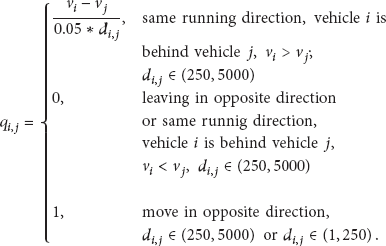
As is shown in Figure 2(a), in the period
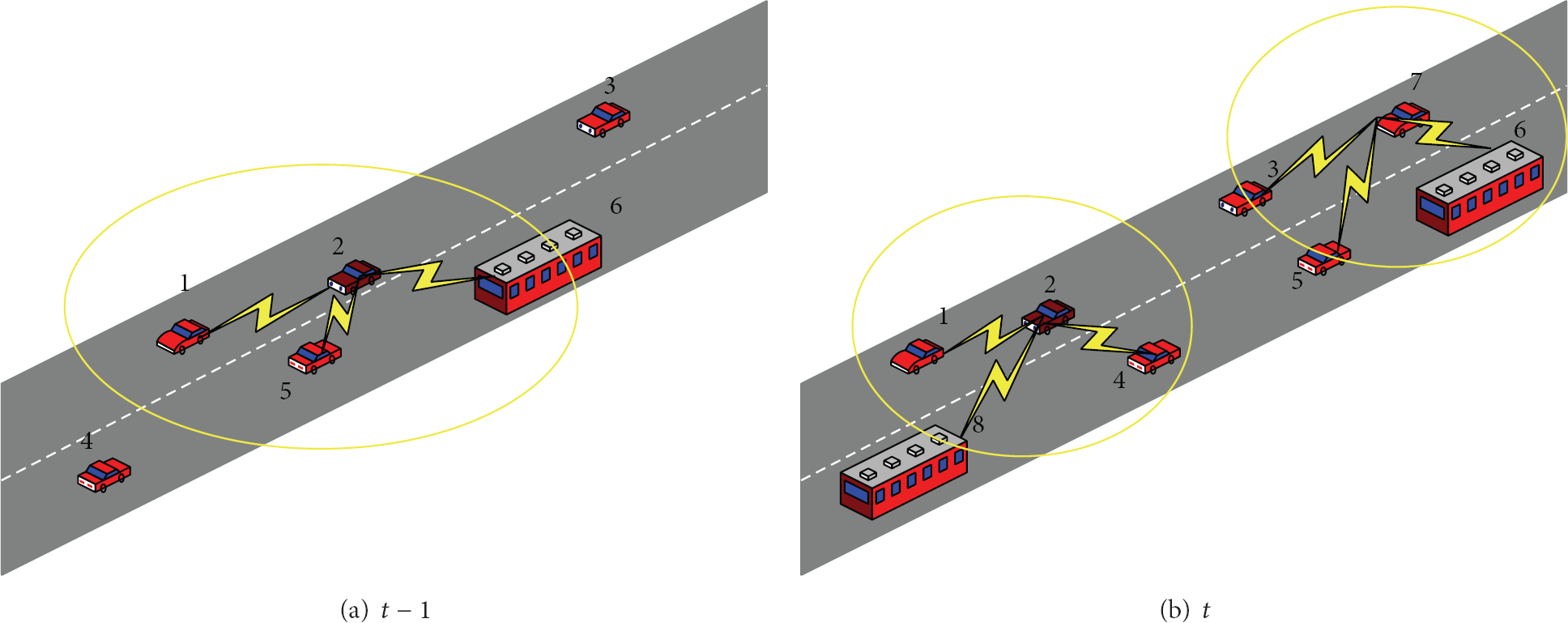
The model of vehicles encounter.
Because of the mobility of vehicles in VANET, it is impossible to choose a fixed reliable third-party to manage a certain number of nodes. For simplicity, first we assume that (1) nodes in VANET have their own media services; (2) initially each vehicle gets a certain amount of media services from the RSU and gets initialized with a certain contribution value when entering the network; (3) the media service among vehicles is instantaneous, and there is no time limit; (4) at the time every vehicle enter the network, it is given a unique real identity; (5) the transmission range of vehicles is the same.
3.2. Media Service Model
In this paper, we divide multimedia services into four kinds based on the type and popularity of the media: (1) critical urgent media services, such as road hazard information and highway information, defined as
When requesters ask for media service from provider, they will give their shared value of the previous phase to the provider. Since vehicles have a strong ability of computing, provider will determine the allocation of resources based on the shared value of all requesters. Meanwhile, at the end of the request, requesters will broadcast information to all nodes in the network, such as information about media service, provider, and value (Section 4 will describe evaluation of media service in detail). Therefore, all nodes in network will store a list: record ID and shared value of all nodes in the network. For nodes that just enter the network, they will get a unique ID, and then when they meet first node, they will copy all records from it to complete information. All nodes update records in each time slot.
4. Offer-Based RGMPMW Incentives Scheme
Since vehicle nodes in VANET are naturally selfish, they will not go to contribute their resources to other peer nodes without motive. Therefore, we need to design an incentive mechanism to encourage the contribution of nodes [17].
In the P2P-based VANET, design of incentive mechanism should consider instant contribution of vehicles. Taking real-time requirement of media streams into account, the vehicles are more strictly required to share their resources in every round; otherwise, the requester may not receive the data before the playback time. When implementing incentive mechanism to nodes, contribution of current time period is more important than historical contribution. Repeated game keeping encouraging nodes to contribute includes a lot of repeated game stages of participators. In each stage, the decisions of participators all depend on their payment. An action can be determined by one participator, giving it the highest payment. Therefore, in the repeated game, when participators decide what strategy to take, they must care about current and future payment [29]. This paper proposes a RGMPMW incentive mechanism based on similar managers.
In this incentive mechanism, we define a noun “shared contribution value,” representing the contribution of a node made in a game stage. It is related to bandwidth, popularity of the media, and amount of providers of nodes’ contribution. In the sharing mechanism, “shared contribution value” of nodes is evaluated by upload/download behavior in a previous stage. Each node broadcasts evaluation of service's popularity and importance before the end of the game. In the same stage, every provider is a similar manager, and it decides requesters’ profit in current stage based on “shared contribution value” of previous stage provided by requesters.
Therefore, the “shared contribution value” of a node kin stage t is the sum of feedback information provided by all nodes that received the media service of k. That is,

For simplicity, we assume that the system model in this paper is that every vehicle node in a slot t provides only one kind of media service. Thus, the “shared contribution value” of a node k in slot t can be simplified as

where
Figure 2 shows the system model of communications among vehicles under urban scenes in VANET. A vehicle may be both a service provider and a service requester in a stage of the game. However, in the incentive mechanism proposed in this paper, we are most concerned about the “shared contribution value.” Here we only consider a simple scenario: one provider corresponds to several requesters, as is shown in Figure 3.

The model of vehicle requesting.
In vehicle request model, when a vehicle asks for media services, it will give its “shared contribution value” in previous stage to provider, and provider will determine the allocation of resources based on the shared value of all requesters. We define the resource assigned from provider S to a requester in time t which is

where

As vehicle node is autonomous, the service media type is decided by each node. In order to obtain greater payoff, each node tends to choose high popularity of media services. We set

In addition, we define the total utility of node i in the service time as follows:

Here
The implementation steps of RGMPMW incentive mechanism based on similar management are shown in Algorithm 1.
Procedure RGMPMW for if (vehicle i begins to request media service) if (vehicle i meets vehicle S & vehicle S has the media service) Vehicle i provide the and requests media; Vehicle S computes how much to share for vehicle i: Vehicle i games with the vehicle if (exist a vehicle j: Vehicle i change its strategy; end if end if end if end for end
We can get from formulas (6) and (7) the following:

The goal of the node i is to maximize

where
We set

That is,

Then the optimal solution

We know that in the condition of NE (Nash equilibrium), the following formula is true for each node:

Therefore, we have

where n is the number of vehicles requesting node S.
Putting the formula (14) to the formula (12), we can get
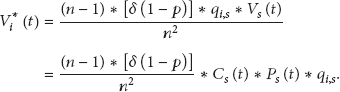
The payoff of the node will be maximized, when the equation above equation is established.
5. Evolutionary Game Model for Veracity of Vehicles
In Section 4, the function of RGMPMW incentives scheme based on information is when the node is rational; it will actively share its media resource to gain more payoffs. But in VANET which is autonomic network, it is not practical for the node to be completely rational. In the process of each game, if each requestor's “shared contribution value” is stable at present, namely, node “shared contribution value” fluctuation is small, he will get unexpected payoff when one requester exaggerates his previous contribution; or there are attacks of malicious nodes, which exaggerate their contribution deliberately and make the payoffs low. So we should study node bounded rationality in VANET and the situation that the nodes do not trust each other. In this section, we present an EGV game model by using a game theory which can be applied to the node bounded rationality, which can prevent the node exaggerating its “shared contribution value” to gain extra payoff or malicious attacks and to guarantee the authenticity of all the nodes.
5.1. Structure and Solution of Evolutionary Game
In this paper, we set the vehicles which request for the same vehicle as an evolutionary group. Researching on evolutionary game theory, a mutation of disadvantage group is the vehicles which exaggerate their own shared services for more payoffs and reduce the payoff of the other competitors. After a long evolution, disadvantage group will be eliminated and vehicles’ real “shared contribution value” will be guaranteed. We know that in the real network the exaggerated nodes will benefit more, because it means that in the case the other nodes are real, the exaggerated nodes will get more in the next round of the game.
In VANET based on P2P, vehicles provide service for each other. In each stage in the game, all the vehicles will broadcast their gains. So all the vehicles in the network will receive the broadcast information and accumulate the value according to the identity of the vehicles. At the end of the stage game, each vehicle records the stage game information (vehicle identification, total service) of all the vehicles in the network. Therefore, the vehicles will refuse to provide service when the nodes choose “exaggerator” according to their record.
In evolutionary game, the game of the participants is two random vehicle nodes. Suppose in the whole population that the population strategy set is {real, exaggerated}. If the two participants I and j are both real, their payoffs are
Pay-off matrix.

We define that

We set
According to the game matrix, the payoff of game parties choosing the real strategy is

The payoff of choosing exaggerated strategy is

The average payoff is

The replication dynamic below indicates how evolution makes dynamic change; in particular, it can be converted to the equilibrium dynamically by replication dynamic. Replicator dynamic describes a population evolution process with multiple strategies. Each individual in the population obeys the following imitation rules: after studying the individual choose the strategy getting more benefit.
We assume that each stage game begins from

where

where

Then, we divide ε at both sides of the equation and get

When

That is the Dynamic replication equation of game participant k is

We set

According to the first condition ESS (evolutionary stable strategy) meeting, we make

The solution is
5.2. Stability Analysis
The above three conditions of solutions are not all ESS. We need according to the second condition ESS meeting to analyze the stability.
Theorem 1.
In EGV game model, there is only an evolutionary stable strategy of ESS.
Proof.
According to the second condition ESS meeting, we know that in the ESS

Therefore, we have the analysis as follows.
According to the introduction of RGMPMW incentive mechanism in Section 4, Next we analyze the case when
Assuming that there are η proportion of players in the game deviating from the strategy “real” and select the “exaggerated,” there are

Therefore,
Assuming that there are η proportion of players in the game deviating from the strategy “exaggerated” and select the “real,” there are
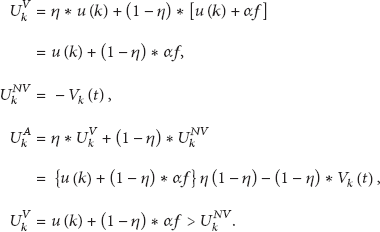
So
In conclusion, in the EGV game model, the ESS is only
The proving is over.
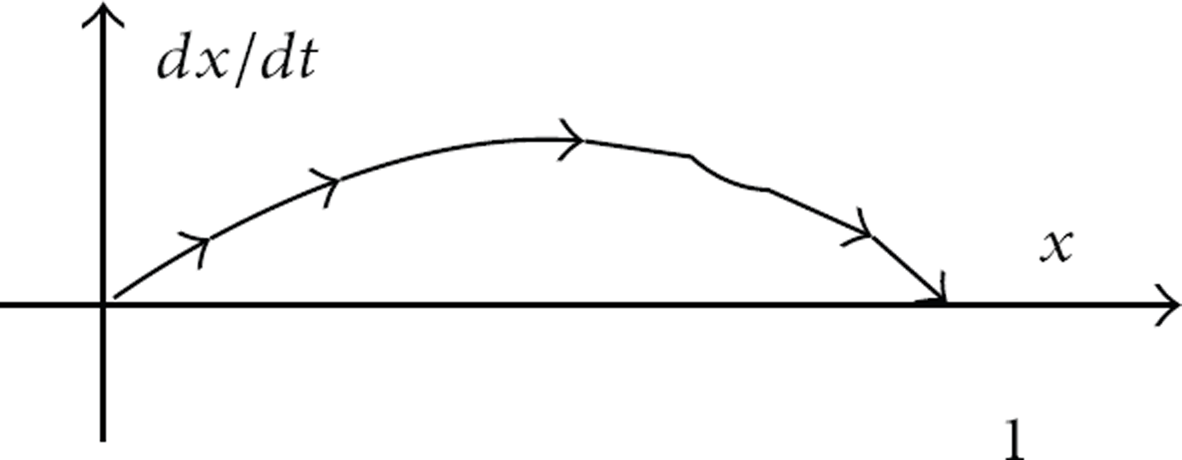
The above analysis of stability shows that whether the population of participants choose real or exaggerated, after a period of evolution, all the participants will choose the pure strategy—real. The proposed game model EGV ensures the authenticity of all participants.
5.3. Influence Factor Analysis of ESS
According to the analysis in Section 4, the benefits of a node k are as follows:

We set

Setting it into formula (31), we can get

When n is large enough, the profit is
Reformatting the formula (25) and putting it into the
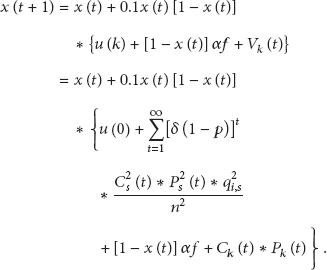
Therefore, the impaction factors on ESS that we can get from formula (34) are as follows:
the reward of choose real: α;
the number of participants: n;
the multimedia types, that is, the “shared contribution value” of node k at the current stage:
the encounter probability of the vehicles:
the concrete analysis is in simulation part.
6. Simulation and Analysis
6.1. Simulation Settings
The system parameters of simulation settings are shown in Table 2. The vehicle is random distribution. Vehicles that provide service probability in a slot t are living service : to complete the media : delay sensitive services : the emergency information service = 1 : 1 : 1 : 2.
System parameters.

6.2. RGMPMW Incentive Mechanism
( 1) Under the Infinitely Repeated Game Nodes Reach Equilibrium State. Figure 4 shows that under the effect of RGMPMW incentive mechanism the “shared contribution value” will increase until reaching a steady state. The initial state of Figure 4(a) is competitive vehicle number

The requester “sharing change contribution value” under the RGMPMW.
After several stages of game, a node “shared contribution value” tends to be stable. This is because node will maximize its own benefits, and the node will increase their “shared contribution value” under the effect of RGMPMW incentive mechanism. When reaching game equilibrium, the benefits of node maximizes and the node “shared contribution value” tends to be stable. But in the next period of time, the node “shared contribution value” nodes has some fluctuation; this is because the balance of “shared contribution value” in each stage game is associated with the number of competing nodes and media service type. The stability of “shared contribution value” does not mean any change but a little change in each stage game. Figure 4(b) indicates that under the same initial value, the number of competing nodes is different, and then the stable value of “shared contribution value” is different. With the increasing of competing node number, the stable value of “shared contribution value” will decrease. From (32) it can be seen when the other parameters are certain, the increase of n will reduce
( 2) Correct and Effective Incentive Mechanism. Figure 5 shows the effectiveness of the RGMPMW incentive mechanism: after a period of incentive, the node utility will reach a maximum. Node will increase their “shared contribution value” for its benefit. We design the RGMWMP incentive mechanism to make the nodes share their resources as much as possible positively, that is, to make the node “shared contribution value” increase. It can be seen from the above two figures that there is a game equilibrium state which makes the benefit reach the maximum. The corresponding “shared contribution value” of bigger one of two

The change of node utility function in RGMPMW.
6.3. EGV Game Model
( 1) Validity Analysis. Figure 6 shows that, when the vehicle group has 50% vehicles select exaggeration, after a period of evolution, they will be eliminated. All the vehicles will select “real”. The results show that, in the vehicle in the group use the EGV game model can obtain satisfactory results. It proves that the EGV game model we proposed is effective.

Vehicle population replicator dynamic evolution.
( 2) Analysis of Influence Factors
(a) Initial Value

The impact of initial value on dynamic evolution of population reproduction.
(b) Incentive Strength α . Consider
Figure 8 shows, when the incentive strength is greater, the group tends to the ESS quicker. The reason is that the incentive strength is greater and can lead the vehicle to have higher incentives. In the dynamic evolution process, there will be more participants who choose strategies to maximize their own real earnings.

The impact of incentive strength on dynamic evolution of population reproduction.
(c) Effects of N Number of Participants. When the number of vehicles in group becomes bigger, that is to say the more number of vehicles to exaggerate, then, in the EGV game, it will converge more slowly to ESS, as shown in Figure 9. But when the number of vehicles involved in the game reaches a certain amount in the group, there was no change in convergence speed. Because of the increasing number of participants, the learning process become very widely. When the number of participants increased to a certain extent, the evolution convergence speed is no longer affected by the number of participants.
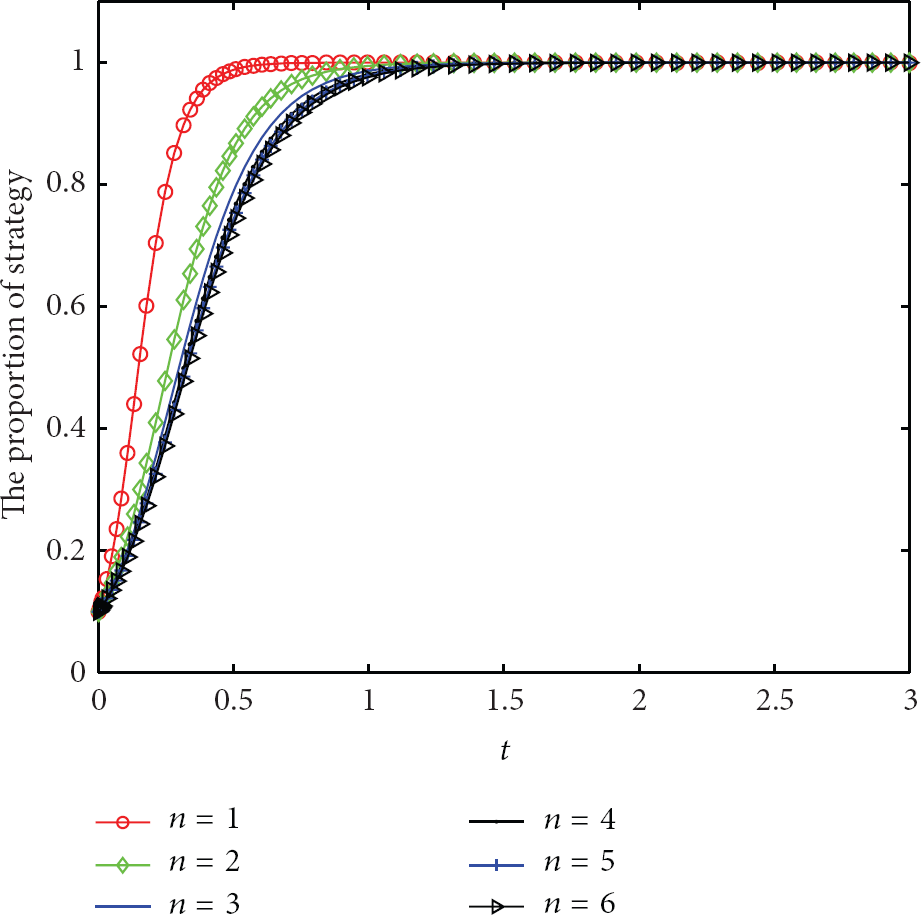
The impact of number of participants on dynamic evolution of population reproduction.
(d) Multimedia Types. Set bandwidth:
As shown in Figure 10, the sharing of multimedia services is more popular; the vehicles tend to stability more quickly. Because the multimedia types not only affect the real vehicle incentives, but also affect the vehicle “shared contribution value,” multimedia is more popular, and vehicles “share contribution value” is bigger, which can also give the option of the real vehicle reward greater efforts. Thus, the vehicle shares more multimedia popular, can incentive mechanism under the RGMPMW faster to achieve stability, and the vehicles will get more reward. Group will arrive at ESS steady state, as shown in Figure 10. That the vehicles will share the popular media more actively, making emergency news media service timely diffusion in VANET, which is the result we want.

The impact of multimedia types on dynamic evolution of population reproduction.
7. Conclusions and Perspectives
In this paper, we studied media services in P2P-based VANET, where all vehicles are regarded as individuals with limited rationality. We proposed “More Pay for More Work (RGMPMW)” incentive mechanism to encourage vehicle nodes to share resources and studied evolutionary game to guarantee the service share veracity of all vehicles. With “shared contribution value,” RGMPMW incentive mechanism accurately evaluated the contribution of each node based on similar manager. Then as expansion to RGMPMW incentive mechanism, EGV game model had been studied to prevent the mendacious service share of vehicles efficiently. The simulation results proved RGMPMW incentive mechanism and EGV game model are correct and effective in VANET. In particular, the analysis of factors ESS shows that the fewer the number of participants is, the more urgent multimedia services are, and the faster the ESS will reach. At the same time, the proposed mechanism can be well adapted to the V2V communication with high mobility and fast topology changes.
We only considered the most simple P2P-based VANET scene, that is, one provider to several requesters. In future work, we will study evolutionary game in more complicated scene of several-to-several, including variations between nodes and unequal connection probabilities in multiple groups.
Footnotes
Conflict of Interests
The authors declare that there is no conflict of interests regarding the publication of this paper.
Acknowledgments
This work is supported by National Natural Science Foundation of China (61370201), the Scientific Research Foundation for the Returned Overseas Chinese Scholars (45), Liaoning Provincial Natural Science Foundation of China (2013020019), and High-Tech 863 Program (no. 2012AA111902).