




Abstract
Healthcare and medical advances have prolonged human life and thus have led to increasing numbers of elderly individuals. To make their lives more convenient, several ubiquitous technologies have been considered, including the RFID system, which can play a vital role in elderly care by caregivers as well as by elderly individuals themselves. Caregivers can take advantage of the RFID system by recording and tracking elderly individuals' belongings and assisting these individuals in healthcare provision by accessing their relevant information, among others. Similarly, the RFID system can help manage elderly individuals' daily lives by reminding them of their daily schedules (e.g., reminding them to take medicine on time) and tracking their personal belongings, among others. In addition, the RFID system can mitigate human errors such as medical mistakes, delays in service provision, and hassles in tracking and identifying patients and objects. This study provides a survey of solutions proposed in the literature and discusses the potential benefits of integrating the RFID system with sensors and applying the integrated system. In addition, the study addresses the opportunities, technological challenges, and research directions for the integrated RFID system in the context of smart solutions in elderly care facilities.
1. Introduction
The global population of individuals aged 85 and over by 2050 is projected to be five times that in the year 2010. These individuals are most likely to need healthcare services, and in the US, about 5% of them live in nursing homes. In South Korea (hereafter “Korea”), one of the fastest-ageing countries in the world, about 40% of all Koreans are expected to be above 65 by that time [1]. Figure 1 shows the world midyear elderly population in 2010 and the estimates for 2013 to 2050. As shown in the figure, 2050 shows a sharp increase in the number of those aged 85 and over.
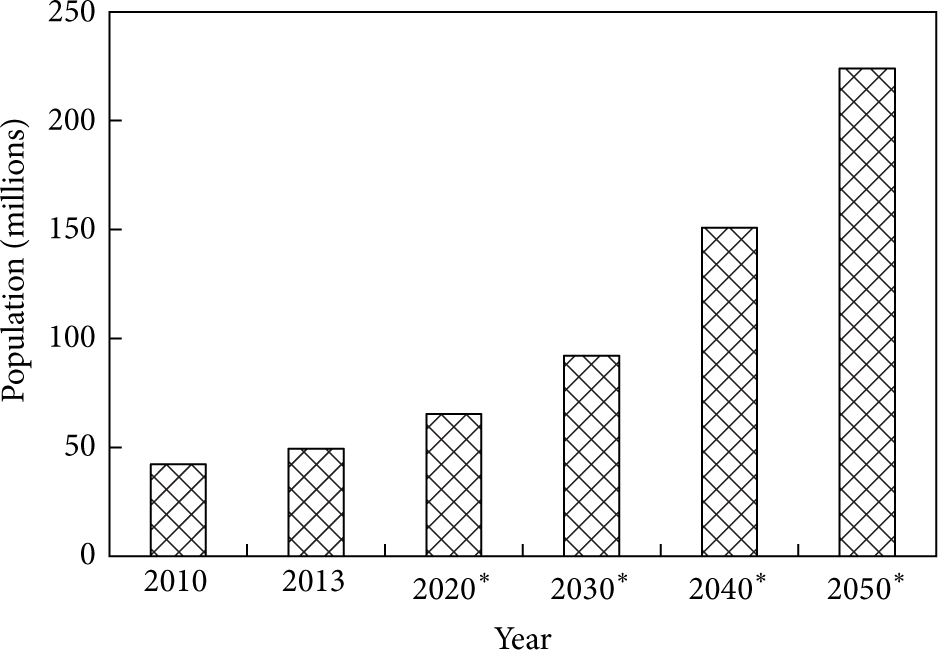
World midyear elderly population (age ≥85 [34]).
The ageing of the population is expected to have considerable influence on the organization and delivery of health care. Of particular importance are the shift from acute to chronic illnesses and the continued shortage of healthcare workers, particularly nurses and paraprofessionals [2]. There is a growing social problem of providing proper care at home because some patients require special medical attention. Recent advances in communications technologies such as the wireless local area network (WLAN), the wireless sensor network (WSN), and the radio frequency identification (RFID) system have provided necessary innovations that can be applied to people's daily lives. However, some challenges hinder the innovative application of such technologies to the management of daily lives of elderly patients in nursing homes, hospitals, and elderly care facilities.
Taking care of elderly individuals can be chaotic at times because they may move without notice and can suffer from some mental disorder that prevents them from knowing where they are. Some may be in a dire physical condition, requiring immediate medical attention. Elderly individuals who are generally healthy but fragile can misplace their belongings, miss their medicine, and forget their schedules, among others. Caregivers sometimes need to locate and track patients in case of emergency. That is, they may need to instantly retrieve patient data.
In addition, home accidents such as falls represent a major cause of injury among the elderly. In developed countries, most falls occur around the individual's home or community [3]. There are several tracking systems used in elderly care. The classification of such systems is given in Figure 2. One of such systems is RFID system. There are many objectives in the deployment of the RFID system for elderly care. Some RFID readers and tags can be deployed at home to ease elderly individuals' daily lives, and family members can obtain information immediately in case of emergency. Similarly, the RFID system can be deployed in nursing homes on a large scale for elderly care. To obtain optimal solutions in an efficient manner, there is a need to integrate various technologies and construct a homogeneous environment for the successful deployment of the RFID system.

Classifications of tracking systems used for elderly care.
As shown in Figure 3, in the RFID system, there are three functional units, namely, RFID readers, tags, and back-end systems. RFID readers can be static readers as well as mobile readers. There are several types of basic tags, including active, semiactive, passive, and integrated tags. Elderly patients have an integrated tag or a handheld portable device such as a reader or a mobile phone integrated with a reader. Whenever an RFID reader wants to read a tag, it sends a read signal to the tag. Upon receiving the read signal, the passive tag sends its identification number (ID). Then the RFID reader sends received data to the back-end server, which sends a reminder/alert to the alert device whenever necessary. The back-end server saves critical data in a centrally located server via the Internet. Any available and reliable network technology can be used to save data in the central server.

Components of the RFID system.
The rest of this paper is organized as follows. Section 2 describes the current status of RFID system deployment in elderly care facilities. Section 3 presents the advantage of integrating the wireless sensor network with the RFID system and its complications. Section 4 applies the integrated RFID system with a sensor to an elderly care facility, and Section 5 describes the opportunities and challenges. Section 6 describes the research challenges, and Section 7 concludes the paper.
2. Current Status of RFID System Deployment in Elderly Care Facilities
A number of studies have considered the RFID system in the context of facilitating elderly individuals' lives in home or hospital environments [4–8]. RFID applications have been deployed in various hospitals to mitigate medical errors, improve patient care, and identify patients, among others. Some pilot tracking projects have been implemented in some hospitals for efficient administration and improved productivity. For instance, an RFID wrist band is used in the operation theater for the safety and relevancy of information. The RFID system is also used for inpatient drug delivery, blood identification, and equipment tracking, among others [9].
Age-related memory loss is common among elderly individuals, and therefore an intelligent remainder system can play an important role in supporting their everyday lives. Huang et al. [10] propose an intelligent RFID system for facilitating independent living for elderly individuals and improving the quality of life for them. Using electronic product code generation 2 (EPC GEN-2) RFID tags, this system helps elderly individuals to locate their belongings such as mobile phones, wallets, and keys and has two main functions: reminding and scheduling. The reminding system is an event-driven system, whereas the scheduling system is a time-driven one. When elderly individuals leave their place of residence, the RFID reader near the exit scans all the tags attached to their belongings and reminds them in case they forget to bring anything they need. The scheduling system notifies of daily schedules such as taking medicine, locking doors/windows, and turning off the gas before going to bed. It also facilitates some other daily schedules such as sending e-mail messages, calling home, and visiting the pension office.
Ho et al. [7] and Moh et al. [8] propose an extended version of the system in [11] by integrating sensor networks with RFID technologies and develop a prototype consisting of sensor and RFID components. The proposed system incorporates high-frequency (HF) and ultrahigh-frequency (UHF) RFID tags. HF RFID tags are cost-efficient, and UHF RFID tags can cover long distances. There are three subsystems: medicine-monitoring, patient-monitoring, and base station subsystems. In the medicine-monitoring subsystem, RFID tags are placed on each medicine bottle. A sensor with an RFID tag communicates with the RFID reader and determines when and which bottles are removed or replaced. With changes in weight and RFID tag events, it determines those medicine bottles and the amount of the medicine to be taken.
Lin et al. [12] present a ubiquitous monitoring system integrated with biosensors and RFID tags by implementing it as a prototype system that can detect emergencies or accidents such as stroke, falls, fainting, and heart attacks. They consider a wearable sensor module containing active RFID tags and sensing, signal-processing, and controller units. A processing unit partially processes biosignal data and saves them to flash memory, and then an active RFID tag identifies and transmits them to a nearby base station. Caregivers carry RFID tags and can be identified and located through specific base stations to reveal their locations. Outdoor readers communicate with the base station by using IEEE 802.11 b (WLAN). Although Lin et al. [12] propose an approach for combining sensors and RFID technologies and forming a ubiquitous monitoring environment for caregivers in serving elderly patients nursing homes, several issues remain unclear, including how the RFID tags can be integrated with 802.11b (WLAN), how elderly falls can be detected, and what the software and hardware architecture is, among others.
A mobile telemedicine solution based on low-cost wearable RFID bracelet tags for perceiving emergency situations for elderly patients with chronic diseases and initiating emergency action has been presented [13]. This system assists the patient by collecting vital signs for prompt care delivered remotely. Hsu and Chen [14] propose an RFID-based technique for modeling human behavior and detecting anomalies in elderly patients by focusing on building an intelligent system that can detect abnormal behaviors of elderly patients at home. An RFID reader is mounted on the elderly patient, and active RFID tags are mounted at home. The reader collects data on daily movements of the patient. With the data, the clustering technique is then used to build a personalized model of his or her normal behavior. Movement patterns of the patient are compared with the normal behavior.
Most of existing fall detection and location monitoring systems use image surveillance, sound detection, and vibration/pressure sensors, among others. Among these, image surveillance is one of the best ways to track elderly patients. However, not everyone wants to be under surveillance all the time for privacy reasons. The cost of installing a surveillance camera and a pressure sensor is relatively high. Hsu and Chen [15] propose a novel system called the intelligent RFID-based indoor tracking system for elderly patients. This system uses the signal strength indication (RSSI) value of the RFID system and estimates the elderly patient's location. The system coordinates with the wireless sensor (WS) node of a three-axis accelerometer and uses a genetic algorithm to compute this location. The system has two modules: a data manager and a positioning manager. The data manager module is for filtering noise from sensor data and determining probable locations of the patient based on the current path and the number of steps. The positioning manager module accesses the environment in which the elderly patient lives and calculates his or her actual location. The development of a prototype RFID home support tool has been described [16], including some issues and challenges. The system is designed to facilitate assisted living for elderly patients and provide relevant information in a simple, usable, and extensible manner, particularly for supporting the finding and identification of commonly used and lost objects such as spectacles. Maderia et al. [17] present preliminary work on design issues surrounding the pervasive healthcare assistive environment for elderly patients and discuss the deployment of smart objects with embedded sensors and RFID system to measure physiological parameters and user IDs. The design of an RFID-based home emergency and notification system with GSM, 3G video services, and two-way radio functionalities for elderly patients has been proposed [18]. Su and Shih [19] describe the development of a home healthcare system based on RFID and mobile agent technologies based on the concept of location-based services (LBSs) and design a home care system for real-time safety to prevent elderly patients from accidentally falling.
Chen et al. [9] propose a 2G-RFID-based e-healthcare system that integrates the wireless area network and the wireless LAN. The purpose of this system is to collect patient data through the body sensor network and facilitate diagnostic assistance and action handling. It uses mobile codes encoding procedural directives stored in the RFID tag, which is mobile with the object's bearer and reduces the hassle of searching the rule database and determining some suitable action based on the tag's associated rule. The rule database needs to be populated in advance because the system would otherwise have no knowledge of how it could process contextless information provided by the tag. The size of the rule database grows constantly with the number of applications. It needs to be manually updated by the human operator and thus is prone to human error. Therefore, the mobile code is updated frequently, and all context information is updated and stored. Mobile codes consist of a simple conditional statement and a series of action codes:
if
then
<action2 (parameter2)>;
<action3 (parameter3)>;
⋯;
⋯;
Example. Emergency: ON; Accident: FALL; Operation: NO; Transfer: ICU.
Zhou and Ranasinghe [20] propose an approach to lower cost deployment without modifying the existing air interface protocols, firmware, or hardware.
Table 1 compares existing methods for easing elderly life based on various parameters.
Comparison of various RFID applications.

*BCG-S: ballistocardiography sensor; rBCG-S: contactless ballistocardiography sensor; FMCW: frequency modulated continuous wave; and IN-S: inertial sensing unit.
3. Integration of the Wireless Sensor Network with the RFID System
RFID is mainly used for identifying and tracking objects and sensors are mainly used for gathering information by sensing environmental factors such as temperature, pressure, humidity, motion, and so forth. Although the RFID system and the wireless sensor are different technologies, integrating them may enhance system performance and improve the quality of service (QoS) for elderly care.
The RFID system stores and retrieves data through electromagnetic transmission to an integrated circuit compatible with the radio frequency (RF); on the other hand, a sensor network is typically used to sense and monitor physical, chemical, and biological environments by sensing their sound, temperature, and light, among others. A number of studies have considered the sensors in the elderly individuals' lives in home or hospital environments [21–27]. Integrating the RFID system with a sensor network can complement both of them because, with sensors, temperature, pressure, humidity, motion, and pulse rate data, among others, can be monitored and obtained. Keeping such data on elderly patients is crucial. Directly adopting the sensor mote to the RFID system is not feasible because of cost, size, architecture, and functional area considerations, among others. There are some approaches to integrate the RFID system with sensors.
There are various ways to integrate an RFID tag with the WS node [28]. This section discusses the practicality of integrating tags with sensors, tags with WS nodes, and RFID readers with WS nodes.
Figure 4 shows the reference module for the integration of the RFID system and the sensor network. Here there are four modules, namely, the back-end system, the support system, the reader module, and the tag module. A tag consists of identification, sensor, and code modules. The unique identification number of elderly patients or objects is stored in the identification field. The sensor module senses events, and there is a module for entering mobile codes. The modules are read by their respective readers. The processing occurs in the back-end system through the EPC network, or the code is interpreted by the interpreter. This process is carried out from the reader to the back-end system and from this system to the reader or a personal assistant with the help of the sensor system, IP networks, or some other system.

Reference module for the integration of the RFID system and the sensor network.
3.1. Integrating Sensors on Tags
Semiactive (EPC Class 3 standard) and active (EPC Class 4 standard) RFID tags are battery-powered and much bigger than passive RFID tags. Sensors can be added in these tags to enhance capabilities of the semiactive and active tags. Existing RFID protocols generally rely on single-hop communication but can be applied to multihop communication through sensor integration. In these types of tags, communication is not limited to the tag and the reader, but they can communicate among themselves for cooperative control. Tags on a wireless sensor node can cooperate with one another and form an ad hoc network, and such tags can decide by themselves when to transmit and receive data. In general, these tags use conventional RFID protocols to read tag IDs or can have some other protocols. Two types of RFID tags are available: (a) RFID tags with integrated sensors and (b) those allowing additional sensors.
3.2. Integrating Tags on Sensors
Passive (EPCglobal Class 1 Generation 2 standard) RFID tags can be added to wireless sensors. Such new wireless sensor nodes may not be in compliance with existing RFID standards and thus may require some other protocols. In the Mica mote, it is possible to add an RFID tag. However, the Mica mote is heavy and thus is not suitable for elderly individuals to carry at all times.
3.3. Integrating RFID Readers with Sensor Nodes and Wireless Devices
Some RFID readers can connect to the WLAN. Such readers are equipped with up to four antennas for reading tags and can communicate through the IEEE 802.11 a/b/g/n standards. In the highly dense area, RFID readers and tags can communicate in the ad hoc mode and relay and forward data from other readers.
3.4. RFID Tags with Cognitive Radio WS Nodes
Recently, many researchers have worked on cognitive radio wireless sensor networks [29]. Most of the existing WSNs and RFID systems work in ISM bands. Because the electromagnetic spectrum of the indoor environment is extremely crowded, ISM bands may sometimes be unavailable. Therefore, the integration of WS nodes and RFID tags may produce a robust and reliable network that can be trusted even in case of emergency.
Table 2 compares various tags and integrated RFID tags with sensors. Motivation of integrating wireless sensor networks with RFID system is well studied in [28].
Comparison of various RFID tags and integrated RFID tags with sensors.

4. Application of an Integrated RFID System with Sensors in the Elderly Care System
This section discusses the application of the RFID system for monitoring elderly patients and notifying of urgent events. Figure 5 shows the framework of RFID deployment in elderly care facilities. Video sensor modules for elderly monitoring are installed on the ceiling, and the RFID reader is placed considering the transmission/reception coverage capacity of the reader. Tags are mounted on medicines, beds, floors, bathrooms, and belongings of elderly patients such as sticks, glasses, wallets, and shoes. Elderly patients are equipped with RFID tags using appropriate RFID tags in conjunction with temperature and movement sensors based on their physical and mental health conditions, and caregivers are equipped with wearable mobile RFID readers. All medicines have passive RFID tags.

Framework of RFID deployment in an elderly care facility.
Data read by stationary or mobile RFID readers pass to the local server or gateway through a wired or wireless network. The local server contains an elderly management system (EMS). A prototype of such an EMS is shown in Figure 6. The local server sends messages to the broadcast unit to send alerts, reminders, or emergency messages to doctors, caregivers, or family members so that they can take immediate action. For security, safety, and administrative purposes, data are saved in the centrally located server, which sometimes also requests the broadcast unit to send messages to all target recipients.

(a) Prototype of the home page of the elderly management system (EMS); (b) setting a list of items and medicines to carry and setting reminders; (c) receiving reminders through the smartphone.
Elderly patients carrying active RFID tags with wireless sensors can communicate in a multihop fashion when the RFID reader is out of transmission or reception range. Figure 5 shows a basic scenario of RFID deployment in a small area. Similar scenarios can be extended to whole buildings and surroundings of elderly care facilities or nursing homes. The deployment scenario may vary according to the number of elderly patients, their physical and mental conditions, and physical locations, among others.
Figure 6(a) shows a prototype EMS that can be developed using C++/Java and a database software on the server side, and in terms of the reminder side (e.g., PDAs/smartphones), reminder applications can be developed using J2ME (Java 2 Micro Edition). J2ME is popular for developing such portable applications for resource-constrained mobile devices. As shown in Figure 6(b), caregivers or elderly patients themselves may set necessary options for essential items to carry while going out, such as PDAs/smartphones, sticks, medicines, and the spacer (for asthma patients). They can also set reminders such as the time to take medicine, eat breakfast/lunch/dinner, get physical exercise, go to bed, call home, and visit the pension office. In addition, they can set the time and frequency for reminders on the reminder device. Figure 6(c) shows a prototype of such messages.
After setting such options on the EMS, when an elderly patient wants to go outside, the RFID reader at the exit reads tags attached to all items carried by the patient. If any predefined essential items are missing, then the EMS immediately sends a reminder message to the reminder device. Here the most important factor is that elderly patients should not forget to carry the reminder device. If the device is forgotten, then there should be some voice output device near the exit of the residence. The voice output device should be the missing reminder device.
5. Opportunities and Challenges
5.1. Advantage of the RFID System in Elderly Care Management
5.1.1. Mitigating Medical Mistakes
Medical errors represent the eighth leading cause of death in the U.S. It is estimated that 44,000 to 98,000 deaths are related to medical errors in US hospitals [30]. The Food and Drug Administration (FDA) estimates that the number of deaths and injuries from medical errors is about 500,000 [31]. However, the FDA also estimated that half of all drug errors are preventable by adopting appropriate IT applications. Many medical mistakes such as misidentification of elderly patients, occurrence of adverse drug events, and polypharmacy can be mitigated through the proper use of the RFID system. This is a valuable tool for quickly retrieving patient information and monitoring patient locations in nursing homes to improve the accuracy of identifying patients and knowing appropriate medicines for them. In addition, appropriate dosages are vital for elderly patients and can be retrieved using the RFID system.
5.1.2. Elderly Safety
Nursing homes care for various types of elderly patients, whose physical and health conditions may not be good. Some may have Alzheimer disease, and others may be handicapped. They may get lost and venture to some hazardous environments. In such situations, tags with sensors may initiate communication and alert caregivers and can enable remote monitoring. They can guide elderly patients to take the right kind of medicine regularly. The alarm system can prevent emergencies, and if there is any emergency with respect to patient's health or safety, then appropriate action can be taken immediately.
5.1.3. Ubiquitous Medical Care and Telemedicine
Routinely monitoring elderly patients, providing timely health information, sending reminders, and supporting elderly patient care ubiquitously without the physical presence of caregivers are practiced as part of telemedicine. The RFID system plays an important role in telemedicine and ubiquitous medical care. Cloud-assisted integrated RFID system with sensor-integrated RFID tags plays a vital role in the life of the elderly patient by sending important information to doctors from remote sites. Elderly patients with deteriorating memory or memory loss have several advantages while using the RFID system.
5.1.4. Time and Cost Savings
The RFID system can save time for locating any items and providing any attention. With the RFID system, elderly patients can take care of themselves, and caregivers or family members can perform some other tasks. Although the installation of this system is expensive, it is beneficial in the long run.
5.1.5. Real-Time Responses and QoS
Data capturing and storing represent one of the most important features of the RFID system. Therefore, the RFID tag can record the medical history of elderly patients. With the use of mobile codes discussed earlier, patient information can be further updated, and such information can be available to health professionals in case of emergency, which can save time and enable the arrangement of immediate care. It can save lives or prevent accidents.
5.2. Technological Challenges of the RFID Integrated Sensor in Elderly Care Facilities
5.2.1. Interference
The RFID system operates in ISM bands where successful wireless networks such as WiFi, ZigBee, and Bluetooth work. Because the RFID system uses the same frequency bands, there is a serious problem of spectrum congestion and interference between various types of networks. The interference problem is not limited to heterogeneous technologies. The problem of interference lies within the RFID system such as stationary-to-stationary readers, stationary-to-mobile readers, and mobile readers-to-mobile readers in denser environments.
Deploying a large number of readers in close proximity is advantageous in the fact that it increases the read rate. On the other hand, there are some negative consequences of interference, such as misdetection of important tags and reading the same tags multiple times.
5.2.2. Localization
Locating a particular patient or item instantly is a problem in case of emergency. The outdoor location of almost any object is possible because of the global positioning service (GPS). The localization problem lies in the indoor system. Several proposals have been made with respect to exact locations of objects [32]. However, such protocols require improved accuracy.
5.2.3. Standardization
The ISO 18000-RFID air interface family of standards is defined by the International Organization of Standardization (ISO). However, the standards describe only single-hop RFID networks, which are difficult to apply on a large scale or in dense environments because of their limited radio communication range and obstacles such as water and steel infrastructure systems. The lack of standardization for RFID protocols at hardware and software levels causes a lack of interoperability across providers. When RFID tags are integrated with sensor networks, there may be additional standardization problems.
5.2.4. Ineffectiveness
Tag placement is one of the main factors involved in the correct identification of individuals and items. The readability of RFID tags is strongly dependent on factors such as the dosage form, the angle of rotation, and the read distance of materials in which it is placed such as metals or liquids. In addition, RF signals cannot penetrate walls. Readability can be affected by an insufficient read range and the existence of multiple tagged objects.
5.2.5. Protocol Issues
The RFID reader uses its own protocol to avoid the reader collision problem as well as the tag collision problem and the problem of misdetection [33]. When sensors are integrated into the RFID system, the protocol needs to be designed such that it can read sensor and RF data without delay. Efficient sleep and awake cycles need to be designed into the protocol to save power. If the sensor RFID is deployed on a large area, then the transmission range of the tag may not be reachable in single hop, and therefore there is a need for designing a multihop routing protocol. The RFID system has collision problems such as RFID tag, reader-to-tag, and reader-to-reader collision problems. This suggests a need for some efficient protocols that can address all these issues.
5.2.6. Range Optimization Issues
Existing technologies do not consider range optimization issues. The implementation of multiple RFID tags in the same object introduces the crosstalk problem, which needs to be minimized. The read range can be boosted by considering the tag sensitivity and bit error rate of the reader.
5.2.7. Cost
Although passive RFID tags are not expensive, the infrastructure for the RFID system, such as RFID readers, software, and back-end systems, may be expensive in the initial stages. According to various vendors, depending on the size of the elderly care facility and the number of elderly patients, RFID system implementation may cost between $50,000 and $500,000.
5.2.8. Privacy and Legal Issues
Privacy concerns can include the inappropriate collection, intentional misuse, and unauthorized disclosure of information on elderly patients resulting from RFID use. The RFID system can introduce an important ethical concern over privacy.
5.2.9. Other Issues
A lack of organizational support, trust issues, an unclear return on investment, security concerns, and willingness to learn new technologies by healthcare professionals, among others, can hinder the successful application of existing RFID systems to elderly care.
6. Research Directions
Conventional hardware is not sufficient for smart elderly care facilities, and therefore the hardware and software design of RFID readers needs to be further modified. For example, the conventional WSN protocol stack can be used if integrated tags are used, but there is a need for some modification if passive and active tags are used.
In addition, off-the-shelf RFID tags are not designed for communication in a multihop ad hoc fashion. If any elderly patient walks away from the range of the RFID reader, then it is not possible to track the patient. Therefore, a multihop RFID system is a possible solution for this issue. Another possible solution is the integration of the sensor with the RFID tag, as shown in Figure 5. Because sensors work in a multihop fashion, they can send messages to the sink whenever necessary. This can extend the capability of the RFID system, thereby producing QoS improvements. However, few studies have addressed this issue, indicating a need for further research.
Collision issues such as those related to reader-to-reader and reader-to-tag collisions are yet to be solved and thus require appropriate attention. Designing media access control (MAC) and routing protocols for multihop RFID systems remain in the initial stages, necessitating an efficient solution to these problems. There is no standard framework for integrating sensors with the RFID system, and there should be efficient PHY, MAC, and routing layer protocols and solutions for various issues surrounding the coexistence of the RFID with sensor networks. Another important factor is the cost of RFID tags, which should be extremely low. In addition, integrating the RFID system with traditional telemedicine such as medical implant communication services (MICSs) may produce some synergy. Several other issues concerning advanced communication systems such as protocols for opportunistic spectrum access and various legal and technological issues surrounding spectrum use, among others, require closer research attention.
7. Conclusions
The rapidly increasing trend in the number of elderly individuals suggests that ubiquitous computing based on RFID technologies can play a vital role in their lives by facilitating their convenience and independence in their homes. In this regard, an RFID system with sensors may be the simplest option. This paper provides a review of existing approaches to RFID implementation for improving the lives of elderly patients. However, all of the surveyed systems have some limitations, indicating an urgent need for an efficient system that can address such limitations. In this regard, this paper suggests that the wireless sensor network can be integrated with the RFID system for better elderly care and discusses relevant technological challenges and research trends.
Future research should develop efficient communications protocols and apply them to the RFID system and the sensor module to address various limitations and challenges discussed in this paper. In this regard, there is a need for a common protocol that can integrate various technologies to facilitate required quality. In addition, future research should develop some applications that can accommodate artificial intelligence and examine elderly behavior for more robust and autonomous decision making. Although several studies have attempted to increase system robustness and reliability, there remains a need for closer research attention to QoS improvements.
Footnotes
Conflict of Interests
The authors declare that there is no conflict of interests regarding the publication of this paper.
Acknowledgment
This work was supported by the 2014 Yeungnam University Research Grant.