




Abstract
The focus of this study is the optimal configuration of a wireless low-power duty-cycled network with respect to the minimal energy consumption. Precisely, the energy consumption of a truncated-ARQ scheme in realistic shadowing environments is examined for the reference IEEE 802.15.4e standard protocol and for its cooperative extension that is presented in the paper. We show how to choose between the direct or multihop forwarding and the cooperative version of the two. We determine the optimal forwarding strategy for both loose and strict reliability requirements. Low-power links are parametrised by the interdevice distance and the corresponding outage probability, for the fixed output transmission power. It is shown that significant amounts of energy can be saved when the most adequate scheme of the three is applied. All analytical results are validated in the network simulator ns-3.
1. Introduction
A device domain of the machine-to-machine (M2M) communication system largely consists of resource-constrained, low-power, and energy-efficient devices. Following years of research and fine-tuning, viable technical solutions for achieving the adequate low energy regime have been devised and the standardised protocol stack has been put forward [1]. The lifetime of wireless M2M devices is measured in years or decades; extreme energy efficiency is thus a must and only achieved through aggressive duty-cycling [2]. A duty-cycled device keeps the radio transceiver in sleep state most of the time, except for the periodic wake-ups used to transmit the collected data. In this way, both overhearing and idle listening are evaded with the goal of conserving energy. The IEEE 802.15.4e standard amendments [3] define the required duty-cycled scheme. Arguments for applying this scheme are provided in [1] that examines the most energy-efficient solutions over the entire protocol stack. With the standardised protocol stack in place, remaining work is to find the adequate device configuration which includes the optimal forwarding strategy, in realistic environments. These issues are addressed in our study.
Link (un)reliability is core to our study: it is known that short interdevice distances typically imply more reliable links, whilst reliability decreases with the increase in distance. Therefore, one of the key parameters in our work is the optimal interdevice distance under the typical (low) values of output transmission power. We characterise the resulting link (un)reliability with the link outage probability. Link outages result in discarded packets; therefore, outage probability provides the estimation of link quality. In addition, this approach enables network design under outage constraints specified in advance.
In order to formulate the energy consumption model for the protocol stack of M2M low-power devices, we start by deducing a link metric that considers realistic operating conditions. Physical layer studies (e.g., [4]) typically focus on the physical phenomena of the wireless channel and related effects on the error probability. The channel is thus subject to large-, medium-, and/or small-scale fading, with the latter two in time being static, block, or fast. On the other hand, the studies of upper layers experimentally measure the impact of wireless channel, such that the channel effects are reflected in bursty or independent link behaviour (e.g., [5]). We connect the two approaches into the link layer analytical model, while capitalising on the results and observations of previous works. Indeed, we analyse how wireless channel effects interact with higher layers, link layer in particular, and how this interaction affects the link quality. A metric we propose is dependent on two critical parameters under study: link distance and the related outage probability. This metric is the Average Number of Transmissions per Packet
Accurate link characterisation offers insight into how to optimise the overall energy consumption. For example, dynamic forwarding is an effective way of combating link outages through path diversity. Using other available links when primary link is in outage eventually saves energy. Specifically, we focus on the Cooperative Automatic Repeat reQuest (C-ARQ) as a reactive form of dynamic forwarding. Traditionally, C-ARQ relies on overheard packets by the neighbouring devices which then become relays [6]. In a duty-cycled scheme, this is not possible. Therefore, we specifically adapt the C-ARQ technique to the duty-cycled scheme without assuming overhearing at the relay and optimise it for the most energy-efficient operating regime. The resulting scheme is denoted as Cooperative and Duty-Cycled ARQ (CDC-ARQ). The main idea of our CDC-ARQ scheme is to introduce path diversity in the scheduling functions. Opposed to C-ARQ, CDC-ARQ does not rely on overhearing, but rather on the analysis of wireless low-power links. We consider realistic wireless channel with shadow fading. In the analysis, we focus on the specifics of low-power M2M networks in order to present customised results that are ready applicable in practice. Nevertheless, our analytical model supports changes in the modulation or coding scheme, output transmission power, and so forth. One of the key features of CDC-ARQ technique is that it can be easily fitted into the standard, as no changes must be done to the physical (PHY) nor the medium access control (MAC) layers but just to the scheduling functions. All references to the standard in the paper refer to IEEE 802.15.4e [3].
Previously, we developed this idea in [7, 8]. In [7], the star topology is examined and it is shown that benefits can be obtained by forwarding through a relay after the initial transmission failure. In [8], we establish a cooperative communication scheme applicable to any topology and evaluate the scheme's energy consumption. In the present paper, we extend the analysis beyond cooperative scenario to offer a comprehensive overview of low-power wireless links. For a given outage probability constraint, we find the most energy-efficient forwarding strategy of the three available choices: direct, multihop, or CDC-ARQ forwarding. CDC-ARQ for a duty-cycled device alternates between the direct and multihop forwarding depending on the channel conditions.
In summary, the main contributions of this paper are as follows.
A link energy consumption model is formulated to reflect the wireless channel effects. Link selection guidelines are provided which strive to minimise the overall energy consumption, for either loose or strict reliability requirements. In particular, the bounds for the efficient direct, multihop, or CDC-ARQ forwarding are derived and presented.
Finally, the analytical model provided in this paper is validated in ns-3 network simulator [9]. An ns-3 simulation mimics the real world as close as possible, since the implementation closely follows the related standard technology. Therefore, aside from validating our analytical model, we show that the techniques presented here are suitable for real devices and can be easily integrated into IEEE 802.15.4e standard.
The remainder of the paper is organised as follows: Section 2 lists some related works. Section 3 presents the system model. Section 4 contains the derived analytical energy model. The model validation is presented in Section 5 together with the results extended beyond the model in the simulations. Finally, the paper is concluded in Section 6.
2. Related Work
The optimal link distance that maximises energy efficiency has been previously investigated in [10] for different node densities and path loss exponents. The results obtained in [10] apply to a circular coverage area without considering the fading effects, which are acknowledged in this work. With the distance fixed, various cooperative schemes have been put forward in the literature in order to improve the reliability without trading it for higher energy consumption. Vardhe et al. study cooperation using distributed space time codes in [11], for equidistant relays on a direct path to destination. In [12], the energy efficiency of direct, multihop, and cooperative transmission schemes is studied for fixed outage probability in order to find the optimal output transmission power; the results, however, span the range of output power values significantly above the typical setting for the M2M low-power networks. These works apply to nonduty-cycled schemes and thus assume overhearing as the basis for cooperation which makes them unsuitable for duty-cycled systems envisioned in [3].
To overcome the complexity of cooperative scheme implementation at the PHY layer (such as synchronisation issues), cooperation at the link layer presents an alternative in the form of C-ARQ. In a C-ARQ scheme, a device seeks cooperation from neighbours to reroute data packets locally in the case of a temporary wireless channel outage on the primary link. C-ARQ for nonduty-cycled schemes was analytically studied in [13]. Alizai et al. take an experimental approach in [14] to show that a rerouting technique decreases the total number of packet (re)transmissions in low-power networks. A detailed energy consumption analysis is still needed to quantify the actual benefits and, therefore, configure the links accordingly. Cooperation at the link layer is simpler to implement in duty-cycled systems compared to the more complex PHY cooperative schemes.
A cost metric similar to ours to characterise the link quality was previously investigated in [15]. However, in [15], indefinite packet retransmissions until success were assumed, which results in significant energy cost in outage conditions, thus diverging from the optimal solution. The cost metric in [15] was verified experimentally, while we take an analytical approach that is validated by comprehensive simulations. Authors in [16] study the problem of dynamic data forwarding depending on the link quality from the routing perspective. Based on the results, they conclude that the dynamic forwarding provides highly robust and reliable systems.
3. System Model
3.1. Scenario
An M2M device network is considered, consisting of N devices and a data collector denoted sink. A traffic pattern is convergecast towards the sink and the devices may opt for a direct or a multihop transmission to the sink if a direct link cannot be established. The number of hops on a multihop path is denoted as k. Any link that can improve progress to the sink by decreasing k is denoted as a direct link. To transmit a packet to the sink, various combinations of links between a pair of devices can be formed, as shown in Figure 1. The links represented with solid lines are short-range and on average more reliable than the medium-range links represented with dashed lines. Therefore, we classify a short-range link with small probability of error as a high-quality link, distinguished from a medium-range link with greater probability of error denoted as a medium-quality link. The unreliability that is bound to the medium-range links is the main reason why they are usually discarded, even though they offer better progress to the sink.
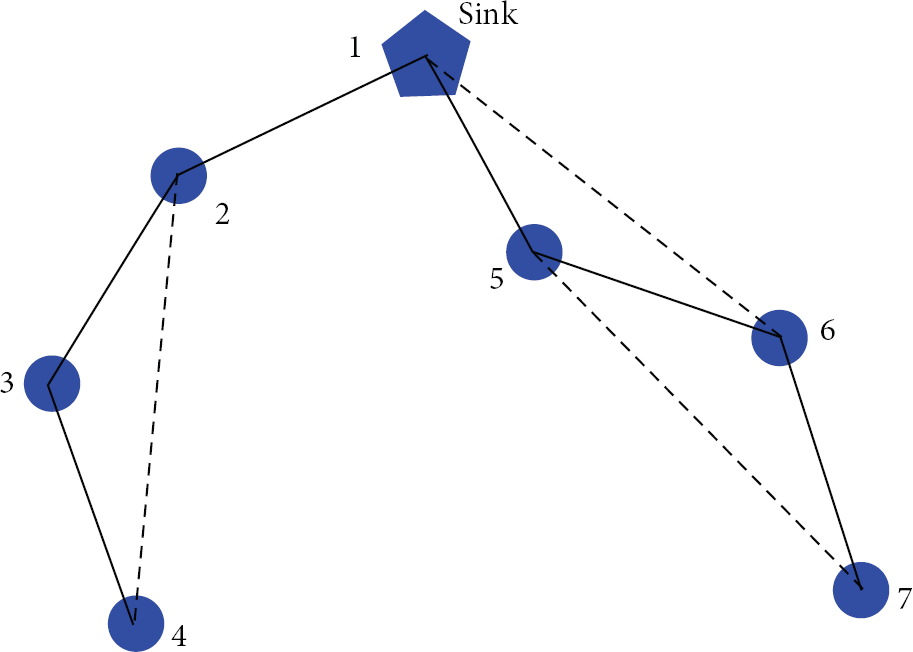
M2M device network scenario; solid line stands for a high-quality link and dashed line stands for a medium-quality link.
3.2. Medium Access Control Layer
We consider time synchronised channel hopping (TSCH) mode of the MAC protocol in IEEE 802.15.4e [3]. It defines a fixed time division multiple access (TDMA) frame structure that is centrally scheduled. Each link formed by a pair of neighbour devices is assigned to a unique time slot that repeats in a cyclical manner. The receiver wakes up only in the assigned slot and may enter a sleep state (i.e., switch off its radio transceiver) for the rest of time. After it has woken up, it either receives a packet if the transmitter has one to send or goes quickly back to sleep if a packet preamble is not detected within a short, predefined time interval, that is, a fraction of the slot duration. The slot without a packet transmission is denoted as the idle listen slot. We consider dedicated links that are scheduled for each transmitter-receiver pair to prevent packet collisions.
3.3. CDC-ARQ Overview
CDC-ARQ technique enables the efficient use of medium-range links. CDC-ARQ operates as follows: each new transmission is first attempted over the direct, medium-quality link, for example, over link 4-2 in Figure 1. If it fails, the packet is redirected to the multihop path that offers higher reliability (4-3-2). Time slots are assigned both for the medium-range and medium-quality links, as well as for the backup multihop path that consists of short-range equidistant links, as shown in Figure 2. If the initial attempt over medium-quality link succeeds, the receivers on backup links only perform idle listen in the fraction of their slots. With CDC-ARQ, two forwarding options cooperate to provide a better service for the current channel realisation. Short-range links are approximated to be equidistant and k times shorter than the direct links. The goal is to find a link distance coupled with the appropriate forwarding scheme that results in minimum energy consumption.
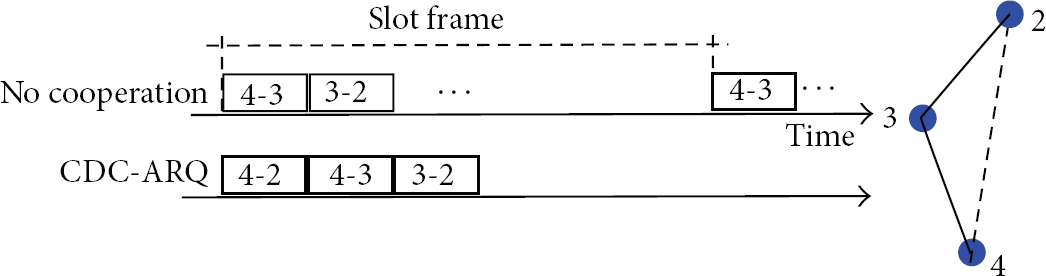
TDMA slot scheduling with and without cooperation.
3.4. Modulation and Coding
To exemplify the analysis, we focus on the transceiver of the IEEE 802.15.4 radios, working in the 2.4 GHz band, whose bit error rate


3.5. Channel Model
The wireless signal strength decays exponentially with distance as described by the large-scale pathloss channel model. Superimposed on this deterministic value is the random medium-scale fading model (also known as shadowing) and small-scale multipath fading. Given the transmission power


In dynamic environments, the assumption of γ being constant in time no longer holds. The empirical study of low-power wireless links in [5] showed that γ is correlated in time on scales larger than a packet duration, which results in effect denoted as link burstiness. In addition, medium success rate on a link is not the result of a corresponding constant packet success probability the realization of the channel fading, both comprising small-scale fading and shadowing, is drawn from distribution in (4); the system is duty-cycled such that for every original packet a new realization of γ according to lognormal distribution is encountered; in case of a transmission error, the packet is retransmitted up to
The last assumption is based on the fact that packet retransmissions are sufficiently close in time to experience link burstiness described in [5]. New packets however are generated at a rate at which burstiness effect disappears. Therefore, independent channel realisation is assumed for new packets.
3.6. Energy Model
From the exemplary radio transceiver data sheets, for example, [20], we distinguish two basic radio power modes (voltage sleep, awake (also, on), that further exhibits two submodes:
active, either transmitting or actively receiving idle (listen), waiting for signal
We assume that the output transmission power is set to

4. Energy Analysis for Low-Power Links
4.1. Average Number of Transmissions per Packet
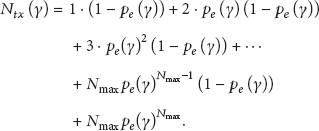
If the upper bound on the allowed number of transmission attempts per packet
Taking the channel model described in Section 3.5, the average number of transmissions for one realization of γ is then


4.2. Outage Probability
We define the outage probability


4.3. Energy Consumption Analysis
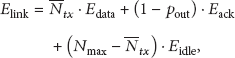
The mean energy spent both at the transmitter and at the receiver to exchange a packet over a link, that is, per time slot, is
For a fixed distance to the destination, a device may opt for a direct, multihop, or CDC-ARQ transmission. In case of a multihop transmission, we refer to the multihop path made of consecutive, equidistant links. A path begins with the source device, continues over
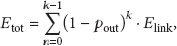

Therefore, we calculate the effective mean energy per delivered packet on a multihop path as follows:
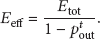
Finally, CDC-ARQ represents a combination of the two, as it alternates between the medium-range link and the multihop transmission depending on channel conditions. Recall that a transmission is first attempted over a direct link. If it results in error, the packet is immediately redirected because the probability of error for the subsequent attempts on the same link is high. If however the attempt over the direct link results in success, the time slots on a backup path remain idle. Therefore, the mean energy spent in a CDC-ARQ scheme for


Although the expressions for the network energy consumption in CDC-ARQ scheme for
For better readability, the notations used throughout the paper are summarized in notations section.
5. Performance Analysis
5.1. Implementation in ns-3 Simulator
ns-3 is an open-source, discrete-event network simulator written in C++. It consists of libraries for various technology models that implement the protocol interface and packet format (including the headers) by closely following the definitions of the corresponding standard. This approach enables a reliable simulation of the real system and facilitates the integration with a testbed. The final goal of a fully supported model is to enable each simulated device to run an entire protocol stack and generate the output trace that is (almost) indistinguishable from the output of a real device. Given that ns-3 is a network simulator, the unit of granularity is a packet, which contains both payload (in case of data packets) and a corresponding header. Each layer of a protocol stack executes its specified role; for example, the MAC layer at the transmitting side generates the MAC header, adds it to the payload received from the upper layer, and forwards a packet to the PHY layer where it is serialised and transmitted over the wireless channel as a set of bits.
The functionality required for this study has been implemented by modifying a model for the IEEE 802.15.4 standard, whose name is lr-wpan and whose source code can be downloaded from [21]. The MAC implementation available in the initial lr-wpan model supports the nonbeacon, mesh mode with all devices in the default idle listen state of the radio transceiver. This model has been significantly extended to include the duty-cycling operation of the devices, to support the energy consumption measurements, and to enable the path diversity necessary for the CDC-ARQ scheme. Firstly, duty-cycling has been implemented with TDMA as explained in Section 3.2. Contention during the CCA phase has been disabled and replaced with the simple CCA without random backoff as specified in [3]. Next, the existing log-distance path loss channel model has been extended with a realistic shadowing model described in Section 3.5 and defined with a standard deviation σ and a channel correlation in time. The CDC-ARQ functionality has been implemented by introducing dedicated tags in the packet header. Finally, the energy consumption module has been extended to subscribe to the changes in the state of a PHY radio transceiver in order to obtain the energy consumption directly from the device (i.e., from the simulated radio). The energy module is not aware of the wireless channel nor of the MAC layer scheme; therefore the two cannot interfere with the energy reading. Because of this design choice, an independent comparison with the theoretical model is provided.
5.2. Results
(
1) Simulation Parameters. The default values of simulation parameters are given in Table 1. The maximum number of transmission attempts
Simulation parameters.

(
2) Link Metrics. The first step in the validation of the energy model is to show that the presented metrics, namely,

Average Number of Transmissions per Packet as a function of link distance; payload of minimum
The (un)reliability of the scheme can be estimated with the number of packets that get discarded after

Outage probability as a function of link distance for different shadowing σ; output transmission power is set to 0 dBm.
( 3) Energy Consumption Optimisation. In the second step, energy consumption is measured in the simulation to verify the model derived in Section 4. While the first step focused on an isolated link, here we study various multinode scenarios. Results show how to optimise system's energy consumption in a multinode scenario. Given the reliability constraints, bounds for optimal link distances are shown to indicate the design choice between direct, multihop, or CDC-ARQ forwarding. For the strict reliability requirement, CDC-ARQ proves to be the most efficient forwarding strategy.
The mean consumed energy per delivered packet of the direct and multihop transmission is compared in Figure 5 for

Total mean energy spent per delivered packet for direct, 2-hop, and 3-hop transmission over the total source-to-destination distance.
For the applications with strict reliability requirements, link distances must be decreased. In the design phase, maximum
Figure 6 shows how much energy can be saved by applying CDC-ARQ in comparison to using the fixed multihop path exclusively. For total distances

Total mean energy spent per delivered packet with the imposed outage constraint
For source-to-destination distances
Although the data packet size L does not influence
(
4) Packet Delivery Rate. Finally, in order to demonstrate that the presented results satisfy the outage constraint set in advance, the total packet delivery rate for the given source-to-destination distance is measured in the simulation and the results are shown in Figure 7. Just as the model predicts, when

Total packet delivery rate for the given source-to-destination distance.
6. Conclusion
In this paper, we introduced a metric adequate for low-power wireless links denoted as Average Number of Transmissions per Packet. The metric considers shadow fading and truncated-ARQ. Based on this metric, we were able to calculate the energy consumption of devices compatible with IEEE 802.15.4e, that is, suitable for duty-cycled, low-power, and energy-efficient M2M networks. The energy model presented in this work was validated in the ns-3 network simulator in the realistic simulation environment that mimics the functioning of an actual device. Based on the energy model, we determined the optimal operating regions of direct, multihop, and CDC-ARQ forwarding, as well as the implications of using each. All these results provide useful guidelines on the design of an energy-efficient network, for systems with either loose or strict reliability requirements.
The presented model and the simulation tools can be further refined to include channel hopping and the related channel model implications. Also, more realistic battery models could measure device lifetime. This will be investigated in our future work.
Footnotes
Notations
Conflict of Interests
The authors declare that there is no conflict of interests regarding the publication of this paper.
Acknowledgments
This work has been partially funded by the Spanish Government through the research project GEOCOM (TEC2011-27723-C02-01) and by the European Commission under the FP7 Program through the projects NEWCOM# (FP7-318306) and ADVANTAGE (MC-ITN-607774).