




Abstract
In the view of the current cockpit information interaction, facilities and other characteristics are increasingly multifarious; the early layout evaluation methods based on single or partial components, often cause comprehensive evaluation unilateral, leading to the problems of long development period and low efficiency. Considering the fuzziness of ergonomic evaluation and diversity of evaluation information attributes, we refine and build an evaluation system based on the characteristics of the current cockpit man-machine layout and introduce the different types of uncertain linguistic multiple attribute combination decision making (DTULDM) method in the cockpit layout evaluation process. Meanwhile, we also establish an aircraft cockpit ergonomic layout evaluation model. Finally, an experiment about cockpit layout evaluation is given, and the result demonstrates that the proposed method about cockpit ergonomic layout evaluation is feasible and effective.
1. Introduction
Aircraft cockpit is the main space for the pilots operating flights and information interactions. With the development of mechanical and electrical technology, the facilities in the cockpit become more complex and the function becomes more comprehensive. The research of this ergonomic layout is to layout the cockpit facilities based on the certain principles, which are according to the ergonomics of flight conditions and mission requirements, in order to make a reasonable decoration inside the cabin space and to give ful space for the pilots to work efficiently, ensuring that the cockpit safety system is reliable [1]. Therefore, the cockpit ergonomic layout and its evaluation methods are the significant content for the aircraft conceptual design.
In the recent years, the foreign research on the cockpit layout is mainly designed and evaluated based on the pilots’ view distribution and used multifunctional comprehensive layout based on the digital display instrument on display [2]. And because Chinese pilots have many differences from the American and Russia ones, it is not proper to directly apply the related foreign research results’ data into our own aircraft cockpit design. And domestic research on such branch is largely confined to the evaluation and method research of the partial facilities; for example, the most used design and evaluation method is based on view distribution, which starts from one-point evaluation factor which cannot meet the fact of multiple attributes; in this case, it often causes the pilot premature fatigue during flight operation [3]; the cockpit comprehensive evaluation method from Beijing University of Aeronautics and Astronautics has made a relatively comprehensive evaluation system, but there will often appear uncertain linguistic information during the evaluation process, and the method does not put forward solutions to such problems [4]. Thus, cockpit layout design and evaluation is a typical comprehensive considered multiattribute problem; it needs a set of comprehensive evaluation systems and build an evaluation model in accordance with characteristics of cockpit facilities, pilots, and man-machine; in this way, we can reasonably and effectively design and evaluate the aircraft cockpit layout, so the research of cockpit ergonomic layout evaluation method is of practical significance.
This study focus on the man-machine-environment system from a new generation of cockpits, which meets the requirements of ergonomic design and evaluation, on the basis of the corresponding evaluation system established, to research on the corresponding requirements meeting the man-machine evaluation method, so as to establish a reasonable man-machine layout evaluation model and provide guidance of cockpit layout ergonomic design and evaluation for aircraft cockpit development.
2. Evaluation System
Aircraft cockpit ergonomic layout is a typical man-machine interaction in small space, which the layout cases are designed and evaluated, not only based on the physical relation between the cockpit facilities and pilots, but also obtained from the different types of uncertain linguistic evaluation information. For these reasons, a certain evaluation system for the aircraft cockpit and its users is a key evaluation carrier for selecting the optimal layout case, namely, the most effective, reasonable, and comfortable cockpit layout.
2.1. The Conditionality of Cockpit Layout
Due to the complexity of the facilities and relationship between man and machine, the variability of the layout cases causes uncertainty and variability in the operation mode. And the variability and uncertainty can usually make unpredictable effects during flight operation [3]. Assume α is an element of cockpit layout facilities domain A, where element α is also in the specific set X, which is one part of the cockpit layout principle domain B; there is a set Y corresponding to the above in the pilot requirement domain C. Assume β is an element of pilot requirement domain C, where element β is also in the set Z in the cockpit layout principle domain B, as shown in Figure 1, where domain O represents layout cases, and domain O′ represents the optimal layout cases.

Attributes relationship diagram of evaluation system.
Figure 1 illustrates that the target optimal solution may not be the only one, according to the facility requirements, pilot requirements, and cockpit layout principles of aircraft cockpit ergonomic layout. That is to say, the optimal case should be selected according to these three parts mutually constraint, and the optimal can be the only one, or several ones. That is why the variability of cockpit layout is caused by many factors, and the required optimal solution embodies the conditionality of layout method research.
2.2. Multiple Attribute Evaluation System of Cockpit Ergonomic Layout
The cockpit ergonomic layout method defines this study as recent new type cockpit layout method and its evaluation method is in accordance with ergonomics.
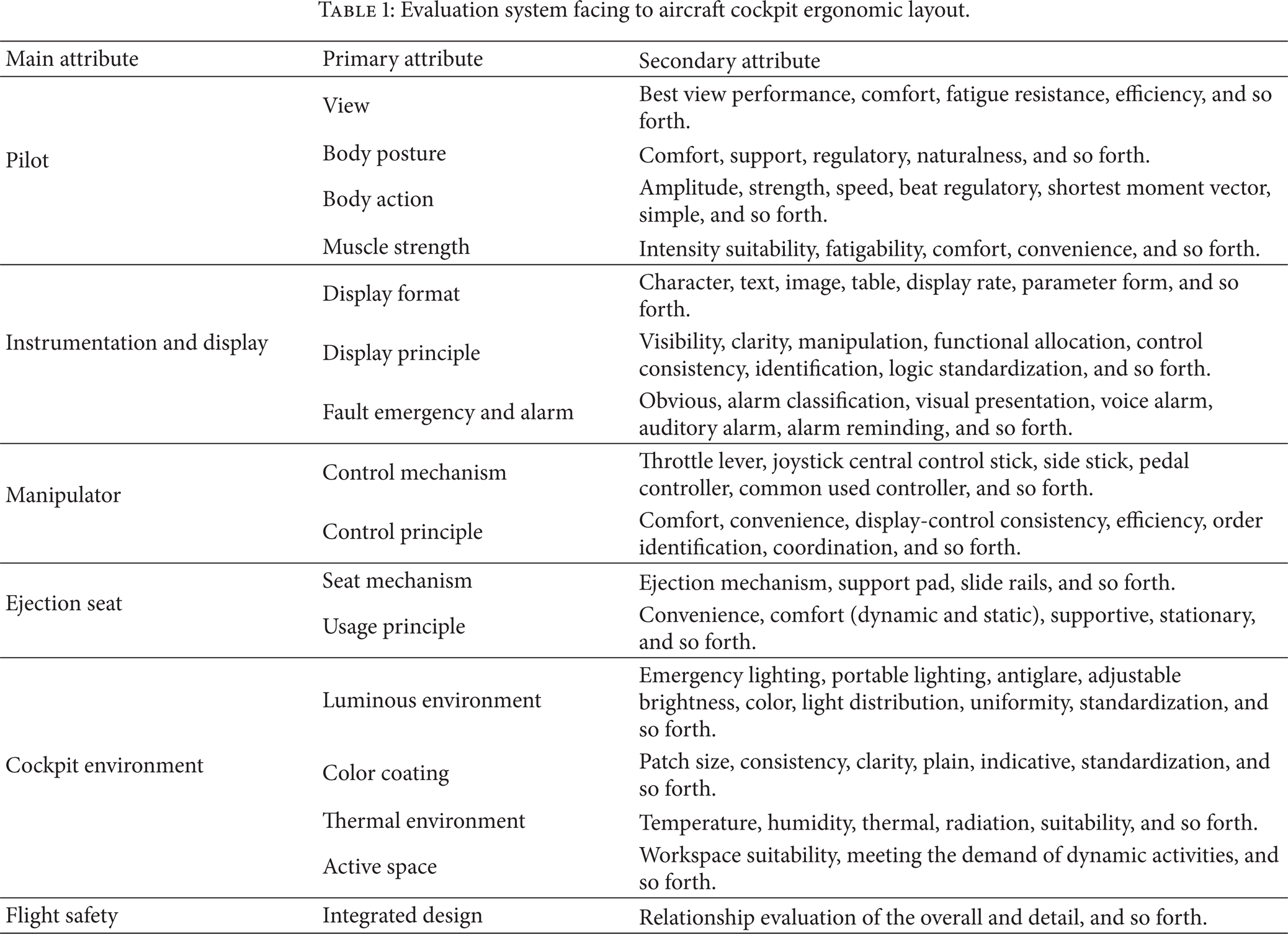
Aircraft cockpit layout has a characteristic of multiple attributes, for example, pilots, instrument and meter, and ejection seat are the main attributes; and each main attribute has many primary attributes, like body posture, view, muscle strength of pilot, instrumentation and display's principle and display, usage principle of ejection seat, and luminous environment of cockpit environment, where different main primary attributes also have common primary attributes. Recently, the evaluation method of cockpit has ergonomic comprehensive evaluation via the view of pilots, but this reference is inadequacy and unitary, so we need to esTablish a cockpit evaluation system, including all the attributes of aircraft cockpit layout of ergonomic factors and give the corresponding evaluation index, as shown in Table 1.
Evaluation system facing to aircraft cockpit ergonomic layout.
In the earlier cockpit ergonomic layout, evaluation methods are based on the experts’ experience, which consists of much uncertainty. And evaluation system is also affected by other objective factors, such as the production level of domestic manufacturers, related enterprise culture, and decision making; namely, there may appear different orientation on the same type of cockpit evaluation content at one time. In this way, we need to put forward a set of all attributes as integration for the evaluation from the perspective of vague sets, to evaluate the cockpit ergonomic layout comprehensively, so as to get the most appropriate layout case.
In the real cockpit layout cases, there is a close relationship between the evaluation attribute and function application. Some facilities, such as display, controller, and light, are the main parts for the pilots under the flight operation, so the ergonomic weight of these attributes is higher than others, in the other way, like the ergonomic attribute value of ejection seat's slide rails construction is lower. Because the weights of each attribute and attribute level is determined jointly by different facilities, pilots’ requirements, and other elements, there is also a larger difference between different evaluation indexes [5, 6].
The ergonomic evaluation of cockpit man-machine layout is a multiple attribute decision making process focusing on the pilots and cockpit facilities [7]. Due to the diversity and conditionality, the cockpit layout has a characteristic of comprehensive and multi-attribute relationship, which needs to be evaluated in groups, in order to determine the corresponding optimal layout case under the related conditions. The common comprehensive evaluation methods are expert evaluation methods [8], but because of the complexity of the objective things, uncertainty, and ambiguity, when the evaluation process is restricted by subjective and objective factors, the attribute value is often given in the form of language or uncertain linguistic variables. In addition, each attribute factor mutually influences each other in the evaluation process. However, the complexity and uncertainty also make the evaluation information form the characteristics of uncertainty and linguistic [9]. As a result, we introduce the combinatorial theory of uncertain linguistic multiattribute decision making into the cockpit man-machine layout evaluation, which can improve the effectiveness and reasonability of the layout cases evaluation.
3. Method about Aircraft Cockpit Ergonomic Layout Evaluation Based on DTULDM
Aircraft cockpit ergonomic layout evaluation is a typical multiple attribute decision making (MADM) problem. With different types of uncertain linguistic information, in order to solve the highly decision making problem, we introduce a kind of the DTULDM method and use DTDM and ULWA operators to solve the ergonomic layout evaluation problems in aircraft cockpit system.
3.1. Definition of DTULDM
In the process of the ergonomic layout evaluation, consider that decision makers (DM) generally need an appropriate linguistic assessment scale; we can set a linguistic assessment scale beforehand: S = {s
i
∣ i = − t,…,t}; t is a natural number, whose cardinality value is an odd one, such as 9 and 11, and it requires the following: (1) s
i
> s
j
, if i > j; (2) there is a negation operator rec(s
i
) = s
j
, especially i + j = t + 1; (3) max(s
i
,s
j
) = s
i
, if s
i
≥ s
j
; (4) min(s
i
,s
j
) = s
i
, if s
i
≤ s
j
[10]. But the decision makers may provide different types of linguistic information as a result of work pressure and lacking of professional knowledge and experience; in these cases, some results may not exactly match any linguistic label in S. To preserve all the information [11], we extended the discrete linguistic label set S to a continuous linguistic label set
Definition 1 (see [12]). If ergonomic layout evaluation linguistic information sα ∈ S, then sα is a termed original linguistic label; otherwise, sα is termed a virtual linguistic label. Usually, the DM use the original linguistic labels to evaluate ergonomic layout cases and the virtual linguistic labels can only appear in the actual calculation.
Definition 2 (see [12]). For any two layout evaluation linguistic labels
Consider that the DM give three uncertain linguistic variables; then set
Definition 3 (see [12, 13]). Let

Let

Consider the different types of linguistic information given by the different DM; we need to provide this method to preserve all the information and the reasons to keep them in order. So the DTDM is called different types of linguistic information decision making function, DTDM for short.
Definition 4 (see [13]). According to the above definitions, sets

Definition 5 (see [14]). Set ULWA:

where w = (w1,w2,…,w
n
)
T
is the weighted vector of uncertain linguistic data; set
For the uncertain linguistic multiple attribute decision making problems, assume that experts measure the cases A
i
∈ A(A1,A2,…,A
m
) on the attributes C
j
∈ C(C1,C2,…,C
n
), gain the attribute value of case A
i
on the attribute C
i
, and then compose an uncertain linguistic decision making matrix
In the process of aircraft cockpit ergonomic layout evaluation, each layout case should have the biggest bias with the uncertain linguistic negative ideal solutions, in order to obviously differentiate the pros and cons of all the cases [15, 16]. According to the combination method, the choice of the attribute weighted vector w should make all the layout cases’ sum combination bias largest in all the attributes.
Definition 6 (see [14]). Solving the weighted vector w problem is equivalent to solving the single objective optimization problem as follows:

This step is for weighted normalization, where
Definition 7 (see [14]). Use ULWA operators to aggregate the attributes of uncertain linguistic decision making matrix

Obviously, if general attribute value
3.2. Aircraft Cockpit Ergonomic Layout Evaluation Method Research
The different types of uncertain linguistic decision making in aircraft cockpit layout evaluation can be determined according to the evaluation system and method DTULDM. Assume experts measure the cockpit man-machine attributes C
j
∈ C(C1,C2,…,C
n
) of layout cases A
i
∈ A(A1,A2,…,A
m
) and have attribute value
Step 1. Calculate the distance between all the attribute values using DTDM method; then use ULWA operators to aggregate the cockpit ergonomic attribute values of the layout evaluation decision making matrix

Step 2. Use (6) to aggregate the general attribute values

Step 3. Use (3) to compare

where

And obtain ranking vector
Step 4. Rank the cockpit layout evaluation cases in descending order according to the value of w; the larger the value of w, the better the corresponding cockpit layout case.
From the above procedure, we know that the DTULDM method first calculates the absolute distance between each case and two linguistic ideal solutions and calculates the relative distances based on these absolute distances. Then use ULWA operators to rank and select the cockpit layout cases, which can carry out the optimal case without loss of any information and make the final decision result effective and reasonable.
4. Verified Experiment
In this section, we take four ergonomic layout cases of one cockpit CAID model, using the aircraft cockpit ergonomic layout evaluation system, and the method mentioned above as examples to determine the optimal aircraft cockpit ergonomic layout case.
Here are four CAID cockpit layout cases A1~A4 (Figure 2), which are single driving cockpit internal layouts. According to the requirements of the evaluation, experts select five evaluation attributes C1~C5 from Table 1, which are the pilot visual comfort (the primary attribute of view in the main attribute of pilot), display-control consistency (the primary attribute of the display principle in the main attribute of instrumentation and display), order identification of manipulation (the primary attribute of the control principle in the main attribute of manipulator), ejection seat convenience (the primary attribute of usage principle in the main attribute of ejection seat), and antiglare degree (the primary attribute of luminous environment in the main attribute of cockpit environment).

Cockpit layout evaluation experiment subjects.
Because the evaluation system includes almost all the attributes of the modern cockpit layout, the experts need to select what the aim of evaluation is, and the results can be compared from different emphasis. In this case study, the experts are to determine the optimal aircraft cockpit ergonomic layout case based on these five attributes. The linguistic assessment scale is given as follows: S = {s−4,s−3,s−2,s−1,s0,s1,s2,s3,s4} = {worst, worse, bad, notgood, general, a bit good, good, better, best} (i.e., if one expert evaluates the order identification of manipulation between a bit good and good in Case 2, in which s1 represents a bit good and s2 represents good, then it can be filled in like [s1,s2]) and gives a decision making matrix as listed in (11). Consider

In the following parts, we utilize the proposed method to determine the optimal layout case; here are the concrete steps:
Step 1. from Table 1, we get the vectors of these five attribute values corresponding to the four layout cases A1~A4; let (5)a = b = c = d = 1/4, and get the optimal attribute weighted vector w of cockpit layout case: w = (0.1548, 0.1798, 0.2056, 0.2199) T .
Step 2. Use (8) to get the cockpit ergonomic layout general attribute values

Step 3. According to (9), we compare the cockpit general attribute values
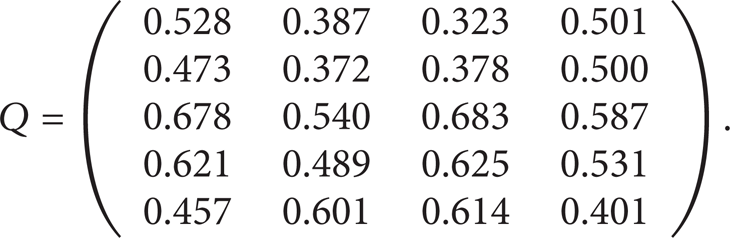
And we use (10) to calculate the ranking vector of complementary judgment matrix Q,

Step 4. Finally we can use w(i = 1, 2, …, 4) to rank the cockpit ergonomic layout general attribute values

and use this order to rank the cockpit layout cases
5. Conclusion
Aircraft man-machine layout cases evaluation is a multiple attribute combination decision making problem. Through building a corresponding cockpit man-machine layout evaluation system, we put forward a combination evaluation method of uncertain linguistic multiattributes based on DTULDM operators and verified the method by a real layout case experiment. The research method in this study can quantificationally evaluate the cockpit ergonomic layout case and compare the pros and cons of different cases, avoid experts’ evaluation deviation, and reduce the development cycle. At the same time, the research method can also provide a reference for related field ergonomics evaluation, such as helicopter cockpit or fighter cockpit man-machine layout.
Conflict of Interests
The authors declare that there is no conflict of interests regarding the publication of this paper.
Footnotes
Acknowledgments
This work was partly supported by the 111 Project (Grant no.B13044), National Natural Science Foundation of China (Grant no. 51105310), and National Key Technology R&D Program (2006BAF01A44).