



Abstract
Reliability and energy consumption are two of the main constraints in wireless sensor networks (WSNs). In this paper, a novel energy efficient and high speed error control scheme is introduced that is based on the Redundant Residue Number System (RRNS) allowing real-time application of WSNs. The proposed approach employs a new 3-moduli set
1. Introduction
Wireless sensor networks with a large number of multifunctional low power sensor nodes have a broad range of applications, such as battlefield surveillance, environmental monitoring, disaster relief, and healthcare [1–5]. The main task of wireless sensor networks is to collect the sensed data from environment and send them back to the sink node for further processing. Because of the dynamic, lossy, and low-power nature of sensor networks, two of the most important constraints that designers have to overcome in these networks are energy consumption and reliability [6]. Moreover, high speed operation is another critical issue in real time wireless sensor networks applications. In-network data aggregation which is proposed for energy conservation [7] and error control schemes such as Automatic Repeat reQuest (ARQ) and Forward Error Correction (FEC) is used to improve reliability. In ARQ-based schemes, the receiver must detect lost packets and then request the sender to retransmit packets [8]. In FEC codes, to transmit data from sensor to the sink node, each aggregator must decode the received data, aggregate them with new data, and encrypt them again before sending to the sink node. These operations cause a significant end-to-end delay and high energy consumption, which leads to a decrease in the network lifetime. Therefore, it is necessary to develop a new solution that offers both low power consumption and guaranteed reliability as well as low end-to-end delay in real-time wireless sensor networks.
In this paper, authors utilize RRNS to design a reliable, energy-efficient, and high speed algorithm for real time applications of wireless sensor networks. The proposed RRNS-based model offers desirable features including robust security, an enhanced error detection, and correction capability. Furthermore, the solution allows parallel operations and thus making real-time functionality as well as the use of low-power components possible. By employing a 3-moduli set
The rest of the paper is organized as follows: a few of related works are discussed in Section 2. In Section 3 a full description of the proposed scheme is presented. This is followed in Section 4 by a detailed explanation of an efficient reverse converter design and derivation of the necessary expressions. In Section 5, error controllability of the proposed scheme is evaluated through simulation. Finally, the paper is concluded in Section 6.
2. Related Works
As was discussed in the introduction section, error control methods in WSNs are divided into two general categories, namely, Automatic Repeat reQuest (ARQ) and Forward Error Correction (FEC). The ARQ method is used only for error detection and once a corrupted data is sensed, a request for information retransmission is made. This approach is based on Cyclic Redundancy Check (CRC). To set specifications for a CRC code it requires a generator of polynomial to be defined. This polynomial resembles the divisor in a polynomial long division, which takes the message as the dividend and in which the quotient is discarded and the remainder becomes the result, with the important distinction that the polynomial coefficients are calculated according to the carry-less arithmetic of a finite field. In order to make checksum, attach a polynomial generator to the packet before it is transmitted. At the receiver, if the division of the bit stream by
By adding redundancy to the sent data, the FEC codes let the receiver detect the errors and correct them by itself. One of these codes is BCH which is represented by (n, k, t), where “n” refers to the length of the total sent bits, “k” denotes the length of the main data, and “t” stands for the maximum number of the errors that could be corrected.
In the age of modern wireless communications, the need for end-to-end reliable data transfer is growing incessantly. Fortunately, to ensure error free transmission, a variety of popular error control techniques devoted to error detection and correction have been published in the literature. In what follows, a number of these reported methods are examined to ascertain how they achieve their objectives. In [6, 11] for example, we note that error control schemes in Bluetooth sensor networks were explored, that is, a low cost wireless technology designed to facilitate the formation of ad hoc networks. In [11], authors studied an energy efficient model for adaptive and custom error control scheme and also investigated energy consumption and reliability constraints of WSNs. For custom coding, they introduced new packet types using some error control strategies. These new packets exploited CRC for error detection (without ARQ), BCH code with and without CRC, and the Hamming code with and without CRC. They also unveiled two adaptive techniques and a packet selection strategy that was based on channel state. The result of their analysis showed that error recovery was energy efficient provided that the channel conditions were known and a suitable control scheme was employed. This meant that with good channel conditions, there was no need to vary energy consumption and the use of packets with little or no error protection resulted in an efficient scenario. However, for low values of signal to noise ratio (SNR), the BCH packet offered the most effective tool due to its ability to correct more errors, in spite of higher energy consumption. Thus, under the circumstances where the error occurrence probability was high, a more robust error recovery strategy had to be employed for the network.
Notice that the results obtained in [11] were only applicable to networks, where designers had access to information on the channel conditions. Moreover, power consumption of the WSN had to be taken into account. It is clear that in situations where channel conditions are very vulnerable a robust error control scheme is the best choice. But the feasibility of this choice must be considered against energy constraints of the given WSN. Another work that also focused on reliability in Bluetooth sensor networks was presented by Khodadoustan et al. [6] which included an attempt to establish reliability/energy tradeoff in Bluetooth error control scheme. The paper investigated a combination of ARQ and a particular CRC code known as CRC-CCITT and also carried out an analysis of the data packets by using different BCH codes. Furthermore, by conducting simulations, authors examined the proposed coding techniques' performance as a result of changes in the number of hops and their effect on SNR. The results of this study can help network designers to decide on suitable packet types and error control schemes. Turning to [8, 20], we find that researchers' main interests were in reliability for underwater wireless sensor networks (UWSNs). Sensors in underwater wireless sensor networks are often mobile and the channels are acoustic. Such WSNs have low available bandwidth, large propagation delays, high error probability, and highly dynamic network topology [20]. Thus, error recovery is a major challenge in underwater wireless sensor networks.
Guo et al. in [8] suggested the use of network coding in multipath for UWSNs to achieve efficient error recovery in the presence of high error probability. An analytical evaluation of the performance of this scheme against several other error-recovery systems revealed that this method was very efficient in terms of error recovery and energy consumption.
Segmented Data Reliable Transfer protocol (SDRT) was another solution that authors reported for UWSNs in [20]. SDRT was a hybrid approach based on ARQ and FEC techniques which adopted efficient erasure codes whereby the packets were transmitted block-by-block and hop-by-hop. Moreover, a mathematical model was subsequently put forward which achieved further energy saving and enabled designers to set an appropriate size for the block for each packet. By using this model, the number of needed packets could be accurately predicted.
Iyer et al. in [21] offered STCP protocol which is a reliable end-to-end transport protocol. This protocol provides different levels of reliability in accordance with application; that is, it provides two levels of reliability for data flows for event-driven and continuous data flow applications. When packets are transmitted, for event-driven applications and continuous data flow applications, ACK packets and NACK packets are used to indicate that the packets have reached the destination, respectively. Before transporting packets over STCP, sensor nodes transmit a Session Initiation packet to the base station. This Session Initiation packet sends data such as the type of data flow, transmission rate, and number of flows to the base station. The base station then stores this packet and sets timer and other parameters of this data flow. When data is received, the base station sends a ACK message to make connection. When sensor node receives ACK, it starts to transmit data. The base station transmits ACK or NACK message, based on the type of the flow. STCP transfers packets according to the size of the window. Also, this method has a congestion detection mechanism and employs occupancy monitoring of the queue of intermediate nodes. The assumption in this paper is that all network intermediate nodes have clocks which are synchronized by sink.
Marchi et al. in [22] suggested a reliable transport protocol called DTSN. This method provides two levels of reliability and is based on full reliability and differential reliability. If it is required that all packets are received at the destination accurately, full reliability is used; otherwise differential reliability is employed. DTSN relies on Selective Repeat ARQ and uses ACK and NACK to provide full reliability. Packets transmit data packets to destination in accordance with the size of Acknowledgment Window (AW). Then Explicit Acknowledgement Request is transmitted to destination. If the destination has received all the packets, ACK packet will be sent; otherwise NACK packet will be sent. DTSN protocol adds Forward Error Correction (FEC) mechanism to provide differential reliability. In this method, a session is a source/destination relationship univocally identified by the tuple
In all of the aforesaid schemes, there is the need for data decryption and encryption during the aggregation phase using secret key. Thus, these algorithms are very energy and time deficient. Moreover, the security and confidentiality of data are in great peril because of decryption of the received packet in each aggregator, aggregation of the recovered message with the new data and, finally, encryption of the new data by the aggregator that is to be sent to the sink. In the proposed scheme, security is preserved in each aggregator and there is no need to decrypt and then encrypt the data again in each aggregator, which results in notable conservation of energy and reduction of transmission time.
In addition to these, none of the above schemes considered the “delay” parameter. Although WSNs are immensely popular but for real-time applications, end-to-end delay becomes a critical design issue. In such circumstances, if delay turns out to be more than a fixed value, the results and information will be useless. It is clear, therefore, that methods presented in [1, 6, 8, 20] could not be adopted effectively and again the technique explored in this paper is the one that meets the requirement for high speed operations.
3. The Proposed Scheme
Minimizing energy dissipation and maximizing network lifetime are among the central concerns when designing applications and protocols for sensor networks. Clustering has been proven to be energy efficient in sensor networks since data routing and relaying are only operated by cluster heads. Besides, cluster heads can process, filter, and aggregate data sent by cluster members, and thus reducing network load and alleviating the bandwidth.
Residue number system is a nonweighted system that employs residue of numbers divided by several specific moduli to represent them [23–25]. Residue number system can be used for computational applications that need real-time processing such as digital signal processing [26], digital filtering [27], image processing [28], RSA encryption algorithm [29], and digital communications [30].
A residue number system is defined in terms of relatively prime modulus set

Such a representation is unique for any integer X in the range
Redundant Residue Number system is specified by moduli set
In the Redundant Residue Number system with
Having studied a variety of literature on the issue of error control in WSNs and the challenges it poses, the proposed scheme has come up with a solution that is based on Redundant Residue Number System (RRNS). The algorithm offers many advantages and overcomes the weakness seen in other approaches. Here, each sensor in a cluster computes remainders of the sensed data using a predefined modulus set and sends the result, that is, data which is a smaller number compared to original data, to the cluster head where the received numbers are then aggregated. It is clear that since aggregation is being performed on remainders rather than on the entire sensed data, it allows for more compact processing units to be utilized at reduced power consumption in cluster heads and also given that all aggregation operations take place in parallel; this has the benefit of increasing the speed noticeably. It should also be noted that unlike other methods studied, where preaggregation decoding and postencoding are required, in the proposed scheme these processes are unnecessary and only cluster head aggregation operation is required. It is therefore seen that this solution results in a significant drop in end-to-end delay which makes it suitable for real-time wireless sensor network applications.
The proposed method for error control could be applied to tree-like network topologies and cluster based network topologies. In tree-like network, children transmit the residue of their sensed data, that has been divided by the moduli set, to their parent and their parent will aggregate the received residues and his own residues. Next, the parent transmits the result to his own parent. This will continue until the residues reach sink. In a cluster-based network, the members of the cluster transmit the residue of their sensed data divided by moduli set to head cluster. Then the head cluster aggregates the received residues and its own residues and transmits the result to the next head clusters.
In this study, we considered 5 moduli, 3 main and 2 redundant. Since wireless sensor networks are limited in terms of energy, processing power, size, memory,…., selection of the number and value of moduli was made in a way that their reverse converters led to the lowest energy consumption and delay. How we select the main moduli determines the value of dynamic range (obtained by product of main moduli). In fact, if we increase the dynamic range, it will allow us to represent larger numbers using the proposed method. On the other hand, increasing the number of redundant moduli results in higher capability of error detection and correction. Thus, if t redundant modulo is considered, t modulo containing error can be detected and
An example illustrating the basic theme of the proposed scheme is shown below, consisting of six sensors located in two clusters. Each cluster has three sensors and a cluster head. In this example, aggregation is a summation operation where the remainders of 5 based on the moduli
Now, in order to achieve a lower power consumption and as compact a design as possible, a new moduli set

An example of data aggregation functionality using the proposed scheme.
Hence an efficient reverse converter is needed. There are two basic approaches that convert a number from RNS to its binary equivalent. These are the Chinese Reminder Theorem (CRT) and Mixed Radix Conversion (MRC) [6], with MRC algorithm being the preferred choice in this paper. Considering also that reliability in data delivery is an important issue in almost all wireless sensor network applications, two-redundant-moduli set
4. Design and Implementation of Proposed Residue to Binary Converter
Various methods can be used to design a reverse converter. The most popular methods are MCR and CRT. The use of CRT or MRC depends on selected moduli since multiplicative inverse should be computed in both methods. Computation of multiplicative inverse is the most difficult part of reverse converter. Therefore, it is important to look for multiplicative inverses that allow the formulation of the most simple equations. Certain moduli set can be designed well and at less cost by employing MCR since their multiplicative inverse is computed more easily through simplified (less complex) equations. As a result, the volume of required hardware and consumption of energy as well as network delay are all reduced. In this study we applied MRC. Using this method the values of multiplicative inverse become so simpler, and the design of the reverse converter costs so much less.
The residue to binary conversion can be performed using the MRC algorithm as follows:


In the general case, we have

According to (2)–(5), the proposed reverse converter can be designed for the new 3-moduli set
Consider the 3-moduli set
Proposition 1.
The multiplicative inverse of
Proof.
One has

Proposition 2.
The multiplicative inverse of
Proof.
One has

Proposition 3.
The multiplicative inverse of
Proof.
One has

Therefore, let the values


In order to design an efficient reverse converter, expressions (9) and (11)-(12) can be rewritten as follows:


Now, in order to implement


Finally, to obtain X based on (9), we have
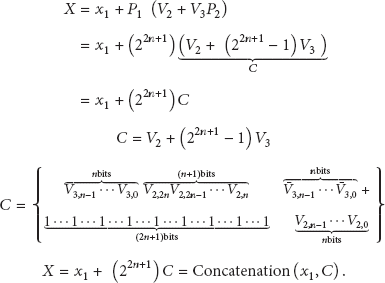
The area and delay specifications for the proposed reverse converter are shown in Table 1.
Characterization of each part of the proposed reverse converter.

From this Table, we have

Now let us discuss comparison of the proposed reverse converter's performance for the new moduli set
Area and Delay comparison.

5. Performance Evaluation
In this section, the performance of the proposed moduli set
This means that if error bits are residing in one modulo, the error control algorithm can easily detect and correct them. However, when error bits are located in more than one modulo, they cannot be corrected although it may be possible to detect them. So, the aim now is to discover what the average percentage of error detection is when error bits reside in more than one modulo by employing the proposed RNS based solution.
In the proposed moduli set,
In the proposed error control method, first sensed data are divided by the proposed moduli set and then the residues are computed. Next, the nodes transmit the residues instead of sensed data. After receiving residues, sink computes the original data using 3 main moduli and their received residues. When the residue of the computed number has been divided by redundant moduli and the received residues for those redundant moduli are not equal, an error is detected and error correction procedure is called for it. Sink can reconstruct the original data using 3 residues out of the 5 residues and MRC reverse converter. There are only 10 possible conditions for selecting 3 residues out of 5 residues (
In order to gauge the error detection capability of the proposed set in a situation where errors occur in more than one modulo and, where therefore, no correction is possible, we simulated the behavior of the error control algorithm using C++ programming language. The experiment runs 30′000′000 different error bit states by setting
Area and delay comparison.

With reference to Table 3 there are several individual conditions for error detection: among the 5 received residues only 1 residue contains error; 2 residues contain error; 3 residues contain error. Since 2 redundant moduli have been considered for this moduli set, error correction of a received residue is possible. It makes no difference whether just one or all bits of the modulo are damaged; this can be corrected. Based on the damaged bits of the residues we will have different conditions (e.g., it is possible that the first and second bits, the first and third bits, or any other combination of bits are damaged); simulation in C++ language considers all these conditions. All possible conditions are simulated for
We evaluated the proposed scheme through NS-2 simulation tool [35]. We considered a randomly deployed network, that is, one hundred nodes that were initially spread over an area of 100 square meters in a random manner. The radio coverage of each sensor node and sink was assumed to be a circular area of 100 m in diameter. The antenna model deployed was omnidirectional. Also, the initial energy of sensor nodes set to 0.1 Joule.
The proposed scheme was analyzed in terms of energy consumption, end-to-end delay, and network lifetime using STCP [21], DTSN [22], TCP, and Reed Solomon. Table 4 shows the simulation parameters.
Simulation parameters.

All simulations were repeated 10 times before calculating the average of the results. As illustrated in Figure 2, the simulation results confirm that the proposed scheme consumes significantly less energy than the other schemes investigated. In Figure 3 end-to-end delay is examined where it can be seen that the proposed scheme generates less network delay. Finally, in Figure 4 it is easy to see that the proposed scheme outperforms its counterparts in terms of network lifetime.

Total energy consumption.

End-to-end delay.

Average network lifetime.
6. Conclusion
In this paper, authors unveiled an innovative energy-efficient algorithm for real time wireless sensor networks that was based on a new 3-moduli set
The new method's error correction capability was found to be
By simulating the proposed error control scheme, using an ns-2 network simulation tool and making comparisons against some popular methods, outperformance in terms of reductions of energy consumption and end-to-end delay as well as extension of network lifetime was clearly evident. These advantages therefore make the proposed method more desirable for real-time wireless sensor network applications where reliability, low energy consumption, and high speed operations are absolute necessities.
Footnotes
Conflict of Interests
The authors declare that there is no conflict of interests regarding the publication of this paper.