




Abstract
A relay transmission is a promising technology to improve network performance in dynamic infrastructure. In this paper, we propose a distributed relay-assisted retransmission (DRR) scheme in multirate wireless home networks. The idea is to exploit overhearing nodes to retransmit on behalf of sender node after receiving the block acknowledgement (B-ACK) from destination node. For the first transmission, a basic relay (BR) node is used by considering the high data rate between source node and BR node. And then, for the retransmission, a retransmission relay (RR) node is used by considering the high data rate between RR node and destination node. The DRR scheme extends a distributed reservation protocol in WiMedia home networks and inquires the candidate relay node as BR nodes and RR nodes during beacon period. In addition, the DRR scheme can minimize control overhead for relay transmission because all nodes should send and listen to the beacon frames of neighbor nodes during beacon period. We also present the relay decision scheme and channel allocation procedure for maximizing the efficiency in the DRR scheme. Extensive simulation results demonstrate that the DRR scheme can improve the overall throughput by 40% and reduce the energy consumption by 47% compared with nonrelay transmission schemes when the number of nodes increases.
1. Introduction
Recently, there has been a growing interest in relay technologies to extend the coverage and improve the reliability of wireless networks by exploiting the spatial diversity gains [1]. In basic relay scheme, packets are transmitted along the relays via a store-and-forward manner, and thus the use of relays does not guarantee perfect transmission (i.e., no error transmission) [2, 3]. Dealing with this, diverse retransmission mechanisms are applied at relays to improve the successful transmission rate over wireless networks. In addition, the multirate transmission mechanism is one of the important relay transmissions to improve the system performance. Most of the wireless networks (i.e., IEEE 802.11 series, 802.15.3 series, and WiMedia MAC) can support multiple transmission rate by adaptively choosing the most appropriate modulation under the current channel conditions [4–6]. For instance, IEEE 802.11a/b wireless local area networks (WLANs) provide diverse transmission rates depending on the distance between source and destination nodes (i.e., 1 Mbps at 100 m, 2 Mbps at 74.7 m, and 11 Mbps at 48.2 m) [7]. The rate adaptive mechanisms by diverse PHY modulations have been studied based on request to send (RTS) and clear to send (CTS) for IEEE 802.11 WLANs. In such multirate wireless networks, relay transmission can improve the overall system performance and reduce the energy consumption, since relay transmission supported that the high transmission rate can reduce the transmission time compared with direct transmission over a lower data link.
Relay communications have been investigated and included in long term evolution-advanced (LTE-A) and IEEE 802.16 m candidates for the international mobile telecommunications-advanced (IMT-A fourth generation) standards [8, 9]. Representatively, the automatic repeat request (ARQ) mechanism can deliver reliable transmission over multicast and broadcast networks [10]. However, the retransmission of failed packets using ARQ schemes may cause a significant delay problem since the transmission failed packets are retransmitted individually and the retransmissions have to be repeated until every destination nodes receive all packets correctly. Furthermore, many studies have been researched to support the relay transmission in various wireless networks. The multihop mechanisms for the relay transmission have been emphasized as the cooperative communications. Liu et al. propose the cooperative MAC by defining the helper ready to send (HTS) using the overheard transmission [11]. Cetinkava and Orsun suggest the cooperative MAC protocol by choosing proper backoff window to be achieved with no compromise in throughput performance for dense wireless networks [12]. Shin et al. provide the use of beacon period to select relay nodes in distributed wireless networks [13]. Wang et al. address the dual communication mode considering different transmission paths with peer to peer path and relay path in ultra-wide band (UWB) WPANs [14]. However, there still exists the problem of compatibility between the relay node and the retransmission problem in distributed wireless networks. The previous work has the control overhead problem; if nodes want to relay packets, they should learn the information of neighbor nodes. In addition, the overall throughput and power consumption of the system suffer from sending the packets through the same path between relay node and retransmission node even though the packets are failed by the relay path.
In this paper, we propose a distributed relay-assisted retransmission (DRR) scheme based on the WiMedia home network standard by using the distributed beacon period. As our knowledge of prior studies, any significant relay mechanism for distributed network to minimize the overheads due to control frames has not been proposed before. Consequently, we focus on the considerations of how to avoid additional control frames when neighbor nodes are collecting information of neighbors and how to maximize the successful transmission rate with the efficient retransmission assisted relay nodes. As a 1st step, we define a distributed relay decision procedure to determine a basic relay (BR) node. Each node manages the modulation support to neighbor (MSN) table which includes the modulations between a node and neighbors. To acquire modulation information of neighbors, we define a new information element for relay decision (RD IE) which includes the request and response frames according to modification of the beacon frame. After all, since all the exchange process of beacon frames is executed during beacon period while RD IE is attached to the default beacon frame, there are no more header frames added except for the minute size of RD IE. Through the MSN table and RD IE, the BR node is selected, then the source node can transmit the packets to the BR node, and the BR node also can transmit the packets to the destination node, respectively. However, this process does not guarantee perfect packet transmission, because the packet error or transmission fail can occur during the source to BR node path or BR node to destination path. Therefore, we also define a relay-assisted retransmission to support the retransmission for the reliable communication as a 2nd step. Specifically, if the intended destination node does not receive the transmitted packets, a retransmission relay (RR) node is elected by investigating the channel condition between the candidate relay node and the destination node. Extensive simulation results demonstrate that the DRR scheme can improve the overall throughput by 47% compared with direct transmission and can reduce the energy consumption up to 40% according to the number of nodes.
The remaining of this paper is organized as follows. In Section 2, we introduce the system model and background of this work. In Section 3, we describe the proposed relay-assisted retransmission scheme. In Section 4, we perform extensive simulations to evaluate the performance of our scheme. Section 5 concludes this paper.
2. System Description
2.1. WiMedia MAC
In the WiMedia MAC, the channel time is divided into fixed-length superframes and each superframe consists of discrete media access slots (MASs), as depicted in Figure 1 [6]. In addition, the superframe consists of a beacon period (BP) and a data transfer period (DTP). During the BP, each node should choose an empty beacon slot in order to transmit its own beacon frame. To occupy an empty beacon slot, all nodes must execute beacon hearing process, in which a new node waits and listens to beacon frames during few superframes. From the received beacon frames, the node can determine an idle beacon slot and transmit its own beacon frame with beacon transmitting rate of 53.3 Mbps during the beacon slot. Furthermore, the DTP defies two distributed channel access mechanisms: a contention-free channel access mechanism as a distributed reservation protocol (DRP) and a contention-based channel access mechanism as a prioritized channel access (PCA). The DRP is a kind of time division multiple access (TDMA) protocol, in which nodes have the exclusive right of transmission during their reserved time slots [15]. On the other hand, the PCA is generally used to send control frames and excessive data of the reservation block as well as to transmit asynchronous traffic with a variable bit rate (VBR) in unreserved periods [16].

WiMedia superframe structure.
WiMedia MAC supports the high speed, short range communications in order to support multimedia transmissions in distributed home networks [17]. Eight traffic classes and four access categories are defined, which can be applied to different QoS and supports both isochronous and asynchronous data types with DRP and PCA. In the proposed DRR scheme, we utilize DRP because it provides robust operations compared with the centralized scheme. In addition, in WiMedia MAC standard supporting UWB PHY, eight kinds of transmission rates are introduced in Table 1. According to the channel condition, PHY modulation algorithm is selected to satisfy the current condition such as bit error rate (BER), signal to noise ratio (SNR), and received signal strength indicator (RSSI). Although the source node should transmit the beacon at the lowest rate (i.e., 53.3 Mbps), the packets are sent at the supported rate as Table 1 received in the PHY capability information element (IE) [6]. The source node may send the data rate information through the link feedback IE attached to the beacon frame. The optimal decision of data rate affects the performance of networks and the acceptable BER. Therefore, the source node should consider the recommended rate from the target or should find the optimal rate.
Data rate-dependent modulation scheme.

In addition, block-acknowledgement (B-ACK) mode was examined because it helps to save wasteful control space because duration of minimum interframe space (MIFS) between data transmissions is much shorter than short interframe space (SIFS). The superiority of B-ACK has been studied to prove its high throughput achievement [18, 19]. However, if the retransmission policy is used together or the channel condition is bad, B-ACK can deteriorate the performance of networks. In the DRR scheme, as the BER is considered to be up to
2.2. Channel Model
In wireless systems, there exist much complicated propagation characteristics of radio waves. Therefore, various channel models were studied to describe the property of wireless channel [20, 21]. Let 

Assuming that the CDMA achieves a higher channel capacity than the TDMA, the interference power should be less than the background noise, that is, 

Relation table between the distance and the data rate.

3. Distributed Relay-Assisted Retransmission Scheme
In this section, we first introduce the distributed relay decision procedure as the 1st step. Then, the relay-assisted retransmission will be followed. In addition, we provide a distributed channel allocation procedure for each path of relay.
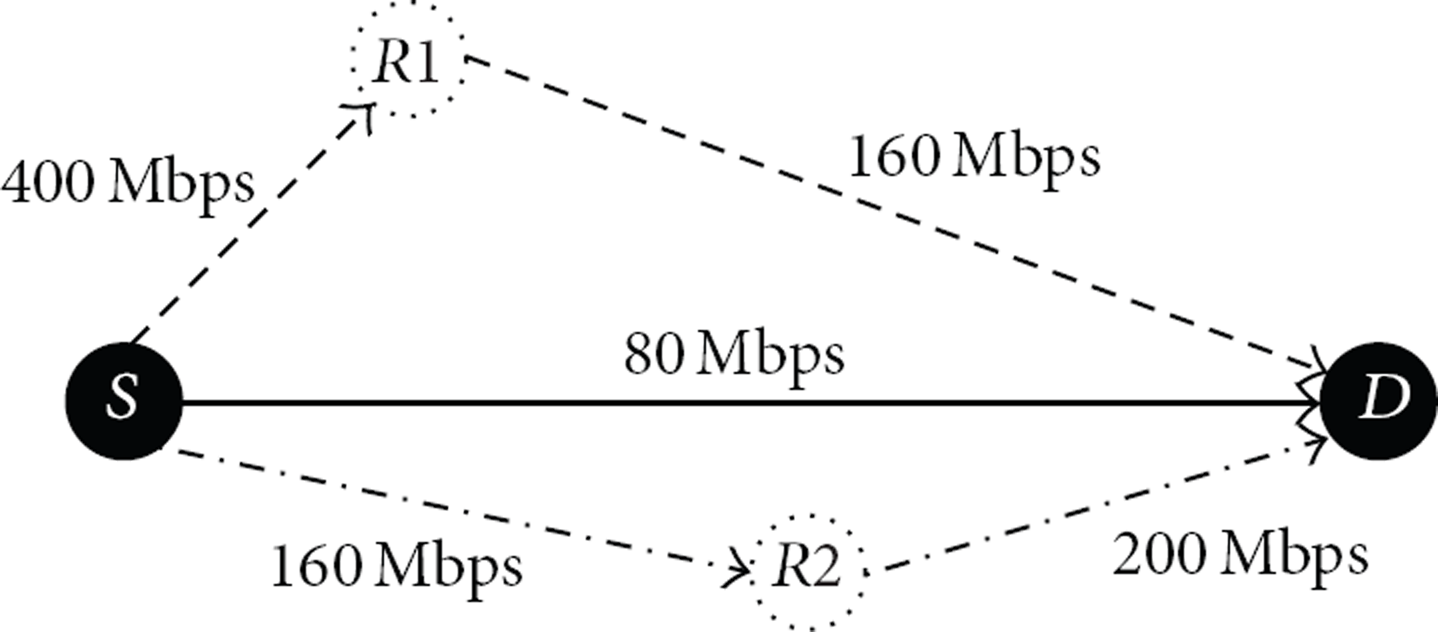
The basic idea of distributed relay-assisted retransmission is to have intermediate nodes that overhear a failed packet to retransmit the packet on behalf of the source node. We provide the intuition into the potential benefits of relay-assisted retransmission using the four-node network in Figure 2. We denote 


A four-node network containing source (S), destination (D), and relay (R).
3.1. Distributed Relay Decision
A beacon frame consists of a MAC header and a payload. The MAC header follows the WiMedia standard and the payload includes one beacon parameter and several IEs [6]. Every IE has a unique identifier (ID) and is attached to the beacon frame payload in an increasing ID value order. After all, by listening to beacon frames from neighbors, every node can obtain communication types and the neighbor information. Specifically, the beacon frame includes several IEs to configure various functions such as beacon period occupancy IE (BPOIE), DRP IE, and identification of IE. In order to support relay based transmission, we define a new relay communication information element (RC IE) as shown in Figure 3. It shows the elements of RC IE and RC IE command value. The relay node address field notifies the selected relay node to relay communication during the relay DRP allocation. The data rate to destination field is filled with the enumerated values (i.e., 0–7) as mark of data rate, modulation, and coding rate defined in the WiMedia standard to prevent consuming large bits [6].

Relay communication information element (RC IE).
A node needs to listen to beacon frames from other nodes during a number of superframes. In so doing, the node can reduce the possibility that multiple nodes use the same beacon slots in the current beacon period. Thus, the collision problem of beacon slots can be mitigated. Moreover, by collecting beacon frames during multiple superframes, it is possible to detect the existence of hidden node problems because a beacon frame of neighbor node includes the information of the neighbor's neighbor nodes [25]. Furthermore, during BP, each node listens to the beacon frames of neighbors and then estimates the transmission rate to each neighbor device from the signal strength by channel model.
Through the listening and the exchanging of beacon frames, we prepare the relay decision procedure for 

An example for simple topology.

An example for the MSN table.
From the example topology in Figure 4, the relay node is determined
3.2. Relay-Assisted Retransmission
When the channel between S and D is very poor, frequent relaying of ACKs may occur. In that case, it may be more efficient to employ a mesh network based approach (i.e., S sends packets to a relay which forwards them to D) as almost all packets will be relayed anyway. However, relays detect failed transmission through the overheard of B-ACK. Eligible relay nodes which have the packet by overhearing the transmission transmit own RC IE (i.e., relay retransmission and supported data rate). If there are several eligible relay nodes in the topology, R should compare the supported data rate of eligible nodes; then R determines the relay node for retransmission by considering the largest transmission rate among

An example for retransmission of DRR scheme and MSN table.
3.3. Medium Access Slot Allocation Procedure
In order to consider the medium access slot (MAS) allocation for relay transmission, the distributed reservation period is used by attaching DRP IE to a beacon frame. We should consider two reserved periods: S to R and R to D, respectively. The DRP is based on a TDMA style reservation [6]. That is, each node reserves its transmission time slots; it needs to reserve the time slots by sending DRP IE. When S broadcasts the beacon frame with the DRP allocation field in DRP IE during BP, all nodes should be aware of the relay node that is selected by receiving DRP IE. And then, the relay node figures out the information of data transfer period. During the reserved MAS block, only the reservation owner can access the channel to deliver packets; that is, DRP will not bring about any channel collisions. First, S should send relay request in RC IE attached to the beacon frame.
4. Performance Evaluation
In this section, the overall throughput and the energy efficiency have been measured when the number of nodes is increasing in order to evaluate the performance improvement of the DRR scheme. The overall throughput means the transmission rate to deliver the packets successfully between S and D considering delay, control space, and frames. Both with no BER and with BER have been evaluated to find the effect of BER on the DRR scheme while the retransmission policy with B-ACK mode is implemented.
4.1. Simulation Parameters
To validate performance of WiMedia MAC and DRR scheme, we develop simulators using Matlab (R2008b) [26, 27]. In order to validate the performance of the DRR scheme, we adopted retransmission policy and B-ACK filling the sending buffer similar to the actual environment. Parameter used in this simulation is shown in Table 3. The PHY model is BPSK described in the channel model. The bandwidth size is set to the closest value to effect similar data rate to the WiMedia MAC standard [6]. In this simulation, since the lowest coding rate is
Simulation parameters.

4.2. Simulation Results
4.2.1. Overall Throughput
Although the networks support high bandwidth and data rate, transmission rate cannot be equal to them. This is because the transmission rate depends on the control frames, queuing delays, packet losses, and other error environment. Therefore, the overall throughput, 

The packets are retransmitted up to three times, BER is set to

Overall throughput as direct transmission, relay-based transmission, and relay-assisted retransmission with no BER.

Overall throughput as direct transmission, relay-based transmission, and relay-assisted retransmission with
In addition, BER is the important factor to influence the overall throughput. Also, packet error rate (PER) can be calculated with BER as
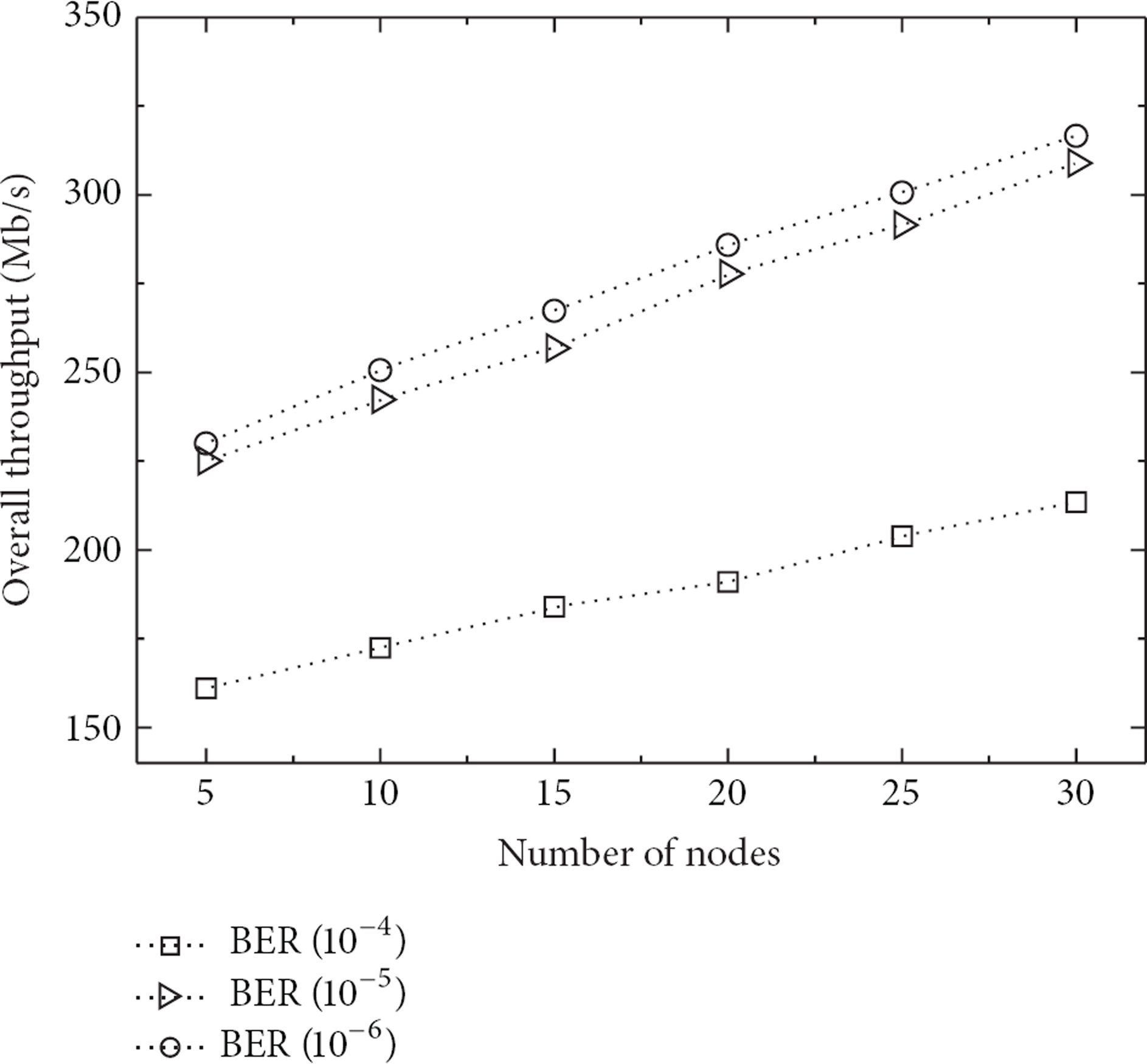
Overall throughput as various BER in case of DRR.
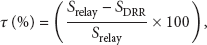
We compute the overall throughput per various packet sizes. Figure 10 shows that the bigger the packet size, the more improved the overall throughput. This is because the overheads by control frames are decreased with the bigger packet size. However, when we add BER into overall throughput, packet size directly influences the throughput and deteriorates the performance. The reason that the overall throughput decreases after 1024 bytes packet size proves the tradeoff between the burst transmission and the packet error rate. Despite of the tradeoff, the relay-assisted retransmission shows higher overall throughput when the packet size is large. This is because the overhead by control frames influence on the throughput remarkably. In addition, we devise the improvement ratio by

Effect of packet size on BER in case of DRR.
4.2.2. Energy Consumption
The energy consumption per bit, 
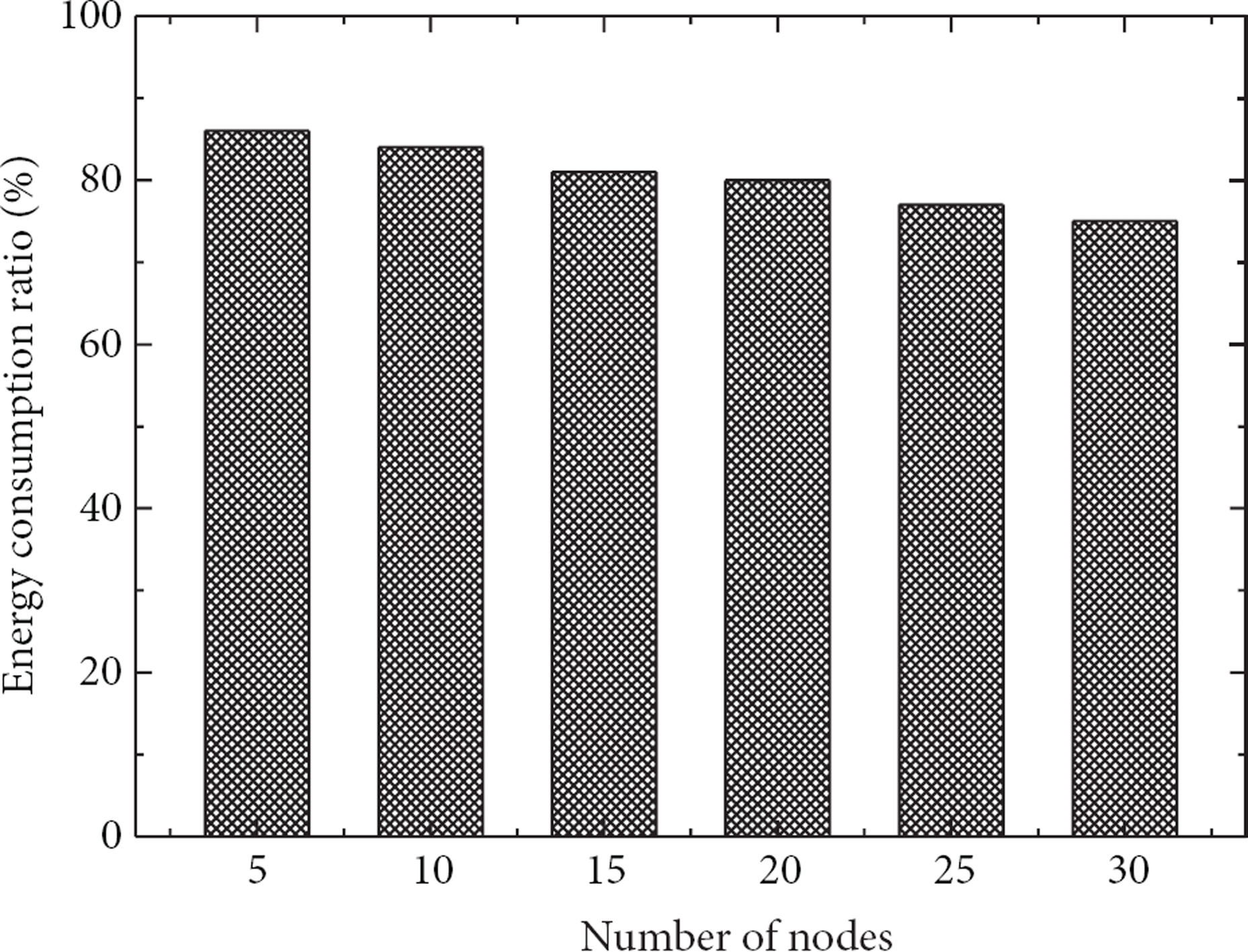
Energy consumption ratio with DRR.
5. Conclusion Remarks
In this paper, we propose a distributed relay-assisted retransmission scheme that employs a distributed relay path and relay-assisted retransmission to efficient system performance in distributed wireless home networks. The DRR scheme outperforms the direct transmission and relay transmission by examining the appropriate data rate for each path and separating each path for relay transmission and retransmission. In addition, the DRR scheme can shorten the transmission time comparing to the direct transmission and the relay transmission, respectively. The extensive simulation results demonstrate that the performance gain of the DRR scheme is significant when the number of nodes is large. Consequently, it leads to the overall throughput improvement and the energy efficiency. Furthermore, the DRR scheme supports compatibility with the WiMedia standard by keeping the rule of beacon period.
Footnotes
Conflict of Interests
The authors declare that there is no conflict of interests regarding the publication of this paper.
Acknowledgment
This research was supported by Hallym University Research Fund, 2014 (HRF-201402-009).