




Abstract
Auxetic honeycombs have proven to be an attractive advantage in actual engineering applications owing to their unique mechanical characteristic and better energy absorption ability. The in-plane dynamic crushing behaviors of the honeycombs with various cell-wall angles are studied by means of explicit dynamic finite element simulation. The influences of the cell-wall angle, the impact velocity, and the edge thickness on the macro/microdeformation behaviors, the plateau stresses, and the specific energy absorption of auxetic honeycombs are discussed in detail. Numerical results show, that except for the impact velocity and the edge thickness, the in-plane dynamic performances of auxetic honeycombs also rely on the cell-wall angle. The “> <”-mode local deformation bands form under low- or moderate-velocity impacting, which results in lateral compression shrinkage and shows negative Poisson's ratio during the crushing. For the given impact velocity, the plateau stress at the proximal end and the energy-absorbed ability can be improved by increasing the negative cell angle, the relative density, the impact velocity, and the matrix material strength. When the microcell parameters are the constant, the plateau stresses are proportional to the square of impact velocity.
1. Introduction
As one kind of new structural material with low weight, unique mechanical characteristics, and good design ability, auxetic honeycombs will be widely applied in aeronautics, electrical techniques, biomedical engineering, and military affairs. At present, the mechanical properties of these materials have attracted a great deal of attention at home and abroad [1–3]. Compared with conventional cellular materials, auxetic honeycombs are significantly different in terms of their internal structures and deformation mechanism. The mechanical responses of honeycombs are not just a base material behavior but are also determined by the local structure properties. Particularly in the dynamic crushing, auxetic honeycombs could show unique deformation behaviors and outstanding energy-absorbed characteristics [4, 5]. So how to establish the relations between cell internal structures and the dynamic crushing performance and further realize the self-design of auxetic honeycombs according to applicable demands is always the frontier [1, 6].
The relative density has been considered as one of the most important factors in describing the mechanical properties of cellular solids. Except for the relative density, some other factors (such as impact velocity and microcell structure) have also an important influence on its static and dynamic performance [3]. By now, the relationship between the cell internal structures and mechanical properties of auxetic honeycombs has been basically established. For example, Choi and Lakes [7] and Zhang et al. [8] analyzed the elastic behaviors of honeycombs with negative Poisson's ratio (NPR) and indicated that most of the differences in mechanical properties of these structures were attributed to the change in internal structures (i.e., from convex to reentrant) [7]. Overaker et al. [9] and Yang et al. [10] studied the effects of morphology and orientation on the elastic behavior of reentrant honeycombs. Wan et al. [11] provided a theoretical approach for evaluating negative Poisson's ratios of auxetic honeycombs and revealed that Poisson's ratio was mainly related to the geometric parameters of microcell structure. Grima et al. [12] discussed a new explanation for achieving the auxetic behavior in cellular solids according to the “rotation of rigid units” mechanism. Ju and Summers [13] analyzed the effects of cell geometries on the elastic limits of auxetic honeycombs under simple shear loading. Based on Eshelby's inclusion concept, Azoti et al. [14] explored the design space of auxetic materials through a micromechanical multiscale analysis. Bezazi and Scarpa [15] investigated the fatigue properties of auxetic foams under tension-tension loading. Alderson et al. [16] discussed the elastic constants and deformation mechanisms of chiral honeycombs under uniaxial in-plane loading. Airoldi et al. [17] studied the buckling and postbuckling responses of chiral honeycombs. Hou et al. [18] analyzed the bending and failure behaviour of sandwich structures with auxetic honeycombs. The results above show that cell internal structure has a very significant effect on the macro/micromechanical properties of auxetic honeycombs [7, 10, 11, 16]. Particularly when the impact loading is applied, the high frequency components will control the dynamic response of the structures. The influence of cell internal structures on the crushing deformation localization and the dynamic load-bearing capacities for auxetic honeycombs becomes more dominant.
In fact, the micro/macrodeformation behavior is very important in the energy-absorbed design for auxetic honeycombs. Only after the relation between the internal structure and macrodynamic response is fully established, could the dynamic crushing performance of auxetic honeycombs be accurately forecasted by the microcell structures. Up to now, lots of researches about the influence of the cell microtopology on the dynamic crushing of honeycombs have been carried out [19–25]. The results show that this simple method of changing the cell structures can enhance the honeycomb's crushing strength and energy-absorbed ability. However, only the conventional honeycombs are referred to in [20, 22, 25]. The dynamic responses and impact energy-absorbed characteristics of auxetic honeycombs are just carried out [5, 17, 26]. Besides, although the results of lots of researchers [7, 10, 11] indicated that the bulk material and cell-wall angle had a great effect on the mechanical properties of auxetic honeycombs, less attention has been paid to the dynamic crushing of ones. The abundant dynamical evolution characteristics in auxetic honeycombs caused by the variation of cell-wall angles under different impact loading should be further clarified.
According to the ideas of changing the cell internal structure by simply changing the cell-wall angle (θ), the objective of the present paper is to investigate the influence of the cell-wall angle, bulk material performance, and impact velocity on the in-plane dynamic crushing of auxetic honeycombs. The distinct deformation modes, the plateau stresses, and absorbed energy of auxetic honeycombs in the y-direction in terms of the cell-wall angle, the impact velocity, and the relative density are numerically discussed. Finally, some conclusions are presented based on the FE study.
2. Finite Element Method Simulation
Aiming to investigate the mechanical performances of auxetic honeycombs with various cell-wall angles under in-plane crushing, the explicit dynamic finite element method (DFEM) using ANSYS/LS-DYNA was employed in this paper. Figure 1 shows the reentrant structure of a single cell for auxetic honeycomb, where l and h are the length of the inclined and vertical cell-wall, respectively; t is the thickness of the edge; and θ is cell-wall angle of the honeycomb's inclined edge to the x-direction (θ < 0). In the present discussion, our interest is focused on the effects of the cell-wall angle. The cell edge inclined length l and vertical one h are the constant with l = 2.7 mm and h = 5.4 mm (i.e., h/l = 2), and the cell-wall thickness t varies from 0.08 to 0.4 mm. By simply changing the cell-wall angle, six types of auxetic honeycombs are obtained with θ being equal to −5°, −10°, −20°, −30°, −50°, and −70°, respectively. In the simulation, the honeycomb specimen consists of 14 cells in the x-direction and 15 cells in the y-direction, which is placed against a fixed rigid plate at distal end (supporting end) and crushed by moving a rigid plate axially at an initial velocity from the proximal end (impacting end), as shown in Figure 2. Research results show that when the cell number is greater than 10, the dynamic response is tending towards stability [27]. It is clear that the FE model could effectively capture the dynamic deformation characteristics and minimize the size effect. Here, the mass of the impact rigid plate is much greater than that of the specimen. So a constant velocity can be applied to the crushing rigid plate. The crushing velocity v is varied from 7 to 200 m/s in order to investigate the effect of the loading rate. Besides, all of the nodes used in the FE model are constrained from the displacement in out-of-plane direction to prevent the specimen from out-of-plane bulking; the left and right edges of the specimens are free.
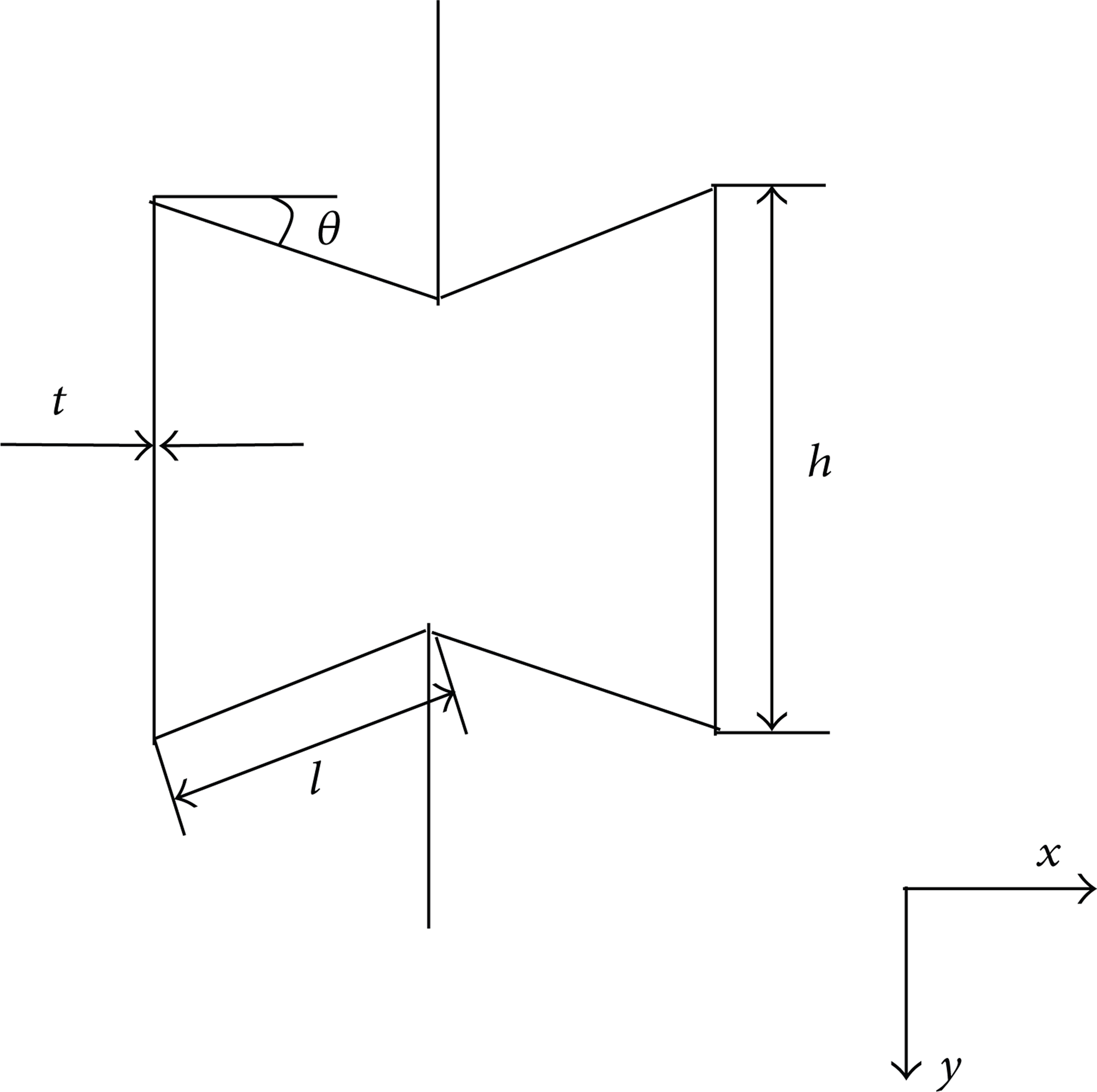
Configuration of a single cell.

Diagrammatic sketch of the calculating model for auxetic honeycombs.
In our discussion, the rigid material is defined for the plates and the bilinear strain hardening model material is defined for matrix material of auxetic honeycombs. When the tangent modulus of bulk material is zero, the detailed material parameters are listed in Table 1. In order to describe the influence of strain hardening on the dynamic crushing of auxetic honeycombs, five values of the E tan /E s (e.g., 0.01, 0.05, 0.1, 0.15, and 0.2) are considered here, where E tan is the tangent modulus and E s is Young's modulus of the matrix material. The mechanical behavior of cell-wall material is treated as rate independent. Moreover, as used by Ruan et al. [19], Liu and Zhang [20], Zou et al. [21], and Qiu et al. [22], each cell is modeled with Shell163 [28] (a 4-node quadrilateral shell element). The inclined edge is meshed into 6 shell elements and there are 12 ones for the vertical edge. The model consists of a total of 5304 shell elements. The quadrature rule is set as Gauss. Numerical results have shown that the shell element is sufficient to produce reliable results [19–22, 29]. Five integration points along the cell-wall thickness are adopted with the aim of providing sufficient accuracy. Each surface of the cell is defined as a single self-contact surface (*CONTACT_AUTOMATIC_SINGLE_SURFACE). Self-contact is also defined between the outside faces of a cell that might contact with other cells during the crushing. Besides, a surface-to-surface contact is applied between the specimen (*CONTACT_AUTOMATIC_SURFACE_TO_SURFACE) and two rigid plates, respectively. Some tentative simulations showed that a friction coefficient of 0.02 between the specimen and the plates was enough and that the effect of the friction on the simulation results could be negligible [30]. So the friction coefficient is 0.02 in this paper. More details on the numerical simulations were described in our previous work [20, 29].
Material parameters of the cell-wall when the tangent modulus is zero.

The relative density of auxetic honeycomb can be calculated as [3]

where Δρ is the relative density of auxetic honeycomb, ρ* and ρ s denote the densities of, respectively, auxetic honeycombs and bulk material, t is the edge thickness, l is the length of the inclined cell-wall, h is the length of the vertical edge, and θ is the cell-wall angle (as shown in Figure 1).
In this paper, the nominal compressive stress σ is defined as the ratio of the load applied by the rigid plate to the initial cross area (L1 × b) (b is the out-of-plane width, b = 1 mm). The nominal strain ∊ is defined as the ratio of the overall compression of the specimen to its original length (L2) along the impacting direction. So a dynamic nominal stress-strain curve could be obtained after conversion. A typical dynamic response curve of auxetic honeycomb is given in Figure 3. It is seen that the specimens will exhibit three distinct dynamic response regimes of deformation under in-plane impacting. The first regime is characterized as a transient response. This is followed by a long collapse plateau and the final compressive densification regime. It is the plateau stress in the second regime that is important in characterizing the dynamic crushing of honeycombs, which has been widely used in the energy-absorbed design and analysis of cellular solid [3, 19–22, 29–31]. The plateau stress is defined as the average nominal stress between the first stress peak and the compressive stress corresponding to the densification strain, and its expression is shown as
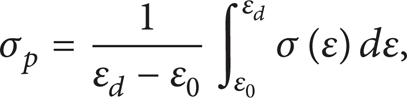
where ∊0 is the nominal strain at which the crushing stress reaches the first stress peak value (as shown in Figure 3) and ∊
d
is the densification strain of auxetic honeycombs. Lots of researches show that ∊
d
is likely to be a velocity-sensitive quantity [21, 22], which is mainly affected by the inertia. When the impact velocity is close to or exceeds the critical impact velocity

where E is the energy efficiency parameter of cellular solids, and it can be defined as the ratio of the absorbed energy up to a given nominal strain divided by the corresponding stress value, as follows:

In fact, there are several local maxima on the efficiency-strain curve (as shown in Figure 3). The full densification can be determined by the last main local maxima point, with the corresponding strain as the densification strain ∊ d [34].

Dynamic nominal stress-strain curve and the corresponding energy efficiency-strain curve for auxetic honeycomb.
3. Numerical Results and Discussion
3.1. Validation of FE Model
In order to validate the reliability of FE model and the quality of the simulations in this paper, the regular hexagonal honeycomb model (i.e., h/l = 1, θ = 30°) was firstly established, which was identical to that of Ruan et al. [19]. Then the in-plane dynamic crushing of hexagonal honeycomb was investigated. Figure 4 shows the in-plane crushing deformation of hexagonal honeycombs in the y-direction at v = 7 m/s, which is compared with the results given in [19]. It is seen that, under the condition that the bulk material properties, boundary conditions, and impact velocity are all the same, the deformation shows a good consistency with the simulation result given by Ruan et al. [19]. On the basis of the above analysis, the in-plane dynamic crushing behaviors and energy-absorbed abilities of reentrant honeycombs with various cell-wall angles are systematically investigated.
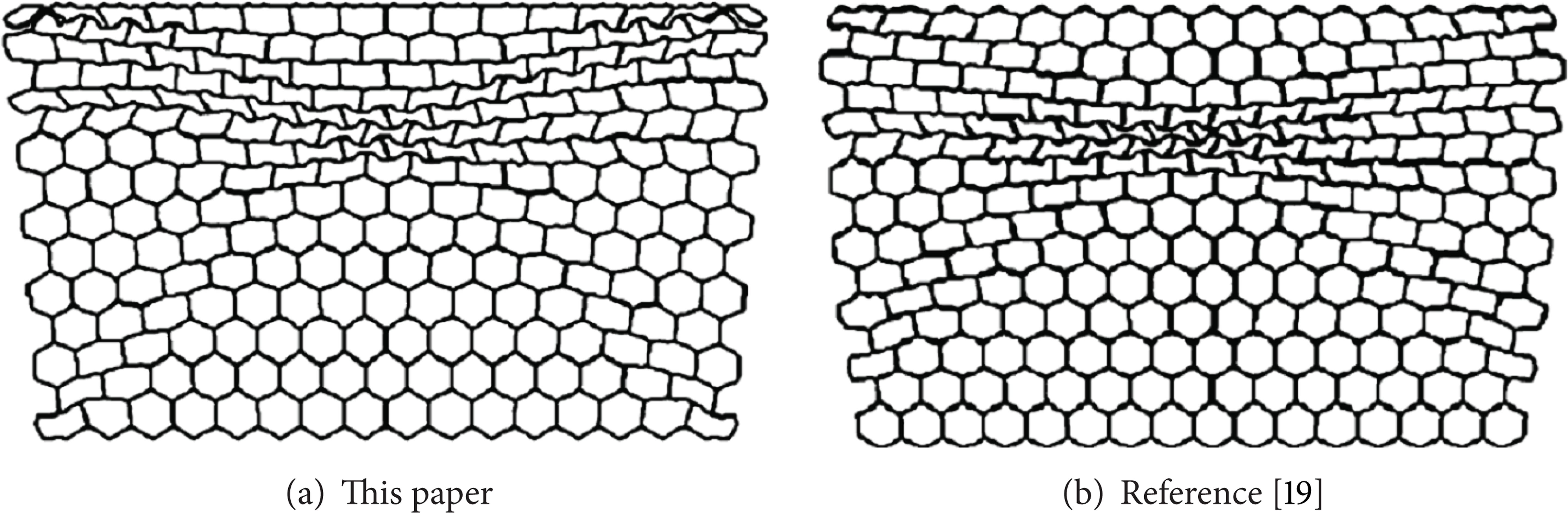
In-plane crushing deformation of regular hexagonal honeycomb in the y-direction.
3.2. Deformation Modes
Reentrant honeycombs with various cell-wall angles will exhibit different collapse modes under y-direction crushing, which have a direct relation of cell internal structures and impact velocity, as shown in Figure 5. In this figure, ∊ is the global strain of the specimen along the y-direction. It is seen from Figure 5 that it will be classified into two types of local deformation modes with the increase of impact velocity: the low-velocity crushing mode (“> <”-mode) and the high-velocity crushing mode (“I”-mode). When the crushing velocity is lower (i.e., v = 7 m/s), the initial localization bands occurred from the proximal end and the distal end, and they spread all over the whole specimen quickly with increasing the absolute value of the cell-wall angle (Figures 5(a)–5(d)). The cells near the free boundary are in a tension state, while the cells near the longitudinal symmetry axis are compressed. This results in the “softer core” of the specimen with stiffened sides. On the one hand, every cell deforms homogeneously with the transverse shrink during the y-direction crushing. They reduce their transverse dimension and show negative Poisson's ratio in such direction. So the “> <”-mode forms during the crushing. This phenomenon becomes more obvious with the increase of cell-wall angles (Figure 5(d)). This is mainly caused by the bending deformation of the inclined edges and the stretching of the vertical cell-walls. On the other hand, the microcell shape changes from reentrant hexagon to the “diamond” with doubled edge thickness during the crushing (Figure 6(a)), which implies the provisional densification of the cell at that moment and causes the difficulty in the further compression process. It should be noted that most of the cells will early approach this provisional densification state with increasing cell-wall angles (Figures 5(a)–5(d)).
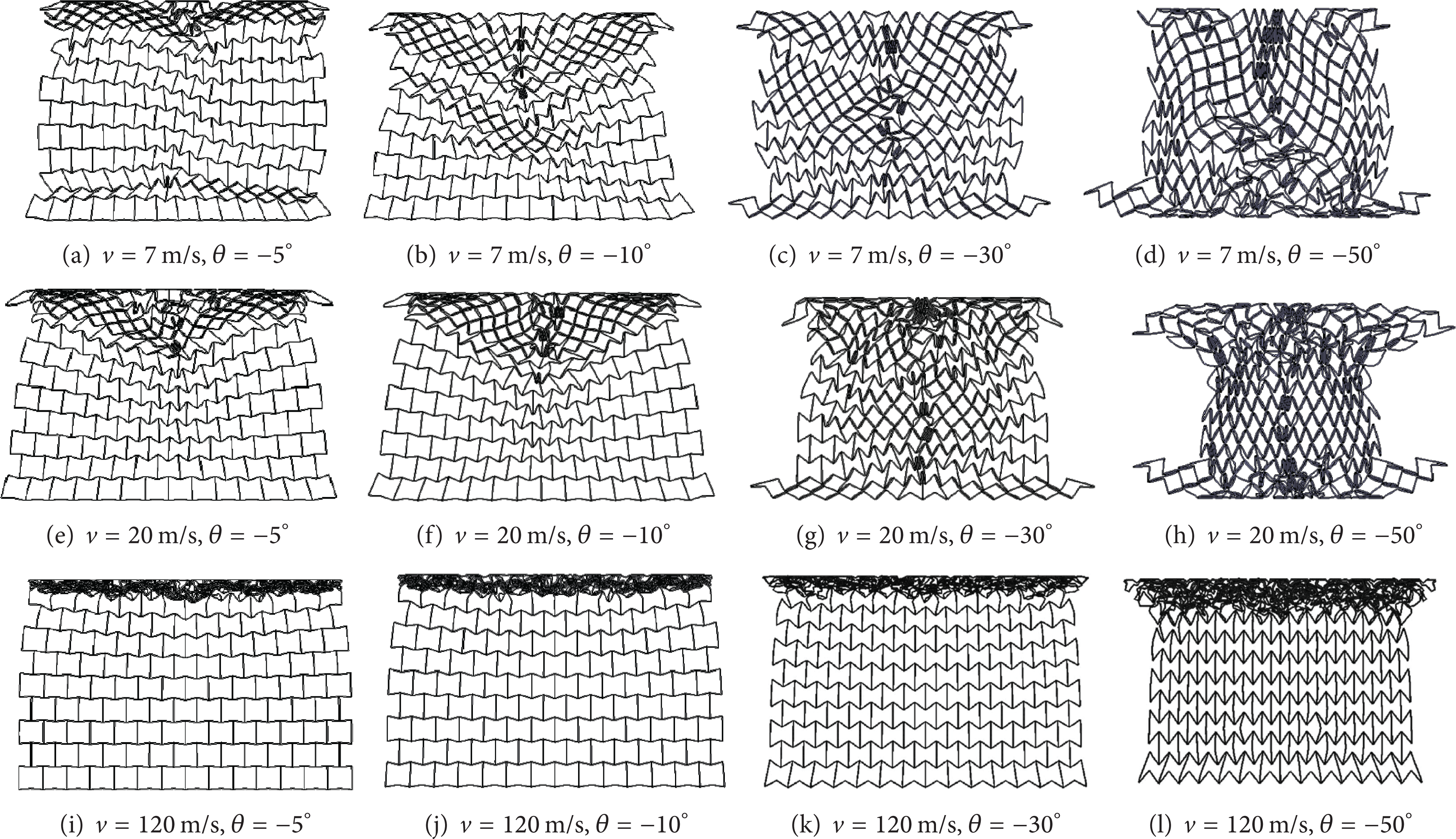
In-plane deformation modes of auxetic honeycombs at ∊ = 0.4 under different impact velocities (t = 0.2 mm).
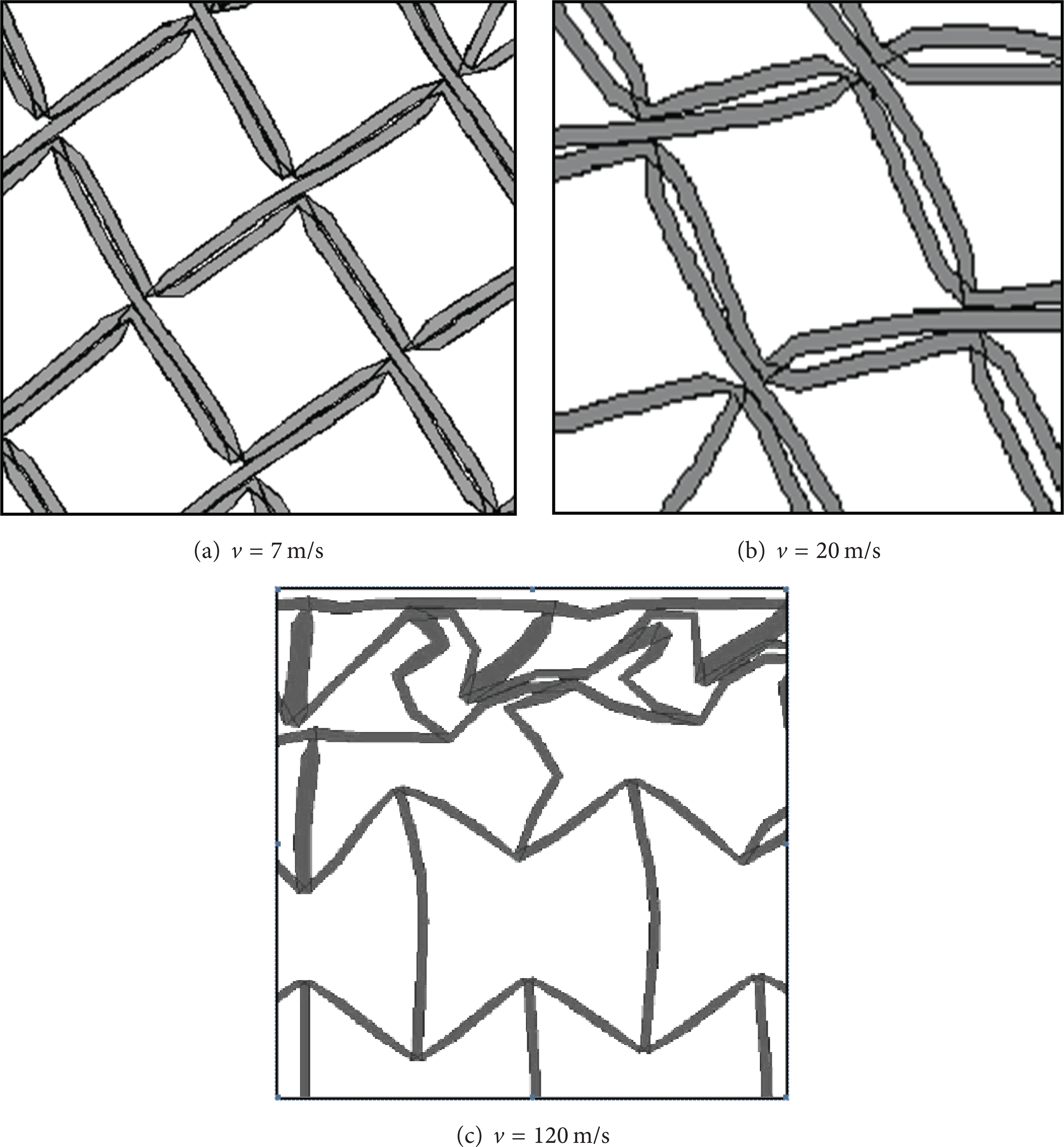
Local provisional densification deformation of auxetic honeycombs under different impact velocities.
With the increase of impact velocity further (v = 20 m/s), the initial localization bands only appear in the proximal end at the beginning (Figures 5(e)–5(h)). Figure 7 shows the full-scale in-plane crushing deformation of reentrant honeycombs at v = 20 m/s. It is seen that, except for the local stiffness along the x-direction, the specimens will display gradient characteristic along the y-direction. The plastic hinge appears in the joints between the inclined edges and the vertical ones. The inclined edge shows the bending deformation and rotates around the joint at the same time, while the vertical cell-wall shows the tension state. This deformation induces the auxetic behavior of reentrant honeycombs (Figures 5 and 7). Moreover, the microcell shape also changes from reentrant hexagon to the “diamond” with doubled edge thickness, just like the low-velocity impacting deformation (Figure 6(b)). Under high impact-velocity crushing (e.g., v = 120 m/s), inertia effects become more dominant. The deformation inhomogeneity caused by the local stress dynamic evolution is relatively weakened. The “> <”-mode local crushing band no longer appears during the crushing along the y-direction. The “I”-mode local deformation band is initiated at the proximal end perpendicular to the impact direction and propagates forward layer by layer to the distal end (Figures 5(i)–5(l)), which is similar to conventional honeycombs [19–22]. Besides, there is no appearance of “diamond” with doubled edge thickness during the compression (Figure 6(c)). The corresponding stress-strain curves of auxetic honeycombs at the impact end are shown in Figure 8. When the nominal stress is exceeded to the first peak (the elastic limit), the plastic hinges form in the joints between the inclined cell-walls and the vertical ones. The plateau stage under low- or moderate-velocity impacting represents the process of the microcell deformation from reentrant hexagon to the “diamond” until the provisional densification. Numerical results show that reducing the edge thickness or increasing the absolute value of cell-wall angles or decreasing the strain hardening of matrix material will have the same effect as improving the impact velocity. It is clear that the in-plane crushing deformation of auxetic honeycombs mainly relies on cell-wall angles, the matrix material strength, and impact velocity.
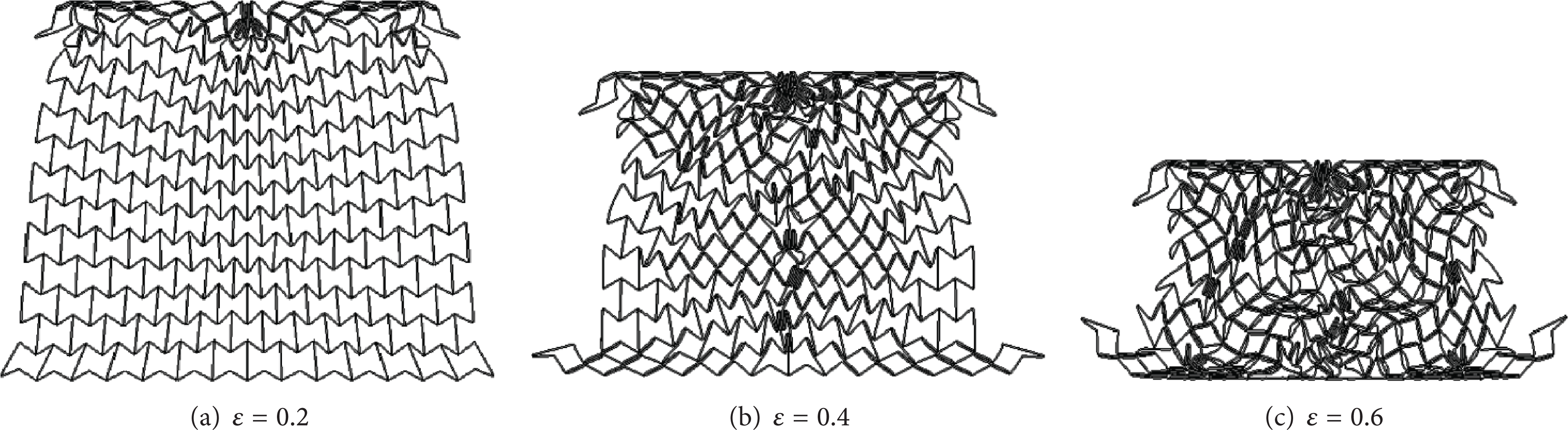
The full-scale crushing deformation of auxetic honeycombs with θ = − 30° at v = 20 m/s.

Dynamic nominal stress-strain curve of auxetic honeycomb under different impact velocities.
3.3. Plateau Stress
The plateau stress is a vital parameter in describing the dynamic crushing characteristics of cellular materials, which has a direct relation to the performance of bulk material itself, the relative density, the cell internal structure, and the impact velocity. In our simulation, we mainly focus on the effects of strain hardening of matrix material, the edge thickness (the relative density), the cell-wall angle, and the impact velocity.
3.3.1. Effect of Strain Hardening of Matrix Material
Aiming to investigate the effect of strain hardening of cell-wall material on the in-plane impact behavior of auxetic honeycombs, five values of the E tan /E s (i.e., 0.01, 0.05, 0.1, 0.15, and 0.2) are used in this paper. According to (2), Figure 9 illustrates the effect of matrix material strain hardening on the dynamic plateau stress of auxetic honeycombs with θ = − 30° and t = 0.2 mm at the proximal end under the impact velocity v = 20 m/s. It is obvious that the plateau stress can be improved with the increase of E tan /E s . The stiffness and strength of reentrant honeycombs are also improved by the strengthening of the matrix material strain-hardening enhancement. So the whole structure's ability can be strengthened with increasing the strain hardening of matrix material.

Variation of plateau stresses of auxetic honeycombs with θ = − 30° and t = 0.2 mm versus E tan /E s at v = 20 m/s.
3.3.2. Effect of the Cell-Wall Thickness
Numerical researches show that the cell-wall thickness (the relative density) has an important influence on the in-plane dynamic plateau stresses of common honeycombs. They found that the plateau stresses are related to the ratio of t/l by a power law for a given impact velocity and they are proportional to the square of impact velocity at high crushing velocities [22]. When the tangent modulus of bulk material is zero, Figure 10 shows the relationship between the plateau stresses of reentrant honeycombs at the crushing end and impact velocity with different cell-wall thicknesses. It is seen that the plateaus stresses of auxetic honeycombs also increase with the impact velocity by a square law. Under the conditions that the cell-wall angle and the impact velocity are all the same, the plateaus stress improves with the increase of relative density (i.e., the edge thickness). Moreover, the plateau stresses also increase with the absolute value of cell-wall angles for the same edge thickness and impact velocity (as shown in Figure 10). When the cell internal structure parameters except for t/l and the impact velocity are the constant, the plateau stresses σ p show a good correlation to the ratio of t/l by a power law, which can be expressed as

where A is a constant and m is an exponent; σys is the yield stress of matrix material. Both A and m mainly depend upon cell configuration parameters except for t/l and the impact velocity. Figure 11 gives the corresponding relation curves of the nominal crushing plateau stresses σ p /σys with respect to t/l in the double logarithmic plot under different impact velocities. In the figure, the plateau stresses calculated by (2) are symbolized as different shapes. According to (5), the corresponding fitting curve is also given in Figure 11. It is clear that σ p /σys increases with t/l by a power law for the given impact velocity. At the low-velocity crushing, the exponent m is equal to or near to 2. With the increase of impact velocity, the exponent m gradually reduces and will be close to 1. Moreover, under the same impact velocity, the exponent m will increase with the absolute value of the cell-wall angle.
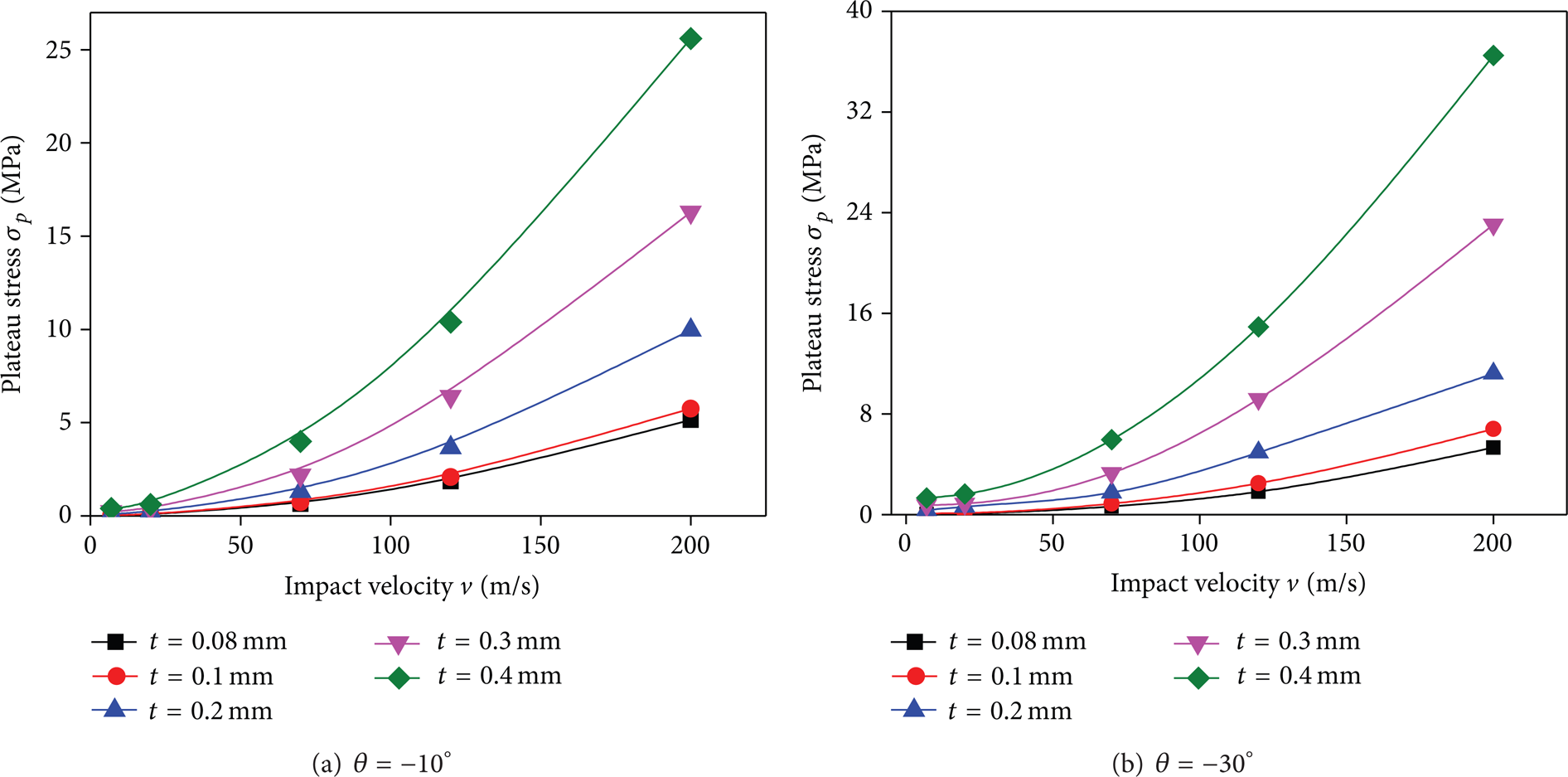
Variation of plateau stresses for auxetic honeycombs versus impact velocity with different cell-wall thicknesses.

Plot of σ p /σys for auxetic honeycombs versus t/l under different impact velocities.
3.3.3. Effect of Cell-Wall Angle
Previous studies have shown that the cell-wall angle is also an important geometric parameter in describing the mechanical characteristics of conventional honeycombs [24, 25, 35]. By simply changing the internal expanding angle of reentrant hexagonal cells, the auxetic honeycombs can be easily obtained. In order to analyze the influence of cell-wall angle on the dynamic plateau stresses of auxetic honeycombs, six values of cell-wall angles (i.e., −5°, −10°, −20°, −30°, −50°, and −70°) are used. Here, the tangent modulus of matrix material is still zero.
Based on the FE simulated results, Figure 12 illustrates the variation of the plateau stresses at the proximal and distal ends of auxetic honeycombs for the same edge thickness t = 0.2 mm with respect to impact velocity. When the cell-wall angle and the edge thickness are the constant, the plateau stress at the crushing end has an obvious increase with the impact velocity. And they are still proportional to the square of impact velocity, just like in Figure 10. It is seen that the plateaus stress at the impacting end is more sensitive to loading rate. While there is difference at the distal end, the plateau stress slightly decreases with the increase of impact velocity. This is mainly due to the difference of deformation modes of the specimens. At high-velocity crushing, the local deformation bands can only be seen in the proximal end. When the cells in the crushing end are completely compressed, the distal end still remains static. So the plateau stress at the distal end is less than the impacting end. It should be noted that the plateau stresses at two ends can improve with increasing the absolute value of θ for the same impact loadings. Moreover, the corresponding relation curves between the plateau stresses at the proximal end and cell-wall angles under different impact velocities are shown in Figure 13. It is seen that, for the given impact velocity, the plateau stresses of auxetic honeycombs are in good correlation with θ by least-square curves when other microcell parameters except for θ are the constant. Then, it can be expressed by the following equation:

where B, C, and D are the constants, which mainly depend on the bulk material performances, the cell structure parameters except for θ, and impact velocity. Here, the unit of θ is radian. It is clear that, under the given impact velocity, the plateau stress at the crushing end increases with the absolute value of θ by least-square curves.

Plot of plateau stresses for auxetic honeycombs versus impact velocities under different cell-wall angles.

Plot of plateau stresses of auxetic honeycombs at the crushing end versus cell-wall angles under different impact velocities (t = 0.2 mm).
3.4. Energy Absorption of Auxetic Honeycombs
As for the weight sensitive applications, another key indicator index in characterizing the energy absorption capacity of cellular materials is the specific absorbed energy, which is defined as [29]
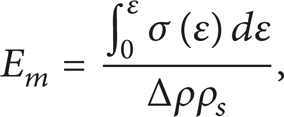
where Δρ is the relative density of the honeycomb and ρ s is the density of the bulk material.
Based on (7), the absorbed energy per mass of auxetic honeycombs with different cell-wall angles under different impact velocities is plotted in Figure 14. It is seen that, under the condition that the shape ratio, impact velocity, and bulk material are all the same, the cell-wall angles have an important influence on the specific absorbed energy of auxetic honeycombs. The larger the cell-wall angle is, the higher the absorbed energy is. This is partly related to the deformation mechanism of cell internal structure, as well as the relative density of auxetic honeycombs being larger with increasing the negative cell-wall angles. Along with the increase of the impact velocity, the effects of cell-wall angles on the absorbed energy are relatively weakened (Figure 14(d)). Numerical results also indicate that auxetic honeycombs have the better energy-absorbed abilities with increasing impact velocity and the matrix material strength.

Variation of energy absorption for auxetic honeycombs with respect to cell-wall angles under different impact velocities (t = 0.2 mm).
4. Conclusions
The mechanical properties of auxetic honeycombs may be affected by lots of factors, such as bulk material behavior, the cell internal structures, and the relative density. In the present study, the dynamic crushing behavior of auxetic honeycombs with various cell-wall angles is numerically discussed under different impact loadings. It is shown that auxetic honeycombs will show two different deformation modes (“> <”-mode and “I”-mode) under y-direction crushing with the increasing of impact velocity, which are mainly related to the cell-wall angles. Under low- or moderate-velocity crushing, due to the bending deformation of the inclined cell-wall and the stretching of the vertical edge, every cell deforms homogeneously with the transverse shrink. The specimens show negative Poisson's ratio during the y-direction crushing. Moreover, the reentrant cell will be compressed into the “diamond” with doubled edge thickness. This deformation becomes more obvious with increasing cell-wall angles. However, the influence of the cell-wall angle is weakened under high-velocity crushing.
The simulated results also show that the inertia effect of auxetic honeycombs is obvious at the crushing end but insensitive at the distal end. Both the plateau stress at the proximal end and the absorbed energy will be improved with increasing the absolute value of cell-wall angle, the matrix material strength, and impact velocity. This dynamic enhancement is caused by the inertia of cell internal structures and mainly depends upon the geometric parameters (i.e., t/l and θ). The plateau stresses at the impacting end show a good correlation to the ratio of t/l by a power law and to the cell-wall angle θ by least-square curves for a given impact velocity. When all microcell structural parameters are the constant, the plateau stresses at the proximal end are proportional to the square of impact velocities.
Conflict of Interests
The authors declare that there is no conflict of interests regarding the publication of this paper.
Footnotes
Acknowledgments
This work is supported by the National Natural Science Foundation of China (nos. 11402089 and 51301068), the Natural Science Foundation of Hebei Province of China (nos. A2013502120 and E2013502291), and the Fundamental Research Funds for the Central Universities (no. 2014MS117). The first author also acknowledges the financial support of the China Scholarship Council Scheme.