




Abstract
Femtocell is a promising technique not only in operator networks but also in having potential applications for industrial wireless sensor networks. In this paper, we investigate energy efficient uplink power control and subchannel allocation in two-tier femtocell networks. Taking transmit power and circuit power into account, we model the power control and subchannel allocation problem as a supermodular game to maximize energy efficiency of femtocell users. To reduce the cochannel interference from femtousers to neighboring femtocells and macrocells, we introduce a convex pricing scheme to curb their selfish behavior. We decompose the resource allocation problem into two subproblems, that is, a distributed subchannel allocation scheme and a distributed power control scheme to reduce costs and complexity. Simulation results show that the proposed algorithm can improve user utilities significantly, compared with existing power control and subchannel allocation algorithms.
1. Introduction
According to the study of ABI, in recent years, more than 70% of the mobile data traffic happens indoors [1], where the coverage of macrocells is poor. Femtocell is a promising technology to improve the capacity and coverage of the indoor environment by shortening the distance of the transmitter and receiver [2]. Moreover, low power femtonode can be also an important technique in industry wireless sensor networks. However, due to the cochannel deployment of femtocells with macrocell, cotier interference and cross-tier interference are serious [3]. On the other hand, in orthogonal frequency division multiple access (OFDMA) based femtocells, different users have different channel gains, and the system throughput can be maximized by appropriately allocating the resources, such as subchannels and power, which can be called multiuser diversity.
In order to obtain the above mentioned multiuser diversity and mitigate the cochannel interference, power control and subchannel scheduling are investigated in two-tier femtocell networks [4–8]. In [4], a noncooperative power allocation with SINR adaptation is used to alleviate the uplink interference suffered by macrocells; while in [5], a Stackelberg game based power control is formulated to maximize femtocell's capacity under cross-tier interference constraints. However, subchannel allocation is not considered. In [6], a joint subchannel and power allocation algorithm is proposed to maximize total capacity in dense femtocell deployments. While in [7], a Lagrangian dual decomposition based resource allocation scheme with constraints on cross-tier interference in power allocation is used. In [9], the distributed subchannel and power allocation for cochannel deployed femtocells is modeled as a noncooperative game, for which a Nash equilibrium is obtained based on a time-sharing subchannel allocation. However, in these works, joint subchannel and power allocation with users’ QoS and cross-tier interference considerations is not studied. In [8], a distributed modulation and coding scheme, subchannel, and power allocation that supports different throughput constraints per user is proposed, but it does not consider two-tier networks.
Moreover, most of the existing literatures focus on capacity maximization of the femtocells. The energy consumption of femtocell networks cannot be ignored due to the massive deployment of femtocells. Meanwhile, in order to apply the adaptive advantage of wireless sensor networks better, we need to find an optimal resource allocation method to improve the energy efficiency of femtocells. In this paper, we investigate the energy efficient uplink power control and subchannel allocation in femtocell networks. Taking both transmit power and circuit power into account, we model the power control and subchannel allocation problem as a supermodular game to maximize energy efficiency of femtocell users. To reduce the cochannel interference from femtousers to neighboring femtocells and macrocell, we introduce a convex pricing scheme to curb their selfish behavior. We decompose the resource allocation problem into two subproblems, that is, a distributed subchannel allocation scheme and a distributed power control scheme to reduce costs and complexity. Simulation results show that the proposed algorithm can improve user utilities significantly, compared with existing power control algorithms.
The rest of the paper is organized as follows. Section 2 presents the system model and problem formulation. In Section 3, supermodular game based energy efficient resource allocation is proposed. The simulation results are provided in Section 4. Finally, Section 5 concludes the paper.
2. System Model
2.1. System Model
Our model involves a central macrocell and K random distributed indoor femtocell base stations. It is assumed that femtocells and macrocell use the same frequency, and there is only one scheduled active user during each signaling slot to avoid interference within a femtocell. Macrousers and femtousers are randomly distributed in the macrocell and femtocell, respectively. Let M and F denote the number of the active macrousers camping on macrocell and femtousers camping on a femtocell, respectively. All femtocells are assumed to be working in close access mode. The bandwidth of the OFDMA system B is divided into N subchannels. The channel fading of each subcarrier is assumed the same within a subchannel but may vary across different subchannels.
Let

The received SINR of macrouser m in macrocell on subchannel n is
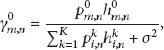

The capacity of macrouser m on subchannel n can be modeled as

In this paper, SINR is selected as the QoS satisfaction indicator, to model the user's QoS satisfaction (UQS), which is the best response of SINR; a UQS function is introduced in this section. This function should satisfy the rule of diminishing marginal returns; that is, UQS (

Sigmoid function is one of the monotone functions which satisfy the above characteristic [10, 11] and has been widely used to solve the resource allocation problem in wireless networks. In [10, 11], Sigmoid function based noncooperative access control algorithm is proposed in CDMA and IEEE 802.11e networks, respectively.
Thus, the UQS function of user i on subchannel n in femtocell k is defined as


User's UQS function.
Here, we consider energy efficiency in two-tier femtocell network; the utility function of user i on subchannel n can be defined as


User's utility function of transmitting power for fixed interference.
2.2. Problem Formulation
Since the macrocell and K femtocells share the N subchannels, the energy efficiency of each femtocell can be defined as

When subchannel n is allocated to user i in femtocell k,

Noncooperative game has been widely applied in resource allocation in wireless networks. We assume that the users in our model are completely selfish and rational for their own utility maximization. Problem (9) can be modeled as a noncooperative game.
3. Supermodular Game Based Energy Efficient Resource Allocation
3.1. Game Framework
According to game theory, we model the energy efficient resource allocation problem as a noncooperative game.
In
The authors in [12] introduced a penalty function that is proportional to each user's transmit power. We use the convex pricing function

Definition 1.
Given the fixed

The joint optimization of subchannel and power allocation in (11) is a NP-hard problem. In order to reduce the computational complexity, we divide the problem into two subproblems. Firstly, we propose a subchannel allocation policy. Secondly, an optimal power allocation algorithm is developed based on the given subchannel allocation.
3.2. Energy Efficient Subchannel Allocation Policy
In this subsection, we present a subchannel allocation method under the condition that the power allocation is given. The difference between our algorithms and the one that is in [12] is that we focus on the femtocell maximization of energy efficiency rather than throughput. We use a convex pricing to protect macrocell users and femtocell users.
Assuming that the power allocation of all users in all femtocells is given, the subchannel allocation problem can be redefined as

Using (1), (2), and (6), (12) can be written as


3.3. Energy Efficient Power Allocation Strategy
Given the allocation of subchannels, power control problem can be modeled as
Definition 2.
A power allocation strategy

As
Definition 3.
The unpricing game
Theorem 4.
The unpricing game
Proof.
Let

One nice property of supermodular game is that the best response has a fixed point and implies at least a Nash equilibrium.
If the utilities of the game under the condition that there is a parameter without the control of any user, we call that parameter an exogenous parameter. Here, we extend the former game
Definition 5.
A parameterized game
Theorem 6.
The pricing game
Proof.
Firstly, we change the variable of

The partial derivative of
The set of Nash equilibrium in super modular game is not empty [13]. Let
Corollary 7.
In modified game
Proof.
Note that, for fixed

According to the definition of Nash equilibrium, and


It can be seen from (22) that

3.4. A Distributed Resource Allocation Algorithm
As mentioned above, in order to reduce the complexity, we have decomposed subchannel allocation and power allocation into two subproblems. We first propose a subchannel allocation algorithm on the premise of uniform power allocation among all the subchannels. We then perform iteration beginning with the smallest possible power value until the smallest Nash equilibrium. The detailed algorithm process is shown in Algorithm 1.
(1) FBS set: (2) (3) Perform uniform power allocation among all the channels; (4) Measure (5) Let (6) (7) The set of subchannel: (8) (9) (a) find n* = arg (10) (b) (11) (c) (12) (13) (14) (a) find ( (15) (b) (16) (c) (17) (18) (19) (20) (21) (22) calculate (22); (23) (24)
4. Simulation Results and Discussion
In the simulation, macrocell radius is 500 m and femtocell radius is 10 m. The simulations consider a system of the total bandwidth
Figure 3 shows the topology of the simulation, where the red star represents the macrobase station (MBS), blue star denotes the femtobase station (FBS), and the red rhombus and green star represent the macrouser and femtouser, respectively.
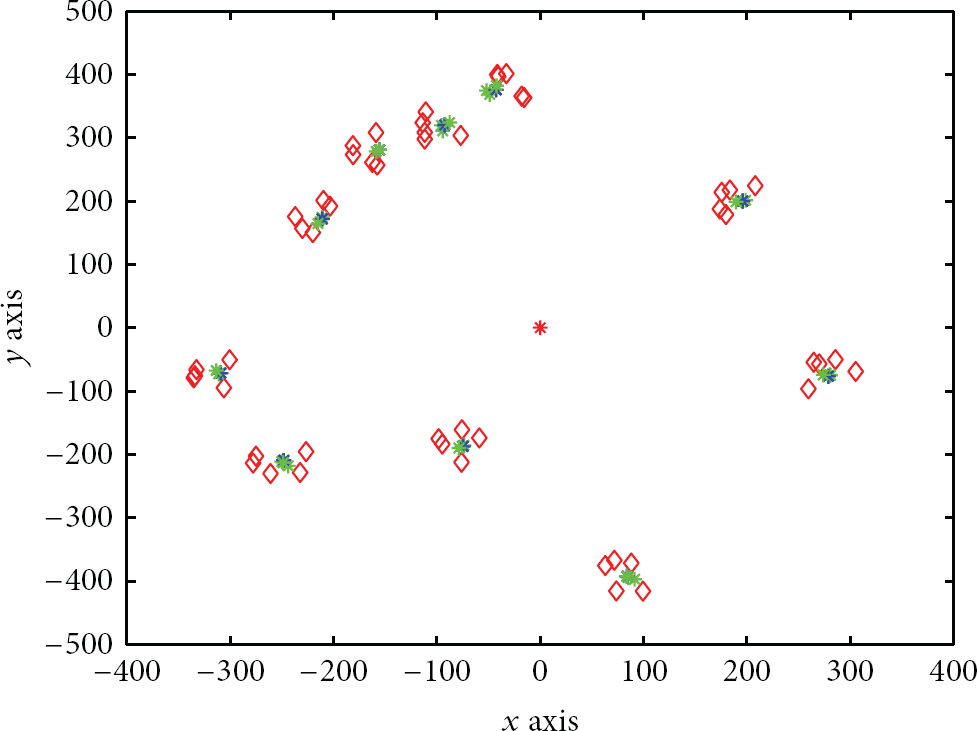
Simulation topology.
Figure 4 shows the average energy efficiency per subchannel of the proposed Algorithm 1 compared with the existing unpricing algorithm in two-tier femtocell networks. Here, energy efficiency is defined as the ratio of capacity to transmit power on each subchannel [16]. The existing unpricing algorithm is composed of energy efficient power allocation in [16] and unpricing subchannel allocation in [17]. The proposed Algorithm 1 shows better performance than existing scheme in terms of energy efficiency. As the figure shows, with the increase of number of femtocells, the average energy efficiency per subchannel decreases because of the increase of aggregated cochannel interference. Moreover, the bigger F results in higher energy efficiency because of the multiuser diversity.

Average energy-efficiency per subchannel.
Figure 5 shows the average power per subchannel of the proposed Algorithm 1 compared with the existing algorithm. As can be seen from Figure 5, the average power per subchannel increases with the increase of the number of femtocells; that is, as the number of femtocells increases, the cochannel interference is more serious; thus, the average power per subchannel needs to increase to maintain the utility of the femtouser.

Average power per subchannel.
Figure 6 shows the capacity of macrocells of the proposed Algorithm 1 compared with the existing algorithm. As can be seen from Figure 6, the capacity of macrocell increases with the increase of the number of femtousers per femtocells because of the multiuser diversity. Note that a large number of femtocells results in a lower energy efficiency because of the cochannel interference.

Capacity of macrocell versus number of femtousers per femtocell.
5. Conclusion
In this paper, we have investigated the energy efficient uplink power control and subchannel allocation in two-tier femtocell networks. Taking transmit power and circuit power into account, we modeled the power control and subchannel allocation problem as a noncooperative game to maximize energy efficiency of femtocell users. To mitigate the cochannel interference, we introduced a convex pricing scheme. We decomposed the resource allocation problem into two subproblems, that is, a distributed subchannel allocation scheme and a distributed power control scheme to reduce costs and complexity. Simulation results show that the proposed algorithm can improve user utilities significantly, compared with existing resource allocation algorithms.
Footnotes
Conflict of Interests
The authors declare that there is no conflict of interests regarding the publication of this paper.
Acknowledgments
This research is supported by the National Natural Science Foundation of China (nos. 61271179 and 61101109), the fundamental research funds for the central universities (2013RC0110), and the Cobuilding Project of Beijing Municipal Commission of Science and Technology.