




Abstract
Shape memory alloy (SMA) wires were embedded within laminated composite plates to take advantage of the shape memory effect property of the SMA in improving post-buckling behavior of composite plates. A nonlinear finite element formulation was developed for this study. The plate-bending formulation used in this study was developed based on the first order shear deformation theory, where the von Karman's nonlinear moderate strain terms were added to the strain equations. The effect of the SMA was captured by adding recovery stress term in the constitutive equation of the SMA composite plates. Values of the recovery stress of the SMA were determined using Brinson's model. Using the principle of virtual work and the total Lagrangian approach, the final finite element nonlinear governing equation for the post-buckling of SMA composite plates was derived. Buckling and post-buckling analyses were then conducted on the symmetric angle-ply and cross-ply SMA composite plates. The effect of several parameters such as the activation temperature, volume fraction, and the initial strain of the SMA on the post-buckling behavior of the SMA composite plates were studied. It was found that significant improvements in the post-buckling behavior for composite plates can be attained.
1. Introduction
One of the major material consideration in the design of aerospace vehicles is the weight saving and fiber reinforced composite (FRC) that meet this requirement. Also due to this weight saving purpose, some parts of these structures are made of thin, flat, or curved panels. Examples of these components are aircraft stabilizer, fuselage section, and body section of an aircraft. These components are subjected to mechanical loading such as lateral pressure and edge compression loads. As these loads are responsible for buckling failure, it is important to study the buckling and postbuckling behaviors of the FRC plates. Buckling of plate refers to the abrupt and huge lateral deflection of a plate that occurs after the magnitude of the load reaches a critical value. A large geometrically nonlinear deflection will follow this critical buckling point. It is important to understand this postbuckling behavior of plates if the usage of these plates is to be optimized.
The postbuckling behavior of the FRC plate can be optimized by determining the correct combination of FRC parameters such as lamination angles and number of layers. However this type of improvement is rather fully utilized. Researchers in recent years have turned to smart materials for improving buckling behavior of FRC plates. SMA is a widely preferred smart material since through its shape memory effect (SME) property, it offers the advantage of high recovery stress and/or strain. Generally the recovery strain provides shape changes of composite plates, while the recovery stress increases strain energy and thus improves structural behaviors of composite plates. A high recovery strain of up to 10% and recovery stress of up to 800 MPa can be induced for nickel-titanium (Nitinol) SMA [1]. In this study, the SME property of the SMA was used by embedding SMA wires within layers of laminated composite plates. The embedment of SMA wires within layers of composite is practical since current technology allows processing of high quality ultrathin SMA with diameter of 50 μm, where as a comparison, the diameter for carbon fiber is 5 μm. This actually has allowed direct integration of the SMA wires within matrix without disturbing the structural integrity of the composite [2].
The SMA methods of improvement of structural behaviors can be classified into two methods: active property tuning (APT) and active strain energy tuning (ASET) [3]. The APT refers to the increase in the Young's modulus, yield strength, and other mechanical properties of the SMA after the transformation of SMA from martensite to austenite phase occurs. On the other hand, the ASET method implements the SME property of the SMA. It involves the embedment of prestrained martensite SMA wires within laminated composite plates. When the heat is increased, the wires are constrained from returning to their memorized length as the transformation to austenite phase occurs and thus generating the recovery stress. This recovery stress can be used to increase strain energy and stiffness of the structures and thus improving structural behaviors such as shifting natural frequencies and suppressing vibration of composite plates [4], providing shape or position change of composite plates and increasing buckling and thermal buckling loads [5, 6].
Studies on the postbuckling behavior of SMA composite plates due to mechanical loading are considerably few even though studies on the postbuckling behavior of SMA composite plates subjected to thermal loading are quite extensive [7, 8]. Baz et al. [9] studied the buckling characteristics of a flexible fiber-glass composite beam that was controlled by SMA wires. Nitinol wires situated inside rubber sleeves were embedded along the neutral axis of the composite beam. Prior to that, Nitinol wires were trained to memorize the shape of the unbuckled beam. Once buckling occurs, the SMA wires were activated to bring the beam back to its original shape. Finite element model was developed and the individual contribution of matrix, Nitinol wires, thermal stress, and recovery stress to the buckling of the beam was analyzed. It was shown that for the given specifications of the SMA beam, embedding eight SMA wires would increase the buckling load three times. The results from the FEM work correlated well to the results from the experimental work. Later this work on the linear buckling improvement of composite beams was extended to linear buckling of composite plates by Ro and Baz [10, 11]. The FEM thermal analysis of the SMA composite plates was firstly conducted to determine the steady-state and transient temperature distributions inside SMA composite plates and this result was used to study the static and buckling characteristics of the SMA composite plates. It was found that the reinforcement of Nitinol fibers within composite plates can dramatically enhance their critical buckling loads even when these plates were clamped from all edges.
In their research, Thompson and Loughlan [12, 13] proved that by embedding prestrained SMA wires within laminated composite plates, the out-of-plane displacement can be reduced. Two concepts of SMA controlled composite plate were used. Firstly, SMA wires were embedded within the outermost layer of a symmetric cross-ply composite laminate with a lamination scheme of [02/902]s and secondly the SMA wires were located within tubing at the neutral axis of the composite plate. The results obtained from the FEM work were compared to their experimental results. It was found that the postbuckling deflection can be reduced even for applying a small volume fraction of SMA. The second concept was found to give more effect on the elevation of the postbuckling response as compared to the first concept. Zhang and Zhao [14] conducted a comprehensive study on the effect of SMA on several structural behaviors of beams such as free and force vibrations, buckling and postbuckling, and deflection using the FEM. The effect of the nonuniformly distributed SMA wires in the transverse direction on the linear buckling of laminated plates was studied by Kuo et al. [5] using the FEM. The motivation to this new study was the important requirement for careful application of SMA fibers in laminated composite plates since the mass density of Nitinol was actually much higher than the mass density of carbon-epoxy. Due to variable fiber spacing, uniform stress was applied to opposite edges that results in the non-uniform stress distribution in the middle of the plate. A plane elasticity problem must be solved first to determine the in-plane stresses caused by in-plane boundary loading and these stresses became the input to the buckling problem. They found that when the fibers were concentrated at the center of the plate, the critical load of the plate will be improved considerably.
More studies are still required to further the understanding on the buckling behavior of SMA plates. Realizing the importance of the smart material technology as the future design base provides the motivation for this research to be conducted. In this study the buckling and postbuckling behaviors of the SMA composite plates subjected to mechanical loading were examined using the FEM. A nonlinear FEM formulation of the SMA composite plates and its source codes were developed. The behaviors of the SMA wires were governed by the Brinson's constitutive model. The effect of several parameters such as the activation temperature, the volume fraction, and the initial strain of the SMA on the postbuckling behavior of composite plates was studied.
2. Material and Methods
2.1. Shape Memory Alloy Composite Plates
The effect of the ASET method of improvement on the postbuckling behavior of the composite plates has been studied for simply supported symmetric angle-ply and cross-ply laminated composite plates. Figure 1 shows this SMA composite plate focusing on the top layer of the plate.

The SMA composite plate [15].
The angle of orientations for angle-ply and cross-ply composite plates are the (45/−45)s and (0/90)s, respectively. The graphite-epoxy (GE) composites are used here. SMA wires at a certain volume fraction are embedded parallel to the graphite fibers in each layer. From Figure 1, the x-y-z and 1–2–3 are the Cartesian and material coordinate systems, respectively. The plate has an aspect ratio of
Properties of the GE and the SMA.

Both of the loaded sides of the plates have simply supported boundary condition, while the boundary conditions correspond to the nonloading sides of the plates that are both simply supported (SSSS), both clamped (SSCC), or one simply supported and one clamped (SSSC).
2.2. The Brinson's Model
The unique behaviors of SMA can be described by the constitutive relationship of the SMA that was proposed by several researchers. A simple SMA constitutive model was developed by Tanaka [18] and later improved by Liang and Rogers [19] and Brinson [17]. The improvement made by Brinson's model was significant since the martensite is divided into the temperature induced martensite (TIM) and the stress induced martensite (SIM) and this model recognizes only the SIM that gives the functional properties of SME. This study thus used the SMA constitutive model of Brinson. Brinson's model requires the use of several parameters which can be determined through experiments. In this study, these material parameters were taken from the experimental works of Zak et al. [20] and are shown in Table 2. With these material parameters, the quasiplasticity and SME properties of SMA were studied using Brinson's model [17]. Here the SMA wires can be initially in a state of fully martensite or fully austenite. These wires were stressed above a critical finish stress, σcr,f for a complete detwinning process to occur [17]. A complete unloading thereafter for each case of the initial state of the SMA will give the maximum residual strain (e L ) of about 0.058 m/m. These behaviors of quasiplasticity are shown in Figure 2.
Parameters of the shape memory alloy Brinson's model [20].

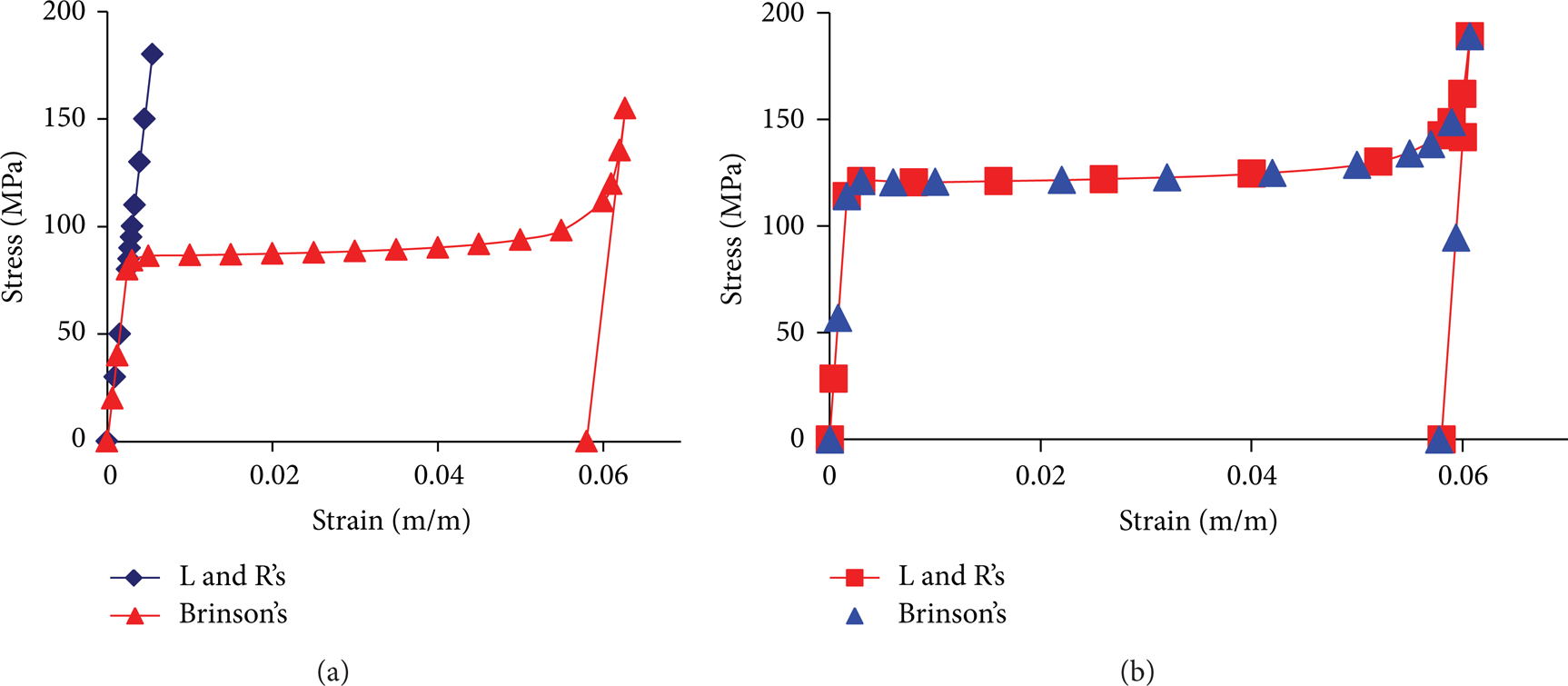
Quasiplasticity of Nitinol SMA with initial phase of (a) martensite and (b) austenite.
Notice that in Figure 2(a), Liang and Rogers's (L&R's) model [19] cannot represent the detwinning process of the martensite, where the loading process becomes an infinite linear elastic loading. This occurs since martensite is not categorized into TIM and SIM as in Brinson's model and as such the detwinning process of the SMA is not considered in this model and the L&R's model [19] cannot represent the quasiplasticity behavior at temperature T<M s . However for the fully austenite loading case, both models provide the same curve of quasiplasticity behavior such as shown in Figure 2(b).
The same type of SMA wire with a certain amount of prestrains is now heated above the austenite start temperature, A s , while the wires are prohibited from recovering its strain. Restrained recovery occurs when the SMA wires are totally prohibited from recovering their strain [19]. Figure 3(a) provides the amount of recovery stress over an increase in temperature for different values of SMA initial strains, e. Notice that in this figure, the incomplete L&R's curve is shown where in the complete one actually, an enormous amount of recovery stress of more than 4000 MPa can be recovered. An alternative assumption for the stress recovery process is the controlled recovery where some recovery strain may occur during the heating process of the SMA wires. The SMA and the composite here can be modeled as a SMA-spring structure, where the amount of recovery stress induced depends on the stiffness of spring [19]. Figure 3(b) shows the reduction of the recovery stress in the controlled recovery for different values of SMA-spring property, kL/s, where k is the spring constant, L is the length of the wire, and s is the cross-sectional area of the wire [19].

Recovery stress of Nitinol SMA for the (a) constrained recovery and (b) controlled recovery.
Notice from Table 2 that the transformation temperatures which are M s , M f , A s , and A f are values determined at a zero state of stress. However, since these transformation temperatures depend on stress, the actual transformation temperatures in this study are higher due to the presence of thermal stress prior to the start of the transformation process.
2.3. Finite Element Formulation
The FEM formulation of the SMA composite plates differs from the typical formulation of composite plates due to the need to include two additional aspects into the formulation: combining the SMA and composite properties to get the effective properties and the inclusion of the recovery stress of the SMA into the formulation. With current technology that allows for the good embedment of SMA wires within composite matrix, perfect bonding can be assumed between SMA wires and the composite matrix. As such the effective properties for Nitinol-GE layers can be calculated using the rule of mixture. As an example, referring to the material coordinate system (1–2–3) of the SMA composite plate in Figure 1, the effective Young's modulus for each layer is

where E1 is the effective Young's modulus in 1-direction, E m and E s are the Young's modulus for GE and SMA, respectively, and V m and V s are the volume fractions for GE and SMA, respectively.
The effect of SMA recovery stress can be included in the composite constitutive relationship. Since the tensional recovery load will be in the direction along the SMA wires, the orientation of the SMA wires should be in the principle 1-direction. The in-plane constitutive relationship for the kth layer of the SMA composite plate in material coordinate system is then

or in a short form

where

where

where u0, v0, and w0 are the midplane displacements in the x, y, and z directions, respectively, while θ x and θ y are the normal rotations in the x-z plane and y-z plane, respectively, and t is the time variable. By including the von Karman's strain, the strain can be expressed as

or

where
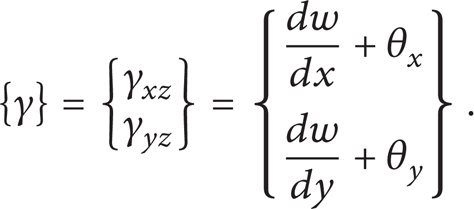
The constitutive relationship based on the stress resultant for the in-plane stress is

and for the out-of-plane stress,

where A, B, and D are the laminate material matrices, while N and M are the force and moment resultant vectors, respectively. N r and M r are the resultant force and moment vectors due to the recovery stress, respectively, such as

Due to its simplicity and ability to represent the linear and nonlinear buckling formulation based on Mindlin's FSDT, eight-noded isoparametric quadrilateral elements were used in this study. Each node carries 5 degrees of freedom.

where {a} and {q} are the generalized and nodal displacement vector, respectively, and [N] is the shape function matrix. The principle of virtual works can be stated as

Combining (5)–(13) into (15) and following the standard FEM modeling procedures [21], we have

The external work done for the case of buckling will be due to compressive loading. Taking this compressive load vector as

So combining (16) and (17) into (14), the FEM governing equation for the nonlinear buckling of SMA composite plates can be obtained as in the following:

where

Applying Taylor's expansion [21] to {ψ},

where

So that the iterative procedure in determining the postbuckling response is

where displacements are incremented such as

Equation (18) can be reduced to the standard classical buckling equation as in the following equation:
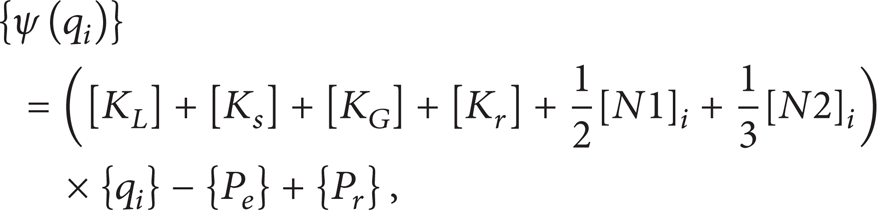
where λ is the eigen-value or the critical load, while {q} is the eigen-vector corresponds to each of the eigen-value. Critical loads are determined here by solving the eigen-value problem in (25) using the inverse-power method [21]. In a more accurate derivation of [K G ] for the linear buckling equation of (25) using Hamilton's principle [21], this geometric stiffness matrix can be expressed as

where

where

3. Results and Discussion
3.1. Validation
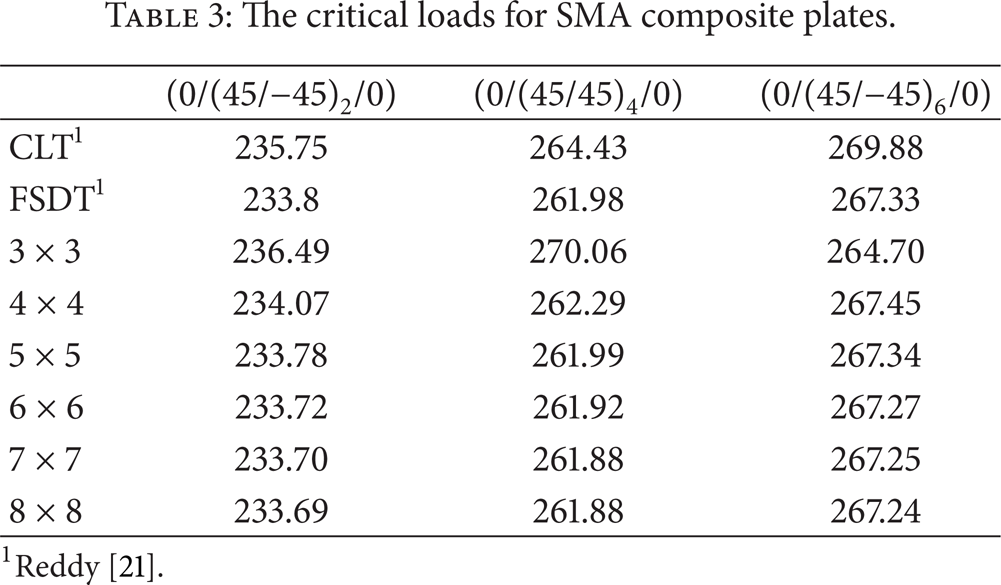
Linear mechanical buckling analysis was conducted on several configurations of SMA composite plates and the results are compared with results from analytical solutions. Beside the purpose of validation, these validation analyses are used as convergent tests in order to get the appropriate mesh size for the elements that are to be applied to the plates throughout the study. In this buckling analysis, three configurations are used: (0/(45/−45)2/0), (0/(45/45)4/0), and (0/(45/−45)6/0), where the angle of orientation of 0° corresponds to the SMA layer. Table 3 shows the critical load results of the linear buckling analysis for three composite configurations, where the results are compared with analytical results that are based on the classical lamination theory (CLT) and the FSDT [21]. Quick convergences can be seen to occur in these finite element analyses for all three SMA composites.
The critical loads for SMA composite plates.
Reddy [21].
It was decided that the 6 × 6 configuration are the best mesh to be applied in this study considering the accuracy and the required amount of computing time.
A postbuckling analysis was conducted on a simply supported antisymmetric angle-ply composite plate with (45/−45) configuration, using the following properties:


The plot of the load ratio (P/Pcr) against the maximum transverse displacement (

The validation of the postbuckling path of the composite plate.
3.2. The Effect of the SMA Activation Temperature
In this study, initial strain of the SMA is set to be ε0 = 0.001 and the activation temperature, T a , is varied. Data in Table 4 shows the amount of recovery stress, σ r , the SIM volume fraction, ξ s , and the Young's modulus, E s at several activation temperature determined through Brinson's model for SMA with initial strain, ε0 = 0.001. The data shows Young's modulus and the corresponding recovery stress are increased as the T a is increased, while the austenite transformation is progressing.
The data determined through Brinson's model at ε0 = 0.001.

Recall from Table 2 that the A s and the A f are 37.2°C and 47°C, respectively. However, these transformation temperatures depend on the level of stress that presents in the SMA composite plate [19]. With the effect of stress that occurs due to the increase of temperature, the actual austenite start temperature, A s m , and the austenite finish temperature, A f m become 38.2°C and 58.2°C, respectively [19]. Figure 5 shows the effect of increasing the T a on the APT and ASET improvements of critical loads for the three cases of boundary condition.

The effect of the T a of the SMA on the RCL of composite plates.
The effects of SMA here are measured through the relative critical load (RCL) [24], which is the ratio of the critical load of the composite plate after the SMA activation to the critical load before the SMA activation. It can be seen from the RCL against T a plot in Figure 5 that as the T a is increased, the RCL is increased for both the APT and ASET cases, where the effect of SMA is greater between the T a of 40°C and 60°C. This is the range of temperatures where stress is mostly recovered and Young's modulus is increased quickly as the austenite transformation takes place within this temperature range according to the values 38.2°C and 58.2°C of the A s m and A f m , respectively. Above the A f m temperature, the process of recovery stress has stopped and the increase of the level of stress is solely due to the effect of temperature. As such the curves become flatter. Figure 5 also shows the trends that the effect of the SMA on the ASET improvement is more significant for the SSSS boundary condition, while the effect of the SMA on the ASET improvement for SSSC and SSCC boundary conditions shows almost similar response.
In the postbuckling analysis, the effect of the SMA activation temperature T a , the initial strain, and the volume fraction of the SMA are fixed at 0.01 and 10%, respectively, while T a is varied. Brinson's model [17] is used to determine the values of the recovery stress and Young's modulus at the required temperatures. Studies are conducted for cases of composite plate without SMA (WO SMA), the APT, and the ASET. Figures 6(a) and 6(b) show the effect of the SMA on the postbuckling behavior of composite plates at different T a for the angle-ply and cross-ply configurations, respectively. For the case of WO SMA, the plates buckle at the P/Pcr = 1 for each angle-ply and cross-ply composite plates as expected [23]. It can be seen that the postbuckling path has improved slightly in the case of the APT. Notice further that the postbuckling behavior has already improved even before reaching the actual start temperature, A m s , of 38.2°C. This is possible since a certain amount of stress has already been generated due to the increase of temperature [19].
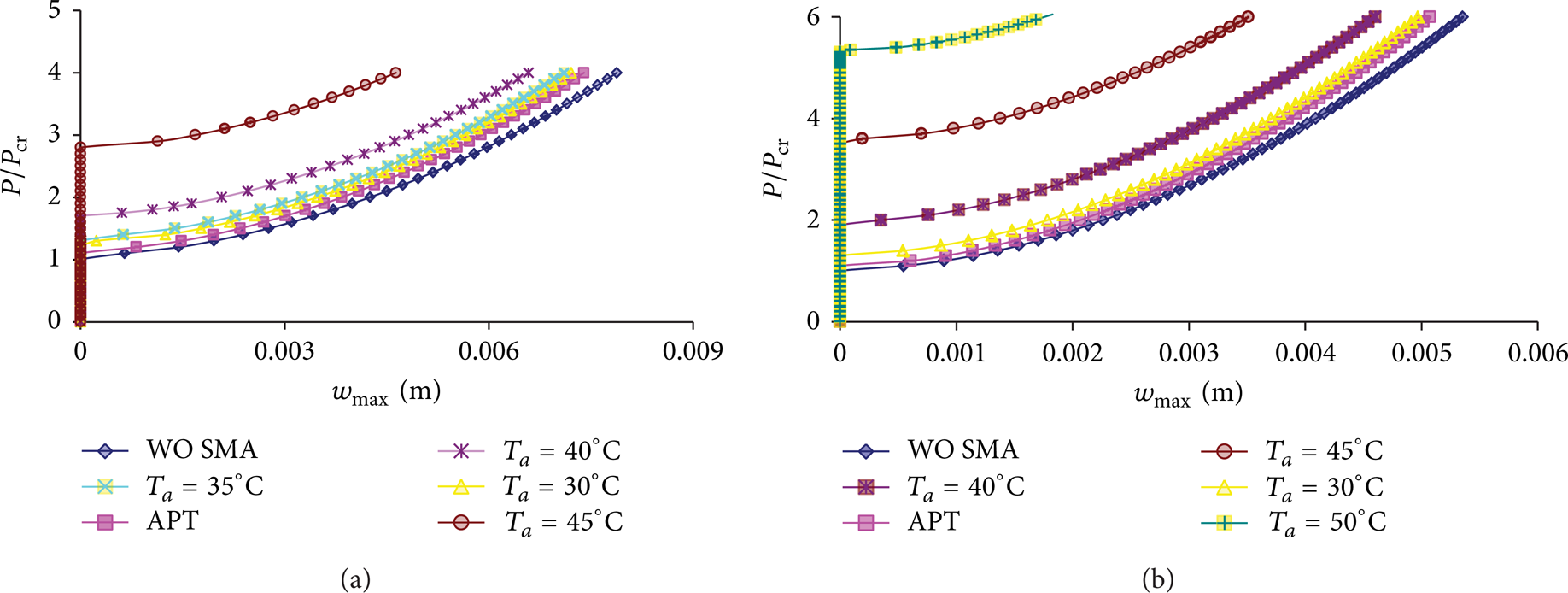
The effect of the SMA activation temperature on the postbuckling of the symmetric (a) angle-ply and (b) cross-ply composite plates.
A big improvement can be seen between the temperature of 40°C and 45°C, where during this time, due to the austenite transformation, that is, occurring, recovery stress is largely generated. At 45°C, the critical buckling loads have increased to almost 3 and 4 times the critical buckling loads of the composites without SMA for the angle-ply and cross-ply composite plates, respectively.
3.3. The Effect of the SMA Volume Fractions
The effect of the volume fraction of Nitinol wires on the critical loads of the SMA composite plates can be studied by varying the V s of the Nitinol wires in the NE layers, while the volume fraction of graphite fibres in the GE layers is kept constant. SMA with initial strain of 0.001 m/m that gives recovery stress of 91.6 MPa at the activation temperature of 60°C, based on Brinson's model [17], is used. The thickness of a NE layer is 0.6 mm. The results of the effect of the volume fraction of the SMA on the RCL can be seen in Figure 7. It shows that as the V s of the SMA is increased, the effects of SMA on the APT and ASET improvements increase at the same time, where the RCLs in all six cases increase. Notice also that the improvement made by the APT is very small compared to the improvement made by ASET. Furthermore, the effect of boundary condition is more significant in the SSSS boundary condition as compared to the other two boundary conditions.

The effect of volume fraction of the SMA on the RCL of composite plates.
In the postbuckling analysis, the volume fraction of the SMA in the composite plate is varied, while the initial strain and the activation temperature of the SMA are fixed at 0.01 and 60°C, respectively. Figures 8(a) and 8(b) show the effects of the SMA on the postbuckling behavior of the SMA angle-ply and cross-ply composite plates, respectively, when the volume fraction of the SMA is varied. It can be seen that, as in the previous study, the plates buckle at the P/Pcr = 1 for each angle-ply and cross-ply composite plate in the WO SMA case as expected. Note that in this study, the effective Young's modulus and the recovery stress are increased as the volume fraction of the SMA is increased. As such, it can be seen for both angle-ply and cross-ply cases, the increase in the postbuckling stiffness occurs as the volume fraction of the SMA is increased. At the SMA volume fraction of 25%, the critical parameter (P/Pcr ratio) has reached a value of slightly below 3 for the angle-ply composite plate, while the effect is higher in the cross-ply composite plate where the critical parameter is more than 3.

The effect of the volume fraction of the SMA on the postbuckling of the symmetric (a) angle-ply and (b) cross-ply composite plates.
It is interesting to see that the improvement caused by the SMA in the ASET method of improvement increases steadily especially for the case of the symmetric angle-ply composite plate. This can be clearly seen in Figure 8(a) that the amount of upward shifting of the post-buckling paths is almost equal for every 5% increase of the V s .
3.4. The Effect of the SMA Initial Strain
In studying the effect of initial strains of the SMA on the improvements of the critical load of the composite plates, Brinson's model is used to determine the recovery stresses and the corresponding Young's modulus of the SMA for several values of initial strains at a fixed temperature of 55°C. Data in Table 5 shows the amount of recovery stress, σ r , the SIM volume fraction, ξ s , and Young's modulus, E s for several ε0 values at T a = 55°C. It can be seen from Table 5 that the increase in ε0 will result in the increase in σ r and the decrease in the E s . This is due to the fact that a higher ε0 requires a higher temperature for the austenite transformation to complete. As a result at the fixed temperature of 55°C, the transformation that occurs will be less complete as the ε0 is increased. This behaviour patterns can be seen in Figure 9 which shows the effect of the initial strain on the RCL.
The restrained recovery stress based on Brinson's model at T a = 55°C.


The effect of the initial strain of the SMA on the RCL of composite plates.
In Figure 9, the reduction of Young's modulus is obvious when the effect of SMA in APT improvement can be seen to be declining as the initial strain is increased. However since the recovery stress is increased, the effect of SMA in the ASET improvement can be seen to increase as the initial strain is increased. Typically, the effect of SMA is at the greatest in the case of SSSS boundary condition.
Similar to the study in Section 3.3, SMA's initial strain, e is varied here while the T a and V s are fixed at 40°C and 10%, respectively. An interesting transformational behavior can be seen here in Figures 10(a) and 10(b) that show the effect of the SMA's e on the postbuckling behaviour of the symmetric angle-ply and symmetric cross-ply composite plates, respectively. Note that as the e is increased, the total recovery stress will be increased. However, this can only occur at the higher temperatures of the austenite finish temperature, A f s [19]. As such at the fixed value of the T a = 40°C, values of the recovery stress shows little increase for the increase of initial strain. Thus for both cases in Figures 10(a) and 10(b), after the significant increase in the buckling and postbuckling stiffness due to the addition of the SMA, that is, moving from the plot of WO SMA to the plot of e = 0.01, little upward shifting of the postbuckling path can only be seen as the initial strain of the SMA is increased.

The effect of the initial strain of the SMA on the postbuckling of the symmetric (a) angle ply (b) cross-ply composite plates.
4. Conclusions
A linear and nonlinear FEM formulation and its source codes were developed to study the effect of SMA on the postbuckling behavior of laminated composite plates. The results show that the formulation and codes are able to produce the expected effects of the SMA on the postbuckling behavior of the composite plates. It is found that as the activation temperature of the SMA is increased, the improvement of the postbuckling behavior is increased along, where the improvement in the postbuckling behavior for the cross-ply symmetric composites is higher than the improvement for the angle-ply composite plates. These improvements are due to the increase in the recovery stress of the SMA that occurs as the activation temperature is increased. The postbuckling behavior is also improved when the volume fraction of the SMA is increased. This is due to the fact that as the volume fraction of the SMA is increased, both Young's modulus and the recovery stress of the SMA plates are increased as well. Finally, as the initial strain of the SMA is increased, for a fixed value of activation temperature, the value of recovery stress does not change much. Thus, in contrast to the previous cases, little improvement can be seen in the postbuckling behavior of the SMA composite plates as the initial strain was increased for fixed values of activation temperature and volume fraction.
Conflict of Interests
The authors declare that there is no conflict of interests regarding the publication of this paper.
Footnotes
Acknowledgments
This work is supported by Malaysia's Ministry of Education through the FRGS Grant (Vot 78700) and the authors would like to express their appreciation to the Universiti Teknologi Malaysia and the Ministry for their supports.