




Abstract
The fierce global competition and market turbulence has been forcing the enterprises towards to the integration and intelligence for supply chain management, and the seamless information sharing and collaboration as well as operation agility are the challenges which need to be conquered, in terms of the highly distributed and heterogeneous resources located in separated warehouses. Although a number of works have been done to achieve the aforementioned targets, few of them are able to provide an overall integration and intelligence support for such system management. In this context, a novel intelligent supply chain integration and management system based on Cloud of Things is presented, in order to provide flexible and agile approaches to facilitate the resource sharing and participant collaboration in the whole supply chain life cycle. Furthermore, the enabling technologies, such as intelligent supply chain condition perception, heterogeneous network access convergence, and resource servicisation, are also studied. Finally, a case study together with the prototype system is implemented and demonstrates that the developed system can efficiently realise the integration of supply chain processes in the form of services, and also provide the effective intelligence support for physical resource management, so as to achieve an overall performance assurance for the system operation.
1. Introduction
As a vital and important process of industrial production, supply chain affects the operation efficiency and beneficial value of enterprises with the cost of transportation, land, and labor. Supply chain integration, which is widely considered as a vital factor determining the supply chain performance, for instance, reducing cost, improving responsiveness, increasing service level, and facilitating decision making, has attracted more and more attention [1–4]. Information sharing and collaboration [1, 5] as well as the agility [6] are the key characteristics of the supply chain integration. On one hand, information sharing and collaboration is able to enhance the supply chain visibility and avoid the information delay and distortion, which would result in tremendous variations and inefficiencies, and even a phenomenon called the bullwhip effect [7, 8]. On the other hand, agility aims at providing the required abilities for an enterprise to respond properly and being actively adapted to rapid and unexpected changes in global market [9]. Over the past decades, the two aspects of supply chain integration are technically challenging due to the high fragmentation of industry, which is induced by economic globalization and distributed manufacturing [10]. With the highly distributed and heterogeneous resources located in separated warehouses, the warehouse integration, which is an indispensable part of supply chain management, will face more challenges. In this context, supply chain integration has higher requirements for real-time information sharing, response speed, and flexibility in agile management. However, few of the existing frameworks and technologies are able to satisfy all of these diverse needs and the adoption of several different technologies and systems may lead to higher cost, lower system flexibility and extensibility, and more complex integration, such as Electronic Data Interchange (EDI) and Enterprise Resource Planning (ERP). Therefore, there is a need for novel frameworks and tools to enhance the performance of agility, real-time sharing, and flexible collaboration in supply chain management.
With the rapid development of ICT technologies, for example, Cloud Computing and Internet of Things (IoT) [11], new opportunities were created to build applications, which better integrate the real-time conditions of physical resources and fill the gap between the virtual and real world [12]. Cloud of Things (CoT) [13], launched initiatively by the MIT Auto-ID Labs, builds on the two concepts of IoT and Cloud Computing and constructs a model of an object in the cloud with a defined set of Application Programming Interfaces (APIs), facilitating the integration of data from heterogeneous sources more readily than trying to establish a common registry or protocol across multiple organizations. In the architecture of CoT [12, 13], the heterogeneous resources (sensing, actuation, computing, and storage) can be virtualised as a service, be aggregated in terms of a given thing-like semantics, and then be provided to the end users. The CoT has emerged as a promising framework and technology solution to integrate the distributed physical resources and manage the things in terms of cloud services in a scalable, flexible, and reusable manner, which can be seen as interfaces independent from location and accessed with simple and pervasive methods [14]. Due to the features of modern supply chain management, such as high distribution of items, more requirements of integration, and agility, the basic ideas and framework of CoT suit the design of supply chain system well.
In order to facilitate the modern supply chain integration and conquer the aforementioned challenges, such as lacking of real-time information and agility, this paper presents an intelligent supply chain integration and management system based on the conception of CoT. In traditional supply chain management system, the efficient supply chain and response supply chain are two main branches [15]. The primary goal of the previous one is to supply demands at the lowest level cost [16], while the other one's aim is to respond quickly to various demands [17]. In this system, more attention is paid to supply chain integration, real-time monitoring requirements, and cloud service for agility, to meet various demands at lowest cost in agile way. It uses the intelligent perception techniques to collect the condition information of resources during the whole life cycle of supply chain for real-time monitoring and enable the resources to be seamlessly adapted to the service management platform using a set of networking approaches for supply chain integration. Moreover, the supply chain resources are virtualised as cloud services to be provided to the users on demand, so as to facilitate the agility for various demands.
The remainder of this paper is structured as follows. Section 2 describes the related works on operation models and technologies for supply chain integration and management. Section 3 develops a system framework for supply chain integration and management based on CoT. Section 4 presents the enabling technologies for the developed system. Then, a case study together with the system implementation and evaluation are presented in Section 5. Finally, Section 6 concludes the paper.
2. Related Works
With the rapid changes in the logistics industry, the following problems [1, 6, 18–22] in supply chain management are identified: (i) high fragments in supply chain, (ii) information sharing and collaboration between participants, and (iii) agile supply chain management for rapid, effective, and efficient response to the changes in market. Some previous researches have been done on the supply chain management, including theoretical research and practical system development. Nevertheless, none of the single existing technologies can solve the problems and provide an overall performance assurance for information sharing and collaboration as well as the agility of supply chain management.
With the emergency of new ICT technologies, the supply chain management system has made a certain development in the last decades. Sense of the operation condition is usually the first step for information sharing and collaboration in the supply chain management. In [11], current development trend of IoT was discussed and the applications in the transportation and logistics domain are analyzed. Real-time information collection technologies based on RFID and other sensors can monitor almost all the supply chain links. Miorandi et al. [23] presented the digital and physical entities that can be linked by various appropriate information and communication technologies using IoT. It not only provided localization and tracking capabilities, but also enabled the things communication with low power. In general, the barcode [24, 25] and RFID technology [26–29] are frequently used to store and acquire product information in logistics, which is considered as an important part of supply chain management. Moreover, the collected information will be transmitted using various communication networks, such as Zigbee, wireless sensor network (WSN), 2G/3G, and Ethernet, located in different part of the supply chain, and this is the realisation foundation of information sharing and collaboration. In [30], the WSN technology was widely adopted in diverse environments, such as remote environmental monitoring and target tracking. In [30–32], the Zigbee technology provided solutions for communication among distributed sensor nodes deployed in the logistics links. After all, the degree of information sharing and collaboration can be improved by the usage of IoT and relevant key technologies. However, the agility which is another target of modern supply chain system cannot be achieved with these.
For the purpose of pursuing the agile and flexible system, more attention has been paid on system architecture, virtualisation, and servicisation technologies. The two technologies are critical for supporting the resource sharing and collaboration. In early stage of cloud computing [33, 34], everything was treated as service and three distinct layers from computing resources were defined to end-user applications in cloud computing architecture, for example, Software as a Service (Saas), Platform as a Service (PaaS), and Infrastructure as a Service (IaaS). Virtualisation and servicisation mean the abstraction of computing and storage resource [35]. In recent years, the applications of resource virtualisation and servicisation have extended to other areas with the development of cloud computing and its enabling technologies, such as manufacturing industry and logistics. In manufacturing domain [36–38], a new computing- and service-oriented manufacturing model, named cloud manufacturing, was proposed, and the manufacturing resources and capabilities can be virtualised and encapsulated for on demand using the virtualisation and servicisation technologies. Xu [39] compared cloud computing and cloud manufacturing and also indicated that cloud manufacturing performs agile and flexible way, in which distributed manufacturing resources are encapsulated into cloud services and the clients use them according to their requirements. In logistics area, as vital link of supply chain, Li et al. [40] proposed the logistics equipment and computing resources can be used flexibly by resource virtualisation, and the methods of selecting the best logistics services to raise the feasibility and effectiveness of logistics system were presented. As the data collected by various sensors becomes more and more large-scale and complex in supply chain management, traditional database software tools for data capturing, storing, managing, and analyzing cannot meet the requirements for the big data processing [41]. Big data strategies, seen as ways and tools for big data processing, are used to deal with the big data. Reference [42] introduces distributed computing as a strategy for big data, including distributing store and analysis.
In summary, most researchers have focused on virtualisation and servicisation technologies as well as the related applications in computing, manufacturing, logistics, and so forth. Few researches investigate the architecture of supply chain integration and management with the integration of IoT and cloud technology, in which distributed resources, for example, suppliers, warehouses, transportations, and so forth, can be treated as services and coordinated dynamically. The CoT aims to integrate the two concepts of IoT and cloud computing and provides the relevant services which can interact with the surrounding environment by collecting data and applying the management using the big data strategies. In a CoT system, things are treated as a service, which means heterogeneous resources can be aggregated and abstracted according to tailored thing-like semantics. As the new characteristics, the CoT is able to provide an advisable solution for improving the performance of agility, information sharing, and collaboration in supply chain system integration and management.
3. Framework
In this section, an overview of the developed system is presented. We firstly introduce a CoT model for supply chain integration and management, and then the architecture of the developed system is described in detail. The research assumes the supply chain management consists of supplier management, warehouse management, manufacturing management, and logistics management. The model of the supply chain integration and management system is developed based on CoT, which can provide diverse services to both the users and resource providers. In the CoT model, as shown in Figure 1, the supply chain management integration and platform are fulfilled with the services provided by individual clouds, supplier cloud, manufacturing cloud, warehouse cloud, and logistics cloud.
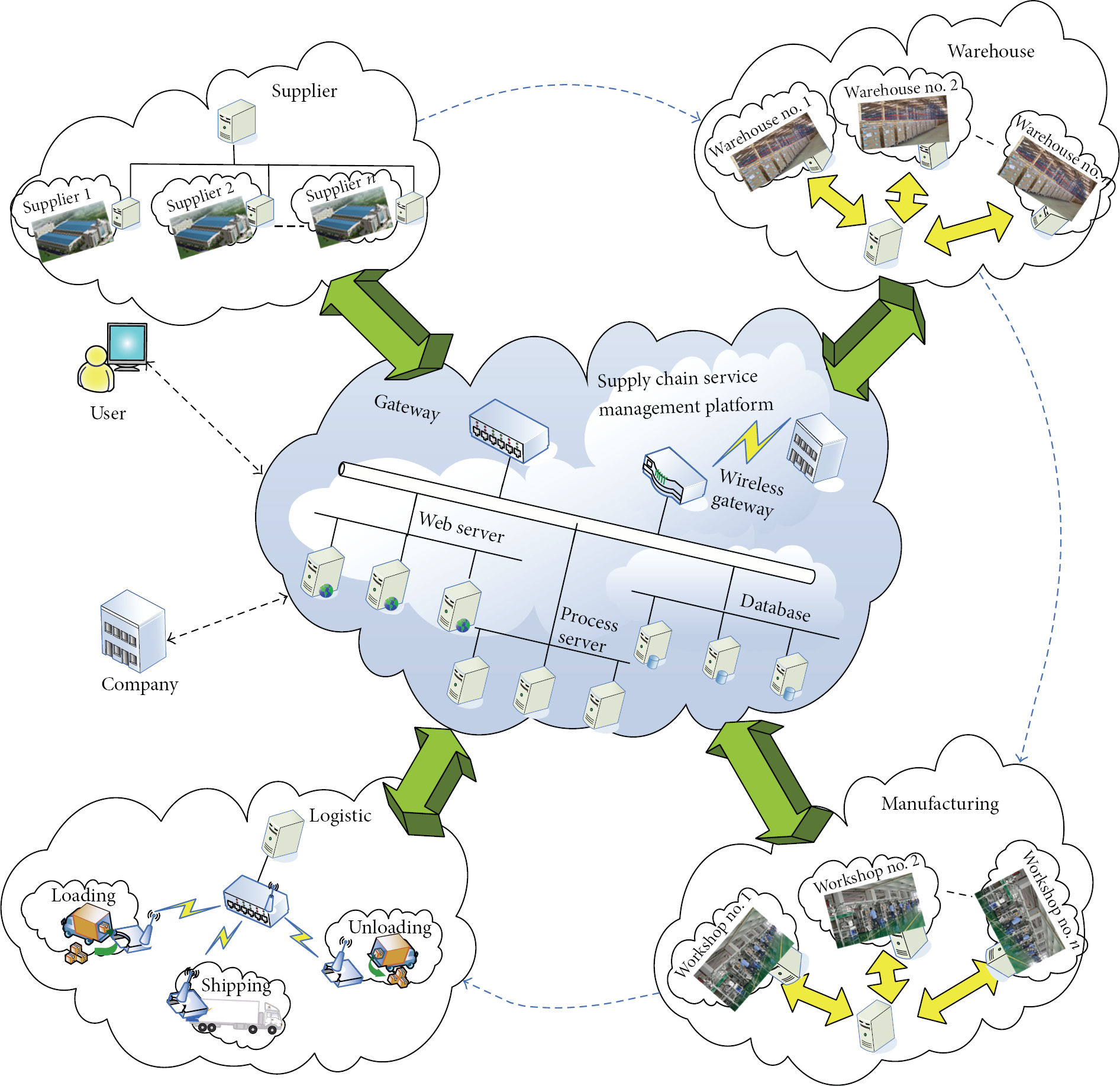
The CoT model for supply chain integration and management.
Various suppliers, providing respective services, gather together to realise the supplier cloud for supply chain management. The warehouse cloud servers the management platform with services provided by distributed warehouses. The resource services and capabilities are provided in the form of service cloud. In logistics cloud, each link of logistics is defined as a service provider, who collects logistics information and provides logistics services to the management platform.
As aforementioned discussion, the developed system focuses on the CoT and relevant enabling technologies for developing the functional system. As illustrated in Figure 2, the architecture of CoT-oriented supply chain integration and management system can be divided into three layers.
Supply chain process perception lies in the bottom of the system architecture and is developed to acquire link condition information of supply chain for material tracking as well as resource integration and management. The whole supply chain management consists of four parts which involve the supplier management, warehouse management, logistics management, and client management. Network access convergence is to connect heterogeneous networks, which are used for transmitting perception information. The process condition perception information is transmitted using a set of different communication approaches according to the requirements of application types and working environment. For instance, the Ethernet used for huge amount and wide area information transmission, Zigbee network used for local monitoring information transmission, GPRS used for logistics location information transmission, and so forth. Diverse subsystems of networking can connect the management platform by heterogeneous network access convergence technology. Supply chain service management platform is developed to manage the whole life cycle of supply chain activities, including the suppliers, warehouses, logistics, and clients, based on the process condition information collected by the intelligent perception modules. The service management platform can be divided into the supplier management, logistics management, client management, and warehouse management, which consists of the warehouse-entry management, shelves management, warehouse-out management, and storage management. In each management module of the platform, the resources in the supply chain are virtualised and encapsulated into services based on the perception information, and the users can inquire the services and invoke them with diverse demands.
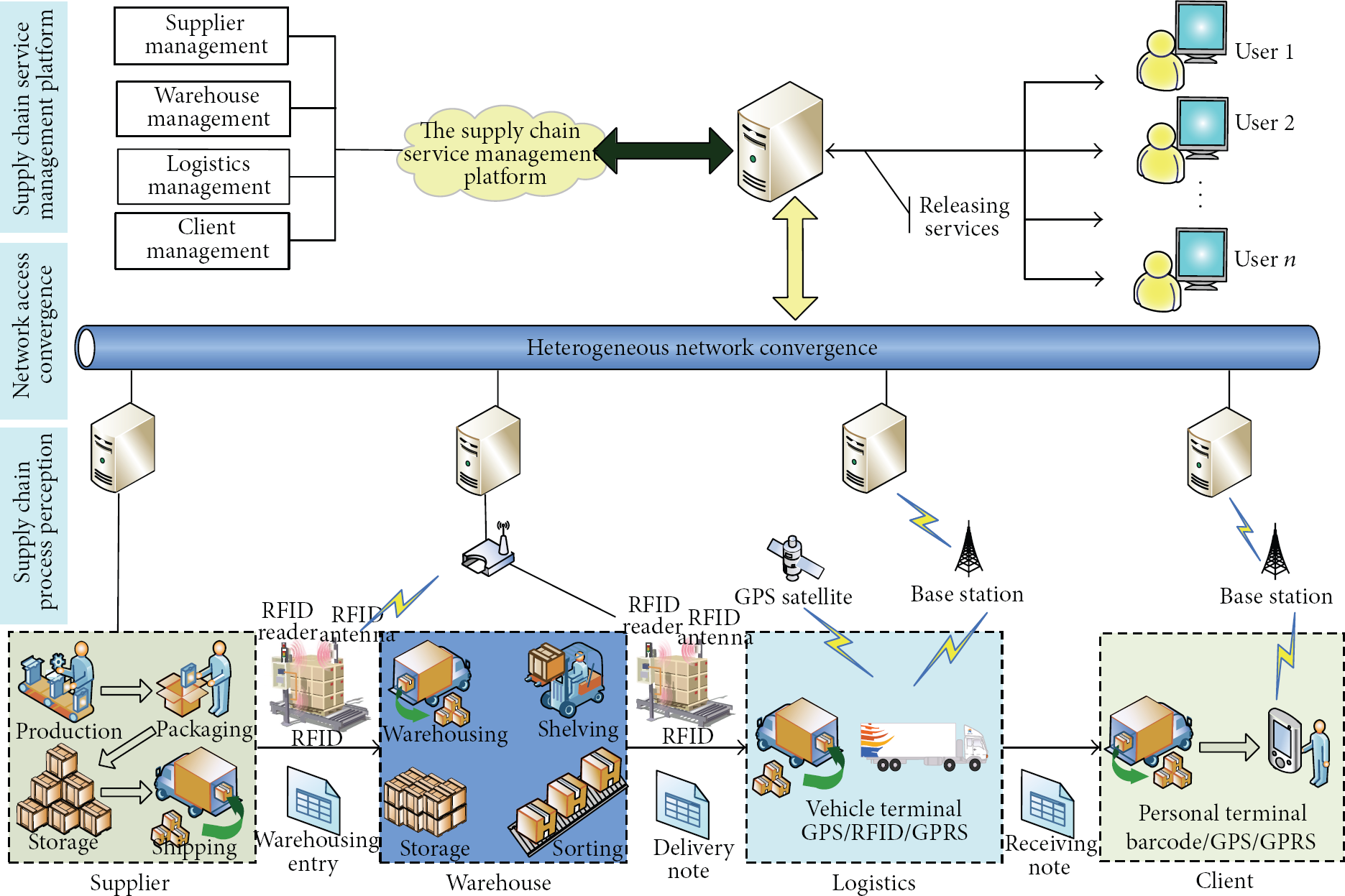
Architecture of an intelligent supply chain integration and management system based on CoT.
4. Enabling Technologies
4.1. Intelligent Process Condition Perception
In order to collect various condition information required by supply chain integration and management, various intelligent condition perception technologies, such as RFID, embedded technology, barcode, and other sensor technologies, are adopted in the developed system.
RFID is an automatic identification technology which depends on remotely storing and retrieving data using RFID tags. Compared with the traditional tracking manual tracking system, the RFID is widely used in the supply chain management with the characteristics of automatic identification, retrieving, tracking, and storing. A whole RFID system consists of two parts, RFID readers connected to one or more antennas and RFID tags, which store produced information in the form of electronic product code. On the other hand, the barcode system is the most popular management approach that has obtained much attention in the field of logistics. There are two kinds of barcode, one is one-dimensional barcode and the other is two-dimensional barcode. With the development of mobile intelligent terminal technology, the barcode data is more and more easily got by smart phones through mobile applications. Although the RFID technology has great unique advantages with wireless operations, it still cannot completely replace barcodes due to the cost and work environmental constraints.
As shown in Figure 3, the suppliers provide the goods with RFID tags or barcodes, which contain their basic information, such as name, model, quantity, producer, and supplier. As RFID tags are not selected by all suppliers, so the RFID tags, which have the same information with barcodes pasted on the surface of goods, should be added before entering warehouse for warehouse management. A fixed RFID device is deployed in the front of entrance to check the inbound goods according to the receipt. In the warehouses, the RFID readers are fixed on the shelves for goods location and inventory through scanning the RFID tags pasted on the goods. Individual environment sensors are deployed to collect the temperature and humidity information as well. As the inbound process, the fixed RFID device is also used to check the outbound goods according to the delivery list. In the process of logistics, the trucks are positioned with a mobile device consisting of GPS and GPRS module for good tracking. When the cargoes arrive at the destination, the receiver will check and sign automatically using a mobile RFID device, which compared the good information of RFID tags with the receive order information shown in the device.
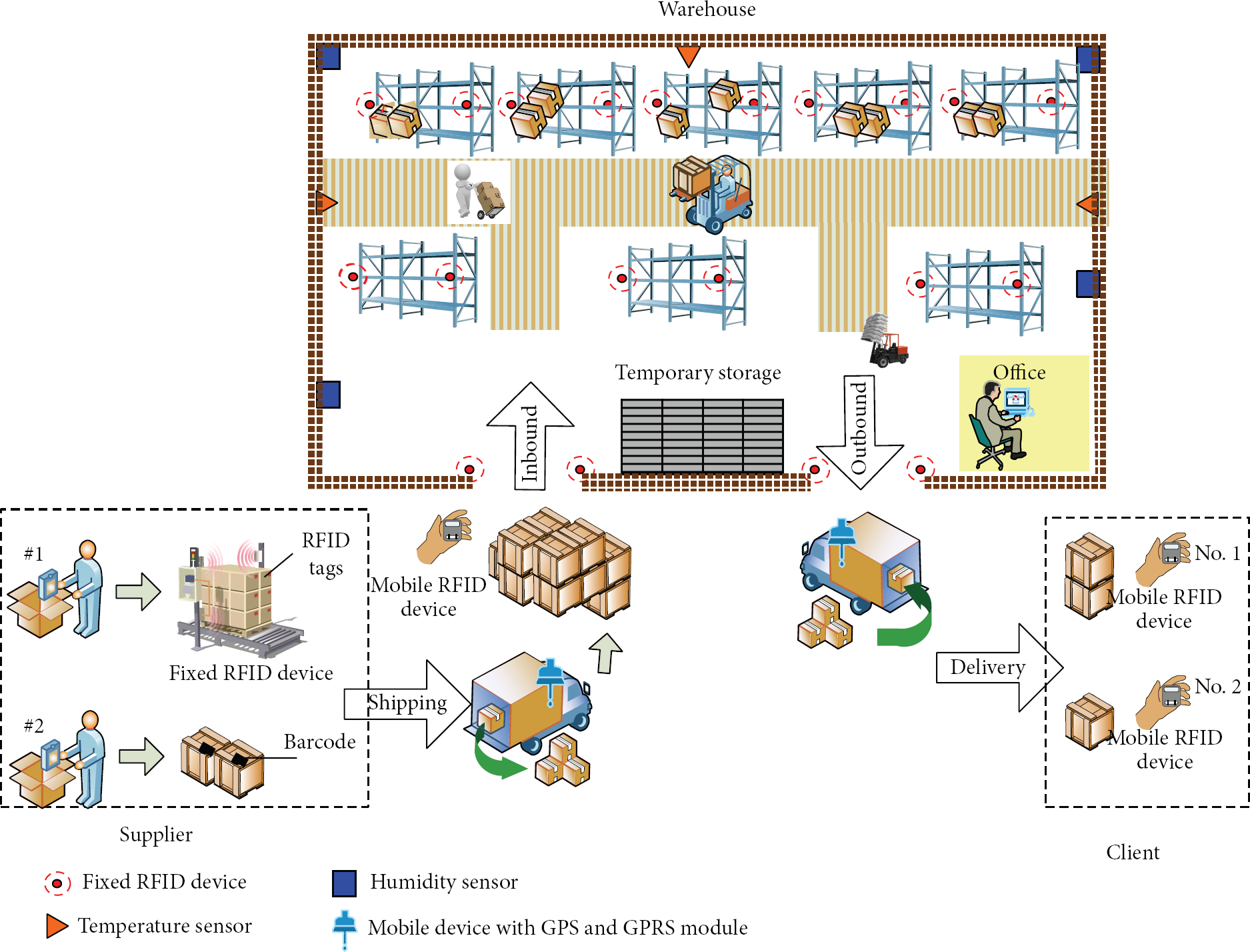
Deployment of process condition perception modules.
4.2. Heterogeneous Network Access Convergence
The resource access adaptation and its data transmission are the premise and guarantee of perception information analysis in the supply chain integration and management. It aims at interconnecting sensor nodes and communicates in real-time and accuracy. During the supply chain process, the perception information is multi-source, massive, and heterogeneous, such as cargo condition information, vehicle position information, and warehouse basic information. The traditional single transmission mode cannot satisfy the diverse needs of distributed information transmission in such complex working environment. Therefore, the heterogeneous network accessing and convergence are used to achieve reliable and real-time transmission of the dynamic condition perception information.
In particular, various means of communication techniques, such as Internet, WiFi, Zigbee, and GPRS are selected according to the types of information perception and the application scenarios. Figure 4 illustrates the realisation of the network accessing and convergence for connecting the resources in the supply chain process. For instance, in the management of warehouse, the goods information, acquired by the RFID readers which are located in the door, is transmitted using the Ethernet, the warehouse environment information is collected by the distributed sensors, and the shelves information will be sent by the Zigbee networks. In the process of transportation, we utilise the GPRS to transmit shipping information, such as location, name, and count. After arriving at the destination, the goods will be checked by customers, who use a mobile device to scan the RFID tags and send the checked information with GPRS to the server.
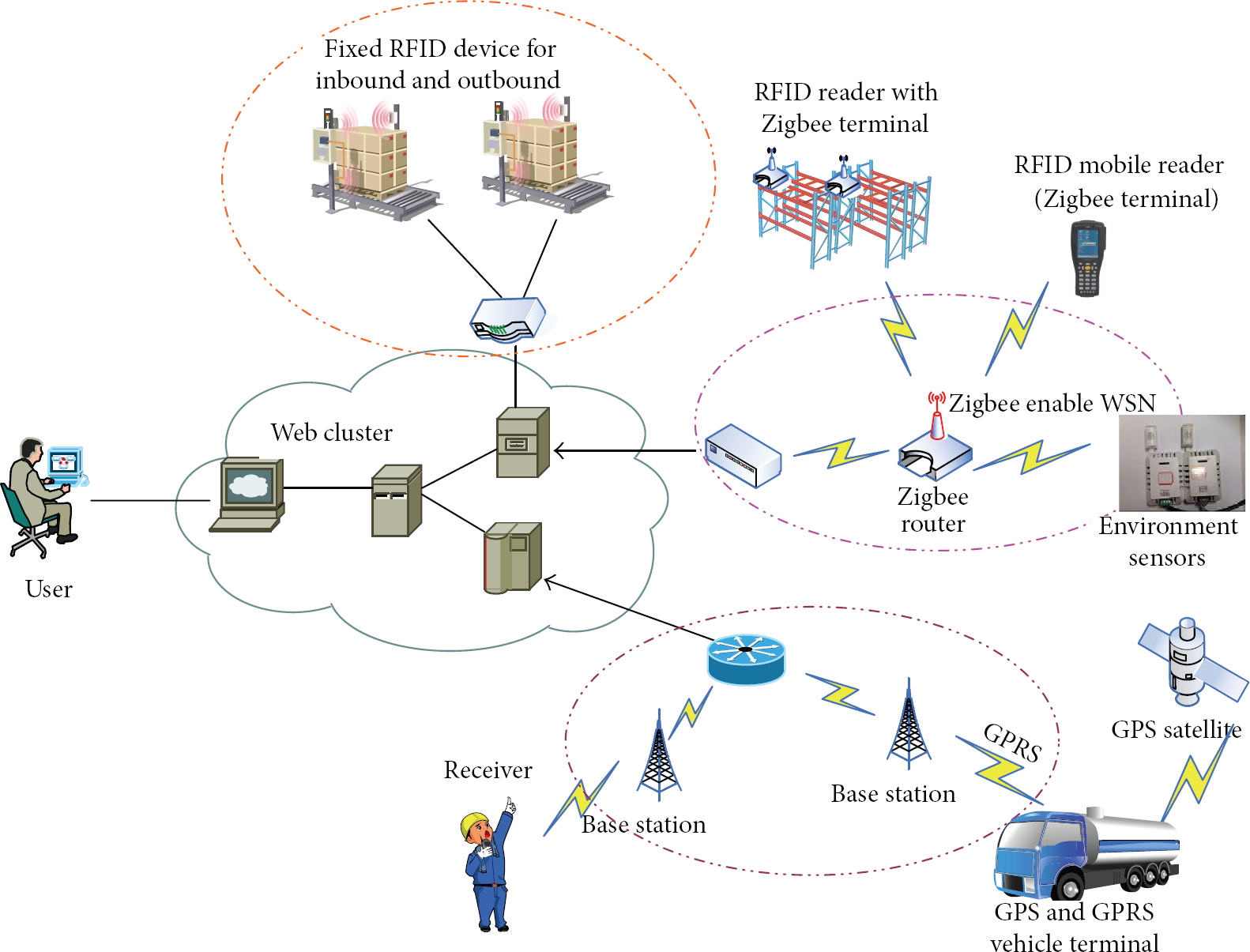
Heterogeneous networking solution.
4.3. Big Data Processing and Cloud Service Management
For the development of the intelligent supply chain management system, services packaging is a key work and the big data processing is the foundation. Figure 5 shows the processes from physical resources to resource service.

Big data processing and service packing.
Since the massive and heterogeneous data is collected by the process condition perception modules, the traditional data analysis tools cannot satisfy the requirements of such data processing. However, big data technology, as a new data processing technology, is playing an increasingly important role in data storage, exchange, and processing. According to the features of perception information, nonrelational database is utilised to store data instead of traditional relational databases. In order to improve data processing capability, the Hadoop framework is used to achieve the distribution storage and analysis work of the collected big data. The goal of big data technology is to improve data processing capability and improve the data value.
The services packaging aims to provide users with the appropriate supply chain services and it can be divided into four steps: (i) the resources analysis is used for the physical resources classification in terms of their characteristics in the supply chain process, (ii) the resource description model should be built to represent the resource information such as basic attributes and functional attributes, (iii) the OWL-S, which is an ontology web language for services, is used to describe the resource services, and (iv) the appropriate containers, such as Axis2, CXF, are utilised for web services releasing.
The conception of CoT guides the development of the whole supply chain integration and management, in particular for the service management platform. The platform is developed to manage the whole supply chain using the supply chain information collected by the process condition perception modules. As shown in Figure 6, the functional modules of the platform can be divided into four parts roughly, supplier management, warehouse management, logistics management, and client management. Each part is realised with SOA architecture. For example, the warehouse management module is designed with the services provided by the distributed warehouse management system. Meanwhile, the supply chain management platform also can provide cloud service for other users by gathering the distributed resource services.
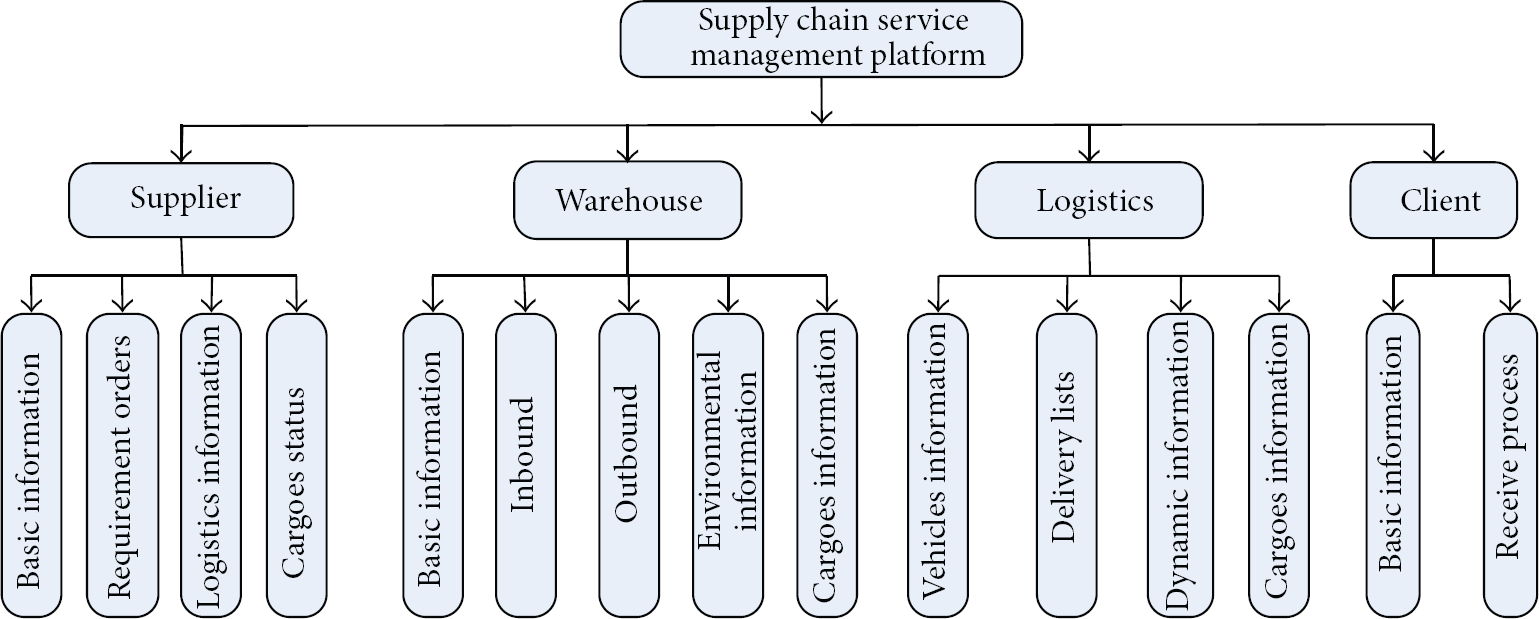
Functional modules of the supply chain service management platform.
5. Case Study and Prototype System Implementation
5.1. Case Study
As shown in Figure 7, a demonstration prototype system in laboratory environment has been built to a case study, and it simulates the supply chain integration and management process of the enterprises based on the developed system and the enabling technologies. The whole supply chain process can be divided into four parts, including the supplier, warehouse, logistics, and customer. Compared to the traditional systems, the demonstration system focuses on the supply chain integration with web services released by each useful independently functional subsystem, in which sensing and actuation resources are not only discovered, but also provided and aggregated as a service. According to the services provided by the warehouse management module, the warehouse keeper can adjust the warehouses for cargoes from suppliers. In the warehouse, distributed sensors and intelligent devices can be encapsulated into services for warehouse management. In order to select the best way for logistics, the manager will use the best logistics services provided by the devices located in the vehicles. When the cargoes arrive at the destination, the clients accept the cargoes with smart device which can provide accepting state service.

Demonstration system for supply chain integration and management.
5.2. Prototype System Implementation
5.2.1. Process Condition Perception
The process condition perception subsystem in the supply chain integration and management is presented in Figure 8. In the subsystem, there are three condition perception modules, including the RFID tags and readers, the GPS module, and the temperature and humidity sensors. Before entering the warehouse, the packing boxes with two-dimension codes provided by the suppliers, which contain the information of supplier, name, count, and so forth, will be labeled with RFID tags. The RFID readers, fixed on the shelves, scan the RFID tags periodically to acquire the goods information automatically. The tags pasted on the boxes are the typical EPC GEN2 UHF passive RFID tags and the RFID reader is Speedway R420, and the reader can connect 32 antennas through an antenna hub. In the process of transportation, the GPS device, which consists of a GPS chip and the GPRS module, is used to locate the goods and transmit the position information in time. As the popularity of mobile phones, which integrates GPS and GPRS modules, we developed a software program based on android system for goods tracking. This subsystem shows the feasibility of our architecture and its hardware realization.

Process condition perception tools.
5.2.2. Network Access Convergence
The network access convergence subsystem is deployed in the warehouse to gather and transmit the information collected by the condition perception subsystem. As shown in Figure 9, the Zigbee network used in the warehouse environment can be divided into three parts, including the Zigbee coordinator, Zigbee routers, and sink nodes. Firstly, a Zigbee coordinator establishes the core network, and then four routers join the Zigbee network. Several sink nodes with RFID devices or other sensors can join the network with a plug-and-play way. The sink node with RFID device is deployed on the shelves to monitor quantity and position of goods. Environment information collected by the sensors will be transmitted from sink node to the routers. The warehouse server acts as a gateway, which cannot only access the Zigbee network by a sink node, but also retrieve and transfer the collected information using Internet.

Network access for warehouse resources using Zigbee.
5.2.3. Supply Chain Service Management Platform
The supply chain service management platform, which uses the B/S structure, is the user-oriented interface of the system. The manager is able to acquire each link real-time status of supply chain process, so as to adjust the management strategies in time. Then the functionality of the supply chain service management platform, which includes supplier management, inbound management, shelves management, outbound management, storage management, and logistics tracking, will be presented individually. Figure 10 illustrates the process of inbound management, which contains three parts including the basic information of invoice, materials list, and actual materials data collected by the RFID devices. The inbound result will be displayed automatically in the web instead of making the comparison manually. After being inbound, the storekeeper sorts the goods into the shelves, selected by the shelves management interface, as shown in Figure 11, which not only help choose shelves, but also display the basic information of goods on shelves in real-time. For the logistics management, as shown in Figure 12, the invoices can be traced and the detailed information of invoices, such as the location, destination, and vehicle number, can be displayed on the web.
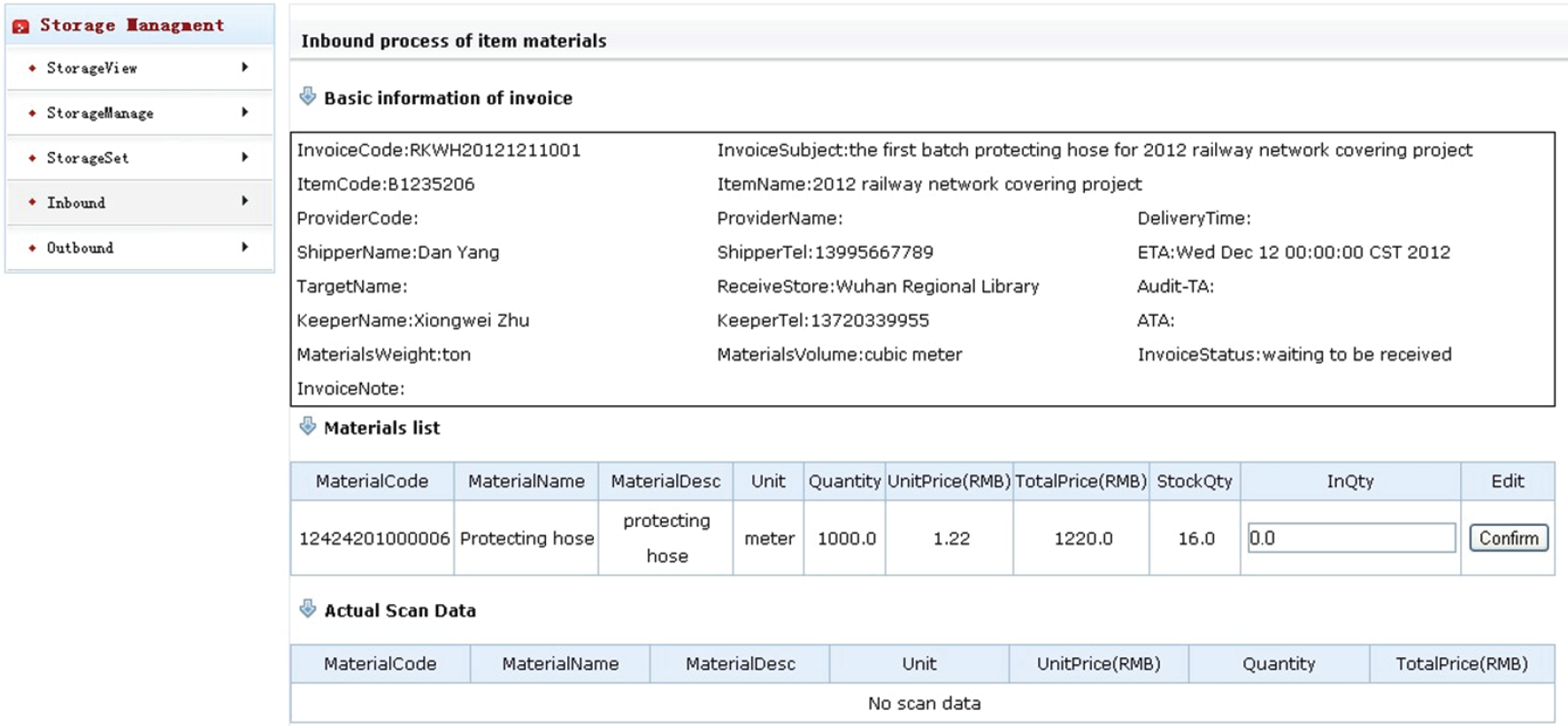
Inbound management.

Shelves management in warehouse.

Logistics tracking management.
In the CoT environment, the supply chain resources are virtualised and encapsulated into cloud services. We focus on the warehouse resources and logistics resources in the supply chain integration and management. The service list of the developed system is depicted in Figure 13. Moreover, as shown in Figure 14, each web service is described with web service description language (WSDL), which contains name, operation, types of parameters, and so forth. After encapsulating the services and generating WSDL files, the tomcat container is used to release the services online.

Service list of the developed system.
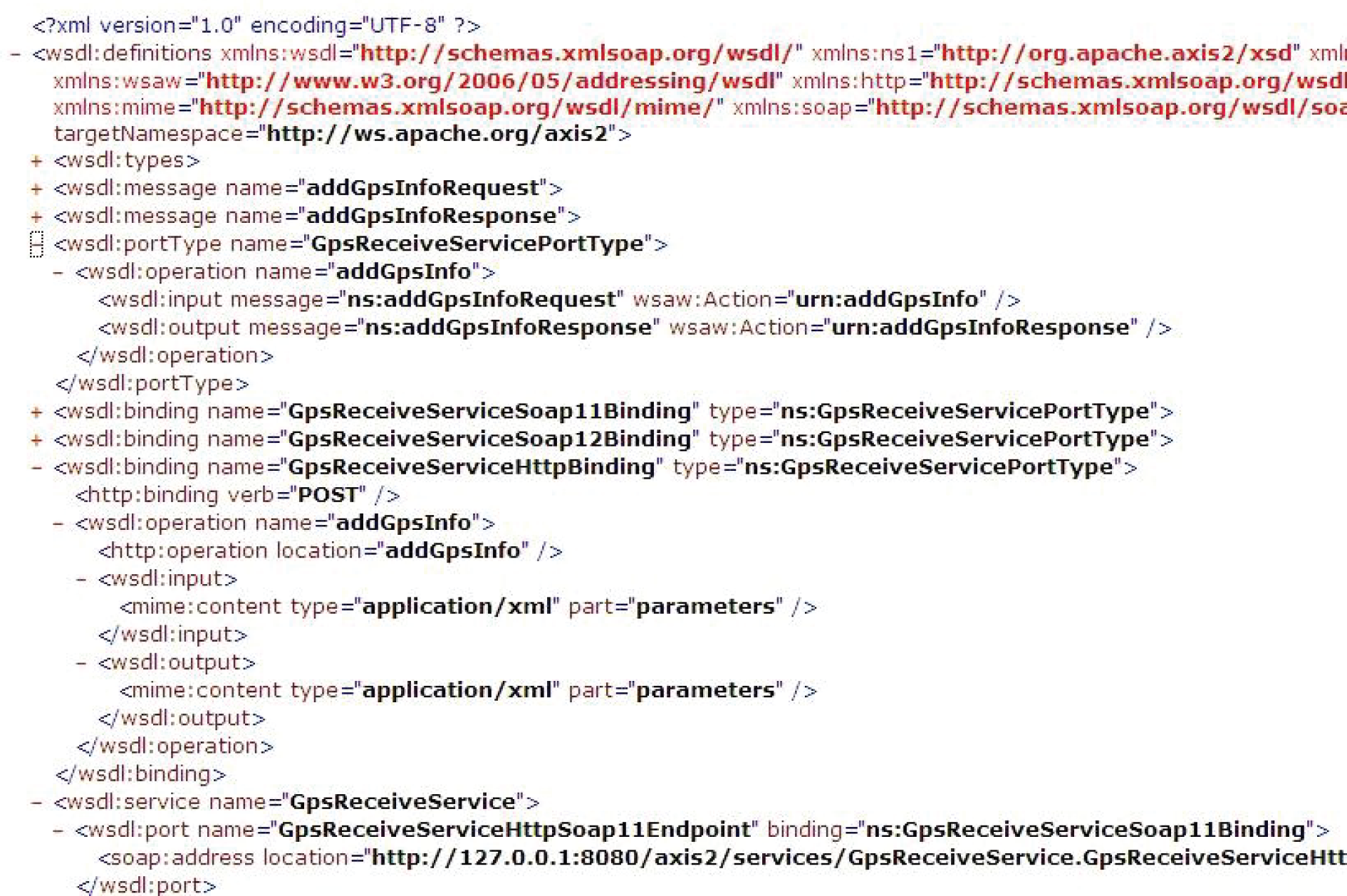
Service description with WSDL.
5.3. Field Trail and Evaluation of System
The prototype system based on the CoT architecture is implemented and tested in the laboratory environment. In order to test the performance of the proposed system, such as real-time, integration of subsystems, and information sharing, the system is deployed in an evaluation environment. Firstly, we deploy the RFID devices in the front of entrance and exit and fix the environment sensors with the Zigbee modules on the board and then install the goods tracking program on the mobile phone. Secondly, the management platform is deployed in the server. Finally, the system is initiated by setting up the server and connecting the distributed RFID devices by wire mode and environment sensors using Zigbee coordinator. The facilities used in the testing are listed in Table 1. Following the test process shown in Figure 15, the CoT-based prototype system, from the warehouse management to the delivery of materials to destination, is evaluated. For a comparison, the original system using barcodes to manage goods is measured in terms of the evaluation time. The test results are summarized in Table 2 by comparing the operation time between the CoT-based system and the original one. From the test results, an obvious improvement has been done in each stage of supply chain management in terms of execution time. Furthermore, the system provides a set of other benefits, such as the availability of goods status in each stage of supply chain and the flexibility of the system with services.
Facilities description.

Comparison between CoT-based and original system.


CoT-based system test process.
6. Conclusion
Highly distributed warehouses and heterogeneous resources located in each link of supply chains may increase the complexity of supply chain integration and management, especially in information sharing and collaboration as well as operation agility. The paper developed an intelligent integrated supply chain integration and management system based on CoT. The developed system is able to facilitate the users managing each link of the supply chain through the real-time collected and analyzed condition information from the subsystems of intelligent perception and network access convergence. The supply chain service management platform can list the services for users inquiring and invoking, and it provides the relevant services by virtualising the resources in warehouse and logistics, such as environment monitoring service and cargoes tracking service. Moreover, a case study with the implementation of the developed system demonstrates that it is an effective approach for supply chain integration and also provides the intelligence support for the physical resource management in the form of services. In the future, further research should be done for improving the performance of real-time, robustness, and security of such system.
Footnotes
Conflict of Interests
The authors declare that there is no conflict of interests regarding the publication of this paper.
Acknowledgments
This research is supported by National Natural Science Foundation of China (Grant no. 51305319), the Keygrant Project of Chinese Ministry of Education (Grant no. 313042), the Wuhan International Scientific and Technological Cooperation Project (Grant no. 2013030409020112), and the Project of Joint Mobile Communication Lab of Wuhan University of Technology and China Mobile Group Hubei Co. Ltd. We are grateful to the postgraduate students Xiaojie Liu, Duzhong Zhang, Xiaolin Sun, Yingying Hu, Sisi Tian, and Shilong Zhang in the lab for their kind help in this work.