




Abstract
Experimental and numerical study of Richtmyer-Meshkov instability (RMI) induced mixing enhancement has been conducted in a liquid-fueled scramjet engine with a central strut. To generate the RMI in the scramjet engine, transverse high temperature jets are employed downstream the strut injector. Compared to the transverse ordinary temperature jet, the jet penetration into the supersonic airstream of high temperature jet increases by 60%. The numerical results indicate that the RMI phenomenon markedly enhances the mixing efficiency (up to 43%), which is necessary to initiate the chemical reactions. Ground experiments were carried out in the combustor, which verify the numerical method from the perspective of wall pressures of the combustor. In particular, the experiment results indicate that the RMI can benefit flame-holding due to the mixing enhancement.
1. Introduction
The supersonic combustion ramjet (scramjet) engine is expected to the most efficient propulsion system in the hypersonic flight regime [1]. And it requires rapid mixing between fuel and air, due to the limited time and space available for chemical reaction in the combustor [2]. The Richtmyer-Meshkov instability (RMI) occurs when an interface between two fluid layers of different thermodynamic properties undergoes impulsive acceleration, typically caused by an incident shock wave, which can affect the rate of mixing [3, 4]. Therefore, we explore the application of RMI phenomenon for kerosene-air mixing enhancement in a strut-based scramjet combustor.
Strut injectors offer the possibility to inject the fuel in the supersonic core region [5, 6]. For the application of the struts, technical difficulties are an increase in the distance (combustor length) to achieve adequate mixing [7] and flame stabilization, especially for a thin strut. Previous experiments [8] and numerical simulations [9] demonstrate flame-holding of the strut-based scramjet configure depends on the subsonic recirculation created in its base, and therefore an increase of the thickness of the strut (i.e., of the blockage ratio in the combustor channel) enhances the capability of the strut injector for ignition and stabilization of the flame. However, a thick strut can lead to significant drag and total pressure losses increase.
Much work has so far been done on RMI phenomenon. Some researchers [10, 11] analyzed the effect of initial conditions on the rate of mixing due to RMI phenomenon. Thornber et al. [12] numerically studied flow physics of a reshock Richtmyer-Meshkov induced turbulent mixing layer using high-order accurate large-eddy simulations, indicating that the reshocked layer has a dependence (although weakened) on the initial conditions. Grinstein et al. and Houas and Chemouni conducted experiments for the RMI in planar shock-tube [13, 14]. However, there are much fewer studies to date on the RMI induced mixing enhancement in the scramjet combustor.
In this paper, The RMI is first introduced into a liquid-fueled scramjet combustor to enhance the fuel-air mixing. To generate the RMI in the strut-based combustor, transverse high temperature jets (THTJ) are employed downstream the strut injector. The effects of THTJ on the mixing efficiency were investigated.
2. Experimental Apparatus and Numerical Method
2.1. Experimental Setup and Uncertainties of Experiments
Figure 1 shows a schematic illustration of the experimental setup. The high enthalpy inlet air supplied to the scramjet combustor was produced by a hydrogen-oxygen burner. Additional oxygen was injected to maintain a 0.21 O2 mole fraction in the heated products. The heater total temperature was 1520 K. The total pressure was 1970 kPa. A strut-based scramjet combustor model was directly connected to a two-dimensional nozzle of the heater. The air enters the isolator at a Mach number of 2.52. A PLC (programmable logic controller) was used in the experiments to trigger various events related to fuel injection timing. A total of 16 pressure-tap ports are distributed along the length of the combustor direction. Every port is instrumented with a pressure transducer. Each of them has a full range of 0∼1000 kPa, a maximum sampling frequency of 1000 Hz, and an uncertainty of ± 0.25% full scale.

Schematic diagram of the strut-based combustor.
The combustor has three segments (labeled as I, II, and III in Figure 1(a)). Segment I is a constant area isolator, followed by a symmetric divergent section II and a constant area section III. The cross-sectional area was changed from 40 × 110 mm in the isolator to 60 × 110 mm in the exit of the combustor. The length of each section has been included at the bottom of Figure 1(a). To minimize aerodynamic disturbance on the flow field and the strut drag, a thin strut is employed locating at the centre of the isolator, only 3% in the blockage ratio. Thermal loads at the leading age of the strut may be intense due to the high enthalpy inflow. Therefore, cooling of the structure of the central strut is necessary. As shown in Figure 1(b), this is done internally by the liquid fuel, which later on is injected from the base of strut in the streamwise direction for combustion. And therefore, a density interface forms between fuel and air layers. For the arising of RMI, we need shock waves to impulsively accelerate the interface. A shock train is attained through transverse high temperature jets (THTJ) in section III, 680 mm downstream of the combustor entrance. A Micro Hot Gas Generator is used to generate THTJ.
The pressure transducers were calibrated using least-squares linear regression fits. All pressure values used to generate the calibration lines within 0.5% of the corresponding linear fit values. Mean wall pressure distributions of the combustor with an equivalence ratio of 0.8 were acquired on six different runs under the same inflow conditions. In addition, linear fits were applied to these six raw data sets to quantify the repeatability of the calibration. This resulted in a sample of six different mean values for the same equivalence ratio corresponding to each transducer location. The rms of the six mean values was then calculated for each transducer location. The average rms was 0.6 kPa. Therefore, the uncertainty of mean pressure values reported herein is estimated to be 0.5% or 0.6 kPa, whichever is greater.
2.2. Computational Fluid Dynamics Model
2.2.1. Computational Fluid Dynamics Code
All the calculations have been performed using the computational fluid dynamics (CFD) software Fluent, which was demonstrated reliable in the simulation of supersonic mixing and combustion [15, 16]. The steady simulations have been carried out using the coupled solver with implicit time stepping. The flow field is 2D in this paper, taking advantage of the symmetry condition.
The low Reynolds number shear stress transport (k-ω) turbulence model is employed for turbulence closure. Single-step laminar finite-rate kinetics has been used to model the chemistry. Viscosity and specific heat of the mixture have been evaluated using a mass-weighted mixing law. For the individual fluids in the mixture, these properties are calculated using Sutherland's law and fifth-order polynomials in temperature, respectively.
2.2.2. Boundary and Initial Conditions
The inflow boundary conditions into the combustor inlet are shown in Table 1. In addition, inlet turbulence intensity (12%) and the hydraulic diameter (to estimate the turbulent length scale) have been specified. Meanwhile, the walls of the combustor were assumed stationary and adiabatic. The mass flow rate of kerosene (corresponding to an equivalence ratio of 0.8), temperature, and velocity are specified. The boundary conditions of exhausting gaseous mixture of the THTJ are also shown in Table 1. Here, the mixture was simplified as CO, CO2, H2O, and C12H23 by mass fraction of 44/23/23/10%. The initial values of the flow field in the entire domain were computed based on the average values of the conditions defined at all boundary zones.
Boundary conditions at the entrance of the isolator and THTJ for numerical simulations.

2.2.3. Grid Independence
Three computational grids of 0.1 million (coarse), 0.5 million (medium), and 1 million (fine) were used to study the grid independence. Figure 2 shows the distributions of top wall pressures obtained from three computational grids. From the curve of pressures, it can be seen that the results of the medium and fine grid agree well. Thus, the medium grid was deemed appropriate for simulation work. The following simulation work was performed on the medium grid in order to save the computational cost.

Certification of grid independence.
3. Results and Discussion
3.1. Effects of Temperature on Jet Penetration of Transverse Flows
The jet penetration, referred to the distance from the wall by the injectant, is directly related to the strength of the bow shock wave. The jet penetration is defined as the boundary of the region that contains the injectant within a selected molar concentration, usually 99.5%. And therefore it is an important precursor in the mixing processes. However, the temperature of transverse jets investigated by previous researches are approximately 300 K (ordinary temperature), and high temperature (2700 K) transverse jet in the supersonic regime has received much less attention, due to the difficulty of generation of high temperature jet. In this research, it is generated by a miniature oxygen-kerosene rocket engine.
Figure 3 shows the effects of temperature on the jet penetrations under the same total pressure and Mach number boundary conditions. Compared to the transverse ordinary temperature jet (TOTJ), the maximum jet penetration of THTJ increases by 60%. Once the maximum penetration of TOTJ is attained, it keeps constant for a distance about 45 mm. By contrast, it immediately decreases in the case of THTJ. Although they have the same Mach number boundary, the sound speed of THTJ is approximately three times that of TOTJ. As a consequence, the mass flow rate decreases to about one-third that of TOTJ. Therefore, in the case of THTJ, the recirculation zone downstream the injection hole is shorter than that of TOTJ. And the total pressure loss also decreases, which is important for the scramjet performance.
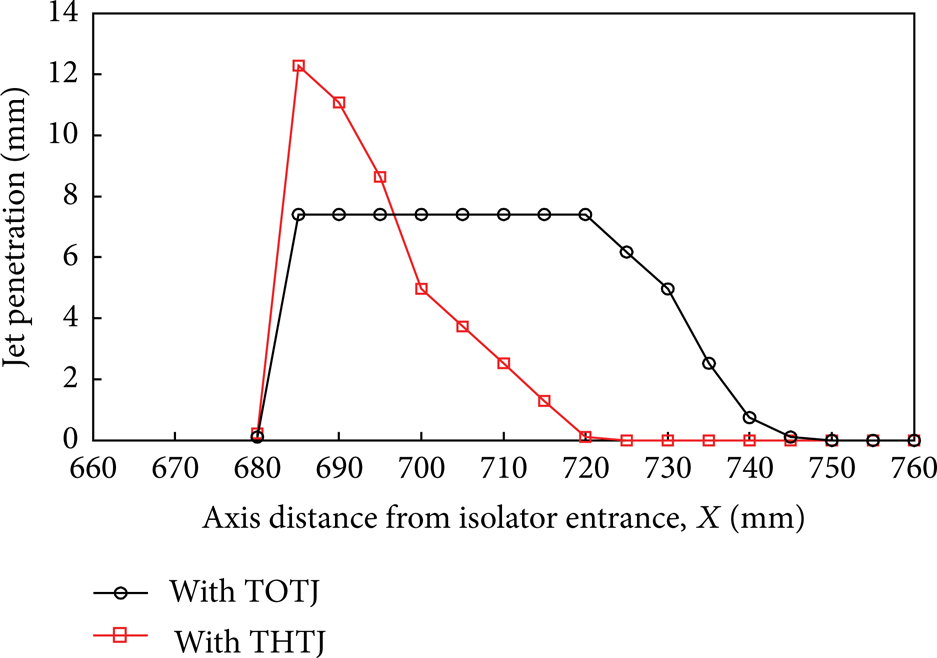
Distributions of jet penetrations along the length of the combustor.
3.2. Generation of the RMI in the Scramjet Combustor
Figure 4(a) shows the contours of static pressure in the scramjet combustor without transverse jet. A pair of weak oblique shock waves formed due to the blockage of the thin strut, and then they reflect periodically and disappear slowly in the downstream of the flow field. The contours of static pressure with THTJ are shown in Figure 4(b). An oblique shock train forms in the downstream of THTJ. It starts with an initial oblique shock wave due to the recirculation zone. This initial wave is reflected from boundary layer from the opposite wall as an expansion wave and then alternate between compression and expansion. Therefore, the density interface between fuel and air layers is impulsively accelerated for more than once. And so the RMI phenomenon occurs. Figure 4(c) shows the contours of static pressure in the reacting flow field with THTJ. A long normal shock train appears due to the combustion-induced back pressure, and then a greater RMI forms in this area.

Contours of static pressure in the combustor.
In Figure 4(c), the contours of static pressure in the reacting flow field with THTJ show asymmetry, while the flow field is symmetrical in Figure 4(b). Asymmetrical behavior under symmetry conditions may be related to flows with large upstream interaction. In Figure 4(c), the combustion-induced back pressure transmitted upstream. Then a long normal shock train appears. The presence of large separated-flow regions interacting with shock-trains creates nonsymmetric perturbations. These perturbations, when coupled with the strong compression characteristic of flows with upstream interaction, may bring about the loss of the symmetry in the flow field. The asymmetric behavior due to upstream interaction was also reported in [17, 18].
3.3. RMI Induced Mixing Enhancement
To investigate the effect of RMI on the fuel-air mixing quantitatively, we define the mixing efficiency as follows:

where

where
In the case of only strut, it shows the poorest mixing efficiency along the combustor axis as shown in Figure 5(a), only with a maximum value of 0.67 at the exit of the combustor. Figure 5(b) indicates that the fuel mainly concentrated in the centre of the flow field and it requires a long distance to achieve the molecular mixing to initiate chemical reactions. In the case of THTJ, a steep increase in the mixing efficiency appears as the RMI occurs, with a maximum value of 0.96 at the exit of the combustor, which indicates that the mixing efficiency increases by 43%. Figure 5(c) shows the fuel obviously spreads to the combustor wall in the downstream of THTJ. For the reacting flow, the mixing efficiency achieves fully near the location of THTJ, and then a stable combustion is attained. The completeness of combustion is high due to sufficient mixing and combustion, and therefore the mass fraction of fuel is very low at the exit of combustor, as shown in Figure 5(d).

(a) Distributions of mixing efficiency along the combustor axis. (b) Contours of mass fraction of fuel with only strut. (c) Contours of mass fraction of fuel with THTJ. (d) Contours of mass fraction of fuel in reacting flow field with THTJ.
Although the TOTJ can enhance the fuel mixing, it is weaker than THTJ. As shown in Figure 3, the THTJ has a larger jet penetration than TOTJ. The jet penetration is related to the bulk transport of fuel in air stream. The larger the jet penetration becomes, the stronger momentum and mass exchange between fuel and airstream are. And therefore, the mixing enhancement effect induced by TOTJ is weaker than THTJ. A comparison between TOTJ and THTJ is shown in Figure 6. Because the mixing is not sufficient with TOTJ, the stable combustion cannot be established in experiments, and the corresponding reacting flow cannot form in the numerical simulations.

Distributions of mixing efficiency for TOTJ and THTJ, respectively.
3.4. Experimental Results
The ground experiments in the scramjet combustor with a central strut are carried out at direct-connect test facility. Experimental results are difficult to directly measure the liquid fuel-air mixing in the combustor, due to the complex flow physics with chemical reaction. So we verify the numerical method from the wall static pressure. Figure 7(a) indicates that numerically predicated values reasonably agree with the experiment data for the most part. A series of Mach disc form in the plume flow exhausted from the combustor as shown in Figure 7(b). These characteristics prove that a stable supersonic combustion occurs in the combustor, which indirectly demonstrates the fuel-mixing is significantly enhanced by THTJ-induced RMI phenomenon.

(a) Comparison of experimental and numerical pressure distributions. (b) Experimental plume structure downstream of the combustor exit.
4. Conclusion
In summary, this paper numerically and experimentally demonstrates the possibility to enhance fuel-air mixing in the scramjet combustor through the use of RMI. Compared to TOTJ, we create the oblique shock train by THTJ, which can induce a greater RMI between the fuel and air layers, because it has a greater jet penetration than TOTJ.
Although the present study is just an initial effort for the application of RMI on the scramjet, this paper delivers some interesting and valuable new findings regarding the mixing enhancement using a strut and high-temperature jets to cause shock trains. For strut-based scramjet combustor, fuel can be injected into the supersonic core region by using the strut injector. But thin strut injector causes the combustor to be long in order to achieve adequate mixing, and thick strut injector causes the drag and total pressure loss to be large because of the significant aerodynamic disturbance. This paper utilizes transverse high temperature jets induced mixing enhancement with thin strut to avoid the difficulty mentioned above and offers a choice for engineering application. Numerical results verify that greater mixing had occurred when the shock trains generated by THTJ were allowed to impinge on a suitable mixing region. The ground experiments verify that THTJ-based mixing enhancement and flame stabilization technique is feasible for application in the field of the scramjet engine.
Conflict of Interests
The authors declare that there is no conflict of interests regarding the publication of this paper.
Footnotes
Acknowledgment
This work was supported by China National Natural Science Foundation (nos. 91216105, 51121004, and 91116001).