




Abstract
In order to set up WSN in various rigorous environments, the size and power constraints are stricter due to the high demands for convenience and reliability. Therefore, power efficiency is very important for a WSN. For this, a novel architecture is presented in this paper. The proposed architecture categorizes sensors into different clusters by events. In each cluster, a minimum spanning tree is constructed for intracluster routing. The hierarchical architecture is useful in reducing the power consumption. In each intracluster routing tree, only leaf nodes are responsible for periodical detection. Data transmissions only occur when abnormal events are detected. An abnormality will be reported to the data center only if the majority of cluster members sense the same event. By reducing unnecessary data transmissions and shortening transmission distances, the proposed mechanism significantly reduces the power consumption and prolongs the network lifetime without influencing the accuracy of event response. The simulations show that the proposed architecture has about an 18-fold improvement rate in the device lifetime and avoids the false positive caused by the erroneous alarm of a single sensor. The proposed architecture is feasible, practical, and highly applicable to many applications.
1. Introduction
Because of the remarkable advances of wireless technologies, many applications have been developed which make human life more and more convenient. Users are free from tangling with wired networks such that they can enjoy various network services no matter where they are. In addition to entertainment services, many other services can be provided by way of wireless technologies such as the application on environmental detections which can assist in improving our daily lives. One of the most notable examples is wireless sensor network [1, 2]. In wireless sensor network, low-cost and low-power-consumption sensors are applied to detect specific events and return gathered information to data centers via wireless links. Data centers analyze the information and give corresponding responses which are preset by users. Wireless sensor network nowadays has been applied to a wide range of applications such as the detection of weather conditions including temperature and humidity, monitoring ocean currents and water pollution, and the invasion detection in military usage. WSN is a good solution to monitor the abnormity in a specific area. While any abnormity occurs, scientists and engineers can be informed rapidly of the benefit of WSN. WSN is also applied to medical care. Recently, a special application called “Body Sensor Network” (BSN) [3, 4] is proposed due to the problem of aging society. In BSN, various sensors are adopted to monitor some physiological conditions such as body temperature, blood pressure, heartbeat, body motion, and so on. In a hospital BSN will be an excellent assistant to the medical care members. It releases the heavy burden on the medical care members. All the sensed data would be transmitted to data centers in the nursing station as usual. Once any abnormal event is detected, the data center can automatically contact the medical center and ask for help.
However, there are still some challenges to apply sensor networks to practical applications, such as (1) size constraint: the size of sensors should be as small as to be suitable to deploy a large amount of sensors in the limited sensing area; (2) cost constraint: because of deployment of large amount of sensors, the price and maintaining cost of a sensor will be an important factor to establish a wireless sensor network; (3) battery power constraint: in order to improve the system reliability and to reduce the mean-time-to-failure (MTTF) between the replacement of batteries, the power consumption of sensors must be low enough.
In the case of abnormity monitoring, the reliability of the system is the most important consideration due to safety issues of human life. All the constraints mentioned above have to be strictly examined. Many researchers pay a lot of attention to the development of miniaturized sensors with reasonable maintenance fees which can be put into narrow areas. Under the constraints of size and cost, the battery size is strictly restricted accordingly. Thereupon the issue of power consumption becomes more and more essential to make WSN feasible. For power efficiency, a novel architecture of WSN is presented in this paper, which reduces the regular power consumption of WSN so that the device lifetime and network reliability can be significantly improved.
We summarize four major contributions of the proposed architecture as follows.
The proposed architecture reduces redundant data transmissions without influencing the accuracy of event response so that server loads are decreased and the number of clients the system can accommodate is increased. By reducing unnecessary data transmissions and optimizing routing path, the proposed mechanism simultaneously reduces the power consumption and prolongs the network lifetime. The proposed mechanism is feasible and highly applicable to many applications. The proposed mechanism achieves the above three advantages through software upgrading without any extra facility and installation cost.
The remainder of this paper is organized as follows. Section 2 presents some related works. Section 3 introduces our proposed WSN architecture. Experimental simulation results are reported in Section 4 which shows the feasibility and advantages of our work. Finally, a brief conclusion is given in Section 5.
2. Related Work
As the secure and efficient issues on the power consumption of body sensor network obtain increasing research interest, some previous works [5–7] focus on the optimization of power consumption of sensors to ensure long term biology detection capability. These works also demonstrate that the collision probability increases if the number of sensors in a BSN increases. Higher collision probabilities cause higher packet loss probabilities which increase the number of retransmission. Therefore, these works also propose some schemes to reduce the collision probability which alleviates the waste of power caused by retransmissions.
A new transmission scheduling scheme, called Distributed Queuing Body Area Network (DQBAN) [5], has been proposed to reduce extra power consumption of retransmissions. DQBAN utilizes cross-layer fuzzy-rule and energy-aware radio activation policy to set the transmission priority for all sensors in BSN. With the consideration of QoS (Quality of Service) and remaining power of sensors, DQBAN determines the transmission priority for each sensor in order to reduce collision and latency. A novel MAC protocol, called Energy Efficient Medium Access Protocol (EEMAP) [6], has been proposed to construct piconets in WSN. Every piconet has a master sensor and many other slave sensors. The master coordinates all other slaves' transmission timings so that the power consumption and the additional latency caused by retransmissions can be reduced effectively. In addition, the coordinating function of the master also arranges the durations of idle mode and active mode for slave sensors so as to reduce the power consumption of sensors. An adaptive power conserving algorithm has been proposed in [7]. In [7], each sensor adopts a coding process to merge its data with the received data from other sensors to reduce the total number of transmissions. After the synchronization among sensors, a sensor can only transmit data in its own individual transmission cycle to reduce the collision probability.
There are some works [8–11] which can save energy by adjusting the sampling rates of sensors. An adaptive sample scheme has been proposed in [8] to keep the sampling rates at the low bound which does not cause excessive loss in sensing resolution. A Markov Decision Process-based Sampling Method (MDPS) has been proposed in [10] which optimizes the sample rates for all sensors by a global coordinate approach. However, it would suffer extra power consumption for negotiations among all sensors. Therefore, they later propose the Reinforcement Learning Average Approximation (RLAA) [11] which replaces the global coordinate approach by a local coordination scheme for reducing the complexity.
Some researches [12, 13] demonstrate that the external transmission is the major cause of the power consumption of BSN and try to shorten the external transmission distances of sensors to save power. The work in [12] partitions the duty regions of base stations within a building by the Voronoi diagram. When users move around within the building, sensors worn by users will dynamically attach to the nearby base station. Therefore, the power consumption of longer-distance transmissions can be reduced. The authors of [13] propose a path optimization scheme in which sensors carried by a user would adopt internal transmissions in BSN to transmit data to the sensor closest to the base station. Then, the sensor performs external transmissions to transmit data to the base station. Therefore, the scheme can reduce the transmission power by minimizing the transmission distance. However, the improvement in power consumption is not significant because the distances from the base station to sensors are not very different.
To solve the power consumption of external transmissions to the base stations with longer distances, a hierarchical network topology, called DexterNet, has been proposed in [14]. DexterNet applies the concept of mobile base station (MBS). In DexterNet, users carry MBSs for gathering data from sensors worn by users and forwarding data to remote servers. The advantage is that sensors only deliver data to the MBS with short-range transmissions. Therefore, DexterNet can reduce the power consumption of sensors by the help of MBS.
The Body-Posture-based Dynamic Link Power Control (BDLPC) has been proposed in [15]. The BDLPC sets the transmission power to the lower threshold of transmission power that can successfully transmit data. By the lower transmission power, the interference between sensors can also be significantly reduced.
In [16, 17], authors focus on the techniques of human motion recognition. Since more sensors are required for motion recognition than other applications, lower power consumption becomes a critical issue to keep the motion recognition mechanisms functioning. The work in [17] presents a priority-based transmission scheme, named Data Compression by Temporal and Spatial Correlation (DCTSC), to reduce the power consumption of motion recognition. The data gathered from neighboring sensors for motion detection are dependent. Therefore, sensors in DCTSC transmit data in the order of their predefined priorities. Sensors with lower priorities receive the data transmitted by sensors with higher priorities, stuff the data with the different parts, and send out the new data with compression. DCTSC involves the principle of “incremental store” to combine related data so that the amount of data transmitted by all sensors can be significantly decreased. In addition to the above state-of-the-art works, some works [18, 19] improve the power efficiency by ameliorating the circuit design of sensors. Similar to the proposed scheme, the tree-based architectures have been proposed in [20, 21]. The Collection Tree Protocol (CTP) proposed in [20] provides reliable and loop-free transmission paths from leafs to the root of a tree. Benefiting from the tree-based architecture, the number of external transmissions can be reduced so that the power efficiency can be improved. To improve power efficiency further, in [21], data from child nodes would be aggregated at their parent nodes so that the total data volume can be decreased. The related works are summarized in Table 1.
The summary of related works.

In this paper, we propose a novel scheme which is different from the above works. It constructs internal routing trees to reduce the number of sensors periodically sensing and transmitting data. Different from other schemes, the proposed scheme directly reduces the power consumption by decreasing the number of periodical senses and transmissions simultaneously. In our proposed scheme, only leaf nodes in the constructed routing tree have to sense and transmit data periodically. Compared to [21], the proposed scheme further reduces the number of transmissions and sensing originating from parent nodes. The performance of the proposed scheme is greatly improved in terms of power consumption and survival time.
3. Event-Based Clustering Architecture
In WSN, compact and lightweight sensors would be installed in some narrow areas. In addition to size and weight constraints, sensors should also be under strict power constraint. Optimizing power consumption of WSN can bring three advantages: (1) reducing sensing interrupts due to battery exhaustion, (2) diminishing maintenance fees of replacing batteries, and (3) lessening trouble in replacing the batteries of the sensors installed in a pathless area. All these motivate us to find effective ways to reduce the power consumption of WSN. In this paper, we aim at the issue of power efficiency and propose a novel mechanism to reduce regular power consumption of WSN, which optimizes the transmission paths and decreases the numbers of transmissions and measurements.
Figure 1 shows a general case of WSN, where multiple sensors are deployed to measure many environmental conditions. All sensors in WSN will periodically transmit measured data to a neighboring base station through wireless technologies, and then the base station transfers those data to a specific data server to recognize whether any extraordinary phenomenon exists or not. IEEE 802.15.4 is one of the famous standards adopted in such a scenario. Following the architecture in Figure 1, each sensor individually reports its data to the server via the attached base station. Therefore, we denote the architecture as Individual Report (IR) in this paper. However, the major cost of IR will be the power consumption to periodically transmit data to the base station. The other way to save power is to reduce sampling rates of sensors. However, it may lead to lower accuracy of abnormality detection. To solve this tradeoff dilemma, we propose a new WSN architecture, called Event-based Clustered body sensor network (EBC) in this paper, which decreases the number of sensors that periodically sense and transmit data instead of the sampling rate.

Sensors individually transmit data to the base station.
EBC algorithm clusters sensors into groups according to the events. One specific event is identified if the majority of the corresponding sensors in the event group are in consensus. After clustering, internal routing tree is constructed for every event-driven cluster. As shown in Figure 2, within an internal routing tree, only leaf nodes are responsible for periodical sensing. A parent node is triggered to evaluate the specific abnormal event only if its children sense the abnormality and report it. Following this methodology, the abnormal event is evaluated and reported upward level by level within the internal routing tree. Finally, the root node similarly evaluates and transmits this abnormal event to the data server. In the proposed EBC algorithm, the number of sensors responsible for periodical sensing is determined by the number of leaf nodes. No periodical sensing is needed for other nodes except the leaf nodes and no periodical data transmission occurs for all nodes in EBC. In addition, the external transmission from the sensor to the BS, the farthest transmission with the most power consumption, only takes place when the abnormality is detected. Therefore, the power consumption can be significantly reduced by EBC. For example, in a binary balance tree with N nodes, the number of leaf nodes, 

The architecture of event-based clustered body sensor network.
In our proposed architecture, an abnormality will be reported to the data center only if the majority of cluster members sense the same event. It can avoid the false positive caused by the erroneous alarm of a single sensor. For example, in the case of temperature monitoring, the false positive will be alarmed by a single sensor when any heat source or cold source passes by occasionally. Therefore, the consensus in the cluster is adopted to report an abnormal event.
There are three phases in our proposed scheme, including Sensor Clustering, MST Routing Tree Construction, and Sensing/Reporting Procedure.
3.1. Sensor Clustering
Firstly, sensors in EBC are categorized to different clusters by events. Each cluster is responsible for the detection of a specific event. An abnormality will be reported as an active event only if most of the sensors in this cluster sense and report it. Suppose that there exist x kinds of events and N sensors in a WSN and the number of sensors which corresponds to the x events is represented as 
3.2. Routing Tree Construction
After clustering sensors, intracluster routing trees would be constructed for each cluster in the second phase. Sensors in a cluster will construct a tree-based architecture for the negotiation and hierarchical report. The tree-based architecture can efficiently reduce the communication overheads among cluster members. In addition, the architecture can decrease the required amount of simultaneously active sensors so as to achieve the goal of power saving.
In EBC, we adopt the Prim Algorithm to construct the minimum spanning tree (MST) for intracluster routing. The data structures such as Fibonacci heap, adjacency list, and so on can be efficiently applied to implement the Prim Algorithm. The pseudocodes of the sensor clustering and the routing tree construction are represented in Algorithm 1.
N: the number of sensor nodes X: the number of events G: the set of event tags g: the event tag of a node C: the set of clusters
T: the set of routing trees for events } } }
3.3. Sensing/Reporting in EBC
In EBC, the hierarchical architecture is utilized to reduce the power consumption. In each intracluster routing tree, only leaf nodes are responsible for periodical sensing with the period of
3.3.1. The Operation of Leaf Nodes
In EBC, leaf nodes are responsible for periodical sensing with the period of
R: Measured Result f: the parent node of a leaf node
R: Measured Result R = } } }
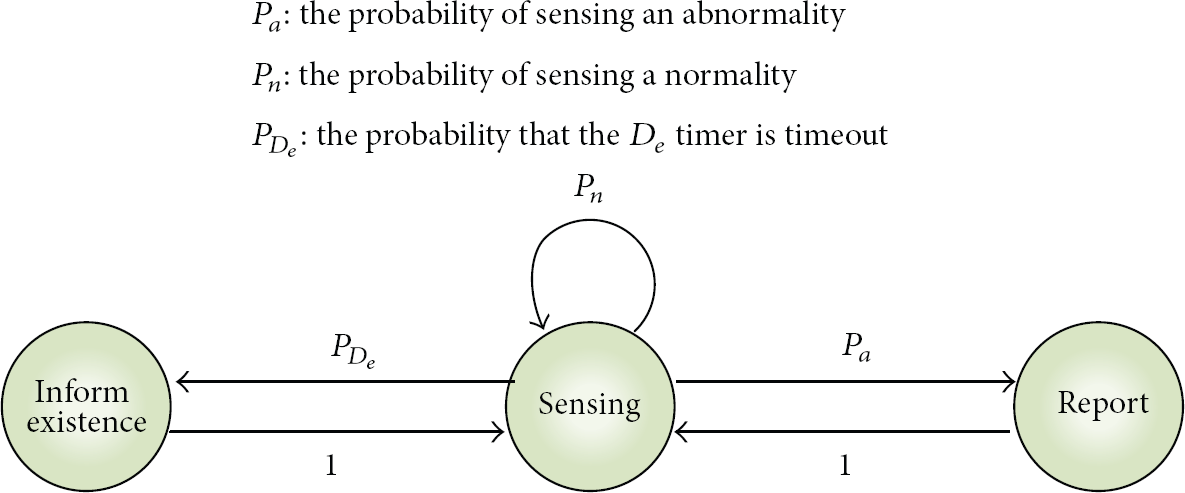
The transition state of a leaf node.
3.3.2. The Operation of Parent Nodes
For reducing power consumption, parent nodes in EBC are usually in idle mode. The transition state of a parent node is represented in Figure 4. Similarly, for system reliability, a parent node must wake up and contact its parent with the period 

The transition state of a parent node.
Based on the constructed routing tree, each parent node can easily obtain the total number of its descendants (d) and the number of its descendants that detect abnormal events (
R: measured result f: the parent node of a node S: the set of child nodes d: the total number of descendants
R: Measured Result b = R = } R = } } } }
3.3.3. The Operation of Root Node
The root node is also one of the parent nodes in the routing tree. Therefore the behavior of the root node is similar to a parent node. The only difference is that the root node is responsible for reporting to the data center via the attached base station rather than reporting to another sensor. Although the transmission distance is longer, the root node still has a longer lifetime than the other members due to the fewer transmissions. The transition state of the root node can be seen in Figure 5.

The transition state of the root node.
The power efficiency of a leaf node in EBC is dominated by the probability of abnormality,
Suppose that
The comparison in power consumption between EBC and IR.
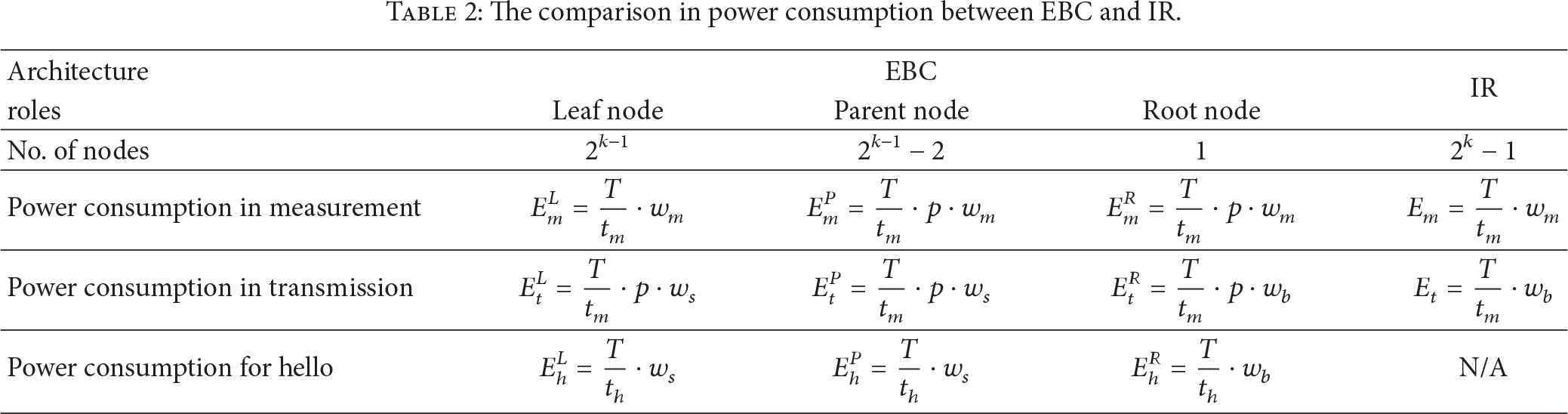
As shown in Table 2, sensors consume power when they are measuring or transmitting data. Furthermore, sensors in EBC consume additional power to transmit hello message to their parents for system reliability. Therefore, the power consumption of a leaf node in EBC within a time interval, T, can be represented as follows:


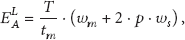

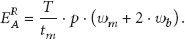

So the following condition is always true for common applications of WSN and 
In addition to the factors mentioned above, EBC can benefit from another important factor, the number of active nodes, and gain notable overall power saving. As shown in Table 2, the number of active nodes in EBC, the leaf nodes, is only
4. Experimental Results
In order to verify the effectiveness of our proposed EBC (Event-based Clustered body sensor network) scheme, we conduct the simulation setup as follows: we randomly generate N sensor nodes in a
Simulation parameters.
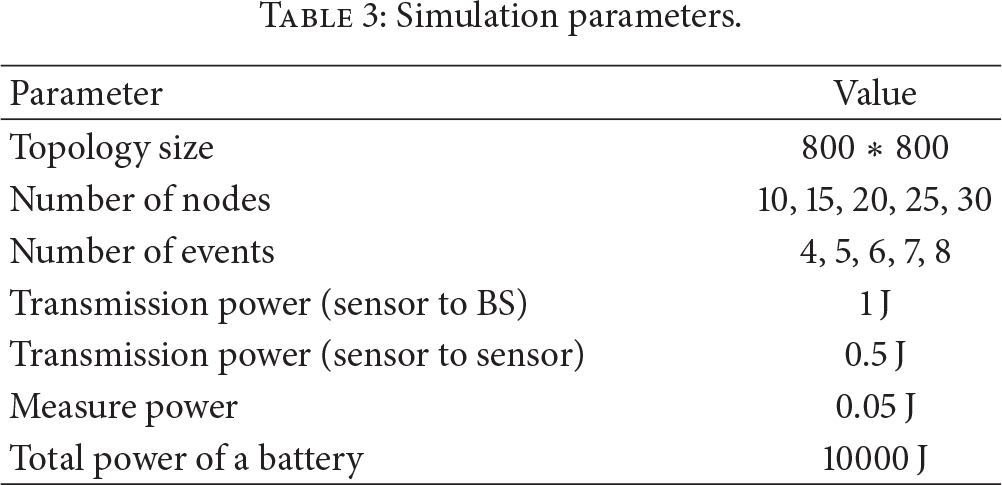
At the beginning of a simulation, each node randomly generates a number from 1 to X, where X denotes the total number of events. This number determines how many events a node is interested in. Therefore, the number of involved nodes for each event may be different. Figure 6 shows a topology generated for our simulation. In Figure 6, the nodes responsible for the same event are marked with the same color. And the node with a circle around it is a root of a tree. In our MST algorithm, the node with the smallest ID is selected to be the root.

A sample topology with
First, we compare the proposed EBC with IR and the scheme in [21] in terms of total power consumption. The simulation time is set to one day and the number of events is 3. As shown in Figure 7, EBC would have lower total power consumption than IR and the scheme in [21]. The primary reasons are that fewer sensors are assigned to periodically sense events, and it is unnecessary to periodically return the sensed data to data centers in EBC. The parent nodes in [21] will periodically sense events and aggregate the data with that from their child nodes and then send to their own parents. The trade volume is less than IR but more than EBC.
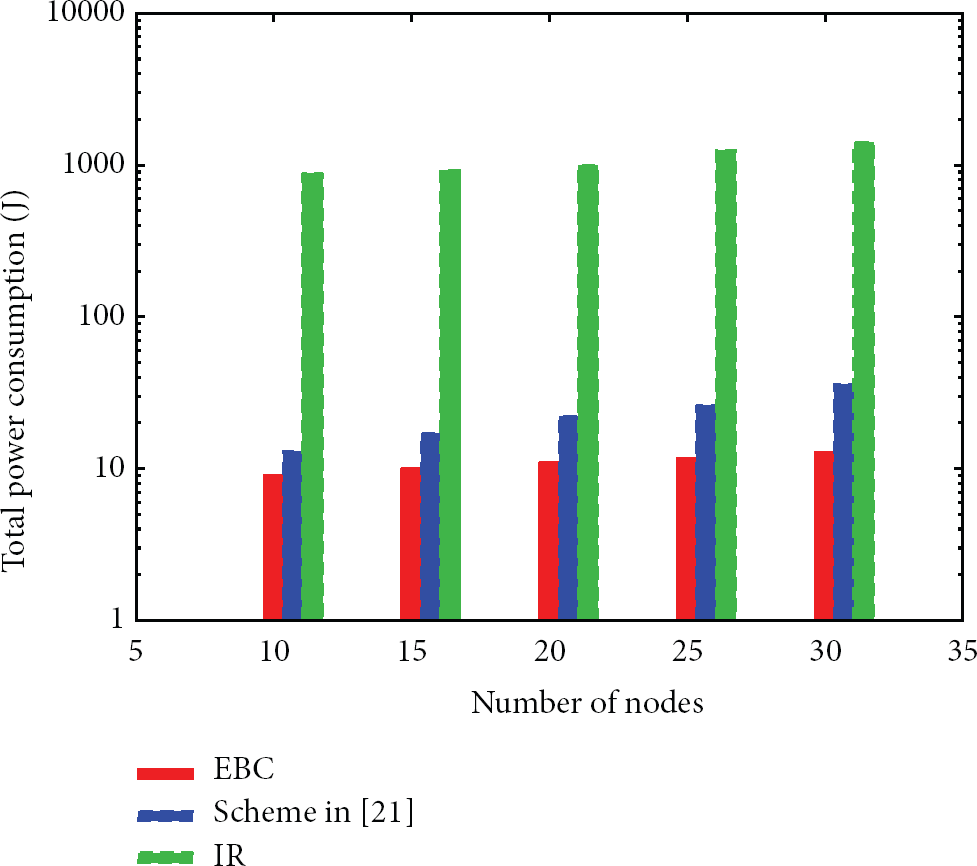
The relationship between the number of nodes and the total power consumption (the number of event is 3).
As we can see from Figure 7, the total power consumption increases with the number of nodes no matter whether EBC or IR is adopted. Gratifyingly, the increasing rate of EBC is less than IR and the scheme in [21]. The reason is obvious. The more nodes are involved, the more measurements and transmissions take place. In EBC, only a fraction of nodes (leaf nodes), instead of all nodes in IR, would be active and the increasing rate is smoother than IR.
It can be further demonstrated by the result shown in Figure 8, for example, that as the total number of nodes increases from 10 to 30, the average number of leaf nodes only increases from 3.7 to 9.1. In contrast to IR and the scheme in [21], which increases 20 nodes to periodically sense and transmit data, only 5.4 additional nodes in EBC are responsible for periodical sensing as the total number of nodes increases from 10 to 30.
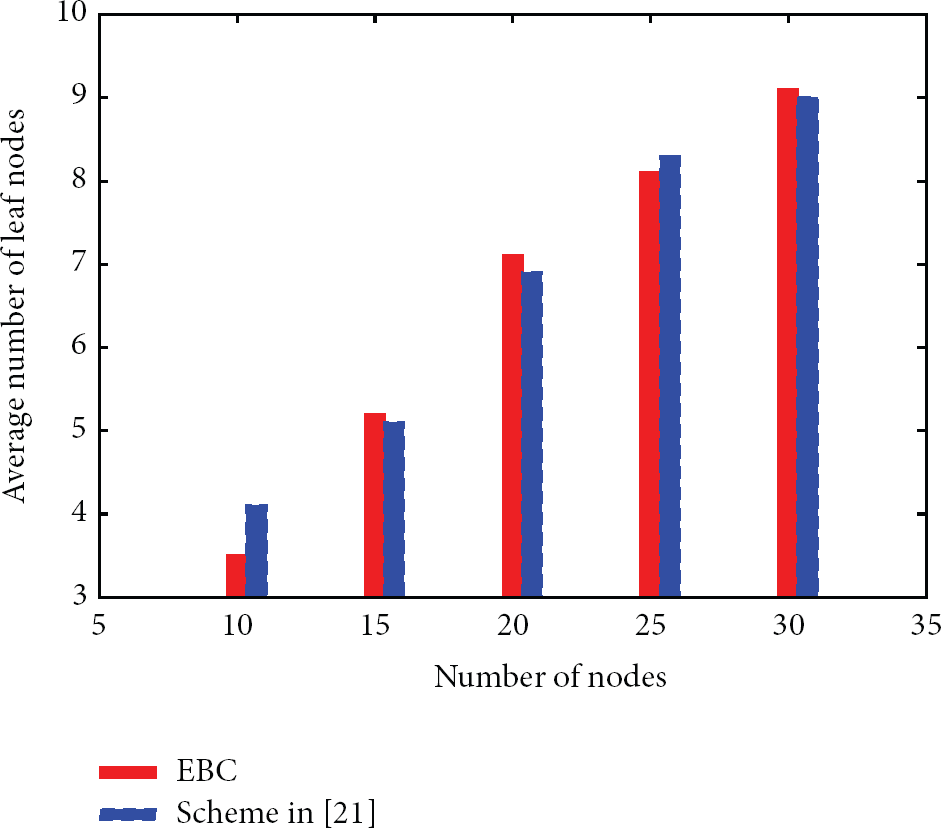
The relationship between the number of nodes and the number of leaf nodes (the number of event is 3).
Secondly, we turn our attention to the lifetime of nodes. As shown in Figure 9, the lifetime of the first exhausted node in EBC is much longer than IR and the scheme in [21]. Because regular transmissions between sensors and base stations are unnecessary, EBC has about an 18-fold improvement rate in the lifetime of the first exhausted node. We would like to note that the power consumption of transmissions is more serious than that of measurements. The total number of nodes would not affect the lifetime of the first exhausted node. The lifetimes of all nodes are quite similar in IR where nodes have the same role. In EBC, the first exhausted node may possibly be a leaf node, whose role is for periodical measurements and transmissions. In the scheme in [21], the first exhausted node may possibly be a root node which periodically senses data and transmits to a base station.

The relationship between the time duration when the first exhausted node appears and total number of nodes (the number of event is 3).
In the following simulations, the total number of nodes is fixed to 20. We try to find the effects of various event numbers. Because IR is not event-based, it would not appear in the following simulations. As shown in Figure 10, the total power consumption would rise with the increase of the number of events. It is obvious that more events means that more tree constructions are needed, which lead to more leaf nodes. As discussed previously, the number of leaf nodes is the primary factor in terms of total power consumption in EBC so that the total power consumption would be affected by the number of events. Figure 11 shows the relationship between the number of events and the number of leaf nodes. Fortunately, the increase rate is not proportional to the number of events as shown. Finally, Figure 12 shows that the lifetime is independent of the number of events. More events would lead to more leaf nodes.

The relationship between the number of events and the total power consumption (the number of nodes is 20).

The relationship between the average number of leaf nodes and the number of events.

The survival time of the first dead node when the number of events is between 4 and 8.
The lifetime of a leaf node is mainly dominated by its number of operations so that it is nearly unrelated with the number of events. Note that a node cannot be a leaf node of different clusters simultaneously in our simulation.
We would note that EBC and the scheme in [21] have more control overheads than IR due to the tree formation. In [21], the root node would be replaced due to its power exhaustion and then tree reformation is needed. In EBC, the strategy of selecting the root node is to select the node closest to the base station. Because the root node in EBC would have longer survival time than other nodes, the possibility of the tree reformation is much lower than the scheme in [21]. During 14 days simulation, the number of control messages due to the tree formation in EBC and the scheme in [21] is 5417 and 29834, respectively.
The results of the simulations can prove that our proposed EBC can have better power efficiency than a general architecture. It would be useful for improving the practicability and reliability of sensor networks.
5. Conclusion
This paper proposed an event-based Clustered architecture to improve the power efficiency of sensor networks. It clusters sensors into groups according to the events so that one specific event is identified if the majority of the corresponding sensors in the event group are in consensus. After clustering, internal routing tree is constructed for every event-driven cluster.
Based on the tree architecture, we can diminish the number of nodes which are assigned to periodically sense data to the number of leaf nodes in a tree. External transmissions between a sensor and its attached base station take place at root node when most nodes in the tree report the same event. By reducing the number of measurements and transmissions, the proposed architecture can have lower power consumption and longer node lifetime. It can improve the practicability and the reliability of wireless sensor networks.
Footnotes
Conflict of Interests
The authors declare that there is no conflict of interests regarding the publication of this paper.