




Abstract
The traditional measurement system of piezoelectric ceramic material could only measure a few electrical parameters with low accuracy, while some other important parameters could not be measured. The plane vibration of the piezoelectric vibrator was taken as an object, and the measurement principles of all performance parameters were also analyzed in detail. The hardware and the software of the integrated measurement system were both pointed out, so that the integrated measurement system could measure most of all performance parameters, and other parameters could be obtained by calculation. The experiment results show that all parameters are measured or calculated with high accuracy, and all error rates of all parameters are below 3%. The integrated measurement system simplifies the measurement methods and improves the measurement efficiency, and it would be of great significance to evaluate the performance of the piezoelectric ceramic material.
1. Introduction
The piezoelectric ceramic material, which is capable of achieving conversion between mechanical energy and power energy, would be polarized if it is under the action of mechanical stress, and this is so called the piezoelectric effect [1]. Because of the piezoelectric effect, it also has some other advantages, such as low power consumption, fast response, high stiffness, and being easy to control and install [2], so the development of piezoelectric ceramic material is extremely rapid in recent years. The properties of different piezoelectric ceramic materials vary a lot, not only because of the different chemical elements, but also because of the fact that some other factors could affect the properties, for instance, the manufacturing process, mechanical molding process, and the polarization effects [3]. Therefore, it is necessary to measure the performance parameters of piezoelectric ceramic materials firstly.
The earliest test design of piezoelectric parameters is a static method or quasi-static method, which is gradually phased out for it is difficult to control the electrical boundary conditions. The transmission line design has been developed later, and though it is simple and it could test the performance parameters fast, its measurement data lacks the phase data. After that, the dynamic resonance process, which is improved based on the transmission line design, is only applicable for the piezoelectric ceramic material with high mechanical quality factor, and there is a large error on measuring the antiresonant frequency. On the other hand, the admittance bridge test method could overcome the defect of the two methods above, but its actual use is relatively small for slow measurement and complicated measuring steps [4–6]. All methods of piezoelectric parameters measurement above have one common feature, which is that lots of parameters could be got only by calculating manually, and the test data are of low accuracy so these methods could not meet the requirement of high precise measurement. In recent years, some new measurement techniques with the characteristic of using computer technology or virtual measurement technology have been gradually applied. Ye and Yu [7] pointed out a new test method of measuring the piezoelectric strain constants based on the interference effect of optical feedback and discussed the iterative algorithm of parameters in detail. Li et al. [8] developed the measurement and analysis system of a piezoelectric device by taking use of the impedance analyzer (Agilent4294A) as the data measurement subsystem, which was combined with the virtual instrument technology. Zhao et al. [9] obtained the piezoelectric parameters of the resonant frequency, the quality factor, and some other electrical parameters after they tested the relationship between frequency and impedance by the dynamic resonance method. Xie [10] also used the active resonance method to measure the main electrical parameters of a piezoelectric vibrator, and though the system has carried out most of all the piezoelectric parameters, the measurement accuracy is not high enough. Fan and Han [11] analyzed the automatic measurement system of a piezoelectric accelerometer based on the LabVIEW, and the accuracy of measurement method for piezoelectric parameters was discussed.
Some disadvantages could be found after studying and reviewing the literatures above as follows.
The traditional measurement methods have some disadvantages, like complicated test measures, low accuracy measurement results, huge amount of calculation, and so on, and all these disadvantages limit the application range of the traditional measurement methods.
Currently, most measurement systems of piezoelectric parameters all adopted the dynamic resonance principle, which would affect the measurement precision of antiresonant frequency greatly, and it would lead all parameters to below accuracy.
Most of the measurement systems focused on electrical parameters, while some other parameters were not mentioned, like elastic constants, dielectric constants, electromechanical coupling coefficients, and so on. All these parameters that are not mentioned are also important for piezoelectric ceramic material as well as the electrical parameters.
In this paper, the plane stretching vibration mode of the thin disk piezoelectric ceramic material was taken as a study object. In order to enhance the accuracy of all parameters, the π-type resistor network circuit was used to measure the basic electrical parameters. All important performance parameters were measured, analyzed, stored, and displayed based on computer test technology.
2. Analysis of Measurement Principle
The piezoelectric vibrator is one of the most basic piezoelectric components, and its performance parameters include the basic electrical parameters, elastic constants, electromechanical coupling coefficients, and the piezoelectric strain constants.
2.1. Basic Electrical Parameters
2.1.1. Resonant Frequency f r and Antiresonant Frequency f a
For the piezoelectric vibrator, there are six important characteristic frequencies: the maximum admittance frequency f m , the minimum admittance frequency f n , the resonance frequency f r , the antiresonant frequency f a , the series resonant frequency f s , and the parallel resonance frequency f p . Currently, all of the existing measurement systems of piezoelectric parameters focus on measuring f r and f a and use them instead of other four characteristic frequencies. For the point of taking use of the approximate principle, which means that f m = f s = f r and f n = f p = f a , the accuracy is also very high, while its error is acceptable.
There are many traditional methods of measuring f r and f a , while the transmission line design and the admittance bridge process are the most classic methods, and both of them were limited because of their low accuracy and complicated circuit. So, the process of testing zero phases by the π-type resistor network circuit was adopted instead of the two methods above. If the impedance system circuit of a piezoelectric vibrator can be regarded as a purely resistive system circuit, the phase difference between the input voltage and output voltage is zero. That is to say, there are two frequencies that could make the phase difference be zero when the piezoelectric vibrator's reactance component is zero. The higher frequency is f a , and the lower one is f r [12]. So, f r and f a could be measured only if the phase difference between the input and output voltage can be detected. The phase difference is always converted into the voltage difference, which is much easier to be measured.
2.1.2. Dynamic Resistance R1 and Freedom Capacitance C T
Because the characteristics of resonance and impedance are similar to that of the LC circuit [12], so R1 and C T of the piezoelectric vibrator could be measured by taking use of the LC circuit. R1 could be obtained only if the piezoelectric vibrator works at the resonant frequency, while C T could be also obtained based on adjusting the working frequency of the piezoelectric vibrator much lower than f r (e.g., 1 KHz).
2.1.3. Mechanical Quality Factor Q m
The mechanical quality factor Q m could be calculated as follows [13]:

In general, |Z m | could be regarded as the active resistance R1 [13], and the approximate principle was adopted, which means that f m = f s = f r and f n = f p = f a , so formula (1) could be simplified as follows:

2.2. Elastic Constants
2.2.1. Poisson's Ratio σ
Poisson's ratio σ is a dimensionless quantity that measures the material transverse shrinkage ratio, and it is very difficult to detect the transverse shrinkage ratio for the piezoelectric vibrator; on the other hand, σ has some relationship with the series resonant frequency f s , so σ could be got according to the formula as follows [13]:
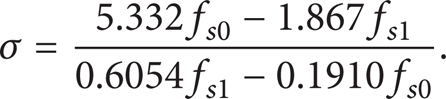
If the pitch frequency fs0 and one harmonic frequency fs1 could be obtained, the Poisson's ratio σ could be calculated, and the accuracy could reach 10−8. In the actual measurement, the sweep signal source was used to find the series resonant frequency. The lowest series resonant frequency is the pitch frequency fs0, which means that fs0 = f s . f s is the first series resonant frequency during the increasing frequency of the sweep signal source after determining fs0.
2.2.2. Short-Circuit Elastic Constants S11 E , S12 E
The short-circuit elastic constants S11 E and S12 E could be calculated as in the following formulae [13]:


η1 could be obtained from the frequency equation (1 − σ)J1(η) = nJ0(η), and S11 E could be calculated after looking up the relationship table between η1 and σ [13].
2.3. Electromechanical Coupling Coefficient k
Electromechanical coupling coefficient k is a parameter that represents the degrees of coupling between the mechanical energy and the power energy, and it also indicates the strength of the piezoelectric properties. For the thin disk piezoelectric vibrator, the radial stretching vibration is the main and most important vibration type, so k p of the plane vibration was calculated in this system. Although it is very complicated to get k p for that it involves large calculation, the following empirical formula facilitates greatly and its accuracy is also very high [13]:

2.4. Piezoelectric Strain Constant d31
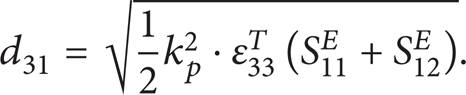
From the literature [13], the relationship between d31 and k p could be defined as follows [13]:

After k p , ∊33 T , S11 E , and S12 E were all fixed, d31 could be calculated as follows:
3. The Design and Implementation of the Measurement System
3.1. System Hardware Design
3.1.1. The Whole Structure of the System
In the automatic measurement system of performance parameters, in order to improve the accuracy, the π-type resistor system was used to measure the related characteristic frequency. The structure principle diagram of the measurement system was shown in Figure 1.

The structure principle diagram of the measurement system.
As shown in Figure 1, the automatic measurement system was constituted with signal source module, detection circuit, acquisition circuit, and interface circuit. The piezoelectric vibrator was connected with the π-type resistor network in parallel. The responsibility of detection circuits was that to detect the phase and change it to a voltage difference, so the system could memorize the characteristic frequency by measuring the voltage difference. The active resistance R1 and the freedom capacitance C T both were also measured by the detection circuits, respectively. All measurement parameters were transported into a computer after converting them to the digital, so that the system could calculate other parameters, and all parameters could be displayed in the form of graphics or tabulations.
3.1.2. The π-Type Resistor Network Circuit
The π-type resistor network circuit mainly included three parts of circuits, and they are π-type resistor circuit, voltage comparing circuit, and phase comparing circuit. The principle diagram of π-type resistor system circuit is shown in Figure 2.

The principle diagram of π-type resistor network circuit.
The π-type resistor circuit is responsible for supplying the sine wave voltage and amplifying it to the piezoelectric vibrator. The voltage comparing circuit could measure the voltage and the phase of U A and U B and change both of their sine wave voltages into square wave pulse with the original phase. The D trigger and XOR gate were used to distinguish whether the phases of U A and U B are synchronized. Only when there is an output jump of the D trigger and the output of the XOR gate becomes zero, the phases of U A and U B are synchronized, and the current frequency could be measured and taken as the resonant frequency or the antiresonant frequency (the lower one of the two frequencies is the resonant frequency).
3.2. System Software Design
The software of the parameter measurement system was developed by Visual Basic 6.0, and its structure diagram and flow diagram of the program were shown as in Figures 3(a) and 3(b).
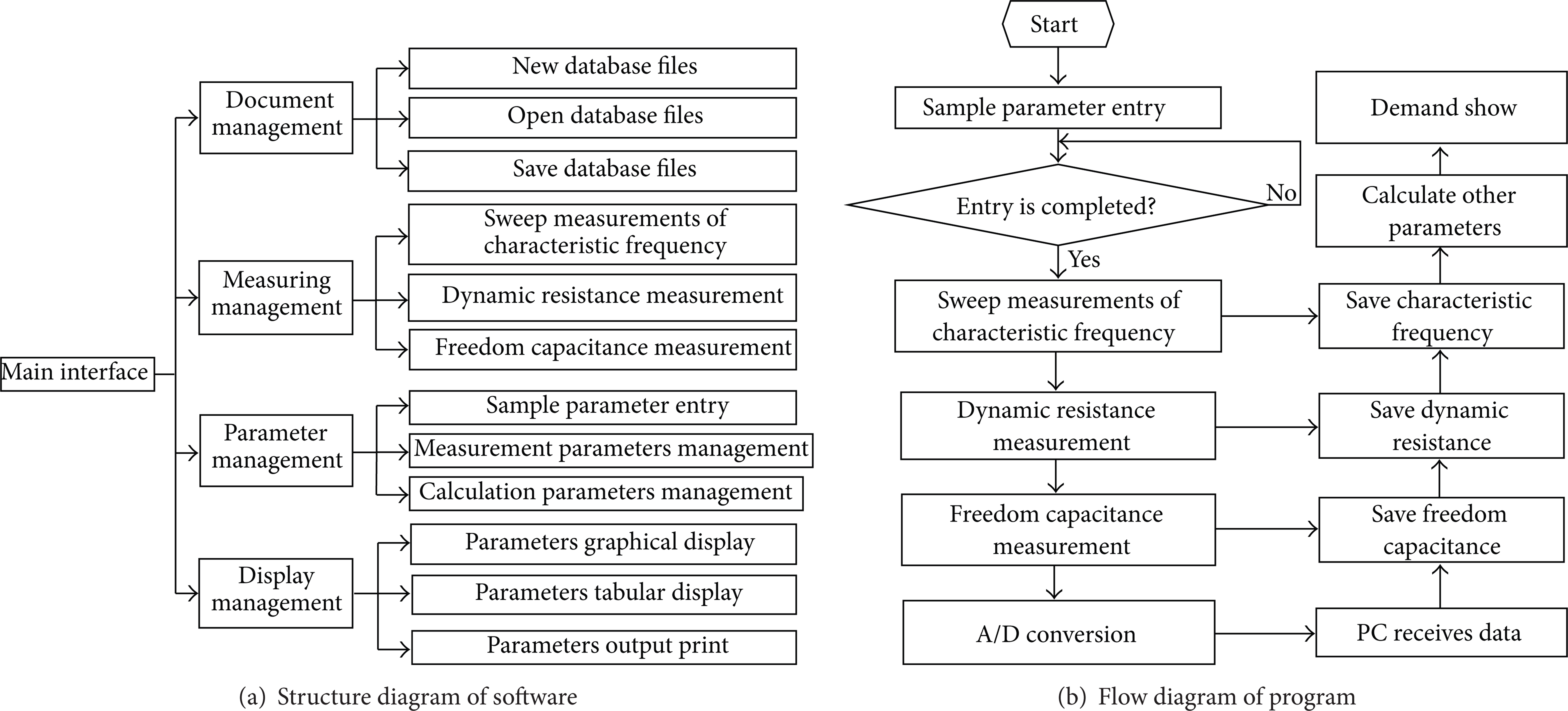
Design diagram of the system software.
The complete automatic measurement program could be divided into four parts, which are document management, measuring management, parameter management, and display management. As from the view of the program execution, all parameters were classified into three types. The first parameters should be entered manually, such as the density ρ and the sample thickness d. The second parameters are the characteristic frequency, active resistance, the freedom capacitance, and so on. All these parameters should be measured by taking use of sweep signal source while the last parameters included mechanical quality factor Q m and Poisson's ratio σ. These parameters could not be measured or detected directly, and they were all calculated by computer. All parameters could be analyzed, stored, and displayed according to the user's demand.
4. Experiment and Results
4.1. Experiment Condition
The thin disk piezoelectric ceramic was chosen as the piezoelectric vibrator sample, and its dimensions were in accordance with the national test standards strictly [14]. The diameter d of the piezoelectric vibrator is 19.5 mm, and the thickness l t is 1.8 mm, and d/l t ≥ 10, while the roundness of the piezoelectric vibrator is not greater than half of the diameter tolerance, and the parallelism is not more than half of the thickness tolerance. The two main surfaces of the piezoelectric vibrator are coated with a metal layer as electrode, so the piezoelectric vibrator is polarized along the thickness direction. The surface of the piezoelectric vibrator is clean and dry.
4.2. Experiment Results
In order to examine the accuracy of the system and improve the comparability of the measurement results, the impedance analyzer (HP3440A) was used to test and measure the same parameters. The comparison results were shown in Table 1.
Comparative measurements.

4.3. Discussion
All experiment results are shown in Table 1. The measurement parameters included the resonant frequency f r , the antiresonant frequency f a , the series resonant frequency f s , the pitch frequency fs0, the one harmonic frequency fs1, the dynamic resistance R1, and the freedom capacitance C T , while other parameters in Table 1 could be calculated based on the measurement parameters.
The experiment results of all the frequency parameters in the integrated measurement system are less than that of analyzer HP3440A, and the error rates between the integrated measurement system and the analyzer HP3440A are only about 1%, while the largest error rate is only 1.54%, which belongs to the antiresonant frequency f a . Because of the fact that the integrated measurement system employed the π-type resistor network, which has large impedance and high sensitivity, all the relevant frequency parameters in the integrated measurement system are less than that of analyzer HP3440A. On the other hand, the error rates of other two measurement parameters of the dynamic resistance R1 and the freedom capacitance C T are 1.09% and 1.04%, respectively.
The rest of the parameters could not be measured directly by the integrated measurement system. According to formulae (2)–(8), these parameters could be calculated based on the measurement parameters, and the error rates of calculation parameters are between 0.7% and 3.37%. Actually, the empirical formulas (2)–(8) all made certain assumptions and simplifications, so the error rates of the calculation parameters are larger than those of the measurement parameters.
Compared with the results of the HP3440A, the accuracy of both the measurement parameters and the calculation parameters is very high. In particular, the largest error rate of the measurement parameters is only 1.54% and the largest error rate of the calculation parameter is only 3.37%. There are some reasons that caused the measurement error and they are as follows.
The performance of the system power and the sweep signal source would affect the measurement accuracy of the voltage comparing circuit and the phase comparing circuit, so there is an error in measuring the resonant frequency f r and the antiresonant frequency f a , and the parameters that are calculated based on f r and f a are deviated.
There is some interference that comes from outside of the measurement system; even an extremely small disturbance would make the voltage of the sampling circuit fluctuate, which affects the measurement accuracy obviously.
Some empirical formulas of calculating parameters might increase the error rate, although its accuracy is still very high.
5. Conclusion
(1) Compared with the traditional measurement system of piezoelectric parameters, the measurement system in this paper could measure all important parameters of the thin disk piezoelectric vibrator's plane vibration mode, and it would be much more convenient for evaluating the performance of the piezoelectric vibrator.
(2) The measurement precision improved a lot, comparing to that of the bypass measurement system. All error rates of the measurement parameters are between 1.02% and 1.54%, and the largest error rate of the measurement parameters is only 1.54%, while the error rates of the calculation parameters are between 0.7% and 3.37%, and the largest error rate of the calculation parameters is only 3.37%.
(3) By taking use of the powerful interaction performance of the computer, the measurement system integrated all functions, such as data collection, analysis, storage, display, and other functions, so that it is significant to study and design the higher performance piezoelectric material based on the measurement system of the piezoelectric parameters.
Conflict of Interests
The authors declare that there is no conflict of interests regarding the publication of this paper.
Footnotes
Notations
Acknowledgment
The authors are grateful to the support from the Yancheng Industrial Support Plan, 2013 (YISP-2013014, 2013, China).