




Abstract
This paper presents a method of assessing fatigue strength for a body in conditions of cyclical tension and torsion. The theoretical calculations have been conducted using the criterion of averaged structural microdamage resulting from local slips. The description of microdamages of such a body, in the view of the slip concept, was done by using a half-sphere with a unit radius, on the surface of which the location of all local physical planes and slip systems was determined employing three angles. A computer method was used to determine the slip boundaries in a complex stress state, analyzing the slip condition for all combinations of angles. Based on the calculated values of the microdamages' intensity function, the number of loading cycles until the moment of fracture initiation was estimated. Experimental verification of the suggested criterion was conducted using cylindrical smooth specimens, made of C45 steel. The tests of fatigue strength were made under conditions of a constant amplitude of zero-start pulsating loads.
1. Introduction
Fatigue strength has an important role in the designing process of machine elements and this notion in reference to complex stress states is still open to discussion. In the case of assessing the fatigue strength of construction elements, a large number of criteria in a stress, deformation, or energetic form can be found in the available literature [1–3]. The lack of universal criteria for assessing the state of construction elements is noticeable [4]. Some of the criteria require the use of an effort hypothesis. The problem here lies in the choice of the appropriate one. This is often addressed by conducting calculations for a few hypotheses. This process is ineffective and does not guarantee a correct assessment of material strength. Taking into account that the accumulation of damage under fatigue depends on the number of loading cycles, the use of classical effort hypotheses to predict material strength in regard to limited fatigue strength is not justified [5]. According to the author, the criteria relating to critical planes seem interesting in this context. However, the problem signaled by other authors [6–10] is the identification and choice of the critical plane and the calculation of appropriate parameters. A large interest of researchers with energetic hypotheses can be seen. They are attractive because they enable us to more fully describe the effects occurring in the fatigue process, due to the simultaneous existence of two parameters: deformation and tensile stress. The correct estimation of material strength, connected with the stabilization of cyclical properties of the material, is a significant problem.
It needs to be stressed that the methods for fatigue calculations are constantly evolving and are often presented in new perspectives. This refers mainly to calculations which take into account the fracture initiation. Keeping in mind that the time of creation and accumulation of structural microdamages leading to the initiation of a fracture may last for a large part of the element's entire fatigue life, one can understand how important and worth researching this subject is.
The majority of criteria refer to a typical monoaxial load or deformation, in an alternating load cycle. Such a load has been described and analyzed fairly well for the majority of materials in use. However, the inclusion of a nonsymmetrical placement of the load or deformation and, what is more, the occurrence of phase shift of its components give significant difficulties to the present methods of assessing fatigue strength. Taking these facts into account, it seems that there exists the need for more synthetic and general descriptions, which would enable us to predict fatigue strength under different conditions [10–16]. It may seem that taking from elementary processes is necessary in creation of new synthetic models. Such an approach is presented by many authors.
The aim of this paper is to assess the usefulness of the fatigue strength criterion, proposed using a modified Batdorf-Budiansky's slip theory, under conditions of cyclical tension and torsion with a phase shift of load components. The criterion of averaged structural microdamages resulting from local slips was suggested assuming the idea that the initiation of fracture is almost always connected with plastic microdeformation [17–20]. According to [17], it was assumed that material fatigue can be treated as a competition of hardening processes—resulting from an increase of structural microdamages and weakening—resulting from relaxation of accumulated internal tensile stress. The criterion of fracture initiation was assumed to be the reaching of a critical intensity of structural damage in a specific area of the material.
A detailed mathematical analysis of the issue of damage accumulation in a polycrystalline body under cyclical complex loads is a very difficult task. Due to this fact, in this paper, the author uses numerical methods, which allow to solve the task quicker and simpler. Additionally, computer graphic at the current level of evolvement makes it possible to easily present and understand the issue.
2. Experimental Tests
Experimental research was conducted by employing three basic elements of pieces of equipment: a machine for fatigue analysis INSTRON 8502, equipped with a twist axis, a scaled microscope with a stroboscope, and a PC class computer (Figure 1).

Research area schematic: CD—digital controller for the fatigue testing machine FD (FastTrack 8800); K—console; P, K, L, M, and S—measuring signal channels, respectively: piston movement, turn angle, force, torsion momentum, and deformation measured with an extensometer S; PC—computer with hardware and software interfaces.
The tests were conducted using cylindrical samples (Figure 2) made of C45 steel. Fatigue tests were carried out in a complex stress state (tension-torsion) under sinusoidal zero-start pulsating loads, achieved by applying to the sample cyclical force F and torsion moment M s (Figure 3). The ratio of tension stress σ z to torsion stress τ xz is determined from η = σ z /τ xz . A constant level of maximum load was maintained at a frequency of 6 Hz.

Sample used for fatigue tests.

Sample load schematic.
Taking into account that the fatigue process is usually divided into the initiation phase and fracture propagation phase [5, 21, 22], it was appropriate to choose a research method, which allows us to distinguish between these phases. Additionally, the possibility of observing and registering parameters such as length and shape of fracture was required, without the need to stop the load cycle of the sample. For the above mentioned reasons, the paper, as the criterion of transition from the initiation phase into the development phase, assumes a crack of length enabling its clear identification in observation through an optical microscope with a stroboscope.
Based on data found in the literature [23–25], as well as our own observations of fatigue fractures, it was assumed that the front of a propagating microfracture would assume the shape ranging from a half-circle to a half-elliptical as it increases in size on the surface of the element. This assumption is made: the depth d of the microfracture, understood as a damage parameter, would be equal half of the size lp of the fracture visible on the sample's surface. Observations and measurements of the length of the fracture visible on the sample's surface were conducted from the instant enabling its clear identification.
During the fatigue tests, the number of loading cycles and corresponding stress values were registered. The number of cycles after which the microfracture reached d = 0,2 mm was assumed as a damage parameter. It was concluded that, at that moment, the first stadium of fracturing ended and the second one began, in which the fracture's development was controlled by processes occurring at its tip.
3. Theoretical Description
There exists a general agreement in the fact that local slips are the cause for initiating microfractures [20]. Nonelastic deformation of the material causes an increase of the number of structural defects (intensity of dislocation) in areas, in which slips occurred [13, 17, 26]. The increase of the intensity of structural defects causes the so-called deformation hardening of the material, that is, an increased resistance to plastic deformation. The forming of slip planes is directly related to the dislocation movement. As the number of load cycles increases, the intensity and the number of fatigue slip planes increase, which depend mainly on the type of load and material properties. Many articles [17, 27] point to the fact that elastic defects of the crystal structure generated through slips relax in time. Relaxation is also supported by the so-called dynamic recovery, as well as cyclical changes in stress. The theory of dislocation points to the fact that microfractures are created when the concentration of dislocations reaches a critical value [17, 28].
In the modified slip theory by Batdorf-Budiansky it is assumed that a polycrystalline body, in its initial state, is a conglomerate of variously oriented grains. The distribution of crystals is random and there exist no preferred directions. Despite the fact that separate crystals and grains show features of anisotropy, the mechanical properties of the whole body at a macroscale are isotropic. It is more convenient to perform a description of structural microdamages of such a body under the slip theory by using a half-sphere unit radius [13, 29], on the surface of which, the location of all possible local physical planes and slip systems is determined through α, β, and ω angles (Figure 4). Any slip plane is described by the normal n determined by angles α and β. The direction of the slip l in the plane tangent to the half-sphere is referred to as the ω angle, measured from the parallel axis ξ1. The other axis ξ2 is perpendicular to ξ1 and located in the longitudinal plane.
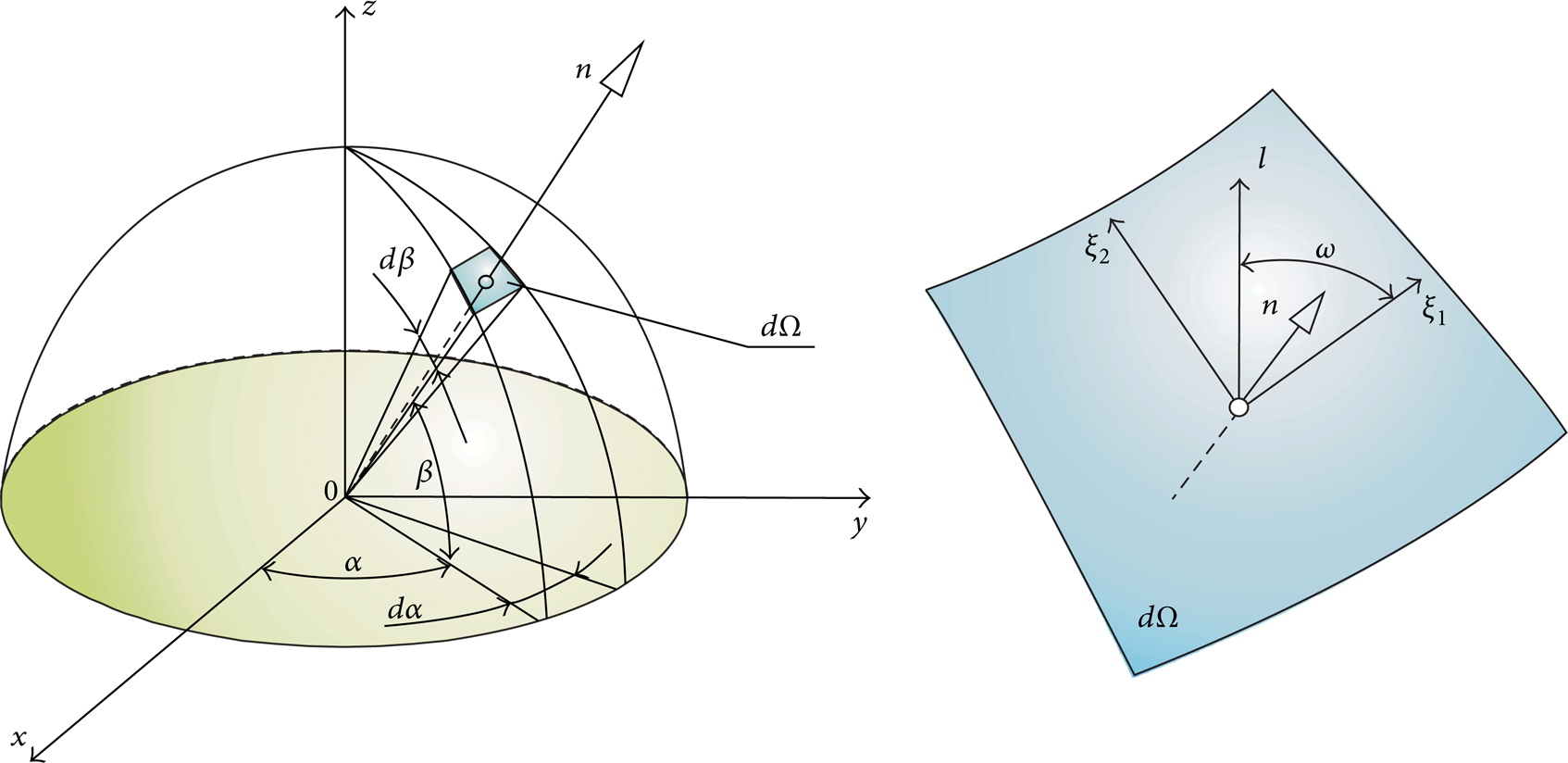
Coordinates of the slip plane.
Taking the presented arguments into account, it can be predicted that the fracture initiation will occur when the averaged size of microdamages in a given area of material, described by the function ψ(α,β), on a unit half-sphere with a surface of Ω, reaches a critical value C, characteristic for a given type of material:

where ψ is the function of structural microdamages intensity; α, β are angles determining the location of the slip plane with a normal n on a unit half-sphere, dΩ = cosβdα dβ is elementary surface of a half-sphere.
At this point it needs to be mentioned that, when referring to values determined in the slip system n, l (i.e. such as: tangent stress τ nl , function of microdamages intensity ψ nl , heterogeneity parameter I nl , and plastic deformation resistance S nl ), indexes n, l marking the axes of the slip system, in order to simplify the notation, shall not be used. As a matter of fact the indexes n, l could suggest that the values characterized by them are tensors, while they are merely components of these values in the n, l system.
The function of plastic resistance S was assumed (in the plane with the normal n) in the following form:

where Z is fatigue boundary of the stadium of fracture initiation, I is function determining the influence of the amount of loading cycles on the increase of structural microdamages, which can be presented as

whereas B and b are material constants and N is the amount of loading cycles to fracture initiation.
Tangent stress τ in (3) is determined from a transformational equation [14]:

where σ ij is the stress tensor in a polycrystalline material and li, nj are directional cosines of n and l axes in relation to the coordinate system x, y, z.
Local tangent stress in the n plane, for simultaneous tension and torsion, from (4) can be written as follows:

Figure 5 presents examples of the distribution of tangent stress values on a half-sphere. The graphs are presented as surface graphs using Cartesian coordinates and were prepared for a level of reduced stress, which was determined using the Tresca hypothesis σred T = 684 MPa.

Distributions of tangent stress values on a half-sphere: (a) η = ∞; (b) η = 2; (c) η = 1; and (d) η = 0.
Slips occur in these local physical planes, determined on the half-sphere with angles α, β (Figure 4) in which the slip condition is fulfilled; that is:

It is assumed that, in all of the half-sphere's planes, slips will occur only in the ω direction, in accordance with the direction of maximum tangent stress occurring in these planes.
In order to present in detail the idea of directions, in which slips are accumulated, maps of directions of tangent stresses were created, in form of so-called vector graphs for several proportional load types (Figure 6). The presented maps are an expanded (brought to a plane) surface of the half-sphere in a rectangular presentation. The orientation of the axes and the beginning of the stationary frame of reference x, y, z on the presented graphs correspond to the orientation presented in Figure 4 (e.g., the direction and sense of the z axis-vertically up). The axis of abscissae represents the value of the angle α, whereas the y axis represents the value of the angle β. The length of the corresponding arrows points out the value of tangent stresses τ in a local system ξ1, ξ2. The orientation of individual arrows represents the directions of maximum tangent stresses.

Tangent stress maps in a situation of proportional complex loads: (a) monoaxial tension (η = ∞); (b) and (c) tension with torsion for η, respectively, (2 and 1); and (d) torsion (η = 0).
Taking into account the assumption that in all planes of the half-sphere the slips will occur only in the ω direction, which is in accordance with the direction of the maximum tangent stress occurring in these planes, the predicted directions and senses of the slips can be determined. The values of the ω angle in Figure 6 need to be measured in accordance with the generally accepted mathematical notation—from the axis of abscissae moving counterclockwise.
An analytical solution of structural microdamages accumulation under complex loads is complicated. In case of loads with a phase shift, the change of the direction of the maximum tangent stress is an additional problem. It can be solved easier using numerical methods. Mathcad software was used to support the computer calculations. Using this software, a program was made which enables us to calculate the structural microdefects intensity and to determine and visualize the areas where they occurred. The program is modular and its flow chart is presented in Figure 7.
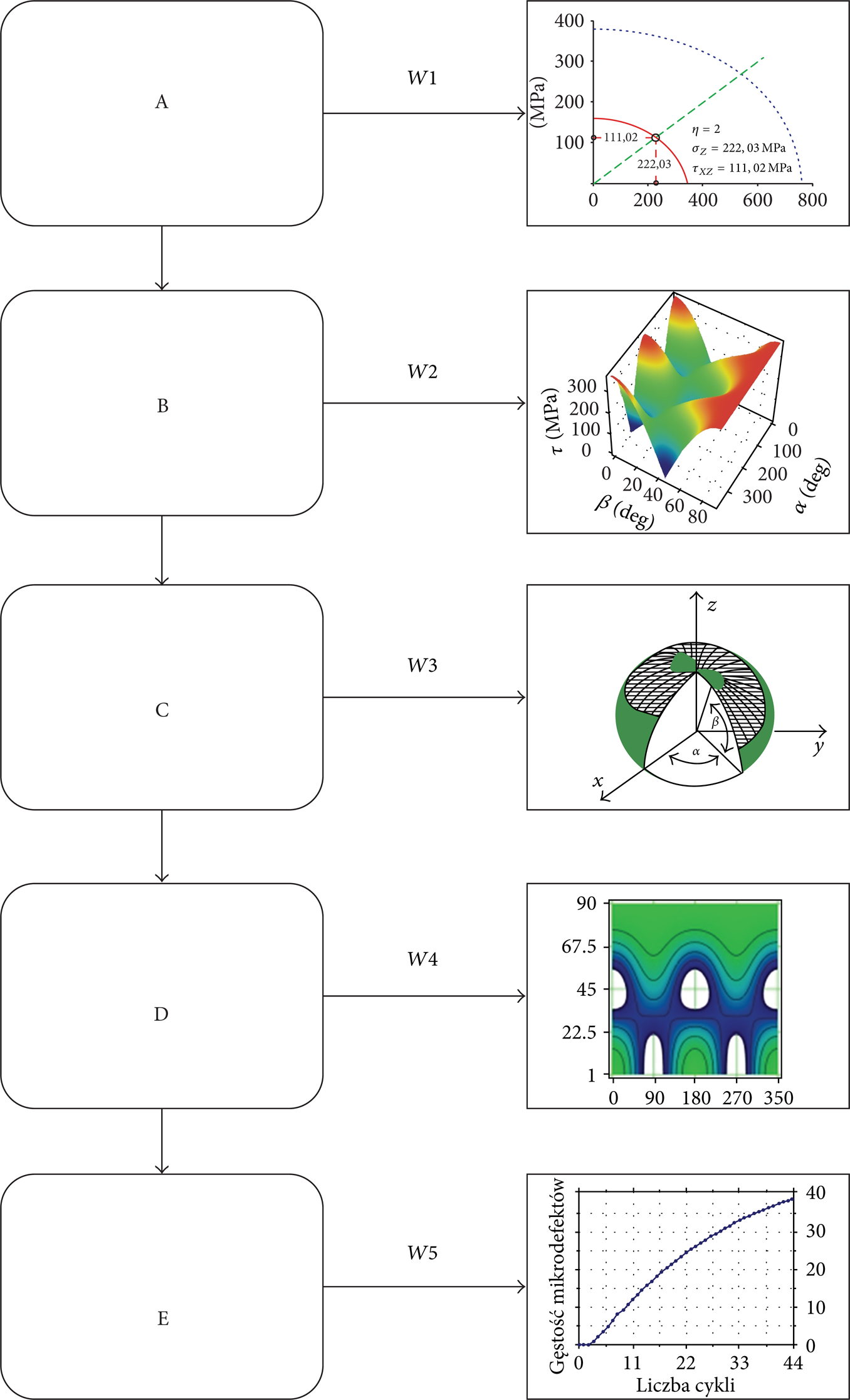
Flow chart of the program.
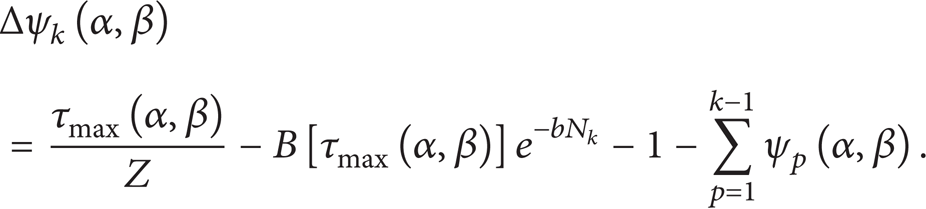
Block A of the program includes the sample loading. Tangent stress τ xz and normal σ z values are calculated. Module B is responsible for the division of the unit half-sphere into a large number of elementary surfaces. The calculation of tangent maximum stresses τ max takes place for all elements of the half-sphere. Block C calculates the value of microdefects intensity increase Δψ(α,β) using the method of recursive iteration:
Module D is responsible for determining the area in which slips occur. The slip conditions are checked here. Module E of the program is responsible for adding the microdefect intensities for all elements of the half-sphere. The predicted number of loading cycles N k is determined up to the point of fracture initiation based on condition in (1).
The constants B, b, and C, from the condition of fracture initiation (1), were determined on the basis of a fatigue curve of fracture initiation, made in a monoaxial stress state, using the Mathcad software. At Z = 110 MPa the result was B = 1,684*10−3 MPa−1, b = 3, 49*10−6, and C = 9, 87. Based on the obtained microdamage intensity function's values and condition (1), while taking into account the values of material constants, a predicted number of loading cycles was determined leading up to the point of fracture initiation. Figure 8 presents a comparison between calculated and experimental strengths.
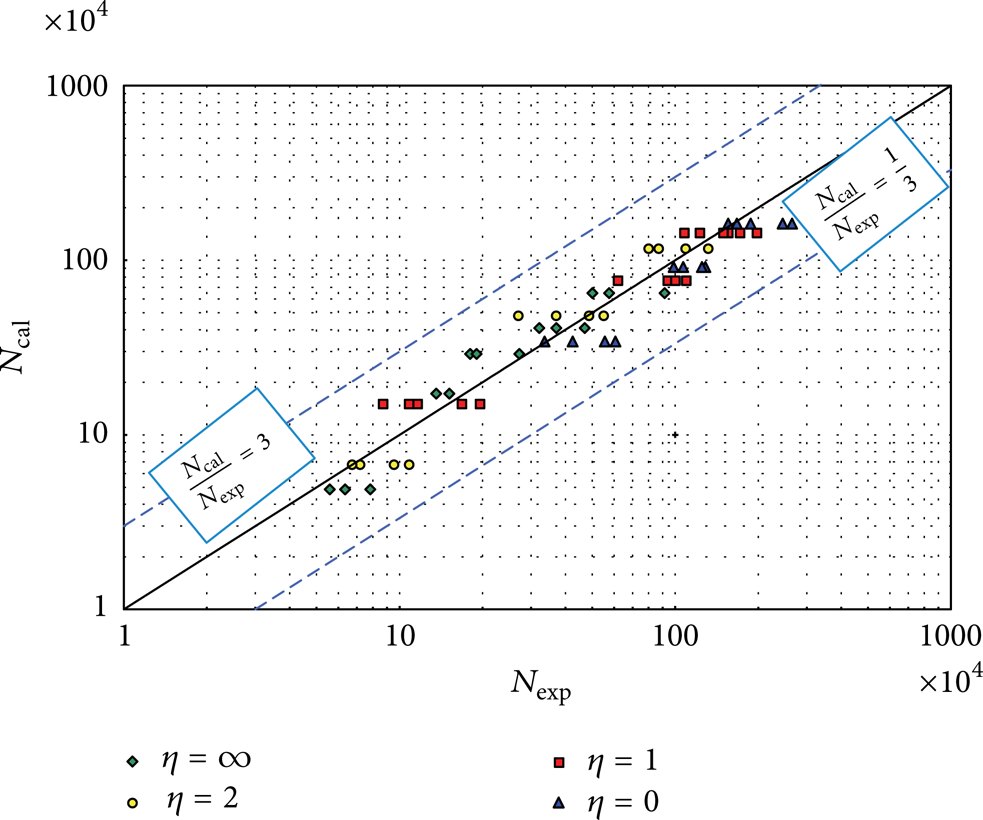
A comparison of calculated fatigue strength with data obtained from experiments.
4. Conclusions
The concept presented in this paper is an attempt to create a phenomenological model of the behavior of a polycrystalline material, under variable loads, largely in reference to the theory of elementary processes.
The results of the calculations using the strength model determined by the dependency (1) provide a satisfactory estimation in relation to the experimental results (Figure 8). The results of calculations fit within a scatter band with a coefficient of 3 (determined as in [8, 10]). A tendency was observed for underestimation of fatigue strength in case of a large participation of torsion stresses in relations to tension. There is need for further analysis of the suggested model for other materials and load conditions.
Conflict of Interests
The author declares that there is no conflict of interests regarding the publication of this paper.
Footnotes
Acknowledgment
The research was carried out under the Project S/WM/2/2013 realized in Bialystok Technical University.