




Abstract
Video sensor networks have been widely used to monitor environment and report abnormality. Each node collects video data, select a head node, and transmit the data to the head, and then the head reports the data to the base station. A head has to process both normal and abnormal data-reporting requests from its nearby nodes. To achieve QoS of surveillance, previous request scheduling methods minimize the data transmission delay or blocking rate but no comprehensive way was studied in the literature. In this paper, we propose a game strategic request scheduling based on a queue priority model in which a handover mechanism ensures that the abnormal requests are processed in time. In the game, video sensors select their heads to decide the arriving rates of both normal and abnormal requests; the heads decide the probability of handing over the abnormal requests. At the Nash Equilibrium Point (NEP), the normal data requesters optimize mean delay, the abnormal data requesters optimize mean blocking rate, and the heads balance the request load on them. Numerical analysis shows that the game strategic scheduling outperforms other scheduling methods that consider single objective (minimum delay or minimum blocking rate).
1. Introduction
Video sensor networks act as an efficient and reliable way to monitor environment and discover emergency or accidents [1, 2]. Each node of a sensor network collects video data and transmits the data to a nearby head, which is also a sensor and selected within a cluster. The head processes the data-reporting requests from members of the cluster and transmits the data to a sink node or a base station. The monitoring quality of service (QoS) of a video sensor network depends on how the data-reporting requests are scheduled and processed [2]. In order to collect data in time, a scheduling mechanism is supposed to optimize a metric of QoS (e.g., delay or blocking rate).
When executing the task of surveillance, a video sensor node can provide two types of service, one of which is to collect the data of normal video stream, and the other one is to collect the data of accident identification. Compared with the normal data, the abnormal data has a strict requirement of real time in order that the emergency and accidents can be discovered in time. A sensor node may transmit either normal or abnormal data to heads, which have to process both kinds of requests. Accordingly, a scheduling mechanism has to be designed to ensure that regular monitoring tasks are accomplished and accident reports are not delayed.
Previous request scheduling mechanisms focused on optimizing a single QoS metric (e.g., delay or blocking rate) without considering different QoS demands of two kinds of requests. Some work deals with packet queue management to improve the reporting delay and the video distortion [3]. Some other work pays too much attention to the occasionally accident data to avoid disturbing the regular monitoring tasks [4, 5]. A comprehensive way to achieve QoS of both kinds of reporting requests has not been studied in the literature. Such request scheduling problem entails a solution to optimize the utility of both the normal data-reporting requesters and abnormal data-reporting requesters. Game theory can be used where multiple participants interact with each other by their own strategies and pursue their respective optimal utility. When the participants arrive a Nash Equilibrium Point, they will not deviate from this solution because no more profit can be achieved by any of them [6, 7].
During the transmission of normal and abnormal data, there are totally three active participants: abnormal data-reporting requesters (ADR), normal data-reporting requesters (NDR), and cluster heads. They interact with each other. Both ADR and NDR have to choose the right heads to report their data because their choices will influence QoS of their monitoring tasks and the performance of the whole network. The cluster heads have to use cooperative way to optimize the cost and prolong the lifetime of the network. The three participants optimize their respective utility objective and converge to an equilibrium at which ADR and NDR make optimal head selection and heads use cooperation mechanism to lower and balance load on them.
In this paper, we propose a game theoretic request scheduling based on a handover mechanism between heads’ priority queues. ADR, NDR, and the heads act as three players in the game. NDR decides the head selection strategy to optimize mean request response delay. ADR selects their heads to optimize mean request blocking rate. The Cluster heads decide the handover strategy to optimize their load. We can get a Nash Equilibrium Point (NEP) at which each participant optimizes its own utility [6, 7]. Using NEP solution as the request scheduling, we satisfy the demand of service quality of both ADR and NDR as well as achieving load balance between heads. The main contributions of this paper include the following:
The remainder of the paper is organized as follows. Related work is introduced in Section 2. In Section 3, we illustrate the network and QoS metrics. In Section 4 we propose the request scheduling game and the NEP solution. Some properties of NEP are validated in Section 5. Evaluation of the scheduling is shown in Section 6. Section 7 concludes the paper.
2. Related Work
In video sensor networks, abnormal data-reporting requests are usually given the high priority for accident discovery. In the paper [4], the authors propose an energy-aware packet scheduling algorithm to minimize the power consumption and prolong the lifetime of the whole video sensor network. In order to minimize the video distortion, they use a priority strategy to let the high priority packets to be transmitted over high bandwidth paths. Their proposed algorithm can constrain the energy consumption by selectively dropping the least important video packets. Durmus et al. propose an event-based fairness scheme for fair resource allocation of the involving events [3]. Their scheme is a queue management to improve the video distortion and the reporting latency. In the paper [5], the authors propose a periodic time scheduling to maximize the quality of monitoring of stochastic events. This scheduling has to decide the proportion of the time of event-monitoring and distribute a sensor's coverage time in order to achieve the proportion sharing and prolong the lifetime.
Cluster head or server selection schemes are studied in wired/wireless networks for efficient data transmission and QoS satisfaction [8–11]. Through redirection of a request dispatcher, distributed system assigns requests and balances loads on source servers. Much work pertains to system performance analysis with resource allocation method [12]. Different optimization schemes have been proposed to achieve QoS in data transmission [13–15].
Queue theory has been widely used in request scheduling [16]. In [12], the authors investigate price of anarchy of the distributed networks with multiple dispatchers. They model the request assignment by the dispatchers as a multiplayer noncooperative game, in which each dispatcher optimizes its own cost. Selfish server selection strategy of each dispatcher results in worse global cost of the whole network. Lower and upper boundaries of price of anarchy are given to illustrate that network performance degrades with increasing number of dispatchers. Authors in [17] study the job assignment problem in heterogeneous distributed server system. They propose an optimal static assignment to minimize the loads on the entire system. For the queue model, the author uses a scheduler to assign jobs (requests) to different servers. The scheduler is similar to the head selecting function in our request assignment game. This method can be deployed with handover mechanism to obtain global optimization of both normal and abnormal requests.
3. Priority Queue Model
3.1. Video Sensor Network Architecture
Cluster-based video sensor network architecture is composed of three types of nodes. As shown in Figure 1, each video sensor serves as a node to collect both normal and abnormal data from surrounding environment and transmits the data reports to their cluster heads. The head processes the data-reporting requests and transmits them to the sink node.

Video sensor network architecture.
3.2. QoS Metrics for Both ADR and NDR
To give the QoS metrics based on the video sensor network, we detail the queue model of handover mechanism between cluster heads.
Let

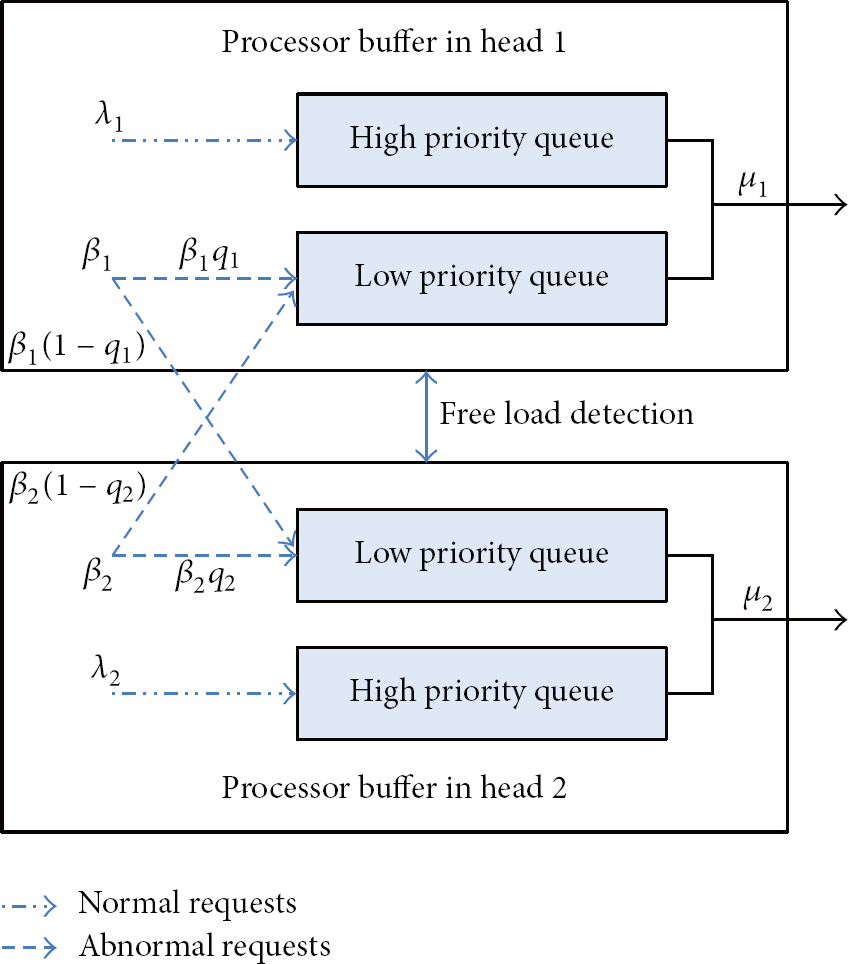
Priority queue model with handover.
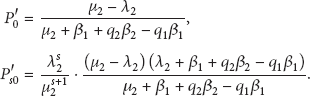
By solving the equations, we can get the state probabilities as follows:

For head 2, the state probabilities are expressed as follows:
3.2.1. Delay for Normal Requests
Let

3.2.2. Blocking Rate for Abnormal Requests
Because the abnormal request packets can be regarded as the one processed by the cooperative heads, the blocking rate should be the average probability of abnormal requests being rejected by these heads. We use the sharing policy to figure out the condition probability.
As shown in Figure 2, the probability that a packet arrives at head 1 is expressed as

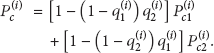
In the same way, we can get the blocking rate

With condition probabilities, the total blocking rate
4. Request Scheduling Game
In this section, we introduce the request scheduling game. By modeling the game as a 3-player noncooperative game, we obtain the NEP at which the three players of ADR, NDR, and cluster heads all optimize their own utilities with no motivation to deviate the NEP.
4.1. The Three-Player Game
A multiplayer noncooperative game includes participants, policy for every player, and utility function for every player. The game is also a complete information static game in which every player knows the policy sets and the objective functions of others, but he does not know the policy choice of others. For the policy set, every player in this three-player game has infinite choices. We also suppose that every player in this game is selfish and rational. They choose the policy that can maximize their own utilities. The Nash Equilibrium Point is defined as the optimal policies chosen by all the players to optimize their own utility. At the NEP, no one has the motivation to deviate from this solution, because they will not gain more profit with other policies.
Consider a video sensor network with n heads at N different times. let the total arrival rate of abnormal requests be a constant β. Let

Since abnormal data is time-sensitive, an abnormal request packet will be dropped if it exceeds the acceptable delay threshold. Therefore, we use the blocking rate to represent the quality demand from ADR. The utility function of ADR is to minimize the average blocking rate.
Let

NDR queue in the high priority queue in a head. We use the average delay to express the objective function.
Two heads can communicate through free load detection message. By using this message a busy head can find the free load head nearby and pass on the requests to them since the abnormal requests are immediate rejection type. Through this sharing way, heads cooperate to balance the load. We define
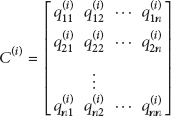
According to the definition of the NEP, given the utility function f, the policy set
4.2. The Game Theoretic Formulae
According to (8), we can get the probability that head k at time i shares at least one request. This probability is shown as follows:
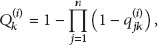
Based on the definitions and constraints above, we obtain the utility objective for the three players in this game.
The ADR wants to minimize the blocking rate which is expressed as follows:
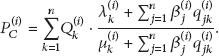
Then we get the average blocking rate in the whole networking by weighting

The NDR wants to minimize the response delay of the normal requests. The delay of head k and the average delay of the whole networking are expressed as follows:


With the queue intensity
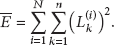
Each player in the game chooses policy to optimize its own utility objective function.
ADR solves the following problem.
Minimize


NDR solves the following problem.
Minimize


Cluster heads solve the following problem.
Minimize
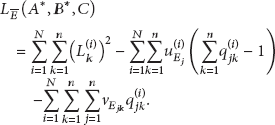
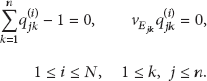
To sum up, we can obtain the NEP solution from the following equation group:

NEP solution is the optimal policy for each player to maximize their own utility. As rational player, no one has the motivation to deviate from this optimal policy choice.
5. Property Validation
In this section, we give some theorems and propositions with their proofs to reveal some properties of the NEP solution. We prove the existence and stability of NEP as well as the advantage of NEP and handover efficiency.
Theorem 1.
A Nash Equilibrium Point exists in the request scheduling game.
Proof.
As defined in Section 3, we use A, B, and C, respectively, to represent the policy sets of NDR, ADR, and heads. So the whole policy space of all the three players will be
Average delay
For NDR and its policy set A, we define the set value mapping

For ADR and its policy set B, we define the set value mapping

For heads and the policy set C, we define the set value mapping

Given

Mapping F is upper-continuous with its convex closed value set
Theorem 2.
The NEP solution to the request scheduling game is stable.
Proof.
Policy sets A, B, and C are all closed and convex subsets in Hausdorff spaces. Objective mappings
This theorem has practical significance in video sensor networks. In this game, when game function, such as average delay, changes slightly into another similar but different formulation, the new NEP will not vary greatly. A NEP represents the results of data-reporting request assignment and networking resource allocation. We know that accidents in the networking always happen without in-time response. As shown in (23), changes of processor in the head will lead to changes of the service rate μ. Then the whole game function of delay will change a little. Because of the stability of the NEP solution, even still following the proper policies, quality of service and performance of networking will not be affected too much. Hence, the NEP can give a smooth transition in some emergent accidents. It is meaningful to stable surveillance.
We will prove that the NEP solution and handover mechanism outperform other mechanisms in some difficult working conditions.
Proposition 3.
Given the arrival rates for both ADR and NDR as
Proof.
We use the waiting time of a normal request packet to express the delay in M/M/1. Delay in M/M/1 and delay of the handover mechanism can be expressed as follows:

By using the condition
Consider
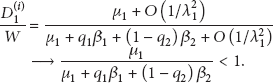
The limitation condition
Proposition 4.
On condition
Proof.
Low priority queue for abnormal requests is immediate rejection. Suppose that there are two heads and the probabilities of sharing are

For M/M/1

In the handover mechanism, weighted blocking rate for abnormal requests to the two heads are expressed as follows:
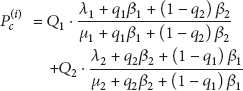

The M/M/1
Proposition 5.
When
Proof.
Suppose that there are two heads to do handover. We use



The nodes of high process ability are supposed to serve more packets in accordance with their practical capacity. To analyze the condition
Proposition 6.
The NEP solution shows inefficiency as the number of heads increases on conditions as follows:
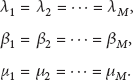
Proof.
By solving the equation group (23) to get the NEP, we have a load balancing constraint. According to the format of the balancing index and the square inequality, we have
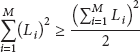
When
When
We define the inefficiency indexes F and
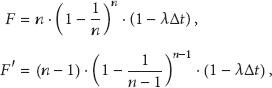

The inefficiency index can be regarded as the degree of wasting networking resource. It is the total probability that one node has to do some work but it does not. On the conditions in Proposition 6, every head in a LSG has the same work load and process ability. But in an infinitesimal period every head has a probability of free load by NDR but receive no abnormal request. It is a waste of networking resource. We figure out the total probability of inefficiency and find that the index gets larger as the head number increases. This proposition also has a practical significance. Because of the similar process ability and same work load, each head does not have motivation to share the abnormal requests. No share means inefficiency of handover. Therefore, we prefer some distinction in head selection.
6. Numerical Results
We use Matlab to evaluate the performance of our proposed handover mechanism and game theoretic scheduling method. We consider the single-hop case. It has 6 heads that response to all the data-reporting requests from 30 sensor nodes. We set the 1st, 3rd, and 5th nodes to have capacity of 4.2 Mbps, and the 2nd, 4th, and 6th nodes to have capacity of 3.3 Mbps. This is because homogeneous nodes may cause the inefficiency which has been shown in Proposition 6. The ADR and NDR packet sizes are both 1 MB. Accordingly, the average service rates of the 1st and 2nd nodes are
6.1. Handover Mechanism
By employing the game theoretic optimization to get the NEP solution, we record the probability changes with the ratio of normal request rate at head 1 to the rate at head 2. Probabilities

Probability of two heads passing on abnormal requests to each other: (a) 10 values of ratio
From Figure 3, we see the interaction between request arriving amount and heads’ policy based on handover. In different state of arriving rate, heads always use the NEP solution to alleviate load and keep balance through handover.
6.2. Performance Evaluation
Let λ be the total normal request arriving rate. Let β be the total abnormal request arriving rate. We record the simulation results in two cases of
In our proposed game theoretic request scheduling based on handover, we use the NEP from (23) to make head selection to optimize utility functions of three players in the game as we discussed in Section 3.
On condition of M/M/1, the solution can be figured out with a load balance constraint as follows:

In minimum delay selection method, based on M/M/1, optimization is to solve the problem

In minimum blocking probability method based on M/M/1

The NEP in our method contains three optimal solutions. Hence, we compare simulation results from three aspects. We compare our NEP with equal load and minimum delay solutions by delay simulation. For blocking rate, we show the comparison of our NEP with minimum blocking probability solution. In load index comparison, results of all the four optimizations will be illustrated.
6.2.1. Delay for NDR
Figure 4 shows three surfaces, which respectively represent the delay solutions of NEP, (minimum delay) MD [13], and (equal load) EL [14]. Each surface shows perform of an optimal delay method by giving delay value change with both ratio

Comparison of average delays in different ratio
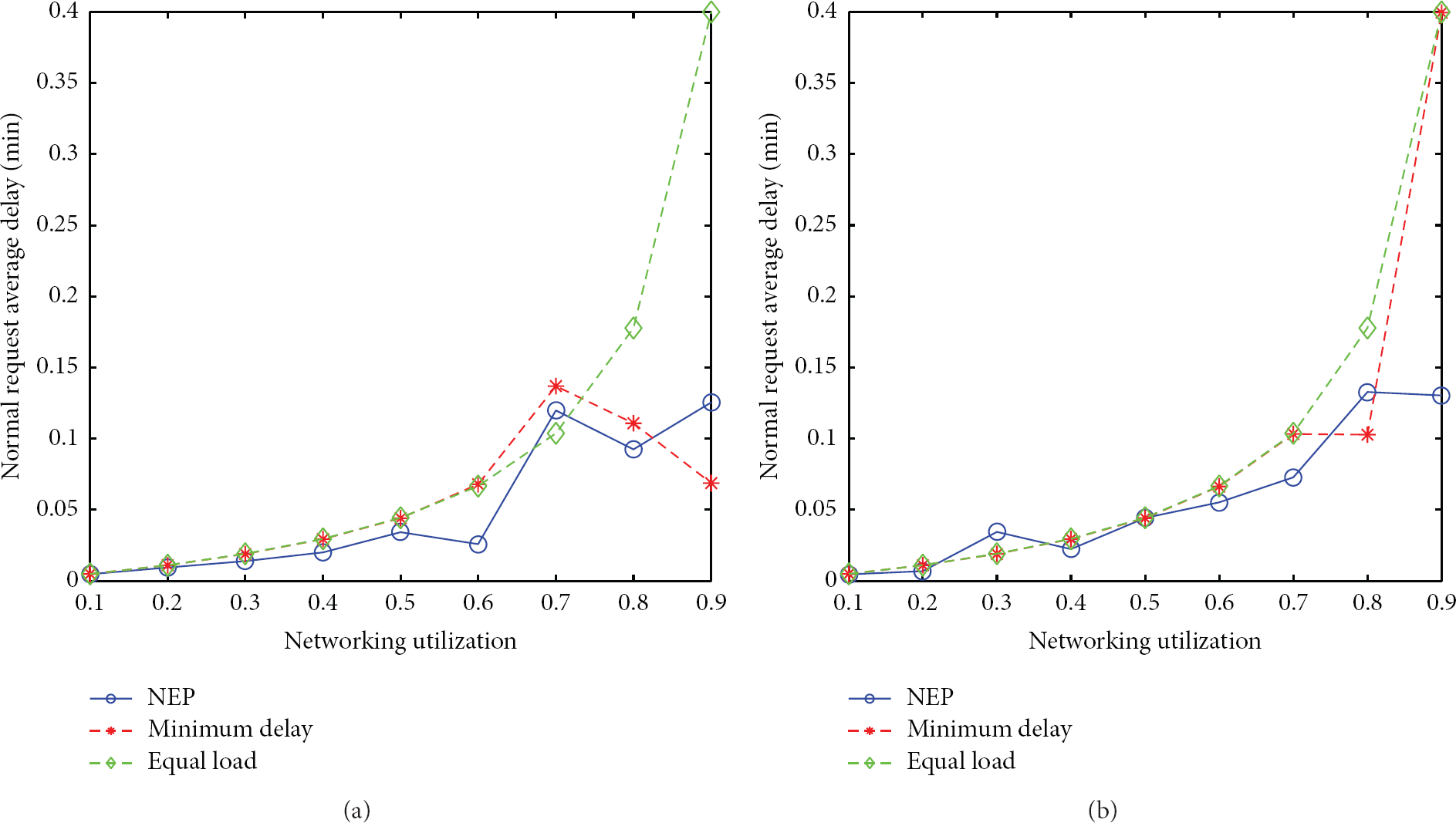
Comparison of average delays in (a)
As shown in Figures 4 and 5, the dominance of NEP is not only in the situation that the networking has relatively small utilizations, but also in the scenario that large amount of load put on the networking. We consider the reason from two aspects. Although NEP solution has the similar optimizing algorithm and constraints as the minimum delay method, the NEP is based on the handover mechanism to balance load. Another reason is that each head use high and low priority queues to process two kinds of packets. The head drops or hand over abnormal request packets when necessary to ensure these request are processed in time.
6.2.2. Blocking Rate for ADR
Minimum blocking probability method based on M/M/1/

Comparison of average blocking rates in different ratio

Comparison of average blocking rates in (a)
We draw two conclusions from the two figures. First, there is an optimal utilization range for blocking rate by NEP like
6.2.3. Load of Heads
According to (16), minimizing the index is a control and optimization process. we have
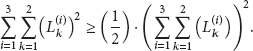
When expression on the right side of the inequality is a constant, we get the condition to equalize (44) as
The NEP load index is figured out with (16). For other methods, the index is expressed as
To evaluate the load balance of the four optimization methods, we let all the 6 heads have the same capacity of 4.2 Mbps. In addition, the total arriving rate

Comparison of load index in different ratio
7. Conclusion
In this paper, we propose a comprehensive way to satisfy the QoS demands of both normal and abnormal data-reporting requests in order to improve the accident discovery but not to interfere with the regular surveillance task in video sensor networks. The request scheduling game optimizes the utilities of both ADR and NDR and balances the load on cluster heads. A handover mechanism ensures that the abnormal requests are processed in time. Based on game theoretic analysis, we prove some properties of the NEP and the handover mechanism. Existence and stability of NEP ensure efficient optimization and good adjustability to some accidents in networks. Numerical analysis shows that the game strategic scheduling outperforms other scheduling methods that consider single objective (minimum delay or minimum blocking rate).
Footnotes
Appendices
Conflict of Interests
The authors declare that there is no conflict of interests regarding the publication of this paper.
Acknowledgments
This work is supported by the National Basic Research Program of China (973 Program) under Grant 2013CB329101, partially supported by the National High-Tech Research and Development Program of China (863) under Grant no. 2011AA010701, by the National Natural Science Foundation of China (NSFC) under Grant nos. 61372112, 61232017, 61003283, and 61001122, by Beijing Natural Science Foundation of China under Grant no. 4142037, and by the Jiangsu Natural Science Foundation of China under Grant no. BK2011171.