




Abstract
Horizontally vibrating linear actuator (HVLA) instead of VVLA has been under study in a few past years and recently HVLA with thickness of 2.5 mm was developed. The one-folded leaf spring to guide the moving part is newly designed and applied in HVLA, but unfortunately it makes HVLA be wider. Accordingly, this paper presents the optimal design of one-folded leaf spring, which results in reduction of HLVA width. The commercial design optimization tool “PIAnO” was utilized based on design of experiments (DOE), approximation techniques, and optimization algorithm. In addition, for the vibration modal analysis and harmonic response analysis to generate metamodeling, the software “ANSYS” is utilized. The optimal width of leaf spring was reduced by 46% compared to the initial one, while all the design constraints were satisfied, which clearly showed the validity of the proposed design approach.
1. Introduction
The slimming of a smart phone has become a competitive issue in the smart phone industry because the display panel is enlarged to show more information to the user. A smart phone is comprised of numerous components: the battery, the camera module, the vibrating actuator, and so forth. One of the thickest components is vibrating actuator which imposes the restrictions on the slimming of smart phones. In currently manufactured smart phone in the market, a vertical vibrating linear actuator (VVLA) is being widely used as a vibration motor, as shown in Figure 1.

Schematic diagram of VVLA.
However, it imposes the thickness problem on a smart phone, because it needs vibration space in the vertical direction [1]. Therefore, a horizontally vibrating linear actuator (HVLA) has been developed in recent years, but it has not been commercialized in the smart phone industry so far [2]. The primary reason is that the fatigue fracture of guide spring due to the cyclic compression and tension loads has not been resolved. The guide spring has the role to support the moving part of the actuator and enable the actuator to vibrate elastically. Accordingly, the various designs of guide spring had been presented to achieve the high fatigue life [3, 4] and among them the one-folded leaf spring introduced by Lee and Kim has the highest fatigue life [5]. Figures 2(a) and 2(b) show the one-folded spring and the schematic diagrams of the HVLA which has the one-folded spring, respectively. Table 1 shows the performance characteristics of the HVLA.
Specification of the HVLA.


(a) The one-folded spring of HVLA and (b) schematic diagram of HVLA.
This one-folded leaf spring enables the HVLA to improve the vibration force and product life. Instead, the HVLA has been enlarged in width due to the wide structure of one-folded spring. Figure 3 shows the top view of the HVLA with one-folded leaf spring.

Top view of HVLA with the one-folded leaf spring.
This one-folded leaf spring has occupied 45% of total width of HVLA. Therefore, the design of one-folded leaf spring needs be optimized to reduce its width. Several researches about the optimal design of the mechanical springs such as helical, coil, and leaf spring had been reported in past decades. These springs are usually designed to avoid resonance, but one-folded leaf spring of HVLA needs to accomplish the best performance. Moreover, there had been no studies reported about the optimal design of one-folded leaf spring. Therefore, this paper presents an optimization of the one-folded leaf spring. For optimal design process, we used the commercial optimization software PIAnO (Process Integration, Automation, and Optimization) which provides the users with various tools for the efficient optimization design [6]. (Ver.3.5, PIDOTECH) The optimal design objective is to minimize the width of one-folded spring to satisfy the stiffness and maximum stress at cyclic loading condition. Five design variables were selected to derive the optimal design of one-folded leaf spring and an orthogonal array used. Modal and harmonic response analyses were performed according to the design of experiments to obtain the natural frequency of the first vibration mode due to stiffness and the maximum stress at resonance using the commercial structural analysis program ANSYS. (Version 14.5, ANSYS) And then, analyses results were saved as a text file and reimported into the PIAnO for generating metamodel. Metamodels were generated based on the results of structural analysis using a Kriging model with PIAnO. Finally, we derived a global optimal point using evolution algorithms.
2. Design Problem
2.1. Design Requirements
2.1.1. Minimization of the Width of Leaf Spring
The width of one-folded spring should be minimized in order to reduce the size of the vibration actuator. This procedure is represented by the following equation:

2.1.2. Design Constraint on the Maximum Stress
A one-folded spring that is affected by cyclic compression and tension loads should have a yield stress of approximately 215 MPa in order to maintain its fatigue life [7]. The one-folded spring is represented as follows:

2.1.3. Design Constraint on the Mechanical Natural Frequency
The mechanical natural frequency of HVLA ranges from 175 Hz to 185.5 Hz:

2.2. Design Variables
We selected the width, length, thickness, height, and radius as design variables for the leaf spring.
Figure 4 shows the shape of the leaf spring, and Table 2 shows the initial, lower, and upper bound values of the design variables.
Initial, lower, and upper bound values of the selected design variables.

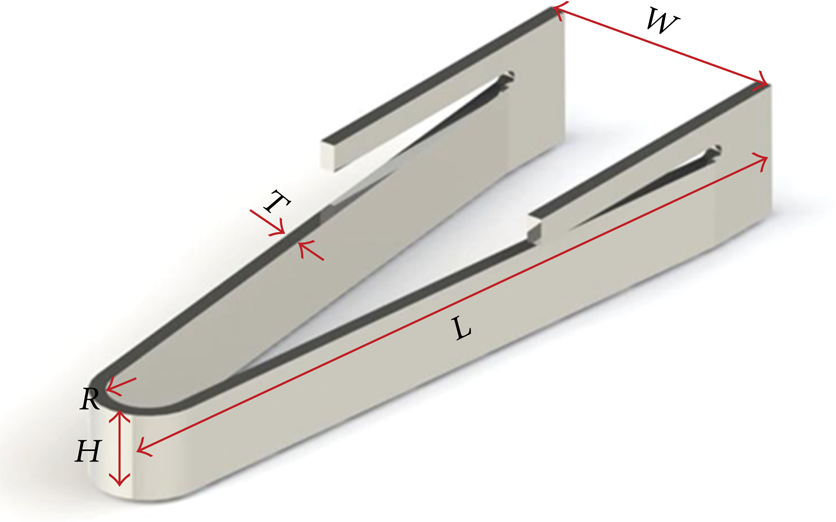
Design variables of the one-folded leaf spring.
2.3. Design Problem Formulation
The design problem for determining the design variables that satisfy all the design requirements can be mathematically formulated as

3. Analysis Procedures and Optimal Design
3.1. Analysis Procedures
Figure 5 shows our analysis procedures. First, we generated a design of experiments (DOE) and then the modal and harmonic analyses were response performed according to sampling points. After, metamodels were generated using the Kriging algorithm provided by the PIAnO software. We used an optimization technique using an evolution algorithm (EA) to find the optimum solution.

Diagram of analysis procedures.
3.2. Design of Experiments
After determining the experimental design using an orthogonal array, which is one of the tools provided by
3.3. Modal Analysis and Harmonic Response Analysis
98 leaf spring FE models are created according to sampling points in the orthogonal array. And then the modal analysis was performed to obtain the vibration natural frequency and the harmonic response analysis was performed to calculate the maximum mechanical stress at the resonance using ANSYS.
(1) Modal Analysis. Figure 6 shows a 3-dimensional finite element (FE) model of moving part with the one-folded spring and constraint. This moving part consists of permanent magnets, yoke, weight, housing, and one-folded spring. Table 3 lists the material properties used in FE model. The modal analysis was conducted to calculate the natural vibration frequency according to DOE [9].
Material properties of the moving part.


3D model of the meshed FE model and constraints.
(2) Harmonic Response Analysis. Figure 7 shows the fatigue fracture of leaf spring at folded area due to the cyclic loading. Cyclic loading is created by the magnetic force which is energized by sinusoidal electric current. It is expressed by [10, 11]

where N is the number of coil windings, B g is the magnetic flux density in the airgap, i is the input electric current, Leff is the effective coil length, and f is the input frequency of the electric current.
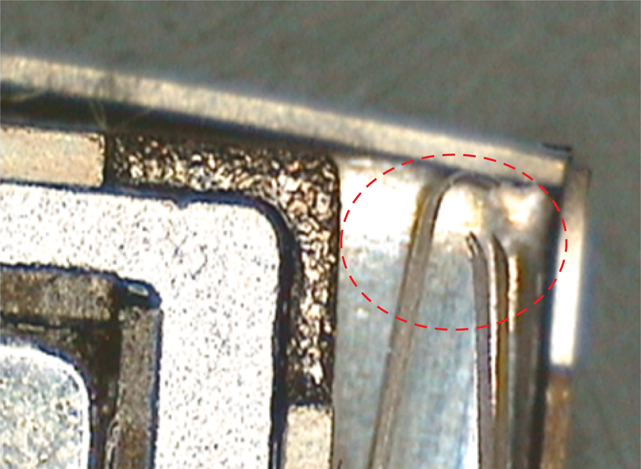
Fatigue fracture of the one-folded spring at folded area.
Accordingly, the harmonic response analysis was performed to calculate the maximum stress near the folded area at resonance frequency. The maximum stress must be less than the yield stress. The harmonic responses were performed with 30 intervals between ± 10 natural frequencies [12]. Figure 8 shows the result of harmonic response analysis.

Harmonic response of HVLA.
3.4. Metamodeling
Metamodeling builds a metamodel that approximates the relationship between performance indices and design variables of a real model by using the analysis results at the sampling points specified by a DOE. Figure 9 shows the result of a parameter study of the nonlinearity of x1(W). The simulation was performed such that x1(W) for the upper and lower bounds was divided into five sections. Then, we modeled the one-folded spring according to a divided x1(W) after a fixed initial value of x2(L), x3(T), x4(H), and x5(R).
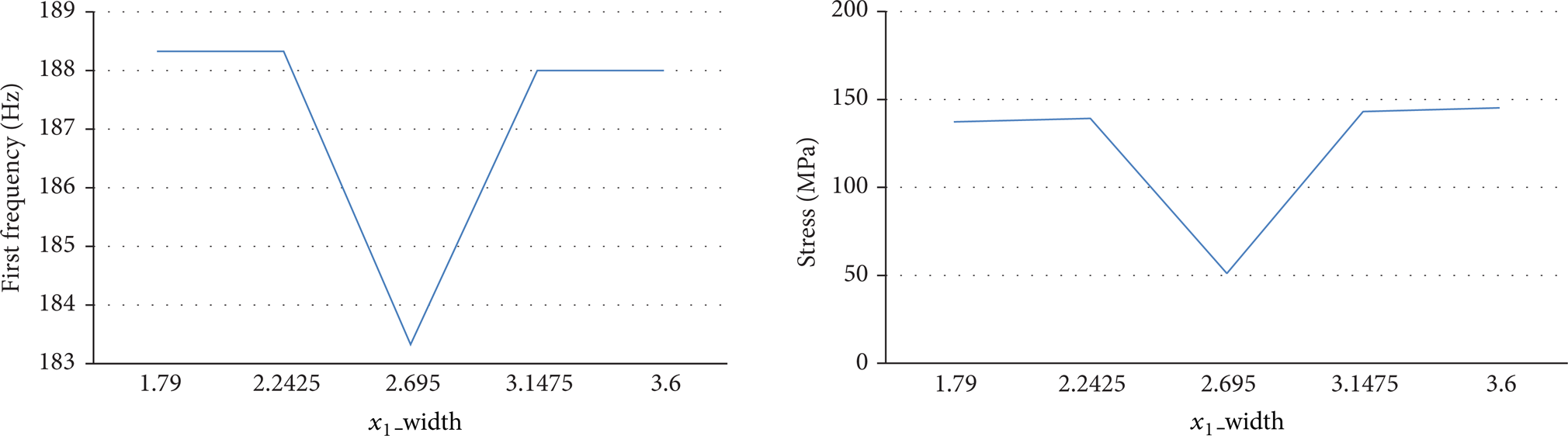
Nonlinearity for x1(W).
We found that x3(T) was a sensitive value. In a previous optimization of the leaf spring, we found a sensitive value of x3(T) because the first frequency and stress level were very responsive, depending on the thickness of the spring. For example, the stiffness of cantilever beams is given by

The stiffness of a cantilever beam is directly proportional to the cube of the thickness. Therefore, the thickness of the leaf spring has a nonlinearity, so we selected the Kriging model, which is one of the metamodels provided in the PIAnO software that was selected. The Kriging model, which a type of interpolation model, was mathematically established by Metheron in 1963 based on research conducted by mining researcher Krige in 1951 [13, 14]. And it shows superb predictive performance under many design variables and is in strongly nonlinear systems, provides a statistical estimation [15]. Also, there are no parameters that depend on the experience and intuition of customers when choosing the design parameters because the Kriging model can optimize design parameters through maximum likelihood estimation (MLE). Therefore, a recent trend is an increase in the use of Kriging models in the field of engineering. Our first Kriging model was generated by using an orthogonal array
3.5. Optimization Technique
We selected an evolution algorithm that is provided in PIAnO. The evolution algorithm (EA) was proposed by Holland in 1975 and is a global optimization technique [17]. This algorithm describes the evolution of the biological genetic trait, so it searches for a global optimum through a process of selection, recombination, and mutation. On the downside, it requires considerable computation time, depending on the analytical model, because more calculation functions are required compared to other optimization algorithms [18]. But we made up for the disadvantage of the evolution algorithm because we used a metamodel with a short analysis time.
3.6. Results
In our results for the optimal design using the metamodel (Opt_meta), the optimal design satisfied the constraints, including the maximum stress and natural frequency of first mode, and the width of one-folded leaf spring decreased by 47% compared to the initial width of 1.9 mm. However, the optimal design results can be changed based on using the metamodel instead of the actual analytical model in this research. The accuracy of the optimization results should be verified by actual analysis using ANSYS. To do this, the Kriging model results (Opt_meta) of the optimal design variables and the analysis results from ANSYS (Opt_exact) were compared as shown in Figures 10(a) and 10(b).

Comparison of the design constraints.
The Kriging model results (Opt_meta) and the ANSYS model results (Opt_exact) were very similar; therefore, we confirmed the high accuracy of the Kriging model's prediction. The initial and optimal values of the design variables were compared as shown in Table 4. Figure 11 shows the compared widths of the leaf spring. Figure 12 shows a comparison of the existing actuator and the actuator with the optimal width of one-folded spring.
Initial and optimal design variable values.


Comparison of the objective function.

Comparison of HLVA according to the initial design and optimal design.
4. Conclusion
We minimized the existing size of a HVLA (16.5 × 15 × 2.5) by decreasing the width of the leaf spring. The following conclusions were drawn from our results.
We formulated the design problem in order to minimize the maximum stress in the bending area and to satisfy the required first mode natural frequency, based on the design requirements.
We generated an orthogonal array using the commercial optimization software PIAnO. Then, each leaf spring designed by sampling points was analyzed by using the commercial structural analysis software ANSYS.
The Kriging model, provided PIAnO, was generated based on simulation results according to the design of experiments
Footnotes
Abbreviations
Conflict of Interests
The authors declare that there is no conflict of interests regarding the publication of this paper.
Acknowledgment
The authors express their gratitude to PIDOTECH, Inc., for providing their PIAnO software as a PIDO tool.