




Abstract
Coal rock rupture microseismic signal is characterized by time-varying, nonstationary, unpredictability, and transient property. Wavelet transform is an important method in microseismic signals processing. However, different wavelet bases yield different results when analyzing the same signal. To study the comparability of different wavelet bases in analyzing microseismic signals, the current paper uses the microseismic signals released from coal rock bursting as the research subject. Through the analysis of the properties of commonly used wavelet basis functions and the characteristics of coal rock microseismic signals, the current study found that Coiflet and Symlet wavelets are suitable for analyzing coal rock microseismic signals. Sym 8 and Coif 2 wavelets were found to be suitable for analyzing and denoising coal rock microseismic signals. After Sym 8 wavelet denoising, signal-to-noise ratio (SNR) and the root mean square error were 30.4184 and 1.3109E–07, respectively. After Coif 2 wavelet denoising, the SNR and the root mean square error values were 35.2176 and 1.0312E–07, respectively. The results will aid in the analysis and extraction of coal rock microseismic signals.
1. Introduction
Coal rock is a type of stress medium. When it is destroyed by stress, its intrinsic flaws will be expanded or closed through fracturing. Simultaneously, low energy level acoustic emissions (AE) will be produced. When the fracture reaches approximately half its breaking strength, a range of crevasses starts to appear and produces high energy level AE called “microseisms.” To a certain extent, the intensity and frequency of microseisms and AE reflect the stress state and deformation energy release rate of a coal rock mass [1–5]. The monitoring of microseisms began in the 1990s. The history of monitoring of mine microseisms extends to only about 20 years [6, 7].
The analysis methods commonly used for microseismic signals are the characteristic parameter analytic method and the waveform analytic method. The characteristic parameter analytic method has been widely used in microseismic signals analysis since the 1990s. Some of its advantages include the capacity to record large amounts of information and faster processing. However, this method also loses a significant amount of information on primitive waveforms. Since the establishment of the modal AE theory in the early 1990s, waveform analytic methods, such as modal analysis and wavelet analysis, have gained more attention in the field of microseismic signals processing [8–14].
Many wavelet base functions can be used for signal analysis. However, different wavelet bases will yield different results when the same signal is analyzed [15, 16]. Different microseismic signals have different characteristics. To perform a reasonable and accurate wavelet analysis of coal rock bursting microseismic signals, coal rock microseismic signals are used as the research subject in the current study. Several types of wavelets are selected, and their effects on the processing of coal rock microseismic signals are compared. The noise reduction of microseismic signal is conducive to better carry out the subsequent signal feature extraction, such as the signal phase, amplitude, and energy spectrum coefficient. We can further detect the coal rock rupture events by analyzing these features.
2. Wavelet Basis Functions and Their Properties
2.1. Properties of Wavelet Basis Functions
Common wavelet basis functions and their main properties are shown in Table 1. Wavelet basis functions are analyzed based on the following criteria.
Wavelet basis functions and their main properties.

Compact Support. The narrower the compact support width, the better the local characteristics in the time domain.
Orthogonality. The Mallat fast algorithm can be used for wavelet transforms when the wavelet basis function is orthogonal.
Symmetry. Symmetrical wavelet basis functions can avoid signal distortion when decomposing and reconstructing the signal.
Vanishing Moments. The signal energy is concentrated in a few wavelet coefficients. It monitors the singularity of the signal and separates the signal from the noise.
2.2. Several Commonly Used Wavelet Basis Functions
Compared with the standard Fourier transform, wavelet functions used in wavelet analysis are not unique because of their diversity. Wavelet functions will yield different results when analyzing identical questions with different wavelet bases. Descriptions of several types of wavelet functions follow.
The Daubechies Wavelet. The Daubechies wavelet was created by the world-renowned wavelet analysis scholar Daubechies. She established the compactly supported orthogonal wavelet, which was a milestone in the development of wavelets. The compactly supported orthogonal wavelet made discrete wavelet analysis possible. Although the Daubechies wavelet does not have analytical expressions and symmetry, its application scope is quite widespread. Daubechies series wavelets are abbreviated as db N, where N represents the order number, N = 1, 2, …, 10.
The Symlet Wavelet. The Symlet wavelet is an approximate symmetrical wavelet function that was proposed by Daubechies. It is an improvement of the db function. The Symlet function is usually expressed in the form of Symlet N (N = 2, 3,…, 8).
The construction of the Symlet wavelet is similar to that of the Daubechies wavelet. However, the Symlet wavelet has better symmetry for the reduction of the reconstruction phase shift.
The Morlet Wavelet. The Morlet wavelet has an analytical expression but does not have orthogonality and compact support. The Morlet wavelet is a complex wavelet that can extract the signal amplitude and its corresponding information. This wavelet is commonly used in geophysical signal processing.
3. Wavelet Basis Functions of Coal Rock Microseismic Signals
3.1. The Selection Principles of Wavelet Basis Function
Wavelet time-frequency localization characteristics and wavelet transform multiscale expansion structures expand the application of signal processing technologies based on wavelets. However, different wavelet bases have different time-frequency characteristics. Analyzing the same signal with different wavelet bases will yield different results. The characteristics of wavelet bases include continuity, regularity, symmetry, orthogonality, the wavelet and disappearing moments, linear phase, compact support, and attenuation, among others. In practical applications, the above factors are considered.
At present, many scholars have already constructed wavelet functions. However, only a few wavelet functions can be effectively used in signal processing. Moreover, not all wavelet basis functions are suitable for coal rock microseismic signals processing. When analyzing signals using the wavelet theory, three common methods are used for choosing the wavelet base [16–18].
(1) Direct Comparison of the Various Mathematical Parameters of Wavelet Bases. This method is hoped to solve the selection problem of wavelet bases in theory. Because various mathematical parameters of wavelet are established completely from the perspective of mathematics, so it has a certain theoretical depth and is difficult to combine with engineering practice. Therefore such a comparison standard has not been fully established.
(2) Selection of a Few Specific Wavelet Bases and Qualitative Comparison of Their Application Effect. The advantage of this approach is a combination of engineering practice, but the selection and application of wavelet base are too one-sided.
(3) Comparison of Wavelet Bases While Relying on Traditional Information Value Functions. The advantage of the third method is to compare various wavelet bases by fewer evaluation parameters, but traditional information value parameters are not applicably proved by the practice.
3.2. Characteristics of Coal Rock Microseismic Signals
Rock microseismic signals have special waveform characteristics because of the distinctiveness of rock material compositions, the unique geological forming process of rock, and “old wounds” inside rocks (unlike in brittle materials). In the loading process of rocks, the microcracks close first. Microfriction on the structure surfaces will occur during the closing process. When the friction energy exceeds the threshold voltage of the microseismics detector, a microsignal will appear. Late in the closure process of microcracks, energy will accumulate inside the rock to a certain extent; then new microcracks will appear. Simultaneously, elastic wave energy will be released. The elastic wave energy is often stronger than the energy from the microcrack closure process. Therefore, the amplitude of the signal is very large, and a large part of the waveform of a microseismic signal quickly peaks and then attenuates gradually. During an event, the amplitude changes from low to high and then decays gradually. The amplitude later changes from low to high and then weakens gradually again [19]. In this paper, we study the microseismic signals released from the coal rock under compression case. A typical coal rock microseismic signal is shown in Figure 1.

The original waveform of a coal rock microseismic signal.
3.3. Wavelet Base's Selection of Coal Rock Microseismic Signals
For some reason, scholars in the signal processing domain have not agreed on a standard wavelet base selection method. Therefore, no fixed modes or well-developed rules can be followed. For coal rock microseismic signals, a wavelet base can be selected using the following method. Coal rock, the particularity of its signal, and the advantages and disadvantages of existing wavelet bases can be analyzed and tested using the aforementioned wavelet functions and engineering practices.
As discussed previously and as seen in Figure 1, coal rock microseismic signal is different from other microseismic signals. Coal rock microseismic signal is a kind of time-varying nonstationary signals, with unpredictable, unexpected transient nature. Compared with concrete, generally the strength of coal rock microseismic signal is very weak, and the main frequency is different [20]. The main frequency of the signals released from different rocks in loading and destroying process is also different, such as sandstone, limestone, bauxite shale, and coal [21]. Therefore, the chosen wavelet base must be consistent with coal rock microseismic signals. Based on the characteristics of coal rock microseismic signals, the discussion of the selection of wavelet base can be summarized as the block diagram (Figure 2).

The requirements of wavelet base for coal rock microseismic signal.
As shown in Figure 2, the following points must be considered when selecting the wavelet base.
The wavelet base must be reconstructable so that it can be more conducive in obtaining the microseismic source signal.
Although the scale factor for a continuous wavelet transform can be freely chosen and can be used for analysis in a finer time-frequency space, its reconstruction formula is complex and its calculation load is large. Therefore, the discrete wavelet transform must be prioritized. Because orthogonal wavelet can constitute orthogonal basis by discretizing, it is very suitable for analyzing signal components for its small amount of calculation and without any redundancy. However, Morlet and Mexican hat wavelet cannot constitute orthogonal or biorthogonal basis no matter how discretizing and cannot even constitute a tight frame according to the usual binary discretization method and have a large signal reconstruction error. Therefore, Morlet and Mexican hat wavelet are generally not used to construct the discrete wavelet. From Table 1, the Morlet and Mexican hat wavelet bases are not considered.
The wavelet base must be adaptable to the transient property and rapid decay characteristics of microseismic signals.
Wavelet base functions with compact support can analyze microseismic signals in different frequency ranges. The Meyer wavelet is excluded because it does not have compact support by nature.
The wavelet base must be capable of extracting useful signal from noises.
As noise greatly interferes with microseismic signals after the wavelet transform, the wavelet base should be able to effectively identify microseismic signals from noise signals. Related studies show that wavelet bases with a certain order of vanishing moments can effectively highlight the singularities of signals. Microseismic signals have a similar impact characteristic; therefore, wavelet basis functions with a certain order of vanishing moments should be chosen. The Morlet, Mexican hat, and Meyer wavelet basis functions are not good choices. The Haar wavelet basis function has only one order of vanishing moment, and its suitability for microseismic signals analysis must be examined.
The wavelet base must be suited for signal analysis.
Orthogonal wavelets are nonredundant. They are suitable for denoising and compressing signals and images. Biorthogonal wavelets are suitable for signal and image feature extraction. Biorthogonal wavelets are not suitable for the analysis of microseismic signals; thus, the biorthogonal BiorNr-Nd wavelet function can be ruled out.
Based on the characteristics of coal rock microseismic signals and the analysis of several commonly used wavelet basis functions, the Symlet and Coiflet wavelet bases can be selected for coal rock microseismic signals. These wavelet bases meet the discrete wavelet transform, time-domain compact support, proper vanishing moment, and symmetry requirements.
4. Wavelet Analysis of Coal Rock Microseismic Signals
Figure 1 shows a coal rock microseismic signal of a field collection that contains a lot of noise. The denoising processing is performed on the signal through wavelet analysis. First, the wavelet is chosen using the above analysis. The Symlet and Coiflet wavelet bases are chosen for the denoising process of the coal rock microseismic signals.
Root mean square error is the square root of the variance between the original signal and the denoised signal and reflects the difference between the original signal and the denoised signal. In practical use, the smaller root mean square error indicates the better denoising effect. Signal-to-noise ratio refers to the ratio of the original signal energy and the noise energy; the higher signal-to-noise ratio, the better filtering effect [22].
To keep other conditions unchanged, the denoising process is carried out using Sym N wavelets of different orders. The signal-to-noise ratio (SNR) and root mean square error (RMSE) values are obtained, as shown in Table 2. By comparison, the Sym 8 wavelet has the best effect, and the denoised coal rock microseismic signal is shown in Figure 3. Therefore, the Sym 8 wavelet is chosen to process the coal rock microseismic signals.
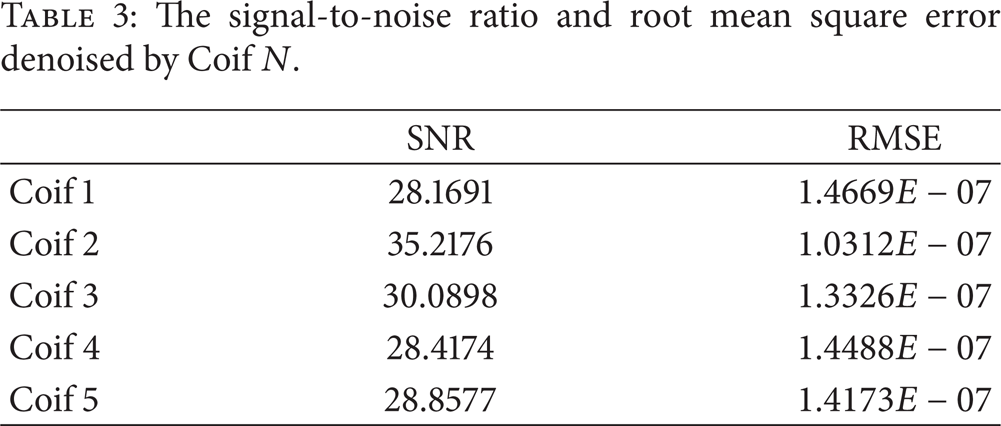
Similarly, to keep other conditions unchanged, the denoising process is performed using different orders of Coif N wavelets. The SNR and RMSE values are obtained, as shown in Table 3. By comparison, the Coif 2 wavelet has the best effect. Therefore, the Coif 2 wavelet is chosen to process the coal rock microseismic signals.
To keep other conditions unchanged, for the same microseismic signal, the denoising process is carried out using common Daubechies (N) and Haar wavelet. Then we can compare with the previous processing results of Coif 2 and Sym 8 wavelets. As shown in Table 4, it can be found by comparison that the noise reduction effect of Coif 2 or Sym 8 wavelet is the best. Therefore, Sym 8 and Coif 2 wavelets are suitable for analyzing and denoising coal rock microseismic signals.
The signal-to-noise ratio and root mean square error denoised by Sym N.

The signal-to-noise ratio and root mean square error denoised by Coif N.
The SNR and RMSE denoised by six wavelets.


The denoised coal rock microseismic signal.
Using the Sym 8 wavelet, the microseismic signal is decomposed to the 6th floor. The low frequency coefficients (a1, a2, a3, a4, a5, and a6) and the high frequency coefficients (d1, d2, d3, d4, d5, and d6) of the coal rock microseismic signals are obtained. The output results are shown in Figures 4 and 5, respectively.
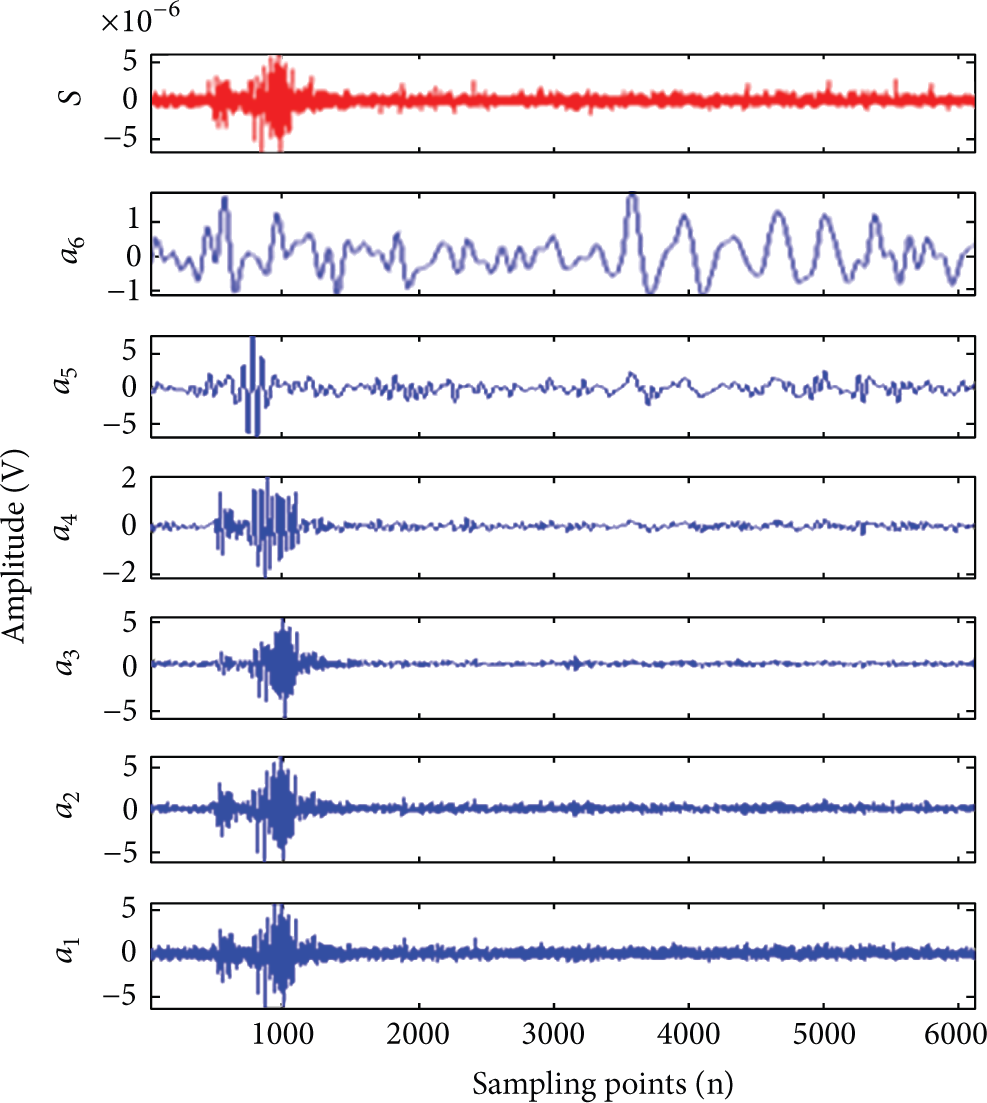
The original coal rock microseismic signal and the low frequency details of decomposition.

The original coal rock microseismic signal and the high frequency details of decomposition.
The definition of wavelet transform shows that the wavelet analysis is a measure of similarity between the wavelets basis functions and the original function. The coefficients calculated indicate how close the wavelet function is to the original function at that particular scale. Orthogonal wavelet analysis is only to do further decomposing for low frequency part of signal, and the decomposition of the high frequency part will not continue, so the wavelet transform can well characterize the signal with low frequency information as main component. And coal rock microseismic signals are mainly in the low frequency band. So it can be seen from Figures 4 and 5, after analyzing by using the Sym 8 wavelet, the low frequency components a1, a2, and a3 can well represent the original microseismic signal, and it can also be found from the high frequency details that noise component of the signal mainly concentrates in d1, d2. In this way, after processing the high frequency details component by using a predetermined threshold, the denoised signal can be obtained after wavelet reconstruction.
5. Conclusion
The selection of a wavelet basis function is a key issue to consider in wavelet transform of signals. Based on the analysis of the properties of common wavelet basis functions and the characteristics of coal rock microseismic signals, suitable wavelet bases must have the following properties: compact support, orthogonality, symmetry, and a certain order of vanishing moments. The Symlet and Coiflet wavelet bases were determined to be suitable for the processing of coal rock microseismic signals.
Coal rock microseismic signals can be decomposed and denoised using Sym 8 and Coif 2 wavelets, and their processing effects are determined to be optimal through comparative analysis. After Sym 8 wavelet denoising, the SNR and RMSE values of the signal are 30.4184 and 1.3109E–07, respectively. After Coif 2 wavelet denoising, the SNR and RMSE values of the signal are 35.2176 and 1.0312E–07, respectively. Therefore, when performing wavelet analysis on coal rock microseismic signals, Sym 8 and Coif 2 wavelets are the appropriate wavelet bases functions. The results will aid in the analysis and extraction of coal rock microseismic signals.
Conflict of Interests
The authors declare that there is no conflict of interests regarding the publication of this paper.
Footnotes
Acknowledgment
This work was supported by the Fundamental Research Funds for the Central Universities, under Grant 2010QNB28.