




Abstract
The introduction of useful microblogging services like Twitter derives significant changes in various areas of society. The smart tools such as mobile devices and microblogging services have led to great changes in the traditional way of education. It is possible to access good quality educational contents and methods in a more convenient way. Although a lot of smart tools have been applied for educational application, there are only limited researches that demonstrate the educational effectiveness of smart tools through experiment considerations. In this study, research documents about smart learning from 2007 have been treated based on 5 major searching sites; we investigate the research trends of smart learning of education. The opinion of the researchers about the educational use of smart tools is analyzed. Then, through substantial experiment, we are acquainted that the smart tools have a positive effect on the educational environment. As a practical application, the Twitter microblogging service is used for educational communications in 2 classes of a university during a semester. As a result, we can find that smart tools contribute to increase the efficiency of education, but learners and teachers need to pay considerable efforts on the use of smart tools to achieve the purpose.
1. Introduction
The popularity of mobile devices such as smart phone and PDA has led to major changes in each field of society. These tools for enhancing the convenience of individuals have caused major changes in the field of education also. In particular, the introduction of smart equipment such as electronic blackboard and smart LMS (learning management system) provides a smart learning environment of education. With the spread of these smart devices, some researches attempt to improve the educational effects through applying these educational tools to educational environment. By the fast introduction of mobile devices, the use of microblogging services such as Twitter and Facebook has increased; it has caused major changes in the fields of society communications also. Because it is possible to send and receive a simple multimedia data in a simple way, microblogging service has been used as a convenient tool of intention delivery in everyday life. In particular, for the convenience of easy access, it can be used as a useful communication tool in interactive educational environment for learners and teachers.
On the other hand, even the microblogging service and mobile device have higher possibilities for usage in educational environment, but limited researches have showed its effectiveness through experimental observations.
In this study, we conduct a literature survey to understand research trends of “smart learning” which is based on smart tools such as microblogging services and mobile devices in educational environment. Smart learning (s-learning) means a new learning paradigm which serves learners to have the efficient learning environment that offers personalized mobile contents and easy adaption to current education model. And it also allows learners to have a convenient communication environment and rich resources [1, 2].
In the literature survey, the SLR (systematic literature review) method that enables us to investigate literature in more systematic way is used. Through the investigation, we can extract some valuable information about smart learning such as research trends, high technologies, educational applications, and author's opinion about the educational utilization of smart tool.
Then, we conducted an experiment to investigate what effect the Twitter microblogging service brings on in educational environment. The experiment progresses for a semester and targets the second year of a university. Throughout the experiment, while we compare the traditional teaching method with the teaching method that utilizes the mobile device, we analyze whether the introduction of the smart tool such as microblogging service gives a positive effect on educational environment and analyze some problems associated with the efficiency.
In Section 2, the SLR method and researches related to the educational applications of mobile devices are introduced. In Section 3, the literature survey according to the SLR method is described. In Section 4, the results of the literature review are analyzed. In Section 5, an experiment on education utilization of microblogging service has been tried. And in Section 6, the results of the experiment are analyzed. Finally, conclusions of this study are shown in Section 7.
2. Related Works
SLR [3] has been accepted as a prominent method to classify and extract the valuable literature. According to Kitchenham [3], SLR is a mean of identifying, evaluating, and interpreting all available researches relevant to a particular research question, topic area, or phenomenon of interest. SLR is composed of three main review phases: planning, conducting, and reporting. Reference [4] expanded and refined up the conducting process to 5 activities to review the literature. Several studies have used the SLR method to classify research area and find research trends of computer engineering. For example, [4] has used the method to classify researches on UML (unified modeling language) and [5] has used the method to find the trend of UML studies. And then, the method was expanded and refined up to six activities by [6]. Figure 1 shows the six procedures based on SLR.

The process of SLR (systematic literature review).
Recently, there have been several researches that try to use a microblogging tool like Twitter as a communication tool in the education environment. These researches can be divided into three areas.
First, it is the research to examine the possibility of educational utilization of Twitter. References [7, 8] are initial studies to analyze the applicability of Twitter to the educational environment. In [7], it indicates that Twitter is a useful tool for collaboration with students, and in [8] it is shown that it is possible to have students perform to cooperate with each other for specific problems, without constraints of time and space. Through an experiment during one semester in a university, [9] indicates that Twitter is useful for academic enhancement of students, and it helps teachers to be more active in education field. References [10, 11] indicate that it has the potential to be able to lead running community to higher education. References [12, 13] are studies that utilize Twitter on the learning of student discussion and demonstrate its effectiveness.
Secondly, it is the research that analyzes the educational utilization pattern of Twitter. Reference [14] is the study of the analysis of the relationship between Twitter usage patterns of students and student achievement. Reference [15] shows that students who earn a higher grade on environment of the microblogging service own more followers and follow more people. In an environment of microblog, [16] analyzes the trends and usage patterns of various students.
The third is the research on the extension of using Twitter in education environment. References [17, 18] show that Twitter can be integrated into a course management system (CMS) in online learning environment. In [19], Twitter is connected to the existing learning system of a university and is utilized in the question and answer session between professor and students.
Most of the above researches show positive opinions for the educational utilization of Twitter. In this study, through an experiment during one semester, we try to analyze the educational utilization pattern of Twitter and to analyze the possibilities and limitations of the educational utilization of Twitter.
3. Systematic Literature Review Process
3.1. Question Formation
The following questions are defined in order to attain some analytic results through the SLR process [8].
What is being studied about smart learning? This question is refined into the following specific questions.
What are the main topics in smart learning research? What are the real opinions of authors about the educational utilization of smart tools? What are characteristics of the authors of each study? Who is studying about smart learning?
What is the major field of authors, their affiliation, their nationality, and so forth?
3.2. Source Selection
The following five renowned literature sources are selected: IEEE Xplore [20], ACM Digital Library [21], Google Scholar [22], Science Direct [23], and Springer [24].
In the selected sources, the important keywords that can access the highest number of useful results are “smart learning” and “education.” So we apply the words to the search machines of each resource site using “and” condition of the two keywords.
3.3. Resource Concentration Process
The papers retrieved from the five sources are concentrated by several review stages. The papers are retrieved March 5, 2014. The three resource concentration stages are the following.
First stage: “smart learning” and “education” keywords are used to search initial candidate papers adapting to the paper title or abstract of the five sources. The result of the first stage is shown in “Stage 1” column of Table 1. Second stage: by considering the citation counts, we select some representative papers of each site from the searched candidate papers of stage 1. The result of the second stage is shown in “Stage 2” column of the table. Third stage: some papers are shown in more than two source sites, and then the overlapped papers are included as final papers. Finally, the final papers that will be examined in this study are selected as shown in the “State 3” column of Table 1. 47 papers are selected.
Selected papers at each stage of the selection procedure.

3.4. Information Extraction Planning
The principles of information extraction from the selected papers are developed based on the research questions defined in Section 3.1. The following data are extracted: resource name (source site where the paper is found), paper title, authors, citation count, sort of paper (journal/proceeding), main category, education area, main tool, main user, and characteristics of authors (author's major, nationality, affiliation, and number of authors). By classifying the selected papers based on “research area,” we can derive several main categories of researches. Table 2 shows 7 main categories and their features. They are “e-learning,” “m-learning,” “u-learning,” “smart learning,” “smart classroom,” “learning support system,” and “computer-based system.”
Main categories and features.

“E-learning” can be defined as the use of computer network technology, primarily over an intranet or through the Internet, to deliver information and instruction to individuals [25]. “M-learning” must include the ability to learn everywhere at every time without permanent physical connection to cable networks. This can be achieved by the use of mobile and portable devices such as PDA, cell phones, portable computers, and Tablet PC [26]. Through the d-learning, m-learning has evolved from e-learning [4].
“U-learning” environment is a situation or setting of pervasive (or omnipresent) education (or learning). Education is happening all around the student but the student may not even be conscious of the learning process. Source data is present in the embedded objects and students do not have to do anything in order to learn. They just have to be there [27]. “Smart learning (s-learning)” is an important and new paradigm of learning today. The concept of s-learning plays an important role in the creation of an efficient learning environment that offers personalized contents and easy adaptation to current education model. It also provides learners with a convenient communication environment and rich resources [1, 2]. “Smart classroom” serves a smart classroom environment using smart technologies such as voice-recognition, computer-vision, and other technologies and provides a tele-education environment similar to a real classroom and facilitates collaborative learning among learners [28]. “Learning support system” focuses on supports for special learners such as hearing-impaired students; it serves some learning care methods [29]. “Computer-based learning” serves a personalized recommendation according to learner's learning style [30].
3.5. Extracting Information
We read the contents of the selected papers carefully and extract the relevant data in the process of extracting information and counting of the papers.
4. Analysis Result of the SLR
The results obtained from SLR are summarized.
4.1. Research Area
Firstly in the research area, “m-learning” and “smart learning” are the most popular research areas as shown in Figure 2. In particular, recently, “smart learning” is studied as a concerning topic in educational utilization of mobile device and microblogging service. Figure 2 shows the number of papers based on main topics in each year.

Trends of smart learning researches.
4.2. Education Area
Smart tools can be used for a variety of educational environments. We investigate the education area of each research; the results are shown in Figure 3. Most of the studies are applied for the higher education (university education), and recently some studies have interests to public education also.

Education area of each research.
4.3. Main User and Tool
The most beneficiaries of the system or method that is introduced in each research are students and teachers. It is because the system or method is introduced for the students and teachers to interact in educational environment. Recently, with the increase of studies for public education, the public is emersing as an important beneficiary also. Figure 4 shows the survey results about the main beneficiary.
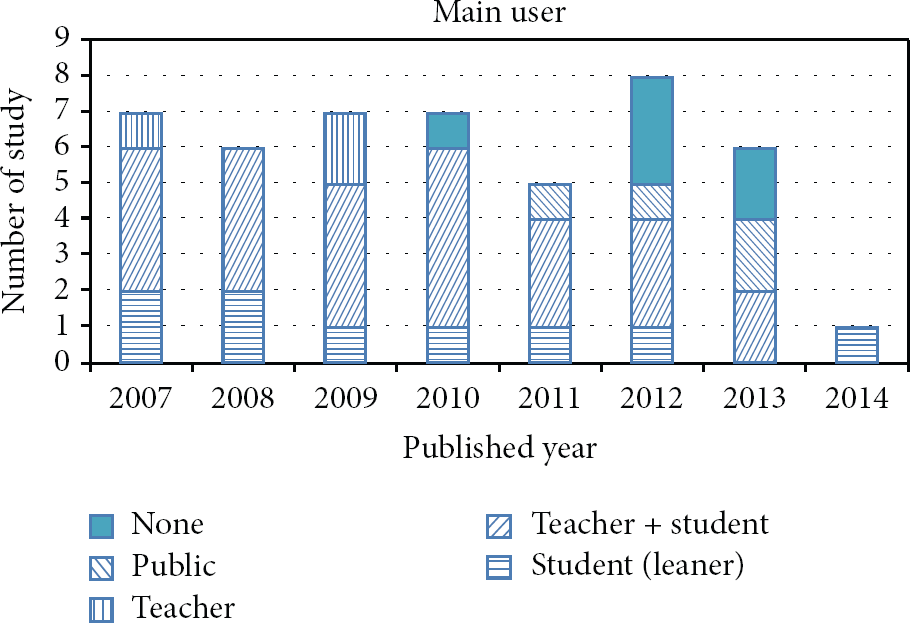
Main user in each research.
The following shows tools which are used in each research. Educational tools that are used most frequently in the system or method suggested in the researches are mobile phones, followed by smart devices and PC. Figure 5 shows the survey results about educational tools.

Main tool of each research.
4.4. Author's Opinion about Educational Usage of Smart Tools
Then, we investigate the opinion of the author; what opinion do they have on the introduction of system and tools such as mobile devices in educational environment. We can find the opinion information of authors from conclusions and experimental results of each research. As a result, in most researches, most of them have positive opinion; namely, they think that the introduction of systems or tools gave a positive effect on educational environment. Figure 6 shows the results.

Author's opinion about adoption tools for education.
4.5. Author's Information
In this study, we investigate the author information such as the number of the authors, fields of study, country, and affiliation. Their country and affiliation are distributed evenly worldwide. The most majors are education and computer science. Figure 7 shows the results.

Author's major field.
4.6. Trends on Smart Education
Through the above survey results, we can find the following research trends of smart education.
In research area, most of the researches are associated with m-learning (mobile learning); recently, the researches on smart learning are increasing. Most of the researches are carried out for higher education, and main beneficiaries in each research are both teachers and students. The main tool which is applied to educational environment is a mobile phone, and PC is utilized often also for other educational environments. For educational application of smart tools such as mobile phone, most of the authors have a positive opinion. In other words, they think that the introduction of smart tools gives a positive effect on the educational environment.
5. An Educational Application of Mobile Tool
For better understanding about educational application of smart tools, Twitter is used as a smart tool for getting a reasonable effect on education environment. For this experiment, we implement a Twitter utilization experiment in 2 classes of a university during one semester. And we investigate the educational effect of smart tools and whether the tools give a positive effect actually.
Twitter has been used in daily life as a comfortable communication tool because it serves some information through following relationships without user permission. And it can be accessed with an easy tool such as mobile phone and desktop. So, we can transmit our information easily and quickly to followers in an easier way. Therefore, in the educational environment, the service can be used as a useful communication tool among students and teachers. In this study, we use Twitter service as an educational tool of the question-and-answer session in the educational environment and investigate and analyse the Twitter utilization patterns of students.
For this experiment, we select two classes of sophomore in computer engineering department of a university. Students receive a brief guide of 30 minutes about how to use Twitter, and they join the Twitter service freely according to the free will of the students. The experimental environment is shown in Table 3. In the beginning of the experiment, professor makes two “lists” in his Twitter account to make a community of each class and invite students to join the lists.
Experiment environment.

In order to analyze the pattern of students' questions, we classify the questions of student based on two criteria. First criterion is the content of the questions, so the questions are classified depending on whether the questions associate with course contents, that is, so the questions are divided into two forms like this: the questions which are associated with course content and the questions which are not related to the course content (hereinafter, nonclass questions). Second criterion is the form of the questions. And they are classified into offline questions and online questions according to the way of questioning.
6. Results of the Application
A quantitative survey such as the question form and the number of questions of students is carried out. In addition, the Twitter activities of the students such as the number of tweets which they sent and the join date to the service are investigated. Finally, we perform a variety of analysis to understand the effectiveness of educational utilization of Twitter such as the relationship between student achievement (grade) and the number of questions. The “effectiveness” of educational utilization of smart tools is considered in this study. It is necessary to consider several factors in order to determine the effectiveness of education. However, in this study, we use the study achievement (grades) as an evaluation factor which is able to determine the effectiveness easily. The grade is calculated based on the comprehensive assessment of the various elements, such as class attendance, class attitude, and test results. Further, in this study, we compared students' grades which mean the achievements of students with the various activities on Twitter. The grades of students are compared with the order of Twitter enrolment of students. And the registering ratio in Twitter and the number of questions are also treated.
6.1. Question Form of Students
Asking questions of the students are done online (for Twitter) and offline (during class hours, immediately after the end of class). And the way of asking questions is selected by students themselves on the basis of their free will. The investigation result is shown in Figure 8. As the result, most of the students' questions are done offline. Therefore, we can know that students prefer the offline question as a traditional way when the selection of questions is left to the students' free will. And when questions are divided into class question and nonclass questions, most of the questions are the class question that is related to the course content.

Question form of students.
We analyze the occurrence time of students' questions. As shown in Figure 9, many of the questions are focused on the middle part of the semester. We think that it is because there is a midterm exam in week 6 and a difficult report in week 10.

The occurrence of questions over one semester.
6.2. Utilization Pattern of Twitter
Joining Twitter is made by students themselves based on their free will. As shown in Figure 10, when in accordance with their free will, joining ratio of Twitter is about 60 percent around. There will be many factors about that probably, but if they are not forced to join the service, the percentage of joining is not high. As previously, when the students make a question on Twitter, they are recommended to use a hashtag to find the contents related to the class easily. However, the students who do not use the hashtag are high relatively as shown in Figure 10.

The percentage of joined students and using hashtags.
6.3. Student Achievement and Questioning Pattern
We analyzed the relationship between student achievement and the questioning pattern of the students. As shown in Figure 11, in the number of questions of the students according to their grade, there are significant differences. That is, the number of questions of the students got a better grade relatively is very high. As shown in Figure 8, the number of online questions is very small than the number of offline questions. However, the online questions came from the students who received “A” or “B” grade. If we take into account that the number of the students who received “A” grade is less than 30% of all students, it can be seen that the students who get better grades have a question more aggressively. And the ratio of questions in Figure 11 is determined as shown in the following:

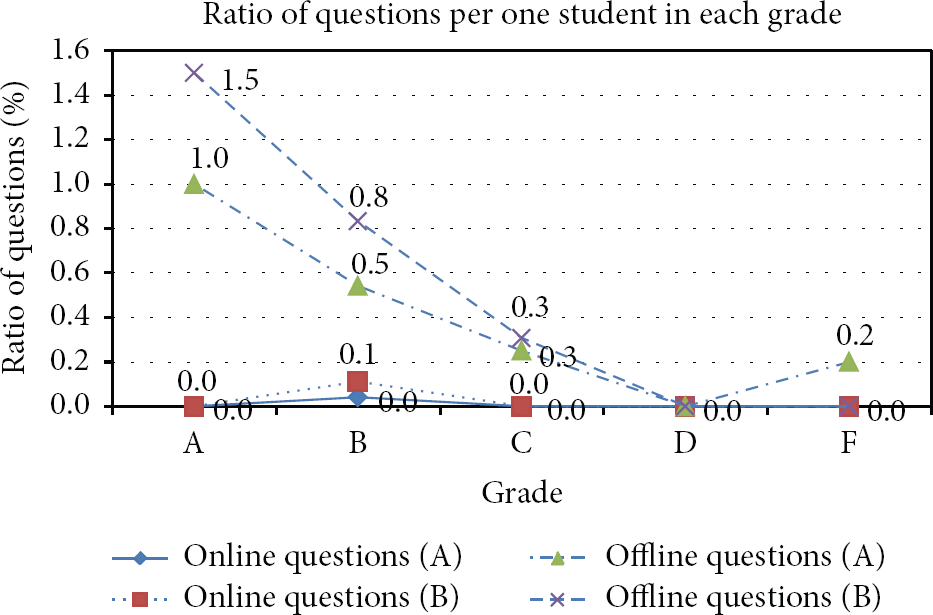
The relationship between student achievement and questioning pattern.
6.4. Student Achievement and Utilization Patterns of Twitter
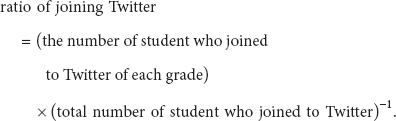
We analyze the relationship between utilization patterns of Twitter of students and student achievement. As shown in Figure 12, in higher grade, the ratio of students who join Twitter is higher than students who do not join. In lower grade, there is no significant difference between them. In Figure 13, we compare the order of joining Twitter and student grade; as a result, relationship between them is not strong. In addition, any special features do not appear in the relationship between the number of questions and the order of joining. The ratio of joining Twitter in Figure 12 is determined as follows:

The relationship between study achievement and joining Twitter.

The relationship between joining order and study achievement.
7. Conclusions
In this study, we investigate the research trends of smart learning that use smart tools such as mobile phone and survey the researchers' opinion on educational effectiveness of smart tools.
As a result, we can find the following research trends on smart learning. First, in research area, most of the researches are associated with m-learning (mobile learning); recently, the researches on smart learning are increasing. Second, most of the researches are carried out for higher education, and main beneficiaries of each research are both teachers and students. And the main tool which is applied to educational environment of each paper is a mobile phone, and PC is utilized often also for other educational environments. Third, for educational application of smart tools, most of the authors have positive opinions. In other words, they think that the introduction of smart tools gives a positive effect on the educational environment.
And then, we conducted an experiment to investigate what effect the smart tool such as Twitter microblogging service brings in educational environment. Through the experiment, we compare the traditional learning method with the learning method that utilizes the microblogging service and analyze whether the introduction of the smart tool such as the microblogging service gives a positive effect on educational environment.
As a result, we can get the following results.
First, without forcing the use of Twitter; if it is free to choose the way of questioning, students prefer the offline question to online question. In other words, if students are not forced to use Twitter, students like the way of existing question.
Second, in the Twitter utilization patterns of students, if the active force is not used in utilization of Twitter, the ratio of using Twitter is very low. Therefore, independent of the problem of “effectiveness” of educational usage of Twitter, we are able to know that the considerable effort of faculty and student is required in utilization of the aid tool.
Third, in relation to the patterns of the Twitter utilization, the number of questions of students who get the excellent grade is much higher than that of the students who get the lower grade; almost all of the students who get a better grade have joined Twitter. We think that it is because the student who gets a better grade has positive attitude to his class.
With the spread of smart tools such as mobile phone and microblogging service, there have been many efforts to use the smart tools for a variety of education environments. Most of the researchers who are to introduce the tool to education field and demonstrate the effectiveness of the smart device have a positive opinion of educational utilization of smart tool. But through the real experiment, we can know that though the smart tool can offer a positive effectiveness to education field, much effort of teacher and students is needed to bring out the effectiveness.
Footnotes
Conflict of Interests
The authors declare that there is no conflict of interests regarding the publication of this paper.
Acknowledgments
This research was supported by the Yeungnam University research grant in 2012. Also, this was supported by the BK21+ program of the National Research Foundation (NRF) of Korea.